Necessity and Proportionality Beyond the Nuclear Threshold

01/11/2018

2018-01-07 By Danny Lam

Necessity and proportionality are central concepts behind legitimate use of force in international law from the Anglo-European tradition.

The simplicity of the concepts belie the moral quagmire when applied to actual cases such as the use of nuclear weapons on Japan in what became the final days of WWII.

The debate continues to this day.

Nuclear weapons was introduced in a form that enabled a single weapon, initially delivered by one bomber, to wreck havoc that formerly required hundreds, if not thousands of bombers and crew.

Because nuclear weapons “scale” – in the case of thermonuclear devices in theory indefinitely – the question of necessity and proportionality evolved into a consensus between the First Nuclear Age powers that such weapons of mass destruction should never be used.

Possession should only be for the purpose of deterrence.

Crossing the nuclear threshold is a dangerous act with dire consequences that between nuclear weapons powers, mean mutual destruction.

How was this “red line” established?

Early on in the nuclear age in 1948, the United Nations Commission for Conventional Armaments (CCA) created an authoritative definition of Weapons of Mass Destruction (WMDs) as:

“… atomic explosive weapons, radioactive material weapons, lethal chemical and biological weapons, and any weapons developed in the future which have characteristics comparable in destructive effect to those of the atomic bomb or other weapons mentioned above”

(UN document S/C.3/32/Rev.1)

This definition was adopted in UN General Assembly Resolution 32/84 and have been incorporated by reference to mean all Chemical, Biological, Radiological and Nuclear weapons and is integral to international law and treaties governing WMDs. (12, W. Seth Carus, 2012)

The essence of this definition is the notion that WMDs have the characteristic of causing mass destruction and / or casualties, though there is no clear definition as to what constitutes “mass”.

Conventional weapons used in sufficient quantity accounted for far more casualties than WMDs.

World War II era fire bombings of cities in Germany and Japan, the Taiping uprising against Manchu rule, Stalin’s communist collectivization and purges, Chinese communism’s campaigns like Mao’s Great Leap Forward or Cultural Revolution, and the Pol Pot Communist regime, accounted for far more casualties than the totality of all casualties from WMDs since the 19th Century.

It is hard to rationalize that tens of millions of deaths from the Taiping uprising against Manchu imperial conquest and rule is somehow preferable to a nuclear attack on Hiroshima that killed under 200,000.  

Or mass deportation to Gulags or concentration camps or genocide by Manchus is preferable to nuclear war.

The revulsion against WMDs arise not in the scale or scope of mass destruction or casualties, but from the ease and rapidity from which it can happen: “at the push of a button” by a handful or as few as one person.

Mass destruction of the past required mass participation by a willing cohort of executioners are no longer required.

A small band of state or non-state actors can conceivably have the same impact. Hence, the focus on absolute prohibitions on the spread of WMDs to non-state actors, and limitations on state actors with “legal” nuclear arsenals to those who share a consensus about its danger and utility as deterrent only.

Consensus on international arms control, limitations and disarmament for WMDs was built around this view of nuclear weapons as instruments whose use will inevitably lead to mass destruction and or casualties.  

Between nuclear powers, that means “mutually assured destruction”.

Thinking on nuclear arms control evolved around the idea of reducing the likelihood that the nuclear threshold should ever be crossed, whether accidentally, or a “madman”, or the development of systems that destabilize “mutually assured destruction” such as ballistic missile defense.

Prevention of a surprise “knock out” blow by any nuclear power meant the creation of “triads” that are invulnerable to any conceivable surprise attack.

Tactical nuclear devices are regarded as dangerous as it crosses the threshold, which will increase the likelihood of strategic nuclear weapons from being used in an escalatory ladder understood by both sides.

The presumption is there is a slippery slope, much like the Rubicon that cannot be crossed without consequences.

Around this theory, an arms control community was formed with the expressed goal of preventing the use of nuclear weapons, limiting its proliferation, and ultimately, banning their use.

The UNSC “permanent 5” that emerged as victors in WWII are the only legitimate nuclear weapons powers under the nuclear non-proliferation treaty.

Over time, a new group of “illegal” nuclear weapons powers emerged despite efforts aimed at curbing them.

The US aided UK and France in acquiring a nuclear arsenal before the NPT.

Post NPT, China aided their allies Pakistan and North Korea.

India, Israel chose to illicitly acquire the means, often with a nudge-nudge-wink-wink from others.

Other states, like Iraq, Syria, Taiwan, South Korea, Japan, South Africa, Libya, etc. had their programs terminated by force, disabled, or deliberately held back.

North Korea is the outlier in terms of their motives and intentions behind states that successfully acquired a nuclear arsenal.

Every nuclear weapons power to date, with the exception of North Korea, accepted the consensus that nuclear weapons are a deterrent or insurance policy of last resort to guarantee regime survival, preferably never used.

North Korea, on the other hand, view the nuclear weapons as a means to alter the status quo, forcing the withdrawal of US forces from South Korea, unifying Koreas on their terms, and to extract compensation (or indemnities) from belligerents.

This exception altered the dynamic of international nuclear proliferation since the 1990s.  

Rather than going away, other nuclear powers followed.

Established nuclear powers like Russia, a shadow of itself as USSR, have adopted doctrines like “escalate to de-escalate” that suggest the limited first use of nuclear weapon as a show of force. China, ostensible alleged to have about 300 warheads, expanded their launcher capacity by adding 4 SSBNs (+1 under construction), mobile missiles, and MIRV/MARVed missiles: far beyond the western estimate of size of their arsenal and no longer a “minimal means of reprisal”.

The CCP’s claimed “no first use” doctrine have been undermined by their campaign to prevent South Korea from deploying THAAD and participating in a regional missile defense system that suggest a tactical nuclear first strike strategy.

Pakistan, meanwhile, have moved to develop and deploy tactical nuclear weapons in response to India’s “cold start” doctrine.

Israel is contending with regional powers like Iran that can readily “breakout” and deploy nuclear weapons before considerations of aid from North Korea.

Technologically, nuclear weapons are no longer necessarily WMDs that produce indiscriminate, mass destruction or casualties.

Nuclear precision munitions have ushered in an era where a nuclear explosion may have very little persistent radiological effect (i.e. fallout, contamination, etc.) while achieving a narrowly targeted destructive effect with minimal collateral damage to civilians nearby.

Compared to late 20th century nuclear weapons, precision nuclear munitions may be the only viable solution to certain target sets where limiting civilian casualties and long term radiological effects is a key consideration.

Coming from another perspective, electromagnetic pulse (EMP) weapons, once only feasible to be nuclear pumped, can now be conventionally pumped or otherwise generated to produce a range of effects made possible by the widespread use and deployment of microelectronic devices in both military and civilian applications.

A nuclear EMP attack can disable much of the civilian and military infrastructure in a wide area for upwards of a year, leading to societal collapse while leaving most physical infrastructure like buildings intact.

The nuclear threshold that existed as a clear line circa 1975 is now blurred by these developments.

It is a product of the first nuclear age, when the prospect of virtually unlimited destructive effect at the push of a button horrified a small group of European, Russian and then Chinese decision makers, all of whom are barely recovered from a horrifying series of wars in recent memory and have no wish to repeat the carnage.

The Second Nuclear Age ushered in a new, larger group of players driven by competition and conflicts driven by nationalism, ethnic rivalries, rage, religion, and old fashioned garden variety territorial and great power disputes.

Many of these new players, i.e. radical political Islamist, if they should secure a nuclear device, will not necessarily view it as a defensive weapon nor will they be necessarily deterred by greater powers.

Possession of a large, invulnerable nuclear arsenal for retaliation may have no utility against these adversaries.

Presently, the US and allied relies on dominance in conventional weapons against states without a proven nuclear arsenal.

But the utility of this approach, even if used in concert with the conventional capabilities of P5 powers, will not necessarily be sufficient to prevent insurgent powers like Iran from acquiring WMDs or be able to proactively eliminating their capabilities militarily by “surgical” strikes.

Then there are states like North Korea that have passed the point of no return, having successfully demonstrated thermonuclear weapons and is on the way to credible nuclear ICBM arsenal.

In this environment, the nuclear threshold as an absolute bar may be more a hindrance than a threat to peace and security when it is technically the only feasible way to militarily achieve effects that meet the test of necessity and proportionality for adversaries unlikely to be deterred.

Nuclear weapons can have destructive effects that are far below generally accepted conventional weapons used en mass.

It does not follow that nuclear will be by definition more destructive than conventional explosives though nuclear explosives will have considerable advantages in form factor and ease of delivery.

Nor is it for certain that the use of nuclear devices will necessarily result in large scale, persistent radiological effects particularly if the device is used in such a manner and optimized to minimize persistent contamination.

A nuclear device need not necessarily be a WMD with a more up to date definition used by the CCA that do not define nuclear as WMD by default.

Prevention of mass destruction & casualties may require the nuclear threshold to be crossed in a judicious and tightly controlled manner when there is no other feasible method.

It does not follow that crossing the nuclear threshold in such a manner will automatically lead to wholesale nuclear war.

There is no reason why an escalatory latter have to exist for a given adversary or for it to be operative.

On the contrary, nuclear explosives may be the only practical way to prevent war caused by indiscriminate use of nuclear weapons in dangerous hands like North Korea.

Technology and doctrine have evolved since nuclear weapons were used last in 1945 and WMD taboos became institutionalized in international law.

The laws are now obsolete.

The nuclear threshold as it was formulated in the 20th century may be no less an obsolete concept than the Pope Innocent III’s prohibition on the use of crossbows on Christians.  

It is time to reconsider and revisit the work of the CCA.

If you wish to comment on this article, please see the following:
Revisiting the Nuclear Threshold in the Second Nuclear Age

Textron Scorpion Collaborates with U.S. AFRL on AgilePod Program

01/10/2018

2018-01-06 By Todd Miller

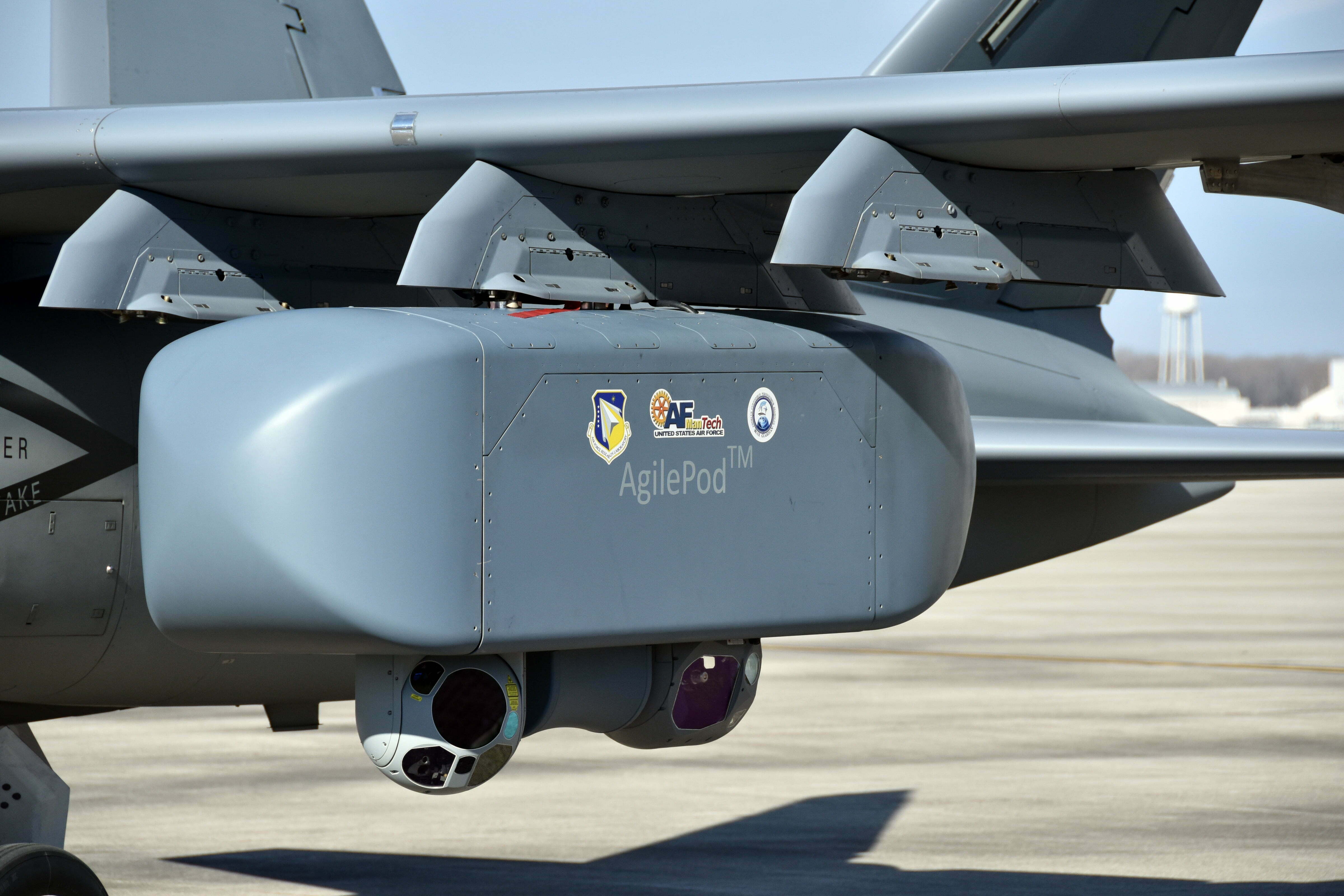
In an encounter that could be described, “AgilePod meets AgilePlatform” the USAF AgilePod was recently fitted to a Textron Aviation Defense LLC Scorpion jet.

The test fitment took place December 21, 2017 at the Air Force Research Laboratory (AFRL), Wright-Patterson AFB.

The event showcased both the versatility of the AgilePod and the Scorpion.

According to a USAF news release, Andrew Soine, an electronic systems engineer at AFRL commented, “We met with the Textron Aviation Defense Scorpion team and discussed the possibility of doing a fit check with their Scorpion platform and the AgilePod.

A few days later they called and said they could get the plane to Wright-Patterson within the week.

We couldn’t miss the opportunity to show the AgilePod’s capabilities on a new class of aircraft.”

The Air Force AgilePod program, run by the AFRL Sensors Directorate Blue Guardian team completed inflight testing on a DC-3 this past summer and is pending test flights on an MQ-9 Reaper.

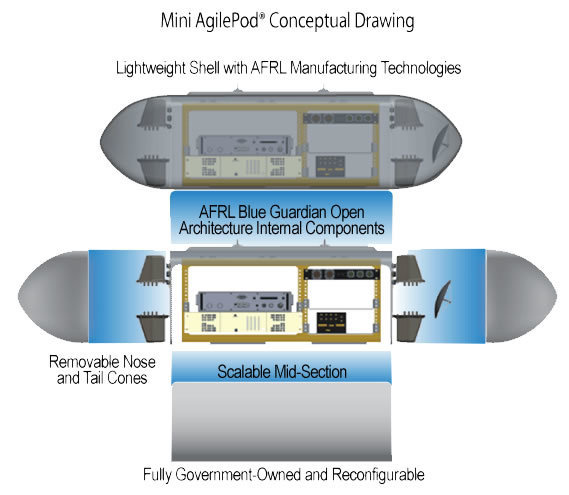
The Mini-AgilePod, conceptualized here, will be designed with an open floor plan and reconfigurable middle sections in various sizes that can be changed depending on specific sensor technologies and missions.

The resulting family of AgilePod platforms will be able to host optimized sensors and fit an increased number of aircraft. (U.S. Air Force graphic/David Dixon)

The AgilePod prototype utilizes an Open Missions System (OMS) modular software architecture and a modular physical configuration of 28 – 60 inches in length that can house a variety of ISR sensor payloads.

It may be conceivable that configurations include communication nodes to enable 4th Gen to 5th Gen data sharing for using data as a weapon in the “combat cloud”.

The AgilePod is designed to be flightline configurable while deployed at forward locations to enable maximum support of the warfighter.

It is a description that sounds remarkably like the Scorpion, itself utilizing a modular open system architecture (MOSA) and featuring exceptional physical modularity in its payload bay for ISR/Communication payloads.

The AgilePod initiative is a good example of an ongoing program that fits within the messaging from the leadership of the Air Force — Secretary of the Air Force Heather Wilson, Chief of Staff General David Goldfein, and the entire command structure.

Such direction was captured by Wilson at the OA-X demonstration this past summer at Holloman AFB, “Our adversaries are modernizing faster than we are and it is up to the USAF to drive innovation so that our adversaries are surprised by just how powerful we are and how ready we are for any fight, anytime, anywhere. That means we have to think about things in new ways and identify new capabilities faster than we have done in the past.”

The Air Force will utilize OMS and rapid, cost effective innovation to drive superior capability in the face of global challenges.

Utilizing the Scorpion for AgilePod integration may seem like an odd fit – given the Scorpion’s capability to internally carry what would amount to similar sensors and communication payloads.

However, the collaboration between AFRL and Textron Aviation Defense is not intended to validate the Scorpion with the AgilePod, but rather to validate the fitment of the AgilePod on a light jet in a rapid, and cost-effective manner.

Given this first step, the USAF and AFRL may consider flight testing and ultimately demonstrating the integration of the AgilePod “streaming data” into the Scorpion’s own open mission system to designate targets for engagement with precision weapons from the host platform.

Streaming ISR data to a ground station has appeal, as does streaming to additional airborne platforms and manned, tactically relevant assets in the combat cloud.

The Scorpion’s low operating cost, OMS, ease of support and flight operations would appear to be a sound fit for further validation of the AgilePod.

The Scorpion demonstrates this capability on a consistent basis, such as the recent transit made overseas to the Dubai Air Show.

During transit the Scorpion visited nine countries in six days with 100% readiness.

During demonstrations in Saudi Arabia, Royal Saudi Air Force (RSAF) pilots and weapons system officers designated targets by laser and dropped inert GBU-12s on target after only 2 hours of ground instruction and 15 minutes of flight!

According to Steve Burke, Textron Aviation Defense Senior Advisor, the opportunity to collaborate with the AFRL on this initiative demonstrates Scorpion’s additional capabilities, “not only does the Scorpion have great capability within itself to integrate ISR/Communication payloads, but this fit check demonstrated how quickly the aircraft can integrate a defined Air Force ISR payload with little-to-no change in its existing OMS software.

Further collaboration could demonstrate the Scorpion’s capability to fly with and tactically integrate the AgilePod to demonstrate getting to the “future faster”, a priority for General Mike Holmes, Commander, Air Combat Command.

Like any development program, questions remain. What platforms will ultimately utilize the externally mounted AgilePod?

Will Textron’s “AgilePlatform” be a fit for the U.S. or other Air Force as a dedicated ISR/Light Attack platform that drives tremendous operational savings?

Given the clear direction to “network enabled information dominance” both approaches appear promising.

Innovations in technology have many systems obsolete by the time they are fielded.

Approaches that provide the desired capability while demonstrating modularity and scalability have great appeal – to deploy near term, and remain relevant in the future at a manageable cost.

Photos and Graphic, USAF David Dixon/released.

Trump’s National Security Strategy: Positioning the US In the 21st Century Global Game

2018-01-01 By Richard Weitz

The Trump administration’s National Security Strategy (NSS) has likely had a more impact than most previous versions of this document. Foreign observers are probably reading the text closely, especially the sections referencing their own country.

The strategy has four primary pillars:

(1) protecting the homeland by securing U.S. borders against malign state and non-state actors, pursuing terrorists and similar threats at their source, and increasing U.S. resilience against cyber and other dangers:

(2) making Americans prosperous by rebuilding U.S. infrastructure, facilitating research and innovation, promoting fair and reciprocal foreign partnerships, and embracing energy dominance:

(3) achieving peace through strength by renewing U.S. strategic advantages, regional balances of power, and applying the entire portfolio of U.S. military, economic, cyber, space, intelligence, and diplomatic capabilities; and

(4) advancing U.S. global interests and influence by inspiring others, catalyzing complementary private initiatives, and leading reformed international organizations that promote American values.

President Trump announcing the new national security strategy.

The new strategy shares similarities and differences with the approximately 16 previous versions of this document.

As in the past, there is an insistence on the imperative of U.S. global leadership, using all elements of power but especially military, at the head of an international network of like-minded democracies.

There are also several points of emphasis not found in past strategies.

For example, the Trump NSS stresses the need to cultivate U.S. energy power and protect an extended U.S. national innovation base—not just defense industries–from foreign predation.

Additionally, there is more focus than previous versions on challenging a rising China; the previously common language about Sino-U.S. ties having an unavoidable mixture of cooperation and conflict is largely absent from Trump’s strategy.

In this regard, the new NSS identifies many more types of international threats.

The administration’s national security team believes, “the global balance of power has shifted against U.S. interests,” as seen by the growth of potential adversaries’ military power, their economic rise at U.S. expense, and their development and application of new cyber information tools.

Trump’s team sees the general global environment as decidedly darker than the more hopeful texts released by previous administrations. For example, its NSS sees globalization, embraced by previous presidents as a generally positive force, as weakening barriers against international menaces such as illegal migration and Chinese economic aggression.

The conceptual framework of the Trump NSS is competitive.

The text’s goal is to reverse U.S. decline by renewing American strengths. In the words of President Trump, “We are declaring that America is in the game and that America is going to win.”

At the conceptual level, the text recommends that Washington join Moscow and Beijing in seeing global politics as “an arena of continuous competition” that transcends false binary distinctions between war and peace.

At the global level, the strategy calls for modernizing U.S. diplomatic, economic, cyber, space, intelligence, and military tools “to operate across these environments.”

The NSS offers several principles to guide the revitalization of each instrument, which will need to be supported by adequate financing.

Denying that “America first” meant “America alone,” Trump observed that, “Our strategy emphasizes strengthening alliances,” based on shared values and a fair distribution of “responsibility for our common security.”

At the regional level in Europe, the NSS sticks to fundamentals.

It begins with the observation that, “A strong and free Europe is of vital importance to the United States” for strategic as well as “our shared commitment to the principles of democracy, individual liberty, and the rule of law.”

Looking ahead, the administration will work with European allies and partners to improve energy security, fortify national and regional defenses, punish Russian aggression with costly sanctions, and disprove the Kremlin’s propaganda with truthful messages.

The NSS arguably employs the most critical tone regarding Russian behavior yet issued by the Trump administration.

The words “Russia” and “aggression” regularly appear together, including the first four times the text mentions the country. The fifth occasion makes an equivalent reference to “Russia’s violation of Ukraine’s sovereignty and territorial integrity.”

According to the authors, Moscow strives to subvert U.S. power through cyberattacks, political interference in foreign countries, flexing Russian military power, asserting spheres of influence, and weakening U.S. allies and alliances.

The text warns that, left unchecked, Russia’s regional ambitions, expanding military power, and “unstable frontier in Eurasia” could lead to Russian miscalculation and conflict.

Our colleague Stephen Blank has already noted how the 2017 NSS breaks new ground by warning of Russian challenges to U.S. interests in Latin America, including Mexico, through various disruptive economic and security policies.

Another difference with previous versions in that the current NSS, besides repeating longstanding concerns about Russian and Chinese anti-access/area-denial capabilities, bemoans how the two countries are impeding U.S. access to “critical commercial zones during peacetime,” such as Eurasia.

The NSS stresses the need to resist Russian sub-conventional (also known as “hybrid” or “grey-zone”) aggression, which is problematic since it often falls “below the threshold of open military conflict” that would provide a clear-cut trigger for U.S. military counter intervention, such as the provisions for activating NATO’s Article 5 collective defense clause.

Another difficulty for Western planners is that the lack of internal checks and balances in “repressive, closed states” like Russia, in comparison with the Western democracies, allow their governments to more rapidly mobilize and combine their military, economic, and informational resources “to accrue strategic gains over time—making it harder for the United States and others to respond.”

Despite these complications, the NSS adumbrate various principles to cope with the Russian challenge.

More detailed plans will likely be offered in the National Defense Strategy and the Nuclear Posture Review.

The NSS does say that the administration will “keep the door open to greater collaboration with Russia in areas of common interests,” should Moscow change course and respect “the sovereignty and democratic development of neighboring states.”

Yet. Moscow needs to change its behavior first since the NSS says that the Trump administration has lost faith in “the assumption [attributed to previous administrations] that engagement with rivals and their inclusion in international institutions and global commerce would turn them into benign actors and trustworthy partners.”

Moreover, the United States needs to restore its instruments of power to ensure that it can negotiate with Russia and other countries from a position of strength.

As Trump put it, “weakness is the surest path to conflict, and unrivaled power is the most certain means of defense.”

Editor’s Note: There is a clear shift from assuming a multiple-sum hidden hand of globalization creating a greater global good, to one where competition and cooperation are forged on a case by case basis. And that is at the heart of the shift associated with the Trump national security strategy,

Sea Ceptor Test Firings Completed: A 21st Century Air Defense Capability at Sea

01/09/2018

2018-01-06  The Sea Ceptor is a sea-based supersonic missile defence system developed by MBDA for the UK’s Royal Navy.

The Sea Ceptor is based on MBDA’s common anti-air modular missile (CAMM). CAMM is being developed in three versions – CAMM (M) for maritime, CAMM (L) for land and CAMM (A) for air defence. CAMM (M) is the first to be developed, in the form of the Sea Ceptor.

Recently, the Royal Navy has completed flight tests of the missile onboard its first platform to use the missile, namely the Type 23 Frigate.

According to an article published on December 20, 2017 by the UK Ministry of Defence:

The second ship fitted with Sea Ceptor has also conducted a successful firing to verify the weapon system upgrade.

Credit: MBDA Copyright 2017

The new missile defence system will provide UK personnel with a powerful shield against airborne targets – including hostile combat jets and helicopters, as well enemy missiles travelling at supersonic speeds.

The completion of the firing trials from Type 23 frigate HMS Argyll means Sea Ceptor can proceed to the next stage of the acceptance into service with the Royal Navy.

Minister for Defence Procurement Harriett Baldwin said:

“In the face of intensifying global threats, cutting-edge systems like Sea Ceptor will keep the UK safe. These successful trials from HMS Argyll mark a major milestone towards the introduction of this world-class missile system into service for the Royal Navy….”

The first firings of Sea Ceptor were conducted from HMS Argyll at the Hebrides range off the coast of Scotland and involved firing the system to assess its performance against a range of scenarios.

Two sets of trials were conducted by Defence, Equipment and Support (DE&S) and supported by a number of other organisations, lasting around two weeks each.

During the firings the system was first tested against single aerial targets. This was followed by more demanding tests, including a single target engaged by two missiles and a twin firing (two targets, each engaged by a single missile at the same time).

An installation test firing from HMS Westminster – the second ship fitted with Sea Ceptor – took place in November, with each of the Type 23 ships due to carry out installation test firings in due course.

Lieutenant Nick Andrews, HMS Westminster’s Anti-Air-Warfare Officer, said:

“HMS Westminster managed to explore the real potential of the system during her training and to say it is a real game changer is an understatement. Unlike its predecessor, the system is capable of defending ships other than Westminster herself. Whether it’s engaging multiple air threats or fast incoming attack craft, Sea Ceptor represents a massive capability upgrade for the Type 23 frigate.”

Designed and manufactured by MBDA in the UK, Sea Ceptor is being fitted to replace the Sea Wolf weapon system on the Type 23 frigates and will provide the same capability for the Royal Navy’s future Type 26 Frigates.

HMS Argyll will deploy to Japan next year, fitted with the Sea Ceptor missile system. Credit: UK MoD

HMS Argyll will deploy to Japan next year, fitted with the Sea Ceptor missile system. Credit: UK MoD

Sea Ceptor defends escort vessels within a maritime task group, such as for the new Queen Elizabeth Class aircraft carriers, and with HMS Argyll due to deploy to Japan next year, the trials successfully showcased the short range capabilities of the new defence system.

Another Type 23, HMS Sutherland, is due to deploy to Australia in the New Year.

The system uses a new UK-developed missile, the Common Anti-air Modular Missile or CAMM, that is capable of reaching speeds of up to three times the speed of sound, and will have the ability to deal with multiple targets simultaneously, protecting an area of around 500 square miles (1,300 square kilometres) over land or sea…..

Richard Smart, Director Weapons, for the MOD’s procurement organisation Defence Equipment and Support, which is based at MOD Abbey Wood in Bristol, said:

2017-Sea-Ceptor-Data-Sheet

“These trials are a significant step in getting the Sea Ceptor weapon system to acceptance and a great example of how important live trials are in helping us to understand a new military capability before using it in operational service.

“The success of the trials is testimony to the hard work put in by the DE&S project team and the working relationship they have with industry.

“The results of the firings are now going through extensive analysis; our assessment so far is positive and shows how Sea Ceptor is capable of protecting both the ship which fired it and other ships in its task group, which could include the UK’s two new Queen Elizabeth Aircraft Carriers.”

https://www.gov.uk/government/news/sea-ceptor-missile-test-firing-complete-at-sea

Russia’s Latest Steps In the Mediterranean

2018-01-01 By Stephen Blank

In a previous article this author laid out the dimensions and capabilities in Russia’s expanding network of air and naval bases in and around the Middle East.

Recently, Moscow took another significant step towards the consolidation and extension of its naval capabilities in the Mediterranean.

Moscow announced that over the next 2-3 years it would be building a full naval base at Tartus in Syria, which it now has under lease (along with the air base at Khmeinim) for 49 years.  That base, when completed, will be able to accommodate 11 ships at a time and host nuclear-powered ships as well.  In this connection Moscow also reiterated that its Mediterranean Squadron (Eskadra) would constitute a permanently deployed element of the Russian fleet.

Ultimately Moscow aspires to possess the capability to integrate this network of air and naval bases throughout the Middle East and Eastern Mediterranean (and Tartus is by no means the only one located on that sea) to form a genuine reconnaissance-strike complex.

“Former chief of staff of the Russian Navy, Admiral Viktor Kravchenko, told Interfax that the expanded base would contribute to the navy’s “operative capabilities” in the Mediterranean Sea and Middle East as a whole.”[i]

The base is part of an evolving capability not only be able to project power into the Middle East as a whole, including key strategic waterways or against our allies, Israel, Jordan, and Saudi Arabia, but also to Southern and Southeastern Europe, most of whose states are NATO allies.

While ostensibly the base and the ships stationed there are there to frustrate attempted terrorist attacks, including amphibious landings, in reality the main mission is to thwart NATO efforts to dominate the Mediterranean and enter into the Black Sea during times of conflict. 

And then,  having repulsed NATO, it could then go on the offensive and support other Russian military operations as needed.

Given Russian naval plans that revolve around submarines and multi-purpose smaller but lethally armed ships like corvettes and frigates we can expect a powerful contingent of ships to be based at Taurus.

It is entirely possible they will be armed with Russia’s naval SLCM, the Kalibr’, whose range is 1500 miles (2500KM) in either its land attack or ship-based cruise missile form.

And the nuclear version is apparently able to launch 2600 KM (1560 miles).

Thus many states in the Balkans, Turkey and potentially Italy, if these vessels sail far enough out to sea, can be targeted.

And these ships’ capabilities, not to mention those of Russian submarines who have been prowling around the coastlines of NATO members in the Mediterranean and the North Sea, are clearly intended to deter NATO and the U.S. Sixth Fleet.

These weapons like the Kalibr’ can be deployed, as Moscow now intends, along with ship-based hypersonic Tsirkon anti-ship cruise missiles which are already being tested and are expected to be deployed by the end of the decade.[ii]

The Tsirkon can be launched from the same universal shipborne platform with ZS-14 launchers that are used for the Kalibr’ and Oniks missiles making it difficult to determine what is coming at the target.[iii]

These systems taken in tandem offer both a potent offensive and defensive capability from which to erect this Reconnaissance-strike capability and an A2AD network capable of striking at great distances.

For example, in his 2015 account of Russian military strategy, Tim Thomas describes how these missiles, in their land-based or land-attack cruise missile capability support Russia’s air and missile defense network around Moscow,

“The defense ring around Moscow is called the S-50 system, and it can reportedly intercept from 400-800 complex aerodynamic targets simultaneously.

“As new radar and missile facilities and equipment are added, the defense ring will be termed the S-100. New Konteyner-type beyond-the-horizon radars are aiding distant early warning capabilities. Nebo-M complexes are being delivered.

“They can operate in several frequency ranges simultaneously at distances of 600-1800 km and altitudes of 600-1200 km.

“The complex of such systems is being created by the production firm Shlyambur, where work on strategic precision missile weaponry and other fields are brought together. This could include such missiles as the Tsirkon.”[iv]

According to Russian sources, “most current
Russian submarines, cruisers, destroyers, frigates, and even corvettes will
be capable of firing any of these three missiles. It is also likely the Tsirkon
may be fielded in air-launched variety as well.

“This practice is an example
of Russia’s current line of effort for modularity and interoperability.” [v]
 More generally these deployments reflect that new Russian orientation to cross-domain fires from land, sea, and air based systems.[vi]

In other words, systems now in production or in actual deployment can strike at a range of targets from submarines to low-earth orbit satellites.

Given the formidable air assets that will also be deployed to Syria and, if Moscow is successful, to its other bases from the Black Sea into the Middle East and Mediterranean we can see the steadily expanding contours of this A2AD system, Russia’s integrated air defense system and the dawning reconnaissance-strike concept.

Indeed, according to Western analysts, “This weaponry would allow Russia to carry out precision air strikes while disregarding missile defense systems. It would also allow Russia to bypass nuclear options, as the kinetic energy of the warhead arriving from space would be more than enough to destroy the intended target.”

The Russian military threat is hardly confined to the Baltic and Arctic or to land-based forces alone.

The transformation of Russian strategic thinking that is at least as impressive as its new capabilities that are either in production or in deployed versions indicate a comprehensive strategy to push NATO forces back and expand the envelope where Moscow’s military forces can act.

Most importantly, this envelope is a steadily expanding one in terms both of actual capabilities and of operational reach for we can be reasonably certain not only that Moscow is seeking other bases that will receive comparable or analogous capabilities but that it will also expand the reach of the Mediterranean Eskadra and its associated air and air defense capabilities as well putting much of southern Europe,

Turkey and the Balkans well within reach of devastating strikes.

Especially if Moscow can gain bases, as it now seeks, in Egypt, Cyprus, and Libya this threat will become much more conceivable.

Here too NATO must awake to the challenge and not only formulate but also implement a strategic as well as operationally deployed and tested counter-capability.

  1. Putin Wants To Expand Syria Naval Facility Into Full-Fledged Naval Base,” https://www.sott.net/article/371144-Putin-wants-to-expand-Syria-naval-facility-into-full-fledged-naval-base, December 13, 2017.
  2. “Russia’s Hypersonic “Tsirkon” Missile, Foreign Military Studies Office, Ft. Leavenworth KS. OE (Operational Environment) October 2017, pp. 44-45, www.fmso.army.mil
  3. “Russia Includes Hypersonic Missile Deployment On Navy’s Warships In New Armament Plan,” Tass, December 19, 2017
  4. Timothy L. Thomas, Russia Military Strategy: Impacting 21t Century Reform and Geopolitics, Fort Leavenworth, KS: Foreign Military Studies office, 2015, p. 184
  5. “Russia’s Hypersonic “Tsirkon” Missile, pp. 44-45
  6. Ibid.

Dr. Stephen Blank is a Senior Fellow at the American Foreign Policy Council. He is the author of numerous foreign policy-related articles, white papers and monographs, specifically focused on the geopolitics and geostrategy of the former Soviet Union, Russia and Eurasia. He is a former MacArthur Fellow at the U.S. Army War College.

Indian Navy Wants the Latest Technologies for its Future Aircraft Carriers

2018-01-09 By Gulshan Luthra

New Delhi.

The Indian Navy is considering the latest technologies for its future aircraft carriers, and has sought “a go-ahead” from the Ministry of Defence (MoD) for a design feasibility study to look at “the latest advances in this field.”

Chief of Naval Staff Admiral Sunil Lanba told India Strategic in an interview and media interaction that over the last few years, new technologies have emerged relating to “propulsion, launch and recovery systems for aircraft as also other ship-borne systems of aircraft carriers” and that the Navy is looking at all the options considering “our operational necessities and financial outlay.”

Chief of Naval Staff Admiral Sunil Lanba with Editor Gulshan Luthra

Very significantly, he mentioned, the idea is “to move forward from the configuration of INS Vikramaditya and the Indigenous Aircraft Carrier IAC-1 that is under construction.

Notably, both these carriers have ski jumps and arrestor wires to launch and recover aircraft, and the Navy is known to be studying the latest Electromagnetic Aircraft Launch System (EMALS) and Advanced Arrestor Gear (AAG) that the US Navy has adopted beginning with its newest aircraft carrier USS Gerald Ford.

So far, all aircraft carriers have used turbines or nuclear power to generate steam to propel the ships and onboard aircraft.

A ski jump of around 14 degrees is built to give a boost to launch the aircraft on full power.

EMALS and AAG use high bursts of electric energy to propel and stop the aircraft.

General Atomics (GA), which owns the patent for these two systems, has already offered them to the Indian navy subject to clearance by the US Government.

So far, the Indian Navy was also considering nuclear power for its future aircraft carriers but Admiral Lanba disclosed that the second Indigenous Aircraft Carrier or IAC-2 will be non-nuclear.

He did not elaborate but MoD sources indicated that electric propulsion, as for instance used by the latest British Royal Navy’s HMS Queen Elizabeth and US Navy’s Zumwalt class destroyers, was an option.

India is yet to master the technology for building and maintaining modern shipboard nuclear reactors.

Carriers using Low Enriched Uranium (LEU) need periodic maintenance and the technology for using Highly Enriched Uranium (HEU) is not available with India although scientists of the Atomic Energy Commission (AEC) have been working towards developing indigenous capability.

For the Indian Arihant class of nuclear submarines, India has been assisted by Russia.

Admiran Lanba pointed out that the design and construction of an aircraft carrier is a long-drawn process – 10 to 15 years – even for the most advanced nations.

“There are several competing factors such as the type of aircraft, deck and hangar space, propulsion, tonnage etc., and each of these have associated financial implications.

The Navy has invested a lot of time and effort for evaluating various options “through consultations and subject matter experts.

“Over the last few years, some new technological advances have taken place related to the propulsion, launch and recovery systems….We have taken cognisance of these developments and all options are being examined.”

The Naval Chief agreed that the Indian navy needs at least three aircraft carriers, normally, two should be operational while the third goes for periodic maintenance.

Although the Navy’s Design Bureau should be looking at aircraft carriers beyond IAC-2, at present the plan is only for three carriers, INS Vikramaditya, IAC-1 Vikrant and IAC 2.

“That is the basic minimum requirement for performing our mandated tasks in India’s areas of maritime interests” on the Eastern and Western seaboards.

Delivery timelines for the indigenous carriers are 2019 and 2032.

Republished with permission of our strategic partner, India Strategic.

Trump, “Shock and Awe” and Europeans

01/07/2018

2017-12-30 By Robbin Laird

My wife is French and I have spent a good deal of my professional life dealing with European security and defense issues. 

I have lived through several phases almost ages  of European-American relations and have travelled widely in Europe, and the Soviet Union over the past thirty years.

With Carter, you had Brzezinski and Brown leading the effort to rework a nuclear war fighting strategy against the Soviets.  This was a shock to most European governments which really did not want to think about the nuclear challenges posed by the Soviets.

Next entered Ronald Reagan, an actor who was a life time anti-communist and very much focused on dealing with the Soviet Union and ending its existence as the “evil empire.” The battle of Euromissiles was a key axis of conflict in the early 1980s.  The initial reactions of most Europeans was disdain for Reagan as an intellectual lightweight who did not understand global politics.

I travelled Europe during the Euromissile crisis and argued the case for nuclear modernization against a widespread negative opinion about nuclear weapons held in Germany and elsewhere

With the election if the first President Bush, the reunification of Germany came onto the agenda, an effort on which I worked a great deal.

It was clear that virtually no European leader or many elites supported German unification, in part because of what they expected to be the Soviet backlash.

Next up was George W. Bush and dealing with the 9/11 attack and then invading Iraq. 

Despite significant warnings that taking down Saddam Hussein would leave a power vacuum, George W. Bush went ahead anyway.  The US reaction to Europeans not supporting the invasion was extremely negative with silly things like renaming French fries Freedom Fries.

After the US and the allies involved in the Iraq War worked through several years of dealing with the Afghan situation as well, the defense side was in full engagement for fighting land wars, and reduced significantly the support for air and naval modernization.

Then came President Obama, the “toastmaster in chief” who was lionized throughout his presidency in ways that made him virtually more of a European than an American President. 

He extended the role of the regulatory state, and travelled globally resetting the US image by often apologizing for went before. 

He put in place red lines which he did not enforce, failed to respond to the Crimean crisis and set in motion Putin unleashed. 

He negotiated a deal on Iran nuclear weapons which did little to deal with the increasingly aggressive behavior of Iran and in the words of one senior UAE official: “the agreement became more important to make and protect than dealing with the increasingly aggressive behavior of Iran, which in any case has wide latitude to become a nuclear power down the road.”

Enter President Trump, an event that was not supposed to happen. 

Because this was not to happen, the high priests of strategy in Washington and Brussels did not see a real need to prepare for plan B.

The Trump campaign was of interest simply showing the strange culture the Americans outside of Washington (except for California and New York) seem to pursue.

In part, the election of Trump exposed the general lack of knowledge many Europeans have about the Untied States and about the politics and economics of the United States.  The US is a federal system and one in which in electing its President the role of the electoral college reflects a federal rather than a national system. 

So when Trump won a majority of electoral votes while Mrs. Clinton won a majority of popular vote, there were many articles in the European press that expressed dismay against what was viewed as almost an illegal election.

Then the Russian factor folded in and the various opponents of Trump focused on Russian cyber engagements as  some sort of strategic surprise and launched a continuous and ongoing campaign that somehow Trump is a compromised President simply by some of his folks having dealings with the Russians.

Trump’s style is one of shock and awe with regard to the political system and has without any doubt stunned allies of the Untied States who expect not only a different style but a different handling by the US government of allies.

And in a shocking development, Trump ended up focusing on what he thought was in the US interests, not some vague and amorphous globalization agenda, an agenda which at least one major adversary of the United States, the PRC, is working any way they can to their global advantage.

When one travels in Europe one hears mostly negative comments about the President and his style, but very little focus on what the President might actually be doing and even more to the point, simply neglecting what global adversaries of the liberal democracies are about as they work their interpretation of globalization.

This is a problem because Trump loves to shape a saga via his shock and awe tactics, and play off oft the responses to his shock and awe and then he shapes his real politics. 

He could be a Viking in this sense.

This does not make for an easy interaction with the Administration, but given the significance of both the economy and strategic power the United States provides for the liberal democracies,it is an evolving narrative which needs to be understand, and interactively shaped.

To give one a sense of how the European press works the Trump Administration, the new tax law is interpreted by a number of continental newspapers as being anti-European because it will draw investments into the United States. 

Of course, Brexit plus the new US tax laws might well have a negative impact on European inward investment, but here is a radical idea: how about lowering tax rates in Europe? 

But this is much too Trumpian for a number of European analysts.

I started the year by being in Norway at a conference (ironically at a major Viking settlement) and heard an amazing diatribe passing as analysts of the Trump challenge to Europe. 

Besides being lectured on European values and the long history of Germany democracy, this German speaker decided to argue de facto for the rise of a threatening type of populism in the United States which would undercut liberal democracy. 

Trump would not comply with the rule of law and because Republicans controlled the Congress and most the states, the wave of anti-liberal and anti-democratic populism would wash away the US ally that Europe once knew. 

Trump would attack the EU and rip apart NATO and shape an isolationist US agenda.

It was somewhat difficult to listen to this and my comment to a number of Norwegian officers was that I promised that we would not invade the Sudetenland.

A more measured look at the challenges was provided by the then Norwegian defense minister who is now the foreign minister who underscored the challenges but expected a solid working relationship with both Brexit Britain and Trump America.

http://sldinfo.wpstage.net/the-changing-norwegian-strategic-environment-the-perspective-of-the-norwegian-defense-minister/

I am pleased that recent dialogue with, and statements from, the new US administration emphasize US commitment to NATO and transatlantic security. But at the same time, there is still much we do not know about President Trump’s foreign and security policy.

While I don’t think we should exaggerate the significance of Russian influence, we shouldn’t underestimate it either. In any case, we need to pay close attention to what is going on in our own countries now. Because these underlying currents in many countries may also undermine international defense and security cooperation at a time when the need for cooperation is greater than in a very long time.

The security challenges that we are all facing from violent extremism, a more assertive and destabilizing Russia and the consequences of conflict and instability in North Africa and the Middle East, requires more trust and closer collaboration, not the opposite.

And given the current situation, one of my greatest concerns is that our ability to make decisions in NATO or the EU will be challenged.

It is clear that President Trump’s style and some of his statements can give pause, but it remains as always what is the reality of what is going on in the United States which after all is a bigger entity than any one President. 

What bothers me and bothers me deeply is the unwillingness to do analysis rather than simply to justify whatever one’s own particular views are. 

President Donald Trump, Melania Trump, King Salman bin Abdulaziz al-Saud of Saudi Arabia and Egyptian President Abdel Fattah al-Sisi open the World Center for Countering Extremist Thought in Riyadh, Saudi Arabia on May 21, 2017. Saudi Press Agency / EPA

Certainly, the President has focused on the North Korean threat directly in a way earlier Administration’s simply ignored.  His work with the Saudi government and the UAE might yield significant breakthroughs in the Middle East. His efforts to refocus US forces on meeting the high end threat are clearly a work in progress, but at least there is a work in progress.

And underlying all this is a clear effort to grow the American economy and to deal with strategic challenges in a broader manner than the last two administrations.

http://sldinfo.wpstage.net/preparing-for-2018-implementing-the-trump-administration-national-security-strategy/

With a significant European crisis underway with Brexit, Poland and its dynamics, Spain and its separatist agenda, the absence of a new government in Germany, and general uncertainty about the new phase of European development, having a President like Trump is a useful foil for internal European debates.

Clearly, the shift from Obama to Trump has been a shock to the European system which when coupled with the new Russian threats and Brexit as well as other internal dynamics raise fundamental questions about the shape of Europe over the next decade and what kind of America will be its ally.

One European analyst recently contrasted, the shift from Obama to Trump as follows:

The switch in the US from Nobel laureate and first black president, Obama, to Trump, a billionaire populist who tweets fake news and insults, and defends white supremacists, could hardly have been more extreme.

This analyst started his article with the broad point that a year into the Trump Administration “the foundations of the transatlantic relationship are still intact.”

https://euobserver.com/europe-in-review/139870

One might ask why? 

And the answer has nothing to do with Trump but rather to the forces both within and without his Administration resisting Trumpism.

We learn that NATO is doing well and why?

US military chiefs have repeatedly pledged their commitment to Nato. The US is also leading a Nato battalion in Poland to deter Russian aggression.

In effect, there seems to have been a military coup d’erat in the United States marginalizing the President. 

It could have nothing to do with Trump’s actual policies as opposed to a tweet.

In a way Trump creates this problem for himself, but it is also his still of fomenting change. 
He uses shock and awe as a means to an end — reform of American policies in a fundamental sense.

What remains to be seen will be the results at the end of the day of his efforts.

If the United States and its ability to support allies is enhanced under the Trump Administration as opposed the obvious weaknesses of the United States evident to Americans fostered by the “Nobel laureate,” the challenges will be worth it from the standpoint of many Americans. 

But according to a European diplomat, the effort is not worth focusing upon because the United States is already the “weakest” state in the Western Alliance.

In what could only be labeled as values based analysis, here is what this European diplomat had to say:

Speaking to EUobserver on condition of anonymity, one senior EU diplomat said Trump’s antics were no laughing matter. 

“The biggest danger for Europe is a paralysis with regard to the question of Russia … the US is emerging as the weakest point of the Western alliance,” he said.

To be clear, this is a values based judgment in which the European diplomat sees the US under Trump deviating from the path on which it ought to be following; but as a statement of fact, it is hardly correct, unless one believes that the US economic and military power, let alone the continuing cultural attraction of the United States is of no consequence.

And with the forceful coming of the Second Nuclear Age, Europe like the United States faces some rather unpleasant realities of the return of the nuclear problem. and one not solved by earlier equations of nuclear deterrence.


Shaping a 21st Century Deterrence in Depth Strategy: The Role of ADA

01/06/2018

2017-12-28 By Robbin Laird and Ed Timperlake

The shift from engaging in the land wars and the con-ops associated with those land wars to preparing for higher tempo and higher intensity operations are key to the transformation of U.S. and allied forces.

The challenge facing the liberal democracies was well put in a recent presentation by a senior Finnish defense official: “The timeline for early warning is shorter; the threshold for the use of force is lower.”

Shaping a deterrence in depth strategy which address and then mitigate any threats posed by adversaries in their attempt to build anti-access and area denial capabilities is at the heart of this effort.

https://sldinfo.com/allied-pacific-exercises-and-training-shaping-a-deterrence-in-depth-strategy/

The US Army provides a key combat enabler with air defense artillery now engaged in global military operations.

ADA plays an increasingly significant role within joint and coalition forces shaping the US 21st Century offensive-defensive enterprise way of war.

Modern ADA has seen the growing importance of Patriot and THAAD within the joint force, but for the reshaping of the Army’s ground maneuver force, ADA must be built more broadly into its transformation going forward.

https://sldinfo.com/the-north-korean-threat-and-high-intensity-war-shaping-integrated-missile-defense/

Recently, we had a chance to talk with one of the US Army’s leading ADA architects, Brigadier General Randall McIntire. 

The General is the Commandant of the ADA School based at Fort Sill, Oklahoma and in this capacity both trains for the current fight and prepares for success in combat within the future evolution of the US Army, joint services and allied forces as well.

As the US Army prepares its future with the return to a priority on high tempo and high intensity operations, ADA plays a key role, not just as a capability, but a leaven for change as well.

We started the conversation by focusing on how the current Chief of Staff of the US Army, General Mark Milley, looked at the key modernization priorities in the way ahead as well as the key role of ADA in contributing to and shaping the future Army.

Chester Petry, Electromagnetic Railgun lead systems engineer, briefs Army Brig. Gen. Randy McIntire, commandant of the Air Defense Artillery School, on electromagnetic railgun projectiles. McIntire, who is also the Chief of the Army’s Air Defense Artillery, was briefed on Navy railgun and directed energy programs — including high energy lasers — during his tour at Naval Surface Warfare Center Dahlgren Division. The Air Defense Artillery Center and School provides the Army and combatant commanders with a flexible, adaptive, and tailorable Air Defense Artillery force able to defeat the full range of threats across the spectrum of operations. It’s operational mission is to provide fires to protect the force and selected geopolitical assets from aerial attack, missile attack and surveillance. Credit: USN, July 7, 2017.

BG McIntire: “The Chief of Staff of the U.S. Army has highlighted a number of key priorities for Army modernization.

“The first priority is to fix long-range strike.

“Second, we need the next generation combat vehicle and one which enables the offensive-defensive approach to Large Scale Combat Operations.

“Third, we need a new vertical lift capability. We need a much higher speed helicopter capability and one that can operate effectively in the 21st century multi-domain maneuver space.

“Fourth, we need to have a better open architecture network. We need to work on our C2 and we need a transformation of our mission command system.

“But without effective defense in the maneuver force, you’re not going to be able to survive. Air Defense is a key enabler for the maneuver force.

“Survivability of the maneuver force requires an organic air missile defense as well as extended defense for the integrated battlefield.

“It is not an afterthought; it is a core requirement of mission success.”

BG McInture emphasized that integrated fires are the key to breaking up adversary efforts to shape anti-access and area denial of operational areas.

At Fort Sill, both offensive fires and defensive fires are co-located. The situation created by the BRAC in the mid-2000s of co-location of offense and defense has provided a foundation for working the kind of integration crucial to develop offensive and defensive integrated fires.

Put another way, a template has been put together – integrating offensive and defensive fires – which lays down the foundation for incorporating the technologies which are entering the force.

But it is clear that is not just about technology.

“Technology is important.

“But we are constantly evolving the organization structures which incorporates the new technologies and looks forward to developing new ways to extend our battle space and increase our ability to sense, control fires and shoot.

“It is definitely a shift in our current culture to ensure that we have the right kind of approach to defense integrated into the maneuver force. We are back to the Future!”

BG McIntire provided an analogy to explain how the two sides of Army fires were working together.

“The way I look at the situation is similar to two boxers sparring and working together to defeat the adversary. One boxer is throwing the offensive punches; the second boxer is providing for the defense of the force. The two boxers working together provide for the striking defense force to defeat the adversary, thus allowing the maneuver force the ability to get into the close fight.”

BG McIntire highlighted the fact that at Fort Sill they were both training for the current fight and preparing for the future fight.

The simulation and training facilities at Fort Sill provide core competencies for the current fight.

As those simulators are folded into live virtual constructive training, they are also available for shaping preparation for the future fight.

https://sldinfo.com/building-in-integration-reshaping-training-and-encompassing-development/

A key missing part of defense in the Army is short-range air defense (SHORAD).

Here he sees the need for the new combat vehicle to be enabled to provide defense as part of the organic maneuver force. The new combat vehicle can incorporate the evolving range of technologies to deliver defensive capability to the battlefield and must be able to keep up the maneuver force.

We discussed the addition of directed energy as part of the maneuver force.

He saw directed energy and the sharing of technologies amongst services in the directed energy area as a key element moving forward. Directed energy will not completely replace other elements in the defense toolbox, but provide new complementary tools.

https://sldinfo.com/shaping-a-way-ahead-to-prepare-for-21st-century-conflicts-payload-utility-capabilities-and-the-kill-web/

The new generation of ADA warriors are comfortable working in the integrated battle space, with other services and allies as well.

In fact, ADA can provide key strategic deterrence, as well as reassurance for our partners and allies, without needing a heavy “boots on the ground” force.  Air Defense is a key enabler for “setting the theater” for all levels and phases of military operations.

It is important however to understand that ADA forces on the ground in an allied situation must be integrated with the air and naval power of the United States to provide for the kind of protection which land warriors on the ground deserve.

It is also the case that ADA is becoming a key part of multi-domain warfare, which is the cutting edge way of looking at where the US and allied forces need to go to reverse engineer the threat.

Rear Adm. Nils Wang, former head of the Danish Navy and now head of the Danish Royal Military Academy recently introduced the reverse engineering approach to deal with anti-access and area denial.

Wang clearly argued that the Russian challenge has little to do with the Cold War Soviet-Warsaw Pact threat to the Nordics. The Soviet-Warsaw threat was one of invasion and occupation, and then using Nordic territory to fight U.S. and allied forces in the North Atlantic. In many ways, this would have been a repeat of how the Nazis seized Norway during a combined arms amphibious operation combined with a land force walk into Denmark.

In that scenario, the Danes and their allies were focused on sea denial through use of mines, with fast patrol boats providing protection for the minelayers.

Aircraft and submarines were part of a defense in depth strategy to deny the ability of the Soviets to occupy the region in time of a general war.

He contrasted this with the current situation in which the Russians are less focused on a general war, and more on building capabilities for a more limited objective, controlling the Baltic States. He highlighted the arms modernization of the Russian military focused on ground-based missile defense and land- and sea-based attack missiles, along with airpower, as the main means to shape a denial-in-depth strategy which would allow the Russians significant freedom of maneuver to achieve their objectives within their zone of strategic maneuver.

A core Russian asset is the Kalibr cruise missile, which can operate off of a variety of platforms. With a dense missile wolf pack, so to speak, the Russians provide a cover for their maneuver forces. They are focused on using land-based mobile missiles in the region as their key strike and defense asset. “The Russian defense plan in the Baltic is all about telling NATO, we can go into the Baltic countries if we decided to do so. And you will not be able to get in and get us out. That is basically the whole idea,” the admiral said.

Wang argued for a reverse engineering approach to the Russian threat. He saw this as combining several key elements: a combined anti-submarine (ASW), F-35 fleet, frigate- and land-based strike capabilities, including from Poland.

https://breakingdefense.com/2017/11/denmark-eyeing-russia-oks-20-spending-boost-what-it-means/

But to get where ADA needs to go and to achieve its full promise of providing core capabilities within an integrated offensive-defensive force, requires shifting acquisition approaches in some fundamental ways.

Most importantly, rather than buying whole systems, and being dependent on prime contractors for the complete integration of those systems, the US Army is looking towards a commodity approach.

What the U.S. Army is looking to do is be able to manage interactions among C2, sensors, and missiles and to plus whichever of these “commodities” needs to be plused up. It is also crucial for the US Army to be able to integrate the defense systems in the maneuver force as well as to focus on what is necessary for the evolving integrated battle space.

It is not simply about after-market integration; it is about building in integration from the ground up as new systems are added as well.

This means that sorting out integration of Patriot and THAAD is necessary for the current fight and for establishing a way ahead for future integration as well.

Rather than looking at a very broad network integrated across at battle space, it makes sense to look at discrete force packages integrated around the effects that they can create.

Clearly it is important that Patriot and THAAD can work together but also provide tools to be integrated with air and naval systems operating to support a particular force insertion mission as well.

By the U.S. Army focusing on its ability to integrate with the services C2 or missiles or sensors as the case needs to be, it will be in a position to shape integrated force packages to support the evolving needs of the integrated battle space.

In other words, one can look back at the last 20 years in which Patriot and THAAD have emerged as important systems and see these as foundations for moving forward to a more integrated approach going forward.

But it is important as well to understand the defense is not simply about force protection; is about enabling the maneuver force to reverse engineer the threats that are adversaries are posing to us and to our allies.

Brigadier General Randall McIntire

Brigadier General Randall McIntire is currently serving as the 41st Commandant of the U.S. Army Air Defense Artillery School and as the Chief of Air Defense Artillery.

He entered the active Army in 1988 after graduating from Western Illinois University with a Bachelor of Science degree and receiving a commission through the Reserve Officer Training Corps.

He also holds a Master of Science degree from Central Michigan University in Administration and Master of Arts in National Security and Strategic Studies from the Naval War College.

His military education includes: the Air Defense Artillery Officer Basic Course, the Armor Officer Advance Course, the U. S. Army Command and General Staff College, and the U.S. Naval War College.

http://sill-www.army.mil/ADASchool/team.html