Putting Anti-Access/Area Denial Strategies in Perspective

12/28/2017

2017-12-18 Last year, the Chief of Naval Operations had enough with the growing emphasis on what our adversary’s might be able to do as opposed to focusing on U.S. and allied modernizations to support the freedom of action of the liberal democracies.

Adm. John Richardson in October 2016 argued: “We’re going to scale down the mention of A2AD (Anti-Access/Area Denial).

“It’s a term bandied about pretty freely and lacks the precise definition it probably would benefit from, and that ambiguity sends a variety of signals. Specifics matter.”

“The concept is not anything new – the history of warfare is all about adversaries seeking to one-up each other.

“Use of the word “denial is too often taken as a fait accompli when I fact it really describes an aspiration.

“The reality is far more complex.”

https://www.defensenews.com/naval/2016/10/04/cno-bans-a2ad-as-jargon/

Richardson said seeing potential conflict through just the proliferation of guided weapons or a fortress of “red arcs” around mainland China in which the U.S. could not operate was also less than helpful.

“It’s also true that these systems are proliferating, they’re spreading but the essential military problem that they represent is largely the same that we’ve appreciated and understood for sometime.”
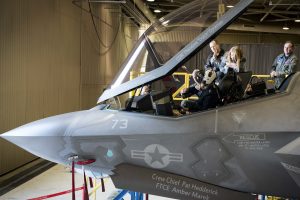
PATUXENT RIVER Md. (Jan. 13, 2016) Chief of Naval Operations (CNO) Adm. John Richardson sits in the cockpit of an F-35C Lightning II carrier variant joint strike fighter at Naval Air Station Patuxent River. Richardson also held an all-hands call, toured facilities and viewed aircraft and systems including the E-2D Advanced Hawkeye and MQ-4C Triton unmanned aircraft system. (U.S. Navy photo by Mass Communication Specialist 1st Class Nathan Laird/Released)

“It doesn’t mean that they don’t present a challenge but we fixate on A2/AD we’re going to miss the boat on the next challenge. We’ll fail to consider that thing right around the corner that will entail a fundamental shift and takes the contest and competition to the next level.”

https://news.usni.org/2016/10/03/cno-richardson-navy-shelving-a2ad-acronym

Earlier this year, Jyri Raitasalo, a lieutenant colonel, docent of strategy and security policy at the Finnish National Defence University and a member of the Royal Swedish Academy of War Sciences, made a similar case as did the CNO.

His assessment was published on June 16, 2017 and posted on the Royal Swedish Academy of War Sciences website.

http://kkrva.se/en/it-is-time-to-burst-the-western-a2ad-bubble/?utm_campaign=shareaholic&utm_medium=twitter&utm_source=socialnetwork

According to the mainstream western strategic narrative, Russia has since 2014 erected multiple Anti-Access Area Denial (A2AD) exclusion zones or “bubbles” around Europe and the Middle-East.

These bubbles supposedly hinder or even prevent western military action and troop deployments during a potential military crisis between the West (read: NATO) and Russia. Symbols of this new Russian A2AD policy can be found in modern long-range weapon-systems like the S-400 Triumf long-range surface to air missile system, SS-26 Stone (aka Iskander) short range ballistic missile system or the K-300P (aka Bastion-P) mobile coastal missile system.

It is true that Russia has been developing and fielding new long-range weapon systems lately. In addition it is true that these would pose a challenge to NATO forces in the case of a military conflict between Russia and the West.

However, I argue that the recent western A2AD discourse is as much a reflection of two decades of outright neglect concerning the development of real high-end military capability in Europe and within NATO against advanced state-based adversaries than it is about Russia’s new capabilities.

Russia has not developed a new brilliant policy or doctrine – either on the strategic or operational levels – that corresponds with the western notions of its A2AD capabilities.

Rather, in many cases Western states are projecting their own capability shortfalls onto Russia – shortfalls that are a product of over-focusing for almost two decades on multinational expeditionary military operations against weak third rate adversaries in the name of stability operations, military crisis management and counterinsurgency operations.

Bluntly put, for two decades many western states have focused on marginal military threats out-of-area to guide the maintenance and development of their militaries.

Now that Russia has brought back the traditional great-power perspective to international politics and military affairs in Europe and in the close proximity of Europe, many Western states have become surprised as they lack the capabilities – nationally and in many cases even in a multinational setting – to deter or fight conventional large-scale war. A2AD has become one western tool to manage the confusion and surprise that Russia’s actions have caused within the West.

Western A2AD narrative reveals how hollow many European military forces have become – when looked from the perspective of high-end warfighting. By deploying modern military systems to advance its interests Russia is allegedly doing something strategically brilliant and new. Within the West this deteriorating security situation has been called “the new normal”. Looking at the situation today it might be better described as the “old normal” – recognizing how great powers sooner or later drift to the opposing sides in international affairs.  The Cold War era great-power confrontation was a good example of that.

If anything, the two decades of the post-Cold War era (1990-2013) could in retrospect be called “the new abnormal”, at least according to the Western reading of this era. It was supposed to be a non-zero-sum world of managing common security threats in a globalizing and increasingly interdependent world. Former adversaries – Russia included – were engaged and cooperated with. This era coincided with the post-Cold War American unipolar moment – two decades of sheer western (read: American) dominance in international politics.

The events already in Georgia (2008) – but at the latest in Ukraine (2014) – brought a quick end to this western post-Cold war era strategic myth. Unfortunately during this 20+ years many western (read: European) states lost a good part of their military capabilities and the associated military ethos related to national and territorial defence by military forces.

The ongoing western A2AD discourse needs to be understood against this western predicament: having given up many of the high-end warfighting skills and capabilities, and faced with the resurgent (but very traditionally behaving) great-power Russia, western states need something that can explain away the conceptual surprise and the associated challenge that Russia’s actions have caused.

The western A2AD discourse has served precisely this function – it has facilitated the western states to come to terms with Russia’s confrontational actions, which have been contradictory to the post-Cold War era western outlook to international politics and strategic affairs.

At the heart of this western A2AD narrative are Russia’s new long-range military systems. They make easy headlines and their destructive potential can be easily represented by drawing circles on the map of Europe. As was reported in March 2015,

“The Iskander missiles deployment to Kaliningrad reflects Moscow’s readiness to raise the ante in response to NATO moves to deploy forces closer to Russia’s borders. The missiles, which are capable of hitting enemy targets up to 500 kilometers (310 miles away) with high precision, can be equipped with a nuclear or a conventional warhead. From Kaliningrad, they could reach several NATO member states.”

This kind of Iskander (or other) missile deployment news, focusing on the technical aspects of military systems, bring almost nothing new to the strategic equation in Europe. Russia (and the Soviet Union before its demise) has for decades had the possibility to target any city or military facility with conventional or nuclear warheads. Also, deploying mobile platforms has a sound military logic – mobile platforms are supposed to be moved and deployed where needed.

The down side of the western A2AD narrative is located in the fact that it has actually empowered Russia at the expense of the West. Today we face a situation where western media and even western statesmen react with frenzy whenever Russia deploys new military systems and by so doing creates new or reinforces its existing “A2AD bubbles”.

Iskander and S-400 Triumf launchers have become a way for Russia to communicate non-verbally its discontent about western actions. Moreover, Russia does not even have to actually deploy any “A2AD systems” in order to make a point. It is enough for Russia to declare its intent to deploy these systems. After such a declaration, Western media is guaranteed to deliver the message to a worldwide audience.

As an example, the Express published a story in November 2016 on an “ACT OF WAR: Putin deploys nuclear missiles IN EUROPE as he admits FURY at Nato expansion”. And the essence of the story was told upfront in the beginning of the piece: “AN ALARMING signal Vladimir Putin is preparing for war has come after his top military chiefs revealed the Kremlin is deploying much-feared Iskander and S-400 long-range missile defence systems deep inside Europe.”

The above-mentioned article relies on the mainstream way in the West to conceptualize one’s adversary’s military capability: focus only on the technical aspects of modern weapon-systems without any reflection about the dozens of ways to neutralize their “edge”.

For example, to thwart the combined threat posed by ballistic missiles and long-range air defence missiles – what in the western strategic parlance is called A2AD threat” – the following counter-measures can be used:

International cooperation, alliance-politics (expanding the area of operations, collective action/defence)

  • Intelligence, Surveillance, Reconnaissance (analyze the threat, early warning),
  • Decentralization (multiply the number of targets, saturate the battlefield),
  • Deception (confuse the adversary),
  • Fortification (hardening targets to minimize losses),
  • Maneuver (difficulties for opponent to locate troops/systems),
  • Protecting the troops/systems (e.g. missile defence),
  • Taking out the threat directly (long-range fires, electronic warfare, special operations forces, cyber capabilities),
  • Minimizing the threat indirectly (degrading the opponents ability to control its systems, e.g. destroying C2-assets or degrading its electricity production),
  • Developing defensive systems (e.g. flares, chaff, HARMs, jammers, standoff capability, stealth, passive sensors), and
  • Developing TTPs (how to operate in a high-risk environment, e.g. tactical maneuver).

The list above is only indicative of the vast pool of strategic, operational, tactical and technical level means to counter the so-called A2AD systems or bubbles. But the bottom line is clear: focusing solely on the technical and/or tactical aspects of adversary’s military systems may make good headlines, but it does not by itself facilitate the formulation of sound strategy.

In addition, it should be noted that deploying military assets – any military assets – to the previously mentioned Kaliningrad is a real problem for Russian military planners or commanders, at least when the shooting war starts. Kaliningrad is a small exclave, surrounded by NATO member-states. Defending Kaliningrad without going nuclear is almost unimaginable.

The alternative for Russia would be a large-scale conventional military push west (and north from Belarus) in order to pre-empt any future military operation taking place from the area of the Baltic states. Even this would not be sufficient to secure the Kaliningrad area, as NATO would be able to stage forces using its strategic depth in Western Europe until sufficient reinforcements in terms of troop numbers and capabilities had arrived.

Much of the western A2AD narrative is located on the military-technical or tactical levels. It almost completely bypasses the operational, military strategic and grand strategic level thinking and logics. Being able to pinpoint A2AD bubbles on the map – containing some sophisticated long-range military systems – does not a good strategy make.

We would like to thank our partner, Hans Tino Hansen, for bringing this article to our attention.

If you would like to comment on this article, please see the following:

Bursting the A2/AD Bubble

The Russians Build Out Their Naval Bases in the Middle East

2017-12-05 By Steven Blank

Western governments and commentators have both neglected to analyze Russia’s overall strategic campaign in the Middle East, rather than primarily focusing on its actions in Syria.

Focusing almost exclusively on Syria and/or on the issue of oil prices that Moscow is negotiating with OPEC and especially Saudi Arabia, they have ignored or simply overlooked the strategic dimension of Russia’s overall regional policies.

However, the recent announcements about Russian air and naval bases in Egypt and Sudan impel us to realize that across the Middle East and Eurasia, the Russian Federation pursues a deliberate strategy to negate Western (American) military capabilities while ensuring the expansion of Russian power in all its forms.

These recent announcements about an agreement to share air space in each country and the acquisition of an air base in Egypt and the concurrent discussions with Sudan for a naval base on the Red Sea coast highlight the range of Moscow’s objectives, the capabilities it can increasingly bring to bear in pursuit of those goals, and conversely Western strategic failure.

Air bases in Egypt and the use of Egyptian air space, along with a projected use of a Sudanese base on the Red Sea coast, allows Russia to expand its A2AD bubbles from the Arctic, Baltic, and Black Seas, the Caucasus and Central Asia regions into the Middle East.

Russian Air Force Sukhoi Su-24 Russian Air Force Sukhoi Su-24 at Latakia Air Base, Syria. Mil.RU

It now has naval and air bases in Syria and is angling for another naval base in Egypt; while potentially seeking access to naval facilities and naval and air bases at Cyprus, Libya, and Yemen; and it already has potential access to a base in Iran.

Moscow will undoubtedly use its Egyptian air base to strike at anti-Russian factions backed by the West in Libya.

It also now has for the first time direct reconnaissance over Israeli air space and increasing leverage through its Egyptian and Syrian air bases upon Israel, something Israel has sought to reject since its inception as a state.

And in addition to the projected base in Sudan it now has the capability to strike at Saudi targets as well.

But the dimensions of Moscow’s achievement go further.

These bases register Russian military and political influence throughout the region.

Moscow will now have strike and/or ISR capabilities across the entire Middle East. In practical terms this means that the bases in Syria, Egypt, and probably in Iran give it the capability, along with its other bases inside Russia, including the Crimea, and in Armenia, to project power across the entire breadth and length of the Middle East.

Meanwhile, Russia will probably deploy its fire-strike weapons and integrated air defenses across these bases.

Should Moscow outfit these naval and air bases with UAV, UCAV, UUV, EW, and ISTAR capabilities and long-range cruise missiles, as is likely, Russia could then contest Western aerospace superiority throughout the atmosphere over these areas.

In other words, given the bases already acquired and those that Moscow still seeks, a naval base in Alexandria, bases in Libya and Cyprus, Moscow would be able to contest the entire Eastern Mediterranean.

And given its strong ties with Algeria we should not rule out the possibility that it seeks a deal along these lines with that government as well.

With the ability to contest the entire Mediterranean it will place NATO land, air, and/or naval forces at risk.

The bases in Sudan and Egypt will also have a similar effect in regard to the Suez Canal and Red Sea if not the Persian Gulf’s western reaches. Meanwhile Moscow probably still has the potential to recover the use of an Iranian base as it had at Hamdan and is seeking another one in Yemen as it had in Soviet times at Socotra.

If those new bases come into play and Moscow can deploy its long-range strike capabilities and integrated air defense network there as it has done at its already existing bases, then it will have coverage of the Mediterranean, Black Sea, Caucasus, and Central Asia that would make any Western operation in any of those theaters extremely hazardous and costly.

In this file photo taken on Tuesday, Aug. 12, 2014, Russian President Vladimir Putin, left, and Egyptian President Abdel-Fattah el-Sissi, visit missile cruiser Moskva ( Moscow) in the Russian Black Sea resort of Sochi, Russia. Russia is negotiating an agreement with Egypt that would allow its warplanes to use Egyptian air bases, according to a government document released Thursday, Nov. 30, 2017 a deal that would allow Moscow to further increase its military foothold in the Mediterranean. (Alexei Druzhinin, Sputnik, Kremlin Pool Photo via AP, file) less

Given the existing bases in the Black Sea, Caucasus, and the Levant, Turkey is already almost totally surrounded and Balkan states and Italy could be vulnerable as well.

Arguably Russia is attempting to create what Marshal Ogarkov once called a reconnaissance-strike complex across the Mediterranean, Red Sea, Suez Canal, Caucasus, Central Asia, and Persian Gulf.

This is not only an issue of challenging the West’s reliance on an aerospace precision-fire strike in the first days of any war and thus Western and American air superiority.

These capabilities also threaten international energy supplies because Moscow can then use the threat of its naval and/or air power in the Persian Gulf, Red Sea, Suez Canal, and Mediterranean to interdict or curtail energy supplies that traverse these waterways.

Thus completion of this network of naval and air bases not only challenge Western aerospace superiority and key NATO or Western allies, these bases also consolidate Russia as an arbiter within each country’s politics where it has bases and as a regional one too.

Moscow also stands to gain enormous leverage on Middle Eastern energy supplies to Europe because it will have gained coverage of both defense threats and international energy trade routes.

Undoubtedly it will then use all these situations and assets to free itself from sanctions and propose a vast but nebulous anti-terrorist campaign that legitimizes its seizure of Crimea and the Donbass.

Meanwhile at the same time, in the Middle East its main interest is not peace but the controlled or managed chaos of so called controlled conflict.

Since “power projection activities are an input into the world order,” Russian force deployments into the greater Middle East and economic-political actions to gain access, influence and power there represent competitive and profound, attempts at engendering a long-term restructuring of the regional strategic order.[1]

One wonders what it will take to arouse regional and Western governments from their continued refusal to think and act strategically before it is too late.

[1] Henk Houweling and Mehdi Parvizi Amineh, “Introduction,” Mehdi Parvizi Amineh and Henk Houweling, Eds., Central Eurasia in Global Politics: Conflict, Security, and Development, International Studies in Sociology and Social Anthropology, Leiden, the Netherlands: Brill, 2004, p. 15.

Stephen Blank is an internationally recognized expert on Russian foreign and defense policies and international relations across the former Soviet Union.

He is also a leading expert on European and Asian security, including energy issues.

Since 2013 he has been a Senior Fellow at the American Foreign Policy Council in Washington, DC, www.afpc.org.

From 1989–2013 he was a Professor of Russian National Security Studies at the Strategic Studies Institute of the U.S. Army War College in Pennsylvania.

In 1998–2001 he was Douglas MacArthur Professor of Research at the War College.

Editor’s Note: The Russians will probe, push and seek to expand their influence and ensure that the expansion East of Europe stops.

Clearly, Putin will achieve greater recognition for Russian interests and power, and his policies in the Middle East are part of that effort.

That is inevitable.

Watching some in Congress acting like children thinking they are playing a game in their minds akin to pin the tail on the Donald are missing the point — there is a need to debate and forge a new strategy to deal with the Russians.

What is a realistic approach to engagement and deterrence with Russia?

Editor’s Note: If you would like to comment on this article, please go to the following:

Russia and the Middle East: Building Out Bases and Presence


Building out Missile Defense Capabilities: Working the US-Allied Relationship

2017-12-15 By Richard Weitz

One problem with the National Defense Authorization Act (NDAA) for Fiscal Year 2018 (H.R. 2810) signed by President Trump on Tuesday is that the costs of defending foreign countries from missile threats is disproportionately paid for by American tax payers.

To sustain funding for the U.S. nuclear modernization, revitalization of the U.S. ground forces, expansion of the full F-35 fleet, and the Ground-Based Midcourse Defense (GMDS) system, it is important to displace more of the costs of protecting foreign countries from missile threats onto those countries themselves.

These states need to spend more on missile defense and cooperate more closely in networking their regional systems

This would allow more of American taxpayer dollars to go to protecting the U.S. homeland.

In Europe, President Trump is but the latest U.S. leader who has decried the persistent imbalance in transatlantic defense spending. Having the United States account for some three-fourths of all NATO military expenditures undermines the long-term foundations of the alliance.

NATO countries need to follow the Polish example and spend more on their national missile defenses.

Poland is building one of the best integrated air and missile defense system in the world through its so-called Wisla program, including by spending billions of dollars on the U.S.-made Integrated Air and Missile Defense Battle Command System and U.S. Patriot air-and-missile defense interceptors.

In the future, Poland and Romania should, along with other NATO allies, pay a greater share of the Aegis Ashore SM-3 missile batteries that the United States has been building on their territories as part of the European Phased Adaptive Approach to Missile Defense that guided the Obama administration’s approach.
In Asia, South Korea and Japan need to invest more in their national defense to enable the United States to spend more on protecting its own homeland. If North Korean leaders believe that they can threaten the U.S. homeland with impunity, Pyongyang will escalate its provocations against Japan and South Korea.

For example, Japan and South Korea can rapidly enhance their defenses against North Korean missiles at modest cost by funding a new short-range hypersonic interceptor with already available unmanned aerial vehicles (UAVs).

This proposed “High-Altitude Long-Endurance Boost-Phase Intercept Unmanned Aerial Vehicle (HALE BPI/UAV)” could patrol the airspace off the Korean Peninsula and destroy North Korean missiles soon after their launch.

South Korea and Japan could easily share the modest costs of fielding and maintaining national or joint networks of these systems.

Much of the technology for this system is already available or could be developed within a few years.

Missile defense experts have already developed detailed proposals for making the concept practical. Like the GMDSthe HALE BPI/UAV would destroy targets through kinetic energy generated by the force of a high-speed collision rather than through an exploding warhead.

Moving beyond their modest and infrequent joint missile defense exercises, Japan and South Korea can pool resources to develop new missile defense systems. They can draw on technologies from missile tracking and interception already under available or under development. Their enhanced cooperation would, by reducing the U.S. burden, make the U.S. forward presence more sustainable..

Middle Eastern partners that have also benefited from missile defense technologies developed and funded by American taxpayers.

Israel has received substantial research, development, and deployment subsidies, while Arab partners have been able to buy turn-key defense systems developed thanks to generous U.S. funding.

U.S. allies and friends should also assume a greater share of the costs of researching and developing next-generation missile-defense technologies.

These could include laser-based weapons suitable for boost-phase attacks on nearby missiles or enhanced use of F-35 sensors and missiles for close-proximity missile interceptions.

More F-35s would enhance the performance and networking capacity of the air and missile defense networks of Europeans, Asians, and Arabs facing the Russian-provided planes of potential regional troublemakers.

These systems would support other types of missile interceptors already deployed or under development by U.S. allies and partners for their national defense by adding another layer to the global missile defense architecture.

Furthermore, they would allow the United States to rebalance funding to increase the size and improve the performance of the Ground-Based Interceptors in Alaska and California.

For example, the Pentagon wants to start building additional silos at Fort Greely in Alaska, redesign the kill vehicle that rams into incoming warheads, deploy a new two-stage booster, and accelerate other key GMDS components.

Besides this long-term need to rebalance the defense burden between the United States and its allies, and between U.S. regional and homeland missile defense, the immediate priority is to rescind the 2011 2011 Budget Control Act that caps federal spending through mandatory sequestration.

Although the FY2018 NDAA would provide $700 billion for defense spending, the 2011 law restricts actual 2018 defense spending to $550 billion.

As Trump said when signing the NDAA, Congress needs to “finish the job” and end the crazy sequestration requirement for automatic, across-the-board spending cuts regardless of strategic logic or national priorities.

Editor’s Note: If readers wish to comment on this article, please see the following:

Promoting Better Missile Defense Burden Sharing


Poland, Article III and Missile Defense: Shaping a Way Ahead in Alliance Capabilities

12/18/2017

2017-12-18 By Robbin Laird and Ed Timperlake

We have a fundamental respect for the Poles and their history.

No people have learned more about the threats to national survival generated by European insecurities and the Russians than the Poles.

We each have a reach into Poland and its heritage but by different paths.

For Laird, it was the opportunity to work for Dr. Zbigniew Brzezinski.

For Ed Timperlake, it was the opportunity to support Secretary Ed Derwinski, as his Presidential Appointee in arranging for the State Funeral and return to Poland of the great Musician and Primer of Poland Ignacy Jan Paderewski. Paderewski’s remains were returned to Warsaw and placed in St. John’s Archcathedral. Paderewski’s dying wish, while in America during World War II, was to be returned to a free Poland and that wish was granted by President Bush in 1992.

Article III of the NATO Treaty focuses on the need for a country to take its self-defense seriously in order for the rest of the treaty to have real effect, including the Article V clause with regard to an attack on one is an attack on all.

If a country has not prepared to defend itself, it is difficult to see how allies can do that for the given country.

Or put bluntly, if a country cares so little for its own defense that it spends its money and efforts and everything but, why should other allies take up the slack?

Or put even more bluntly, if a country is not working to defend itself, it has put itself into the military world of becoming an area upon which both allies and adversaries will operate to protect their own interests.

With Poland’s history and knowledge of the Russians, there is a clear understanding that they have little interest in being the forward edge of a battle.

But the challenge facing Poland and NATO has changed as the Russians have crafted a version of 21st century conflict, which is built around a significant missile strike force with adjacent combat capabilities.

The threat has been put well by Rear Adm. Nils Wang, former head of the Danish Navy and now head of the Danish Royal Military Academy recently introduced the reverse engineering approach to deal with anti-access and area denial.

Wang clearly argued that the Russian challenge has little to do with the Cold War Soviet-Warsaw Pact threat to the Nordics. The Soviet-Warsaw threat was one of invasion and occupation, and then using Nordic territory to fight U.S. and allied forces in the North Atlantic. In many ways, this would have been a repeat of how the Nazis seized Norway during a combined arms amphibious operation combined with a land force walk into Denmark.

In that scenario, the Danes and their allies were focused on sea denial through use of mines, with fast patrol boats providing protection for the minelayers. Aircraft and submarines were part of a defense in depth strategy to deny the ability of the Soviets to occupy the region in time of a general war.

He contrasted this with the current situation in which the Russians are less focused on a general war, and more on building capabilities for a more limited objective, controlling the Baltic States. He highlighted the arms modernization of the Russian military focused on ground-based missile defense and land- and sea-based attack missiles, along with airpower, as the main means to shape a denial-in-depth strategy which would allow the Russians significant freedom of maneuver to achieve their objectives within their zone of strategic maneuver.

A core Russian asset is the Kalibr cruise missile, which can operate off of a variety of platforms. With a dense missile wolf pack, so to speak, the Russians provide a cover for their maneuver forces. They are focused on using land-based mobile missiles in the region as their key strike and defense asset.

“The Russian defense plan in the Baltic is all about telling NATO, we can go into the Baltic countries if we decided to do so. And you will not be able to get in and get us out. That is basically the whole idea,” the admiral said.

Wang argued for a reverse engineering approach to the Russian threat. He saw this as combining several key elements: a combined anti-submarine (ASW), F-35 fleet, frigate- and land-based strike capabilities, including from Poland.

Another player in the region, Finland, looking out at the Russian threat is in the process of reworking their strategy to encompass allies in the region for self defense. And one Finnish defense official put the challenge very clearly:

“The timeline for early warning is shorter; and the threshold for the use of force is lower.”

Poland is approaching its Article III efforts by shaping a core missile defense capability, both medium and short range which allows it to deal with the threat as identified by the Finns and to contribute to broader regional defense in the way suggested by Rear Admiral Wang.

It is about building a capability which can defend Poland but link into the defense in depth which is necessary in the region.

The Poles are focusing on both building mid-range and short-range missile defense.

With regard to building out their mid-range missile defense, they are doing so with regard to ongoing modernization and building in capabilities for networking back to their own forces and to those of their neighbors and allies.

The system selected by the Poles to fill the mid-range missile defense system is a variant of the Patriot system.

But very noteworthy is the command and control aspect of the approach they are taking.

They are not pursuing a classic prime contractor provides all approach to a system but are opting for an open architecture system which will allow them to both have open ended modernization but also work the linkages to NATO neighbors and allies.

The Poles are acquiring the Integrated Air and Missile Defense Battle Command System or IBCS.

Rather than buying a legacy proprietary C2 system, the Poles are leaning forward to procure an open architecture C2 system.

They won’t have siloed systems that require new or upgraded C2 with each new radar or interceptor.

This is important as other allies acquire missile defense systems going forward, and new air systems like F-35 become part of the extended defense equation, as Rear Admiral Wang suggests.

It is about shaping a defense in depth capability across Poland, German, the Baltics, Finland and the Nordics. Without shaping common C2 capabilities, defense in depth will be more limited than the defense capabilities could allow for.

Secretary of Defense Jim Mattis hosts a bilateral meeting for Poland’s Minister of Defense Antoni Macierewicz Sept. 21, 2017, at the Pentagon in Washington, D.C. (DOD photo by Air Force Tech. Sgt. Brigitte N. Brantley)

Siloed systems do their tasks but do less than they could to provide full up capabilities to the integrated battlespace.

The Poles are also moving in the direction the US Army is looking to transition as well.  

Rather than buying whole systems, and being dependent on prime contractors for the complete integration of those systems, the US Army is looking towards a commodity approach.

What the U.S. Army is looking to do is be able to manage interactions among C2, sensors, and missiles and to plus whichever of these “commodities” needs to be plused up.

It is also crucial for the US Army to be able to integrate the defense systems in the maneuver force as well as to focus on what is necessary for the evolving integrated battle space.

It is not simply about after market integration; it is about building in integration from the ground up as new systems are added as well.

This means that the Polish approach is symmetrical with the strategic direction of the US Army itself.

Poland is working through the challenge of affordability with regard to missile defense, but senior Polish officials understand that the open architecture C2 system is not an add on but a core capability to the evolution of core Polish defense capabilities.

Asked about speculation that Poland could resign from the IBCS to lower the price of the Patriots, (Deputy Defense Minister) Kownacki stressed that the air defense management system obviously may be the subject of discussion, but “it’s not that it (IBCS) fundamentally changes the price proportions in the middle-range air defense system”.

 “We are analyzing the document and we will be negotiating, but you must know that IBCS is what everyone will buy. This is the future that awaits all of us, and sooner or later we will bear this cost.”

http://www.defence24.pl/710584,kownacki-nieakceptowalna-jest-dla-nas-kwota-105-mld-usd-za-patrioty-mowilismy-to-od-poczatku

In short, Poland has demonstrated NATO leadership in pursing the most modern air and missile defense system available.

They are acquiring a system built not just for today, but to anticipate and counter future threats.

It is clearly in the US and NATO interests that the US and Poland work together to get to a price that satisfies both sides, while still preserving the investment in the future which IBCS represents.

Changing the Business Rules: Moving Beyond Slo Mo War Preparation

2017-12-18 By Brian Morra

The Department of Defense’s acquisition system is a major cause of the erosion of the defense capabilities of the United States.

This erosion is visible in high profile, fatal accidents like those the US Navy has experienced in the Western Pacific over the past two years.

Less visible is the long-term deterioration of defense capacity relative to peer competitors like China and Russia.

That decline is the product of both defense budget reductions since 2009 and the fundamental failure of the DoD to reform its antiquated acquisition system.

The DoD requires high-intensity acquisition to prepare for high-intensity conflict.

The growing importance and rapid evolution of cyber and digitally-enabled systems means that DoD can no longer operate with its traditional procurement and sustainment rules.

I will not attempt in this paper to offer broad remedies for acquisition reform.

Instead, I will address a specific aspect of the system that is not keeping pace with the advances we are observing in China and Russia.

The acquisition of major weapon systems comprises two major phases: acquisition/procurement and operations/sustainment.

Those phases follow a bi-modal budget distribution.

There is a large budget expenditure during procurement for a small number of years, followed by a much larger and longer-term expenditure during the many years of operation and sustainment.

The current system and matching budgetary method leave the United States vulnerable to adversaries that develop and deploy new capabilities at a much faster pace than the bi-modal approach offers.

Moving to a multi-phased acquisition method is required for the United States to keep up.

And, “keeping up” probably does not mean that the US will be able to retain its “over-match” position relative to peer competitors.

Changing business rules allows for strategic redirection and agile evolution of the combat force. Credit Graphic: IBM

Given the steady progress being made by adversaries, reforming DoD’s acquisition process is no longer just a smart thing to do; it has become existentially vital.

The digital nature of new weapon systems like the F-35 makes multi-phased development and multi-modal budgeting feasible.

This approach bears some similarity to the spiral-development approaches used in the past.

However, a new approach will need to be qualitatively different than traditional spiral development.

The ability to upgrade new weapon systems primarily through software upgrades makes this new approach possible.

The new approach would have shorter upgrade cycles or modes, based on 3-5 year centers.

Budget planning will need to change since each new “mode” would blend acquisition and O&S monies. Each new mode would require a business case to support decisions to deploy funds.

This is a very different approach.

It would require different business rules and procedures than are currently employed by the DoD’s acquisition centers.

The obstacles to this kind of reform are not technical, although some will assert that technical issues are insurmountable. The real obstacles are DoD’s current business rules and acquisition policies and budgeting procedures.

The question is will we reform these procedures now, or will we only do so when we are confronted with a crisis?

The US aerospace and defense industry maintains proprietary control over its core capabilities.

This is a key challenge that DoD confronts that China (in the main) does not. In order to have affordable, multi-modal weapons system development, DoD will have to establish new business rules to enable proprietary sharing or compartmentation schemes that create the conditions for development across proprietary stove pipes.

The need is clear.

The DoD requires business rules appropriate for high-intensity acquisition to meet the rapidly evolving threats represented principally by China and Russia.

The growing importance of cyber and digitally-enabled systems means that DoD can no longer operate with industrial-age procurement and sustainment rules.

Fortunately, the transition to digital systems lend themselves to a new, multi-modal approach that will help the United States keep pace with evolving threats.

Brian Morra is a retired career Aerospace industry executive, who currently serves on several corporate and academic boards.  

If you would like to comment on this articles, please see the following:

Changing the Business Rules to Allow For High-Intensity Warfare Acquisition Models

Reflections on the Australian Foreign Policy White Paper: Facing the Challenge of Global Engagement, Conflict and Realignment

2017-12-05 By Robbin Laird

During my last visit to Australia, I spent time with colleagues in the Australian government discussing various aspects of the strategic environment in flux and what the impact of such an environment has on Australian interests.

The newly released Foreign Policy White Paper provides a public statement of how to look both at the environment in flux and the challenge of defining, and protecting Australian interests.

2017_foreign_policy_white_paper

Because of how dynamic the environment is, what can be shaped is an optic or a template at best to look at the environment and to focus on how best to navigate the way ahead.

The White Paper provides some insights into how Aussies are doing so.

We are in as profound a period of historical change as we faced with World War II and its aftermath, but hopefully not as deadly. In that transition, the Australian leadership moved from being a key part of the British empire and providing forces for the defense of the empire and its interests, to self defense and working with the strongest democratic ally in the region, namely the United States.

Now Australia faces a China, which fits no easy formula as either a mercantile or strategic military power, and an America which is facing significant pressures for change at home and abroad. How stable China will be is an open question and how America will navigate the new cold civil war it is going through domestically is an open question.

With regard to the defense of Australia, there is little question that the solid relationship they have had with the US military is the foundation of shaping their approach to deterrence in depth. At the same time, it is crucial to ramp up capabilities to work with other powers in the region, such as Japan and to find ways to deepen the ability to provide defense against the Chinese push and the second nuclear age North Korean nuclear power.

Will American nuclear deterrence remain credible enough to deal with China, Russia and North Korea?

What will Australia need to develop and deploy to make a significant impact on the perceptions of a China or North Korea?

At the same time, the prosperity of Australia rests on a global order where trade is open and fair.

The coming of Trump has jolted the broader liberal democratic discussion of what is open and fair, and what trade orders will emerge.

The Chinese have played the global trade game significantly unfairly with a clear strategic interest to build political influence on trade, but not as if they were 18th Century Dutch traders.

They are playing the game to expand the unique vision of Chinese communism.

How best to define a rules based order?

How to intertwine security and trade interests in the shaping of an evolving or perhaps new version of what that means in the shift from liberal globalization to a more conflictual global order where defining the rules is precisely in play?

The Australian Prime Minister put it well in his introduction to the White Paper:

“We are creating the competitiveness and flexibility our economy needs to thrive in an interdependent, fast-changing world. But we must also acknowledge we are facing the most complex and challenging geostrategic environment since the early years of the Cold War. We cannot assume that prosperity and security just happen by themselves.”

What Turnbull calls for is enhanced Australian sovereignty in a world in flux.

“More than ever, Australia must be sovereign, not reliant. We must take responsibility for our own security and prosperity while recognising we are stronger when sharing the burden of leadership with trusted partners and friends.”

“As this White Paper makes clear, in a complex and uncertain environment we will have to work harder to maximise our international influence and secure our interests.

“We will need to keep reforming our economy, boost our competitiveness and resilience, and invest in the other domestic foundations of our national strength.”

This is more eloquently said than has been articulated by President Trump without the histrionics and tweeting but this is clearly resonant with a core instinct in the effort to enhance national competitiveness in a global order in significant flux.

“We must guard against protectionism and build robust support for open economic settings by ensuring all Australians have the opportunity to benefit from our growing economy. Our trade and investment agenda will assist by boosting jobs and supporting higher living standards.”

This would seem to be at odds with Trump’s stated agenda but what is in play is how the Chinese have distorted the global trade agenda and how best to respond to that distortion. It is not so much simply keeping in place an inherited rules based order, but shaping a realistic one for the period ahead.

The White Paper lays out a number of key attributes of how the Australian government sees the current global competition as well as ways to better achieve Australian sovereign outcomes.

The dichotomy of hard and soft power has often been used to describe the tools to be used, but if the 21st century order is fundamental flux, there will be no dominant rules based order unless liberal democracy can defend its values and its interests.

A key part of shaping the way ahead is finding ways to expand Australian cooperation within what the White Paper calls the Indo-Pacific region, which makes a great deal of sense as both China and the United States are undergoing fundamental change.

A good statement of where we are currently is made on page 21 of the White Paper.

“Australian foreign policy in recent decades has focused on advancing our interests as globalisation deepened and economies in Asia grew strongly. In the decade ahead, both trends will continue profoundly to influence our prosperity and security.

“Other major trends will shape our world, including the pace and scale of technological advances, demographic shifts, climate change and new global power balances. The threats posed by North Korea and terrorism and other transnational issues will require resolute, long-term responses.

“The United States remains the most powerful country but its long dominance of the international order is being challenged by other powers. A post-Cold War lull in major power rivalry has ended.

“These trends are converging to create an uncertain outlook for Australia.”

The challenge will be to shape a template, which allows Australia to shape a sovereign solution in a world in conflict, a world in flux, and a world in which the rules of engagement, including trade are in fundamental flux.

The White Paper provides some statements of principle with regard to shaping the way ahead, but the antinomies of a number of these principles are clearly the challenge.

How to navigate what kind of future for Australia in a world which is neither dominated by China nor the United States, but in part by their competition and by the fundamental shifts in both of these societies as well?

It is difficult as well to understate the impact of the second nuclear age crisis evident with the nuclear force being built by North Korea. The North Koreans are not pursuing a deterrent force in a cold war sense, but an operational force to reshape the Pacific order.

How will Australia deal with this challenge?

In short, we have to deal with the world as it is becoming, not the world simply we would like to see.

Australia faces the challenge of shaping a sovereign way ahead in a world which does not easily fit into the templates of the past twenty years, but in which global conflict and struggle over the global rules of engagement are defined not in the think tanks, but on the global plane of struggle and cooperation.


Secretary Tillerson Goes to Canada: Trudeau’s Canada in Strategic Transition

2017-12-16 By Danny Lam

The United States seized on an opportunity co-host with Canada a meeting of the United Nations Command Sending States plus the Republic of Korea and Japan after the last DPRK missile test.

The stated purpose of the meeting for the US was to “discuss how the global community can counter North Korea’s threat to international peace.”

But there is no consensus between the co-hosts as to how this is to be achieved.

The US wants to Canada to host the “Tehran Conference (1943)” while Canada is trying for the “Paris Peace Conference (Versailles 1919)”, with the same predictable outcomes.

UN Command Sending States with ROK and Japan is a brilliant term of art that reminded all those who signed the Armistice Agreement with the Korean People’s Army and Chinese People’s Volunteers that they are all technically still at war and bound to uphold the Armistice agreement.

That is supposed to include Canada.

The 16 sending states that committed military forces that are legally bound to “their national commitment to the UNC in the defense of ROK should the armistice agreement fail” are: US, UK, Australia, Canada, New Zealand, South Africa, France, Belgium, Netherlands, Luxembourg, Greece, Colombia, Ethiopia, Turkey, Thailand and the Philippines.

Convening a meeting of “sending states” explicitly reminded all the participants that they were, and are, and remain belligerents as no peace treaty was ever concluded.

All of them (including Japan and ROK) have a military stake in the outcome and a treaty obligation to defend the Armistice.

Canada interpreted the mission quite differently from the US.

Chrystia Freeland, the Canadian foreign minister and her staff, did not know about or disregarded the angle of sending state’s legal obligations to uphold the Armistice and took the proposed meeting as a multilateral effort to bring “key players” together for a non-military solution.

Chrystia Freeland, discussed “in great detail” the proposed meeting with PRC’s foreign minister Wang Yi at the APEC meeting in Vietnam (Nov 6-11) and then went ahead to invited the PRC to the meeting in December.

This was almost certainly done without consulting with and obtaining the consent of the US or key allies like Japan.

It is hard to imagine how bringing PRC to this meeting can contribute to forming a consensus on under what circumstances will military options be the necessary.

Japan took exception to Canada’s stratagem.

No sooner had Canada issued an invitation to Japan in December, it was rejected by Foreign Minister Kono because “the pursuit of dialogue may take the emphasis away from pressure [on Pyongyang].”

Then in the classic Japanese diplomatic style, the timing of the meeting initially proposed by Canada in December was termed “inconvenient” as it conflicted with Minister Kono’s commitment in New York.

Finally, Japan objected to inviting all the “Sending States” and by insinuation PRC, because it is “out of step with Japan’s direction”.

For all practical purposes, Japan declined to participate in this Canadian led venture despite the risk of making the US uncomfortable and embarrassing Secretary Tillerson.

 Canada basically sabotaged the meeting before it began by inviting PRC.

Just what did Canada do that so offended Japan and ensured the failure of this joint initiative with the US?

During the APEC/ASEAN meetings, Canada deliberately sabotaged the TPP11 free trade deal that was co-chaired by Australia and Japan.

Canadian Minister for International Trade François-Philippe Champagne deliberately mislead Japan and Australia that Canada agreed to sign TPP11, then issued a tweet stating otherwise at 9:30pm Danang Time the night before without immediately informing the co-chairs.

This resulted in an ambush where PM Abe was only told by PM Trudeau of his refusal to sign 20 minutes before the signing ceremony, ensuring the failure of the entire agreement.

Canada then followed the sabotage of TPP11 with an attempt to parlay an invitation to be an observer at the East Asia Forum into membership when Canada is viewed as “not adding substance to the Group”.

Left unspoken and unsaid is Canada have taken stances that turn a blind eye to the most pressing security interests in the region, namely, the PRC’s “sea grab” of the South China Sea as “territorial waters” in violation of UNCLOS, and similar moves in the East China Sea and dismissing the DPRK and PRC threat to North America and the liberal international order.

The sabotage (rather than graceful withdraw by Canada) of TPP11 and vociferous demands for Canada to join EAS and campaign to become a UNSC member under the Liberal regime makes sense if the intent of Canada is to align with the PRC and serve as their comprador on these forums.

Not surprisingly, right after these two events, Canada’s Liberal regime gleefully tried to get PRC to reward Canada for their efforts by formally starting negotiations for a Canada-PRC free trade deal which the liberals wanted to conclude in time for the 2019 Canadian Federal Election: Only to be disappointed because Canada failed to deliver Bombardier to PRC, and; will likely require a national security review of the PRC takeover of Aecon (Canada’s largest public A&E firm).

Furthermore, the Liberals was unable to guarantee existing NAFTA access for PRC enterprises via Canada despite the best efforts of Canadian officials to sabotage the NAFTA renegotiations to protect the status quo by default.

Canadian politicians and officials had no illusions as to how beneficial negotiating a free trade deal with PRC can be when the Australian Trade Minister and PRC-Australia FTA negotiator Andrew Robb got a A$880,000/year “confidential” contract with a CCP aligned Chinese firm for doing very little after concluding the deal and resigning from Parliament.

Such rewards are just not available from the US for Canadian officials re-negotiating NAFTA or from parties to TPP11.

Canada’s Liberals have expressed no concern or intention to review and strengthen national security, investment, and transparency laws to limit foreign influence and CCP subversion as Australia and other allies are presently doing.

Let us now turn to Canada’s stance on North Korea and consider this as a key part of the formula being generated by the current Canadian government.  

Canada’s top defense official Chief of the General Staff General Jonathan Vance publically stated on December 1 that “I would say it’s [North Korea nuclear ballistic missiles] an emerging threat. It’s not yet developed to be an extant threat, a proven threat.”

He did not believe North Korea has demonstrated that capability and “It’s [the threat] theoretical at this juncture”.

Vance specifically and categorically rejected the idea that Canada should discuss with the US joining the American Ballistic Missile Defense system.

Likewise, the idea that Canada might be asked to contribute forces for a war on the Korean peninsula that require specific preparations now was summarily dismissed even as other close allies began mobilizing and making those preparations.

This is in line with Canada’s official position is that North Korea do not pose a credible existential threat to North America in terms of capabilities.

What about North Korea’s intent?

Global Affairs Canada have alleged that “There has been no direct threat to Canada” and “Pyongyang does not consider Canada as an enemy, but rather as a friendly and peaceful country”.   Global Affairs official Mark Gwozdecky believe, “We must convince Pyongyang that it can achieve its goals through peaceful diplomatic means.”

And that DPRK’s only concern is with regime survival.

To sum up: Canada, categorically, do not see a threat from North Korea either in terms of their nuclear ballistic missiles capabilities, or hostile intentions toward Canada.

Nor do Canada see treaty obligations (UN, UNC, NATO, etc.) that will almost certainly drag Canada into any conflict on the Korean peninsula as binding on Canada.

Contrast this with the US Government consensus on the threat from North Korea: “North Korea’s pursuit of nuclear weapons has aggressive and offensive objectives. Pyongyang, they believe, will use its nuclear weapons to push U.S. forces out of South Korea and then force reunification of the Korean Peninsula on its terms.”

Canada’s official position on DPRK is similar to the PRC’s stance that seeks dialog.

All that remain is for Canada to openly advocate “freeze for freeze” together with PRC and Russia and talk the other participants into accepting it.

With this perception, is it a surprise that Canada took the initiative with Secretary Tillerson to mean that a military solution is off the table and only diplomatic means are viable when Canada’s top defense and security officials have a clear consensus that they do not see a threat (capability and intent) from DPRK toward Canada in the near term?

Indeed, some in Canada have advocated for Canada to be neutral in the conflict (disregarding treaty obligations), or in some cases, to seek protection from the PRC.

PM Trudeau only regard the risk of debris falling on Canada from US intercepts of DPRK missiles heading to America.

Moreover, PM Trudeau specifically suggested using Cuba as a channel to DPRK just because they have diplomatic relations with North Korea. (Singapore has diplomatic relations with DPRK.) Apparently ignorant of, or dismissing the risk of Cuba might leverage that into acquiring nuclear weapons from North Korea like what happened during the Cuban Missile Crisis before Justin Trudeau was conceived.

What about Canada as the champion of “rules based international order”?  

Based on recent behavior, Canada do not appear to regard the legally binding obligations to defend the Armistice to be legally binding, nor do Canada see a binding treaty obligation under NATO Article 5 to defend allies like the USA if attacked, or NATO Article 3 obligations to provide for an adequate self-defense capability that include both mutual defense and mutual offense in general, and defense against DPRK ballistic missiles in particular.

Canadians have a belief that the US will come to Canada’s defense and take such American protection as an entitlement even as Canada is acting in violation of NATO Article 3 and 5 treaty obligations, and routinely sabotaging allied initiatives like the UNC conference often with PRC the prime beneficiary.

David Pugliese, a well-known Canadian defense correspondent and contributor to Defense News explicitly asked, “whether it is worth having an ally that has an official policy to sit back and let a catastrophic attack proceed on its neighbour and one of its closest partners even though it believes it has the means and technology to stop it.”

And called for Canada to find a new ally. PRC, perhaps?

Secretary Tillerson will have the nearly impossible task of fundamentally changing core Canadian beliefs and hallucinations on a brief visit: including rectifying Canadian dismissal of the near term nuclear ballistic missile threat from DPRK to Canada; the medium term threat from PRC that if not checked soon will irrevocably alter the liberal international order.

Critically, the problem of subversion of Canada’s political, government, academic and economic elites by CCP United Front organizations that have so far, been largely ignored by the Canadian Federal, Provincial and local governments.

If he can accomplish that on a brief visit, it be a miracle.

If not, perhaps it is time for a policy review.

Editor’s Note: If you wish to comment on this article, please see the following:
Secretary Tillerson Meets PM Trudeau about North Korea and China

Editor’s Note: To gain a sense of the significant gap between Canada and many allies, please compare the current Canadian government’s position to that of Australia.

http://sldinfo.wpstage.net/the-new-australian-foreign-policy-white-paper-the-perspective-of-the-australian-institute-of-international-affairs/

http://sldinfo.wpstage.net/reflections-on-the-australian-foreign-policy-white-paper-facing-the-challenge-of-global-engagement-conflict-and-realignment/

The New Australian Foreign Policy White Paper: The Perspective of the Australian Institute of International Affairs

12/16/2017

2017-12-05 By The Australian Institute of International Affairs

Australia’s first Foreign Policy White Paper in 14 years opens with Prime Minister Malcolm Turnbull’s declaration, “change, unprecedented in its scale and pace, is the tenor of our times”; and it is the changes in global power dynamics, international trade, security, technology and the environment that profoundly shape the document.

Adopting a 10-year horizon, the White Paper says the rapidly changing world presents Australia with new opportunities for free trade, security cooperation and transnational connections. During this time, it claims Australia’s interests will be supported by the continuing strong presence of the US in the region. However, the changes also bring challenges, including the upheaval to the existing order of the ongoing rise of China.

Within the context of this changing world, two main priorities underpin the White Paper. The first is Australia’s continued commitment to upholding the rules-based international order and pursuing increased trade.

The prosperity that the existing international order fosters is said to be closely intertwined with our security, making efforts to sustain it more important than ever. The White Paper maintains that, although a middle power, Australia’s resilient democracy and robust economy will ensure it continues to have considerable international influence. Importantly, that influence will be most strongly felt within the Indo-Pacific region.

The second priority of the White Paper is stability in the Indo-Pacific region.

The paper is full of references to the Indo-Pacific and Australia’s capacity to play a role in determining regional outcomes. It anticipates that emerging powers will be incorporated into the international institutional framework and cooperation between Indo-Pacific countries will increase as new markets emerge from Asia’s ongoing economic boom. Australia’s influence is highlighted as being particularly vital for its closest neighbours, including Timor-Leste, Papua New Guinea and other Pacific island states.

The Great Powers

The ever-present influence of the US and China is recognised.

While the US is expected to remain the most powerful country in the region, its dominance “is being challenged by other powers”.  China’s power and influence are “growing to match—and in some cases exceed—that of the United States”.

The power balance between the US and China make Sino-American relations of great strategic importance.

Australia will encourage China and the US to manage their economic divergences to ensure that the economic tension “does not fuel strategic rivalry” or “damage the multilateral trading system” in the region.

Australia seeks to engage both powers proactively to ensure regional stability and Australia’s security and prosperity.

Much emphasis is placed on the relationship with the US and the importance of Washington’s continued commitment to the region.

The defence of the existing rules-based order is central: “… the Government will place a high priority on protecting and strengthening the international rules that guide the conduct of relations between states.”

At the same time, the White Paper says Australia will seek to further engage China across different levels and on various issues.

Security

In response to a rapidly changing security situation the government has committed to a holistic and dynamic action plan. This includes a focus on new threats posed by cyber security and by activity in space, in addition to countering existing threats posed by North Korea, terrorism and irregular migration.

The White Paper identifies a number of “fault lines” that may prompt regional conflict, including the South China Sea and it restates Malcolm Turnbull’s comments from earlier this year that any attack on the US by North Korea would trigger Australia’s commitments under ANZUS.  At the same time, the country will continue cooperating globally to combat international terrorist organisations both domestically and abroad, most notably the increasing regional threat in the Southern Philippines.

Australia will remain committed to combatting people smuggling and irregular migration with continued humanitarian efforts and by helping to maintain community support for refugee resettlement in Australia. By cooperating with regional partners, Australia will also continue its turn-back policy.

The White Paper reiterates the 2016 Cyber Security Strategy to partner with businesses, strengthen cyber defences, pursue global influence in the cyber sphere, foster growth and innovation, and create a cybersmart nation. This is coupled with a commitment to also pursue offshore cyber criminals.

The paper recognises the need to engage with new media platforms in strengthening national security and citizens’ safety.

There is a concern that these platforms allow foreign governments to spread misinformation and interfere with sovereign institutions to influence decision makers and public opinion. DFAT will pair with social media companies to make the most of technologies such as Facebook to ensure citizens’ safety in disasters abroad.

Interestingly, the government is also strengthening its space surveillance capabilities and developing a space agency to counter threats posed by foreign space innovation.

Trade

Australia’s economic interests are intertwined closely with its security interests. This convergence underpins the entire Foreign Policy White Paper, with emphasis on maximising trade and openness to mitigate the challenges that arise from an uncertain world.

The White Paper outlines a clear agenda for advancing the prosperity of Australia through increased trade and inclusivity.

By ensuring opportunity for business and workers in an expanding economy, reducing trade barriers and fiercely rejecting protectionism, the government aims to strengthen its economic hand.

Regional trade and investment arrangements that increase competition and transparency are outlined as key to mitigating strategic rivalry and great power dynamics.

One example is Australia’s commitment to the RCEP negotiations—a partnership that involves ASEAN alongside Australia, China, India, Japan, Korea and New Zealand. Emphasis is placed on both bilateral and region-wide integration as key to successful Australian foreign policy over the coming decade.

Asia’s continuing growth will provide ample opportunities for Australia:

“We live in the most economically dynamic region of the world and have the minerals, energy, goods and services sought by growing Indo–Pacific economies.”

Multilateral agreements are listed at length—trade and investment links such as AANZFTA, alongside FTAs with Singapore, Thailand and Malaysia. With the obstacles to progress at the multilateral level, bilateral agreements with China, Japan and Korea are presented as paramount to Australia’s prosperity. The paper also outlines how the government will negotiate an ambitious FTA with the EU as well as the UK post-Brexit.

Aid and development

The White Paper establishes a clear commitment to advance human rights through development assistance and humanitarian support. There is an emphasis on how development assistance can catalyse economic outcomes in the region, in turn promoting Australia’s national interest.

It is argued that development aid, when used to support initiatives such as effective governance, will be the foundation for economic opportunity and poverty reduction. In turn, the increased stability of Australia’s neighbours will reduce vulnerability to “challenges such as irregular migration and extremism”.

This is consistent with the 2003 White Paper which emphasised that mature institutions and accountable systems were the objective.

The Pacific region is the largest recipient of the aid program receiving $1,097.8 million in funding for 2017-18. PNG alone receives $550 million in assistance. As a broad objective, Australia aims to enhance engagement with Pacific countries such as Timor Leste, the Solomon Islands, Fiji and particularly PNG, linked to shared security interests. PNG and the wider Pacific are “vital to our ability to defend…our borders and protect our exclusive economic zone”. Australia will continue to make substantial long-term investments in the region’s development.

Assistance has been allocated to build resilience to natural disasters and climate change. Australia is improving its capacity to respond to international natural disasters via 48 hours relief response units and the deployment of humanitarian specialists.

Additionally, Australia is also investing in “regional disaster preparedness” to mitigate impacts. In the face of unprecedented and worsening climate conditions, natural disasters will increasingly impede economic stability and national security interests. Australia is therefore investing “more than $1 billion over five years” to alleviate the costs of climate change in developing countries.

Zoe Halstead, Nicholas Taylor, Gillian Davenport, Breanna Gabbert, Adam Bell and Shixi Guo contributed to this report. They are all researchers at the Australian Institute of International Affairs National Office.