ROTC and Harvard: How Goes It?

09/22/2011

09/12/2011 – Editor’s Note: We received an article presented to the Military Order of the World Wars in Boston on 7 September 2011 from the author, Captain Paul E. Mawn USN (Ret) Harvard ‘63, who is the Chairman of the “Advocates for Harvard ROTC”. The article provides an important update on an important subject.

The Advocates for Harvard ROTC mission is to promote diversity of opinion at Harvard and a climate of tolerance, acceptance and support for those Harvard undergraduates who believe in duty, honor and country as evidenced by their participation in the Army, Navy/Marine Corps and Air Force ROTC Programs now based at MIT.

Harvard president A. Lawrence Lowell stated in 1916: “The aim of a country which desires to remain at peace must be ready to defend itself, should train a large body of junior offices who can look forward to no career in the army, and can have no wish for war, yet who will be able to take their places in the field when needed”.
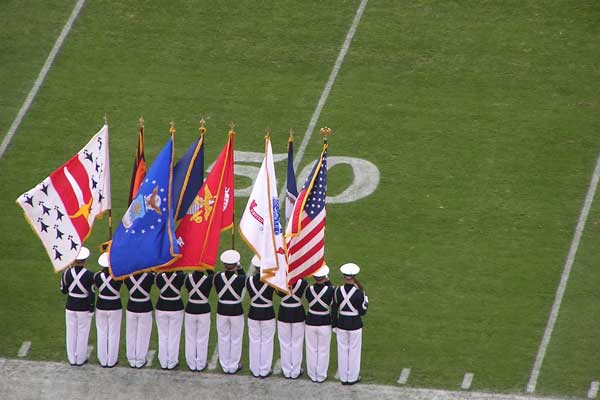
ROTC cadets lined up at the sideline of the 50-yard-line of a football field. They bear the flags of the united states, of the commonwealth of Virginia, and of the various armed services. (Credit: Bigstock)ROTC cadets lined up at the sideline of the 50-yard-line of a football field. They bear the flags of the united states, of the Commonwealth of Virginia, and of the various armed services. (Credit: Bigstock)

Harvard and ROTC

A Current Sitrep from Captain Mawn

For 20 years after 1972, Harvard students, who were so motivated, could continue to officially participate in various ROTC programs which were then based at host school MIT serving only MIT & Harvard but also Tufts as well as other local colleges depending on the military service. Despite being thrown off campus, ROTC participation was never “banned” at Harvard.

However in 1992, a Democrat completely controlled congress and a Democrat president passed the “Don’t ask, Don’t tell” law which caused many left leaning faculty at the College of Arts & Sciences to pressure the Harvard administration for de-recognition of the ROTC units at MIT serving Harvard cadets and midshipmen, which is analogous to derecognizing a fraternity.

As a result, Harvard Cadets and Midshipman were not allowed to indicate an ROTC affiliation in their yearbooks or official records. The denial of credits for ROTC courses continued of course and no Harvard facilities could be used for ROTC related activities, military uniforms were strongly discouraged from being worn on the Harvard campus. Although, Harvard kept all of the ROTC scholarship money from DOD for ROTC scholarship cadets and NROTC Midshipman but refused to pay any allocation of ROTC related overhead costs borne by MIT.

This situation between Harvard and ROTC gave birth to the Advocates for Harvard ROTC in 1993. About 5 years ago under the leadership President Larry Summers and efforts of the Advocates, consequently many of the above noted petty restrictions were removed. This contributed in part to the eventual firing of President Summers. While the “ball” was moved forward during this time, official recognition of the various ROTC programs for Harvard students remained elusive purely due to politics and the low level of participation in ROTC among Harvard students remained challenging.

Under the new administration of Harvard President Faust, short term goals of the Advocates was to not to lose any ground continue to maintain an on going dialogue with the Harvard administration as well as a conducting a pro active media campaign for official recognition of ROTC at Harvard.  Part of this effort involved promulgating the long tradition of Harvard grads serving our country and Harvard’s support for the military which was defined as the “Long Crimson Line”, with full honor to West Point for their wonderful description of their cadet tradition.

After months of negotiating with the Harvard administration, Advocates activities eventually resulted in a formal ceremony in Memorial Church to unveil the MOH plaque for the 17 Harvard alumni MOH recipients.  The event featured Gen. George Casey USA, Chief of Staff as the keynote speaker. In attendance were also President Faust and a Church full of Harvard alumni, many in their service dress military uniform.

On 3 March 2011, an important beachhead was established relative to struggle between Harvard and NROTC. However, the mission of the Advocates is far from being accomplished. The proposed tentative agreement with the Navy was laced with politics.

Unfortunately, the headlines of the Boston Globe and Herald as well as many other print and TV media noted: “Harvard opens the door to ROTC” which is incorrect and misleading for the following reasons:

  1. The decision for Harvard to again host a ROTC unit or multiple units on the Harvard campus is not a decision that can be made unilaterally by President Faust or the Harvard Corporation.
  2. The military is currently under a severe budget crunch and is not looking for added places to spend money such as new ROTC facilities and related overhead costs. During the 1970’s and continuing to the present time, there was a significant shift of ROTC units from the North to the South.  For example from 1968 to 1974, the Army closed 30 units at Eastern colleges and opened up 33 in the South resulting in Southern college ROTC units outnumbering Eastern colleges by 180 to 93.
  3. All of our military services are currently making all their officer candidate quotas and the need for more junior officers has decrease dramatically with the severe shrinkage of platforms and units in the last two decades since Desert Storm.
  4. Some (but not all) senior flag officers in the Pentagon view Harvard as well some other Ivy Schools as snobby elites with a detectable left wing tilt who personally insulted the military during  a time of war in the 1960-1970’s. Some of these senior flags with no Ivy connections are not chopping at the bit to spend more money on schools that have insulted their very existence.  Furthermore in a time of budget constraints, financially it is a lot cheaper to pay for students at an existing ROTC program at a land-grant institution rather then Harvard or Yale.
  5. Due to supply & demand, students desiring to AFROTC and the NROTC programs (excluding the USMC option) currently are required to have an engineering major. Unless a rare waiver could be obtained, all liberal arts majors will be left out in the cold.
  6. Finally, a total population of only 20 cadets and midshipmen from all 4 Harvard undergraduate classes serving in the 3 ROTC units based at MIT do not provide a sufficient critical mass in to justify a ROTC unit hosted by Harvard in the near to mid term.

So far nothing has changed to date at Harvard relative to ROTC since the well publicized announcement of 3 March 2011, which was contingent on the ultimate certification by JCS and Sec Def that “Don’t Ask, Don’t Tell” will not affect our military recruiting, retention and readiness in a time of war.

On 22 July, this certification for DADT was stamped by the Obama administration and is effective on 20 September 2011. It is a done deal but the agreement of 3 March only involved NROTC and so far has left Army and USAF out in the cold.

So to summarize: it is still a challenging and ongoing work in progress for the “Advocates for Harvard ROTC”.

Needed next steps: Harvard, DOD & US government
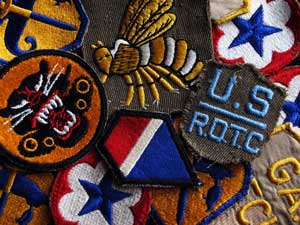
ROTC at Harvard: In a Tough Patch? (Credit: Bigstock)

Prior to Harvard’s hosting an ROTC unit, there are more than a dozen other steps that are required by Harvard in the short, mid & long term beyond  the current tentative policy of 3 March 2011 relating only to NROTC. In addition, other steps need to be addressed in the long term by DOD, the Congress and even the White House.

Short term – Harvard – keep promises among them: To follow up on promise to provide an official ROTC space on campus; to provide official recognition of AROTC & AFROTC as well as NROTC; and to pay the promised ROTC overhead allocation to MIT since Harvard has been keeping the entire $40M + of tuition scholarship $ from DOD paid for Harvard ROTC scholarship students

Mid Term – Harvard attitude adjustment: Proactive outreach/ “quotas” for 2 classes of students who are most likely prospects for ROTC participation. For Example: Applicants with an ROTC scholarship in hand. Veterans, especially those  with combat experience as does Columbia and Dartmouth of which some percentage  may desire a commission or would at least be mostly pro- military.

Such a step would greatly add to true undergraduate diversity at Harvard, most Harvard Cadets and Midshipman  have direct military family members.  Furthermore, the majority of Harvard undergrads have no clue about the military which is typically not on their “radar scopes” as a service option and they would more like consider joining the  French foreign Legion or even Roman Legions before signing up for the US military.

In addition, the awareness of military service has negatively suffered in the long term US cultural war; especially Hollywood and other media have generally been anti military for four decades. In addition, a significant part of this problem originates in the US public education system where children no longer  say pledge of allegiance in many high schools, lack discipline,  are often exposed to left wing revisionist, anti military history teachers and a minimization or abandonment of any positive military history. Harvard motto is “Veritas” (i.e. truth) which should be pursued and taught relative to the sacrifices, nobility and achievement of the US military where “Some gave all and all gave some.”

For the Harvard class of 2013, 5 out of 20+ applicants with Army scholarship were positively vetted by the Army for admission. The end result were: two rejected, two wait listed but did not get in and one  was admitted but was significantly hassled by Harvard financial aid office for room & board help that he went to West Point. For 2014, only one of 5 Army vetted applicants were admitted to Harvard

Another key objective would be to promote a climate of tolerance and acceptance for the US military at Harvard  College. For example, the Center for Public Interest Careers at Harvard College does not consider US military as a Public Interest career.

The Harvard Alumni Association had a recent colloquium on “Reflection on careers in government service” – the good, the bad & the ugly” – no mention was made of the military as government service! However, several but not all of the Harvard graduate schools have maintained a positive relationship with the military for many decades, especially HBS and Kennedy School with annual program for national security fellow under the leadership of Advocate member, Lt. Gen. Tad J. Oelstrom USAF (Ret.)

An additional objective would be to stress and help market unique benefits of military service to Harvard students, the college and USA— teach real military history & leadership. There is no greater crucible for leadership, experiencing the unique “Band of Brothers” phenomenon , doing something beyond self, seeing  the world, be a patriot , living with real diversity and  multi-culturism as a shipmate or part of a battalion  and preserve freedom & national security

Longer Term – Harvard

  • Course credits for some or all ROTC courses – currently none are provided
  • Vetting and professors of Military and/ naval science as faculty members as well as junior officers as associate adjunct professors – a future battle if  Harvard becomes a ROTC host school
  • Implement effective actions striving to ensure Harvard has the best ROTC units in the country
  • Continue to appropriately honor Harvard military heroes and veterans.
  • Return of military history geopolitical courses and professors (al la the  current black history bureaucracy). “Those who do nor remember the past are doomed to repeat it” – George Santayana (H-1886).
  • Pro actively help ROTC to build up Harvard undergrad participation in ROTC.

The Harvard View of the Future of ROTC? (Credit: Bigstock)

Beyond Harvard: DOD and Congress need to provide a budget to expand ROTC activities at Harvard. There is a need to approve an eventual Harvard request to host one or more ROTC units, when qualified. There is a need to provide liberal waivers for non- engineering major participation in AFROTC & NROTC units

In conclusion, the glass is half full vice half empty relative to Harvard and the US military. In the mid term and hopefully in my life time, I am confident that the mostly patriotic support of our country & military by Harvard University over the last 375 years will be fully restored and the shameful stain of intolerance or indifference to our military and national security projected by Harvard over the last 4 decades will be neutralized.

Coda:

History of the Long Crimson Line with a nod to West Point’s Long Gray Line

Harvard which is the oldest university in the USA was voted into existence by the General Court of the Mass Bay Colony in 1636 as New College. This name was changed to Harvard College in 1639 to honor the deceased John Harvard, a minister from Charlestown, whose will had bequeathed his entire library and a sum of money equal to half his estate to the College. Since the first Harvard graduation class in 1642, numerous Harvard alumni have served in the military of their country from the King Phillip’s War in 1675 through operations in Afghanistan.

Harvard now has more Medal of Honor recipients than any other university or college in the Universe, except for Military & the Naval Academies, Harvard, 17, 82 at West Point and 74 from Annapolis. The next closet MOH count among colleges is the University of Washington with 8 MOH recipient alumni (inc. Pappy Boyington).

Harvard grads served on both sides of the American Revolution when Patriots outnumber Loyalists by 7 to 1. During this conflict, 7 Harvard alumni were KIA.

During the Civil War 1,813 Harvard alumni reportedly served on active duty. Among the 1,195 names of Civil War veterans from Harvard documented by the Harvard Alumni Association, most people are amazed to learn that 22% were Confederates. An even further interesting related static is the Rebels represented 43% of all Harvard warriors who were killed in action and 32 % of those who died from disease or accidents.

On the Union side, 7.4% of Harvard alumni who served in the civil War were killed in action, another 2.8% died from accidents and disease with 20.2% of the Crimson Confederates KIA and another 4.7% killed from other accidents and diseases. It should be noted that the Rebs served for the duration of the war, while many union officers and enlisted only had short term service unless they re-upped. It would also seem that did not have the same quality and quantity of medical care as well.

Despite the availability of draft avoidance techniques such as foreign travel and the $300 exemption, chump change to most of these Yankee Brahmin families,  when war came many willingly Harvard families sacrificed their most precious assets—their children—to the Federal cause.The best indication of Harvard’s commitment to the war is found in the percentages of the eve-of-war graduating classes that served in the Federal army and navy: 42% of the Class of 1859, 55% of the Class of 1860, and 68% of the Class of 1861.

The 117 Harvard Union casualties are forever memorialized by picture and a brief bio on a plaque in Memorial Hall near the Harvard Yard which includes Major General James Wadsworth (H-28), the colonel son of Senator Daniel Webster (H-33), the 2 grandsons of Paul Revere, the grandfather of the architect, Buckminster Fuller (H-47) and Col. Robert Gould Shaw (H-60) of the famed 54th Mass Volunteer black infantry regiment. Furthermore, the 20th Massachusetts Infantry Regiment was known as the Harvard regiment since most of the officers were Harvard graduates such as; Major Paul Revere (H-52), Surgeon Edward Revere (H-47, Major Oliver Wendell Holmes Jr. (H-61) and several others. These battle scarred warriors fought at Ball’s Bluff, Yorktown, Fair Oaks, Antietum, Fredericksburg, Chancellorsville and Gettysburg.

Other notable Harvard alumni union Army veterans include 7 Medal of Honor recipients noted above as well as: Brig. General Charles Francis Adams (H-56) of the 1st Mass Calvary & great, grandson of John Adams and the grandfather of the Navy vet founder of Raytheon, Captain Robert Todd Lincoln (H-64), Major General & later President Rutherford B. Hayes Co of the 23rd Ohio Infantry Division (HLS-45).

However, nowhere on the Harvard Campus is there any recognition of the 64 Harvard warriors who died for their country which happened to be the Confederacy in which were their home states including: the Brig. General Ben Helm, brother in law of Abraham Lincoln of the 1st KY Calvary (HLS-53), BG States Rights Gist from SC commanding the 27th TN division (HLS-51) and Sgt. George Washington (H-64) of the 2nd VA Infantry who was the great, great grandson of President George Washington’s younger brother John.

In addition other Harvard rebels not killed in action included; Maj. General W.H.  Rooney Lee (H-57), 2nd in command of the Confederate Calvary who was the 2nd son of General Robert E. Lee CSA and Lt. General Richard Taylor (H-45), CO- 9th LA Infantry, the son of President Zachary Taylor, who after his sophomore year at Harvard made the foolish mistake of transferring to and graduating from Yale.

As mentioned Harvard has 17 Medal of Honor recipients among which include a father and son with combatants from every major US war since the Civil War. They are General Leonard Wood (HMS-84 & LLD-99), Col. & President Teddy Roosevelt (H-80) from Spanish American War, a Marine from the Mexican War at Vera Cruz in 1914, three from WWI, including the two CO’s of the Lost Battalions in the Argonne Forest.  Two are from WWII, including Teddy Roosevelt II (H-09) who received a DSC during WWI and was the senior flag on Utah Beach during the Normandy Invasion. Maj. General Pierpont Morgan Hamilton USAF a former WWI pilot (H-20) who as a wounded POW during WWII convinced an enemy general to surrender his division before an allied invasion in North Africa. He was the grandson of JP Morgan and the great, great grandson of Alexander Hamilton.  There are MOH recipients from both the Korean and Vietnam Wars who both jumped on grenades to save their platoon mates. Except for the latter two Harvard MOH recipients, none of the Harvard MOH recipients were killed in action for their heroics.

This pantheon of Harvard heroes included: Flag officers in the USMC, Navy and USAF, eight Army flag officers, four field grade Army officers, a Marine 2nd Lt. and an Army staff sergeant. Another perspective on the MOH recipients from Harvard, 29% were career military, 24% were lawyers, 18% were businessmen and 18% were politicians and 12% were recent graduates who were KIA with no other post graduate experience. Based on the Harvard Alumni Association, at least 11,319 men from Harvard served in the US military during WWI and many others were in the French Foreign Legion, French Army Aviation units, as well as the British and Canadian Armies.

I have also so far identified to date over 130 Harvard alumni recipients of the DSC and Navy Cross including the 2nd highest ace in WWI, Captain Doug Campbell- H-17). Among other notable Harvard military veterans include: President FDR (H-04), LT USN & President JFK (H-40), Captain USAF & President George W. Bush (MBA-75), 2nd LT Norman Prince AF – Founder of the Lafayette Escadrille Squadron (H-08 & HLS-11) who was killed in action, Captain Kermit Roosevelt USA who received the UK Military Cross (H-12), 1st Quentin Roosevelt USA (H-19)- killed in action, Lt. Gen Hanford MacRider USA- 3 Silver Stars (H-11), Capt. Leroy Anderson USA (H-29), Brig. General James Roosevelt USMC (H-30) the son of FDR – Navy Cross & Silver Star, Lt. Joseph Kennedy USN w ho received a Navy Cross and was killed in action  (H-38).  LCDR Charles Francis Adams USN (H-32) was the great, great, great grandson of President John Adams and founder, former CEO of Raytheon, Capt. Casper Weinberger USA- Bronze Star (H-38), Lt. Ben Bradlee USN (H-43) who is the former Editor in Chief of the Washington Post – NCM, Sgt. Henry Kissinger USA- Bronze Star (H-50), Lt. Ted Roosevelt IV (H-65) USNR – NCM who was SEAL in Vietnam and now is a senior partner of a major NYC investment bank, Lt. James Roosevelt (H-68) the grandson of FDR & currently CEO of Tufts Health Plan.

In addition to Memorial Hall noted above for the Union Civil War casualties, the only other military related memorial at Harvard is Memorial Church in the Harvard Yard which was dedicated in 1932 to initially honor Harvard alumni killed in the War to end of all Wars — WWI). However, subsequent wars through the Vietnam have necessitate the addition of more names on the walls of the Church which not totals 1,086 Harvard heroes who made the supreme sacrifice during WWII, 671, WWI (376 – including 4 who were in the German Army and 3 Cliffies), 17 names from the Korean War and 22 from Vietnam including the colonel father of the recent Army Chief of Staff – General George Casey USA.

Excluding the public Land Grant colleges, the blueprint for current ROTC programs at civilian colleges was initiated in 1913 under the leadership of General Leonard Wood USA with the active support of Harvard president A. Lawrence Lowell who stated in 1916: “ The aim of a country which desires to remain at peace must be ready to defend itself, should train a large body of junior offices who can look forward to no career in the army, and can have no wish for war, yet who will be able to take their places in the field when needed”. This effort joint military / Harvard effort was know as the “Plattsburgh movement” since an officer training camp was initially established at Plattsburgh in upstate NY in 1913. Until mid 1916, the Army officer candidates spent 4 weeks each summer at these camps where they paid for their own uniforms, transportation and subsistence with the US War Department just providing tents, rifles, bayonets, belts, ammunition and instructors. However, these regiments had no official standing as part of the military establishment until June 1916 when the US congress passed the Reserve Officers Training Corps directing the War Department to take over this training and activated all officer candidates into the Army.

During WWI, about 90% of the all the Army line officers were trained at Plattsburg or at similar facilities that later cropped up in other locations. Under the direction of Assistant Secretary of the Navy Franklin D. Roosevelt (H-04), similar Naval Plattsburg training facilities for Naval officers were establish on select US battleships. During WWI, Harvard in effect became a government military school until the end of hostilities when the military training at Harvard was scaled back significantly. However, the Harvard Army ROTC was reconfigured to be what was intended to be a permanent training unit. Harvard later welcomed one of the first 6 Navy ROTC units in the country in 1926. Harvard continued this crucial and patriotic service of training future junior officers until all of the ROTC units were thrown off the campus in 1971 due to the myopic and divisive politics relating to the Vietnam War. Although few in number relative to the past, many junior officers from Harvard have served proudly and honorably in Iraq and Afghanistan as well as elsewhere around the world  over the last decade. The prime mission of the Advocates of Harvard ROTC is to help ensure that the Long Crimson Line of military service is enhance and continues for the decades to come.

Note: (H = Harvard College, HLS = Harvard Law School & HMS = Harvard Medical School  which are followed by class or abbreviated year of graduation)

A New Project Solarium

09/20/2011
What are the top 5 items

By Dr. Richard Weitz

09/21/2011 – Many think tanks have been launching new “Project Solarium” exercises designed to assess the advantages, costs, risks, and implications of several plausible U.S. grand strategies in coming years.

These exercises seek to identify the most important trends, drivers, and potential “black swans” that could affect U.S. national security policy, highlighting in particular those issues on which analysis most disagree, such as the importance of preventing failed states in developing countries or of sustaining a large American military presence in Afghanistan and Central Asia even after 2014. The areas under review encompass the evolving international context; domestic political, economic, and social factors that could affect U.S. foreign policy; alternative U.S. world roles; and the implications of various grand strategies for the U.S. military.

What are the top 5 items, which should appear on the strategic whiteboard for the next decade? (Credit: Bigstock)

Project Solarium was a classified strategic planning exercise that President Dwight Eisenhower initiated during the summer of 1953 to assess U.S. strategic options for dealing with the Soviet Union. It established the foundation of Eisenhower’s “massive retaliation” doctrine and effectively legitimized the containment doctrine, which some Republicans had criticized during the 1952 national elections, the United States pursued toward the Soviet Union during the next four decades of the Cold War.

Historians have praised the well-structured nature of the exercise as well as for its thoroughness, inclusiveness, consensus-building effects, and communications value. They particularly laud Eisenhower’s decision-making approach for adhering to the principle that “process and product are inseparable and interdependent” and that alternative proposals should be developed and assessed.

Early in his administration, Eisenhower became deeply aware of the conflicting views held by different members of his administration about the best strategy to pursue concerning the USSR following Stalin’s death that year. Project Solarium aimed to establish a long-term Cold War grand strategy for the United States by providing a conceptual guideline that would integrate the various individuals and agencies managing American foreign policy. The process generated the core principles of the National Security Council Document (NSC) 162/2, which established the basic elements of Eisenhower’s New Look in foreign policy and the administration’s nuclear doctrine of massive retaliation.

Historians describe the project as a very deliberative enterprise managed directly by Eisenhower. The immediate catalyst for running the exercise arose from an intense discussion between Eisenhower and Secretary of State Foster Dulles in the Solarium Room of the White House in early May 1953. During the encounter, the president became more deeply aware of the conflicting views held by different members of his administration about the best strategy to pursue concerning the USSR following Stalin’s death in 1953. Dulles outlined three broad alternatives, ranging from drawing a global line against further Soviet bloc expansionism, including in peripheral areas like Korea, to a policy of seeking to “roll back” the Soviet bloc by peaceful means. Eisenhower then decided to conduct a major strategic planning exercise to assess the alternative grand strategies the administration should pursue toward the Soviet Union. The exercise would serve to unify his entire national security and foreign policy team behind a single approach toward the Soviet Union.

The exercise sought to include the set of alternative strategies available to the administration, ensuring that they embodied genuine differences and disagreements. Eisenhower’s basic rules were simple: Truman’s policy of containment would serve as the default position, participants were to justify why it needed to be kept or changed, proposed strategies should avoid extreme options such as world government or isolationism, all the proposals should consider the budgetary implications of their strategies, and each group was required to act as zealous advocates of their approach while still acknowledging possible weaknesses.

In organizing the enterprise, Eisenhower picked three teams of eight to ten people. Each team was designated to represent a specific policy standpoint in addressing the Soviet threat. One advocated a détente policy, another drawing a line and threatening massive retaliation should the Soviet bloc seek to go beyond it, and the last argued for a  “rollback” option on the grounds that that containment was too passive, lacked a clear conclusion, and might be read in Moscow as evidence that a fearful Washington could be intimidated.

Team A was headed by George Kennan.

According to all accounts, this team rejected the idea of a general war against the Soviet Union. However, the document on Project Solarium complied by the Eisenhower Institute described team A’s position as urging a dynamic “waging peace” campaign toward Moscow. Military force would serve at best an enabling role in support of diplomatic, economic, and political initiatives aimed at both negotiating with Moscow and shoring up the U.S. position as long as the Cold War persisted.  In contrast, Henry Brands viewed team A as advocating the continuation of the already established containment policy, in which force build-up was still the core method to exhaust the USSR.

Team B was led by Air Force Major General James McCormack.

By all accounts, this team looked into the possibility of “drawing a line” beyond which Soviet expansion would result in general war and U.S. nuclear retaliation. In fact, this team did not make a full-hearted case for this defensive line. Instead, it concluded less confidently that “a preponderant show of U.S. force combined with a definitive geographical boundary line could lead to a change in Soviet policy and/or a mellowing of the overall regime.”

It also acknowledged that America’s allies were unlikely to agree on where to draw this line and domestic support for nuclear war would also prove difficult to generate. Historians disagree over how expensive Team B members considered their proposal. They seemed to have considered the initially high up-front costs as yielding long-term savings since the proposals implementation would hasten the demise of the Soviet threat.

Vice Admiral Richard Conolly chaired Team C.

This team assessed the “rollback” option, accepting the campaign rhetoric that containment was excessively passive, lacked a clear end point, and could be read in Moscow as evidence that a fearful Washington could be intimidated. Brands’ account records the team as saying that the United States should “prosecute relentlessly a forward and aggressive political strategy in all fields and by all means: military, economic, diplomatic, covert, and propaganda.”

The Eisenhower Institute records suggest that the team advocated using military actions “short of a general war” (such as covert paramilitary operations or economic coercion). They also advocated seeking to shrink and transform the Soviet bloc through a gradualist rollback sequence starting from Soviet satellite states and then applying to pressure on the USSR itself.

After five or six weeks of secret and intense study by all three teams at the National War College, they were called to the White House library on July 16 to present their arguments to Eisenhower. The cabinet members of the National Security Council, the military chiefs of staff, the military service secretaries, and various other national security advisors were also present. Only after the briefings concluded did Eisenhower respond, first by assessing all the strengths and weaknesses of the positions and then by expressing his own conclusions. He generally favored the views of Team A, but added a few elements of Team B to the guidance eventually incorporated in NSC 162/2.

Observers have come to view Project Solarium as a “best practice” for national strategic planning. The exercise required senior policy makers to reveal and evaluate a number of often implicit and hidden assumptions about the nature of the Soviet threat and U.S. response capabilities.

In addition, some historians praise the exercise for employing an exemplary task-driven reactive style of decision-making and for considering all alternative paths for achieving a clear goal. The benefits of multiple advocacy at the early stage of a presidency are that they can help all senior administration officials agree on fundamental strategic guideline.

In addition, the principle of multiple advocacy underlying Project Solarium was an effective communication tool, both within Eisenhower’s administration and to his adversaries. In particular, it allowed Eisenhower’s team to consider how different audiences would react to his statements.

Yet, while Eisenhower’s attention to organization led to the orderly acquisition and processing of information, that very orderliness discouraged creativity and often left the decision-making process static despite the demands of a dynamic security environment.

In addition, historians debate how open Eisenhower was to considering alternative strategies.

Some believe he was seeking a way to save money by reducing defense spending and used the exercise to justify cutting conventional forces and relying instead more on nuclear weapons. Eisenhower entered office with the convictions that the Cold War would be a long-lasting struggle. Some analysts warned at the time that the growth of U.S. military spending when the Korean War began in 1950 and the influence of the armed forces on policy might weaken the U.S. economy and American constitutional principles.

The strategy of “massive retaliation” endorsed by Project Solarium served the purpose of containing the Soviet threat at a lower budgetary and ideological cost than the other alternatives considered.

Many defense analysts have called for replicating the process now that we are facing another era of strategic uncertainty and budget stringency. Each of the U.S. military services are organizing such exercises, as are some think tanks.

They primarily focus on U.S. grand strategy rather than a specific country or issue. Some of these exercises seem primarily academic, whereas others are designed to both understand and defend their institutions’ roles in the new order. Military leaders recognize that their personnel must understand these issues to best prepare their services, their units, and themselves for future security challenges and opportunities. They also appreciate that they will need to justify their programs in an increasingly stringent budgetary environment.

(This is a contribution to the Strategic Whiteboard

https://www.sldinfo.com/resources/strategic_whiteboard/)

South Asian Proliferation Dynamics

09/19/2011

By Dr. Richard Weitz

09/19/2011 – Last week, I attended a Trilateral Relations in Asia Conference in Phuket, Thailand that examined the political, economic, and security-related interactions among China, India, and Pakistan. Perhaps the most interesting dynamics occur in the nuclear realm.

The Triangular Dyanmic Among India, China and Pakistan as Key Global Driver (Credit: Bigstock)

The tensions between the members of the triangle is manifest in how even predominately bilateral arms races regularly affect, and are typically influenced by, the third party. The resulting triangular dynamic adversely affects regional security dynamics. To the alarm of many other governments, the reciprocal military modernization programs of the three countries both reflect, and contribute to, conventional, nuclear, and missile proliferation in neighboring countries. The most serious problem lies in the nuclear realm due to the interconnected nature of Asia’s nuclear programs.

After the Sino-Soviet split occurred in the late 1950s, the Chinese Communists redoubled their efforts to acquire nuclear weapons to counter the USSR’s superiority in nuclear and conventional force. The PRC’s successful development of an atomic bomb in 1964 in turn persuaded Indian leaders to pursue nuclear weapons. After India detonated a non-deliverable fission device in May 1974 at its Pokhran testing site in Rajasthan, China increased its sharing of nuclear material and nuclear technology with Pakistan, allowing Islamabad to reciprocate rapidly when India finally detonated several deliverable nuclear warheads at Pokhran in May 1998. Indian policy makers cited Chinese actions, including the PRC’s increasing nuclear weapons capacity and Beijing’s transfer of nuclear weapons and ballistic missile technologies to Pakistan, as the reasons for their tests. The Indian claim implied that New Delhi was seeking the capacity to target China with nuclear weapons. India’s growing nuclear potential in turn has stimulated Pakistani officials to strengthen their own nuclear deterrent.

China’s nuclear forces are more capable than those of India and Pakistan, but the PRC’s nuclear-armed missiles have many potential targets, including Japan, Taiwan, Russia, and the United States as well as India. While the PRC has an estimated 200-400 active nuclear warheads, India and Pakistan likely have half approximately half as many. China’s nuclear missiles are capable of reaching North America with their ranges of over 10,000 kilometers, though the PRC has modernized its nuclear missile fleet facing India, most recently replacing its older CSS-3 liquid-fuel ballistic missiles with CSS-5 medium-range missiles. Being solid fueled, these new missiles can be readied for launch much more rapidly than their predecessors, potentially providing China with preemptive options vis-à-vis India’s smaller nuclear force, especially if the PRC starts placing multiple warheads on a missile. The PRC’s military (and civilian) space program is also superior to that of India, with many more satellites in orbit and one of the most active space research programs of any country. China has also demonstrated a superior anti-satellite capability, confirming its capability by successfully destroying one of its own satellites in 2007. Along with Russia, the PRC is also considered to have the world’s most active military cyber program.

As a countermeasure, the Indian armed forces too are trying to enhance their C4SIR (command, control, communications, intelligence, surveillance and reconnaissance) capabilities, which include cyber defenses as well as possible cyber-offensive options.

Another important asymmetry lies at the conceptual level. Whereas Indian strategists often consider the direct military balance between the military power of India and the PRC, most Chinese security experts focus more on the balance of power between the PRC and the United States or Taiwan, probably because they discount the prospects of a war with India, consider Pakistan’s nuclear forces capable of negating India’s deterrent, or because PRC planners treat a war with India as a lesser included case of China’s other security challenges because they would not expect India and another country to wage nuclear war with the PRC concurrently.

The trilateral arms racing also extends to the non-nuclear military realms (conventional for now but soon likely to encompass space, cyber, and missile defense). Although India has been increasing its military strength, and remains Russia’s preferred arms recipient and defense industrial partner, including for Russia’s new fifth-generation stealth fighter, Indian strategists realize that China’s military capability considerably exceeds their own. They have therefore called for strengthening India’s own conventional forces, reinforcing the border region with special forces designed for mountain fighting in the Himalayan highlands, bolstering India’s nuclear deterrent, and enhancing the country’s cyber defenses.

What impact is Chinese military modernization having on the triangular dynamic? (Credit: Bigstock)What impact is Chinese military modernization having on the triangular dynamic? (Credit: Bigstock)

The military gap between China and India could widen further should the PRC continue to develop its military capacities more rapidly, should Chinese policy makers cease worrying about other potential threats, if Indian policy makers confronted a greater threat from Pakistan, or if the PRC ever establishes control over Taiwan which, even if PLA forces do not establish a base there, would allow the Chinese Navy to focus on other missions such as developing its foreign presence and power projection capabilities.

The size of both India’s defense budget and its armed forces are less than half that of China, due largely to the PRC’s larger economy and greater population. While the PRC’s military-related spending is probably the second-highest in the world, India ranks several levels lower. Furthermore, a greater percentage of the Indian defense budget goes towards personnel and maintenance costs. The PRC pay its troops less and spends more on military modernization and procurement.

Despite the PRC’s general superiority in the nuclear and other military balances, India now has a sufficient portfolio of nuclear delivery systems to provide it with a probable minimum deterrence capability vis-à-vis China. India is working to expand its fleet of ground-launched ballistic missiles capable of delivering nuclear weapons and has fighter aircraft that can perform this mission. The Indian government is also developing nuclear-capable ballistic missiles that can be launched from surface ships and submarines. In July 2009, India launched its first indigenous-built nuclear submarine, INS Arihant, placing India among those few countries having the capacity to manufacture nuclear-power submarines. The Indian military can now launch nuclear weapons from the air, land, and water since India has developed a variety of ballistic and cruise missiles. In February 2010, India began testing the Agni-5, a nuclear-capable missile having a range of 5,000 km. The Agni-III, the longest-range missile India has thus far successfully flight-tested, has an estimated range of 3,000 kilometers. Both Agni-III and Agni-V can deliver a nuclear warhead against vital Chinese targets, including Shanghai or Beijing. The shorter ranges of other Indian missiles, such as the Prithvi, Agni-I, and Agni-II, make them more suitable for use against Pakistan.

India is also collaborating with the United States to develop ballistic missile defenses, though these too are directed against Pakistan’s smaller and less advanced missile fleet, which is based on earlier Chinese military technology, rather than designed to intercept the PRC’s large number of sophisticated ballistic and cruise missiles.

Russia has also helped India build a supersonic cruise missile, the BrahMos, with both anti-ship and land-attack versions. China and India have historically been the Russia’s two largest arms clients, but Moscow was occasionally wiling to sell India its most advanced weapons systems, which it still denies China. In any case, during the past few years, Chinese orders of Russian weapons have declined dramatically due to the growing capabilities of the PRC’s own domestic defense industry. Meanwhile, India’s military industrial complex continues to suffer from various problems, requiring the Indian government to rely on foreign suppliers for its most advanced air and navy platforms.

China’s extensive assistance to develop Pakistan’s nuclear infrastructure concerns India as well as other countries. The PRC remains the only major nuclear weapons state willing to help Pakistan develop its civilian nuclear energy sector, providing technical and other dual-use assistance that could potentially assist Pakistan’s nuclear weapons program. The official PRC position is that China’s aid is for exclusively peaceful purposes, meets Pakistan’s demonstrable need for more civilian energy, involves only legally permissible items, and escapes NSG restrictions because it began before Beijing joined that body. Unofficially, PRC representatives argue that, since the United States and other countries are waiving NSG rules to provide nuclear assistance to India, Beijing has the right to render comparable aid to Pakistan.

Several general factors make the nuclear competition between India and Pakistan, supported by China, especially dangerous.

First, active political disputes between the two countries have resulted in three past wars and additional conflicts waged by proxy. Pakistani leaders in particular have acted as if their nuclear arsenal will deter India from again using its conventional forces to attack Pakistani territory (as opposed to the insurgents operating inside India’s frontiers). As a result, their implicit nuclear doctrine presumes the possible first use of nuclear weapons. In addition, Indian analysts speak about the phenomenon of Nuclear Weapon Enabled Terror (NWET). According to this concept, with their nuclear shield, Pakistani officials feel more comfortable supporting terrorist attacks against India on the presumption that the Indian government would not retaliate with conventional military power for fear of deliberate or inadvertent nuclear escalation.

Second, the physical proximity of the two countries combined with their reliance on ballistic missiles as delivery vehicles means that early warning times of an impending nuclear attack might be as little as 5-10 minutes. Although it remains unclear whether India or Pakistan has mated the nuclear warheads with their delivery systems, such a precarious situation increases the risks of both accidental and catalytic war (i.e., a nuclear conflict between both governments precipitated by a third party, such as a terrorist group).

Third, Pakistan may find its own nuclear program increasingly inadequate as India seeks to achieve a situation of mutual deterrence with China. India’s attempts to develop a deterrent that is viable against Pakistan and China simultaneously will invariably cause strategists in Islamabad to elevate the nuclear capabilities they deem necessary to maintain rough nuclear parity with New Delhi regardless of the PRC’s nuclear posture.

Fourth, widespread political disorders in either country could encourage aggressive acts by the other to exploit the situation or foreign adventures by the competing political leaders of the afflicted country (i.e., to distract attention and rally domestic support). These outcomes could trigger, if not actual nuclear war, then at least a destabilizing arms race that would affect all three members of the South Asian triangle.

Finally, nuclear proliferation most anywhere increases the risk that a non-rational actor, whether a leader of a rogue state or a terrorist group, will acquire a nuclear weapon or dangerous nuclear materials. Everything being equal, moreover, the risk of nuclear accidents or nuclear weapons diversion to non-state actors rises with the increase in the number of nuclear weapons states.

Pakistan is often seen as the country presently most susceptible to these risks. In their 2008 report, the Commission on the Prevention of WMD Proliferation and Terrorism describes Pakistan as “the geographic crossroads for terrorism and weapons of mass destruction” given the combination of so many Islamist extremists co-located with the country’s growing arsenal of nuclear weapons.

To these critics, Pakistan presents several proliferation challenges.

First, its successful development and retention of its nuclear arsenal encourages other governments to believe they too could acquire a nuclear arsenal and overcome the resulting international opprobrium.

Second, Pakistan could employ nuclear weapons in a war with India.

Third, the country’s political instability raises the risk of regime collapse followed by the transfer of Pakistani nuclear weapons to a less moderate government, domestic extremist groups, or foreign countries or non-state actors such as a terrorist group or transnational criminal organization. A related and final concern is that extremists could gain control of a Pakistani nuclear weapon even in the absence of regime collapse.

Pakistani officials reassuringly insist that they have stored their various nuclear warheads in multiple secure locations throughout their country, while keeping them separate from either their delivery systems or the conventional explosive devices used to trigger their detonation. According to some sources, however, Pakistani extremist groups have conducted several attacks on these supposedly secret nuclear storage sites at Sargodha, Kamra, and the Wah cantonment. Sites around the facility and within the city of Dera Ghazi Khan have also been attacked. Although separatist fighters from the nearby Baloch region and not the Pakistani Taliban were likely responsible for most of these incidents, there is evidence of Taliban involvement in at least some of the assaults.  While none of these attacks penetrated Pakistan’s nuclear facilities, the U.S. National Security Advisor, General James Jones, warned at the time that the Pakistani Taliban insurgency could compromise the security of Pakistan’s nuclear weapons.

The larger Pakistan’s nuclear arsenal, the more difficult it could become for Islamabad to secure all its weapons adequately.

South East Asia’s Dynamic Maritime Threat Environment

09/15/2011

Risk Intelligence

By Karsten Von Hoesslin, Senior Analyst, Risk Intelligence

Strategic Insights, No. 30, February 2011

09/25/2011

Overview

A considerable increase in reported incidents occurred between 2009 and 2010 with elevated levels of sophisticated piracy and armed sea robbery in the South China Sea, the Sulu Sea, and nearing the end of 2010, the Singapore Strait. In 2010, piracy/armed sea robbery increased in all three aforementioned areas with a number of notable new developments.

South China Sea

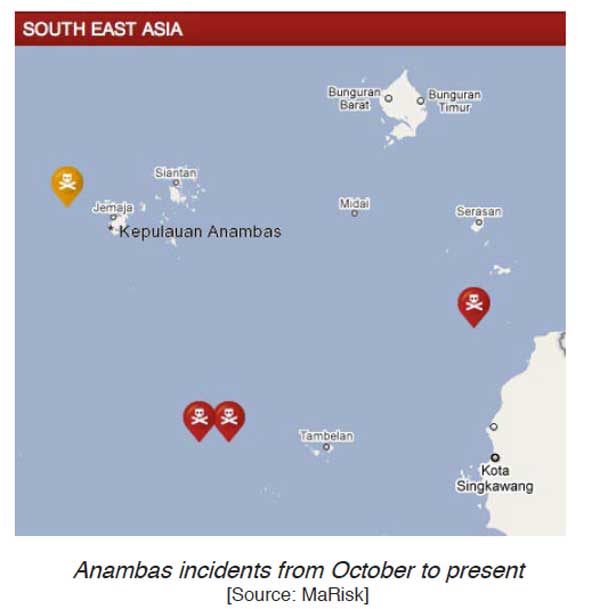
Incidents in this area were of two types: tug hijackings along the east coast of Peninsular Malaysia and piracy attacks within the shipping lanes to the northwest of the Anambas Archipelago.

Source: MaRisk

There were three notable cases of tug hijackings; all were recovered, however, due to a swift response by maritime enforce­ment agencies as well as information sharing through ReCAAP channels. Since the last incident involving the tug ATLANTIC 3 on 27 April 2010, there have been no new reported cases. Additional incidents involving suspicious activity continued to occur throughout 2010, which were connected to illegal bunkering operations such as the case with the BINA MARINE 51 on 11 June 2010.


Illegal bunkering, although more common in the eastern Singapore Strait, has increased sharply since 2008, correlating with the global economic slowdown. In addition to medium sized vessels bunkering illegally in the Singapore Strait, tugs are suspected to be playing an increasing role in illegal bunkering in the southern South China Sea.

Robberies of vessels in transit increased in the second quarter of 2010 off the Anambas Islands. The unique cluster piracy was increasingly fine-tuned where the syndicate targeted up to six vessels within a seven-day period. As of June 2010, incidents began occurring further to the east in the Natuna Archipelago and to the south off the Kalimantan coast including Serasan Island as well as the Tembelan Archipelago.

As the robbers increasingly targeted vessels to the south closer to Kalimantan, they decreased their focus off the Anambas Archipelago and minimized their attacks to two-three per cluster. They also increasingly moved back to Indonesia’s territorial waters after the first robbery knowing very well that foreign anti-piracy patrols would be active after the first incident within a cluster pattern.

Throughout 2010, the robbers enhanced their modus operandi in boarding tactics off the Anambas Archipelago by minimizing the time spent on the target vessels and focusing specifically on the Master’s safe. The most recent incidents that occurred off the Tembalan Archipelago showcased robbers boarding the vessel by night and holding an able body seaman captive and taking him to the Master’s cabin without even interfering with the navigation of the vessel or letting their presence be known on the bridge. Since August 2010, incidents off the Anambas Islands tapered off and moved closer towards the Kalimantan coast and by the end of 2011, short of two clusters off the Tembalan Islands, activity appears to have ceased in this area for the time being.

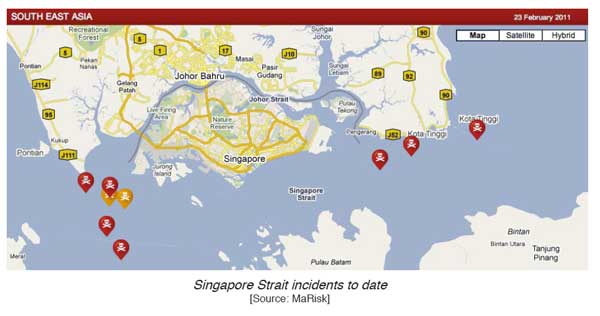
Singapore Strait

Armed sea robbery in the Singapore Strait was mostly focusing on ships at anchor in the eastern strait off Johor. A smaller and more simplistic syndicate was responsible for the bulk of boardings at anchor. They were suspected to have been operating as a tank cleaning crew in the daytime. At night, they return to specific softer targets of opportunity and rob them of small effects including crew valuables or ship’s stores before retreating back to Batam Island.

Source: MaRiskThese incidents showed low levels of violence and sophistication. In the fourth quarter of 2010, however, they were complimented by a new syndicate displaying far more sophistication and tenacity. The new syndicate, based on Belakang Pedang, began targeting low freeboard vessels in transit (such as tugs) as well as occasional vessels at anchor of Tanjung Piu in the western Singapore Strait.

Of concern was this new syndicate’s modus operandi in holding crewmembers captive as well as arriving on scene better armed and possession of at least one handgun. In one incident in November 2010, the robbers even discharged their weapon during a boarding. Overall, the boardings have been carried out swiftly and increasingly resemble the tactics of the syndicate responsible for piracy attacks in the southern South China Sea.

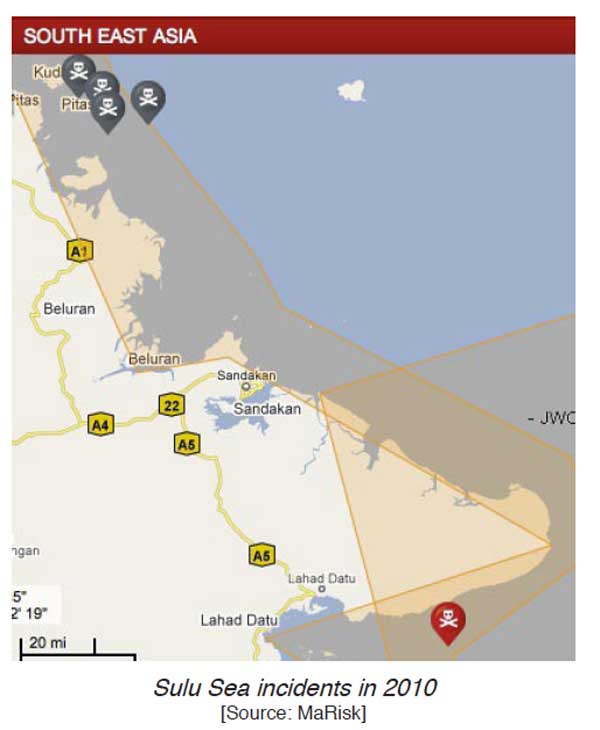
Sulu Sea

Source: MaRiskAlthough incidents are still heavily under-reported, notable incidents did occur within the region in 2010, namely off the Sabah coast. In addition to well-armed piracy incidents, there were four reported hijackings against fishing trawlers. A specific syndicate based in the Philippines that is launching into Malaysian waters and targeting both tugs and fishing trawlers carried these out.

Factors affecting piracy incidents

Jurisdictional issues

The primary factor at play in South East Asia is the continued abuse of jurisdictional boundaries, whether in the Anambas Islands, the Singapore Strait, or off the Sabah coast in the Sulu Sea. The ability for suspects to venture back into their territorial waters after raiding vessels in another nation’s or international waters will continue to be the primary obstacle for law enforcement agencies that are taking maritime security seriously.

In both the Singapore Strait and Sulu Sea, the Malaysian Maritime Enforcement Agency (MMEA) is combating armed sea robbery incidents. However, in their respective areas, the Indonesian and Philippine syndicates quickly return to their home waters to avoid pursuit from the MMEA.

In light of the Singapore Strait syndicate being based on Belakang Pedang the group can return to their home island, which sits a comfortable 21 nautical miles from the western anchorages off Tanjung Piu and 25 nautical miles form the eastern anchorages.

Furthermore, the maritime border sits less than six nautical miles from each of the anchorages and primary target locations. Vessels that are boarded in transit such as tugs are practically running the boundary line, which makes an escape back to Indonesian waters relatively easy.

Continued global economic slowdown

The global shipping crisis has also been credited in playing a role in piracy and armed sea robbery incidents in the region, namely in the eastern Singapore Strait. Vessels at anchor over extended periods of time off the Johor coast are targets of opportunity by both robbers who work as tank cleaners and legitimate bunkerers in the day or by more advanced syndicates – both based in the Indonesian Riau Islands.

In nearly all cases, the vessels are robbed of ship’s stores and occasionally of crew effects that are easily accessible, although robbers never attempt to target the Master’s safe, which typically would not possess a large sum to begin with due to the ship’s inactivity and anchorage. Wider criminal networks

Wider criminal networks, such as the Orang Butong Group that has an extensive reach spanning from the southern Philippines to Sulawesi to the Riau Islands, play a key role in smuggling activities as well as limited piracy operations in the region. Smaller networks, often associated with larger syndicates, including the Orang Butong, remain active in the southern Philippines, the Riau Islands, and off the Kalimantan coast.

Larger criminal networks are evident in the hijacking cases where pre-arranged buyers were secured prior to the hijacking, internal information concerning the tug’s movements was leaked, and a financier fronted the operation.

Law enforcement

Law enforcement agencies continue to increase their capacity in combating maritime crimes in South East Asia, but are also challenged by the jurisdictional abuse of syndicates operating in foreign waters.

As indicated earlier, maritime agencies such as the Singapore marine police/coast guard and the MMEA struggle in interdicting suspects as they flee into Indonesian and Philippines waters respectively.

Law enforcement agencies also differ in priorities: while the MMEA has focused on piracy and armed sea robbery and human smuggling, Singapore remains concerned about contraband smuggling and armed sea robbery incidents. Although piracy and armed sea robbery correlates between the two, Indonesia, for example, has put illegal fishing and timber smuggling at the forefront of its interests.

Overall, however, law enforcement capacity building and coordination continues to improve maritime security within the region’s waterways. This is particularly the case with Malaysia, Singapore, Thailand, and increasingly Vietnam. Indonesia and the Philippines continue to face obstacles ranging from internal bureaucracy, identity, and, unfortunately, corruption. However, it is possible to ascertain that both nations’ capabilities are improving, but simply not fast enough.

Information sharing

Information sharing has become a key asset to the region, which is partially due to the increased presence of ReCAAP. The organization played a key role in dis­seminating and sharing information during the hijackings of the tugs ASTA, PU2007, and the ATLANTIC 3.

Although not all littoral states are members of ReCAAP, the organization has healthy relationships with the non-members when it comes to sharing intelligence and information. Although ReCAAP cannot be directly credited for the recovery of all three tugs, in the cases of the ASTA and ATLANTIC 3, their role in information ex- change was crucial in assisting law enforcement agencies both during the hijacking phase as well as during the post-investigation phase.

Complementing organizational and governmental information sharing is the increased reporting by Masters and ship owners themselves. Incidents were grossly underreported in previous years. Attacks and increasingly failed attacks continue to filter in, however, which helps build better statistical databases and profile the modus operandi of specific syndicates….

The Littoral Combat Ship and Irregular Warfare

09/14/2011

09/14/2011 – Captain Robinson Harris US Navy (Retired), now with Lockheed Martin Mission Systems and Sensors (MS2), provides an assessment of how the new Littoral Combat Ship (LCS) might be used in an irregular warfare scenario. The case described was that of a notional crisis in Nigeria with the need to assist the fragile Nigerian government in protection of its oil infrastructure.

Capt. Harris: The Gulf of Guinea lies at the intersection of the Equator and the Prime Meridian at 00.00 latitude, 000.00 longitude. Looking at the strategic components, the United States gets more oil from Africa, mainly from the Gulf of Guinea than we do from the Persian Gulf, and more from Nigeria than from Saudi Arabia.  From Accra, Ghana to Malabo, Equatorial Guinea is 550 nautical miles.

The Gulf of Guinea area is not as large as the piracy threat area off the coasts of Somalia.  The piracy threat area off the coast of Somalia is the equivalent of the distance between the US border of Maine and Canada stretching all the way down to Key West.

Our scenario is drawn in part on a Center for Strategic and Budgetary Assessments (CSBA) study, which looked at various naval scenarios including the Gulf of Guinea area.

The CSBA study divided the Gulf of Guinea into two sections: Task Force West and Task Force East.  We chose the Task Force East because this is where most of the oil infrastructure is located.   The Task Force East area in our Gulf of Guinea scenario is about 73,000 square nautical miles (roughly 340 x 210 nm dimensions), which includes roughly 43,000 square nautical miles at sea.

Indigenous insurgent movements and coastal piracy are widespread in the area, including the close coastal/littoral area.  It is significant that our shallow draft LCS can operate within a five-meter curve of the shore, and the five-meter curve is very close ashore in the Gulf of Guinea area. The proximity to the coast is an advantage in our imagined scenario.

SLD: And obviously offshore oil drilling is a growing industry and with it the need to provide for security.  Your Gulf of Guinea supposed scenario then highlights the nature of security challenges as well to this industry.

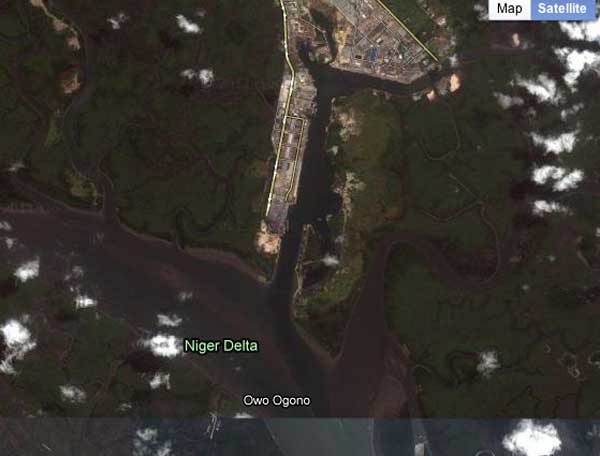
Port of Onne (Credit: http://www.worldportsource.com/ports/maps/NGA_Port_of_Onne_1732.php)

Port of Onne (Credit: http://www.worldportsource.com/ports/maps/NGA_Port_of_Onne_1732.php)

Capt. Harris: For example, a typical pier within the Port of Onne is able to accommodate eight to 10 ships. And every day there are work crews that transit from those piers back and forth to the off shore oil terminals.  That represents a 150-mile track which these workboats travel several times every day.

SLD: Similar to our own Gulf situation off of New Orleans.

(See the interview with Admiral Landry of the 8th USCG District)

Capt. Harris: To say the least, the work crew boats are vulnerable to piracy, which is rampant in the Gulf of Guinea.  Recently, pirates in the Gulf of Guinea seized two Panamanian-registered ships, staging the second attack there in a week.  Additionally, pirates attacked an Italian tanker carrying a cargo of diesel fuel off Benin, making off with some goods but leaving the crew unharmed. Just before that, pirates released a Greek-owned, Liberia-flagged tanker they had seized, also off the coast of Benin.  Indeed, if you correlate the offshore oil infrastructure with the occurrence of piracy events you see a significant threat. In addition to the threat of piracy, there are various real or projected inland threats, including Al Qaeda-type elements.

To deal with the threats to their oil infrastructure in this hypothetical situation, the Nigerian government might ask for U.S. assistance.

In this imagined case, the irregular warfare mission might then consist of the following missions:

  • Advising police military units to improve quality
  • Protecting offshore oil/gas infrastructure and critical onshore facilities
  • Engaging in coastal and riverine patrols to provide security in the Delta region
  • Conducting counter terrorism and counter-sanctuary operations against al Qaeda-type element in the North.

Protecting Nigeria’s offshore oil and gas infrastructure, in addition to critical onshore facilities, would be a key part of that mission.  It would be important to establish wide area surveillance to detect and classify all Critical Contacts of Interest (CCOI) and be able to interdict and board CCOI’s as directed.

SLD: In this potential scenario, the LCS, in effect, functions as your engagement and C2 platform to help identify and prosecute threats to the offshore oil infrastructure as well to provide a partnership element with the Nigerians in this scenario.  And it is enabled by various ISR assets which you might have available as well in the region.

Capt. Harris: That’s right.  For this hypothetical scenario, we developed a set of notional assets, which Lockheed Martin might bring to bear to work with the LCS.  Obviously, there are other potential assets from other companies or countries which could come into play, but we know the capabilities of the Lockheed Martin systems and how they would perform.  We placed a lot of emphasis on the role of C2 and ISR.  I must point out that this scenario is an excellent example of the value of LCS’s speed which, with its 45 kt capability, would be able to respond quickly to ISR-identified threats.

In this type of scenario we would suggest four tethered aerostat systems similar to the Persistent Threat Detection Systems (PTDS) the U.S. Army has fielded in Iraq and Afghanistan.    The tethered aerostats would operate up to 5,000 feet above ground level and would provide broad area coverage with a variety of sensors.  The data comes down through the tether or via other media to a small command center.

SLD: These are tethered balloons?

Capt. Harris: Yes.  In our imagined irregular warfare setting, we could provide four PTDS units, three of which would be tethered to unused offshore oil rigs in the Gulf of Guinea, and one which would be positioned ashore in the port of Onne. These systems provide fantastic ISR capability.

SLD: Long endurance ISR.

Capt. Harris: Long endurance ISR, relative to the cost of a UAV, is more cost effective.  It is truly an effective and affordable persistent ISR.  An additional capability could be the high altitude airship, which is in development. Lockheed Martin and the U.S. Army Space and Missile Defense Command (SMDC) had a successful launch of the HALE-D system from Akron, Ohio, in July 2011. The flight test, which ended before the HALE-D could reach the desired altitude, still demonstrated several key technologies, including a closed loop power system (battery, solar array electricity generation), remote piloting communications and control capability, in-flight operations, and vehicle descent and recovery. The lessons learned from the demonstration will pave the way for much larger, operational high altitude airships that will be recoverable, reusable and outfitted for different missions, making it one of the most cost-effective technologies available to the military.

A third ISR capability to consider in this type of scenario would be maritime patrol aircraft.  Currently, P3 aircraft are operating out of Equatorial Guinea.

Other assets one might bring to bear in supporting the irregular warfare operation are Lockheed Martin Coastal and Boarder Surveillance Systems, which we currently have installed in Cameroon. For this hypothetical scenario, we suggest the installation to include Chemical Biological Radiological and Nuclear Detection Systems, training teams, 46 in-shore boat units and three LCS’s with embarked mission packages; for example: H-60s, remote mine countermeasures and Fire Scouts.

SLD: The LCS functions as the tip of the spear or the presence or engagement asset, which visibly executes the mission.  The ISR assets are in support of such an effort.

Capt. Harris: Correct. The LCS would become the C2 focus platform as well as the launch platform for H-60s, Firescouts, etc.  The maritime patrol aircrafts, working with the High Altitude Airship and the PTDS would be able to provide widespread overlapping ISR coverage.

With regard to the PTDS, as I pointed out earlier, one would be deployed ashore, and the other three would be mounted on unused offshore oil platforms.

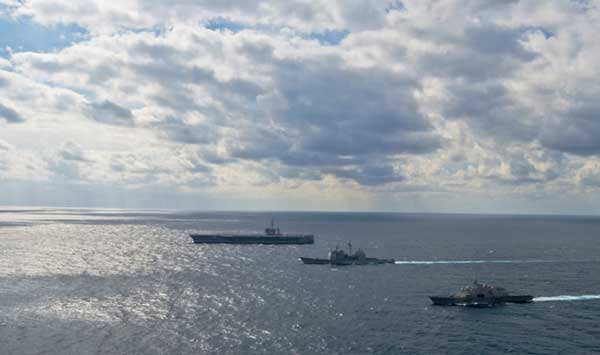
The littoral combat ship USS Freedom, the guided-missile cruiser USS Bunker Hill and the Nimitz-Class aircraft carrier USS Carl Vinson steam alongside each other in formation. (Credit: USN Visual Service 02/04/2010)The littoral combat ship USS Freedom, the guided-missile cruiser USS Bunker Hill and the Nimitz-Class aircraft carrier USS Carl Vinson steam alongside each other in formation. (Credit: USN Visual Service 02/04/2010)

Also, the LCS can be linked to other maritime assets to execute the mission as required leveraging this ISR information.  For example, one could imagine the use of a DDG to launch Tomahawks against certain insurgent elements ashore. So such a capability would complement the LCS as needed.

And the LCS can be linked as well to the USN-USMC amphibious team. In this imagined scenario we deploy three LCS’ and one LSD.

LCS provides the speed and presence.  Given the 45 knot speed capability of an LCS, the LCS can provide impressive coverage within the operational area to contribute to the mission of protecting the offshore oil infrastructure.

With an H-60 aboard each of the LCS, you would get additional reach and range from the LCS operational area.  And if you overlay on that maritime patrol aircraft, or P3 coverage, you would extend as well the reach of the LCS in the operational area.

Capt. Harris pointed out that his study concluded that the postulated platforms and sensors in the hypothetical scenario provide  a large, continuous volume of rich data and  information from three LCSs, off-board vehicles (P-3, 3-6 H-60, 9+ UAVs, 3+ USV), and off-board sensors to include more than three PTDS.  However, currently the On-Scene Commander would not be able fully to leverage all the benefits of Sea Frame/Mission Packages/Off-Board Sensors due to limitations in the ability to fuse sensor data.  Harris added that his team is developing an affordable off-the-shelf C2/ISR solution for such a Maritime Irregular Warfare scenario that would enable fusing sensor data.

The Amphibious Ready Group (ARG) and Libya: Shrinking “The Average Commute”

09/13/2011
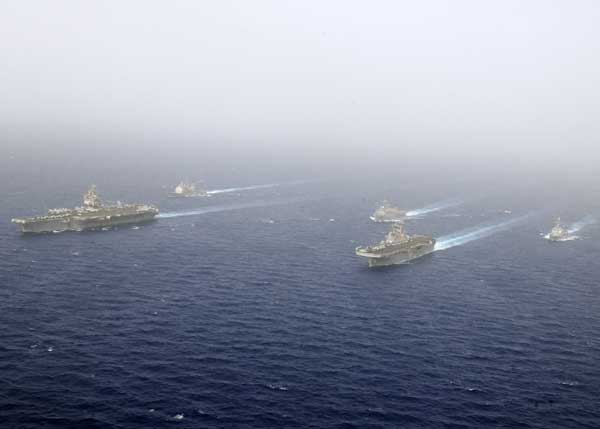
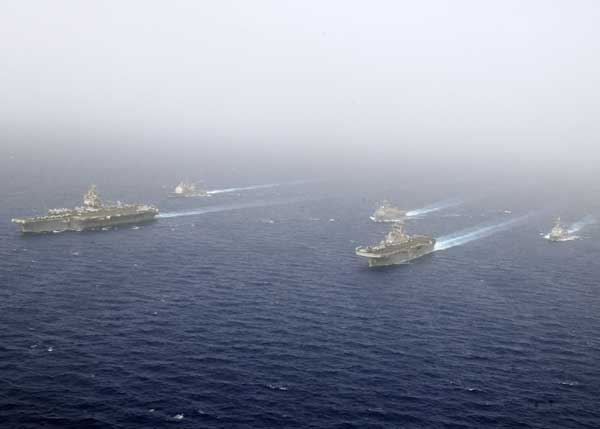
Ships of the Kearsarge Amphibious Ready Group and the Enterprise Carrier Strike Group steam in close formation for a scheduled photographic exercise known as a PHOTOEX. (Credit: USN Visual Service 2/16/2011)

An Interview With Colonel Mark Desens, Commander of the 26th MEU

09/05/2011 – In July 2011, Second Line of Defense sat down with Colonel Mark Desens to discuss the recent deployment of the 26th Marine Expeditionary Unit.  Earlier we had discussed, with Col. “Ozzie” Osborn, the 15th MEU, the evolution of the ARG as a very flexible combat structure and set of assets.

Colonel Desens led the 26th MEU through two deployments:

  • the first in Sept. 2008 – April 2009
  • and most recently Aug. 2010 – May 2011.

His deployments included exercises throughout the Central and Africa Commands, and operations in Pakistan, Afghanistan, and Libya. Indeed, one might refer to the Agile Response Group rather than to the Amphibious Ready Group.  We crafted a slideshow, which shows the flexibility of the ARG during a deployment.  The 26th MEU is shown during its multi-month deployment, which included Operation Odyssey Dawn. We noted at the time that  “it is clear that the range of operations capable of being executed concurrently is not widely grasped in the strategic community.”

In this interview, Colonel Desens shares his thinking about the challenges of aggregating and disaggregating an ARG/MEU during a deployment, while providing us with some insight with regard to the Libyan operations as well.


Ships of the Kearsarge Amphibious Ready Group and the Enterprise Carrier Strike Group steam in close formation for a scheduled photographic exercise known as a PHOTOEX. (Credit: USN Visual Service 2/16/2011)Ships of the Kearsarge Amphibious Ready Group and the Enterprise Carrier Strike Group steam in close formation
 for a scheduled photographic exercise known as a PHOTOEX. (Credit: USN Visual Service 2/16/2011)

SLD: Could you discuss the challenges of aggregating and disaggregating an ARG/MEU during a deployment?

Colonel Desens: We need to aggregate for combat.  We better be good at that because it could cost you lives otherwise. We also aggregate for missions that require the whole MAGTF, (Marine Air-Ground Task Force) such as a major humanitarian aid mission. The centerpiece of doing this effectively is robust Command and Control.  We are finally catching up a bit with the Carrier Strike Groups in regards to C2 ,but have a ways to go, especially when we consider future employment scenarios.   Our newer amphibious ships, like the LPD-17 (Landing Platform Dock), offer greater potential, given the proper theater-level support.  If we are to view and employ our future LHA-6 class of  Amphibious Assault ships, with the F-35B, as “Lightning Carriers,” then we must ensure that our LHAs have the commensurate combat and information systems to play in that arena. In my recent deployment, the fact that we had battle hardened Marines with significant experience on the land, provided a solid basis for both MEU/Battalion-level operations, as well as independent tasks.  I believe there will be a premium on our ability to train to and employ these capabilities in the future.

SLD: On the recent deployment, could you give us a sense of covered by your disaggregated ops?

Colonel Desens: In the middle of November 2010, we were spread over 3,000 miles ranging from Kenya, to Jordan, to Djibouti to Pakistan.  We concurrently supported three Combatant Commanders.  This is not unique to our deployment.

26th meu post deployment brief


View more presentations from robbinlaird


SLD: When you’re operating over such a large area, the challenge is to put the resources up against the priority missions?

Colonel Desens: Right. Every day you’re looking at a mission.  Do I have the capabilities matched up correctly?  Tomorrow, by the way, that mission stands down, and a new one stands up over here.  Are you postured correctly for it?  Do you have the C2, mobility, and logistical support?  Force Protection? How am I migrating command and control, to include satellite coverage?  How am I using my aircraft?  What are the Combatant and Component Commanders providing? What’s theater and organic lift doing for me?  The MV-22, by the way, has become a game changer in this discussion.  Moreover, our organic KC-130s are ubiquitous and a key enabler to everything we do.

Then there is the people piece.  We need small teams that we can task organize and put into unfamiliar environments and know they will succeed.  We’re talking about small, maybe five man teams, with a sergeant in charge. So does that sergeant understand what I want him to do if I can’t talk with him through the C2 system?  In order to conduct truly disaggregated operations, you have to use a lot of commander’s intent and have built trust and confidence into your Marines and sailors.

In order to conduct truly disaggregated operations, you have to use a lot of commander’s intent and have built trust and confidence into your Marines and sailors.


Aviation Support Equipment Technician 3rd Class Jack Strickland, left, and Aviation Ordnanceman Airman Josh Goodrich stand roving security watch on the flight deck as amphibious assault ship USS Kearsarge (LHD 3) approaches Ash Shuaybah, Kuwait.  (Credit: USN Visual Service)
Aviation Support Equipment Technician 3rd Class Jack Strickland, left, and Aviation Ordnanceman Airman Josh Goodrich stand roving security watch on the flight deck as amphibious assault ship USS Kearsarge (LHD 3) approaches Ash Shuaybah, Kuwait. (Credit: USN Visual Service)


Should I have the ability to pick up my smart phone, and talk to anybody in the 2,400 people in the MEU anywhere, any time?  Technically a good idea, but from a command and control point of view, completely unpractical.  There’s a term used these days called “Mission Command.”  The Marine Corps has lived this for a long time.  I believe that was a key to our recent success.

SLD: So walk us through the situation as you approached the Libyan operation?

Colonel Desens: In the January time frame, we put almost 1,400 people into Afghanistan. Lebanon kind of simmers with the Special Tribunal and gets on our radar screen.  Then Tunisia goes upside down.  We’re between the Gulf of Aden and other missions at this time.  We’re reconstituting our TRAP (Tactical Recovery of Aircraft and Personnel) capability.  We’re reconstituting our NEO (Noncombatant Evacuation Operations) capability.  Both were lost or degraded when we split the MEU for Afghanistan.


We’re reconstituting our TRAP (Tactical Recovery of Aircraft and Personnel) capability.  We’re reconstituting our NEO (Noncombatant Evacuation Operations) capability.  Both were lost or degraded when we split the MEU for Afghanistan.

At the end of February, the USS Kearsarge (LHD3), USS Ponce (LPD15) are together.  The USS Enterprise (a large deck aircraft carrier) has come through the Med, and through the Suez Canal.  So all three ships are now at the northern end of the Red Sea. February is when Libya starts warming up. As we do our mission analysis, job one is to protect American citizens. So, the first thing on our mind is NEO. Folks are talking about potential humanitarian assistance operations, not so much in Libya itself, but crossing the border into Egypt and Tunisia.

As we looked towards what would become Operation Odyssey Dawn, it was clear the maritime forces would be significant players. On the second of March, Kearsarge and Ponce go through the Suez. Marines with 1st Battalion, 2nd Marine Regiment, augmented 26th Marine Expeditionary Unit, and boarded the USS Kearsarge at Souda Bay, Greece on March 4th.  By the 7th of March, we were off Benghazi ready to go to do our missions.

The logistics of the situation made it clear that the maritime operational bases were clearly critical to the operations.  The nearest non-naval attack aircraft are coming out of Aviano, Italy. That’s about 1,000 miles north of Benghazi.  For a fixed wing guy, that’s at least one tank (aerial refueling) just to get to work, one tank to get back, and probably a tank in between.  Whereas, with a big deck amphib in the Gulf of Sidra, the average commute was 100 miles.

The logistics of the situation made it clear that the maritime operational bases were clearly critical to the operations.  The nearest non-naval attack aircraft are coming out of Aviano, Italy. That’s about 1,000 miles north of Benghazi.  For a fixed wing guy, that’s at least one tank (aerial refueling) just to get to work, one tank to get back, and probably a tank in between.  Whereas, with a big deck amphib in the Gulf of Sidra, the average commute was 100 miles.


Sailors assigned to the deck department aboard the amphibious transport dock ship USS Ponce (LPD 15) prepare for a replenishment at sea with the fleet replenishment oiler USNS Kanawha (T-AO 196) and the Amphibious assault ship USS Kearsarge (LHD 3).  (Credit: USN Visual Service, 3/10/11)Sailors assigned to the deck department aboard the amphibious transport dock ship USS Ponce (LPD 15)
 prepare for a replenishment at sea with the  fleet replenishment oiler USNS Kanawha (T-AO 196)
 and the Amphibious  assault ship USS Kearsarge (LHD 3). 
Credit: USN Visual Service,  3/10/11

On the 18th of March, Gaddafi’s forces are shelling the outskirts of Benghazi and we’re a bit concerned about doing everything from the air.  If you’re doing everything from the air, you can do a lot until a guy is into an urban fight.  And then you become somewhat limited.

On the 19th, we get the first air strikes.  As the ATO [Air Tasking Order] shook out, the Marines ended up being the last ones to fly that night.  However, there’s a silver lining in every cloud.  The litening pod, integrated on the AV-8B Harrier II, is one of the best things ever invented.

The beauty of us coming in towards the end of the night is we were able to go do a complete run with a litening pod up and down the roads south of Benghazi, record everything in that battlespace, and do all the processing in quick order aboard the Kearsarge.   We shared everything we had with the JFACC (Joint Forces Air Component Commander) who didn’t have UAVs available until a few weeks later.  We were able to do a complete analysis from the systems on the Harriers, turn it back around, and start getting ready for the next day.

Cpl. Sean Moberly with Marine Medium Tiltrotor Squadron (VMM) 266, 26th Marine Expeditionary Unit, runs preflight checks on an AV-8B Harrier on the flight deck of amphibious assault ship USS Kearsarge in preparation of Operation Odyssey Dawn missions. (Credit: USN Visual Service)


This is where you start to see the advantages we had by being close to the target area, If I’m coming from Aviano, my data’s at least two and a half hours old. Things may well have moved.  So now I have to reacquire to do the things I need to do.  On the other hand, if you are only 100 miles away, the intelligence update you walked to the aircraft with is only fifteen minutes old as you enter the target area – and your target is right there waiting for you.  We enjoyed a very high target to sortie rate because of tactical intelligence advantage.

The litening pod, integrated on the AV-8B Harrier II, is one of the best things ever invented. The beauty of us coming in towards the end of the night is we were able to go do a complete run with a litening pod up and down the roads south of Benghazi, record everything in that battlespace, and do all the processing in quick order aboard the Kearsarge. (…) if you are only 100 miles away, the intelligence update you walked to the aircraft with is only fifteen minutes old as you enter the target area – and your target is right there waiting for you.  We enjoyed a very high target to sortie rate because of tactical intelligence advantage.


SLD: The Ospreys played a key logistical role for your operation as well?

Colonel Desens: Osprey was a game changer.  On a couple of occasions, MV-22s flew 500 miles legs to get critical parts to keep the ACE flying.  Without the MV-22, the ship would have had to leave station and risk the execution of the mission. From a seabased platform, you really see the impact of the V-22. It’s fine in Afghanistan, but it really shines in the shipboard environment and the speed and range it offers a maritime force.

SLD: Could you speak to the TRAP operation?

Colonel Desens: When we learned that a F-15 crew had ejected east of Benghazi, we immediately focused our efforts on getting ready to rescue them.

The mission was given to us for two reasons: one, first and foremost, was the uncertain environment. We didn’t know what’was going on on the ground with the pilot. The second is we were the most ready and had the most responsive assets, most notably, the MV-22.  Backed up by CH-53s and Harriers, we had very potent reaction force in case we needed to fight to get the crew out or reinforce the recovery or crash site. As an aside, a recovery asset launching from land base — the next closest locations being Sigonella or Souda Bay — would have been four or more hours.

There were USAF HH-60G rescue helicopters embarked on the Ponce to give a CSAR capability with improved reaction times.  However, you’re comparing 270 knots versus 140. It would have taken at least 45 minutes longer for a helicopter to get there. U.S. forces may well have not been the first to reach that pilot without the MV-22.  Given the situation, that was not acceptable. The other thing is that for a helo, a direct flight path (to save time) to the pilot would have gone through Benghazi, a potential threat area at the time.  The Osprey could chart a very different path, avoiding any potential air defense threats.

Again the speed and range of the Osprey coupled with the ability to have Marines on the ground to secure the perimeter and Harriers providing air cover meant that the TRAP team could get the job done much more rapidly and safely.

As an aside, a recovery asset launching from land base — the next closest locations being Sigonella or Souda Bay — would have been four or more hours. There were USAF HH-60G rescue helicopters embarked on the Ponce to give a CSAR capability with improved reaction times.  However, you’re comparing 270 knots versus 140. It would have taken at least 45 minutes longer for a helicopter to get there. U.S. forces may well have not been the first to reach that pilot without the MV-22.  Given the situation, that was not acceptable. The other thing is that for a helo, a direct flight path (to save time) to the pilot would have gone through Benghazi, a potential threat area at the time.  The Osprey could chart a very different path, avoiding any potential air defense threats. Again the speed and range of the Osprey coupled with the ability to have Marines on the ground to secure the perimeter and Harriers providing air cover meant that the TRAP team could get the job done much more rapidly and safely.

SLD: We heard that the Kearsarge had some problems during the operation?

Colonel Desens: The Kearsarge had a significant engineering casualty late in Odyssey Dawn. It broke in such a way that they were afraid that if they went too fast, it could cause further damage or endanger personnel.  The ship had to lock the shaft in place and the speed of the ship was limited four to six knots.   This essentially halted AV-8B operations. The Osprey was key to getting the ship into a repair port quickly by bringing engineering experts to the ship from 400 miles away on short notice.  This enabled the ship to resume greater speed to get into port for repairs while Marine air and ground forces repositioned ashore to provide uninterrupted support to Strike and TRAP missions.

The Kearsarge had a significant engineering casualty late in Odyssey Dawn, [… which] essentially halted AV-8B operations. The Osprey was key to getting the ship into a repair port quickly by bringing engineering experts to the ship from 400 miles away on short notice.  This enabled the ship to resume greater speed to get into port for repairs while Marine air and ground forces repositioned ashore to provide uninterrupted support to Strike and TRAP missions.

SLD: What is your overall conclusion about the lessons learned for the deployment?

Colonel Desens: The lesson is the tremendous capability, flexibility and agility that a naval Marine Air-Ground Task Force can offer.  It is unique in our Nation’s inventory.

Sea Knight USMC Ops

09/13/2011: Sea Knight USMC Ops

[slidepress gallery=’sea-knight-usmc-ops’]

Credit: USN Visual Service: 7/17/2011 (1st Photo); 7/9/11 (remaining photos).

  • In the first photo, CH-46 Sea Knight helicopters assigned to the Evil Eyes of Marine Medium Helicopter Squadron 163 refuel on the flight deck aboard the amphibious assault ship USS Boxer during night flight operations. Boxer and the 13th Marine Expeditionary Unit are underway supporting maritime security operations and theater security cooperation efforts in the U.S. 5th Fleet area of responsibility.
  • In the second photo, A CH-46 Sea Knight helicopter assigned to the Evil Eyes of Marine Medium Helicopter Squadron 163 transfers supplies from the Military Sealift Command fleet replenishment oiler USNS Leroy Grumman, left, to the amphibious dock landing ship USS Comstock during a replenishment at sea. Comstock and the embarked 13th Marine Expeditionary Unit are underway supporting maritime security operations and theater security cooperation efforts in the U.S. 5th Fleet area of responsibility.
  • In the third and fourth photos, CH-46 Sea Knight helicopters assigned to the Evil Eyes of Marine Medium Helicopter Squadron 163 approach the Military Sealift Command fleet replenishment oiler USNS Leroy Grumman, left, to transfer supplies to the amphibious dock landing ship USS Comstock during a replenishment at sea.