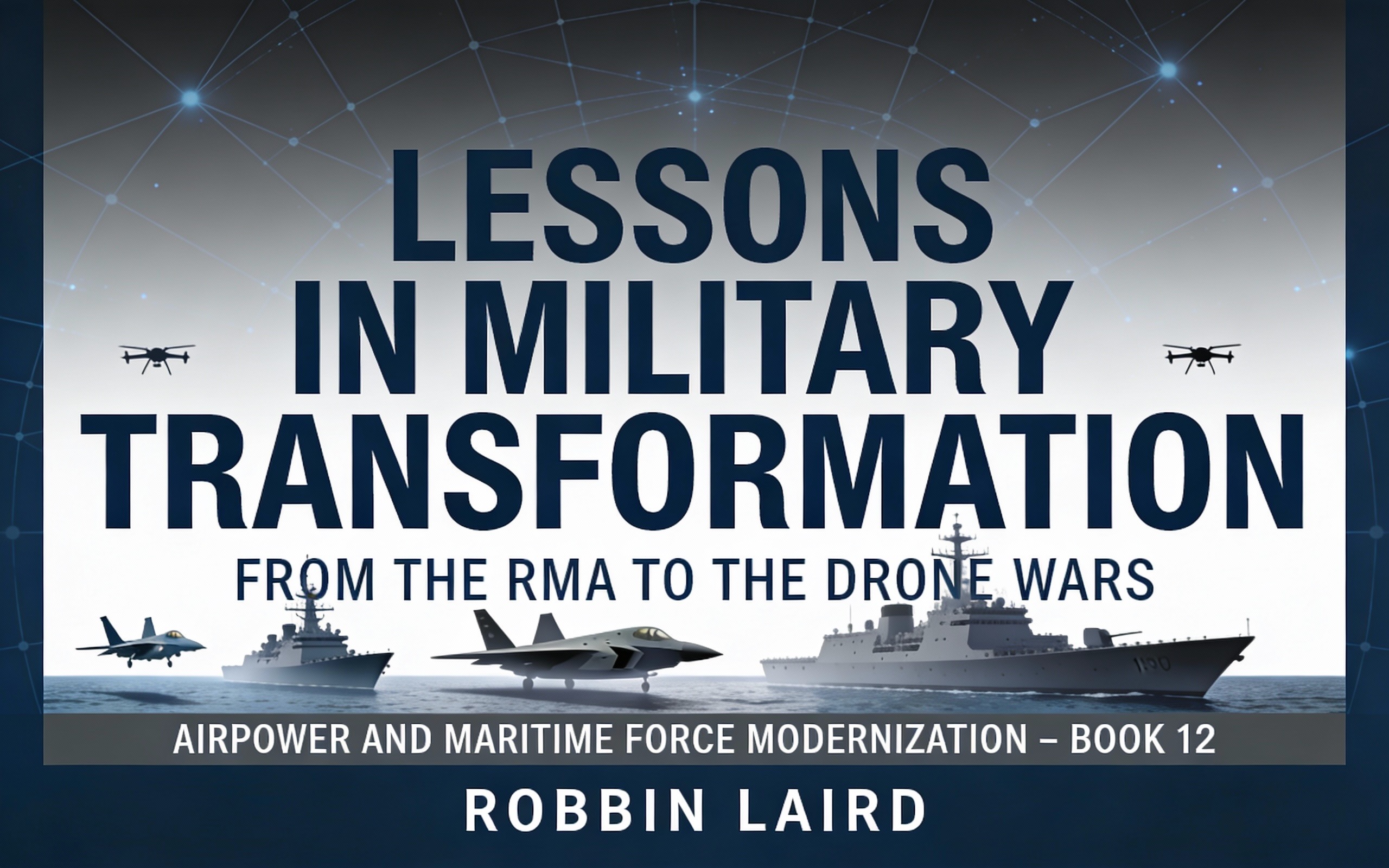
Lessons in Military Transformation: From the RMA to the Drone Wars examines military transformation as it is actually experienced by operating forces rather than as it is conceived in doctrine or policy, tracing how air and maritime power have evolved from the Revolution in Military Affairs (RMA) frameworks of the 1990s to the contemporary world of drones, hypersonics, and distributed kill webs. It argues that what is often labeled as “revolution” is better understood as an unfinished, iterative process in which concepts, technologies, and organizations co‑evolve under constant pressure from adversaries, budgets, and operational friction.
The analytical vantage point is firmly grounded in practice. Instead of relying on archival research or purely theoretical constructs, the book draws on decades of field work: interviews with pilots flying networked aircraft, maintainers keeping advanced platforms running in austere conditions, and commanders experimenting with new ways to organize and fight. This practitioner‑centric method treats front‑line operators as “lead users” in a complex adaptive system, on the logic that meaningful transformation emerges from their experimentation at the edge rather than from top‑down design in national capitals.
Structurally, the volume is organized conceptually. An introduction and multiple forewords establish the intellectual frame and highlight the central themes: skepticism toward briefed revolutions, emphasis on field experience, and insistence on adversary adaptation and measure‑countermeasure dynamics. Subsequent parts cover: re‑assessment of the original RMA (and associated leadership issues); case studies of airpower transformation in practice; platforms as catalysts of wider change; training and joint force development; institutional friction; the “unfinished revolution” represented by drone and hypersonic warfare; and concluding chapters on managing ongoing transformation and exercising strategic judgment.
In revisiting the RMA and its successors—network‑centric warfare, effects‑based operations, and the pivot to Asia—the book highlights how each conceptual wave came with elegant briefings and confident timelines but collided with operational reality. Budget constraints, legacy organizations, doctrinal inertia, and adversaries who refused to behave as expected repeatedly limited the realization of grand designs. Yet the analysis avoids dismissing these concepts as failures; instead, it traces how durable elements such as precision targeting, sensor‑shooter networking, and shortened sensor‑to‑shooter timelines have been retained and extended into contemporary kill web and drone‑enabled operations.
A central argument concerns the reconceptualization of platforms as network nodes. The F‑35 is treated less as a traditional “fifth‑generation fighter” and more as an information hub within a distributed kill web, whose primary value lies in sensor fusion, information sharing, and the ability to orchestrate effects across coalition forces. This shift demands new cognitive frameworks for pilots, who must move from individual platform‑centric engagements toward managing information flows and contributing to wider, multi‑platform engagements. The MV‑22 Osprey offers another example: emerging from a contentious development history, it becomes a key enabler of expeditionary operations once its range and speed are exploited for distributed operations across wide theaters and for integration into complex air packages that blur traditional categories of assault support and tactical aviation.
Across these and other case studies—including digital light attack units, A330 MRTT and A400M fleets, and the global Aegis enterprise—the book underscores that platforms become transformative only when practitioners discover and institutionalize new ways of using them. Maintainers develop practices and workarounds to sustain complex aircraft under stress; pilots and aircrews devise tactics that exploit unanticipated strengths; and commanders re‑shape organizations and exercises to unlock these capabilities. Large‑scale exercises and training constructs, such as those used by Marine aviation and initiatives like Italy’s International Flight Training School, are presented as key laboratories where these new operating concepts are explored.
Institutional friction is a constant presence. The narrative repeatedly contrasts national‑level rhetoric about transformation with the realities of readiness, force generation, and coalition integration experienced by units. Programs like the U.S. Coast Guard’s Deepwater initiative are analyzed as cases where visionary ideas ran into structural and acquisition constraints, yet still produced partial transformation as units adapted available tools to new missions. The emergence of the Coast Guard as a “strategic competition” service, the modernization of the Australian Defence Force, and European modernization efforts all illustrate how different institutions navigate these frictions.
A key conceptual innovation is the contrast between “crisis management” and “chaos management.” Crisis management assumes a temporary disturbance and seeks to restore a prior equilibrium; this mentality aligns with much of the counterterrorism and counterinsurgency era. Chaos management, by contrast, assumes continuous turbulence—driven by technological acceleration, peer competition, and cross‑domain contestation—and expects no return to a stable baseline. The shift of units like Second Marine Aircraft Wing from permissive, base‑centric close air support to operating under anti‑access/area‑denial threats and the tyranny of distance in the Indo‑Pacific is used to illustrate what chaos management requires of platforms, organizations, and training.
The chapters on drone warfare and hypersonic weapons situate these systems within this broader “unfinished revolution.” Drones and autonomous systems democratize precision strike, allowing states and non‑state actors with modest resources to challenge legacy air and maritime power. Hypersonic weapons compress decision time and complicate deterrence, raising questions about escalation control, command and control, and defense investments. The book emphasizes that every new capability generates a counter‑capability: advantage is temporary and conditional, not permanent.
In its conclusion, the book argues that the central strategic task is not to achieve a final, stable “transformed” end state but to manage a sequence of overlapping revolutions under conditions of strategic competition. Strategic judgment is defined as the capacity to discern patterns in practitioner experience, technology, and adversary adaptation early enough to adjust institutions, training, and acquisition before crises force rushed adaptation. The work highlights the importance of preserving field‑grounded, practitioner‑driven innovation pathways and the kind of strategic imagination associated with figures like Andrew Marshall in order to navigate an era in which transformation is both continuous and contested.