

Military aviation stands at a decisive inflection point.
For the past two decades, air power development was largely defined by the demands of counterinsurgency and crisis management in the “land wars” of Iraq and Afghanistan.
This era has decisively ended, supplanted by a new strategic reality of peer competitors, proliferating multi-domain threats, and a global security environment best described as “chaos management.”
This shift from predictable flashpoints to simultaneous, overlapping crises has compressed decision timelines from days to seconds, rendering many long-held assumptions about air combat obsolete.
This new strategic environment has, in turn, rendered traditional, platform-centric pilot training dangerously inadequate.
The necessary evolution from linear, sequential “kill chains” to distributed, resilient “kill webs” has forced a fundamental paradigm shift in how combat aviators are developed.
The core of this shift is the prioritization of cognitive agility, networked decision-making, and information management over the pure “stick-and-rudder” proficiency that once defined pilot excellence.
The modern pilot is no longer just a skilled operator of a single platform but a strategic decision-maker or a “quarterback in the cockpit” who orchestrates effects across a complex, integrated battlespace.
What are the strategic drivers, cognitive requirements, and technological enablers of this transformation?
- The Strategic Imperative: From Crisis Management to Kill Web Operations
The profound changes occurring in combat pilot training are not arbitrary or internally driven; they are a direct and necessary response to a fundamentally more complex and dangerous global security landscape.
To understand the revolution in the cockpit, one must first appreciate the revolution in the strategic environment.
The shift away from a world of predictable crises to one of constant, overlapping chaos has created the imperative for a new warfighting architecture, forcing air forces to move beyond legacy concepts and embrace a more resilient, networked approach to combat.
Contrast: Crisis vs. Chaos Management
The core conceptual shift is the move from a “Crisis Management” to a “Chaos Management” paradigm.
This distinction fundamentally alters the assumptions upon which military forces plan, train, and operate.
| Crisis Management Paradigm | Chaos Management Paradigm |
| Predictability: Assumes identifiable flashpoints and linear escalation. | Unpredictability: Requires operating effectively when multiple, simultaneous crises emerge across different domains. |
| Command Structures: Relies on clear, established chains of command. | Decision-making: Demands decision-making at the speed of relevance, often with incomplete information. |
| Timelines: Operates on predictable timelines with well-rehearsed responses. | Adaptability: Necessitates forces that can rapidly reconfigure and shift mission sets without extensive retraining. |
| Threat Nature: Focuses on defined problem sets in a relatively stable operating environment. | Threat Environment: Involves ambiguous or contested rules of engagement and seamless collaboration across service and international boundaries. |
The Evolution from Kill Chain to Kill Web
This strategic evolution has rendered the traditional warfighting model—the kill chain—obsolete. The kill chain is a linear, sequential process: find, fix, track, target, engage, and assess. While logical, this step-by-step approach is too rigid and vulnerable against a capable peer adversary. Disrupting any single link in the chain can cause the entire operation to fail.
In response, modern air forces are moving toward a kill web architecture. A kill web is a distributed, resilient, and networked model where multiple pathways exist to achieve a desired effect. Its foundational principle is that “any sensor can inform any shooter” across the joint force. In practice, this means a naval destroyer’s radar could provide targeting data for an F-35’s weapon, or a satellite could cue a ground-based artillery strike, creating a resilient and unpredictable web of effects. This creates a more robust and adaptive system that is not dependent on any single platform or a rigid sequence of events.
Fifth-generation aircraft like the F-35 are the central enablers of this new architecture. They are not merely improved versions of legacy fighters; they are fundamentally different assets designed to operate within this new framework.
“Fifth-generation aircraft such as the F-35 are not simply “better fighters.” They are flying information systems: sensing, fusing, distributing, tasking, and coordinating effects across air, land, sea, space, and cyber. They sit inside the kill web, a distributed, resilient battlespace architecture where any sensor can inform any shooter, and where no single point of failure can collapse the entire strike sequence.”
— Lt. General (Retired) Pasquale Preziosa, Former Chief of Staff, Italian Air Force
Key Strategic Drivers for Change
The convergence of several strategic trends has accelerated this paradigm shift, creating a set of non-negotiable imperatives for change.
- The Rise of Peer Competitors: The end of the “land wars” marked a decisive pivot away from counterinsurgency operations toward preparing for contested, high-intensity conflict against near-peer adversaries. This new reality demands forces capable of operating and surviving in lethal, complex environments.
- The Proliferation of Anti-Access Capabilities: Peer competitors have invested heavily in sophisticated anti-access/area denial (A2/AD) systems designed to challenge traditional force projection. Operating effectively inside these contested zones requires the distributed and resilient capabilities inherent in the kill web model.
- The Demands of Multi-Domain Operations: Modern conflict is no longer confined to discrete air, land, or sea battles. Pilots must now be prepared to coordinate and integrate effects across all domains—air, land, sea, space, and cyber—often simultaneously.
These strategic imperatives have rendered the traditional pilot archetype obsolete, demanding a complete cognitive revolution in the human who will command these new systems.
- The Cognitive Revolution: Redefining the Modern Combat Aviator
The most profound revolution in modern air combat is not technological but cognitive. While fifth-generation aircraft represent a quantum leap in hardware, their true potential can only be unlocked by a new type of aviator. The pilot’s role has evolved from a skilled platform operator into a strategic decision-maker and a “node of command” within the kill web. This section analyzes the new cognitive skill set that defines the modern combat aviator and illustrates the deep-seated challenges in moving away from legacy mindsets.
From Legacy Pilot to Modern “War Winner”
The attributes that defined excellence in a previous era of air combat are no longer sufficient.
The new operational environment demands a shift in focus from individual prowess to networked effectiveness.
| Legacy Pilot Archetype | Modern Aviator / “War Winner” |
| Core Skill: “Stick-and-rudder” mastery; wrestling a difficult machine. | Core Skill: Information management; commanding a flying information system. |
| Focus: Individual platform proficiency and excellence and build out to wine man proficiencey | Focus: Functioning as a “node of command” within an integrated force. |
| Role: Executing predefined roles within a linear kill chain. | Role: Distributed, autonomous decision-making within an adaptive kill web. |
| Mindset: Tactical performer executing a mission. | Mindset: Strategic decision-maker with broad battlespace awareness. |
The “Quarterback in the Cockpit”
Military aviation analyst Tom Webster aptly describes the modern pilot as a “quarterback.”
This metaphor perfectly captures the cognitive demands of the role. Like an NFL quarterback at the line of scrimmage, the pilot must:
- Process multiple, simultaneous information streams from their own sensors and the wider network.
- Assess a dynamic battlespace populated with friendly and enemy forces across multiple domains.
- Make rapid, real-time strategic decisions that orchestrate effects across the entire kill web.
This pilot may become aware that an adversary system is vulnerable to a cyber effect and communicate that information into the network to be actioned.
They are not simply executing a pre-planned mission; they are actively shaping the operation based on a holistic understanding of the battlespace.
The Cognitive Shock of the 5th Generation Transition
The transition from a 4th to a 5th generation mindset is not a simple evolution; it is a cognitive rupture.
The experience of LtCol “Chip” Berke later Col Berke powerfully illustrates this challenge. When he transitioned to the F-22 Raptor, he expected his extensive experience to give him an edge. The reality was a shock.
“I showed up with guys about half my experience, who were just annihilating me in the airplane. They just understood things way better than I did. It was a very difficult transition for me. So much of what you knew as a pilot didn’t apply. It was very frustrating to make fourth generation decisions – my Hornet brain – inside an F-22. A lot of those times, if not most of the times, those decisions proved to be wrong.”
— LtCol “Chip” Berke, USMC (Retired)
Berke’s story reveals a critical truth: legacy training and experience can actively hinder performance in a 5th generation environment. Berke’s “Hornet brain” was optimized for a machine that was hard to fly; he was unprepared for the F-22, a platform that, as Maj. Gen. Kreuder would later articulate, was far “easier to fly and harder to employ,” demanding cognitive, not mechanical, mastery. A mindset forged on the principles of individual platform performance and visual-range combat is counterproductive in a world defined by information dominance and beyond-visual-range networked operations.
This cognitive chasm reveals that legacy training pipelines were not merely insufficient; they were actively counterproductive, creating a strategic deficit by failing to develop the “mental furniture”, the ingrained cognitive frameworks and decision-making patterns—required for modern air combat.
- The Training Deficit: The Hidden Costs of Legacy Methodologies
For decades, military aviation training systems exhibited a dangerous institutional inertia. While operational aircraft and tactical realities evolved at a revolutionary pace, the methods used to train new pilots remained largely unchanged. This created a widening gap between what was taught in the training pipeline and what high-end combat demanded. This misalignment was a direct consequence of institutional inertia, a failure to adapt the training pipeline to the new reality of “chaos management” which prioritizes decision-making over basic motor skills. This section evaluates the specific failures of legacy training methodologies, particularly the strategically costly phenomenon of “negative transfer.”
The “Negative Transfer” Phenomenon
In learning theory, negative transfer is the process where prior learning actively interferes with the acquisition of new skills. For years, this was the hidden, uncalculated cost of the U.S. Air Force’s training pipeline, perfectly exemplified by the T-38 Talon.
The T-38, a sixty-year-old aircraft, was designed to prepare pilots for Vietnam-era jets like the F-4 Phantom. Its flight characteristics are fundamentally different from modern, computer-controlled fighters. The strategic consequences of training on such an outdated platform were severe. In a recent analysis, author Robbin Laird underscored a striking detail from an interview with Maj. Gen. Clark Quinn. Quinn, during his time as a T-38 instructor pilot, spent approximately a quarter of the entire training syllabus just teaching students how to land the jet without crashing.
This was not a trivial detail. It meant that student pilots spent hundreds of hours ingraining motor patterns and developing compensatory behaviors specifically to manage the T-38’s tendency to stall during landing—a design problem that simply does not exist in a modern, “carefree” aircraft like the F-35. These deeply practiced skills created neural pathways that were not just irrelevant but actively detrimental when transitioning to a modern fighter. Pilots had to unlearn bad habits before they could begin to learn good ones.
A Misaligned Focus: Flying vs. Employing
This training deficit was rooted in a fundamental misunderstanding of the modern pilot’s role. Maj. Gen. Gregory Kreuder offered a crucial insight into the evolution of fighter aircraft: “Over time, I have seen our aircraft get easier to fly and harder to employ.”
Legacy training on a difficult-to-fly aircraft like the T-38 taught precisely the wrong mental model. It forced students to dedicate enormous cognitive bandwidth to basic “stick-and-rudder” skills just to maintain control of the aircraft. This directly contradicted the needs of modern air combat.
“We want pilots focused on employing the mission weapon systems and not focused on whether or not they’re going to stall and fall out of the sky.”
— Maj. Gen. Gregory Kreuder
By training pilots on an aircraft that demanded constant attention to basic flight characteristics, the legacy system taught them to focus on the machine, not the mission. It built the wrong kind of “mental furniture” for a world where systems management and tactical decision-making are paramount.
The Impact on Operational Readiness
The cumulative effect of this training deficit was a pipeline that produced pilots who were not properly prepared for the cognitive demands of their frontline aircraft. Graduates arrived at expensive and over-tasked Operational Conversion Units (OCUs) needing significant remediation before they could even begin learning advanced tactics. This systemic inefficiency wasted critical time, taxpayer money, and valuable flight hours on frontline fifth-generation aircraft, which were being used for remedial training instead of high-end mission preparation.
Overcoming this entrenched training deficit was impossible with live training alone; it demanded a technological revolution capable of safely and affordably replicating the chaos of modern warfare, a revolution delivered by the integrated framework of Live-Virtual-Constructive training.
- The Technological Enabler: The Rise of Live-Virtual-Constructive (LVC) Training
Live-Virtual-Constructive (LVC) training has emerged as the critical technological enabler for preparing pilots for kill web operations. By seamlessly blending real platforms with hyper-realistic synthetic environments, LVC architecture resolves the core dilemma of modern training: how to replicate the complexity of high-end combat in a way that is safe, affordable, and secure. This section defines the LVC framework and analyzes its revolutionary impact on training realism and efficiency.
Defining the LVC Components
An integrated LVC training environment is composed of three distinct but interconnected elements:
- Live: Real people operating real systems. This is the traditional form of training, such as an actual pilot flying an actual F-35.
- Virtual: Real people operating simulated systems. This includes pilots in high-fidelity, full-mission simulators that replicate the aircraft’s cockpit and systems.
- Constructive: Computer-generated forces and scenarios that populate the training environment. These synthetic entities, such as enemy aircraft or surface-to-air missile sites, behave according to realistic doctrines and are controlled by artificial intelligence or human operators.
When integrated, these components create a shared battlespace where live aircraft can interact with virtual pilots in simulators and engage with constructive threats, creating a training environment of unprecedented scale and complexity.
The Strategic Benefits of LVC
An integrated LVC architecture provides a set of powerful advantages that are essential for preparing pilots for fifth-generation warfare.
- Replicating Complexity and Scale. Modern aircraft like the F-35 are so capable that it is nearly impossible to challenge them in a purely live training environment. As Air Marshal (Retired) Geoff Brown noted, “it’s very hard to challenge these aircraft in the live environment.” LVC solves this problem by allowing instructors to populate the battlespace with a large number of advanced, synthetic threats that would be prohibitively expensive, dangerous, or logistically impossible to replicate with live “red air” forces alone.
- Enhancing Cost-Effectiveness. LVC drastically reduces the financial and operational burden of high-end training. By substituting synthetic entities for live aircraft, air forces can lower fuel and maintenance costs, reduce wear and tear on frontline fleets, and execute complex scenarios without assembling a full wartime strike package. A single live aircraft can effectively train against a full synthetic combat package, multiplying the training value of every flight hour.
- Enabling Multi-Domain and Coalition Training. The networked nature of LVC allows for the integration of disparate assets into a single, shared training environment. Air, sea, and ground-based systems can be linked together, allowing pilots to practice the multi-domain coordination required for modern operations. Furthermore, this network can be extended to allied partners, enabling coalition forces to train together in a shared virtual battlespace, forging interoperability and shared procedures long before a crisis emerges.
These benefits are not merely incremental improvements; they represent a fundamental resolution to the core dilemma of modern training. LVC is, therefore, not an adjunct but the central arena for forging 5th-generation combat effectiveness.
While LVC provides the technological architecture, its true potential is only unlocked through a holistic and fully integrated ecosystem, a model that the Italian International Flight Training School has not just theorized, but masterfully executed.
- Case Study in Transformation: The Italian International Flight Training School (IFTS)
The International Flight Training School (IFTS) in Decimomannu, Sardinia, is more than just an advanced training center. As described by Lt General (Retired) Preziosa, former Chief of Staff of the Italian Air Force, it is a “live, functioning prototype” of the new training paradigm.
By seamlessly integrating military leadership, industry innovation, and cutting-edge LVC technology, the IFTS has created a comprehensive combat preparation ecosystem.
Let us examine the key elements that make the IFTS model a global benchmark for 21st-century pilot training.
5.1 A New Model: Military-Led, Industry-Powered
The IFTS is built on a unique partnership structure that combines the strengths of the military and private industry. This “Military Led, Industry Powered” model avoids the pitfalls of both traditional, slow-moving military procurement and fully outsourced, contractor-run programs.
- The Italian Air Force is the ultimate owner of the program. It sets the standards, develops and constantly updates the syllabus, guarantees the quality of instruction, and provides the military instructor pilots who conduct all critical evaluations. This ensures that the training remains aligned with operational realities and meets the highest military standards.
- Industry Partners (Leonardo and CAE) provide the “engine” of the school. They supply and maintain the M-346 aircraft fleet, deliver the ground-based training systems and simulators, and manage the campus infrastructure and support services.
This “sistema paese” (country system) creates a dynamic and agile enterprise.
The Air Force can define a new requirement, and its industry partners can deliver the necessary technological or logistical solution without the bureaucratic delays common in traditional military programs.
5.2 The LVC Ecosystem in Practice
The technological core of IFTS is its fully integrated LVC ecosystem, built on the principle of “one simulation.”
The exact same software that runs in the live M-346 aircraft also runs in every ground-based simulator, from simple desktop trainers to full-mission domes.
This eliminates “negative training” and ensures a seamless transition between synthetic and live environments.
This ecosystem is organized into four interconnected clusters.
- Cluster One: Mastering the Machine. Students use Simulation-Based Trainers for unlimited, cost-free practice on aircraft systems and emergency procedures. This self-paced learning ensures every pilot achieves foundational mastery before moving to more complex tasks.
- Cluster Two: Immersive Cognitive Training. Using full-fidelity cockpits with augmented and virtual reality, this cluster develops the cognitive skills needed for information management and decision-making. The systems can track eye movements and monitor cognitive load, enabling adaptive, AI-enhanced instruction.
- Cluster Three: Mission-Level Integration. This is where Live, Virtual, and Constructive elements merge. Live aircraft, pilots in simulators, and computer-generated forces all interact within a common scenario, orchestrated by instructors acting as mission commanders.
- Cluster Four: The Integration Room. This capstone cluster functions as an operational command center that projects an extended, multi-domain battlespace directly into the live aircraft’s sensors. A single pilot flying over Sardinia can find themselves engaging a full package of synthetic hostile aircraft, dodging virtual surface-to-air missiles, and coordinating with simulated coalition assets, all in real-time.
5.3 The Living Curriculum: Harmonizing the Training Pipeline
Perhaps the most significant innovation at IFTS is its “living curriculum.” Every six months, instructors from IFTS meet with their counterparts from the operational F-35 and Eurofighter conversion units and frontline squadrons. They fly together, review procedures, and harmonize the entire training pipeline.
This rapid feedback mechanism is arguably the IFTS’s single greatest innovation, transforming the curriculum from a static document into a dynamic weapon against tactical obsolescence. It creates a powerful and rapid feedback loop where real-world intelligence and tactical lessons learned from NATO air policing missions over the Baltics are fed directly back into the IFTS training syllabus. As a result, students are learning tactics that are just weeks or months old, not years out of date.
This dynamic harmonization has produced dramatic, measurable results, including a 20-30% reduction in the training time required at the Eurofighter operational conversion unit because pilots arrive with the correct “mental furniture” already in place.
5.4 Forging a Coalition Mindset
The IFTS is international by design, with pilots from over 13 nations, including the United States, Japan, Germany, Canada, and the United Kingdom, training together in Sardinia. This has a profound strategic value that extends beyond simple training efficiency.
By training together from the beginning of their advanced careers, pilots from allied nations build shared procedures, common tactical language, and personal relationships. Coalition interoperability is no longer something to be improvised at the start of a crisis; it is built into the nervous system of the aviators from day one.
This shared foundation of trust and understanding is a powerful force multiplier and a cornerstone of effective deterrence.
The success of the IFTS model offers more than just a case study; it provides a proven blueprint and a set of non-negotiable principles for any air force serious about developing 21st-century air power.
- Conclusion: A Path Forward for 21st-Century Air Power Development
This analysis has chronicled a fundamental and irreversible paradigm shift in combat aviation.
The era of the lone aviator, defined by exceptional “stick-and-rudder” skill and individual platform mastery, is definitively over.
The modern strategic environment, characterized by peer competition and multi-domain “chaos,” has created an imperative for a new kind of warrior.
The ultimate goal of training is no longer to produce proficient pilots, but to develop “war winners”, cognitive masters of the kill web who can process vast amounts of information, make distributed decisions at the speed of relevance, and orchestrate integrated effects across the battlespace.
The transformation from legacy methodologies to this new paradigm is not merely a technological upgrade; it is a cognitive, organizational, and cultural revolution.
The lessons drawn from this shift provide a clear path forward for air forces seeking to build and sustain a decisive competitive advantage.
Key Principles for Modern Training
- From Platform to Network. The central focus of training must shift from perfecting individual platform proficiency to ensuring integrated force effectiveness. The primary measure of a pilot’s value is their ability to contribute to and leverage the power of the distributed kill web.
- Cognition is the Center of Gravity. The most critical objective of modern training is to build the “mental furniture” for adaptive, multi-domain decision-making. Mechanical flying skills, while still necessary, are now the foundation upon which the far more crucial cognitive capabilities are built.
- Embrace the LVC Revolution. Integrated Live-Virtual-Constructive training is not an adjunct to live flying; it is the central arena for developing the complex cognitive skills required for high-end combat. It is the only environment capable of safely, affordably, and securely replicating the scale and complexity of a peer-level conflict.
- Adopt a “Living Curriculum”. Training systems must be dynamic and adaptive, incorporating rapid feedback loops from operational units to remain relevant against constantly evolving threats. A static curriculum is a blueprint for obsolescence.
- Build Coalitions from Day One. True interoperability is not forged in large-scale joint exercises or improvised during a crisis. It is most effectively built through shared training experiences at the foundational level, creating a common culture, shared procedures, and ingrained trust among allied aviators.
A Final Strategic Outlook
Looking ahead, the nature of air combat will become increasingly software-defined, networked, and integrated with autonomous and semi-autonomous systems.
In this future, the cognitive and adaptive capabilities of the human in the cockpit will become the ultimate determinant of air superiority.
The most advanced hardware will provide no advantage if operated by pilots trained with outdated methods and mindsets. Conversely, air forces that invest in developing strategic, cognitively agile decision-makers through models like the International Flight Training School will possess a decisive and enduring advantage.
The battle for the skies will be won by the one that has most effectively mastered the art and science of training the minds that will command their cluster of air combat capabilities. For cluster it will be of various generations of manned assets working with autonomous systems and unmanned systems.
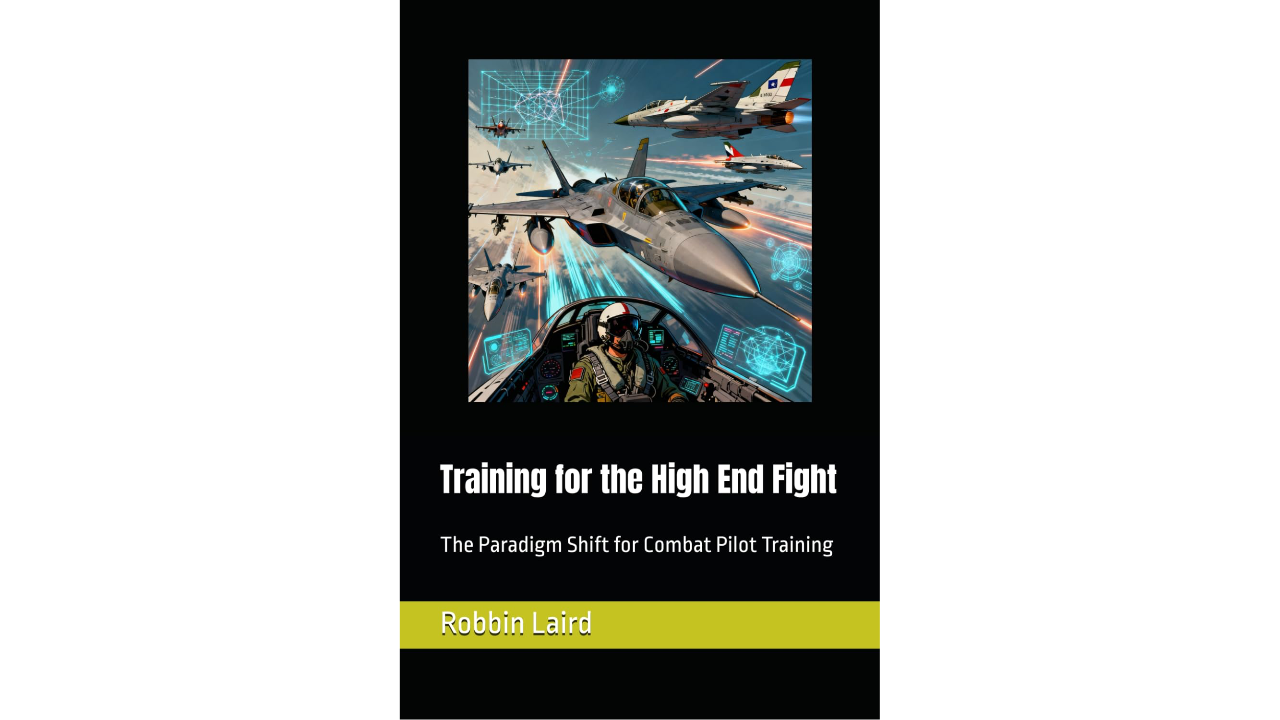
Training for the High-End Fight: The Paradigm Shift for Combat Pilot Training
For a video discussing the main argument of the book, see the following: