

By Robbin Laird
The GAO’s recent report on Osprey safety draws attention to real mishaps and genuine concerns, but its framing, methods, and omissions risk reinforcing an outdated caricature of the V‑22 rather than illuminating the actual safety problems the force faces.
A more rigorous and operationally grounded assessment shows that the Osprey’s long‑run mishap record sits near the middle of the U.S. military aviation pack, while the real outliers are rising accident rates across multiple fleets driven by under‑resourcing, training erosion, and maintenance stress.
The GAO defines its core problem as “serious Osprey accidents” over roughly the last decade and then highlights that Class A and B accident rates rose in FY23–FY24 and often exceeded Navy and Air Force fleet averages. That narrow time frame produces an alarming narrative of spikes of 36–88 percent over the previous eight‑year average, but it does not answer the more fundamental question: is the Osprey a safety outlier when viewed across its full operational life compared with similar platforms in similar regimes?
A broader framing, consistent with CRS data and Marine Corps internal analysis, looks at Class A mishap rates per 100,000 flight hours across the 2015 to 2024 period and finds that the MV‑22’s rate of roughly 2.56 sits slightly below the Marine Corps’ overall aircraft average of 2.67. That result places the V‑22 in the statistical middle of the type/model/series spectrum and undercuts the idea that there is a unique “Osprey problem” rather than a wider safety challenge affecting multiple fleets.
The GAO report does include comparative tables in its appendices but those data never meaningfully shape the headline storyline which remains centered on Osprey‑only rate charts. That choice is crucial: by decoupling recent spikes from the aircraft’s longer history, the report blurs the fact that over a decade or more of intensive operational use, the V‑22’s mishap record is broadly comparable to other heavy‑use rotorcraft and tiltrotor‑like profiles.
Independent analyses cited by CRS and in operator‑driven commentary place the ten‑year MV‑22 mishap rate around 3.4 per 100,000 flight hours, again squarely in the middle of Marine type/model/series. Over the same period, legacy helicopters such as the CH‑53, H‑47, and H‑60 families have experienced similar or greater numbers of fatal mishaps, and in some cases higher rates, yet they do not attract the same existential questioning of their right to remain in the inventory. A serious safety review would have led with that comparative context, not relegated it to the back pages.
GAO’s next move is to aggregate all Osprey Class A and B mishaps into a single “serious accidents” bucket and to treat that aggregate as a proxy for inherent airframe safety. Yet the report’s own breakdown acknowledges that major mishaps have involved intertwined human, cultural, and materiel factors, leadership and risk‑assessment failures in the August 2023 Marine accident, decision‑making and checklist issues in the November 2023 CV‑22 mishap, and gearbox metallurgy problems in the same event.
Experienced Osprey engineers and commanders have long drawn a sharp distinction between genuine design or component issues, such as early vortex ring state concerns, hard clutch engagement, and gear metallurgy, and the separate domains of training, maintenance culture, and operational risk tolerance. The program’s record shows that technical issues have been identified and mitigated, in some cases turned into comparative advantages, while a significant share of recent Class A mishaps fall into familiar categories of operator error or degraded proficiency that recur across all rotorcraft fleets. By treating the sum of these events as a property of “the Osprey,” GAO blurs precisely the causal distinctions that matter for policy.
GAO does commendably detail the formal system‑safety apparatus around the V‑22: 79 risk assessments since 2010, with 45 closed and 34 still open or in monitor status, including a limited set of catastrophic‑severity items tied to airframe and engine components. It also notes that some generic aviation hazards, from bird strikes to aerial refueling risks, are accepted for the life of the program.
The analytical error comes in the sharp boundary GAO draws between “system” risks those captured in formal hazard registers and “non‑system” risks linked to maintenance workloads, flight‑hour levels, aircrew experience, and sustainment shortfalls. The report describes that second category clearly, over‑stretched maintainers, cannibalization of parts, constrained training time, but then relegates it to a secondary tier in its recommendations, in part because those issues sit outside the formal remit of system‑safety boards. That inversion sidesteps a key reality that operator‑analysts like Anthony Krockel highlight: under‑funded operations and maintenance accounts, eroding proficiency, and acceptance of higher readiness risk are now primary drivers of mishaps across the aviation enterprise, not quirks of a single platform.
Perhaps the most important omission in the GAO report is its silence on operational value and how that value feeds back into overall force safety. The Osprey exists because it does what helicopters cannot: it moves Marines and special operators faster, higher, and farther, shrinks exposure time in threat envelopes, extends the reach of medical evacuations, and enables distributed maritime and expeditionary operations at ranges that legacy assault helicopters simply cannot match.
Interviews with MAWTS‑1 instructors and senior Marine aviators make the point concretely. Missions in Afghanistan and the Horn of Africa have demonstrated that Osprey speed and range directly translate into lives saved, whether by rapidly extracting troops from IED‑laden landing zones or moving critically ill sailors over 1,000 nautical miles to definitive care in a single night. Commanders from Third MAW to the current Commandant have repeatedly stressed that the platform’s ability to get Marines “out of harm’s way faster than anything else” and to range entire theaters with tanker support is central to modern Marine and joint concepts. A safety analysis that ignores that trade‑space invites a simplistic league‑table mentality, comparing mishap rates in isolation, rather than asking whether marginal differences in accidents are outweighed by systemic reductions in tactical risk.
The narrative underpinning much external coverage of the V‑22 still leans heavily on developmental mishaps from more than two decades ago, particularly the 2000 crash linked to vortex ring state. GAO does little to push against that inertia by clearly distinguishing between prototype‑era failures and the mature operational aircraft now in service.
Post‑2000 testing and envelope development showed that tilting the rotors forward by about 15 degrees enables a V‑22 to escape vortex ring state, turning a perceived “fatal flaw” into a recovery regime that compares favorably to conventional helicopters. More recent concerns such as hard clutch engagement have been addressed through measures like 800‑hour clutch replacement regimes, which bring Osprey practice in line with other rotorcraft and have effectively closed out that issue as an active safety driver. The Gundam 22 accident off Japan, while genuinely tragic, also demonstrates how mature safety systems respond: identifying gearbox alloy inclusions, examining triple‑melt steel processes, modifying alloys, and updating aircrew training so that chip warnings are treated with the urgency they demand. A balanced official review would foreground this pattern of identify‑understand‑mitigate rather than leave the impression of an aircraft trapped in its developmental past.
Krockel points to a paradox that the GAO report does not fully wrestle with: the Osprey program is one of the most transparent aviation efforts in the Pentagon, with every mishap subjected to intense scrutiny and substantial public documentation. That openness generates more material for critics and reporters to cite, even when the underlying documents show a system that learns and improves over time.
Less transparent programs with comparable or worse safety records simply generate fewer public data points and thus less critical attention. By not explicitly acknowledging this transparency differential, GAO risks reinforcing a biased media ecosystem in which the best‑documented program becomes the easiest target, and the existence of detailed safety records is taken as indirect evidence of unsafety.
Perhaps the most consequential gap in GAO’s analysis is its failure to follow the evidence where it points: mishap rates have risen across multiple fleets over the last several years, pointing toward systemic problems in training, readiness, and sustainment rather than a single flawed aircraft. Krockel traces a clear chain of causality starting with operations and maintenance under‑funding, moving through parts shortages and cannibalization, reduced aircraft availability, and fewer flight hours, and culminating in crews whose currency and judgment are eroded.
These are precisely the kinds of non‑system factors GAO describes but then structurally downgrades. If crews across platforms are flying less, maintaining aircraft with fewer spares, and operating under higher tempo and lower manning, then it is unsurprising that mishap curves bend upward across the force. The question Congress should be asking is not whether the V‑22 is uniquely dangerous, but whether it has properly resourced the training, sustainment, and safety nets that all complex aircraft, tiltrotor or helicopter, require.
A more credible and useful GAO treatment of Osprey safety would rest on three pillars that the current report only gestures toward.
- First, it would start from a whole‑of‑life, comparative baseline that makes clear where each V‑22 variant sits relative to peer aircraft across services and mission profiles, rather than isolating recent spikes in a narrow time band.
- Second, it would disaggregate causal factors rigorously, separating airframe design and component issues from training, culture, and resourcing, and then tying each category to specific remedies from metallurgy and clutch regimes to flying‑hour programs and leadership accountability.
- Third, it would explicitly connect safety analysis to operational value, recognizing that a platform that reduces exposure for ground forces and enables otherwise impossible missions may, on balance, improve force survivability even if its mishap rate is only average.
In that more mature debate, the V‑22 would appear not as a uniquely dangerous outlier but as a heavily scrutinized, continuously improved system whose safety record is broadly in line with other demanding military aircraft and is operating inside a force that is under‑resourced and over‑tasked.
The real policy choice is whether to tackle the systemic conditions that drive accidents across the aviation enterprise, rather than once again putting the Osprey in the dock for problems that it shares with the rest of the fleet.
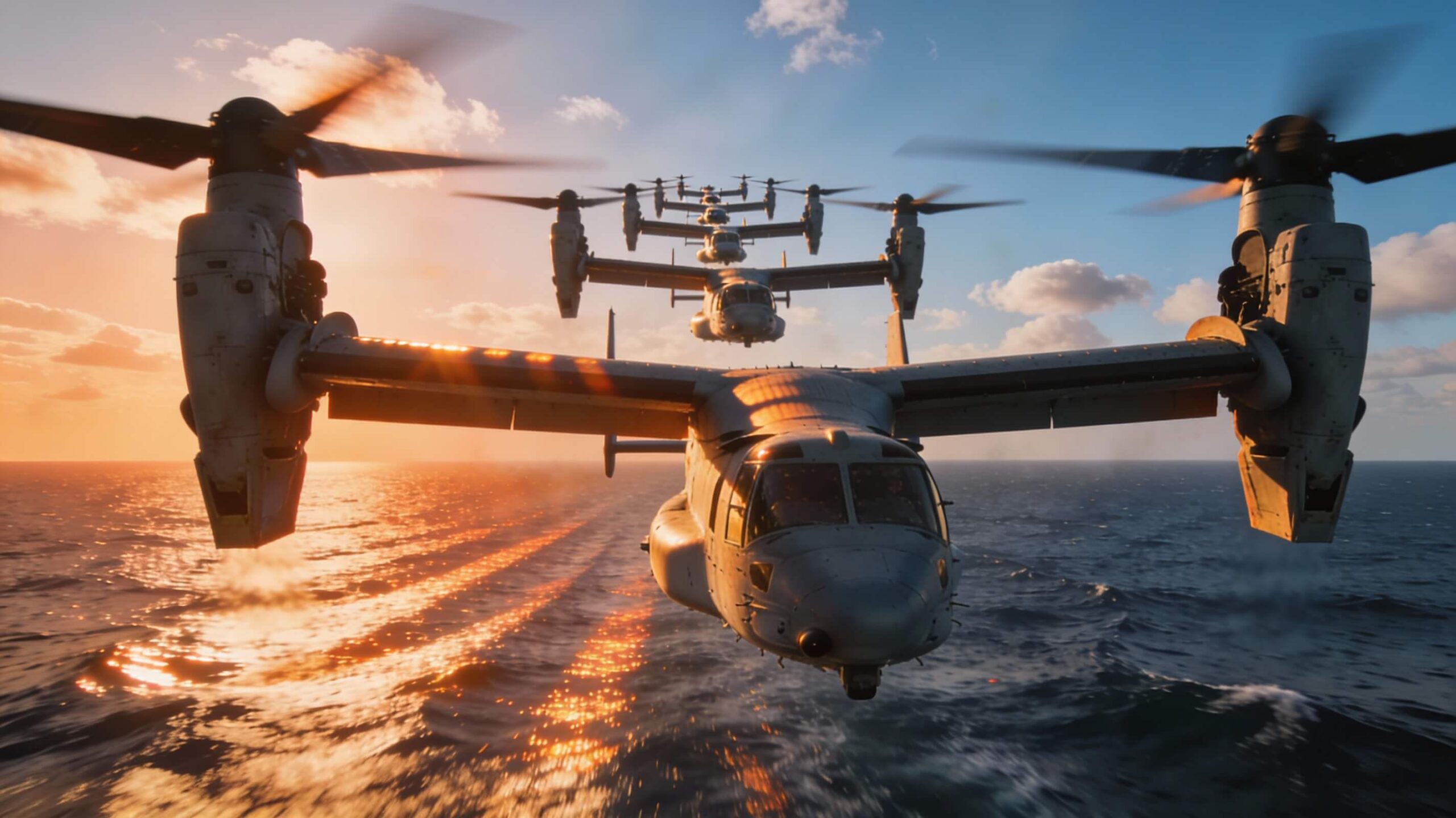
The featured photo was generated by an AI program and highlights the global fleet concept of the Osprey.
And less we forget, there is a “global Osprey enterprise” today consisting of roughly 450 V‑22 tiltrotors built or on order across all variants and operators, centered on U.S. services (USMC, USAF, USN) with Japan as the sole export customer.
The V‑22 fleet of about 450 aircraft that has accumulated more than 800,000 flight hours, reflecting the total production run across all customers and variants.
The three main variants are the USMC MV‑22B (assault support), USAF CV‑22B (AFSOC long‑range special operations), and USN CMV‑22B (carrier onboard delivery), with Japan operating a configuration based on the MV‑22.
The Department of Defense has procured about 360 V‑22s for the Marine Corps, which constitute the bulk of the global Osprey fleet and underpin the assault support and expeditionary role of the aircraft.
These aircraft equip multiple active and reserve VMM squadrons and MEU/ARG deployments, forming the core of USMC medium‑lift and ship‑to‑objective maneuver capability.
The Air Force has acquired around 56 CV‑22s for Air Force Special Operations Command, focused on long‑range infiltration, exfiltration, and resupply in contested environments.
CV‑22s operate from CONUS and overseas bases (including Europe and the Pacific), giving the tiltrotor enterprise a global special operations footprint.
The Navy program of record originally envisioned 48 CMV‑22Bs, but current plans call for 44 aircraft, replacing the C‑2A Greyhound for carrier onboard delivery.
CMV‑22B squadrons (VRM‑30, VRM‑40, VRM‑50 and supporting test units) provide logistical support to carrier strike groups, including long‑range logistics and F‑35C engine transport.
Japan is the only foreign customer and is procuring 17 V‑22s, which form an “Air Transport Squadron” under the JGSDF for rapid deployment and island defense missions.
As of 2025, the Japanese V‑22 unit has completed relocation from its temporary base at Kisarazu to its permanent base at Camp Saga on Kyushu, positioning the fleet closer to the Nansei/Southwest Islands and the East China Sea.
Industry and Navy sources describe a fleet that has now surpassed 600,000 flight hours and has grown to more than 400 operational aircraft, consistent with the broader “~450 aircraft” enterprise figure when including aircraft in production and on order.
The global enterprise thus spans multiple services and one key ally, with common industrial support from Bell and Boeing and shared sustainment, upgrade, and safety initiatives across this ~450‑aircraft tiltrotor community.
Note: I highly recommend comparing the recent GAO report with the CRS report.
For the GAO report:
https://www.gao.gov/products/gao-26-107285
For the CRS report:
https://www.congress.gov/crs_external_products/R/PDF/R48703/R48703.1.pdf
When Safety Data Contradicts the Narrative: Why Doesn’t the Narrative Change?
https://www.defenseone.com/ideas/2024/02/groupthink-gives-v-22-bad-rap/394420/
https://arc.aiaa.org/doi/pdf/10.2514/6.2025-99024