

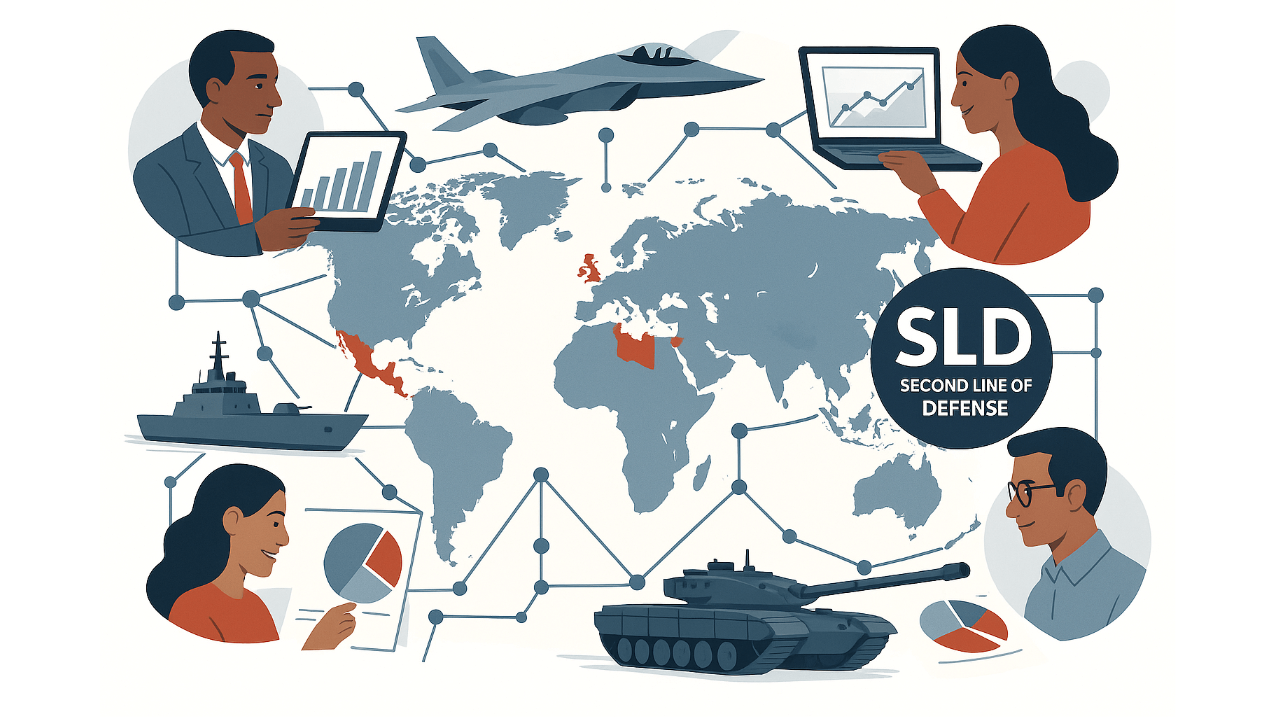
The Second Line of Defense effort has been focused on providing a venue for the expression of fresh thinking about the way ahead to deal with global challenges and defense innovation which can allow the military forces of the liberal democracies to compete effectively with their authoritarian competitors.
Second Line of Defense and defense.info aren’t just websites. They’re strategic communities where policy, technology, and operational realities converge.
Brian Morra has from the outset and indeed even before we launched our website was a key architect in thinking through the effort to shape a new website to generate innovative strategic thinking.
Brian is a highly decorated former American intelligence officer who has successfully transitioned from protecting national security to crafting award-winning historical thrillers that illuminate some of the most perilous episodes of the late twentieth century.
Brian Morra’s journey to literary acclaim began in the high-stakes world of military intelligence during one of the most volatile periods in modern history. Raised in southern Virginia, Morra embarked on a distinguished career that would place him at the center of critical Cold War operations. His impressive educational foundation, degrees from William and Mary, the University of Oklahoma, and Georgetown University, culminating with completion of the Advanced Management Program at Harvard Business School, prepared him for a career that would span both military service and corporate leadership.
As a U.S. Air Force intelligence officer, Morra found himself thrust into the heart of some of the most significant intelligence operations of the 1980s. Perhaps most notably, he helped lead the American intelligence team in Japan that uncovered the true story behind the Soviet Union’s shootdown of Korean Airlines flight 007 in September 1983, a tragic incident that claimed 269 lives and brought the superpowers dangerously close to direct confrontation. This experience would later serve as crucial source material for his literary works, providing him with firsthand knowledge of how intelligence operations unfold and how individual decisions can alter the course of global events.
Morra’s service extended to the Pentagon, where he served on the Air Staff while on active duty, gaining invaluable insight into the mechanisms of national defense policy and military strategy. Following his military career, he transitioned seamlessly into the aerospace industry as a senior executive, working on numerous important national security programs that further deepened his understanding of the complex relationship between technology, defense, and international relations.
His expertise in these fields has been recognized through prestigious appointments to influential think tanks. Currently, he serves as a senior fellow and member of the Board of Regents of the Potomac Institute for Policy Studies, an organization that specializes in examining how advanced technology influences national security. Additionally, he holds the position of non-resident senior fellow at the Mitchell Institute for Aerospace Studies, widely regarded as the world’s preeminent think tank focused on air and space power in the twenty-first century.
The transition from intelligence officer to novelist might seem unusual, but for Morra, it represented a natural evolution, a way to share the profound lessons learned during his years in service while respecting the boundaries of classified information. His approach to writing historical fiction is uniquely informed by his personal experiences, creating narratives that ring with authenticity because they are grounded in the realities of intelligence work and international relations.
Morra’s writing philosophy centers on bringing real events to life through the experiences of characters based on people he encountered during his intelligence career. He draws upon countries and locations he knows firsthand from his extensive travels throughout Europe, Asia, and the Middle East, lending his narratives a geographical and cultural authenticity that sets his work apart from other historical fiction.
Morra’s literary debut came with “The Able Archers,” a historical thriller that introduces readers to one of the most terrifying episodes of the Cold War, a series of events that nearly triggered nuclear war in the autumn of 1983. The novel represents far more than entertainment; it serves as a crucial historical document that reveals how close the world came to nuclear annihilation during a period when most of the public remained blissfully unaware of the escalating tensions.
The book introduces Kevin Cattani, a young American Air Force Intelligence officer whose experiences mirror Morra’s own journey through the intelligence community. Cattani’s Soviet counterpart, Colonel Ivan Levchenko of the GRU (Russian military intelligence), represents the human face of America’s adversaries, a complex character who embodies the reality that intelligence officers on both sides of the Iron Curtain were often more alike than different in their dedication to serving their countries while attempting to prevent global catastrophe.
“The Able Archers” garnered immediate critical acclaim and commercial success, earning the 18th Annual National Indie Excellence Award for Military Fiction and achieving finalist status in the Historical Fiction category. The novel’s impact extended beyond literary circles, with prominent figures from the intelligence and defense communities praising its accuracy and insight.
Jack Carr, the #1 New York Times bestselling author and former Navy SEAL, described the book as “a fast-paced ride through one of the worst crisis periods of the Cold War… a terrifying yet factual story of how a few people prevented a global nuclear war.” William S. Cohen, former Secretary of Defense, called Morra “the master craftsman” and praised “The Able Archers” as “brilliant.” Perhaps most significantly, Michael Morrell, former Acting Director and Deputy Director of the CIA, noted that the book “delivers a story that is both realistic and riveting.”
Following the success of his debut, Morra released “The Righteous Arrows” in April 2024, published by Koehler Books. This sequel picks up where “The Able Archers” concludes, following the same characters as they navigate the complex and dangerous landscape of the Soviet war in Afghanistan. The novel incorporates the true story of the CIA’s role in supplying Afghan rebels who fought against Soviet occupation—a covert operation that would have profound implications for global politics and the eventual rise of international terrorism.
“The Righteous Arrows” presents a more complex moral landscape than its predecessor. Where “The Able Archers” showed Cattani and Levchenko working together to prevent nuclear war, the sequel finds them on opposite sides of a brutal conflict. Cattani conducts a perilous covert mission inside a Soviet bunker in East Germany, barely escaping with his life, before finding himself supplying advanced weapons to Islamic resistance fighters in Afghanistan—weapons designed to kill Russian troops under Levchenko’s command.
The novel’s exploration of the Afghanistan conflict proves particularly prescient, as Morra uses his characters’ experiences to foreshadow the global war on terror that would define the early twenty-first century. The “righteous arrows” of the title refer to the Stinger missiles supplied to Afghan mujahideen, weapons that proved devastatingly effective against Soviet aircraft and ultimately contributed to the USSR’s decision to withdraw from Afghanistan.
Like its predecessor, “The Righteous Arrows” earned critical acclaim and industry recognition, winning the 18th Annual National Indie Excellence Award in the Military Fiction category. General Doug Brown, 7th Commander of United States Special Operations Command, praised the sequel: “The battlefield has moved from the nuclear Cold War threat to the shadow wars of Afghanistan, but the suspense, excellence in writing, and his ability to weave real world events and capabilities into a robust fictional story continues to set Morra apart.”
Beyond their entertainment value, Morra’s novels serve as important educational tools that illuminate historical events often overshadowed by more prominent Cold War episodes. The nuclear war scare of 1983, for instance, remained largely classified for decades, leaving the public unaware of how close civilization came to destruction. Through his fiction, Morra provides accessible insight into these critical moments while respecting the classified nature of much of the source material.
In effect, his novels are case studies in the study of crisis management. And as we have argued throughout the years, shaping a more agile military without evolving new capabilities for crisis management will not yield the West the kind of capabilities necessary to compete successfully with the authoritarian powers.
His expertise has been recognized by major media organizations seeking authoritative voices on Cold War history. Morra served as an on-air expert for Netflix’s documentary series “Turning Point: The Bomb and the Cold War,” and contributed his extensive knowledge to the CNN/BBC documentary “Secrets and Spies: A Nuclear Game.” These appearances have helped bring his historical insights to broader audiences, establishing him as a credible voice in both literary and historical circles.
What distinguishes Morra’s work from other historical fiction is his commitment to authenticity. His characters behave like real intelligence officers because he understands their world intimately. His descriptions of classified operations, international tensions, and military procedures carry the weight of experience rather than research alone. This authenticity extends to his portrayal of both American and Soviet characters, avoiding the simplistic good-versus-evil narratives that often characterize Cold War fiction.
Morra’s writing style reflects his intelligence background, precise, economical, and focused on the human elements that drive major historical events. His novels demonstrate that history’s most significant moments often turn on individual decisions made by people under extraordinary pressure, whether they’re trying to prevent nuclear war or navigating the moral complexities of proxy conflicts in distant lands.
As Morra continues to develop his literary career, his unique perspective as both insider and storyteller positions him to make lasting contributions to our understanding of recent history. His work serves multiple audiences: general readers seeking compelling narratives, history enthusiasts interested in Cold War operations, and policy makers who can learn from past crises to better navigate contemporary challenges.
Living between the Washington, D.C. area and Florida, Morra remains active in policy discussions through his think tank affiliations while continuing to write. His transition from protecting national security to illuminating its complexities through fiction represents a remarkable second career that enriches our understanding of the recent past while providing entertainment and insight for future generations.
In an era when historical events are often reduced to political talking points or forgotten entirely, Morra’s work serves as a vital bridge between the classified world of intelligence operations and the public’s need to understand how their safety has been protected and threatened by forces operating far from public view.
Reaping the Results of More than Two Decades of Western Appeasement of Vladimir Putin