

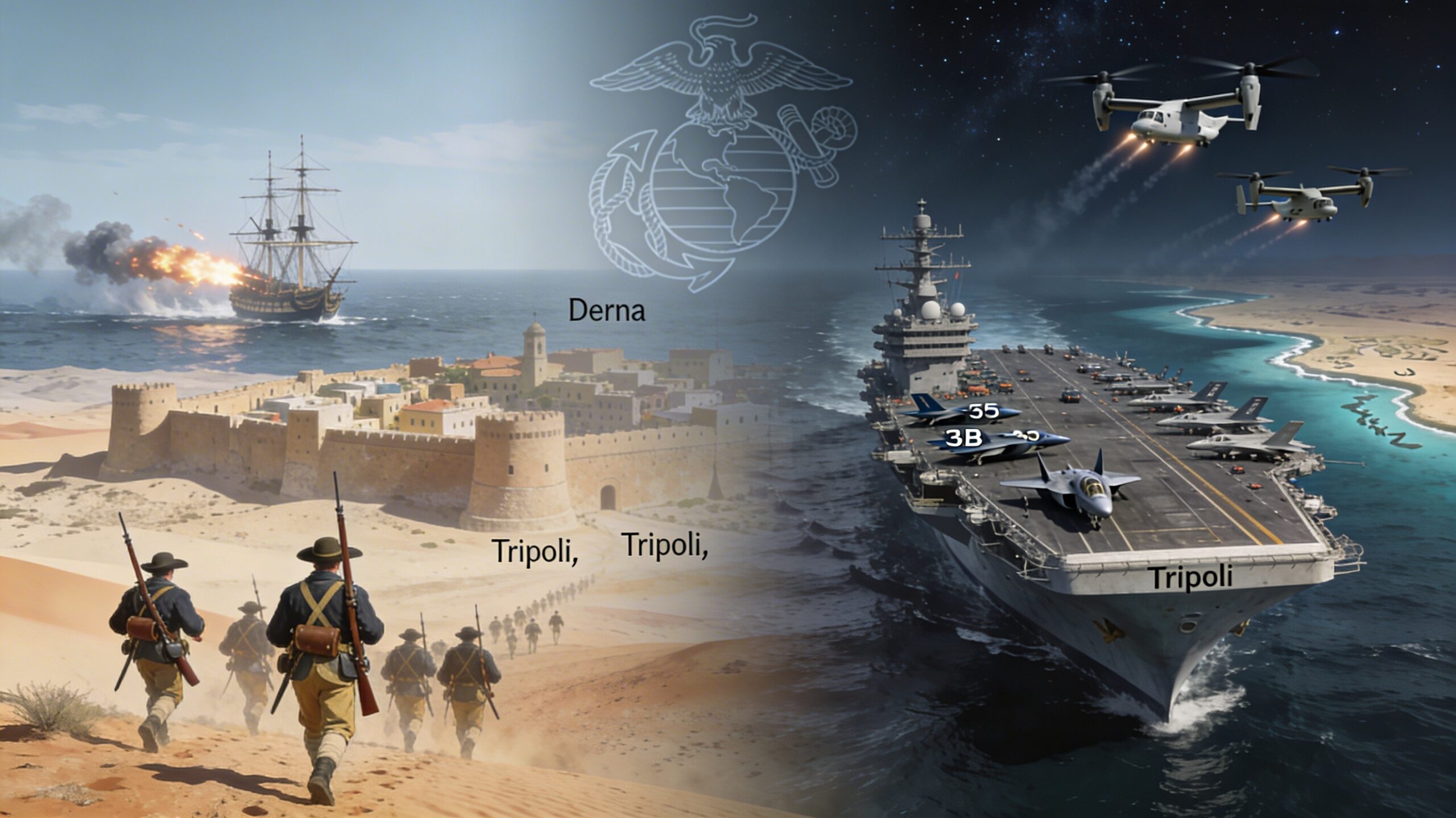
History rarely offers the same strategic irony twice.
In 1805, a small detachment of U.S. Marines marched out of Alexandria across the North African desert to put steel on the “shores of Tripoli,” breaking the grip of Barbary pirates who believed they could hold American commerce and citizens hostage at acceptable cost.
In 2026, Marines are heading eastward again, this time aboard a ship actually named USS Tripoli into a Middle East where Iranian mullahs have made a strikingly similar wager: that maritime coercion, hostage-taking, and missile-driven terror can be sustained as a stable instrument of power.
They are wrong.
And the Marines sailing east on Tripoli carry the proof.
What no Iranian planner has confronted before is a vertically-enveloping, F-35B-enabled Marine Expeditionary Unit operating from an aviation-centric assault ship that can project power ashore without ever staging a traditional forced landing. The ship brings fifth-generation situational awareness, tiltrotor reach, and the kill web architecture that transforms a MEU from a landing force into a networked strike system.
From the Barbary pirates to the Islamic Republic, the message has not changed: you can threaten commerce, take hostages, and wrap coercion in religious justification, but eventually the sea brings the Marines.
The First Tripoli: Pirates, Potentates, and the Birth of a Tradition
The Barbary story is worth revisiting because it frames the core continuity. The Barbary states, nominally under Ottoman suzerainty but effectively autonomous in their behavior, financed themselves by predation at sea. Their rulers combined piracy, protection rackets, and a veneer of religious legitimacy to extract tribute from commercial powers that found it cheaper to pay corsairs than to change the facts at sea.
The young American republic initially followed the familiar European pattern. Having lost the protection of the Royal Navy after independence, the United States signed treaties and paid tribute to keep American shipping moving in the Mediterranean. That approach held, until it did not. The more Washington paid, the more the Barbary rulers demanded.
When Thomas Jefferson became president, he reversed the equation. Instead of accepting a permanent tax on American commerce paid to North African potentates, he sent warships to the Mediterranean. Naval coercion alone, however, could not change the political calculus in Tripoli. Frigates could bombard harbors and shield American ships at sea, but they could not topple a regime or reshape local power without men willing to go ashore.
Enter the Marines. In 1805, Lieutenant Presley O’Bannon and a small detachment joined a force of mercenaries and local allies, marched overland from Alexandria, and attacked the port of Derna. With naval gunfire supporting from the sea, they took the town and raised the American flag on foreign soil for the first time. That action, embedded in the Marine Corps hymn as “to the shores of Tripoli,” made a durable strategic point: oceans are not moats, they are highways, and sea power achieves political effect only when it can put disciplined force ashore.
That is the origin story behind the modern ship named Tripoli sailing east today, carrying a Marine force that is once again the connective tissue between sea power and political outcomes on land.
From Corsairs to the Quds Force: A Different Flag, the Same Logic
Fast-forward two centuries and the names have changed, but the operational logic is depressingly familiar. Instead of Barbary corsairs, we have the Islamic Revolutionary Guard Corps Navy employing fast boats, drones, limpet mines, and seizures of merchant shipping in and around the Strait of Hormuz. Instead of letters of marque from North African beys and pashas, we have religious decrees and “revolutionary” rhetoric from a clerical regime that treats maritime harassment and missile strikes on neighbors as instruments of resistance.
The technology has evolved, but the political method has not. Use geography, narrow chokepoints like Hormuz, to threaten global commerce. Hide behind a mix of deniability and proxies, whether corsairs or militias, so the regime can calibrate escalation while claiming distance. Assume that major trading nations, risk-averse and dependent on oil flows, will ultimately pay, deter themselves, or confine their response to statements and sanctions.
The Barbary rulers bet that the United States would rather pay tribute than fight. The Iranian leadership made the same wager: that the United States would absorb tanker seizures, missile strikes on partners, and proxy attacks so long as American casualties stayed low and oil kept flowing. Both concluded that maritime coercion, wrapped in ideological language and backed by local irregulars, could function as a sustainable business model.
What breaks that business model is not a communiqué or a sanctions package. It is the credible prospect that someone will not only fight back at sea but will come ashore to impose consequences. The Barbary states discovered this. Iran now faces a U.S. naval posture that includes not just carrier strike groups and land-based aviation but an amphibious force configured to do what Marines have always done: go where they are not wanted and change the facts on the ground.
The New Tripoli: An Aviation-Centric Assault Ship
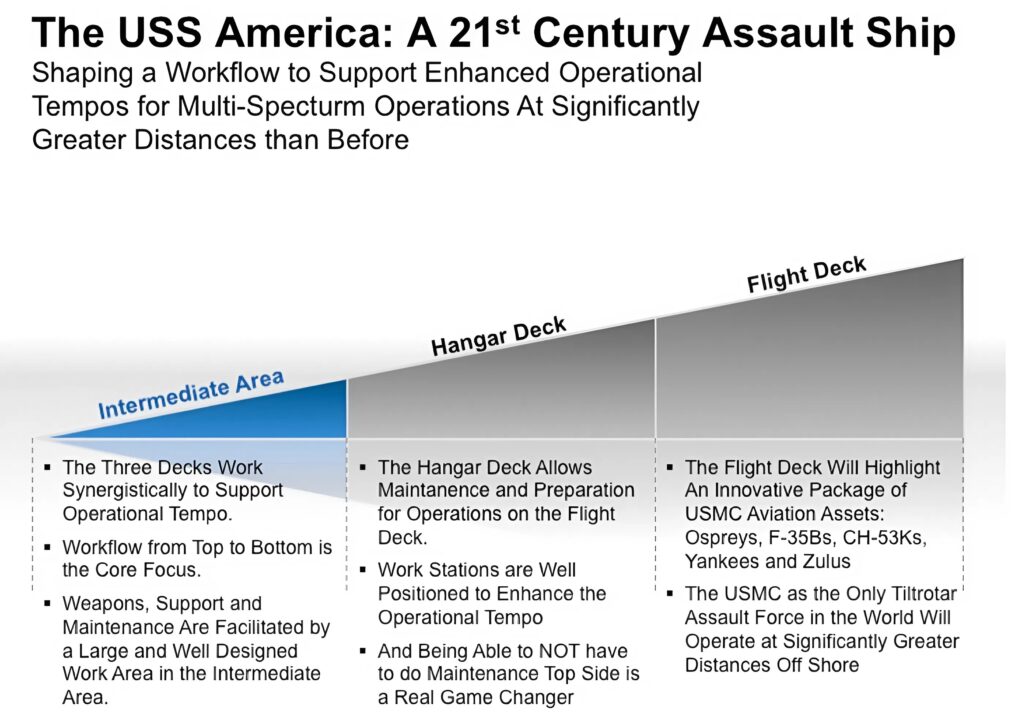
The USS Tripoli is not a 19th-century frigate, and the Marines embarked today bear no resemblance to O’Bannon’s small detachment. The modern Tripoli is an America-class amphibious assault ship, designed from the keel up as an aviation-centric platform, a ship that deliberately blurs the line between amphibious warfare and light carrier operations.
Unlike earlier big-deck amphibs, Tripoli carries no well deck in its baseline configuration. That is not an oversight; it is a design decision. Where older amphibious ships married a modest flight deck to an extensive internal bay for landing craft, Tripoli trades that well deck volume for enlarged aviation capacity, more flight deck, more hangar space, more aviation fuel, more weapons storage. The ship is optimized not for massing surface connectors on a beach but for launching vertical-lift and STOVL aircraft into three-dimensional maneuver.
The centerpiece of that aviation capability is the F-35B. Operating in “Lightning Carrier” configuration, an America-class ship can embark around 20 F-35Bs, supported by MV-22 Ospreys and helicopters. That package is not a peer to a full carrier air wing, but it is far more than an adjunct. It is a self-contained, fifth-generation, networked strike and sensing node operating from a platform built specifically to support it.
For a regime like Iran’s, that distinction matters. The F-35B does not just bring precision strike; it brings pervasive situational awareness. It fuses data from its own sensors and from other platforms across the kill web, then shares that picture with the force. A Tripoli-centered amphibious ready group can see, understand, and target threats in the air, on the surface, and ashore with a clarity previous amphibious forces never possessed.
Tehran has studied American carriers and Tomahawk strikes for decades. It has adjusted air defenses, hardened key sites, dispersed capabilities, and invested heavily in anti-ship missiles, UAVs, and ballistic systems. What it has not faced is a Marine force afloat that combines fifth-generation aviation, long-range tiltrotor reach, and a doctrine of vertical envelopment as its default mode of entry.
Vertical Envelopment, Not Forced Landing
The iconic images of amphibious warfare, Tarawa’s bloodied reefs, Iwo Jima’s beaches, Inchon’s tidal flats, are images of forced entry against defended shores. Waves of landing craft, slow and exposed, carrying Marines into pre-registered artillery, interlocking machine gun fire, and prepared obstacles. The cost in lives is seared into the Corps’ institutional memory. It also lives in the minds of adversaries, many of whom still think about amphibious assault in exactly those terms: boats on the beach, bodies in the surf.
The MEU embarked on Tripoli is built to fight differently. Its default approach is not to mass surface craft against a fortified shoreline but to execute vertical envelopment, going over and around, landing combat power where the adversary is weakest rather than where he is strongest.
Vertical envelopment has existed as a concept since helicopters entered service, but its practical reach was long constrained by helicopter speed, range, and payload. The MV-22 Osprey changed that calculus. Its tiltrotor design delivers turboprop-like speed and range combined with vertical takeoff and landing flexibility. Marines can now move hundreds of miles inland in a single bound, bypassing coastal defenses to strike nodes that matter: command centers, missile batteries, logistics hubs, critical infrastructure.
Overlay the F-35B’s sensor and strike capabilities and vertical envelopment becomes part of the wider kill web. Marines can be inserted into areas already mapped by fifth-generation ISR, supported by precision fires from both ship and aircraft, and connected into a broader joint command-and-control architecture. They fight not as an isolated landing force but as forward nodes of an integrated system, exactly what the kill web concept demands.
From Tehran’s perspective, this means the amphibious group centered on Tripoli is not merely a threat to beaches or coastal islands. It is a mobile base for three-dimensional maneuver across the full Iranian problem set: from the Hormuz littoral to inland missile fields, from proxy training camps to the critical infrastructure Tehran prefers to treat as sanctuary.
Beyond Numbers: Changing the Option Set
It is easy to look at the headline figure, a few thousand Marines, several dozen aircraft, and treat Tripoli’s deployment as marginal reinforcement of an already substantial U.S. presence in the region. That misses the point.
What Tripoli brings is not more of the same. It is a different option set.
First, it restores a flexible, credible option for noncombatant evacuation and crisis response under threat. In a region where embassies and expatriates are perpetual targets, a MEU afloat with its own aviation and ground combat element can extract citizens from collapsing states without depending on host-nation infrastructure. Vertical lift allows Marines to move directly from sea to rooftops, airfields, or open ground inland, even under contested conditions.
Second, it opens options for seizing and holding key terrain that shapes the maritime fight: islands, peninsulas, ports, chokepoint-adjacent infrastructure. Vertical envelopment lets the United States put Marines onto key nodes quickly and unpredictably, backed by fifth-generation airpower, without telegraphing intent through a slow buildup of ships and landing craft.
Third, it enhances deterrence credibility in concrete terms. Adversaries are not deterred by what they cannot imagine. They are deterred when they can visualize specific, plausible actions the other side could take that would be painful and hard to counter. A Tripoli-centered MEU that can appear along the Iranian periphery, put Marines ashore beyond the horizon, and integrate with joint and allied fires is precisely that kind of action set. It complicates Iranian planning and erodes the regime’s confidence in its escalation assumptions.
Finally, it signals something tangible to allies and partners around the Gulf. Regional states are watching not only what Washington says about Iran but what it is actually willing to deploy and sustain. The arrival of a modern amphibious force, configured for 21st-century maneuver and backed by F-35B capability, tells them the United States is still prepared to underwrite maritime security with more than rhetoric.
From Derna to the Gulf: The Enduring Message
The arc from Barbary pirates to Iranian mullahs is not a neat morality play. Geopolitics never is.
The Barbary conflict played out in the age of sail, with empires and corsairs and a United States still experimenting with its role in the world.
The current confrontation with Iran unfolds in a nuclear-tinged environment, amid networked economies and social media, with multiple major powers in the mix.
Yet at the core of both episodes sits the same recurring theme: actors who believe they can weaponize geography and maritime predation to punch above their weight, who assume that major trading nations will ultimately pay or adapt, and who build domestic legitimacy around the image of humiliating foreign powers at low cost. The Barbary states were not the last to try this model. They were simply among the first to discover its limits when confronted with naval resolve and Marines willing to go ashore.
The USS Tripoli now steaming toward the Middle East carries that earlier lesson in its name. It is not a guarantee of wise policy, flawless execution, or frictionless operations.
It is a concrete signal that the United States still understands what Jefferson grasped in his own era: that tribute and passivity invite further predation, and that sea power without the capacity to act ashore is strategically incomplete.
The Iranian leadership has built a regional strategy around missiles, proxies, and maritime harassment, confident that the constraints of domestic politics and alliance management will keep American responses within bounds the regime can absorb. That may hold for a time.
But Marines on a ship called Tripoli, trained for vertical envelopment and backed by fifth-generation aviation integrated into a kill web, mean that if Tehran miscalculates, the answer need not be confined to sanctions and statements.
One more thing: the Marines heading to the Gulf have not forgotten what Iran and its Hezbollah proxies did to their fellow Marines in Beirut in 1983, when a single Iran-backed suicide truck bomb killed 241 American service members in their barracks. That memory does not drive policy.
But it is part of the institutional fabric of every Marine who has ever worn the uniform.
The Barbary rulers learned that piracy and state-sponsored predation at sea carry a reckoning when they go far enough. The men who delivered that message wore leathernecks and carried muskets.
Their successors fly F-35Bs, ride tiltrotors, and operate within a kill web spanning air, sea, and land.
The technology has changed.
The Marines have not.
And from the shores of Tripoli to the waters off Iran, the enduring message remains: here come the Marines.
Then and Now: Two Tripolis in U.S. Strategy
Tripoli then—Derna, 1805: A handful of Marines and mercenaries march from Alexandria, seize a Barbary port with frigates in support, and prove that American sea power can reach ashore to overturn a predatory status quo.
Tripoli now—Gulf, 2026: A Marine Expeditionary Unit sails on an aviation-centric assault ship, carrying F-35Bs, MV-22s, and a fully networked kill web architecture, able to project power deep inland without ever staging a classic beach landing.
Instrument of policy: Jefferson’s small squadron and Marine detachment were the sharp end of a political decision to stop paying tribute. Today’s Tripoli and MEU embody a decision to contest Iran’s use of proxies, missiles, and maritime harassment rather than normalize it.
Message to adversaries: The Barbary rulers learned that piracy and state-sponsored predation at sea can trigger regime-shaping force ashore. Iranian leaders now face a Marine Corps configured to deliver that consequence with 21st-century speed, reach, and precision integrated into a kill web that no previous amphibious force has ever brought to the fight.
And by the way, the Marine Corps aviators on USS Tripoli will be joining up with their mates who fly the F-35C Lightning IIs on the USS Abraham Lincoln. Those planes are from Marine Fighter Attack Squadron 314 (VMFA-314), the Black Knight.
I spent time with the USS America and wrote a great deal about why this ship is special.
The featured image was generated by an AI program.