

By Robbin Laird
For most of its history, U.S. Central Command has been an Army officer’s domain. Since its founding in 1983, CENTCOM has been led predominantly by Army and Marine generals whose careers were shaped by the grinding land campaigns of Iraq and Afghanistan. The combatant command that oversaw two of America’s longest wars naturally gravitated toward the warrior traditions of ground combat.
That era, for now, appears to have passed.
When President Donald Trump nominated Vice Admiral Brad Cooper to lead CENTCOM in June 2025, selecting him over Army General James Mingus who had been widely expected to receive the post it was widely interpreted as a deliberate strategic signal.
The Trump administration was signaling, well before Operation Epic Fury commenced, that what was coming would not be another ground war. It would be a maritime and air campaign against the world’s leading state sponsor of terrorism.
And to fight it, they wanted the officer who understood these waters, literally and figuratively, better than anyone else in uniform.
Cooper took command at MacDill Air Force Base on August 8, 2025, becoming the first naval officer to lead CENTCOM since Admiral William J. Fallon in 2008.
He brought to that command something no recent predecessor could match: nearly three years living and operating in the heart of the region he would now command in war.
From 2021 to 2024, Cooper served as Commander of U.S. Naval Forces Central Command, U.S. Fifth Fleet, and Combined Maritime Forces, all headquartered in Manama, Bahrain. That triple-hatted role placed him at the center of the most consequential maritime geography on earth: the Arabian Gulf, the Strait of Hormuz, the Red Sea, and the Gulf of Aden. The three chokepoints that govern global energy flows and commercial shipping all fell within his area of responsibility.
But the significance of the Bahrain years runs deeper than geography.
As 5th Fleet Commander, Cooper was simultaneously the commander of Combined Maritime Forces, a multinational naval coalition that, under his leadership, expanded to encompass over forty nations. He also led the International Maritime Security Construct, another coalition architecture focused on the critical waterways now at the center of the Iran conflict.
In Bahrain, Cooper was not merely a forward-deployed American admiral. He was the operational hub around which the entire region’s maritime security architecture revolved.
During those years, Cooper made relationship-building the explicit centerpiece of his command philosophy. He spoke publicly and consistently about what he called ‘the four most important ships in the Middle East’: relationships, partnerships, friendship, and shared leadership. It was a framing that struck some observers as unusual for a combatant commander, more diplomat than warrior. But Cooper’s view was that in a region as complex as the Gulf, where trust between the United States and its Arab partners had been tested by years of perceived strategic retreat, those four ‘ships’ were operational prerequisites. Without them, no coalition would hold under fire.
The depth of Cooper’s regional investment during the Bahrain years is visible across multiple dimensions. He oversaw the expansion of Combined Maritime Forces when Egypt joined, bringing the coalition to 34 nations at that time. He established Combined Task Force 153, a new multinational formation focused specifically on the Red Sea, the Bab el-Mandeb, and the Gulf of Aden, the waters that would become, just months later, the killing ground of Operation Prosperity Guardian and then Operation Poseidon Archer against the Houthis.
His relationship with Bahrain itself went beyond the transactional. Cooper described the island kingdom as a ‘second home’ for Naval Forces Central Command and Fifth Fleet, noting that American and Bahraini families lived side by side, with children attending school together. He presided over exercises like Neon Defender, a bilateral training event covering maritime security, installation security, airfield repair, medical response, and explosive ordnance disposal that demonstrated the operational intimacy between U.S. and Bahraini forces. When he briefed Bahraini naval leadership on the capabilities of the newly established Task Force 59, he was not presenting to a distant partner. He was briefing allies who already shared his operational picture.
That operational picture was being transformed. In September 2021, Cooper established Task Force 59, the Navy’s first unmanned and artificial intelligence task force in Bahrain. Beginning as an experimental formation, TF-59 grew under his command into an operational entity that fielded unmanned surface vessels from multiple nations, conducted the world’s largest unmanned maritime exercise with over 80 unmanned systems from 10 nations, and achieved what Cooper described as the ‘first use of weapons aboard an unmanned platform’ in the region’s operational history. In 2022 alone, TF-59 was already integrating MARTAC Mantas T-12 unmanned surface vehicles with Bahraini naval assets in joint exercises, a harbinger of the mesh-fleet approach to maritime operations that would define the 2026 campaign.
The Gulf Cooperation Council states, Saudi Arabia, the UAE, Bahrain, Qatar, Kuwait, and Oman, have historically maintained complex, sometimes contradictory relationships with U.S. military operations in their neighborhood. The 2023 Hamas attacks and the subsequent Gaza conflict strained those relationships further, as Arab publics and governments navigated the tension between their security dependence on Washington and their political exposure on the Palestinian question. Cooper understood these tensions firsthand. He was sitting in Manama when Operation Prosperity Guardian was assembled, when the Red Sea crisis deepened, and when the Biden administration’s Houthi response drew criticism for being too hesitant.
When the Trump administration began its diplomatic and military pressure campaign against Iran in early 2026, Cooper was already serving as CENTCOM Deputy Commander, then as its commander. He was present at the indirect negotiations in Muscat on February 6, 2026, a visual reminder, as the Center for Strategic and International Studies noted, that the USS Abraham Lincoln was operating just offshore. Iran’s refusal to renounce its nuclear ambitions across three rounds of negotiations set the stage for what followed.
On February 28, 2026, Cooper ordered the commencement of Operation Epic Fury, a jointly coordinated U.S.-Israeli campaign which is the most significant American military action in the Middle East since the Iraq War. The stated objectives were fourfold: prevent Iran from acquiring nuclear weapons, destroy its missile arsenal and production infrastructure, degrade its proxy networks, and eliminate its conventional naval capability. Cooper’s own framing was characteristically direct: ‘The goal of CENTCOM’s operation is to dismantle the Islamic Revolutionary Guard Corps.’
What distinguishes Operation Epic Fury from CENTCOM’s recent history is not simply its scale, though the scale has been extraordinary, with over 50,000 U.S. troops, 200 fighter aircraft, two aircraft carrier strike groups, and strategic bomber packages from B-2, B-1, and B-52 assets all committed to the campaign.
What distinguishes it is its character: this is fundamentally a naval and air campaign, executed from maritime platforms, targeting maritime and missile infrastructure, in a theater where the Strait of Hormuz, the Arabian Gulf, and the broader Persian Gulf littoral form the decisive terrain.
Cooper has been at the podium describing the campaign’s progress with the precision of a commander who knows every nautical mile of his battlespace. By day six, he was reporting that ballistic missile attacks against U.S. forces and partners had decreased by 90 percent since the campaign’s opening, and drone attacks by 83 percent. The Iranian Navy, which for decades had harassed commercial shipping and threatened to close the Strait of Hormuz, was being systematically annihilated. Over 30 Iranian naval vessels were sunk or destroyed, including what Cooper described as an Iranian drone carrier ‘roughly the size of a World War II aircraft carrier,’ which U.S. forces struck and left ablaze. In a particularly significant operational milestone, Cooper confirmed: ‘There is not a single Iranian ship underway in the Arabian Gulf, Strait of Hormuz, or Gulf of Oman.’
This is a statement no CENTCOM commander has been able to make in the modern era. Its strategic significance extends well beyond the immediate campaign. The Strait of Hormuz has long been Iran’s most potent asymmetric lever, the threatened closure of which underpinned three decades of Iranian deterrence strategy. Cooper and the forces under his command have now, at least for this operational phase, removed that lever from the board.
Perhaps the most underappreciated aspect of the current campaign is what is not breaking down: the coalition architecture.
Iran, in its initial retaliatory phase, attacked twelve countries and launched drone strikes toward civilian residential areas in Bahrain, a direct strike at the hub of the regional maritime partnership Cooper spent three years building. The attack on Bahrain’s Fifth Fleet headquarters on February 28, which damaged satellite communications terminals and several base structures, was a direct targeting of the command architecture Cooper once led.
Yet Bahrain has held. The GCC states, whatever their private reservations about the broader political dimensions of the campaign, have not fractured from the U.S. operational framework. Saudi Arabia, the UAE, and other Gulf partners are not openly opposing Operation Epic Fury. This coalition resilience did not happen by accident. It is, in significant measure, the product of the patient, sustained relationship investment Cooper made during his Bahrain years, the exercises, the personal relationships, the shared operational experience of Task Force 59, the work of bringing forty-plus nations into Combined Maritime Forces and keeping them there through the Red Sea crisis.
Cooper’s critics on the Iran question, those who would have preferred continued diplomacy, point to the risks of escalation and the human costs of military action. These are legitimate concerns that serious strategists must weigh.
But the operational framework Cooper has constructed is notable for its precision as well as its power. His public statements have consistently emphasized the distinction between the Iranian regime and the Iranian people, and he has framed the campaign’s objectives in terms of capability destruction rather than indefinite occupation. When he told Iranian forces that their attacks on civilians ‘will not go unanswered,’ he was drawing a line that reflects both American resolve and his own understanding of what sustainable campaign objectives look like in a region he knows intimately.
The Trump administration’s decision to break with tradition and appoint a naval officer to lead CENTCOM reflected a clear-eyed assessment of the strategic environment. The next major confrontation in the Middle East was not going to be a counterinsurgency campaign requiring Army ground forces at scale. It was going to be a confrontation with a state adversary whose most dangerous capabilities, ballistic missiles, naval assets, drone infrastructure, nuclear program, required maritime and air power to defeat. In that environment, an officer who spent decades as a surface warfare officer, who commanded a destroyer and a cruiser, who led naval coalitions across 2.5 million square miles of contested water, and who built the unmanned maritime architecture now being used operationally, was not a departure from CENTCOM tradition. He was exactly the right commander for this moment.
There is also the question of what comes after the kinetic phase. Whoever holds power in Tehran when the shooting eventually stops will need to be engaged. The GCC states, who will be living with the consequences of this campaign long after American forces have drawn down, will need to be managed. The maritime architecture of the region, the task forces, the coalitions, the shared operating picture that Cooper built over three years in Bahrain, will be the foundation of whatever security order emerges. Cooper knows that architecture from the inside. He built much of it himself.
For four decades, CENTCOM was an Army command fighting Army wars. The appointment of Admiral Brad Cooper, and the campaign he is now executing, suggests that the command’s character is shifting to match a strategic environment defined less by occupation and counterinsurgency than by deterrence, maritime control, and the targeting of state military power. Whether Operation Epic Fury achieves all its objectives remains to be seen. What is already clear is that the officer leading it spent years preparing the ground, literally and diplomatically, for exactly this moment.
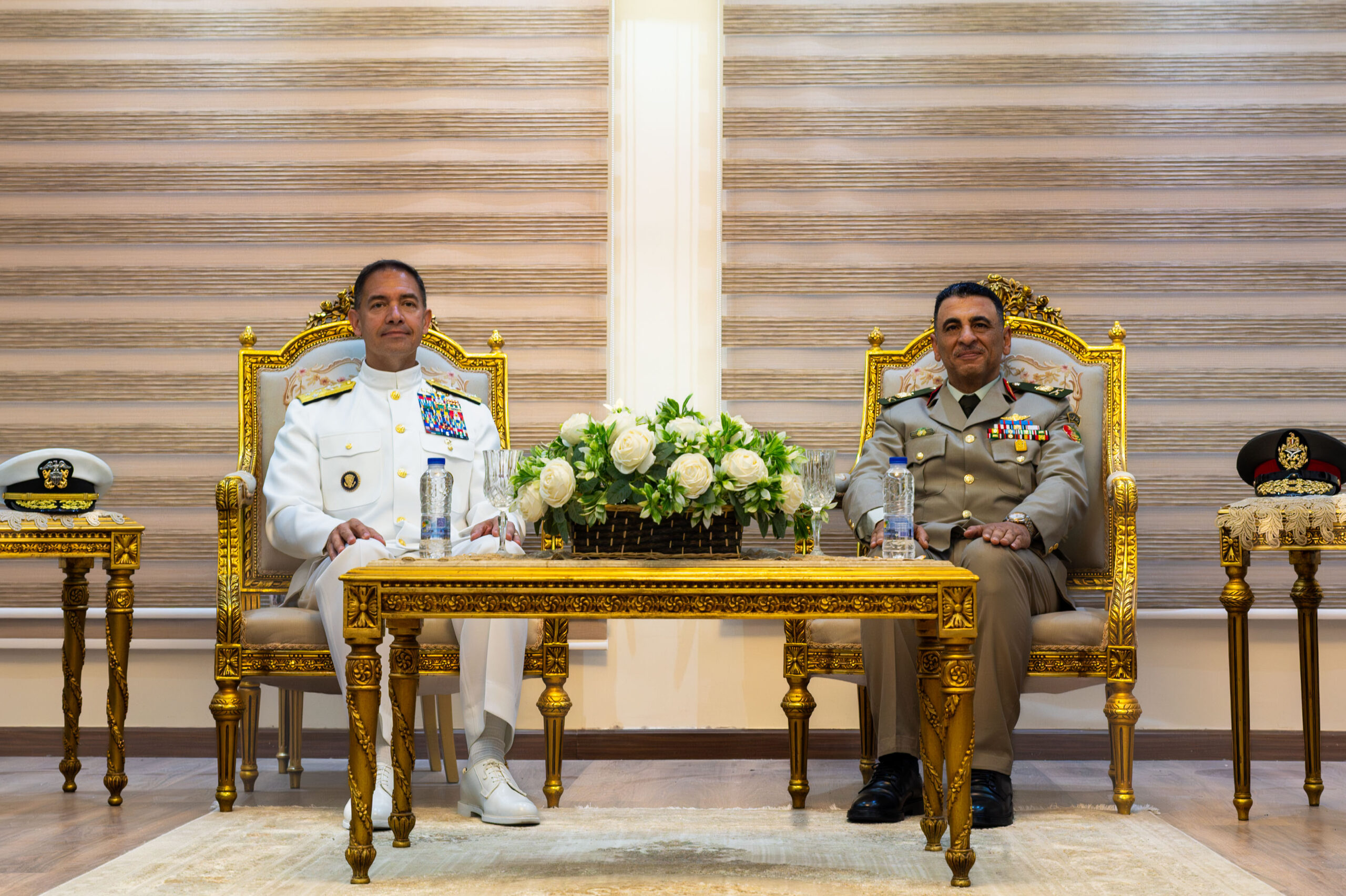
Featured image: From left, U.S. Navy Admiral Brad Cooper, U.S. Central Command commander and Egyptian Army Commander Mohamed Monatser assistant chief of staff of the Central Area pose for a photo after Cooper’s arrival for BRIGHT STAR 25 at Cairo East Air Base, Egypt, Sept. 8, 2025. The U.S. is one of over 40 countries participating in BRIGHT STAR 25, a multinational exercise, showcasing the ability of our collective partners to operate in a joint, high-intensity environment, improving readiness, responsiveness and interoperability. (U.S. Air Force photo by Staff Sgt. Kevin Dunkleberger).
Sources
Cooper, Brad. “Special Briefing via Telephone with Vice Admiral Brad Cooper, Commander, U.S. Naval Forces Central Command, U.S. Fifth Fleet, and Combined Maritime Forces.” U.S. Department of State, May 11, 2022. https://2021-2025.state.gov/special-briefing-via-telephone-with-vice-admiral-brad-cooper-commander-u-s-naval-forces-central-command-u-s-fifth-fleet-and-combined-maritime-forces/
Cooper, Brad. “CENTCOM Commander Bio.” U.S. Central Command, August 2025. https://www.centcom.mil/ABOUT-US/LEADERSHIP/Bio-Article-View/Article/4269737/commander-admiral-brad-cooper/
Center for Strategic and International Studies (CSIS). “Operation Epic Fury and the Remnants of Iran’s Nuclear Program.” CSIS Commentary, March 2, 2026. https://www.csis.org/analysis/operation-epic-fury-and-remnants-irans-nuclear-program
Combined Maritime Forces. “Cooper Hands Over Command of U.S. 5th Fleet to Wikoff.” Combined Maritime Forces Public Affairs, February 1, 2024. https://combinedmaritimeforces.com/2024/02/01/cooper-hands-over-command-of-u-s-5th-fleet-to-wikoff/
Defense-Update. “Operation Epic Fury / Roaring Lion.” Defense Update, March 3–4, 2026. https://defense-update.com/20260303_epic-fury.html
DefenseScoop. “Adm. Cooper Takes the Helm at Centcom.” DefenseScoop, August 11, 2025. https://defensescoop.com/2025/08/11/adm-brad-cooper-commander-centcom-us-central-command/
DefenseScoop. “U.S. Targeting Iran’s Space Capabilities Early into Operation Epic Fury.” DefenseScoop, March 5, 2026. https://defensescoop.com/2026/03/05/operation-epic-fury-targeting-iran-space-capabilities/
Fox News Digital. “Operation Epic Fury Destroys Iran’s Navy and Cuts Missile Attacks by 90% in Ongoing Campaign.” Fox News, March 5, 2026. https://www.foxnews.com/politics/operation-epic-fury-destroys-irans-navy-cuts-missile-attacks-90-ongoing-campaign
Fox News Digital. “Live Updates: CENTCOM Says It’s Eliminating Iranian Threats in Operation Epic Fury with ‘Lethal Precision.'” Fox News, March 5, 2026. https://www.foxnews.com/live-news/us-iran-israel-war-latest-march-5
International Counter Terrorism Institute (ICT). “Operation ‘Epic Fury:’ SITREP (3 MAR 2026).” ICT, March 3, 2026. https://ict.org.il/operation-epic-fury-sitrep-3-mar-2026/
Laird, Robbin. “Task Force 59: Creating Maritime Capabilities for the 5th Fleet Area of Operations.” Second Line of Defense, October–November 2021. https://sldinfo.com/2021/10/task-force-59-creating-maritime-capabilities-for-the-5th-fleet-area-of-operations/
Laird, Robbin. “Task Force 59 Works Concepts of Operations for Unmanned Maritime Systems.” Defense.info, February 23, 2022. https://defense.info/defense-systems/task-force-59-works-concepts-of-operations-for-unmanned-maritime-systems/
Al Majalla. “Why US Naval Presence in the Middle East Matters.” Al Majalla, 2024. https://en.majalla.com/node/312056/politics/why-us-naval-presence-middle-east-matters
U.S. Naval Institute News (USNI). “Vice Adm. Brad Cooper Nominated to Lead U.S. Central Command.” USNI News, June 4, 2025. https://news.usni.org/2025/06/04/vice-adm-brad-cooper-nominated-to-lead-u-s-central-command
White House Office of Communications. “ICYMI: Update from CENTCOM Commander on Operation Epic Fury.” The White House, March 4, 2026. https://www.whitehouse.gov/articles/2026/03/icymi-update-from-centcom-commander-on-operation-epic-fury/
Reshaping Maritime Security and Defense Capabilities in Eastern Mediterranean
The Abraham Accords: The Art of the Deal and Middle East Dynamics
BIDEC 2019: A Window into Bahraini Perspectives on Defense and Security