

By Robbin Laird
For generations, military aviation followed a familiar rhythm. Crises escalated in predictable sequences. Training focused on perfecting physical flying skills. Pilots mastered their aircraft through countless hours of stick-and-rudder practice, building muscle memory that would serve them throughout their careers. That era, according to defense experts examining the future of air combat, is definitively over.
We have entered the age of “chaos management”, a reality defined not by sequential, manageable crises but by simultaneous, overlapping conflicts across multiple domains. Air, land, sea, space, and cyber operations now converge in what experts describe as “total networked ambiguity.” This fundamental shift demands an equally fundamental transformation in how we prepare fighter pilots for combat. The question is no longer whether pilots can master their aircraft, but whether they can command the information battlespace while their aircraft does the flying.
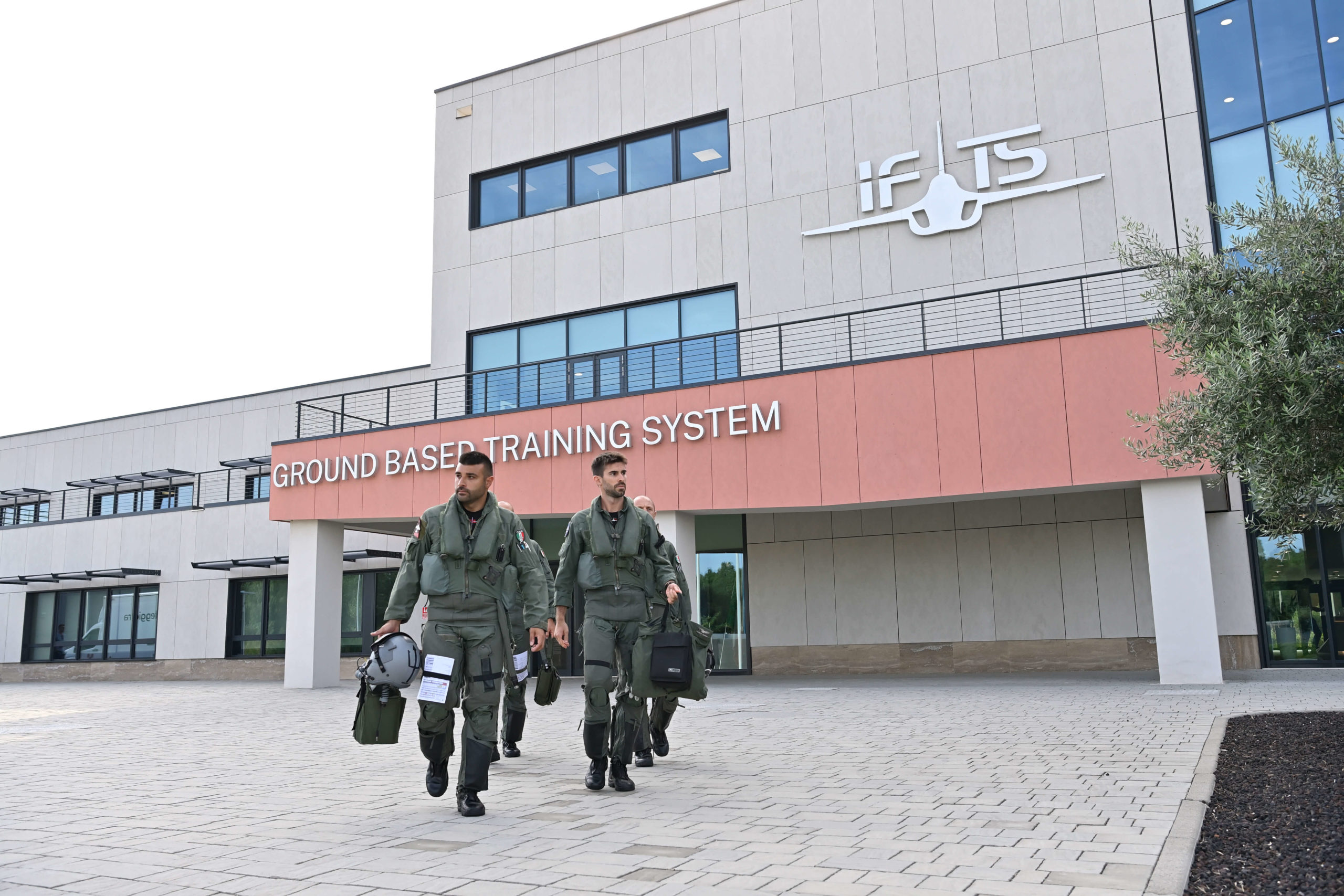
At the center of this training revolution sits an unlikely location: a facility in Decimomannu, Sardinia, where Italy’s International Flight Training School (IFTS) is pioneering solutions to challenges that have plagued military aviation for decades. Through an innovative combination of technology, partnership models, and radically different training philosophy, IFTS represents not just an incremental improvement but a complete reimagining of how to create the fighter pilots that modern warfare demands. I visited IFTS in October 2025 and my visit underscored the reality of the dynamics of change in pilot training.
The Hidden Crisis in Traditional Training
To understand why IFTS matters, we must first confront an uncomfortable truth about conventional pilot training: for decades, it was actively causing damage. The problem, which experts call “negative transfer,” was insidious precisely because it seemed benign. Consider a pilot spending hundreds of hours in a legacy trainer like the T-38, a design now over sixty years old. During that time, the pilot physically embeds specific instincts, motor skills, formation techniques, and procedures deep into muscle memory. These habits become automatic, reflexive, unquestioned.
Then that same pilot transitions to a fifth-generation fighter like the F-35 or Eurofighter Typhoon, and those deeply ingrained habits actively work against them. The old skills don’t just fail to help—they actively interfere with the cognitive patterns needed for modern operations. It’s the equivalent of learning to type on a manual typewriter and then being asked to write complex software code. The fundamental interface has changed so completely that the old expertise becomes an obstacle rather than a foundation.
The story of Lieutenant Colonel “Chip” Burke, an experienced F/A-18 Hornet pilot transitioning to the F-22 Raptor, crystallizes this paradox. Despite his extensive combat experience and thousands of flight hours, Burke found himself consistently outperformed by pilots with far less total experience. The problem wasn’t his flying ability—he remained a master aviator. The issue was what he termed his “Hornet brain,” which kept making fourth-generation tactical choices in an information-rich fifth-generation environment. Those choices, honed over years of operational experience, proved instantly and consistently wrong in the new context.
This paradox reflects a deeper transformation in what modern fighters actually are. The phrase “easier to fly, harder to employ” captures the essential challenge. Fifth-generation platforms use sophisticated flight control computers to handle basic stability and maneuvering, deliberately freeing the pilot’s cognitive bandwidth for other tasks. The pilot’s job has shifted from worrying about keeping the aircraft stable to commanding a vast sensor fusion ecosystem, managing terabytes of data, and employing incredibly complex weapons systems.
An F-35, in this context, functions less like a traditional fighter and more like what one expert described as “a flying iPhone for the whole operation.” It can simultaneously push tailored, relevant tactical data to a general in the Combined
Air Operations Center and to a wingman ten miles away. The pilot doesn’t just fly the jet—they orchestrate this entire information ecosystem. The mission has transformed from being a competent flyer to becoming what strategists now call a “node of command” in the distributed kill web.
The LVC Revolution: Building Training That Matches Reality
If traditional training methods were creating negative transfer, and if modern pilots need fundamentally different cognitive skills, then incremental improvements wouldn’t suffice. The solution had to be revolutionary, which brings us to the core innovation at IFTS: Live-Virtual-Constructive (LVC) training integration.
LVC training blends three distinct elements into a seamless whole. The “live” component consists of actual aircraft flying real sorties. The “virtual” component encompasses high-fidelity ground-based simulators. The “constructive” element adds computer-generated forces, threats, and environmental conditions. While other air forces have experimented with these concepts, IFTS has achieved something distinctive through what they call the “one simulation” principle.
This principle ensures that the operational flight program software running on the actual M-346 advanced trainer aircraft is identical to the software running in ground-based simulators. This isn’t merely similar or comparable—it’s the exact same code base. This eliminates the disconnect that has plagued training for generations, where habits learned in simulators required adjustment when transitioning to actual aircraft. At IFTS, what students practice on the ground transfers directly to flight operations because the simulation is identical to the reality.
The economic implications are substantial. Because the M-346 was designed specifically for LVC integration through its embedded tactical training system (ETTS), students can practice extremely complex scenarios—simulating laser-guided bomb employment, beyond-visual-range active radar missile tactics, advanced electronic warfare—at roughly one-third the cost per flying hour of an operational Eurofighter. This cost difference isn’t marginal; it’s transformational. It means students can practice high-end scenarios repeatedly until they achieve genuine mastery, rather than being limited to one or two expensive training sorties in frontline aircraft.
The system is also designed for evolution. The planned Block 20 upgrade for the M-346 will introduce large touchscreen displays similar to the F-35 and advanced helmet-mounted display integration. This means students will train on the actual human-machine interface they’ll encounter in fifth-generation cockpits, building familiarity with complex digital systems before they even reach operational squadrons.
Through the ETTS system, instructors on the ground can inject an entire synthetic battle package around that aircraft: hostile fighter formations, sophisticated surface-to-air missile systems, threats emerging from maritime environments, dense electronic warfare conditions.
Crucially, these aren’t abstract symbols on a planning map. They appear on the pilot’s actual cockpit displays, trigger their radar warning receiver, and interact with the aircraft’s sensors exactly as real threats would. The aircraft’s own systems perceive these synthetic entities as genuine threats. The pilot experiences authentic tactical pressure, must manage realistic information overload, and faces consequences for poor decisions, all while actually flying through real airspace with real weather and real aircraft performance characteristics.
This capability enables training scenarios that would be impossible, prohibitively expensive, or dangerously risky using only live assets. Instructors can saturate pilots with simultaneous threats, introduce unexpected complications, and replicate the kind of dense, chaotic environment that defines modern warfare. Rather than training pilots to follow predetermined scripts, they’re conditioning them to make rapid decisions amid authentic confusion and ambiguity.
The Sistema Paese
The technology alone doesn’t explain IFTS’s success. Equally important is the organizational structure supporting it—what Italians call “sistema paese,” or country system approach. This represents a sophisticated public-private partnership that maintains clear boundaries while enabling remarkable efficiency.
The Italian Air Force owns the training syllabus and sets operational standards, maintaining complete control over what gets taught and why. Industry partners—principally Leonardo and CAE—provide the how: the aircraft, simulators, maintenance infrastructure, and support systems needed to sustain high-tempo operations. This division of responsibility delivers measurable results: aircraft availability rates averaging around seventy percent and, more impressively, approximately ninety-five percent of all scheduled training sorties actually completed.
This reliability matters enormously for training effectiveness. Canceled sorties don’t just waste time—they disrupt learning progression, create training gaps, and reduce the number of repetitions students need to build genuine expertise. The IFTS system’s consistency ensures students can progress through their training pipeline predictably and efficiently.
The Living Curriculum: Adapting at the Speed of Relevance
Perhaps the most distinctive characteristic of IFTS isn’t any single piece of technology but rather the speed at which the entire system can adapt. The curriculum isn’t a static document approved years in advance. It’s a living system that can be updated within weeks of identifying new operational requirements.
This responsiveness comes from an engineered feedback loop. Instructors from operational F-35 and Eurofighter squadrons, the Phase Five instructors actually flying combat missions, regularly sit down with Phase Four IFTS instructors. They review procedures, discuss tactics, identify what’s working and what isn’t. When something changes in the operational world, perhaps a NATO air policing mission encounters new adversary radar behavior, or a deployment reveals gaps in coalition procedures, that information flows directly back to IFTS.
Instructors can immediately update simulation parameters, adjust scenario complexity, and modify training emphasis. Within weeks, students are training against the latest intelligence, facing current threats rather than historical assumptions. The result is measurable: graduates from IFTS Phase Four now require approximately twenty to thirty percent less training time when they reach their Eurofighter Operational Conversion Units. They arrive with what instructors call “the right mental furniture already in place”—the cognitive patterns, information management skills, and decision-making frameworks that fifth-generation operations demand.
Building Coalition Competence From Day One
The benefits of this system extend well beyond Italy’s borders. IFTS deliberately operates as an international facility, training pilots from the United States, Canada, Japan, Qatar, the United Kingdom, Germany, and over a dozen other nations. This isn’t merely a business model: it’s a strategic choice to build coalition competence from the earliest stages of pilots’ careers.
When pilots from different nations train together, they develop more than just shared technical procedures. They build a common tactical language, learn to anticipate each other’s responses, and forge the personal relationships that become crucial during complex multinational operations. They learn to think and communicate as coalition forces before they ever face actual combat together.
Italy is positioning itself as a central hub for advanced NATO training through this approach. The plan to establish the first F-35 pilot training center outside the United States, at Trapani-Birgi in Sicily, reinforces this strategic positioning. Combined with the major F-35 assembly and final checkout facility at Cameri, Italy is making a substantial commitment to becoming Europe’s center of gravity for fifth-generation training and sustainment.
The Next Frontier: Training Humans to Command Machines
Which brings us to perhaps the most provocative question raised by IFTS’s capabilities. The LVC system can already realistically simulate wingmen operating ten miles apart, all connected through data links in a distributed fight. It creates authentic training pressure for managing separated formations, coordinating actions across distances, and maintaining situational awareness of dispersed forces.
But if this training environment can realistically simulate human wingmen at such distances, how quickly must it adapt to integrate simulated autonomous wingmen?
The collaborative combat aircraft (CCAs) that every major air force is developing will fundamentally change the pilot’s role once again. Instead of commanding only human wingmen, pilots will potentially direct and control semi-autonomous or fully autonomous platforms flying in formation, executing complex missions with varying degrees of independence.
This represents the next evolution in the pilot’s transformation from stick-and-rudder aviator to information system manager to, ultimately, commander of a hybrid human-machine formation. The challenge for systems like IFTS is preparing pilots not just for today’s technologies but for capabilities that don’t yet fully exist. The training infrastructure itself must evolve perhaps even faster than the threats it’s designed to counter.
Conclusion: Adaptation as Doctrine
The revolution in fighter pilot training that IFTS represents isn’t fundamentally about new hardware, though the technology matters. It’s about recognizing that the cognitive demands of modern air combat have diverged so completely from traditional flying skills that incremental training improvements are insufficient. Success requires fundamentally reimagining what pilots need to know, how they need to think, and what kinds of decisions they must make at machine speed.
The IFTS model works because its entire philosophy is built around continuous adaptation. It doesn’t just train pilots for current aircraft or present threats. It creates a system designed to evolve alongside warfare itself. When the operational environment changes, the training changes with it, sometimes within weeks. When new technologies emerge, the system incorporates them rather than resisting them.
This approach acknowledges an essential truth about modern military aviation: in an era of chaos management, where simultaneous crises across multiple domains create unprecedented complexity, the most valuable skill isn’t mastering a specific platform or procedure. It’s the ability to adapt, learn, and make sound decisions under conditions of radical uncertainty.
That capability can’t be implanted through rote repetition of outdated skills. It must be cultivated through training that itself embraces complexity, accepts ambiguity, and prepares pilots not for the last war but for conflicts we can’t yet fully imagine.
In that sense, what happens in Sardinia isn’t just about pilot training. It’s a case study in how military institutions can overcome institutional inertia, overcome the negative transfer of outdated methods, and build systems that are genuinely prepared for an uncertain future. That might be the deepest lesson of all: that adaptation must be more than a buzzword: it must become doctrine itself.
Training for the High-End Fight: The Paradigm Shift for Combat Pilot Training
For a video discussing the book, see the following:
For a podcast discussing the book, see the following:
Training Combat Pilots for the Kill Web Era: A Strategic Evolution