By Robbin Laird
November 2025 articles published in The Australian reveal a troubling disconnect at the heart of Australian policy toward China, one that raises fundamental questions about how democracies should respond to authoritarian pressure while maintaining essential economic relationships. The contrast between Foreign Minister Penny Wong’s carefully calibrated diplomatic messaging and the stark, unvarnished warnings from Australia’s intelligence chiefs suggests a government struggling to reconcile competing imperatives: economic pragmatism and national security realism.
This divide is not merely a matter of different communication styles or bureaucratic turf protection. It reflects a deeper tension in Australian strategic thinking about how to manage the most consequential relationship in the Indo-Pacific region. The question is whether Australia’s current approach, maintaining diplomatic courtesy while intelligence officials sound alarm bells, represents sophisticated statecraft or dangerous self-deception.
The Diplomat’s Careful Balance
Foreign Minister Wong’s address to the Australian Institute of International Affairs exemplified the government’s preferred narrative on China. Her speech emphasized the necessity of engagement, arguing that Australia has “no choice” but to work closely with Beijing to safeguard economic prosperity. She rejected what she termed the “false binary” between protecting sovereignty and maintaining productive economic ties, insisting that both objectives can be pursued simultaneously.
Wong’s language was measured and strategic. She acknowledged that China would “continue trying to reshape the region according to its own interests”, a diplomatic formulation that sounds more like normal major power behavior than a threat to the regional order. When discussing countries that “continue to sabotage and destabilise,” she conspicuously named only Russia, Iran, and North Korea, placing China in a different, seemingly more benign category.
This rhetorical choice is revealing. By comparing China favorably to these overtly revisionist states, Wong implicitly suggests that Beijing, despite its assertiveness, remains a potential partner rather than an adversary. Her speech emphasized dialogue “at every level,” including military-to-military communications, and highlighted the government’s success in stabilizing ties “without compromising on our interests.”
The economic rationale behind this approach is compelling. China remains Australia’s largest trading partner, with two-way trade reaching $312 billion in 2024. Trade Minister Don Farrell projects this could hit $400 billion by decade’s end. For a trading nation like Australia, maintaining access to Chinese markets is not simply desirable—it is seen as essential for national prosperity. The painful memory of $20 billion in trade sanctions imposed by Beijing between 2020 and 2023 remains fresh, providing a powerful incentive to avoid provocative language.
The Intelligence Chiefs’ Blunt Assessment
Standing in stark contrast to Wong’s diplomatic caution are the public statements from ASIO Director-General Mike Burgess and outgoing Office of National Intelligence Director-General Andrew Shearer. These intelligence professionals have adopted what The Australian describes as the role of “Canberra’s honest hawks,” speaking with a directness about the China threat that would be unthinkable from government ministers.
Burgess warned business leaders of an “explosion” in Chinese state-sponsored cyber attacks aimed at infiltrating Australia’s critical infrastructure. In language deliberately crafted to cut through bureaucratic euphemism, he painted vivid scenarios: “Imagine the implications if a nation state took down all the networks? Or turned off the power during a heatwave? Or polluted our drinking water? Or crippled our financial system?” His assessment: “These are not hypotheticals, foreign governments have elite teams investigating these possibilities right now.”
Burgess made clear, with minimal diplomatic obfuscation, that China leads this threat: “one nation state, no prizes for guessing which one, conducting multiple attempts to scan and penetrate critical infrastructure in Australia and other Five Eyes countries.” This represents a “high-impact sabotage” capability that Beijing has systematically developed and could deploy in a crisis or conflict.
Shearer’s warnings were equally stark. He described Beijing as “taking advantage of Australia’s preference for restraint to distract and divide us… and chip away at our resolve.” He characterized Xi Jinping’s government as waging a “concerted campaign of military intimidation and state-sponsored hacking against Australia and its closest partners,” emphasizing that it was “vital to ‘be candid’ about the threat.”
These assessments reflect not speculation but classified intelligence about China’s actual capabilities and intentions. When Shearer warned that “the rules and norms that once gave us stability and supported unprecedented global prosperity are fading,” he was describing a strategic environment fundamentally different from the one Wong’s diplomatic language seems to inhabit.
Beijing’s response to Burgess’s remarks, lodging an official protest and accusing him of spreading “disinformation” and “deliberately sowing division and confrontation”, only confirmed the accuracy and impact of his assessment. Authoritarian regimes protest most vigorously when uncomfortable truths are publicly articulated.
The Evidence of Chinese Aggression
The intelligence chiefs’ warnings are supported by a mounting body of evidence about Chinese behavior. A People’s Liberation Army Air Force jet fired flares into the path of an Australian surveillance aircraft over the South China Sea in October 2024. a dangerous act that could have caused catastrophe. PLA Navy warships conducted a circumnavigation of Australia earlier in the year in what defense experts characterized as a rehearsal for potential attacks on Australian cities.
Wong acknowledged Australia faced surging “disinformation, interference, transnational repression, cyber attacks and the unregulated use of AI”, all tools being deployed by Beijing to disrupt the rules-based order. She spoke of a “collapse of truth” with “false voices, fabricated images, manufactured narratives, algorithms amplifying fiction masquerading as fact.” Yet she attributed this malicious behavior to unspecified “others” who wanted to “tear at the fabric of our cohesion,” rather than naming China directly.
This rhetorical gap, acknowledging threats while avoiding attribution, captures the government’s dilemma. The threats are real and growing, but naming China as their source risks the hard-won stabilization of diplomatic and economic relations achieved since Labor took power in 2022.
The Strategic Question: Hawks or Doves?
The question raised by The Australian‘s coverage is whether this two-track approach, diplomatic engagement coupled with intelligence warnings, represents coherent policy or dangerous contradiction. There are arguments on both sides.
The case for the current approach rests on the premise that Australia must pursue what might be called “competitive coexistence” with China. This means maintaining economic integration while building defensive capabilities, engaging diplomatically while preparing for confrontation, and preserving channels of communication even as strategic competition intensifies. In this view, Wong’s measured language keeps dialogue open while intelligence chiefs ensure the public and private sectors understand the real threats they face.
This division of labor has historical precedent. During the Cold War, Western governments often maintained diplomatic courtesy with the Soviet Union while intelligence agencies publicly documented Soviet espionage and subversion. The practice allowed for necessary engagement without papering over fundamental conflicts of interest and values.
The counterargument, however, is that overly cautious diplomatic language can itself become a strategic vulnerability. If the government appears unwilling to speak plainly about Chinese threats, it may send the wrong signals, to Beijing, to allies, and to the Australian public. Beijing might interpret diplomatic restraint as weakness or division, encouraging further pressure. Allies might question Australia’s commitment to regional security if economic considerations consistently trump security concerns in public messaging. The Australian public might fail to understand the scale of the challenge and the investments required to meet it.
Moreover, there is something unsettling about a situation where only intelligence officials, not elected ministers responsible for foreign policy, are willing to speak candidly about threats to national security. This suggests either that the government’s public position differs from its private assessment, or that diplomatic and security agencies are operating with fundamentally different threat perceptions.
The Cost of China’s Trade Leverage
Wong emphasized that the government had prioritized trade diversification to guard against future economic coercion. Yet the reality is that efforts to boost trade with India and Southeast Asia have largely stalled, while China trade continues to grow. This reflects a deeper problem: China’s sheer economic scale and Australia’s commodity export profile make genuine diversification extremely difficult.
Beijing understands this leverage and has demonstrated willingness to weaponize economic interdependence. The 2020-2023 trade sanctions, imposed because Australia called for an investigation into COVID-19’s origins, showed how quickly economic ties can be turned into instruments of coercion. The fact that these sanctions were progressively removed after Labor adopted a more conciliatory tone suggests that Beijing sees diplomatic language as having strategic value.
The question is whether Australia is buying necessary breathing space through diplomatic restraint, or inadvertently teaching Beijing that economic pressure produces desired changes in Australian behavior. If the latter, then Wong’s measured approach may be storing up greater problems for the future.
The Path Forward
The tension between Australia’s diplomatic and intelligence voices on China reflects genuine complexity in the relationship. China is simultaneously an essential economic partner and a strategic competitor whose authoritarian system and regional ambitions conflict with Australian interests. There may be no purely satisfactory way to manage this contradiction.
However, the current approach carries risks that deserve acknowledgment. By leaving candid threat assessment primarily to intelligence officials rather than political leaders, the government may be avoiding necessary public education about the scale of the China challenge. Building the national resilience and defensive capabilities that both Wong and the intelligence chiefs agree are necessary will require sustained public support and investment—support that depends on honest communication about the threats Australia faces.
The intelligence chiefs’ willingness to speak plainly, even at the cost of Chinese protests, suggests they believe the Australian public needs and deserves straight talk about national security. The question is whether the government’s diplomatic approach adequately complements this message or undermines it.
As The Australian‘s coverage makes clear, Australia currently has two voices speaking about China, the diplomat’s careful calibration and the intelligence professional’s blunt assessment. For policy to be effective, these voices need not be identical, but they should at least be mutually reinforcing rather than contradictory. Whether the current balance serves Australia’s interests, or whether greater candor from political leaders is required, remains an open and urgent question as strategic competition in the Indo-Pacific continues to intensify.
Ben Packham, “Penny Wong backs China ties amid disinformation, ‘collapse of truth’”,
The Australian, November 17, 2025.
Cameron Stewart, “Only one China, but two ways to talk about it”,
The Australian, November 17, 2025.
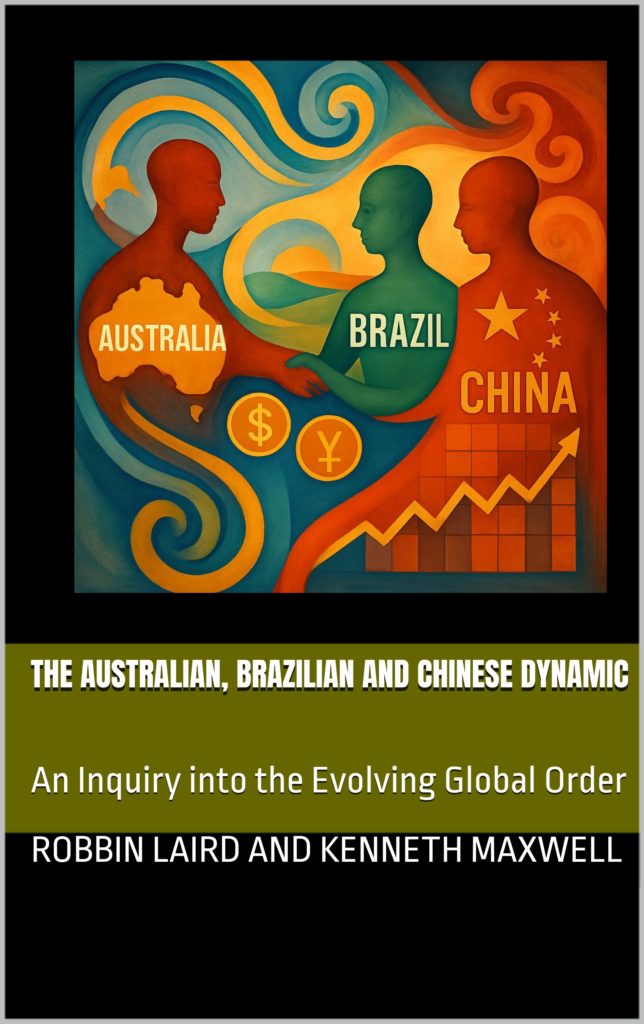
I am publishing with Kenneth Maxwell later this year a look at Global China and its approach to two critical middle powers, Australia and Brazil, and the impact on the dynamically changing global system.