By Robbin Laird
On February 11, 2026, Allied Command Operations (ACO), which is responsible for the planning and execution of all NATO exercises, activities and operations, noted that they began Arctic Sentry.
The multi-domain activity will further strengthen NATO’s posture in the Arctic and High North as persistent NATO presence in the region grows.
“Arctic Sentry underscores the Alliance’s commitment to safeguard its members and maintain stability in one of the world’s most strategically significant and environmentally challenging areas,” said U.S. Air Force Gen. Alexus G. Grynkewich, Supreme Allied Commander Europe.
“It will leverage NATO’s strength to protect our territory and ensure the Arctic and High North remains secure.”
This builds on NATO’s growing focus on Arctic security and follows a meeting between U.S. President Donald J. Trump and NATO Secretary General Mark Rutte last month in Davos, Switzerland, where the two leaders agreed that NATO should collectively take more responsibility for the defence of the region considering Russia’s military activity and China’s growing interest there.
The preparations for Arctic Sentry provided NATO planners with full visibility of Allied nations’ activities in the Arctic and High North. Moving forward, ACO will use Arctic Sentry to cohere these actions into one overarching operational approach to Allies’ increasing activities, which will enhance NATO’s presence there.
These activities include, among others, Denmark’s Arctic Endurance, a series of multi-domain exercises designed to enhance Allied ability to operate in the region, and Norway’s upcoming exercise Cold Response, where troops from across the Alliance have already begun to arrive.
Arctic Sentry will be led by Joint Force Command Norfolk (JFC Norfolk), the Alliance’s newest Joint Force Command, whose area of responsibility, since December, now includes this entire region.
“In terms of NATO’s Joint Force Commands, Norfolk is the bridge between North America and Europe, defending the strategic approaches between the two continents and much more,” said Grynkewich, who received a briefing on Arctic Sentry planning from the joint force command there yesterday.
ACO and JFC Norfolk will collaborate with Allied Command Transformation and coordinate activities with the U.S. and Canada’s North American Regional Aerospace Defense Command (NORAD), as well as with U.S. Northern Command and U.S. European Command.
NATO’s new Arctic Sentry activity is best understood as the High North successor to Baltic Sentry, carrying forward a model in which maritime autonomous systems (MAS) and other uncrewed platforms underpin persistent surveillance, critical‑infrastructure protection, and distributed deterrence in contested waters.
Together, these initiatives signal a shift from episodic presence to a web of manned and unmanned assets designed to monitor and shape the battlespace from the seabed to space, with MAS at the heart of that transition.
When NATO Secretary General Mark Rutte announced Baltic Sentry in January 2025, it was framed as a direct response to a rash of attacks and suspected sabotage against pipelines and telecommunications cables in the Baltic Sea. The mission combined frigates, maritime patrol aircraft (MPA), and a “small fleet of naval drones,” and was explicitly tasked to bolster the protection of critical undersea infrastructure and improve the Alliance’s ability to respond to destabilizing acts. In practice, Baltic Sentry became an operational laboratory for blending traditional naval presence with new technologies, including uncrewed underwater vehicles (UUVs), surface drones, and AI‑enabled surveillance architectures.
A year later, Arctic Sentry emerges as a multi‑domain “enhanced vigilance activity” that extends this logic northward. Led by Joint Force Command Norfolk under Allied Command Operations, Arctic Sentry is designed to knit together national exercises, allied forces, and advanced sensors across the Arctic and High North. NATO documents and official commentary stress that the activity’s emphasis is on coordination, surveillance, and situational awareness rather than a large new permanent force posture, but planners also acknowledge that filling surveillance and infrastructure gaps will demand heavy use of drones and other uncrewed systems.
This continuity is not accidental. Defence24’s coverage notes explicitly that Arctic Sentry is “based on” Baltic Sentry and seeks to apply its approach to the broader Arctic theater, where Russian and Chinese activities, melting sea ice, and new sea routes are transforming the strategic environment. In that sense, Baltic Sentry is the prototype: a concentrated experiment in using MAS to protect underwater infrastructure and deter hybrid threats in a constrained sea. Arctic Sentry is the scaling effort, meant to apply the same manned–unmanned mix to a far larger, harsher, and more politically complex region.
Baltic Sentry’s stated mission was to enhance NATO’s presence and resilience in the Baltic Sea, particularly regarding critical undersea infrastructure. NATO’s launch announcement emphasized a blend of assets—frigates, MPA, “new technologies,” and naval drones—while stressing cooperation with national surveillance systems and industry through a Critical Undersea Infrastructure Network. The key innovation was not simply adding drones to an existing task group, but using them to thicken the Alliance’s underwater sensor grid and shorten the detect‑to‑act chain against shadow fleets and covert sabotage.
Open‑source reporting suggests that Baltic Sentry evolved over 2025 into a broader technology and concept‑development venue. American University’s analysis of Baltic Sea infrastructure security describes an operation that uses ships, aircraft, drones, artificial intelligence, and UUVs to monitor the seabed, map cable routes, and identify suspicious activity, including sanction‑evading “rogue vessels.” Stars and Stripes’ coverage of a U.S. destroyer joining Baltic Sentry underlines that the mission has expanded beyond pure infrastructure protection to include airspace defense and counter‑drone deterrence in the region. U.S. Navy P‑8 patrol aircraft and air‑defense frigates have been brought in to cope with repeated incursions by unidentified drones, linking the undersea security mission to a broader aerial and electromagnetic contest.
Within this construct, MAS play several distinct roles:
- Persistent seabed sensing and cable surveillance. UUVs and bottom‑mounted sensors can patrol, map, and monitor critical cables and pipelines, signaling anomalies that might indicate tampering or sabotage.
- Surface pickets and patrols. Naval drones and small USVs augment manned ships in tracking commercial and “shadow” vessels, extending coverage at lower cost and risk.
- Data fusion and anomaly detection. AI tools applied to continuous data streams from MAS, ships, and MPA enable early detection of suspicious behavior such as loitering near cables or erratic navigation by under‑flagged vessels.
Breaking Defense and others have argued that missions like Baltic Sentry should be used as proving grounds for combining manned and unmanned platforms in a “mesh” that can generate deterrent effects across the conflict spectrum—from day‑to‑day transparency and attribution to rapid response if sabotage is detected. In effect, the Baltic is where NATO has begun learning how to run a kill‑web‑style maritime surveillance architecture in practice, with MAS as key nodes.
Arctic Sentry, announced in February 2026, exports this model into a domain where the operational problems are more severe and the opportunities for MAS are greater. NATO’s Arctic security page describes Arctic Sentry as a multi‑domain activity that strengthens the Alliance’s posture by coordinating exercises, surveillance, and operations across the Arctic and High North, under the leadership of JFC Norfolk. It is categorized as an “enhanced vigilance activity,” aligning it with other regional frameworks like Baltic Sentry and Eastern Sentry.
Media and think‑tank coverage highlight three drivers behind Arctic Sentry:
- Intensifying Russian military presence and dual‑use infrastructure across the Arctic, including bases, airfields, and a growing ice‑capable fleet.
- Increased Chinese diplomatic and commercial engagement in the High North, including shipping, energy, and potential dual‑use scientific activities.
- The political impetus generated by disputes surrounding Greenland and U.S. calls for NATO allies to assume more responsibility for Arctic defense.
NATO emphasizes that Arctic Sentry is not about building new permanent bases or deploying large increments of forces, but about “leveraging what we are doing much more effectively” and identifying gaps that need to be filled. Officials cite a heavy reliance on improved intelligence sharing, existing air and maritime assets, and drones to achieve persistent surveillance and rapid coordination across a vast, sparsely populated region with limited infrastructure.
Here, uncrewed systems become less an add‑on and more a structural necessity. CEPA’s “High Stakes in the High North” report argues that uncrewed systems—air, surface, and subsurface—are indispensable for NATO and its Arctic allies because they can extend domain awareness, enhance “deterrence by detection,” and multiply targeting options in an environment where manned patrols are costly, dangerous, and limited. The report notes that melting ice and new sea routes are opening corridors that adversaries can exploit, and asks how NATO can secure its northern flank and infrastructure when distances are vast and weather is punishing. Its answer is a maritime sensing mesh: a network of uncrewed platforms that widens detection windows, shortens response times, and enables near‑persistent monitoring of choke points, transit routes, and under‑ice approaches.
In this sense, Arctic Sentry can be read as the political‑military wrapper around precisely the kind of MAS‑enabled sensing mesh CEPA describes. By bundling exercises like Denmark’s Arctic Endurance and Norway’s Cold Response under a single umbrella, NATO creates a framework in which uncrewed systems can be systematically tested, integrated, and scaled across multiple national contexts. The activity’s focus on coordination and gap assessment creates an institutional demand signal: where human crews and legacy platforms cannot provide sufficient coverage, uncrewed systems become the default solution.
Uncrewed systems in Arctic and High North operations can be grouped into four broad operational roles that mirror, but also extend, their Baltic use.
- First, they serve as persistent domain‑awareness platforms. Long‑endurance UAVs, high‑latitude‑capable MQ‑9 or MQ‑4‑type systems, USVs, and UUVs can watch shipping lanes, chokepoints, and under‑ice approaches far more continuously than manned patrols. CEPA notes that this persistent sensing enables deterrence by detection: if Russian or Chinese vessels know that their actions are likely to be observed, recorded, and shared across the Alliance, their freedom to conduct covert or ambiguous activities shrinks.
- Second, MAS contribute to critical‑infrastructure protection. Just as Baltic Sentry uses UUVs and AI to monitor underwater cables and pipelines, Arctic Sentry can leverage uncrewed systems to surveil seabed installations, energy infrastructure, and emerging routes in places like the Barents, Norwegian, and Greenland seas. The combination of mobile UUV patrols, fixed sensor arrays, and surface drones provides a layered picture of the undersea environment, making it harder for adversaries to tamper with or map critical assets undetected.
- Third, uncrewed platforms support targeting and fire support for traditional forces. CEPA’s analysis points out that uncrewed systems improve targeting options, allowing allied maritime and air forces to hold adversary assets at risk across greater distances and in more complex environments. In a kill‑web construct, MAS act as sensors and, in some cases, as shooters or electronic‑warfare nodes, cueing manned platforms and cross‑domain fires. This logic parallels U.S. 5th Fleet’s Task Force 59 in the Gulf and NATO’s Task Force X in the Baltic, which both use uncrewed systems to feed a common operational picture and drive more agile responses.
- Fourth, MAS can enhance logistics, SAR, and resilience. While less emphasized in headline reporting, uncrewed systems can move supplies, support search‑and‑rescue, and monitor environmental hazards in regions where human access is difficult and dangerous. Scenario work on autonomous vessels in the Arctic underlines their potential to support safety of navigation, emergency response, and environmental monitoring along emerging sea routes, roles that directly reinforce NATO’s resilience and security objectives.
All of these roles are tempered by environmental and technical challenges. CEPA stresses that extreme cold, remoteness, limited communications, and unique logistical demands reduce reliability and increase sustainment burdens for uncrewed systems in the Arctic. NATO’s ability to turn MAS into genuinely transformative tools will depend on procurement speed, specialized infrastructure, doctrinal adaptation, and training tailored to Arctic operations. Arctic Sentry, by systematically organizing allied training and surveillance, offers a vehicle to address these integration and sustainment issues in a coherent way.
What ties Baltic Sentry, Arctic Sentry, and the broader MAS agenda together is a conceptual move from platform‑centric presence to network‑centric vigilance. Baltic Sentry demonstrated that protecting cables and pipelines in a constrained sea requires not just more ships, but a layered sensor web that fuses data from drones, UUVs, MPA, and national surveillance systems. Arctic Sentry takes that insight into a domain where the human footprint is thin and distances are vast, implicitly making uncrewed systems central rather than peripheral.
The CEPA report’s notion of a “maritime sensing mesh” maps closely onto this emerging NATO practice. In such a mesh, each uncrewed platform is a node that can share data, hand off tracks, and be retasked dynamically, supporting a wider kill web in which any sensor can inform any shooter across domains. Applied to the High North, this means that an underwater drone detecting anomalous activity near a cable, a USV tracking a suspicious surface vessel, and a high‑altitude UAV monitoring airspace all feed into a common operational picture that JFC Norfolk and national commands can act on.
Arctic Sentry’s design as an enhanced vigilance activity, rather than a one‑off showcase, suggests that NATO is moving toward making this mesh routine. By aggregating national exercises like Arctic Endurance and Cold Response into a coherent framework, the Alliance can iteratively refine how MAS are deployed, how data is fused and shared, and how gaps are identified and filled—whether by new sensors, different basing, or doctrinal adjustments. In that sense, Arctic Sentry is not just another exercise umbrella; it is an institutional mechanism for embedding MAS into the fabric of High North deterrence and defense.
Sources:
NATO and official documents
NATO. “NATO Secretary General Outlines New Activity ‘Arctic Sentry’ Ahead of Defence Ministers’ Meeting.” News article, 10 February 2026. https://www.nato.int/en/news-and-events/articles/news/2026/02/11/nato-secretary-general-outlines-new-activity-arctic-sentry-ahead.
NATO. “NATO Launches ‘Baltic Sentry’ to Increase Critical Infrastructure Security.” News article, 13 January 2025. https://www.nato.int/en/news-and-events/articles/news/2025/01/14/nato-launches-baltic-sentry-to-increase-critical-infrastructure-security.
News and analytical coverage of Arctic Sentry
Defence24. “NATO Launches the Arctic Sentry Mission.” 12 February 2026. https://defence24.com/armed-forces/nato-launches-the-arctic-sentry-mission.
NHK World-Japan. “NATO Launches ‘Multi-Domain Activity’ Focused on Arctic.” 11 February 2026. https://www3.nhk.or.jp/nhkworld/en/news/20260212_N01/.
The Arctic Institute. “The Arctic This Week: Take Five – Week of 9 February, 2026.” 12 February 2026. https://www.thearcticinstitute.org/arctic-week-take-five-week-9-february-2026/.
Baltic Sentry, Baltic Sea security, and undersea infrastructure
American University, School of International Service, Transatlantic Policy Center. “NATO’s Need for Regional Cooperation in Baltic Sea Infrastructure Protection: Securing the Depths.” 31 December 2024. https://www.american.edu/sis/centers/transatlantic-policy/articles/20250424-securing-the-depths.cfm.
Naval News. “NATO ACT Deploys Unmanned Vehicles for Surveillance in the Baltic Sea.” 7 July 2025.
Stars and Stripes. “Navy Destroyer Joins NATO Baltic Sea Mission amid Growing Drone Threat from Russia.” 30 September 2025. https://www.stripes.com/branches/navy/2025-10-01/russia-baltic-nato-bulkeley-19285177.html.
Breaking Defense. “Baltic Sentry Mission Could Provide Proving Ground for NATO’s Underwater Drones.” 16 September 2025.
Militarnyi. “NATO Deploys Naval Drones in Baltic Sea.” 22 February 2025.
Arctic, High North, and uncrewed / autonomous systems
Center for European Policy Analysis (CEPA). “High Stakes in the High North: Harnessing Uncrewed Capabilities for Arctic Defense and Security.” 11 February 2026. https://cepa.org/commentary/high-stakes-in-the-high-north-harnessing-uncrewed-capabilities-for-arctic-defense-and-security/.
O’Shaughnessy, H., et al. High Stakes in the High North: Harnessing Uncrewed Capabilities for Arctic Defense and Security. Washington, DC: Center for European Policy Analysis, November 2025.
Military Times. “Unmanned Systems Key to Arctic Maritime Defense, Experts Say.” 25 January 2026.
Yahoo News. “Unmanned Systems Key to Arctic Maritime Defense, Experts Say.” 26 January 2026.
High North News. “Formidable Shield 2025: ‘One of NATO’s Most Important Deterrence Exercises This Year’.” 4 May 2025. https://en.highnorthnews.com/politics/formidable-shield-2025-one-of-natos-most-important-deterrence-exercises-this-year/109906.
Prism Scenario Series. “Geopolitical Implications of Autonomous Vessels in the Arctic Region.” 8 September 2025.
News and analytical coverage of Arctic Sentry
Defence24. (2026, February 12). NATO launches the Arctic Sentry mission. https://defence24.com/armed-forces/nato-launches-the-arctic-sentry-mission
NHK World-Japan. (2026, February 11). NATO launches “multi-domain activity” focused on Arctic. https://www3.nhk.or.jp/nhkworld/en/news/20260212_N01/
The Arctic Institute. (2026, February 12). The Arctic this week: Take five – Week of 9 February, 2026. https://www.thearcticinstitute.org/arctic-week-take-five-week-9-february-2026/
Baltic Sentry, Baltic Sea security, and undersea infrastructure
American University, School of International Service, Transatlantic Policy Center. (2024, December 31). NATO’s need for regional cooperation in Baltic Sea infrastructure protection: Securing the depths. https://www.american.edu/sis/centers/transatlantic-policy/articles/20250424-securing-the-depths.cfm
Naval News. (2025, July 7). NATO ACT deploys unmanned vehicles for surveillance in the Baltic Sea.
Stars and Stripes. (2025, September 30). Navy destroyer joins NATO Baltic Sea mission amid growing drone threat from Russia. https://www.stripes.com/branches/navy/2025-10-01/russia-baltic-nato-bulkeley-19285177.html
Breaking Defense. (2025, September 16). Baltic Sentry mission could provide proving ground for NATO’s underwater drones.
Militarnyi. (2025, February 22). NATO deploys naval drones in Baltic Sea.
Arctic, High North, and uncrewed/autonomous systems
Center for European Policy Analysis. (2026, February 11). High stakes in the High North: Harnessing uncrewed capabilities for Arctic defense and security. https://cepa.org/commentary/high-stakes-in-the-high-north-harnessing-uncrewed-capabilities-for-arctic-defense-and-security/
O’Shaughnessy, H., et al. (2025, November 30). High stakes in the High North: Harnessing uncrewed capabilities for Arctic defense and security [PDF]. Center for European Policy Analysis.
Military Times. (2026, January 25). Unmanned systems key to Arctic maritime defense, experts say.
Yahoo News. (2026, January 26). Unmanned systems key to Arctic maritime defense, experts say.
High North News. (2025, May 4). Formidable Shield 2025: “One of NATO’s most important deterrence exercises this year”. https://en.highnorthnews.com/politics/formidable-shield-2025-one-of-natos-most-important-deterrence-exercises-this-year/109906
Prism Scenario Series. (2025, September 8). Geopolitical implications of autonomous vessels in the Arctic region.
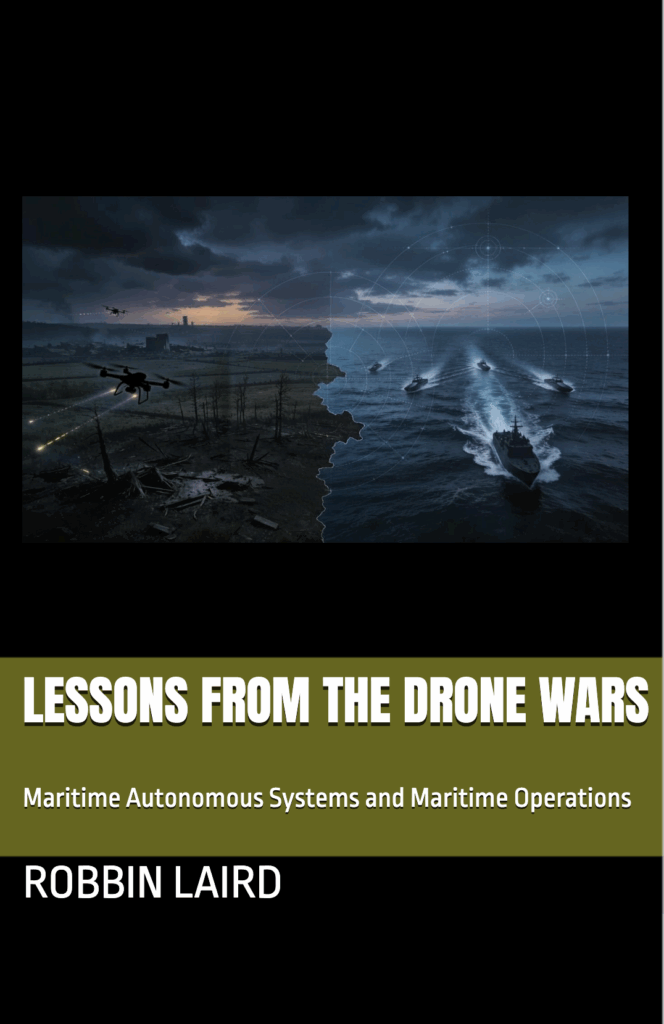
On March 15, 2026, my new book on maritime autonomous systems will be released on Amazon.