

By Jim Jenkins
I. Introduction
In The First Battle of the Next War: Wargaming a Chinese Invasion of Taiwan, the Center for Strategic & International Studies (CSIS) lays out the results of extensive wargaming of a Taiwan scenario, revealing several serious friction points for U.S. success in the conflict. These challenges include barriers to resupply, high attrition of air and naval assets, regional base vulnerability, and rapid depletion of munitions, all of which impair the ability of the Joint Force to generate the volume of sorties necessary to prevail.
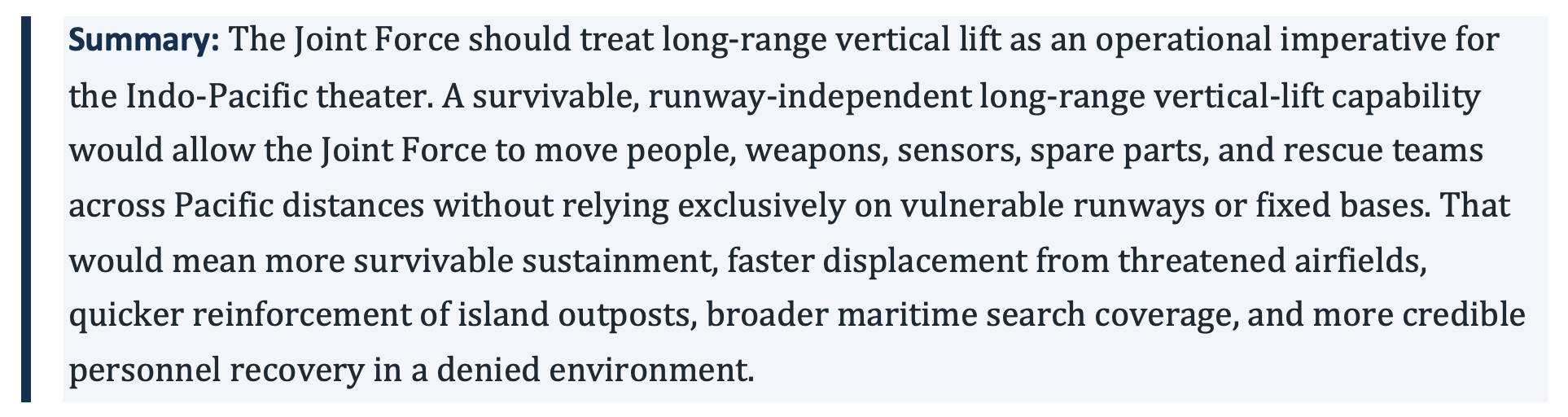
Long-range, survivable, runway-independent vertical lift would enable the Joint Force to move people, weapons, sensors, spare parts, and rescue teams across vast Pacific distances without depending exclusively on vulnerable runways or fixed-base operations.
Conventional helicopters lack the range and endurance to operate across these distances at useful scale. Fixed-wing aircraft remain dependent on runways that are highly vulnerable to missile or drone attack. The operational problem is broader than any one service program.
A common joint capability could connect distributed forces before, during, and after the opening salvos of the conflict and maintain operational flexibility throughout the campaign.
If the United States expects to fight using a dispersed concept of operations, survive the first salvos, and regenerate sorties and combat power faster than the adversary can suppress them, then multi-service, long-range vertical lift should be treated as a theater requirement, not a service preference.1 Accordingly, the Joint Force should define and field a long-range vertical-lift capability with service-specific variants optimized to Title 10 requirements.
II. The Challenge of the Opening Phase of a Taiwan Conflict
CSIS and RAND vividly illustrate how a Taiwan scenario is likely to compress time, punish short-range limitations, and expose the vulnerability of a concentrated U.S. posture in the Western Pacific. The same operational geometry and challenges appear across the Ryukyus, the Luzon Strait, the northern Philippines, the South China Sea, and the approaches to Southeast Asian chokepoints. The central question that flips many Taiwan wargames is whether the United States can operate combat aircraft from Japanese territory, especially Kadena and other Okinawa bases. Without that access, or with those airfields out of commission, the battle changes dramatically.2
The opening hours of a conflict over Taiwan begin with sudden reciprocal strikes, disrupted command and control, and an immediate contest to keep aircraft and ships in the fight. First-wave missile salvos land on airfields in Japan and Guam. Aircraft that seemed safe in peacetime prove to be crowded onto too few ramps, with too few hardened shelters.3 Naval forces disperse to survive, but dispersion impairs the reach of naval aviation and makes sustainment, rearming, recovery, and rescue an even greater challenge.
Small island sites become valuable not because they are comfortable bases, but because they complicate enemy targeting. Chinese targeters first must find the U.S. forces, and if those forces move rapidly, they can outpace the Chinese decision-making cycle. Dispersion also means that even if some U.S. forces are detected and targeted, only a fraction of the total force can be attrited.1,4
CSIS wargames show that four conditions largely determine whether the United States and its allies can defeat a Chinese landing: Taiwanese resistance, the political and military availability of Japanese bases, the quantity of U.S. long-range anti-ship missiles, and the surge readiness of U.S. submarines—the latter being the single most decisive military asset in the opening phase of the war.
III. Current Capability Limitations in the Indo-Pacific
Submarines, bombers, fighters, dispersed maritime forces, and island-based missile units all depend on being sustained, repositioned, repaired, and, when necessary, rescued. The connective tissue required to do that while under fire is thin today.1,5
The Joint Force already fields capable aircraft, but most of them are mismatched to the geometry and geography of a Pacific fight. Conventional helicopters offer vertical access but generally suffer from limited range, payload, and speed. The HH-60W is a valuable combat rescue platform, but official testing documents state that its threshold combat radius is roughly 195 nautical miles without aerial refueling.
Fixed-wing aviation closes some of that gap, but, again, it does so by depending on runways that are increasingly vulnerable to precision missile strikes, as recent events in the Gulf countries have shown. Agile Combat Employment (ACE) improves survivability by distributing forces, but ACE depends on a sustainment and recovery architecture that can move people, parts, fuel, and mission systems among dispersed sites. The architecture for ACE remains underdeveloped.1,6
Naval surface forces are vulnerable to attack from land- and air-based missiles, creating a dilemma for commanders. They must choose between penetrating the Anti-Access/Area Denial (A2/AD) envelope under a barrage of missile attacks and repositioning outside it, which increases survivability but limits combat effectiveness. Both choices play out against the unknown political impact of losing a U.S. combatant and a limited (at best) industrial capacity to replace vessels.
The shortfalls are especially acute in logistics, personnel recovery, and maritime support. Combat search and rescue (CSAR) coverage in the Pacific is constrained by distance and tanker availability. Distributed maritime operations require wider-area sensing, more resilient rearming and maintenance, and better support for anti-submarine and surface warfare from positions other than a few major fleet hubs.
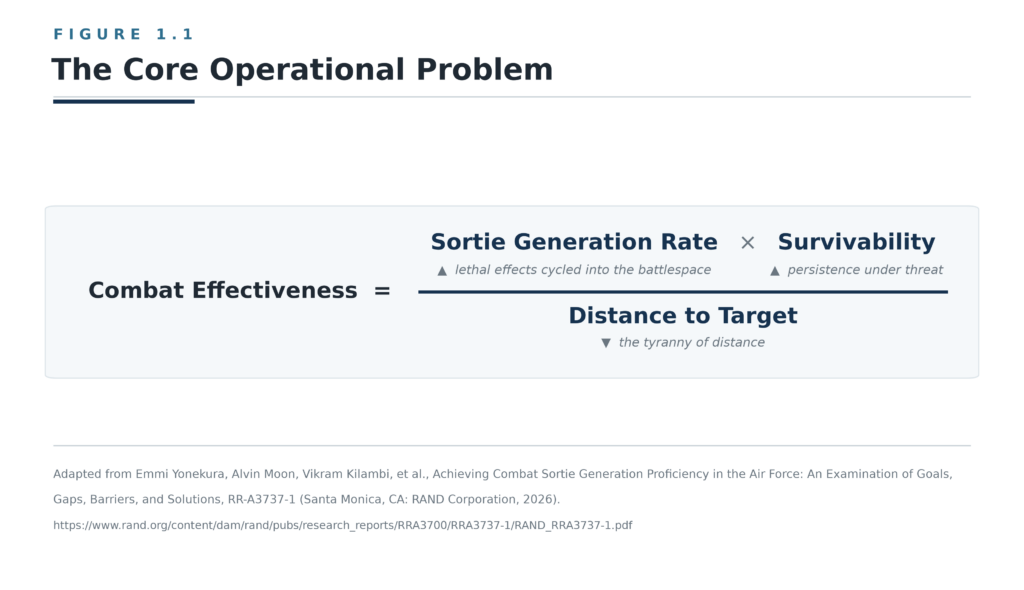
The findings of the CSIS report are categorical: the single most decisive variable in a Taiwan conflict is the ability of the United States to generate sorties under fire. In modern air and maritime warfare, total force size is a vanity metric; the metric that matters most is the rate at which a force can cycle lethal effects into the battlespace.
As distance increases and the vulnerability of fixed bases approaches 100 percent, the math of combat effectiveness becomes unforgiving (see Figure 1.1). To address this, survivability must be seen not only as a matter of hardening hangars but, more importantly, as a matter of agility.
IV. A Multi-Service, Long-Range Vertical-Lift Family to Address the Agility Gap
Long-range vertical lift addresses the gap in agility. It reduces dependence on a few Japanese runways by enabling distributed sustainment and displacement from austere sites; it helps move missile crews, maintainers, and high-value loads needed to keep anti-ship fires in the fight; and it supports submarine surge by moving repair teams, parts, weapons, and rescue capability among dispersed maritime nodes when traditional infrastructure is degraded.
This necessitates a common airframe employing a modular, open-systems architecture, with service-specific mission variants able to move loads, crews, sensors, and weapons across Pacific distances while retaining vertical and short takeoff and landing flexibility.
This logic is broadly consistent with the Army’s Future Vertical Lift approach, which has sought improved speed, range, lift, maneuverability, and digital integration across next-generation aircraft.7 (For purposes of this article, long-range vertical lift refers to a notional family of joint aircraft rather than any single service program of record.)
The advantages of a common long-range vertical-lift family are straightforward. First, commonality would simplify logistics through shared engines, drive systems, digital backbones, training pipelines, and depot pathways. Second, it would improve industrial resilience by supporting a larger, more stable production and sustainment base. Third, it would reduce duplication across the services and lower total ownership costs compared with four unrelated aircraft solving adjacent problems. Finally, it would provide a common operational tool that commanders could adapt through service-specific mission kits rather than wholly separate development lines.
The concept should also incorporate optional manning. In a contested Pacific fight, commanders will want some sorties flown with crews onboard because communications will be degraded, cyber threats will be real, and some missions will require onboard judgment in dense maritime and littoral environments. They will also want the option to launch the same aircraft without crews for repositioning, relay, or preplanned logistics. Those aircraft could also be flown unmanned to fill time blocks such as the 0200–0600 window, when the campaign is still ongoing but crew exposure can be economized. Optional manning would also support self-deployment from rear locations such as Hawaii and Guam. Fully unmanned solutions will also have a role, but an optionally manned design may be better suited to contested, degraded operations.
V. Service-Specific Operational Advantages of Long-Range Vertical Lift
Each service would use a common long-range vertical-lift family differently, but all services would gain from the same theater-level attribute: the ability to move operationally useful loads across long distances without depending on runways. The result would not be a one-size-fits-all aircraft; rather, it would be a shared operating system with a modular open-systems architecture for distributed combat.
A. Army: Korean Peninsula Basing Advantage
The Army’s MV-75 variant, based in Korea, can create a northern axis of mobility that is underappreciated in most Taiwan-centered debates. U.S. posture on the peninsula already includes major installations such as Camp Humphreys, Osan, and Kunsan, and those locations sit inside the broader network of bases that would matter in a Western Pacific contingency. Korea is not a substitute for Japan or the first island chain, but it is inside the operational envelope, and it can enable rapid reinforcement and maneuver across the northern Pacific theater.8
From Korea, Army long-range vertical lift can support rapid theater logistics, move small but high-value loads forward, reposition distributed fires packages, reinforce island defenses, shuttle maintenance teams, and move critical munitions or sensors without waiting for intact runway access. The CSIS report notes that many U.S. concepts implicitly assume Marine Littoral Regiments and Army Multi-Domain Task Forces are already in place before the first shot. That assumption may be politically questionable and operationally unrealistic. Army long-range vertical lift reduces the penalty for not getting everything forward in time. It gives commanders a means to move combat power laterally and incrementally after the war has started, even including follow-on forces that self-deploy from the continental United States (CONUS).1,8
B. Marine Corps: First Island Chain Operations
The case for the Marines is directly aligned with current Corps operating concepts. Expeditionary Advanced Base Operations (EABO) is intended to allow Marines to persist within contested areas, contribute to sea denial and sea control, and serve as forward sensors and shooters in support of naval campaigns. A long-range Marine MV-75 attack or escort variant would make EABO more executable in practice by extending the distance between launch point and objective, while preserving vertical access to austere island positions.9
Operating from Okinawa, the Ryukyus, or expeditionary island sites, such aircraft can provide longer-range escort for assault support packages, armed overwatch for stand-in forces, rapid repositioning between small island bases, and distributed strike support that is more survivable than conventional helicopters in a high-threat environment. The MV-75 platform would help Marine stand-in forces displace more often, survive longer, and continue supporting naval anti-surface warfare (ASuW) and anti-submarine warfare (ASW), contributing to the fight even after airfields are hit.
C. Air Force: CSAR Expansion
The Pacific is particularly unforgiving for personnel recovery. Western Pacific-based rescue forces provide critical capability, but the range challenge is severe in peacetime training and becomes even more acute in war. Today’s CSAR architecture often depends on tanker support and long flight profiles for helicopters operating over water. That increases vulnerability, complicates timing, and narrows the number of rescue options available once the theater becomes contested.10,11
A longer-range MV-75 rescue variant would change the geometry of the problem. It would reduce tanker dependence, shorten time-to-pickup for isolated personnel, expand maritime recovery coverage for distributed air operations, and allow rescue packages to stage from more austere locations. It would also support nontraditional personnel recovery, forward medical evacuation, battle-damage assessment, and mobile sustainment for ACE. Airmen are more likely to operate aggressively from distributed sites if they believe the rescue enterprise can reach them quickly and reliably.
D. Navy: Maritime Strike, ASW, and ASuW
The Navy needs a longer-range aircraft family to make Distributed Maritime Operations more lethal and more resilient from both shore and sea. The MH-60R remains a capable shipboard helicopter for ASW and ASuW, but the Navy’s distributed concept increasingly depends on pushing sensing, relay, targeting, and strike functions outward across much wider areas than conventional rotorcraft can comfortably cover.9,10
The S-3 Viking, which conducted intermediate-range ASW for the Carrier Battle Group (CVBG), was retired without a replacement. The H-60 still conducts the close-range ASW mission but is also asked to fill the gap left by the S-3’s retirement. This often means CVBG ASW efforts suffer because the H-60 simply does not have the legs to be effective. If a cruiser or destroyer must push forward to accommodate the H-60’s shortcomings, this creates vulnerabilities in the CVBG’s integrated defenses.
A Navy maritime MV-75 variant would be useful—at first—as a land-based aircraft operating from Okinawa, the southern Ryukyus, or northern Philippine locations, rather than forcing immediate integration onto every destroyer or cruiser.
That approach avoids the very real hangar, deck-handling, and maintenance constraints of smaller surface combatants while still delivering operational value, such as wider-area surface surveillance, distributed sensor carriage, anti-submarine prosecution, standoff missile employment, and rapid resupply of maritime nodes. A Navy maritime MV-75 variant would extend search, anti-submarine, and anti-surface coverage from land bases that are harder to target than a few crowded ports or aviation hubs.
In other words, the Navy should not reject the concept of an MV-75 because it does not fit neatly inside a destroyer hangar. It should ask how the aircraft can best contribute to sea control and sea denial from the island chain.10
E. Joint Snapshot: MV-75 Impact on Wartime Operations
The value of multi-service long-range vertical lift is in improved distributed operations. The MV-75 does not pretend to replace submarines, hardened airfields, bombers, fighters, tankers, or anti-ship missiles outright. It is an amplifier.
Joint Force MV-75s would help move the people, weapons, sensors, repair teams, rescue packages, and high-value equipment that make those other systems useful under fire. In the opening phase of conflict, that means faster displacement from threatened airfields, quicker reinforcement of island outposts, broader maritime search coverage, more survivable sustainment, and better personnel recovery across a theater where a single broken link can collapse combat output.1
In an Indo-Pacific contingency, one service’s MV-75 could be forced to recover at an austere location where the nearest available maintainers very likely belong to another service. A common family would let those maintainers conduct inspections, line replacement, and battle-damage repair with shared tools, training, and parts. That is exactly the kind of practical efficiency that matters in a theater defined by distance and disrupted logistics.
The MV-75 also expands operational flexibility beyond the Taiwan Strait itself. The same capability would matter in the northern Philippines, the South China Sea, and the approaches to the Strait of Malacca, where local sea and air superiority may be temporary, and where commanders will need to move Marines, Navy sensors, Army enablers, and Air Force recovery teams among dispersed locations.
The result is a force that creates more dilemmas for the adversary and makes the Joint Force more resilient and less dependent on fixed airfields to generate combat power at scale.
VI. Industrial and Acquisition Considerations
A multi-service aircraft family is attractive not only operationally but also institutionally. Common supply chains, pooled training, shared software baselines, and cross-service depot work would reduce duplication and increase surge capacity. The H-60 and V-22 enterprises, both operating successfully today, demonstrate that shared sustainment across multiple services is possible, and a next-generation system could build on their readiness and maintenance lessons.
Commonality also has benefits for the initial training of pilots and maintainers at home. A multi-service approach to training would be more economical and require fewer instructors overall, for pilots and maintainers alike.
Acquisition discipline would still be essential. Congress will rightly ask whether a joint family could become an overdesigned compromise that serves no service well. The answer is to keep commonality at the airframe, propulsion, digital backbone, and sustainment level while allowing sensors, weapons, mission kits, and software to diverge where mission requirements truly differ. Done correctly, the result would be one family with several useful variants rather than one rigid aircraft forced into every role.7,12
VII. Risks and Tradeoffs
This concept is not without risks and tradeoffs. The first is cost. A new multi-service aircraft family would compete against other programs with strong claims on scarce resources. The second is integration risk: making one airframe do too much can produce an expensive platform that is hard to maintain and operationally compromised. The third is doctrinal risk. Commanders may overestimate what long-range vertical lift can solve and underinvest in the hardened bases, stockpiles, and passive defenses that remain indispensable.7,13
There are platform-specific tradeoffs. As noted above, a maritime variant may prove most practical ashore before it is practical on small-deck combatants. An optionally manned design could reduce crew exposure, but it would increase software, autonomy, and cyber-assurance demands. Any high-speed vertical-lift solution will face scrutiny on safety, readiness, and sustainment.
Those objections are serious, but they are arguments for disciplined requirements and realistic acquisition planning, not for ignoring the operational gap itself.12
VIII. Conclusion: The Imperative of Long-Range Vertical Lift
A Taiwan conflict, especially in its opening phases, will reward the side that can keep combat power moving after the opening salvos, at ranges and speeds relevant to U.S. Indo-Pacific Command. CSIS shows that access to Japanese bases, survivable sortie generation, and the ability to blunt an invasion fleet quickly are decisive. RAND shows that a war with China could become a long and punishing campaign. Existing concepts such as Agile Combat Employment, Expeditionary Advanced Base Operations, Distributed Maritime Operations, combat rescue modernization, and Future Vertical Lift all move in the direction of dispersion and reach. What remains underdeveloped is the connective, agile capability that links them.1,4,6,9
That is why the Joint Force should recognize long-range vertical lift as an operational imperative for the Indo-Pacific. Once that requirement is accepted, a common family of service-specific aircraft becomes not an indulgence, but a credible answer to a real theater problem: how to expand operational reach, preserve resilience, and sustain distributed operations when the Western Pacific is under sustained attack.
About the Author
Jim Jenkins is a retired Marine Colonel and AH-1W Cobra pilot who commanded units at the squadron and group level, with 28 years of operational experience across more than 40 countries. He served on the Joint Staff J3 in the Indo-Pacific Command division and directed future technology development for the Marine Corps Warfighting Laboratory. For the last eight years, he has taught and advised UAE and Saudi aviation units.
Notes
- Mark F. Cancian, Matthew F. Cancian, and Eric Heginbotham, The First Battle of the Next War: Wargaming a Chinese Invasion of Taiwan (Center for Strategic and International Studies, January 2023).
- ; Kadena Air Base official materials describing Kadena as the keystone of the Pacific.
- Timothy Walton and Thomas Shugart, “Concrete Sky: Air Base Hardening in the Western Pacific” (Hudson Institute), https://www.hudson.org/arms-control-nonproliferation/concrete-sky-air-base-hardening-western-pacific-timothy-walton-thomas-shugart.
- David C. Gompert, Astrid Stuth Cevallos, and Cristina L. Garafola, War with China: Thinking Through the Unthinkable (RAND, 2016); Joel B. Predd et al., Thinking Through Protracted War with China: Nine Scenarios (RAND, 2025).
- CSIS, The First Battle of the Next War, on the decisive early effect of U.S. attack submarines and their contribution against invasion shipping.
- CSIS, The First Battle of the Next War, on 3.5-day turns, sortie generation, tanker and base constraints, and the continuing importance of hardened bases; see also Air Force Doctrine Note 1-21, Agile Combat Employment.
- Government Accountability Office, Future Vertical Lift Aircraft: Army Should Implement Leading Practices to Mitigate Acquisition Risk (GAO-23-105554); and Association of the United States Army, Contested Logistics in the Indo-Pacific: Joint Sustainment Through Positional Advantage.
- USAG Humphreys official site; RAND analyses on sustaining U.S. Army operations in the Indo-Pacific; CSIS discussion of forward basing assumptions for Marine Littoral Regiments and Army Multi-Domain Task Forces; and the Stimson Center’s analysis of the four tyrannies of logistical deterrence.
- Headquarters, U.S. Marine Corps, Tentative Manual for Expeditionary Advanced Base Operations, 2nd ed. (May 2023); Congressional Research Service, Defense Primer: Navy Distributed Maritime Operations (updated July 3, 2024).
- Director, Operational Test and Evaluation, HH-60W Jolly Green II (FY2020); official U.S. Marine Corps V-22 Osprey materials; official NAVAIR CMV-22B materials; and official U.S. Navy MH-60R fact files.
- Kadena Air Base official materials on the 33rd Rescue Squadron and Pacific helicopter air-to-air refueling training.
- NAVAIR reporting on shared V-22 sustainment at Fleet Readiness Center East and the December 2025 comprehensive V-22 review findings.
- CSIS, The First Battle of the Next War, discussion of Chinese attacks on Japanese air bases and the finding that roughly 90 percent of aircraft losses in the base-focused scenarios occurred on the ground.
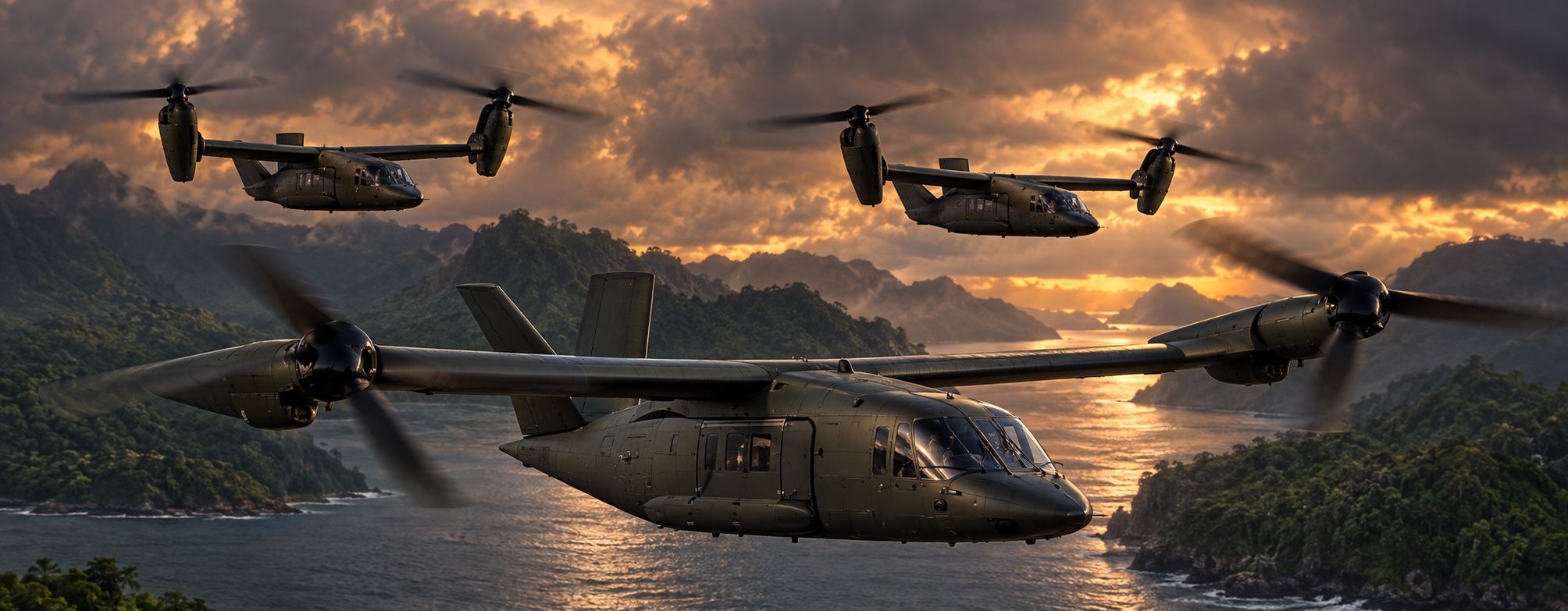
Note: The featured image was generated by an AI system.