By Kenneth Maxwell
At about 9:45 on the morning of November 1, 1755, All Saints Day, the earth beneath Lisbon began to move. The churches were full. Many of the faithful were at mass when the vaults and walls came down on the congregations. “I could hardly take a step without treading on the dead and dying,” one eyewitness recalled.
Today is the 271st anniversary of the Great Earthquake of Lisbon. It was the most powerful earthquake to strike the continent of Europe in recorded history, probably the equivalent of 8.5 to 9 on the Richter scale. Its source lay several hundred miles off the southwest coast of Portugal, along the fault that marks the boundary between the African and Eurasian plates. A segment of that fault, somewhere between 150 and 600 kilometers long, thrust upward by as much as ten meters, releasing energy at least three times greater than the eruption of Krakatoa.
Then came the sea. A tsunami, very rare in the Atlantic, struck the city. Then came fire, which took hold and consumed much of what was left.
The destruction fell hardest on the Baixa, the low-lying commercial heart of Lisbon built over alluvial landfill between steep hills. The riverfront quay sank and disappeared. The Royal Palace, the Customs House, the India House and the Royal Shipyard, all built hard against the Tagus, were destroyed. So was the new Patriarchal Church, and so was the magnificent Opera House, inaugurated only months earlier, on March 30, the Queen’s birthday. Some fifty-five convents and monasteries were severely damaged. The British consul wrote to London in December that the waterfront district was “nothing but a heap of rubbish, in many places several stories high, incredible to those who are not eyewitnesses of it.”
Lisbon at that moment was one of the great ports of the world. Into it flowed pepper from India, porcelain and silk from China, and sugar, diamonds and gold from Brazil. In a single morning its ceremonial and commercial core ceased to exist. Estimates of the dead vary. But between 15,000 and 30,000 people died.
Europe Asks Why
The earthquake shook more than buildings. It shook the European mind.
Many were quick to assign blame. For the Jesuit Father Gabriel Malagrida, the catastrophe was the wrath of God, retribution for the sins of Lisbon. Voltaire, for whom Portugal was the perfect emblem of superstition and irrationality, turned the disaster against the comfortable optimism of the philosophers. In his Poem on the Lisbon Disaster, or an Examination of the Axiom “All Is Well,” he wrote:
“Oh, miserable mortals! Oh, wretched earth!
Oh, dreadful assembly of all mankind
Eternal sermon of useless sufferings!
Deluded philosophers who cry, ‘All is well.'”
Rousseau answered him, and his answer still repays reading. “Would you have preferred that this earthquake had taken place in a desert rather than in Lisbon?” he asked. Must nature be subject to our laws, so that “in order to prevent her from causing an earthquake in any particular place all we need to do is build a city there?” Rousseau’s point was that the disaster was natural, but the scale of the suffering had human causes: where and how people had built.
The shock reached across the Atlantic as well. On November 18, an earthquake struck Massachusetts east of Cape Ann. In Boston the worst damage was where buildings stood on landfill near the wharves, just as in the Baixa. John Adams, at Braintree, wrote in his diary that his house seemed “to rock and reel and crack as if it would fall in ruins.” At Harvard, Professor John Winthrop lectured on earthquakes in the college chapel on November 26, with approving reference to the “very ingenious Mr. Franklin of Philadelphia.”
In Britain, George II asked the House of Commons for “speedy and effectual relief,” and Parliament appropriated £100,000 in specie, provisions and tools. Portugal was Britain’s oldest ally and, since the Methuen Treaty of 1703, a vital trading partner. Lisbon’s ruin was a British concern.
The Practical Response
In Lisbon itself, the reaction was more prosaic and far more practical.
King Dom José I had shown little interest in government, preferring hunting and the opera. He was at the palace at Belém, well west of the city center, when the shocks and the wave struck, but he was so terrified that for the rest of his life he refused to sleep in any building made of stone. The royal family camped in the gardens at Belém and later moved into a wood and canvas barracks, the barraca real, on the hill of Ajuda.
The man who acted was Sebastião José de Carvalho e Mello, the future Count of Oeiras and Marquês de Pombal. He had served as Portuguese ambassador in London from 1739 to 1743, living on Golden Square, and had been elected to the Royal Society, sponsored by among others Sir Hans Sloane. He had then served in Vienna. He came to the crisis with a mind shaped by the practical, utilitarian outlook of the English Enlightenment.
His response was immediate and draconian, summed up in the phrase long attributed to him: “bury the dead and feed the living.” In his own spidery handwriting, he set out three priorities. First, dispose of the dead to prevent disease. Second, feed the survivors, imposing ceilings on the price of bread to deter speculators. Third, restore public order.
He persuaded the Patriarch of Lisbon to allow bodies to be collected, loaded into boats and dropped into the Atlantic without funeral rites. He brought in troops from the hinterland. He gave magistrates power to act instantly against murder and looting; according to one eyewitness, some eighty gibbets soon stood across the city.
It is sometimes claimed that Pombal took credit afterward for measures others devised. The documentary record says otherwise. In the Houghton Library at Harvard there is a handwritten draft of a decree in Pombal’s hand, written at Belém on November 3, 1755, threecommercia days after the earthquake. The measures were later compiled in the volume known as the Providências: the collection of corpses, the avoidance of food shortages, care of the sick and wounded, temporary price controls on essential foods, and planning for the reconstruction of the city.
A City Redesigned From the Ground Up
The ambitious young Scottish architect Robert Adam, then in Rome, saw the earthquake as “Heavenly judgement on my behalf.” He hoped to become royal architect of Lisbon and sketched a new city modeled on Bernini’s piazza before Saint Peter’s.
Pombal had something very different in mind. He did not call on the Italian, Austrian or French architects Portugal had so often used for its great public buildings, and he held no international competition. He turned instead to Portugal’s own military engineers: Manuel da Maia, the chief engineer of the realm, then nearly eighty; Eugénio dos Santos, a colonel in the engineering corps in his mid-forties; and Carlos Mardel, a Hungarian émigré who had come to Portugal to work on the Lisbon aqueduct, which survived the earthquake. These were men used to managing large works, materials and manpower.
Pombal froze all building and property sales until a master plan existed. Maia delivered his “dissertation” on December 4, 1755. He weighed whether debris should be used to raise the low ground, how tall buildings should be in relation to the width of streets, how to drain the lowlands against tidal flooding, and even whether the capital should be moved west toward Belém, where the subsoil was firmer. He studied two precedents: Turin, where a new city had been built alongside the old, and London, where Christopher Wren’s grand plan after the Great Fire of 1666 had been defeated by property rights and old street lines.
Here the King’s terror proved decisive. Because Dom José would not rebuild his palace on its old site, he surrendered the most valuable real estate in the city. If the King gave up his ground, it would be difficult for anyone else to refuse.
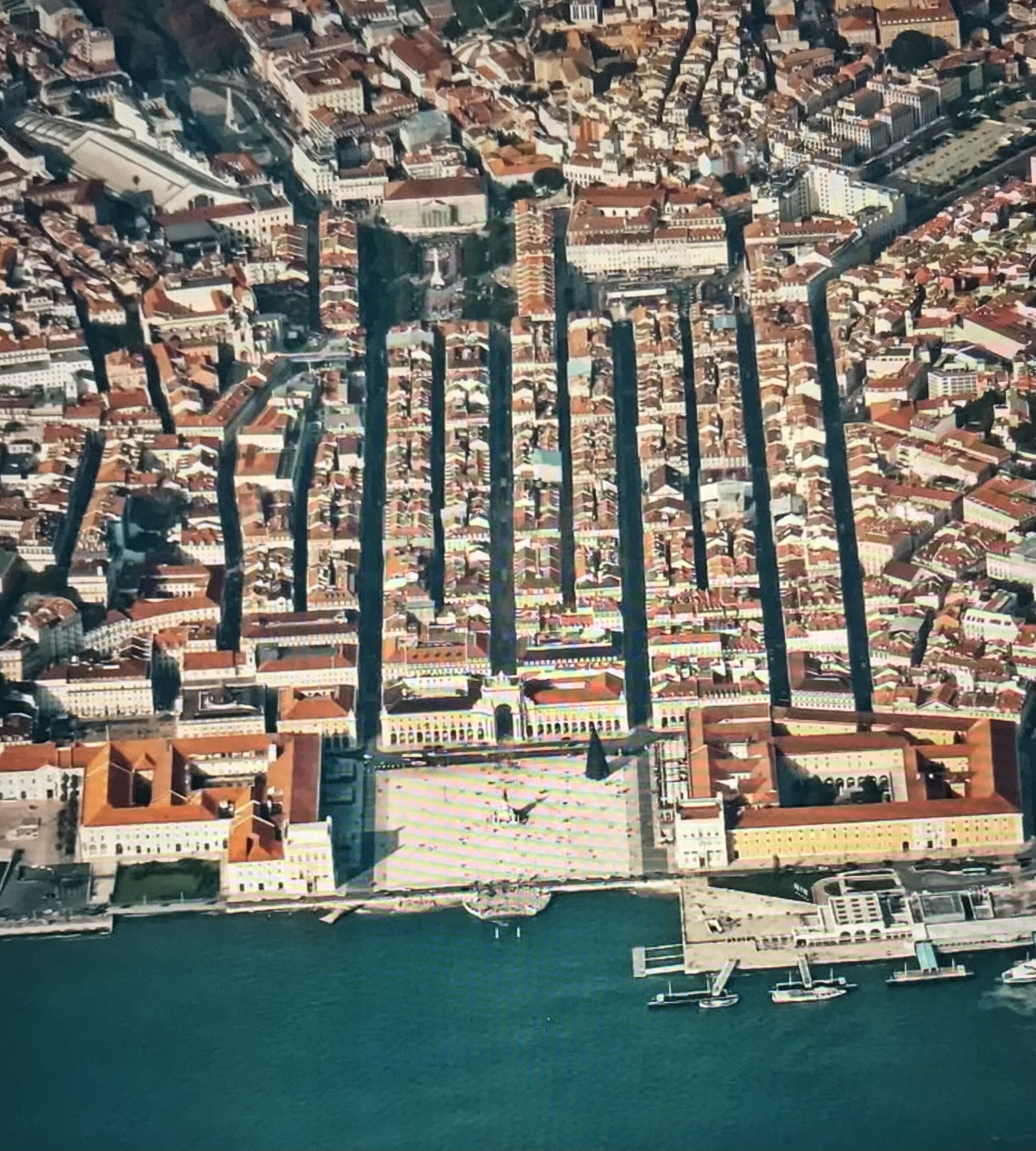
Of six plans drawn up, the most radical was adopted: the fifth, by Eugénio dos Santos and Carlos Mardel. It overrode the old street pattern and the old property lines completely. The royal Terreiro do Paço gave way to the Praça do Comércio, a square of commerce, government, customs and exchange, with identical arcaded buildings on three sides and pavilions of gleaming pedra lioz limestone on the river. The art historian Robert C. Smith wrote that this stone gave “Lisbon a glittering appearance not unlike Venice.” From the square, a grid of streets ran north to the rebuilt Rossio and Praça da Figueira. The result, Smith wrote, was one of the “greatest uniform architectural undertakings of the age of the enlightenment.”
Legislation in May 1758 provided for the assessment and reallocation of property, substituting geometric measurement for old locations so owners could be compensated. Loans were offered, and new owners had five years to build. Every plan, down to the smallest detail, bore Pombal’s signature.
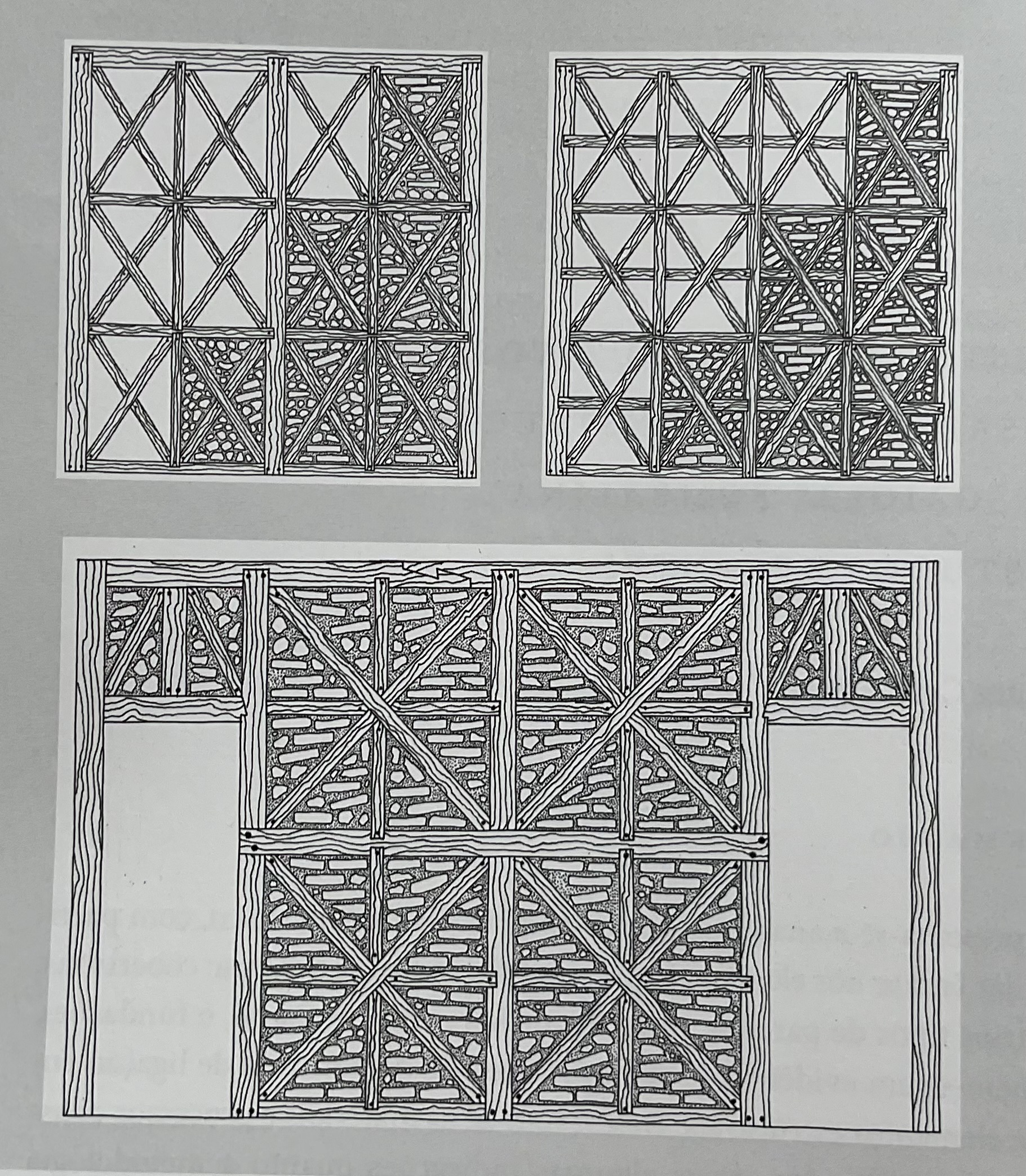
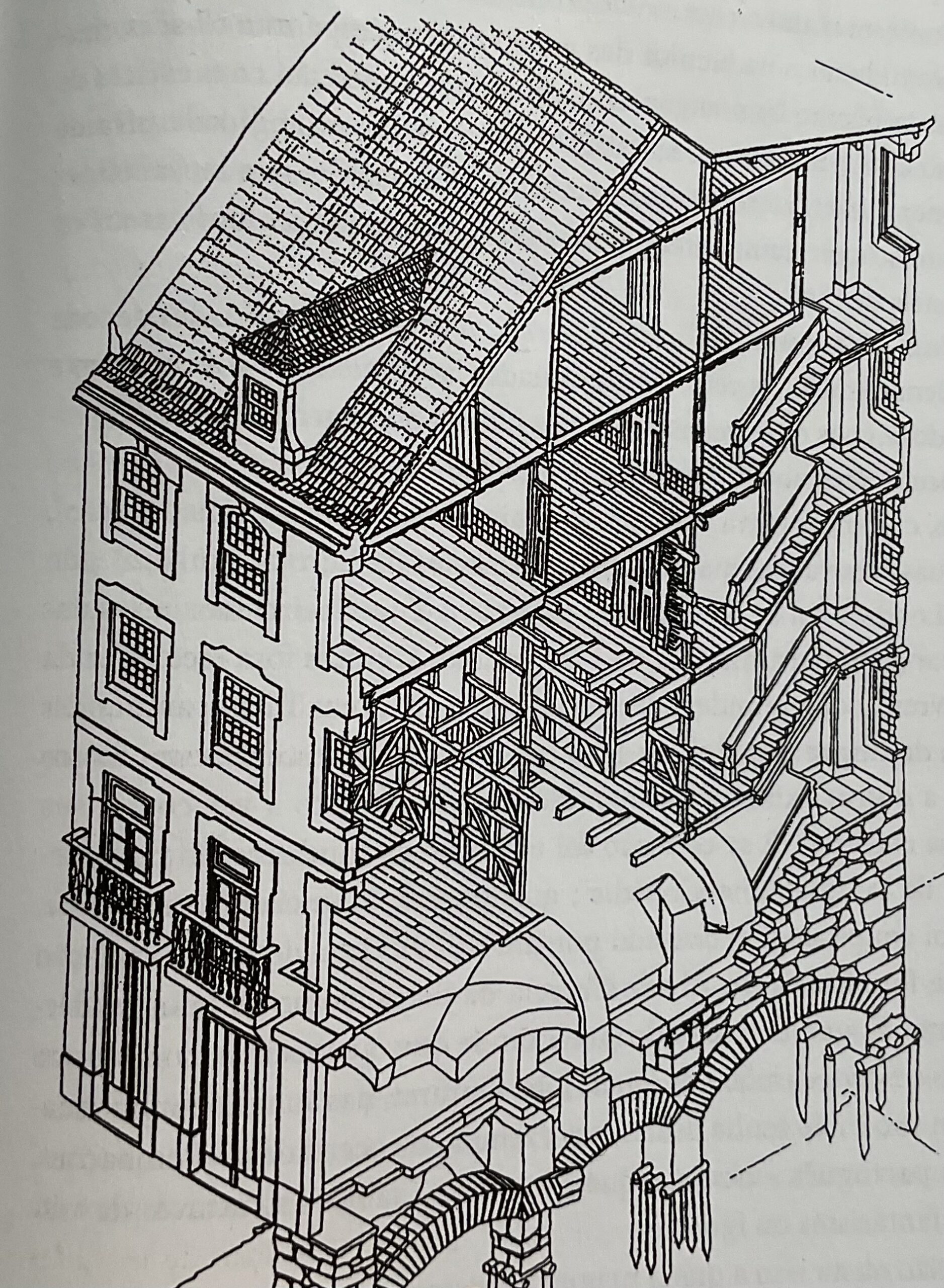
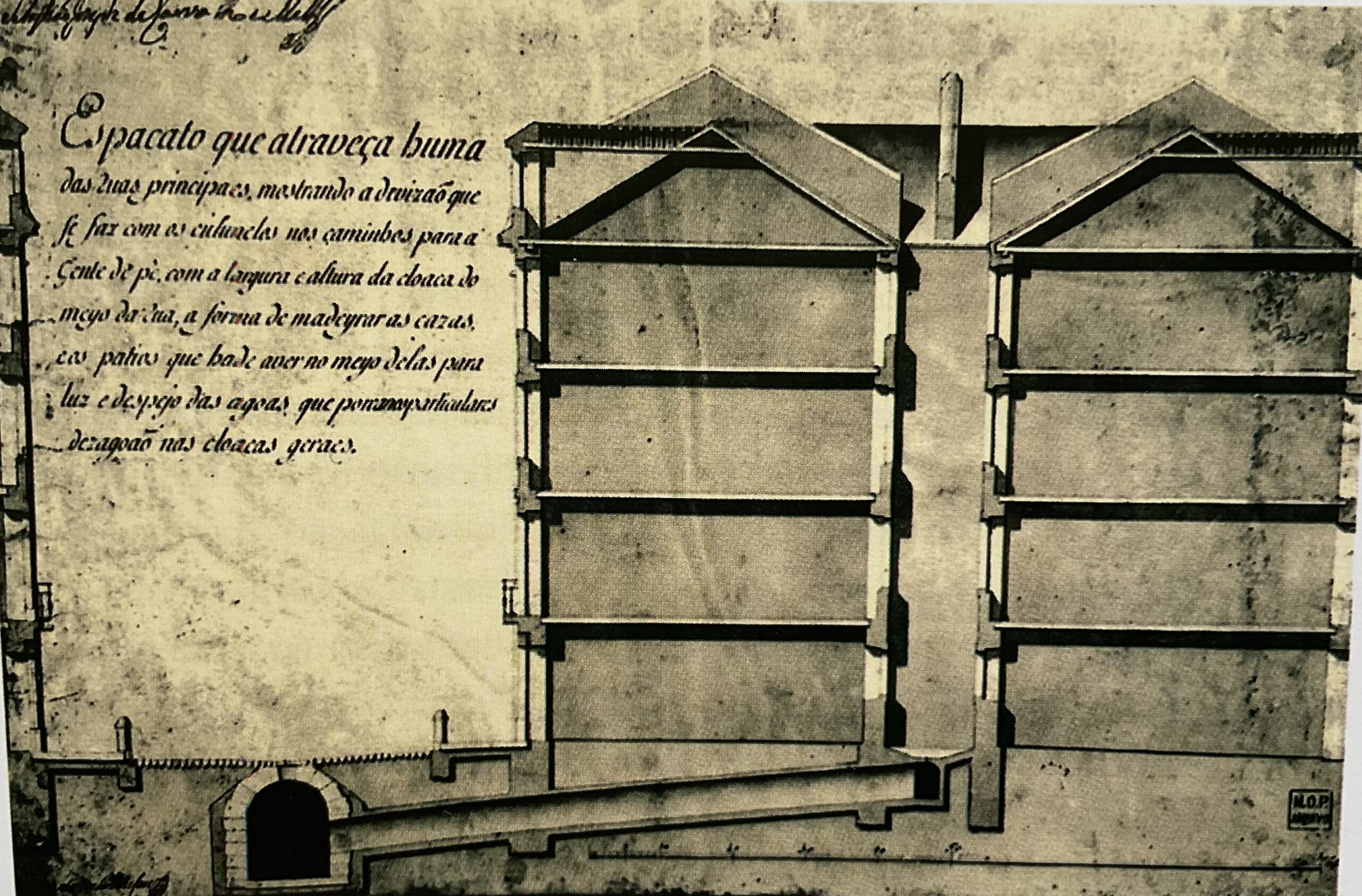
Most important, the buildings were designed to survive the next earthquake. Each was built around the gaiola, a flexible wooden cage of diagonal trusses bracing a horizontal and vertical frame, set on piles of green pine. Firewalls divided the roofs. Doors and windows were standardized. Following the advice of António Nunes Ribeiro Sanches, the New Christian physician then living in Paris, the new city was planned for light, air and sanitation. Ribeiro Sanches argued that earthquakes had natural causes, and Pombal published and distributed his work. Malagrida, who preached divine wrath, was later denounced to the Inquisition and burned at the stake.
Reconstruction also became industrial policy. Standardized stone facings, ironwork, cut timber, mortar, quick-drying cement, glass and tiles all had to be produced at scale. Pombal used this demand to build up a Portuguese artisan class and placed an industrial suburb, with silk, ceramic and cotton works, where the aqueduct ended.
There is an English thread in this story that has been overlooked. Two merchants from Devon, where I now live, were critical collaborators. William Stephens held a monopoly to supply glass for the new windows. John Parminter, ruined by the earthquake, recovered by marketing a quick-drying cement for the new buildings; Parliament even passed an act permitting the duty-free export of Welsh culm to fire his kilns at Alcântara. And when the architectural historian John Harris looked at the Praça do Comércio in the 1960s, he found it strikingly similar to Inigo Jones’s Covent Garden. Eugénio dos Santos’s design for the north side of the square is almost identical to the north and west sides of Covent Garden. It is a curious historical irony that Wren’s unrealized plan for a mercantile London and Jones’s piazza should have helped shape Pombal’s commercial Lisbon and Inigo Jones piazza.
The Lessons of Three Cities
In The Tale of Three Cities, I set Lisbon beside London after the Great Fire and Paris under Napoleon III and Baron Haussmann. The comparison clarifies what Lisbon achieved.
London had a catastrophe and a brilliant plan, but not the political authority to override property. It was rebuilt in brick and stone on its old medieval street lines, and its streets remain much as they were before the fire. Paris had no single catastrophe; Haussmann’s transformation was driven by imperial will and ended in the disaster of 1870 and the Commune. Lisbon combined catastrophe, a practical plan, professional engineers and concentrated power, and the result still stands. Lisbon and Paris remain much as Pombal and Napoleon III envisioned them.
Yet Pombal’s Lisbon was long undervalued. Europe’s image of Portugal remained Voltaire’s, fixed by the execution of Malagrida and of the aristocrats accused of trying to assassinate the King in 1758, not by Ribeiro Sanches’s treatise on public health. An article on the reconstruction by the Abbé Correia da Serra arrived too late for the Encyclopédie. When I first lived in Lisbon in 1964, many Lisboetas still called the Praça do Comércio the Terreiro do Paço, though the palace had vanished two centuries earlier. The square served as a gigantic parking lot. Pombal’s tomb in the Igreja da Memória was unvisited. He had died ill and in disgrace, in internal exile, far from the city he had rebuilt.
Why the Anniversary Matters Now
The anniversary is not only an occasion for historical reflection. The fault that destroyed Lisbon in 1755 has not gone quiet.
On August 26, 2024, a magnitude 5.3 earthquake struck about 60 kilometers off Sines and was felt across greater Lisbon, Setúbal and as far as Porto, according to The Portugal News. No one was hurt. A further 4.7 tremor shook the Lisbon area in February 2025, and the city’s mayor pointed to reviews of more than 1,400 buildings and the training of 700 engineers in seismic resistance, with the Baixa Pombalina a primary concern, as Portugal.com reported.
Portuguese specialists warn that Pombal’s gaiola can no longer be relied on to protect the Baixa. Francisco Mota de Sá of the Instituto Superior Técnico has noted that owners have altered the buildings at will, inserting steel beams and cutting through the timber cages to run gas, water, electricity and communications, according to Cadena SER. The protection designed in the 1750s has been eroded, piece by piece, by two and a half centuries of convenience.
That is the lesson of November 1, 1755, worth remembering tomorrow. Pombal and his engineers understood that the real test of a disaster is what follows it: whether a government can bury the dead, feed the living, keep order, and then build something that will withstand the next shock. Rousseau was right that the earthquake was nature’s work and the scale of the suffering was ours. The engineers who drew the Baixa took that lesson seriously. The question for Lisbon, and for every city that sits on a fault line or a floodplain, is whether we still do.
Note: Ken’s book contains the full text in English, Portuguese and French.