


By Robbin Laird
The Indiana National Guard has built a leadership course whose design principle is productive discomfort, and its organizers describe the target in terms that match the argument of Mastering Chaos and what Nevada Army National Guard leaders have been telling us on Second Line of Defense.
On Sept. 13–18, 2026, the 138th Regiment, Regional Training Institute ran the seventh iteration of its Adaptive Leader Development Program (ALDP) at Camp Atterbury, Indiana. Twenty-six participants, from team leaders to battalion commanders, trained without a script and without rank on their uniforms. The National Guard Bureau’s Oct. 20 report quotes ALDP’s founder, Col. Nick Roukas: “The sweet spot between chaos and order is where people learn.”
What the 138th is doing
ALDP treats ambiguity as the curriculum. Participants run through five days of outcomes-based events, from foundational Soldier tasks to situational training exercises, each “built around deliberate ambiguity.” Roukas says he built it because he was “tired of seeing leadership training for robots instead of critical thinkers.”
The design rests on mission command. In Roukas’s words, “There’s no portion of a five-paragraph operations order more important than commander’s intent.” The aim is formations and leaders who “can find work, anticipate requirements, and operate simply off a commander’s intent and a concept sketch.” The program manages what facilitators call the training threshold: enough friction to force learning, not so much that people shut down.
Three features matter for what follows.
- Rank is removed. Col. Ben Ramos, who commands the 38th Combat Aviation Brigade and took the course himself, said it was good to “see officers take a step back and let junior Soldiers lead and become the subject matter expert.”
- The debrief is where it lands. Staff Sgt. Josh Ross spent four days skeptical. Two hours into the last after-action review, when facilitators “laid out the ‘why,'” he said: “I had more of an epiphany. I get it.”
- The program renews itself. ALDP began about ten years ago as a two-day course in the 152nd Cavalry. It survived deployments and reassignments because returning participants volunteered as facilitators, 15 to 20 per iteration. Command Sgt. Maj. Alex Nobbe says it “never skipped a year” because “facilitators kept showing up as volunteers, because we believed in it.”
Roukas’s one-sentence definition of the product: “An adaptive leader is somebody who can win, regardless of the circumstances or the environment.” The limits are stated plainly. Seats are few and resourcing is constrained, which is why the question is how the lesson spreads beyond one course in one state.
What Nevada told us on Second Line of Defense
Our discussions with Brig. Gen. Randy Lau, Land Component Commander of the Nevada Army National Guard, started from the same premise ALDP does: readiness is built by putting people into friction and learning from it. Two Second Line of Defense pieces carry that thread.
“Desert Forge 2026: Exposing Gaps, Building Readiness” (Oct. 19). Public reporting called Desert Forge the largest and most complex Army-led exercise in Nevada in more than 25 years. Its scenario (a notional cyberattack, telecommunications outages and an attack on a power-distribution station near Hawthorne) was the vehicle, not the object. As the article puts it, the real test was the Guard’s own command, coordination, sustainment and decision-making.
That is what Lau and I called operational discovery: using an exercise not to validate a known solution but to surface what a formation does not yet know it needs. The method has three parts.
- Send people into the field with broad intent, not a checklist.
- Bring them back and debrief hard.
- Capture what they found: equipment gaps that cost time, information that would have changed the response, assumptions that proved wrong.
Lau grounds this in the difference between complicated and complex problems. His Afghanistan experience convinced him that the military decision-making process fit counterinsurgency poorly, because the problem was too dynamic. His message to the force is “progress over perfection,” which he does not take to mean lower standards.
The medical detachment shows the effect. Clinicians who had never done it before relocated a battalion aid station under a simulated drone threat and ran night triage in the field. To them Lau said, “There’s no front lines. You are the line.” Desert Forge 27 will push on contested communications and counter-uncrewed aircraft systems. Vision Guard Defense, with NORTHCOM, will examine the Title 10 federalization threshold. Nevada will host Vigilant Guard 2027 at full scale.
“Mastering Chaos: A Leadership Framework for Homeland Defense” (Sept. 16). This piece adapts the remarks I gave to the Nevada Guard Pre-Command Course on Sept. 15. It argues that crisis management assumes the ground eventually goes still, while homeland defense is a condition of continuous disruption. Its prescriptions: design exercises as laboratories that break plans, favor resilience over brittle efficiency, and build leaders who can navigate. Nevada was receiving the book’s argument as the Guard was already practicing part of it.
How Mastering Chaos explains both
Mastering Chaos (Book 3 of the Personal Professional Development Insights Series, with a foreword by Air Vice-Marshal John Blackburn) opens with a claim ALDP’s founder would recognize: “You cannot plan your way through genuine chaos.” Plans fail because the parameters themselves shift, so the book shifts the emphasis from predicting scenarios to building adaptive capacity: intellectual flexibility, institutional resilience and social cohesion.
Chapter Four, “The Chaos Navigator,” is the closest match to what Indiana is doing. It names four trainable skills (adaptive thinking, pattern recognition under uncertainty, emotional regulation, and collaborative sensemaking) and a forge with three parts: realistic simulation, structured reflection and organizational follow-through. The table sets the book’s concepts beside what the two Guard programs are doing.
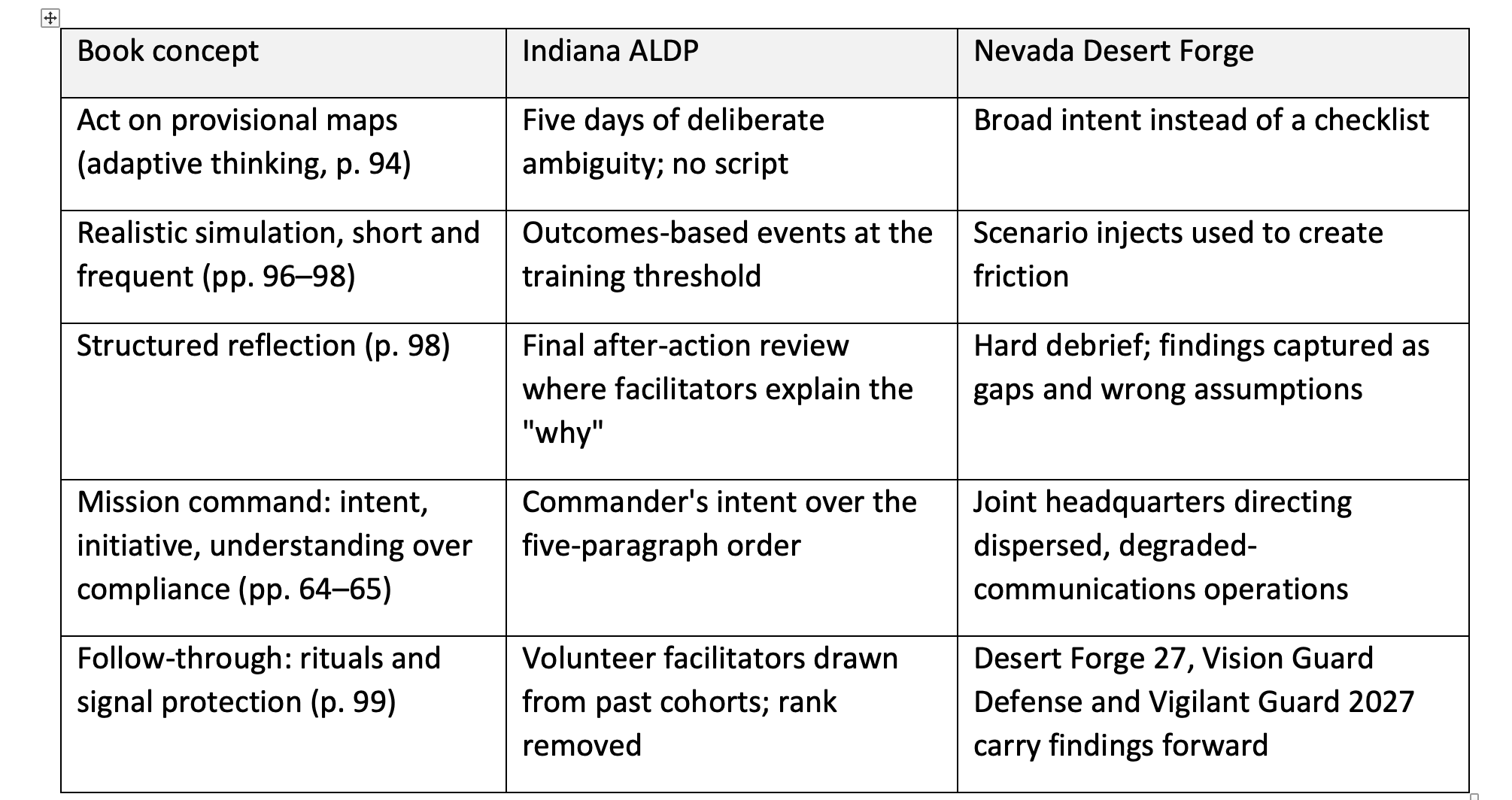
The book also sets a test for the Guard’s next step. It says a Navigator program fails if the operating environment punishes the behaviors it teaches, and that “the forge extends beyond the training facility.” The 138th’s answer is a pipeline of returning facilitators. Nevada’s answer is a sequence of exercises that treats each year’s gaps as the next year’s curriculum.
Where the two converge, and what is still open
Indiana and Nevada reached the same design from different directions. One state built a course for individual leaders; the other built an exercise for a whole command. Both put people into friction without a script, debrief the reasoning rather than the result, and rely on commander’s intent. That agreement across two states is evidence that this is a pattern in the Guard and not one commander’s preference.
Three questions remain, and the book speaks to each.
- ALDP seats are limited and resourcing is constrained. The book’s answer is the short, frequent micro-drill: a 30-minute scenario in an ordinary staff meeting that forces a pattern call, a decision and a reassessment.
- Who is in the room. ALDP’s most mixed cohort yet (cavalry, infantry, engineers, human resources and public affairs) trains inside the Army. Homeland defense also needs the civilian partners Nevada brought into Desert Forge and will bring into Vigilant Guard 2027. The book’s fourth skill, collaborative sensemaking across agencies, is the one that needs them.
- The public accounts of both programs rest on participant testimony. The book’s test is whether incentives and rituals reward the behaviors taught, so the next step is to track whether alumni lead differently and whether Desert Forge gaps close.
The National Guard Bureau’s headline calls chaos and order a sweet spot. Mastering Chaos makes the same point as a design rule: build enough structure to keep coherence and enough friction to keep learning, and treat the leader’s thinking as the thing being trained.
Sources
-
- ‘The Sweet Spot Between Chaos and Order’: Inside the 138th’s Adaptive Leader Development Program, Maj. Micah Maxwell, National Guard Bureau, Oct. 20, 2026
- Desert Forge 2026: Exposing Gaps, Building Readiness, Second Line of Defense, Oct. 19, 2026
- Mastering Chaos: A Leadership Framework for Homeland Defense, Second Line of Defense, Sept. 16, 2026
- Robbin F. Laird, Mastering Chaos: Shaping a Way Ahead for Chaos Management (Second Line of Defense, 2026), pp. xiii–xix, 62–65, 92–103