

By Robbin Laird
I. Introduction: From a Division to a Theater
In “Reach Needs a Web,” I argued that the MV-75 and autonomous systems should be built as a single force.1 That argument started from a commander’s requirement. Maj. Gen. David Gardner told Task & Purpose that the 101st Airborne Division must deliver a brigade into contested territory, fight on landing, and stay supplied, and that it may “need to rely on autonomous logistics delivery systems” to do so.2 The MV-75 provides the reach. Uncrewed systems give that reach persistence, awareness, and sustainment.
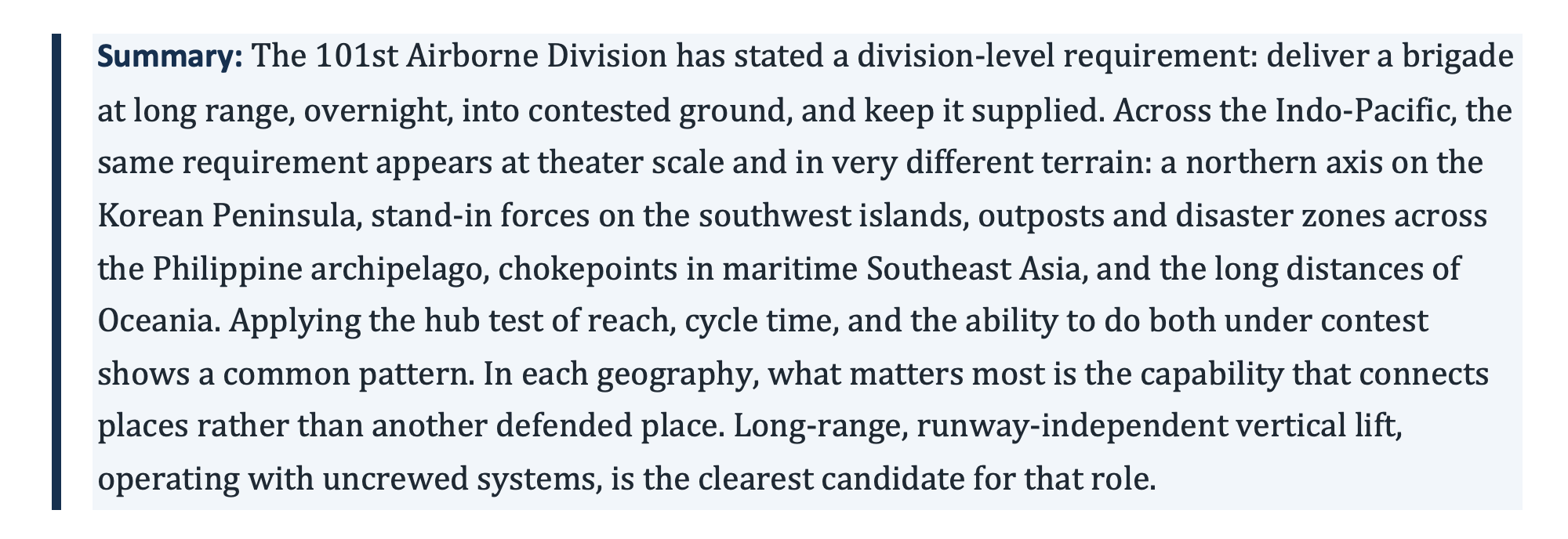
This article moves from one division to the theater. The Indo-Pacific asks the same question of every place a commander wants to use: what can this place send out, how far, how fast, and how many times? Strategic debate about the region, however, tends to collapse into a single contingency and then let that contingency set requirements for everything else. The theater is not one scenario. It is a set of distinct geographies with their own terrain, partners, pressures, and tempo. Forces there are asked to reinforce a peninsula, sustain isolated outposts, recover downed aircrew, track submarines through narrow waters, deliver relief after a typhoon, and keep scattered units supplied across thousands of miles of ocean.
What these missions have in common is distance, and the problem of staying connected across it when access is contested or degraded. That is the problem my earlier article on Guam addressed when it argued that a base is a noun and a hub is a verb.3 A base is judged by what it holds and how well it survives an attack. A hub is judged by what it sends out, how far and how fast, and by what it can take back in and turn around for another cycle.
Here I apply that hub test beyond Guam to five other geographies: the Korean Peninsula, the southwest islands and East China Sea, the Philippines and South China Sea, maritime Southeast Asia, and Australia and Oceania. For each, I ask what the geography demands and what capability would let a node pass the test rather than merely survive.
The answer is consistent across very different terrain. Jim Jenkins, a retired Marine Colonel and Cobra pilot who served on the Joint Staff in the Indo-Pacific Command division, has argued that long-range, runway-independent vertical lift should be treated as a theater requirement rather than a service preference.4 The hub lens helps explain why. Wherever the question is how a place generates outward effect, the binding constraint turns out to be the connective capability that moves people, parts, and munitions among places, more than the places themselves.
II. The Hub Test, and the Web Inside It
The Guam argument rests on three tests. Reach asks how far a node can actually send forces and supplies. That depends on the specific aircraft and ships based there, not on where the node sits on a map. Cycle time asks how quickly a node generates outward effect and regenerates afterward, which turns on speed, on how widely stocks are dispersed, and on how many sorties each airframe can fly. The third test is whether the node can do both while contested. A hub that is beautifully defended but cannot push forces outward under fire has, in the Guam article’s phrase, built an expensive, well-guarded warehouse.3
Cycle time is the test most easily overlooked, and speed affects it in three ways. Speed shortens the interval between a decision to reinforce and the arrival of what was sent. It lets more of a dispersed network be serviced inside the same operational window, which makes dispersal workable rather than a plan that quietly concentrates risk again. And it raises the number of sorties each airframe can fly, so that a fleet shrinking under attrition can still meet the same sustainment demand.3
The division-level lesson from Fort Campbell carries over directly. In “Reach Needs a Web,” I described the MV-75 as the long-haul connector and small autonomous systems as the last tactical mile.1 At theater scale, the same division of labor applies. Crewed long-range aircraft move the people, decisive cargo, and judgment that a mission requires across the long legs between hubs and spokes. Uncrewed systems carry out the persistent, repetitive, and high-risk tasks around them: relaying communications, carrying sensors, scouting landing sites, and distributing small loads among dispersed positions once the aircraft has arrived. The hub test measures the whole system, not the aircraft alone.
The aircraft at the center of this discussion is the MV-75 tiltrotor. It is designed to fly roughly two and a half times farther than the aircraft it replaces, at higher speed, with electronic-warfare protection suited to defended airspace.3 It is also still in development. The aircraft has not flown, and the Army said in October that first flight is no longer expected this year while it conducts a schedule risk assessment.5 The argument here does not depend on a single program or a particular date. It concerns a class of capability, of which the MV-75 is the clearest current example.
III. The Korean Peninsula: A Northern Axis
The Korean Peninsula is the Indo-Pacific’s most concentrated base geography. Installations such as Camp Humphreys, Osan, and Kunsan hold substantial combat power in a small space. They are the fixed, hardened, defended places that base-centered thinking was built to produce, and their defenses are not optional. They buy the time that everything else depends on.
The hub question is different: what moves outward from those installations when the situation demands it, and by what route? Jenkins observes that Korea is not a substitute for Japan or the first island chain, but that it sits inside the operational envelope and can anchor a northern axis of mobility that most regional debates underweight.4 A long-range Army aircraft based on the peninsula could move small but high-value loads forward, shuttle maintenance teams, reposition distributed fires, and reinforce island defenses without waiting for intact runways at either end.4
Two features of this geography sharpen the case. The first is density. Where forces, infrastructure, and civilians are packed into a narrow space, any logistics plan that relies on a few ground routes, airfields, and ports is exposed. Aircraft that can land at austere sites give commanders alternatives that avoid the obvious chokepoints. The second is direction. Most thinking about the peninsula runs one way, with reinforcement arriving from outside. A hub also pushes capability laterally, toward Japan and across the northern Pacific, and takes casualties, evacuees, and damaged equipment back in. A noncombatant evacuation exercises both directions at once, and it tests reach and cycle time under the conditions the Guam article treats as decisive.3
Uncrewed systems fit naturally here. On a crowded peninsula, cargo drones can distribute supplies from an austere landing site to dispersed units without adding ground traffic to congested roads. Optionally manned aircraft able to self-deploy from rear locations such as Hawaii and Guam would also shorten the time before follow-on forces and sustainment arrive.4
IV. The Southwest Islands and the East China Sea
South of the Japanese main islands, a chain of small islands runs far into the Western Pacific, with Okinawa as the principal U.S. node. This is the geography for which the Marine Corps’ Expeditionary Advanced Base Operations concept was designed: stand-in forces that stay inside contested areas, contribute to sea denial and sea control, and act as forward sensors and shooters for naval campaigns.4 The concept has always had a weak joint, and that joint is connection. Small forces on small islands must move to survive, and they must be resupplied and reinforced across water where runways are few and ports are exposed.
Long-range vertical lift addresses that weak joint directly. It extends the distance between launch point and objective while preserving vertical access to austere island positions, and it makes moving among small sites routine rather than exceptional.4 Here the cycle-time logic of the hub test becomes a survivability argument. A force that can move more often is harder to find and harder to hold at risk. A force that can keep supporting naval operations after a nearby airfield is struck still contributes when a fixed-site force would not.
The mission is not only a wartime one. In the East China Sea, pressure on islands and surrounding waters comes largely from coast guard and other maritime forces, short of open conflict. Meeting that pressure requires a credible ability to monitor, respond, and reinforce quickly enough that outcomes are not settled by default. Reach and speed matter in competition as much as in conflict, because they determine whether a government’s options are real. Japan has been strengthening its own posture on the southwest islands, and a hub on Okinawa or Guam that can reach Japanese-held positions adds to what Japanese forces can do alone.3
Personnel recovery shows the same pattern. Today’s combat search and rescue architecture often depends on tanker support and long over-water flight profiles that add vulnerability and narrow the options once the theater is contested.4 A longer-range rescue aircraft would reduce dependence on tankers, shorten the time to pickup, and allow rescue packages to stage from more austere locations. Airmen are also more likely to operate aggressively from dispersed sites if they believe rescue can reach them quickly.4 Uncrewed scouts launched ahead of a rescue aircraft could locate the survivor and check the pickup area before the crewed aircraft commits.
V. The Philippines and the South China Sea
Few geographies make the case for hub logic more clearly than the Philippine archipelago and the waters around it. The country spans thousands of islands, with uneven road networks, limited port capacity outside a handful of cities, and a coastline regularly struck by typhoons. Distances across the sea are large even by Pacific standards. The run from Scarborough Shoal to Hainan alone is roughly 550 nautical miles, well beyond what much of the legacy inventory was designed to cover.3
Three mission sets converge here. The first is sustaining isolated outposts and partner positions under gray-zone pressure. Where the pressure comes from coast guard and maritime militia vessels rather than warships, surface resupply can be obstructed without a shot being fired. Air delivery by aircraft that need no runway offers another route, but only if the aircraft can cover the distance and survive in the airspace it crosses. As the Guam article notes, extending range without extending survivability simply moves the vulnerability outward.3
The second is humanitarian assistance and disaster relief. The same aircraft that carry supplies to outposts can carry relief to communities cut off by a storm, and in this mission set the peacetime and wartime value of the capability converge. Relief operations also build the partner relationships and access arrangements that later operations depend on.
The third is support to partner forces at the Philippine sites made available under the Enhanced Defense Cooperation Agreement and at other dispersed locations. Each is a spoke, and a spoke is only as valuable as its connection to a hub that can regenerate. Range turns Guam from a point that projects influence within a radius drawn on a map into a node that can reach the Philippines, Japan, and Okinawa to resupply, evacuate casualties, insert small teams, and sustain forces at scattered, austere positions.3 Jenkins adds that a land-based Navy variant could operate from northern Philippine locations, extending search and anti-submarine coverage without requiring integration onto every ship.4
Cycle time completes the picture, and this is the geography where the division of labor from Fort Campbell matters most. In an archipelago with many positions needing support and few aircraft, a faster aircraft can service more positions in one operational window.3 Small autonomous cargo systems can then spread what each sortie delivers among nearby positions, so that the crewed aircraft makes one long trip rather than many short ones. That arithmetic decides whether dispersal is viable.
VI. Maritime Southeast Asia and the Approaches to Malacca
Farther south and west, the geography changes character. Maritime Southeast Asia is a tangle of narrow, busy waters, including the approaches to the Strait of Malacca, through which a large share of the world’s seaborne trade passes. The partner nations along these coasts hold differing political positions and in most cases have little appetite for a permanent foreign military presence. The mission set is correspondingly different: maritime domain awareness, anti-submarine and anti-surface presence, maritime security cooperation, search and rescue, and disaster response, often conducted from partner airfields or expeditionary sites rather than from American bases.
The hub idea is especially useful here, because a hub is a function rather than a fixed installation. Capability that arrives, operates, and departs is easier for partners to host than capability that stays. Aircraft with long range and the ability to use austere sites can provide wider-area surface surveillance, carry distributed sensors, relay data, hunt submarines, employ standoff weapons, and resupply maritime nodes without a large footprint ashore.4
The Navy’s gap is plain. The S-3 Viking, which performed intermediate-range anti-submarine warfare for the carrier battle group, was retired without a replacement. The H-60 that inherited part of the mission often lacks the range to be effective, which can push cruisers and destroyers forward to compensate and create vulnerabilities in the group’s integrated defenses.4 A land-based maritime variant operating from allied or partner locations would extend coverage from places that are harder to target than a few crowded ports, and would avoid the hangar, deck-handling, and maintenance constraints of smaller surface combatants.4
Optional manning adds another choice. Persistent tasks such as relay, sensor carriage, and preplanned logistics can be flown without crews when crew exposure can be reduced, with crewed sorties reserved for missions that need onboard judgment.4 In a region where partners prefer a light footprint, the ability to fly many routine sorties without crews may make the capability easier to host.
VII. Australia and Oceania: Depth and Distance
The southern end of the theater offers depth rather than exposure. Northern Australia sits far from the most heavily contested axes, has room for dispersal, and provides a natural area for regeneration: repair, resupply, and reconstitution away from the threatened edge. U.S. Marines already rotate through Darwin, and Australian and American forces are developing integrated approaches to littoral and island operations. In hub terms, northern Australia is less a forward base than a rear hub, whose value lies in how quickly and how far it can send capability north and east.
Beyond Australia lies Oceania, where distance is the dominant fact. The island states and territories of Micronesia, Melanesia, and Polynesia are scattered across an ocean larger than any continent, with thin infrastructure, few runways, and exposure to cyclones, earthquakes, and volcanic events. The missions are humanitarian response, medical evacuation, maritime surveillance of vast exclusive economic zones, and demonstrating reliable presence to partners weighing competing offers of support. Guam is the natural hub for Micronesia, and here the Guam article’s point applies in its purest form: a perfectly defended Guam that sends nothing outward has succeeded at survival and failed at relevance.3
In Oceania, the argument for long-range vertical lift is almost entirely about reach. A helicopter that can fly a few hundred miles is a regional tool for a few places. An aircraft that can cover far greater distances, land without a runway, and carry meaningful loads changes what is possible for an island that is days away by sea. A disaster response can begin within hours, and a small deployed team can be resupplied or extracted. Uncrewed surveillance can watch the exclusive economic zones between visits. In competition for influence, the visible ability to help quickly is itself a form of presence.
VIII. The Allied Multiplier
Every geography above has an allied dimension, and the hub lens treats it as a source of capability rather than a courtesy. The Guam article makes the point that Japanese, Australian, and other partner forces integrating with Guam-based operations add reach and cycle-time capacity that no single nation could generate alone. That is why “hub” is a more honest description of regional security architecture than “American base with foreign visitors.”3
The geographies also show that allies contribute in different ways. South Korea provides the base density and the northern axis. Japan provides the southwest islands and the forces already strengthening them. The Philippines provides access to sites that put spokes within reach of contested waters. Southeast Asian partners provide airfields from which a light-footprint capability can operate. Australia provides strategic depth and room to regenerate. A hub network that uses all of these is larger, more dispersed, and harder to attack than any American posture alone. It is also only as good as the aircraft that connect its parts, and the agreements on access, basing, and support that must be negotiated before a crisis rather than during one.
How far that allied logic can extend into shared aircraft, shared maintenance, and a common sustainment base is a question for the next article in this series, which asks what long-range vertical lift adds to the Pacific kill web and why the services should build it together.
IX. What the Comparison Shows
Side by side, the five geographies stress the hub test differently, but they point to the same kind of capability.
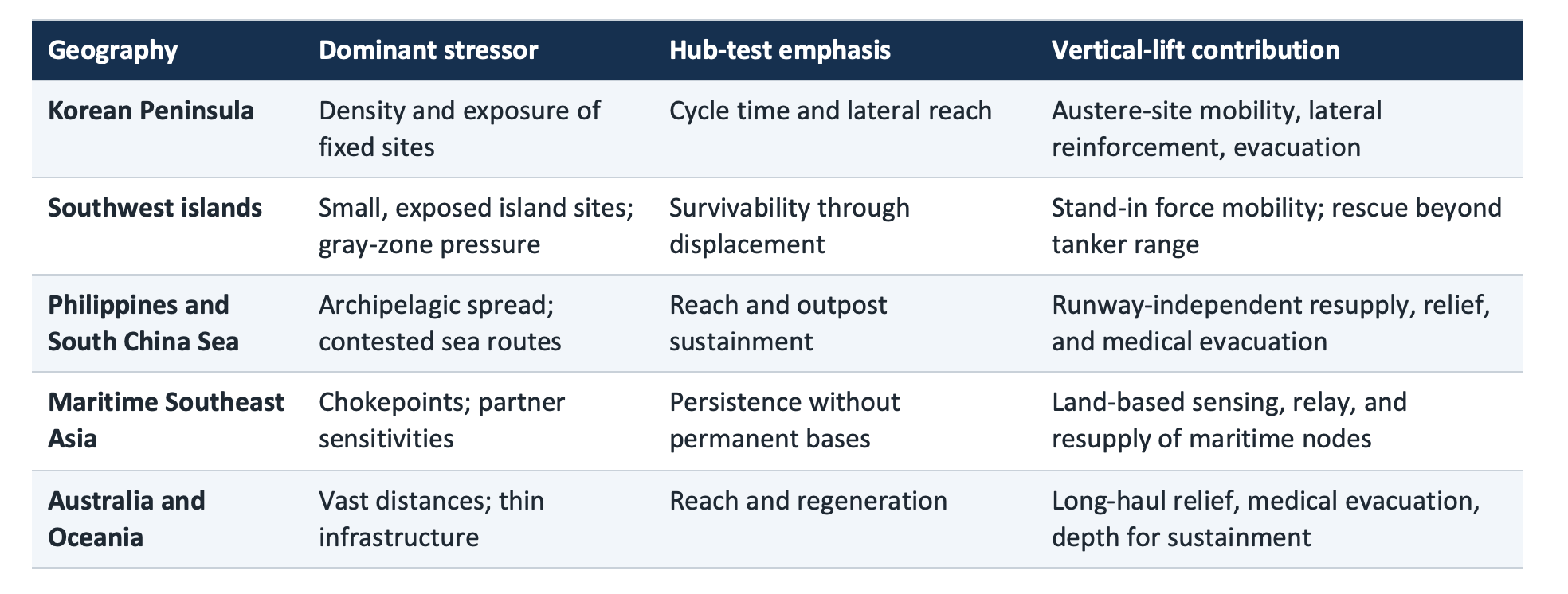
Three patterns stand out. Density drives the case on the peninsula, while distance drives it almost everywhere else. Partner sensitivities shape the basing logic in Southeast Asia in ways they do not elsewhere. And in every case, the value of the capability is measured by what it connects. That is why it makes little sense to evaluate a long-range aircraft as a platform in isolation, or to evaluate it without the uncrewed systems that extend what each sortie delivers.
IX. Conclusion: Judging Nodes by What They Send Out
The Indo-Pacific will not present its challenges one at a time or in one place. A peninsula, an island chain, an archipelago, a set of straits, and an ocean of scattered states will each place their own demands on the same limited force, often at once. Planning that starts from a single scenario will produce a posture poorly suited to the rest.
The hub test offers a more portable standard. Ask of each node what it can send out, how far, how fast, and how many times, and whether it can still do so when contested. Ask what it can take back in. A node that can only hold is a base, however well it is defended, and bases will remain necessary. But the nodes that matter most in a theater of distance are those that act. Acting depends on aircraft built for the distances involved, on uncrewed systems that extend what those aircraft deliver, on logistics designed for dispersal rather than concentration, and on partners who add their own reach to the network.
The 101st is working out at Fort Campbell what this means for a division. Guam is working it out for a single island hub. Korea, Okinawa, Luzon, the Malacca approaches, and the Pacific islands will face the same question in their own terms. In each case, the answer will depend less on how much sits in place than on what moves, and on the connective capability that long-range vertical lift is designed to supply.
Notes
- Robbin Laird, “Reach Needs a Web: The MV-75, Autonomy and the Future of Air Assault,” Second Line of Defense, October 23, 2026. https://sldinfo.com/2026/10/reach-needs-a-web-the-mv-75-autonomy-and-the-future-of-air-assault/
- Task & Purpose, interview with Maj. Gen. David Gardner, commander, 101st Airborne Division. https://taskandpurpose.com/news/101st-air-assault-future-commanding-general/
- Robbin Laird, “Base Is a Noun, Hub Is a Verb: Rethinking Guam’s Strategic Function,” Defense.info, September 23, 2026. https://defense.info/re-thinking-strategy/2026/09/base-is-a-noun-hub-is-a-verb-rethinking-guams-strategic-function/
- Jim Jenkins, “Expanding Operational Reach in the Indo-Pacific: Multi-Service, Long-Range Vertical Lift as an Operational Imperative,” Second Line of Defense, October 8, 2026. https://sldinfo.com/2026/10/expanding-operational-reach-in-the-indo-pacific-multi-service-long-range-vertical-lift-as-an-operational-imperative/
- Aerospace America, “Flight test engines for first FLRAA prototype are nearing completion, Rolls-Royce says,” October 15, 2026. https://aerospaceamerica.aiaa.org/flight-test-engines-for-first-flraa-prototype-are-nearing-completion-rolls-royce-says/
- Stars and Stripes, “Budget issues slow MV-75 timeline, but Bell predicts Army aviation leap with its future tilt-rotor aircraft,” October 22, 2026. https://www.stripes.com/branches/army/2026-10-22/army-mv-75-cheyenne-ii-tilt-rotor-23231023.html