

By Robbin Laird
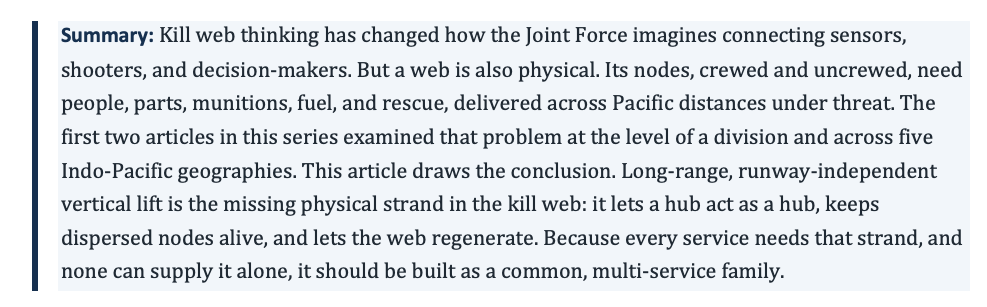
This series began with a division. In “Reach Needs a Web,” I argued that the 101st Airborne Division’s requirement to deliver a brigade at long range and keep it supplied calls for the MV-75 and autonomous systems to be built as one force, with the aircraft as the long-haul connector and small uncrewed systems as the last tactical mile.1
The second article, “The Hub Is a Verb Everywhere,” widened the lens. It applied the hub test from my Guam analysis, which judges a place by what it can send out rather than what it holds,2 to the Korean Peninsula, the southwest islands, the Philippines, maritime Southeast Asia, and Australia and Oceania. In every geography, the binding constraint was the capability that connects places more than the places themselves.
This article asks what those findings mean for the kill web, the organizing idea of modern joint warfare, and what they mean for the services that will have to buy the capability.
It draws heavily on the multi-service case made by Jim Jenkins, a retired Marine Colonel who served on the Joint Staff in the Indo-Pacific Command division.3
The claim is simple: reach is the fight. A web that cannot reach its own nodes is a diagram, not a capability.
From Kill Chain to Kill Web, and What the Web Leaves Out
A kill chain is a sequence: find, fix, track, target, engage, assess. Break any link and the sequence fails. A kill web replaces the sequence with a network in which sensors, shooters, and decision-makers connect through multiple paths, so that losing any single node or link degrades the whole far less than it would a chain. That is the core of the concept Ed Timperlake and I developed, and it is why connection, more than any single platform, is the source of combat power.
The web favors what I have called intelligent mass over exquisite scarcity. Instead of a few extremely capable platforms whose loss would be crippling, it relies on many connected nodes, crewed and uncrewed, that can be dispersed, can shift roles, and can be lost without collapsing the whole. Adversary missile forces make that logic more compelling: a concentrated point, however hardened, is also a known, targetable point.2 Dispersal is the answer, and the web is what makes dispersal coherent.
Most discussion of the kill web concentrates on its digital strands: data links, sensor fusion, and command and control that survives jamming. Those matter enormously. But a web strung across the Pacific also has physical strands, and they receive far less attention. Every node depends on people, spare parts, munitions, fuel, and sometimes rescue. That is as true of a fighter squadron on a dispersed airfield or a Marine stand-in force on a small island as it is of an autonomous vessel on a distant patrol line. Those things do not travel on data links.
Autonomous systems sharpen the point. Uncrewed vessels and aircraft extend the web’s sensing and strike reach and reduce risk to people, but each is also a node that needs servicing, payload changes, recharging or refueling, and recovery. The more the web relies on uncrewed systems, the more physical servicing it needs. A data link can tell a commander exactly where a shortfall is. It cannot close it.
Distance makes the problem acute. The run from Scarborough Shoal to Hainan alone is roughly 550 nautical miles, well beyond what much of the legacy inventory, built for shorter ranges and more permissive environments, was designed to cover.2 Fixed-wing aircraft remain tied to runways that are increasingly vulnerable to precision strikes. Conventional helicopters generally lack the range, payload, and speed to cover these distances at useful scale. The HH-60W, a valuable combat rescue platform, has a threshold combat radius of roughly 195 nautical miles without aerial refueling.3
The result is a web with a hidden weakness.
Where the physical strands are thin, a dispersed force quietly concentrates its risk again, at whichever node is hardest to reach in time or on whichever few routes carry the supplies.2
The network looks resilient on the diagram and brittle in practice.
Better software alone will not close that gap.
The Hub Is Where the Web Regenerates
The second article in this series applied three tests to every node: reach, cycle time, and the ability to deliver both while contested.2
In kill web terms, those tests describe a specific function. A hub is the node that regenerates the web. It is where damaged platforms are repaired, depleted units are resupplied, uncrewed systems are rearmed and relaunched, and capability is pushed back out.
That makes cycle time the decisive measure for the web as a whole.
Speed shortens the interval between a decision to reinforce and the arrival of what was sent.
It lets more of a dispersed network be serviced inside the same operational window.
And it raises sorties per airframe, so that a fleet shrinking under attrition can keep meeting demand for longer before the arithmetic breaks.2
A web whose hubs cannot regenerate it quickly is a web that fights once.
What Long-Range Vertical Lift Adds: Link and Node
The capability at issue is long-range, survivable, runway-independent vertical lift: aircraft that can move people, weapons, sensors, spare parts, and rescue teams across Pacific distances without depending exclusively on vulnerable runways or fixed bases.3
The MV-75 tiltrotor is the clearest current example. It is designed to fly roughly two and a half times farther than the aircraft it replaces, at higher speed, with electronic-warfare protection to operate in defended airspace rather than only permissive skies.2
The argument does not depend on a single program. It concerns a class of capability, which Jenkins frames as a common family of aircraft with service-specific variants.3
Range, speed, and survivability are not separate virtues. Range is a compound of how far an aircraft can go and how much of that distance it can cover without needing someone else to secure the route first. Extending range without extending survivability would simply move the vulnerability outward.2
In kill web terms, such an aircraft does two jobs. First, it is a physical link. It is the means by which a hub reaches its spokes, and by which spokes reach each other, without passing through the same few vulnerable runways and ports. Every additional route that does not depend on a fixed runway is an additional path in the web, which is exactly what a web is supposed to provide.
Second, it is itself a node. The same aircraft can carry distributed sensors, relay data, provide armed overwatch and escort, and in some variants employ standoff weapons.3 Most important for a web that increasingly depends on autonomy, it can carry, launch, and control uncrewed systems. In my earlier work on the North Atlantic, I described the MV-75 as a flying mothership for air-launched effects and attritable drones, with their loss priced into the operating concept from the start.4 In the Pacific, the same role means the aircraft that delivers a Marine team to an island can also leave behind the uncrewed sensors that watch the surrounding water, and come back to service them. That puts the physical link inside the kill web rather than beside it.
Optional manning extends both jobs.
Commanders will want crews aboard when communications are degraded, cyber threats are real, and missions demand onboard judgment in dense maritime and littoral environments. They will also want to launch the same aircraft without crews for repositioning, relay, or preplanned logistics, including in time blocks such as 0200 to 0600 when the campaign continues but crew exposure can be reduced, and to self-deploy from rear locations such as Hawaii and Guam.3
Bell says the MV-75’s modular open systems approach and fly-by-wire flight controls would prepare the aircraft to potentially be flown autonomously.5
That is a design potential, not a demonstrated capability, but it means the option is being built in rather than ruled out.
The second article in this series examined the Indo-Pacific geography by geography, and its findings can be restated in kill web terms. On the Korean Peninsula, the strand that is missing is lateral: the ability to move capability out of a dense base geography toward Japan and the northern Pacific without waiting for intact runways. On the southwest islands, it is the connection that lets stand-in forces move, be resupplied, and be rescued. In the Philippines and the South China Sea, it is the link between a regenerating hub and scattered spokes under gray-zone pressure. In maritime Southeast Asia, it is a light-footprint means of sensing and resupply that partners can host without a permanent foreign presence. In Australia and Oceania, it is sheer reach, along with the depth to regenerate the force away from the threatened edge.
Each of those strands belongs to a different service’s mission.
That is where the argument turns from operations to acquisition.
Why the Link Must Be Multi-Service
Jenkins argues that the problem is joint and the aircraft should be too.3 The Army needs reach from the Korean Peninsula and across the first island chain. The Marines need to make Expeditionary Advanced Base Operations executable. The Air Force needs combat rescue and Agile Combat Employment support that does not depend on tankers. The Navy needs to push sensing, relay, targeting, and strike across wider areas than conventional rotorcraft can cover; the S-3 Viking was retired without a replacement, and the H-60 often lacks the range to fill the gap.3 Four services with four missions could be read as a call for four aircraft. The reverse is true.
Independent analysis points the same way.
A 2025 RAND study of Army sustainment in the Indo-Pacific found that “none of the individual service components possess adequate lift capabilities to self-move and meet their operational demand; therefore, there is a requirement for a common-user lift solution.”6
Congressional backers have made a related point about the MV-75 itself. A letter from Sen. Jerry Moran and Rep. Ronny Jackson, signed by 87 members of Congress, said the aircraft’s technological foundation “will directly inform future requirements for the Marine Corps, Air Force, Navy and Special Operations (SOCOM) communities.”7
Commonality is what makes the physical strand behave like a web. In an Indo-Pacific contingency, one service’s aircraft could be forced to recover at an austere location where the nearest available maintainers belong to another service. A common family lets those maintainers conduct inspections, line replacement, and battle-damage repair with shared tools, training, and parts.3 The same aircraft can move Marines, Navy sensors, Army enablers, and Air Force recovery teams among dispersed locations. Any airframe, any maintainer, any node: that is path diversity applied to logistics, which is the kill web’s own logic applied to its physical strands.
The institutional benefits reinforce the operational ones. Shared engines, drive systems, digital backbones, training pipelines, and depot pathways simplify logistics. A larger and more stable production and sustainment base improves industrial resilience. And total ownership costs fall compared with four unrelated aircraft solving adjacent problems.3
The H-60 and V-22 enterprises already show that shared sustainment across services is possible.3
Acquisition discipline is the price of the argument. Congress will rightly ask whether a joint family could become an overdesigned compromise that serves no service well.
The answer is to hold commonality at the level of the airframe, propulsion, digital backbone, and sustainment, while letting sensors, weapons, mission kits, and software diverge where requirements truly differ. The result is one family with several variants rather than one rigid aircraft forced into every role.3
An open software architecture matters for the same reason: it lets each service add its own mission systems, including control of its own uncrewed systems, without reopening the core design.
The Allied Strand
The kill web does not stop at American forces, and neither should its physical strands. Japanese, Australian, and other partner forces integrating with Guam-based operations add reach and cycle-time capacity that no single nation could generate alone.2
The commonality argument can be extended across national lines. If allied operators fly the same family, a partner’s maintainers at a remote site could service an American aircraft, and the reverse, and every partner-operated airframe becomes part of the pool that keeps the network moving.
The C-17 offers a precedent. That aircraft is sustained through a shared supply chain serving multiple national operators, so that parts, expertise, and depot capacity are pooled rather than duplicated. A regional sustainment coalition for long-range vertical lift, drawing in Japan, Australia, and South Korea, could follow the same logic.
The prerequisites are political as much as technical: agreements on technology sharing, workshare, and priority of access in a crisis. They have to be negotiated before a crisis, because no coalition can improvise a supply chain under fire.
Building It Without Breaking It
None of this makes vertical lift a substitute for the rest of the force. Long-range aircraft do not replace ships, strategic airlift, hardened facilities, or the pre-positioned stocks and port capacity that carry the bulk of any sustainment load. Dispersed stocks and maritime capacity to absorb sea-based resupply when air access is contested remain part of the cycle-time loop.2 A web with only one kind of physical strand would simply be a new vulnerability.
Jenkins identifies three further risks.3
- The first is cost, since a new multi-service family would compete with programs that have strong claims on scarce resources.
- The second is integration risk: making one airframe do too much can produce an expensive platform that is hard to maintain and operationally compromised.
- The third is doctrinal. Commanders may overestimate what long-range vertical lift can solve and underinvest in the hardened bases, stockpiles, and passive defenses that remain indispensable.
Optional manning, for its part, reduces crew exposure but raises software, autonomy, and cyber-assurance demands, and a maritime variant may prove practical ashore well before it is practical on small-deck ships.3
The more immediate risk is to the program that would anchor the family. The MV-75 has not yet flown. The Army said in October that first flight is no longer expected this year and that it is conducting a schedule risk assessment to set “a realistic, budget-aligned timeline.”8 The Army has requested more than $2.1 billion for MV-75 development in fiscal 2027, and an Army spokesperson warned that a six-month continuing resolution could “significantly delay” the program.5
That is where the multi-service argument becomes practical. A program understood as one service’s helicopter replacement competes with every other Army priority. A program understood as the first member of a joint family, the physical strand that four services and their allies need, has a broader constituency and a stronger claim to stable funding. Congress can support that by funding the program at the requested level, asking the Joint Staff to define the theater requirement Jenkins describes, and protecting the open architecture that would allow other services’ variants to follow.
The kill web’s physical strands must also survive an adversary who understands their importance. How a capable opponent would try to cut them, and how the force should respond, is the subject of the final article in this series.
Conclusion: The Fight for Reach
The Pacific kill web will be tested less by what it can see than by what it can sustain. The digital strands have attracted the attention and investment, and rightly so.
But a web is only as strong as its ability to keep its nodes alive, armed, and connected over distance and under fire, and that ability rests on physical strands that remain thin.
Long-range, runway-independent vertical lift is the most promising way to thicken them. It gives a hub the reach to act, the speed to cycle, and the survivability to do both while contested. It adds routes that do not run through vulnerable runways.
It operates as a node in its own right, carrying sensors, relaying data, escorting forces, and launching and servicing the uncrewed systems on which the web increasingly depends. And as a common family, it lets four services and their allies share one physical network instead of building four.
The 101st is working out at Fort Campbell what this means for a division. Guam, Korea, Okinawa, the Philippines, the Malacca approaches, and the Pacific islands will work it out in their own terms. Each will ask the same thing of the force: not how much sits in place, but what moves, how far, how fast, and how many times.
The kill web has a missing link, and the fight for reach is the fight to supply it.
Notes
- Robbin Laird, “Reach Needs a Web: The MV-75, Autonomy and the Future of Air Assault,” Second Line of Defense, October 23, 2026. https://sldinfo.com/2026/10/reach-needs-a-web-the-mv-75-autonomy-and-the-future-of-air-assault/
- Robbin Laird, “Base Is a Noun, Hub Is a Verb: Rethinking Guam’s Strategic Function,” Defense.info, September 23, 2026. https://defense.info/re-thinking-strategy/2026/09/base-is-a-noun-hub-is-a-verb-rethinking-guams-strategic-function/
- Jim Jenkins, “Expanding Operational Reach in the Indo-Pacific: Multi-Service, Long-Range Vertical Lift as an Operational Imperative,” Second Line of Defense, October 8, 2026. https://sldinfo.com/2026/10/expanding-operational-reach-in-the-indo-pacific-multi-service-long-range-vertical-lift-as-an-operational-imperative/
- Robbin Laird, The Coming of the MV-75: Envisaging Operational Impacts, Second Line of Defense special report, July 2026. https://sldinfo.com/wp-content/uploads/2026/07/The-Coming-of-the-MV-75-Print.pdf
- Stars and Stripes, “Budget issues slow MV-75 timeline, but Bell predicts Army aviation leap with its future tilt-rotor aircraft,” October 22, 2026. https://www.stripes.com/branches/army/2026-10-22/army-mv-75-cheyenne-ii-tilt-rotor-23231023.html
- Dan McCormick et al., Sustaining U.S. Army Operations in the Indo-Pacific: Potential Roles of Allies and Partners (RAND, 2025), p. 5. https://www.rand.org/content/dam/rand/pubs/research_reports/RRA2400/RRA2434-3/RAND_RRA2434-3.pdf
- Rebecca L. Grant, “87 Members of Congress Praise the Army’s Transformative MV-75 Tiltrotor,” Lexington Institute, October 2, 2026. https://lexingtoninstitute.org/87-members-of-congress-praise-the-armys-transformative-mv-75-tiltrotor/
- Aerospace America, “Flight test engines for first FLRAA prototype are nearing completion, Rolls-Royce says,” October 15, 2026. https://aerospaceamerica.aiaa.org/flight-test-engines-for-first-flraa-prototype-are-nearing-completion-rolls-royce-says/