From Barbary Pirates to Iranian Mullahs: Here Come the Marines

03/17/2026

History rarely offers the same strategic irony twice.

In 1805, a small detachment of U.S. Marines marched out of Alexandria across the North African desert to put steel on the “shores of Tripoli,” breaking the grip of Barbary pirates who believed they could hold American commerce and citizens hostage at acceptable cost.

In 2026, Marines are heading eastward again, this time aboard a ship actually named USS Tripoli into a Middle East where Iranian mullahs have made a strikingly similar wager: that maritime coercion, hostage-taking, and missile-driven terror can be sustained as a stable instrument of power.

They are wrong.

And the Marines sailing east on Tripoli carry the proof.

What no Iranian planner has confronted before is a vertically-enveloping, F-35B-enabled Marine Expeditionary Unit operating from an aviation-centric assault ship that can project power ashore without ever staging a traditional forced landing. The ship brings fifth-generation situational awareness, tiltrotor reach, and the kill web architecture that transforms a MEU from a landing force into a networked strike system.

From the Barbary pirates to the Islamic Republic, the message has not changed: you can threaten commerce, take hostages, and wrap coercion in religious justification, but eventually the sea brings the Marines.

The First Tripoli: Pirates, Potentates, and the Birth of a Tradition

The Barbary story is worth revisiting because it frames the core continuity. The Barbary states, nominally under Ottoman suzerainty but effectively autonomous in their behavior, financed themselves by predation at sea. Their rulers combined piracy, protection rackets, and a veneer of religious legitimacy to extract tribute from commercial powers that found it cheaper to pay corsairs than to change the facts at sea.

The young American republic initially followed the familiar European pattern. Having lost the protection of the Royal Navy after independence, the United States signed treaties and paid tribute to keep American shipping moving in the Mediterranean. That approach held, until it did not. The more Washington paid, the more the Barbary rulers demanded.

When Thomas Jefferson became president, he reversed the equation. Instead of accepting a permanent tax on American commerce paid to North African potentates, he sent warships to the Mediterranean. Naval coercion alone, however, could not change the political calculus in Tripoli. Frigates could bombard harbors and shield American ships at sea, but they could not topple a regime or reshape local power without men willing to go ashore.

Enter the Marines. In 1805, Lieutenant Presley O’Bannon and a small detachment joined a force of mercenaries and local allies, marched overland from Alexandria, and attacked the port of Derna. With naval gunfire supporting from the sea, they took the town and raised the American flag on foreign soil for the first time. That action, embedded in the Marine Corps hymn as “to the shores of Tripoli,” made a durable strategic point: oceans are not moats, they are highways, and sea power achieves political effect only when it can put disciplined force ashore.

That is the origin story behind the modern ship named Tripoli sailing east today, carrying a Marine force that is once again the connective tissue between sea power and political outcomes on land.

From Corsairs to the Quds Force: A Different Flag, the Same Logic

Fast-forward two centuries and the names have changed, but the operational logic is depressingly familiar. Instead of Barbary corsairs, we have the Islamic Revolutionary Guard Corps Navy employing fast boats, drones, limpet mines, and seizures of merchant shipping in and around the Strait of Hormuz. Instead of letters of marque from North African beys and pashas, we have religious decrees and “revolutionary” rhetoric from a clerical regime that treats maritime harassment and missile strikes on neighbors as instruments of resistance.

The technology has evolved, but the political method has not. Use geography, narrow chokepoints like Hormuz, to threaten global commerce. Hide behind a mix of deniability and proxies, whether corsairs or militias, so the regime can calibrate escalation while claiming distance. Assume that major trading nations, risk-averse and dependent on oil flows, will ultimately pay, deter themselves, or confine their response to statements and sanctions.

The Barbary rulers bet that the United States would rather pay tribute than fight. The Iranian leadership made the same wager: that the United States would absorb tanker seizures, missile strikes on partners, and proxy attacks so long as American casualties stayed low and oil kept flowing. Both concluded that maritime coercion, wrapped in ideological language and backed by local irregulars, could function as a sustainable business model.

What breaks that business model is not a communiqué or a sanctions package. It is the credible prospect that someone will not only fight back at sea but will come ashore to impose consequences. The Barbary states discovered this. Iran now faces a U.S. naval posture that includes not just carrier strike groups and land-based aviation but an amphibious force configured to do what Marines have always done: go where they are not wanted and change the facts on the ground.

The New Tripoli: An Aviation-Centric Assault Ship

The USS Tripoli is not a 19th-century frigate, and the Marines embarked today bear no resemblance to O’Bannon’s small detachment. The modern Tripoli is an America-class amphibious assault ship, designed from the keel up as an aviation-centric platform, a ship that deliberately blurs the line between amphibious warfare and light carrier operations.

Unlike earlier big-deck amphibs, Tripoli carries no well deck in its baseline configuration. That is not an oversight; it is a design decision. Where older amphibious ships married a modest flight deck to an extensive internal bay for landing craft, Tripoli trades that well deck volume for enlarged aviation capacity, more flight deck, more hangar space, more aviation fuel, more weapons storage. The ship is optimized not for massing surface connectors on a beach but for launching vertical-lift and STOVL aircraft into three-dimensional maneuver.

The centerpiece of that aviation capability is the F-35B. Operating in “Lightning Carrier” configuration, an America-class ship can embark around 20 F-35Bs, supported by MV-22 Ospreys and helicopters. That package is not a peer to a full carrier air wing, but it is far more than an adjunct. It is a self-contained, fifth-generation, networked strike and sensing node operating from a platform built specifically to support it.

For a regime like Iran’s, that distinction matters. The F-35B does not just bring precision strike; it brings pervasive situational awareness. It fuses data from its own sensors and from other platforms across the kill web, then shares that picture with the force. A Tripoli-centered amphibious ready group can see, understand, and target threats in the air, on the surface, and ashore with a clarity previous amphibious forces never possessed.

Tehran has studied American carriers and Tomahawk strikes for decades. It has adjusted air defenses, hardened key sites, dispersed capabilities, and invested heavily in anti-ship missiles, UAVs, and ballistic systems. What it has not faced is a Marine force afloat that combines fifth-generation aviation, long-range tiltrotor reach, and a doctrine of vertical envelopment as its default mode of entry.

Vertical Envelopment, Not Forced Landing

The iconic images of amphibious warfare, Tarawa’s bloodied reefs, Iwo Jima’s beaches, Inchon’s tidal flats, are images of forced entry against defended shores. Waves of landing craft, slow and exposed, carrying Marines into pre-registered artillery, interlocking machine gun fire, and prepared obstacles. The cost in lives is seared into the Corps’ institutional memory. It also lives in the minds of adversaries, many of whom still think about amphibious assault in exactly those terms: boats on the beach, bodies in the surf.

The MEU embarked on Tripoli is built to fight differently. Its default approach is not to mass surface craft against a fortified shoreline but to execute vertical envelopment, going over and around, landing combat power where the adversary is weakest rather than where he is strongest.

Vertical envelopment has existed as a concept since helicopters entered service, but its practical reach was long constrained by helicopter speed, range, and payload. The MV-22 Osprey changed that calculus. Its tiltrotor design delivers turboprop-like speed and range combined with vertical takeoff and landing flexibility. Marines can now move hundreds of miles inland in a single bound, bypassing coastal defenses to strike nodes that matter: command centers, missile batteries, logistics hubs, critical infrastructure.

Overlay the F-35B’s sensor and strike capabilities and vertical envelopment becomes part of the wider kill web. Marines can be inserted into areas already mapped by fifth-generation ISR, supported by precision fires from both ship and aircraft, and connected into a broader joint command-and-control architecture. They fight not as an isolated landing force but as forward nodes of an integrated system, exactly what the kill web concept demands.

From Tehran’s perspective, this means the amphibious group centered on Tripoli is not merely a threat to beaches or coastal islands. It is a mobile base for three-dimensional maneuver across the full Iranian problem set: from the Hormuz littoral to inland missile fields, from proxy training camps to the critical infrastructure Tehran prefers to treat as sanctuary.

Beyond Numbers: Changing the Option Set

It is easy to look at the headline figure, a few thousand Marines, several dozen aircraft, and treat Tripoli’s deployment as marginal reinforcement of an already substantial U.S. presence in the region. That misses the point.

What Tripoli brings is not more of the same. It is a different option set.

First, it restores a flexible, credible option for noncombatant evacuation and crisis response under threat. In a region where embassies and expatriates are perpetual targets, a MEU afloat with its own aviation and ground combat element can extract citizens from collapsing states without depending on host-nation infrastructure. Vertical lift allows Marines to move directly from sea to rooftops, airfields, or open ground inland, even under contested conditions.

Second, it opens options for seizing and holding key terrain that shapes the maritime fight: islands, peninsulas, ports, chokepoint-adjacent infrastructure. Vertical envelopment lets the United States put Marines onto key nodes quickly and unpredictably, backed by fifth-generation airpower, without telegraphing intent through a slow buildup of ships and landing craft.

Third, it enhances deterrence credibility in concrete terms. Adversaries are not deterred by what they cannot imagine. They are deterred when they can visualize specific, plausible actions the other side could take that would be painful and hard to counter. A Tripoli-centered MEU that can appear along the Iranian periphery, put Marines ashore beyond the horizon, and integrate with joint and allied fires is precisely that kind of action set. It complicates Iranian planning and erodes the regime’s confidence in its escalation assumptions.

Finally, it signals something tangible to allies and partners around the Gulf. Regional states are watching not only what Washington says about Iran but what it is actually willing to deploy and sustain. The arrival of a modern amphibious force, configured for 21st-century maneuver and backed by F-35B capability, tells them the United States is still prepared to underwrite maritime security with more than rhetoric.

From Derna to the Gulf: The Enduring Message

The arc from Barbary pirates to Iranian mullahs is not a neat morality play. Geopolitics never is.

The Barbary conflict played out in the age of sail, with empires and corsairs and a United States still experimenting with its role in the world.

The current confrontation with Iran unfolds in a nuclear-tinged environment, amid networked economies and social media, with multiple major powers in the mix.

Yet at the core of both episodes sits the same recurring theme: actors who believe they can weaponize geography and maritime predation to punch above their weight, who assume that major trading nations will ultimately pay or adapt, and who build domestic legitimacy around the image of humiliating foreign powers at low cost. The Barbary states were not the last to try this model. They were simply among the first to discover its limits when confronted with naval resolve and Marines willing to go ashore.

The USS Tripoli now steaming toward the Middle East carries that earlier lesson in its name. It is not a guarantee of wise policy, flawless execution, or frictionless operations.

It is a concrete signal that the United States still understands what Jefferson grasped in his own era: that tribute and passivity invite further predation, and that sea power without the capacity to act ashore is strategically incomplete.

The Iranian leadership has built a regional strategy around missiles, proxies, and maritime harassment, confident that the constraints of domestic politics and alliance management will keep American responses within bounds the regime can absorb. That may hold for a time.

But Marines on a ship called Tripoli, trained for vertical envelopment and backed by fifth-generation aviation integrated into a kill web, mean that if Tehran miscalculates, the answer need not be confined to sanctions and statements.

One more thing: the Marines heading to the Gulf have not forgotten what Iran and its Hezbollah proxies did to their fellow Marines in Beirut in 1983, when a single Iran-backed suicide truck bomb killed 241 American service members in their barracks. That memory does not drive policy.

But it is part of the institutional fabric of every Marine who has ever worn the uniform.

The Barbary rulers learned that piracy and state-sponsored predation at sea carry a reckoning when they go far enough. The men who delivered that message wore leathernecks and carried muskets.

Their successors fly F-35Bs, ride tiltrotors, and operate within a kill web spanning air, sea, and land.

The technology has changed.

The Marines have not.

And from the shores of Tripoli to the waters off Iran, the enduring message remains: here come the Marines.

Then and Now: Two Tripolis in U.S. Strategy

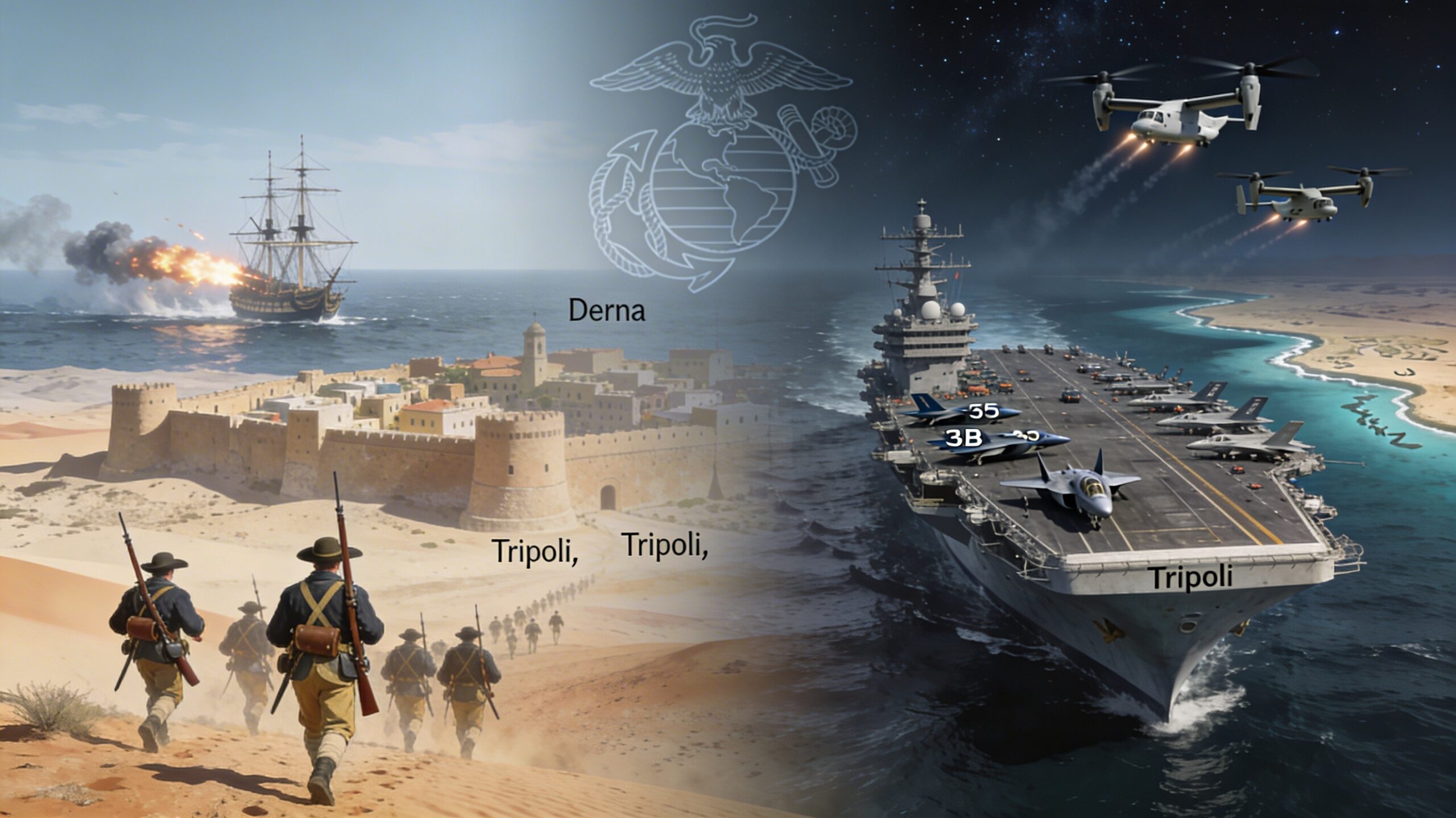
Tripoli then—Derna, 1805: A handful of Marines and mercenaries march from Alexandria, seize a Barbary port with frigates in support, and prove that American sea power can reach ashore to overturn a predatory status quo.

Tripoli now—Gulf, 2026: A Marine Expeditionary Unit sails on an aviation-centric assault ship, carrying F-35Bs, MV-22s, and a fully networked kill web architecture, able to project power deep inland without ever staging a classic beach landing.

Instrument of policy: Jefferson’s small squadron and Marine detachment were the sharp end of a political decision to stop paying tribute. Today’s Tripoli and MEU embody a decision to contest Iran’s use of proxies, missiles, and maritime harassment rather than normalize it.

Message to adversaries: The Barbary rulers learned that piracy and state-sponsored predation at sea can trigger regime-shaping force ashore. Iranian leaders now face a Marine Corps configured to deliver that consequence with 21st-century speed, reach, and precision integrated into a kill web that no previous amphibious force has ever brought to the fight.

And by the way, the Marine Corps aviators on USS Tripoli will be joining up with their mates who fly the  F-35C Lightning IIs on the USS Abraham Lincoln. Those planes are from Marine Fighter Attack Squadron 314 (VMFA-314), the Black Knight.

I spent time with the USS America and wrote a great deal about why this ship is special.
The featured image was generated by an AI program.
China’s Djibouti Hinge and the Persian Gulf: Rethinking Access, Not Just Bases

By Robbin Laird

China’s presence in Djibouti has usually been read through the familiar grammar of bases and bastions, a forward military foothold that extends PLA Navy reach toward the Red Sea and the Persian Gulf. That reading is not wrong, but it is incomplete. Djibouti matters less as a standalone outpost and more as a hinge in a wider system: a “parallel logistics universe” built from African waterfronts, differentiated flag treatment in contested waters, and political relationships that buy access when traditional chokepoints are under stress.

If we take that hinge seriously, the question is no longer simply “What can China do from Djibouti?” but “How does Djibouti connect China’s African ports, the Red Sea crisis space, and the Persian Gulf into a single adaptive access network?” That is the terrain on which the next phase of maritime competition is being defined, and it is where U.S. and allied strategy will either adapt or be overtaken.

Djibouti as a three-theater hinge

The starting point is geography under pressure, not geography on a map. In the abstract, Djibouti sits near the Bab el‑Mandeb, the narrow gateway between the Red Sea and the Gulf of Aden. In practice, in a world of Houthi attacks, U.S.–Iran confrontation, and selective immunity for certain flags, Djibouti becomes a hinge across three distinct but now tightly coupled theaters:

  • The Red Sea and adjacent SLOCs, where non‑state and proxy actors test the limits of freedom of navigation.
  • The approaches to the Strait of Hormuz, where tension with Iran shapes risk for every tanker and merchantman.
  • The ring of African waterfronts, from East Africa around the Cape and up to the Gulf of Guinea, where Chinese-built ports provide depth, redundancy, and options.

Seen this way, the Chinese facility in Djibouti is not simply “a base pointing at Hormuz.” It is a sensor, staging area, and political symbol at the juncture of these three spaces. PLA Navy units alongside Russian assets in Djibouti bring China physically closer to the Gulf, but they also sit astride the re‑routing patterns that Western shipping has been forced to adopt when the Red Sea becomes too dangerous.

This is where the hinge metaphor bites. When Western-linked ships divert around Africa, their dependence on African ports and coastal infrastructure spikes, as do the costs and delays. Chinese-flagged vessels, by contrast, have in some cases been treated with greater restraint by Houthi forces and have been able to signal their nationality as a protective marker. The net effect is not a neat, total Chinese advantage, but a differentiated geography of risk. Djibouti, at the hinge, is where Beijing can observe, position, and quietly exploit that differentiation.

From Fixed Chokepoints to Adaptive Access

What Djibouti highlights is an ongoing shift in maritime competition: the move from fixed strings and static chokepoints to adaptive access. For decades, U.S. naval power has been conceptualized in terms of dominance at key maritime pinch points, the Suez Canal, Bab el‑Mandeb, Hormuz, and the capacity to “fight through” contested waters with carrier strike groups and escorts. China has not tried to mirror that architecture ship-for-ship. It has built something more diffuse and, in some ways, more resilient.

Across Africa, Chinese financing and construction have produced an archipelago of ports—Djibouti, Lekki, Walvis Bay, and others—that are formally commercial but strategically elastic. Under normal conditions, they underwrite trade and political visibility. Under stress, they become options: alternative refueling and maintenance points, bargaining chips in local politics, and material expressions of Chinese reach well beyond the first island chain.

In this model, Djibouti is the forward node of an adaptive access system. When U.S.-influenced chokepoints are contested, China does not need to fight its way through in the same fashion. It can:

  • Lean on friendly or Chinese-operated ports along alternative routes.
  • Use its base in Djibouti to maintain presence and situational awareness near disrupted chokepoints.
  • Combine on‑the‑water flexibility with diplomacy to keep its merchant fleet moving, even as U.S. and Israel-linked shipping is squeezed.

The value of Djibouti under this model is less about sortie rates and more about continuity, keeping Chinese trade flowing when others are forced into ten‑day detours around the Cape. The competition becomes one of resilience under pressure: who can arrange access, escorts, and political guarantees so that their flag continues to move, at tolerable risk and cost, when the seas grow rough?

Converting Logistics into Leverage: Within limits

It is tempting to read this adaptive access system as a tightly orchestrated “string of pearls,” a single, coherent design with Djibouti as a kind of new‑model command center for the Western Indian Ocean and the Gulf. Reality is more textured. Chinese projects differ enormously by country, financier, and local political economy. Some are commercially viable; some are white elephants; some have clear dual‑use potential; others are far more ambiguous.

Djibouti itself is a good example of why we should be cautious about ascribing too much centralized intent. Beijing enjoys a significant footprint and has invested heavily, but it operates in a crowded strategic space. The United States, France, and other partners also maintain bases and have longstanding relationships with Djibouti’s leadership and security services. The host government has its own balancing acts, sensitivities, and interests.

That does not mean infrastructure is neutral. Debt, equity stakes, and operating concessions are forms of influence. In a prolonged crisis involving the Persian Gulf, Djibouti’s leadership would have to weigh the economic benefits of Chinese investment against the security reassurance and political cover offered by Western partners. The outcome would be negotiated, not dictated.

The same is true along the broader ring of African ports. Some governments have already shown that they can renegotiate terms, cancel or scale back projects, or diversify their partnerships when domestic politics or alternative financing permit. Ports are political ecosystems: unions, business elites, navies, coast guards, and parliaments all shape what can actually be done from these facilities. For China, the strategic question is not simply “Do we own a stake in the terminal?” but “What does the local ecosystem permit us to do when it really matters?”

Djibouti’s relevance to the Persian Gulf, therefore, is contingent as much as structural. It provides China with tools—presence, infrastructure, and a symbol of staying power near critical sea lanes but those tools are mediated by African agency and by the embedded interests of other external powers.

Selective Immunity and the Future of the Maritime Order

One of the most striking features of the current Red Sea–Gulf environment is the emergence of what might be called “selective immunity”: de facto differentiated treatment for certain flags and owners. Reports that Houthi actors have declared Chinese vessels safe, or at least have treated them differently from U.S. and Israel-linked shipping, are an early glimpse of a world in which not all merchantmen are equal in the eyes of non‑state or proxy actors.

Here Djibouti’s role is subtle but important. A Chinese base at the hinge, plus an array of African ports and a strong political channel into Tehran, gives Beijing both visibility and leverage over the security of its own commerce. Beijing can signal, negotiate, and, if necessary, redeploy to minimize risk to Chinese vessels, while others bear the brunt of disruptions or rerouting costs.

That does not mean China fully controls the behavior of groups like the Houthis. It does mean, however, that armed actors may see China as a distinct category, an actor whose ships are economically important, whose political relationship with Iran matters, and whose response is likely to be calibrated rather than overtly military. The combination of these factors can produce a tacit incentive to give Chinese shipping a different risk profile.

For the United States and its allies, this emerging practice of selective immunity poses hard questions. How do you sustain a rules‑based maritime order when some actors are both unwilling and unable to treat all legitimate commerce the same? What role does naval presence play in such an environment if presence alone does not equal protection for every flag? And how do you respond when a competitor can quietly insulate its traffic while your own or your partners’ shipping is targeted as a matter of strategic design?

Djibouti is not the cause of this new pattern, but it is part of the infrastructure that enables Beijing to play this differentiated game: a base for observation and liaison, a nearby platform for limited deployments, and a symbol that China is now a resident power in the hinge zone, not a distant observer.

The U.S.–China Contest Reframed

Once Djibouti is placed within this adaptive access and selective immunity frame, the U.S.–China contest around the Persian Gulf looks less like a race to park the most hulls near Hormuz and more like a contest over who can offer the most reliable, politically sustainable access in a crisis.

On the U.S. side, the traditional strengths remain formidable: carrier strike groups, preexisting basing networks in and around the Gulf, rich ISR and strike capabilities, and enduring partnerships with key Gulf monarchies. But those strengths sit inside an access model that assumes the ability to secure chokepoints by force and to treat all legitimate commerce as equally entitled to protection. That model struggles when adversaries or proxies selectively harass some flags and spare others, and when host nations are hedging rather than aligning.

On the Chinese side, the emerging model is not built around dominance at chokepoints. It is built around continuity: ensuring that, under most plausible crisis conditions short of a major power war, Chinese trade can continue to flow along at least some acceptable routes. Djibouti, African ports, and political relationships with actors like Iran are instruments in this continuity strategy. So are more mundane factors like diversified shipping companies, insurance arrangements, and the ability to signal nationality in ways that matter to armed groups making targeting decisions.

In that context, Djibouti reshapes the U.S.–China contest in at least three ways:

  • It brings Chinese presence and observation into immediate proximity with U.S. and allied operations near critical sea lanes, adding a layer of intelligence competition and potential misperception.
  • It strengthens Beijing’s argument to Gulf actors that China is now a resident stakeholder in the security of the approaches to Hormuz, not just a distant energy customer.
  • It underwrites a narrative of Chinese reliability in crisis, “our ships kept moving; we did not abandon our trade”, that can be contrasted with Western rerouting and disruption.

For Washington and its partners, the response cannot be a mirror‑image attempt to recreate a Chinese‑style port network. It has to be an adaptation of their own strengths to a world where access is co‑produced with host nations and where flags are not treated equally by violent actors. That means deeper investment in port resilience with African and Middle Eastern partners, co‑designed security and emergency protocols, diversified financing to avoid single‑creditor dominance, and operational innovations—escorts, unmanned systems, distributed logistics—that make contested routes more manageable.

African Agency at the Center

One of the most important implications of this Djibouti-as‑hinge frame is that African agency is not peripheral to the Persian Gulf story; it is central. The logic of adaptive access assumes cooperation from hosts. Ports are not empty infrastructure waiting to be used; they are embedded in political economies, patronage networks, and security institutions that have their own agendas.

Djibouti’s leadership will calibrate China’s use of its facilities in light of domestic politics, economic needs, and the reactions of other external partners. Kenyan authorities will navigate Gulf trade risks according to their own priorities, not simply as collateral damage of other people’s rivalries. South Africa’s decisions about which naval exercises to host will reflect its foreign policy identity and regional ambitions as much as any leverage held by Beijing or Washington.

For China, this means that adaptive access is always adaptive in two senses: adapting routes and behavior at sea, and adapting relationships and arrangements ashore. For the United States and its allies, it means that efforts to blunt or compete with China’s logistics universe must begin with a willingness to treat African states as co‑authors of maritime order, not as pawns or victims.

Djibouti, again, is illustrative. It is not a Chinese command node in the way a home‑territory base might be. It is a negotiated space where multiple powers jostle for influence and where the host uses external interest to maximize its own options. How Djibouti chooses to manage that space in a prolonged Gulf crisis will tell us as much about African strategic agency as it does about Chinese intent.

Where Maritime Strategy now Begins

Seen through this lens, China’s Djibouti complex and its role in the Persian Gulf are best understood not as a final proof of a grand Chinese design, nor as just one more base in a crowded map of global deployments. They are an early, vivid demonstration of how ports, politics, and flags intersect in an era of adaptive access.

The questions that flow from this are the ones that should animate serious maritime strategy in the years ahead:

How do major powers design logistics networks that can survive selective harassment and contested chokepoints without either capitulating or escalating uncontrollably?

How can coalitions sustain freedom of navigation when some actors will be willing to differentiate among flags and when some commercial partners may quietly accept that differentiation as the price of continuity?

How can external powers work with African and Middle Eastern hosts to build port ecosystems that are resilient, plural, and politically sustainable, rather than brittle, debt‑loaded, and prone to capture?

Djibouti sits at the center of these questions because it sits at the intersection of the Red Sea, the Persian Gulf, and Africa’s waterfronts. Watching how China uses, and is constrained in using, that hinge in the next round of crises will tell us far more about the trajectory of maritime competition than any abstract debate about “strings of pearls.”

This article was stimulated by reading a recent LinkedIn post by Manish Acharya on African ports and China’s so‑called “parallel logistics universe,” which offered a useful provocation, one that deserves to be extended and reframed through the Djibouti–Gulf lens.

𝑻𝒉𝒆 “𝑺𝒕𝒓𝒊𝒏𝒈 𝒐𝒇 𝑷𝒆𝒂𝒓𝒍𝒔” 𝑱𝒖𝒔𝒕 𝑮𝒐𝒕 𝑺𝒕𝒓𝒆𝒔𝒔-𝑻𝒆𝒔𝒕𝒆𝒅. 𝑯𝒆𝒓𝒆’𝒔 𝑾𝒉𝒂𝒕 𝒕𝒉𝒆 𝑼𝑺-𝑰𝒓𝒂𝒏 𝑪𝒐𝒏𝒇𝒍𝒊𝒄𝒕 𝑹𝒆𝒗𝒆𝒂𝒍𝒔.

Exercise Cobra Gold 2026 Maritime Strike

03/16/2026

U.S. Army Soldiers assigned to Task Force Tigershark, 1st Battalion, 229th Aviation Regiment, 16th Combat Aviation Brigade, conduct a sea-based operation from a U.S. Army UH-60 Black Hawk during Exercise Cobra Gold 2026 at Rayong Province, Thailand, March 3, 2026.

Cobra Gold is the Indo-Pacific’s largest annual military exercise in mainland Asia, co-hosted by the U.S. and Thailand. The exercise brings together participants from multiple nations for military training and humanitarian projects that strengthen regional partnerships and demonstrate U.S. commitment to Indo-Pacific security.

U.S. Marine Corps video by Cpl. Kenneth Twaddell.

Russia’s Strategic Insecurity in the Iran War: A Warning, Not a Win

03/13/2026

By Robbin Laird

What is the impact of the U.S.–Israeli war against Iran on Russia? With Washington forced to juggle a major confrontation in the Middle East while continuing to support Ukraine, it can appear as though Moscow has successfully shifted the strategic spotlight away from its own aggression in Europe. In public debate this often sounds like a tidy story: the West is overstretched and distracted; Russia gains time, resources, and leverage.​

Robert Czulda’s analysis points to something more complicated and ultimately more disturbing for Europe’s eastern flank. The conflict is less a clear geopolitical “win” for Russia than a warning about the fragility and volatility of Moscow’s position. Russia does gain certain tactical advantages from the war against Iran, but those gains are contingent, hard to sustain, and intertwined with deep structural weaknesses. That is precisely why the situation should be treated as a cautionary tale rather than a settled outcome.​

As Czulda emphasizes, Iran is not a marginal player for Russia but one of its most important wartime partners. Tehran has supplied Moscow with Shahed and Mohajer‑6 drones, hundreds of short‑range ballistic missiles, artillery ammunition, and a range of other military equipment that has been vital in sustaining Russia’s campaign against Ukraine. Russia has even moved to license‑produce Iranian‑designed drones domestically, further entrenching the partnership.​

The war against Iran therefore hits close to home for Moscow. A state in which it has invested considerable diplomatic, industrial, and military capital is now under intense U.S.–Israeli pressure. Yet Russia’s response, as Czulda underlines, has been highly constrained: rhetorical condemnation of an “unprovoked act of armed aggression” and limited intelligence assistance, but no meaningful effort to alter the military balance or deter further strikes. This is not simply a matter of choice.​

The Kremlin is constrained by its own war in Ukraine and by the structural limits of its defense industry. It must also balance relations with Arab monarchies and avoid a direct collision with Washington that could carry unpredictable risks. The result is an uncomfortable spectacle for states that have come to rely on Russian protection: a “near‑ally” under attack while Moscow stays largely on the sidelines. For regimes in Syria, Venezuela, Mali, or Cuba, this undercuts the narrative of Russia as a reliable strategic patron willing to incur serious costs on behalf of its partners.​

In this sense, the Iran war is exposing a reputational vulnerability. Russia wants to be seen as the alternative to the United States as a security provider, but its actual behavior suggests a power with limited margin for bold action and an acute awareness of its own weaknesses. That is not a stable foundation for long‑term influence.​

Tactical Gains Built on Western Vulnerability

Czulda nevertheless lays out several ways in which the war against Iran appears to work to Russia’s advantage. First and most obvious is the diversion of political and strategic attention. The Middle East once again consumes Washington’s senior leadership bandwidth, media focus, and crisis‑management energy. Events on NATO’s eastern frontier risk sliding from the top of the agenda to second place.​

That shift has operational implications. Czulda points to France’s decision to pull the aircraft carrier Charles de Gaulle and its strike group out of the Baltic and send it to the eastern Mediterranean. For frontline allies such as Lithuania, Latvia, Estonia, Poland, and Finland, this is precisely the pattern they fear: high‑value Western naval and air assets being relocated away from the Baltic and High North just as Russia remains entrenched in its war against Ukraine. The symbolism of presence matters; when key platforms are redeployed, the perception of vulnerability grows.​

Second, the intensity of the Iran conflict accelerates the depletion of U.S. and allied munitions. Czulda notes estimates of more than 800 Patriot interceptors fired in just five days of hostilities, an extraordinary burn rate for one high‑end system. Reconstituting these stocks will take years, not months. In the meantime, promised or planned deployments of additional air and missile defense assets to Central and Eastern Europe risk being deferred. For states living under the shadow of Russian missile and drone forces, the prospect that badly needed systems will arrive later, or in fewer numbers, is alarming.​

Third, the energy dimension matters. Before the crisis escalated, key producers in OPEC+ and beyond had already begun adjusting production in anticipation of turmoil. Even so, oil prices spiked back toward 100 dollars per barrel, levels not seen since the immediate aftermath of Russia’s full‑scale invasion of Ukraine. Under pressure to stabilize markets and protect its own economy, Washington has already shown some willingness to relax elements of its sanctions regime such as allowing Russian oil stranded at sea to be redirected to India. If instability continues, Czulda warns that calls for broader sanction waivers or temporary relaxations will intensify, increasing the incentives for Western governments to normalize relations with Moscow.​

Yet this apparent energy windfall for Moscow rests on a narrowing and unstable set of external supports. Russia’s war economy has come to depend on a shadow ecosystem of discounted oil flows, sanctions‑evasion schemes, and politically aligned buyers that keep hard‑currency revenues trickling in despite Western restrictions. In that system, Iran and Venezuela matter not only as fellow revisionist states but as crucial nodes channeling cut‑rate barrels to Asian demand centres, above all China. When that network begins to fray at the very moment Russia is waging an industrial‑scale land war in Europe, the picture shifts from that of a resilient energy superpower to that of an overstretched petro‑state living off increasingly fragile work‑arounds.​

The effective elimination of Venezuela from the Russian orbit through internal crisis, negotiated openings to Western firms, and renewed U.S. leverage over Caracas’s access to global markets erodes one of Moscow’s more convenient hemispheric partnerships. What had served as an instrument of influence in Latin America and an auxiliary route for financial and energy transactions becomes, at best, neutral ground and, at worst, another case study for other clients in how quickly Russian “protection” can evaporate when circumstances shift. For a Kremlin already losing altitude in Syria and feeling pressure in places such as Mali and Cuba, this loss of position in Venezuela reinforces the broader pattern of a shrinking, not expanding, informal empire.​

At the same time, sustained pressure on Iranian oil exports to China whether through renewed U.S. enforcement, conflict‑related disruptions, or cautious hedging in Beijing cuts into a central pillar of the Russia–Iran–China triangle. Chinese appetite for discounted barrels has been one of the main shock absorbers cushioning both Moscow and Tehran from Western sanctions. If Washington can simultaneously constrain Iranian flows and discourage China from openly backfilling Russian exports, while President Trump ramps up U.S. oil and gas production, the global balance begins to tilt. Increased North American supply gives Washington and its partners more room to absorb shocks and to tighten sanctions without automatically triggering the kind of price spikes that previously forced retreats.​

The uncertainty surrounding the Gulf of Hormuz is the wild card. As long as Iranian and Houthi threats cast a shadow over the Strait, markets will continue to price in disruption risk, and some actors will be tempted to ease sanctions in search of short‑term stability. But the Gulf Cooperation Council states have powerful incentives of their own to keep the sea‑lanes open and to prevent Tehran from weaponizing the region’s main artery of commerce. Their naval deployments, quiet coordination with Western forces, and efforts to harden energy infrastructure are not gestures of charity toward Washington. They are moves to protect their own export lifelines and fiscal stability. In doing so, they narrow the window for Iran to use the Strait as a durable lever and, by extension, for Russia to rely on Iranian‑enabled energy turmoil as a structural advantage.​

From Moscow’s perspective, this convergence is sobering. Instead of a long‑term, structurally favourable energy environment, it faces a world in which key partners like Venezuela drift away, Iran is under unprecedented military and economic pressure, and China calibrates its exposure with increasing care. U.S. production growth and a more activist Gulf only underline the point. Russian leaders may still profit from episodic turmoil and price spikes, but those profits are opportunistic and contingent, not the fruit of a stable external support system.​

From the Kremlin’s vantage point, all of this is welcome: Western distraction, depleted arsenals, and high energy prices that boost Russian revenues. But, as Czulda stresses, these are opportunistic benefits, not products of a coherent Russian strategy. Moscow is not dictating the tempo or parameters of the conflict; it is merely exploiting the side‑effects of Western decisions. That makes these advantages inherently fragile.​

The Iran Campaign as Deliberate Architecture, Not Strategic Accident

Czulda’s analysis, valuable as it is, treats Western distraction from Europe as an unintended side effect of the Iran conflict, a windfall Russia did not engineer and cannot fully control. That framing is correct as far as it goes, but it understates the extent to which the campaign against Iran reflects a coherent strategic logic running across both Trump administrations. When that logic is understood, Russia’s apparent gains look even more contingent and fragile than Czulda suggests.

The Abraham Accords, the Riyadh speech, the calibrated approach to munitions transfers in Ukraine, and the current military campaign against Iran are not disconnected episodes. They are chapters in a single long-range strategy whose core objective is the containment and ultimate transformation of Iran and through Iran, the erosion of Russia’s most consequential partner in its global revisionist project. Iran is not merely a Middle Eastern problem. It is a key node in the alignment of Russia, China, Iran, and North Korea that defines the strategic environment of the current decade. Any serious effort to contest Russian revisionism must reckon with Iran’s role in sustaining it: as a sanctions-busting partner, a supplier of drones and ballistic missiles to Russia’s war in Ukraine, and a spoiler capable of driving energy crises and regional instability to Moscow’s advantage.

The Abraham Accords were, from inception, designed as architecture against Iran, intended to consolidate a U.S.-aligned regional bloc in which Israel and key Arab partners could cooperate on the strategic challenge posed by Tehran’s network of proxies, ballistic missiles, and nuclear ambitions. The “crown jewel” was always Saudi-Israeli normalization, because a deal between Riyadh and Jerusalem would have cemented a coalition spanning the Gulf, the Levant, and North Africa, leaving Iran diplomatically encircled by its own neighbors. That Hamas, an organization sustained by Iranian money, weapons, and training, launched the October 7 attack precisely to derail that normalization process only confirms how seriously Iran’s proxy network understood the strategic stakes. The architects of that attack were willing to risk a regional war to stop a diplomatic process, which is itself evidence of how threatening the Accords’ logic was to Tehran and, by extension, to Moscow.

This context reframes two of Czulda’s key points. First, on munitions: Trump’s calibrated approach to precision weapons transfers in Ukraine has generated criticism from those who read it as indifference to Kyiv or deference to Moscow. But the United States faces a genuine munitions constraint, and the campaign against Iran demands exactly the categories of capability that Ukraine has consumed in large quantities, long-range precision strike, integrated air and missile defense, and ISR architecture needed to prosecute a complex, distributed target set. Prioritizing the Middle East theater is not strategic negligence. It reflects a deliberate judgment about where those finite assets are most critically needed. Russia’s apparent windfall from depleted Western arsenals is, in this reading, a cost the United States has consciously accepted in pursuit of a larger strategic objective.

Second, on energy: Czulda correctly identifies rising oil prices and potential sanction slippage as benefits for Moscow. But sustained pressure on Iranian oil exports to China, whether through U.S. enforcement, conflict-related disruptions, or cautious hedging in Beijing, cuts into a central pillar of the Russia–Iran–China triangle. Chinese appetite for discounted barrels has been one of the main shock absorbers cushioning both Moscow and Tehran from Western sanctions. If Washington can simultaneously constrain Iranian flows, discourage open Chinese backfilling of Russian exports, and ramp up North American production, the global energy balance begins to tilt against the revisionist axis. Episodic price spikes may benefit Russia in the short term; structural degradation of the Iran-Russia-China supply chain is a different matter entirely.

In short, Czulda is right that Russia gains opportunistically from the Iran war. But the deeper point is that Russia is watching the deliberate dismantlement of the strategic architecture on which its revisionism has depended, the Iran partnership, the proxy network, the sanctions-evasion ecosystem. Those are not incidental losses. They are the target. And that makes Russia’s position considerably more precarious than a simple accounting of short-term tactical advantages would suggest.

​A Shrinking Network and Strategic Overstretch

The deeper message in Czulda’s piece is that Russia’s underlying strategic position is more precarious than the superficial narrative of “benefiting from chaos” suggests. Moscow is fighting a grinding land war in Europe that continues to drain men, materiel, and political capital. Its defense industry, while ramped up, remains under sanctions pressure and strained by wartime demands.​

At the same time, Russia’s broader network of partners and clients is under stress. Czulda notes that Moscow has already lost or seen its position weaken in Syria and Venezuela. It faces mounting jihadist challenges in Mali, where its influence has relied heavily on irregular formations, and it feels historical pressure in Cuba. Iran, in this context, is one of the few robust partners left where Russia can claim a mutually advantageous relationship.​

If the current conflict leaves Iran significantly weakened, internally destabilized, or forced into deals that cut across Russian interests, much of that regional leverage could evaporate. And if, as in the present crisis, Russia is seen to offer little more than rhetorical support and limited intelligence assistance, other partners will factor that reality into their own calculations. The image of a confident, globally projecting Russia starts to look more like that of a power juggling multiple fragile dependencies, seeking advantage on the margins of crises it does not control.​

From the perspective of Central and Eastern Europe, this combination, structural Russian weakness plus opportunistic behavior, is unnerving. It suggests a Russia that may feel compelled to exploit short‑lived opportunities aggressively precisely because it doubts the long‑term sustainability of its position.​

The “New Vietnam Syndrome” and Europe’s Risk Calculus

Czulda introduces another crucial concern: the risk that a costly Iran war could produce a “new Vietnam syndrome” in the United States. If the conflict becomes prolonged, bloody, and politically divisive, U.S. domestic appetite for further overseas commitments could erode sharply. For allies on NATO’s eastern flank, that prospect is not abstract for it translates directly into fears that Washington might hesitate to confront Russia in a future crisis.​

Lithuania’s reaction, as described by Czulda, is telling. Senior officials not only support strikes on Iran but signal a willingness to deploy troops to assist the United States. This is less about enthusiasm for a Middle Eastern war than about signaling: Lithuania wants to demonstrate that it is prepared to share risks now in the hope of keeping the U.S. strategically engaged later, when the threat may come directly from Russia.​

The problem is that this is ultimately a bet on U.S. domestic resilience. If a new generation of Americans comes to see Middle Eastern entanglements as proof that “foreign wars” are a costly distraction, isolationist currents could strengthen, undermining the credibility of U.S. commitments to Ukraine and NATO. That outcome would unquestionably benefit Russia in the short term. But it could also catalyze a deeper shift in Europe, as frontline states accelerate rearmament and move toward more autonomous defense structures focused squarely on deterring Moscow.​

The Iran war thus creates a dilemma: it may weaken American willingness to lead, but it may also trigger a more hardened, regionally focused European response. From Russia’s point of view, this is a highly unpredictable mix.​

A Warning from NATO’s Eastern Flank

Taken together, Czulda’s arguments show why the current conflict should be read as a warning about Russia’s strategic environment rather than a verdict in its favor. For Central and Eastern Europe, the war against Iran is not some distant theater. It is a crisis that is reshaping U.S. priorities, straining key military capabilities, testing Russia’s reliability as a patron, and shifting energy and sanctions dynamics, all in ways that can directly affect the balance of power on NATO’s eastern frontier.​

They see an adversary that is still willing to use force, that gains from Western distraction, and that benefits from high energy prices and sanction slippage. But they also see a Russia that is simultaneously overstretched, losing ground in parts of its informal empire, and unable or unwilling to decisively support a critical partner under attack. That tension between tactical opportunity and strategic fragility is exactly what makes the situation so dangerous.​

Czulda’s contribution is to insist that policymakers and analysts grapple with this complexity. The war against Iran may offer Russia short‑term openings, but those openings rest on fragile political and economic foundations. They may also accelerate processes, European rearmament, doubts about Russia’s reliability, renewed attention to NATO’s eastern defenses, that ultimately work against Moscow. In that sense, the Iran conflict is not simply another chapter in a story of Russian advantage. It is a warning that Russia’s strategic position is far less solid than it appears and that precisely for this reason, Moscow may be tempted to exploit volatile crises before its window closes, with NATO’s eastern members standing directly in the line of risk.​

The Iran Conflict and Russia’s Strategic Calculus: Risks, Opportunities, and the View from Central and Eastern Europe

For my recently relesed book on the global war in Ukraine, see the following:

The Global War in Ukraine: An Essay on the Changing Global Order

The IRIS Shahid Bagheri: Iran’s Mobile Drone Carrier and Its Strategic Significance

03/12/2026

By Robbin Laird

The destruction of the IRIS Shahid Bagheri by U.S. Central Command strikes removed from the Iranian order of battle one of the most conceptually significant vessels in the Islamic Revolutionary Guard Corps Navy’s inventory.

The ship was not a blue-water combatant in the conventional sense. It carried no heavy missiles in the fashion of a cruiser, no strike aircraft in the fashion of a fleet carrier, and no submarines in its battle group. What it carried was something arguably more suited to contemporary conflict: a mixed force of unmanned aerial vehicles, loitering munitions, and electronic warfare systems, mounted on a converted container ship and capable of operating continuously across the Indian Ocean, the Red Sea, and the Gulf of Aden for months at a time.

Understanding what Bagheri was, what it carried, and what its operational geometry looked like is essential to understanding both the scale of what was lost to Iran and the broader logic of how the IRGC-N was restructuring its approach to maritime power projection.

The Shahid Bagheri began its operational life as the Perarin, a Hyundai-built container ship approximately 240 meters in length with a beam of roughly 32 meters and a displacement in the range of 42,000 tons. Those dimensions place it firmly in the category of a large commercial vessel, which was precisely the point. Converting a container ship rather than constructing a purpose-built naval vessel allowed Iran to field a mobile aviation platform rapidly and at substantially lower cost than any purpose-designed warship of comparable capability would have permitted.

The conversion added an angled flight deck running approximately 180 meters of the ship’s length, together with a ski-jump ramp at the forward end. The ski-jump is a detail worth pausing on: it is a feature associated not with helicopter operations or drone launches from catapults, but with short-takeoff aircraft, a strong indicator that the ship’s designers anticipated eventually operating heavier fixed-wing assets or larger UAVs with conventional takeoff profiles, even if the current air group remained lighter.

The IRGC publicly claimed an endurance figure of 22,000 nautical miles and a sustained on-station capability of up to one year without refueling. Whether those figures hold under operational load with a full air group embarked remains unclear, but even substantially discounted, they describe a vessel capable of sustained global-range deployment in a way that none of Iran’s conventional surface combatants can approach.

The ship also accommodated electronic warfare and signals intelligence suites, making it a mobile collection platform as well as a strike enabler. In that role Bagheri was less analogous to a carrier in the Western sense and more to a forward deployed command-and-sensor node capable of extending Iran’s maritime domain awareness far beyond its coastal defenses while simultaneously cueing and directing the UAV elements it carried.

The Air Group: A Mixed UAV and Helicopter Force

Assessing the precise composition of Bagheri’s air group requires working from open-source imagery analysis and specialist assessments rather than official Iranian disclosure, but the picture that emerges is consistent across multiple independent evaluations. The ship operated a mixed force rather than a single dominant system, reflecting the same logic of heterogeneous UAV employment that Iran has applied across its land, air, and proxy force operations.

Among the documented or strongly assessed types, the JAS-313, an unmanned derivative of the Qaher-313 manned fighter project, figures as an ISR and light strike platform. The Mohajer-6, Iran’s most operationally mature armed ISR UAV with a combat radius on the order of 200 kilometers and the ability to carry guided munitions, provides a proven organic strike capability at operational range. The Ababil-3 adds endurance-focused ISR at shorter range. Deck and runway geometry analysis by open-source analysts suggests the ship can accommodate larger systems: the Shahed-129, the Gaza, and the Kaman-22 have all been assessed as plausible air group elements, with folding-wing configurations enabling efficient below-decks stowage.

The loitering munition question is the most operationally significant one.

While Iran has not formally confirmed the carriage of Shahed-136 or Shahed-131-class one-way attack drones aboard Bagheri, the combination of the ship’s published mission set, deck dimensions, and Iran’s broader operational doctrine makes their presence highly plausible. The Shahed-136, which Ukraine and its partners have documented extensively in the European and Black Sea theaters, carries a quoted range of up to 2,000 to 2,500 kilometers depending on profile and payload. A ship loaded with multiple dozens of such systems, positioned in the northern Arabian Sea, represents a qualitatively different threat calculation than the same drones launched from Iranian territory.

Manned rotary-wing asset have been listed as part of Bagheri’s complement. These provide organic search and rescue, transport, and close-in reconnaissance capabilities, giving the ship a degree of self-sufficiency that a pure UAV platform would lack. They also enable the ship to conduct boarding operations or humanitarian projection if required by IRGC messaging priorities.

Operational Geometry: Moving the Launch Point Forward

The strategic logic of Bagheri was not that it extended drone range in an absolute technical sense. A Shahed-136 launched from Iran’s coast has the same quoted range regardless of whether the launch platform is a truck in Chabahar or a ship at sea.

What Bagheri did was move the launch point itself. That distinction is operationally fundamental.

Iran’s coastline runs along the Persian Gulf and the northern Gulf of Oman. For a drone launched from those positions, the principal targets reachable at maximum range are within the Middle East and parts of the Arabian Peninsula. The Strait of Hormuz and the approaches to the Gulf represent the outermost boundary of easy Iranian reach. The Red Sea, the Gulf of Aden, the broader Indian Ocean, and any shipping routes connecting Europe and Asia via Bab el-Mandeb require either very long range systems or precisely what Bagheri was designed to provide a mobile forward base that repositions the launch point many miles closer to those targets.

Positioned in the northern Arabian Sea or in the Gulf of Aden, Bagheri placed a full air group of Shahed-class drones and MALE UAVs within reach of the critical chokepoints at Bab el-Mandeb and the southern Red Sea, the shipping lanes carrying hydrocarbon exports from the Gulf to Asian markets, and the reverse flow of container and bulk cargo from East Asia and South Asia to Europe. These are among the highest-value maritime corridors on the planet. Disrupting or threatening them imposes economic pressure on actors far removed from any bilateral conflict between Iran and a specific adversary, giving the IRGC leverage that its conventional naval forces cannot generate.

The IRGC’s own public statements went further, framing Bagheri’s potential operational reach as extending from the Indian Ocean through to the Mediterranean. That framing is more aspirational than operational in wartime: the chokepoints at Suez and the Turkish Straits represent hard transit barriers under anything other than permissive conditions.

But in peacetime or gray-zone operations, the range framing served a deterrence function. It told European navies, NATO maritime forces, and Israeli planners that a persistent Iranian drone carrier presence need not be geographically contained to the Gulf.

That is itself a form of strategic pressure.

Doctrinal Context: Forward Base Ships and Distributed Maritime Harassment

Bagheri was not an isolated procurement decision. It was the most visible element of a broader IRGC-N conceptual shift toward what might be termed forward base ships: large auxiliary vessels repurposed as mobile platforms capable of sustaining persistent operations at extended range from Iranian home waters. The Makran, a converted supertanker that has conducted long-range deployments including a transit to the Atlantic, and the Shahid Mahdavi, another large auxiliary with aviation and logistics capabilities, reflect the same logic.

The underlying operational concept is a distributed maritime harassment and sea-denial posture built around swarming UAVs, cruise missiles, and fast-attack craft rather than blue-water surface combatants.

Iran cannot contest naval superiority against the United States, Israel, or a coalition of Gulf partners in a symmetric fleet engagement. That has been clearly demonstrated in the current ongoing war.

Instead the IRGC-N was built to impose costs through persistence, ambiguity, and the threat of sudden, difficult-to-attribute strikes against commercial shipping, energy infrastructure, and naval logistics. A mobile drone carrier capable of loitering for months in the Indian Ocean or Red Sea operationalizes that concept at a scale and geographic range that land-based UAV forces cannot match.

This doctrinal approach maps closely onto what analysts have elsewhere described as the kill web problem for Western navies: the challenge of defending against distributed, networked threats that do not concentrate in predictable ways and that can generate targeting solutions from multiple vectors simultaneously. Bagheri, carrying EW suites alongside armed UAVs and loitering munitions, was not just a strike platform but a sensor node that could enhance the targeting quality of other IRGC assets whether proxies in Yemen, fast boats in the Gulf, or land-based missile forces in Iran itself. Its presence in a theater complicated adversary air defense planning in ways that a ship with fewer organic electronic capabilities would not.

In short, the IRIS Shahid Bagheri represented one of the more innovative responses to the problem of how a regionally constrained naval power can project meaningful maritime threat capacity at intercontinental range in an era of affordable UAVs and precision loitering munitions. The combination of extreme endurance, a mixed UAV air group that included both ISR and strike assets, organic electronic warfare capability, and the operational concept of persistent forward basing in contested maritime corridors created a platform that complicated adversary planning in ways disproportionate to the cost of the conversion.

For Western naval planners, the Bagheri episode offers a case study worth careful analysis: not only in how the threat was eventually addressed, but in how quickly a conceptually sound low-cost solution to long-range maritime drone projection can be assembled from commercial hulls and off-the-shelf UAV technology and how readily that approach might be replicated by other actors watching the results.

Its destruction also shows that it is good to have a maritime task force within which such a ship operates to have an effective service life.

But such a ship type is a gray zone enabler, notably when liberal democracies are loath to respond effectively to the provacations of the authoritarian states.

Sources:

Official and governmental sources

International Institute for Strategic Studies. The Military Balance 2024. London: IISS, 2024.​

Islamic Revolutionary Guard Corps Navy. “Introducing the Ocean-Going Drone Carrier Shahid Bagheri.” Video and photo releases via Tasnim News Agency, Sepah News, and Islamic Republic of Iran Broadcasting (IRIB), 2023–24.​

Islamic Revolutionary Guard Corps Navy. “Forward Base Ships Makran and Shahid Mahdavi in Long-Range Deployments.” Official media outputs via Tasnim News Agency and Sepah News, 2021–24.​

United Nations Security Council. Report of the Panel of Experts on Yemen. New York: United Nations, 2022–24.​

United Nations Security Council. Report of the Panel of Experts Established Pursuant to Security Council Resolution 2202 (2015) concerning Ukraine. New York: United Nations, 2022–24.​

United Nations Security Council. Reports on Threats to International Shipping in the Red Sea, Bab el-Mandeb, and the Gulf of Aden. New York: United Nations, 2022–24.​

United States Office of Naval Intelligence. Iranian Naval Forces: A Tale of Two Navies.

United Kingdom Ministry of Defence. “Operations in the Red Sea: Updates on Houthi and Iranian-Enabled Attacks Against Shipping.” Official updates, 2023–24.​

Think-tank and analytical reports

Binnie, Jeremy, and colleagues. “Iran’s Forward Base Ships and Long-Range Naval Operations.” Janes Defence Weekly, various issues, 2021–24.​

International Crisis Group. Iran’s Maritime Risk-Taking in the Gulf and Beyond. Middle East Report. Brussels: International Crisis Group, 2021–23.​

Nadimi, Farzin. “The IRGC Navy’s ‘Mosquito Fleet’ and Its Evolving Doctrine.” PolicyWatch essays and reports. Washington, DC: Washington Institute for Near East Policy, 2016–24.​

Samaan, Jean-Loup, and colleagues. “Iran’s Maritime Strategy in the Red Sea and the Indian Ocean.” Research paper. Rome: NATO Defence College, 2021–24.​

Washington Institute for Near East Policy. “Iran’s Use of Proxies and Maritime Attacks in the Gulf and Red Sea,” by Michael Knights and Alex Almeida. Policy briefs, 2019–24.​

Specialist ship and UAV analyses

CSIS Missile Defense Project. “Iranian Drones: Shahed-136, Shahed-131, Mohajer-6, Ababil-3, Shahed-129, Gaza, and Kaman-22.” Missile Threat, Center for Strategic and International Studies, 2022–24.​

Sutton, H. I. “Iran’s New Drone Carriers Shahid Mahdavi and Shahid Bagheri.” Covert Shores, 2023–24.​

Thimio, Claudio. “Warships of the World: Iranian Drone Carrier Shahid Mahdavi / Shahid Bagheri.” NavalAnalyses, 2024.​

Maritime security and commercial shipping

International Chamber of Shipping. “Security Threats in the Red Sea and Indian Ocean: Guidance to Shipping on Drone and Missile Risks.” Industry advisory, 2023–24.​

International Maritime Organization. “Recommended Preventive Measures Against Unmanned Aerial and Missile Threats to Shipping in the Red Sea, Bab el-Mandeb, and Gulf of Aden.” IMO circular, 2023–24

For my latest examination of maritime operations and maritime autonomous systems, see the following:

Lessons From the Drone Wars: Maritime Autonomous Systems and Maritime Operations

The Strait of Hormuz and the Long Shadow of History

03/11/2026

By Kenneth Maxwell

A crisis at the Strait of Hormuz was always coming. The Wall Street Journal reported on March 10, 2026 that Saudi Arabia’s East-West pipeline and the UAE’s smaller Habshan-Fujairah pipeline are now among the most critical pieces of infrastructure in the world economy, the only overland arteries capable of bypassing the Persian Gulf’s chokepoint while more than a thousand ships sit stranded in its waters. The Saudi Aramco chief executive described it as, by far, the biggest crisis the region’s oil-and-gas industry has ever faced.

Yet to anyone who has spent time studying the deep history of the Persian Gulf, this moment carries a powerful sense of déjà vu. The geography has not changed. The strategic imperatives have not changed. What has changed are the players and the technology. The fundamental problem of controlling access to the Persian Gulf’s trading arteries is as old as recorded commerce itself, and no figure in modern history understood this more acutely than Calouste Sarkis Gulbenkian, the Armenian-Ottoman financier known to the world as “Mr. Five Per Cent.”

The Portuguese Template: Choke Points as Strategic Instruments

Five centuries before the current crisis, the Portuguese were grappling with precisely the same geographic challenge and solving it with the tools available to a 16th-century maritime empire. When Vasco da Gama’s fleet rounded the Cape of Good Hope in 1498 and reached the Malabar coast of India, the Portuguese initiated a seaborne revolution in world trade. Within a generation, they had established a chain of fortified trading posts stretching from Mozambique to Japan, sustained by a warrior culture and a ruthless military commitment.

Their most enduring strategic contribution, however, was not their fortresses or their cannons. It was their identification and mapping of the world’s critical maritime chokepoints. The Strait of Hormuz still, half a millennium later, one of the world’s most vital maritime transportation corridors and the Strait of Malacca were the twin pillars of Portuguese commercial power in the East. With superior ships and artillery, the Portuguese seized these key nodes and held them by force, establishing what can only be described as a toll-gate system for Asian trade.

In 1515, Afonso de Albuquerque returned to Hormuz and built the fortress that would anchor Portuguese power in the Gulf for over a century. Together with their positions at Muscat in Oman and Bahrain where they constructed a massive stronghold first occupied in 1521 and enlarged in 1559 the Portuguese created a network of control points from which they could monitor and tax the entire flow of goods between the Indian Ocean and the eastern Mediterranean. Hormuz, with its cosmopolitan population of Arabs, Persians, Indians, Jews, and Christians, was where Portuguese command of the customs house placed a small European power at the crossroads of three great civilizations.

The Portuguese also established a system of “cartazas” essentially protection documents granting safe passage to allied vessels while leaving enemies vulnerable to attack. It was, in modern parlance, a protection racket built on naval supremacy. While there were no European competitors, the system worked. The Dutch East India Company and the English East India Company that followed understood the lesson well: whoever controls the straits controls the trade.

Portuguese control of Bahrain ended in 1602 when Shah Abbas of the Safavid dynasty expelled them. Their fortress at Hormuz fell twenty years later to a joint Persian and English force. But the strategic logic they had established did not disappear with them. It simply passed to new hands and has never ceased to be contested.

Gulbenkian and the Architecture of Modern Middle East Oil

When the world oil industry began its extraordinary expansion at the turn of the twentieth century, it inherited the same geographic logic that had governed trade for millennia. The question was no longer who controlled the straits for spices and silk, but who controlled the pipelines and concessions for petroleum. And for nearly half a century, that question was answered largely by one man operating from the shadows: Calouste Gulbenkian.

Gulbenkian was born in 1869 into a wealthy Ottoman Armenian merchant family. He visited an oilfield only once in his lifetime, a four-week trip to Baku in 1888, yet he would shape the architecture of Middle Eastern oil production for the next six decades. He never ran a drill. He never managed a refinery. What he did, with extraordinary patience and precision, was broker the deals that determined who got access to the oil and on what terms. For this he extracted a five percent stake in virtually everything he touched, becoming — by the time of his death in Lisbon in 1955 — the richest man in the world.

The instrument through which Gulbenkian built his empire was the “red line” agreement of 1928, which brought together BP, ExxonMobil, Total, and Royal Dutch-Shell in a joint venture — the Iraq Petroleum Company (IPC) — to cooperate across the entire former territory of the Ottoman Empire in Asia. This was the foundational compact of modern Middle Eastern oil, and it bore Gulbenkian’s fingerprints throughout. He had spent fifteen years positioning himself to be indispensable to every party in the negotiation. His self-imposed rule of independence, never tying himself irrevocably to any single company, gave him the leverage to be the honest broker that no one entirely trusted but everyone needed.

Critically for our present purposes, Gulbenkian also ensured that the vast oil fields of Mosul and Kirkuk fell on the Iraqi side of the Turkish-Iraqi border after the First World War keeping them within a region that was effectively a British protectorate. A well-placed Ottoman connection and a timely bribe ensured the outcome, as did Clemenceau’s willingness to trade French claims on the Rhineland coal for access to Mosul’s oil. Then Gulbenkian waited. He financed the construction of the pipelines connecting Mosul to the Mediterranean. In 1927 the most productive oil field in the world was discovered near Kirkuk. In October 1934, the first crude oil reached Haifa along a 662-mile pipeline from Kirkuk. Gulbenkian had waited forty years to see the return on his investment.

The pipeline to Haifa ran from the oil fields of northern Iraq across Syria and Jordan to the Mediterranean coast. A second branch ran to Tripoli in Lebanon. This infrastructure was the physical expression of Gulbenkian’s strategic vision: oil from the interior of the Middle East could reach Western markets without crossing the Persian Gulf at all. It supplied British and American forces throughout the Second World War. It was severed in 1948 when Iraq refused to pump oil to the newly established State of Israel.

Pipelines as Geopolitical Instruments: A Recurring Pattern

The history of Middle Eastern pipelines is, in microcosm, the history of Middle Eastern geopolitics. Every pipeline reflects a political calculation about alliances, rivalries, and vulnerabilities. Every closure or diversion reflects a shift in those calculations. The current crisis at Hormuz has forced the world to rely on two specific pipelines, Saudi Arabia’s East-West artery to Yanbu on the Red Sea, and the UAE’s Habshan-Fujairah pipeline to the Gulf of Oman, that were themselves built precisely because of earlier Persian Gulf crises.

The Saudi East-West pipeline was constructed in the early 1980s, during the Iran-Iraq War, when tanker traffic through the Gulf came under threat for the first time in the modern era. The lesson that Albuquerque had grasped in 1507 that maritime chokepoints are strategic vulnerabilities as much as they are strategic assets had been relearned at enormous cost. Saudi Arabia spent decades and billions of dollars building overland capacity specifically to hedge against the day when the Strait of Hormuz might be closed.

That day has now arrived. The Saudi pipeline, 746 miles long and capable of carrying up to seven million barrels per day, has never run at full capacity for an extended period. The UAE’s Habshan-Fujairah pipeline, partially constructed by a subsidiary of China National Petroleum Corp., carries up to 1.8 million barrels per day. Together they represent the only significant bypass routes available. Yet as analysts have noted, they cannot replace the volume normally carried by tankers through the Strait, and they present their own vulnerabilities, the UAE port of Fujairah was struck by a drone attack only last week.

The parallels with Gulbenkian’s era are striking. He too operated in a world where the physical infrastructure for moving oil was perpetually contested, sabotaged, and redirected by political forces. The pipeline from Kirkuk to Haifa became a casualty of the Arab-Israeli conflict. The Trans-Arabian Pipeline — TAPLINE — which once carried Saudi crude all the way to the Lebanese Mediterranean coast, was progressively shut down between 1976 and 2002 as regional hostilities made it impossible to operate. Each closure forced a recalculation of routes and dependencies.

The Abraham Accords and the Return of Old Geographies

The Abraham Accords of 2020, the normalization agreements between Israel and the UAE, followed by Bahrain, represented, among other things, a potential return to the geographic logic of the Gulbenkian era. My analysis in my 2020 article noted that the accords offered a plausible path toward reconstructing and reactivating the very infrastructure that Gulbenkian had built: overland pipelines connecting the oil fields of the Middle East interior to Mediterranean ports without transiting the Strait of Hormuz.

Haifa which in the 1930s was the Mediterranean terminus for Iraqi crude, and which Gulbenkian’s pipeline had supplied until 1948 was identified as the ideal terminal for Saudi oil if normalization extended to the Kingdom. Dubai’s DP World expressed immediate interest in partnering on Haifa port operations. The logic was exactly what Gulbenkian had understood: the overland route from the Gulf to the Mediterranean, bypassing both Hormuz and the Suez Canal, would be cheaper, more secure, and more strategically valuable than any maritime alternative.

The current Hormuz crisis has given that logic an almost brutal clarity. Iraq, Kuwait, and Bahrain have oil stranded in the Persian Gulf with no easy exit. The pipelines that do exist cannot handle the volume. And Iran has not only blocked the strait but has signaled its willingness to attack the overland infrastructure that bypasses it. The strategic geography that the Portuguese identified five hundred years ago, that Gulbenkian monetized in the twentieth century, and that the Abraham Accords were beginning to reshape, is now the central fact of the global energy crisis.

The Long Continuity

What the current crisis reveals, above all, is the extraordinary durability of geographic logic in international affairs. The Strait of Hormuz mattered to the Portuguese because it was where the Persian Gulf met the Indian Ocean, the junction of the overland and maritime trading systems of Asia. It matters today for precisely the same reason, except that the commodity at stake is crude oil rather than pepper and cloves, and the tankers are supertankers rather than carracks.

Gulbenkian understood this continuity intuitively. He was, as the historian Jonathan Conlin has written, a spider at the center of a global web, an oilman who thought in decades and in maps. He grasped that the real value of Middle Eastern oil lay not just in the oil itself but in the infrastructure that moved it: the pipelines, the concessions, the agreements that determined who could pump, who could transit, and who could export. He spent his career building that infrastructure and defending his stake in it through litigation, negotiation, and the patient cultivation of relationships across governments and corporations.

The lesson of both the Portuguese thalassocracy and the Gulbenkian era is the same: whoever controls the choke points controls the trade, and whoever controls the trade controls the geopolitical balance. The Saudi and Emirati pipelines are the contemporary equivalent of the Portuguese fortress at Hormuz, the physical expression of the same strategic imperative. They were built by states that understood, as the Portuguese had understood five centuries earlier, that dependence on a single maritime passage is an existential vulnerability.

The deeper question raised by the current crisis is whether the Abraham Accords framework, the emerging architecture of Gulf-Israeli normalization can survive and mature into the overland economic corridor that both Gulbenkian’s legacy and the region’s geography suggest is its natural destiny. A pipeline from Iraqi or Saudi fields to the Israeli Mediterranean coast, an energy corridor connecting the Gulf to Europe through Jordan and Israel, a Haifa that once again serves as the terminus for Middle Eastern crude: these are not fantasies. They are the restoration of a geography that existed within living memory, severed not by economics but by war and politics, and now potentially restorable by the same forces that severed it.

Whether that restoration occurs will depend, as it always has, on decisions made by a small number of actors with enormous stakes and competing interests. Gulbenkian would have recognized the situation perfectly. He might even have recognized the solution, a patient, long-term, quietly brokered deal that served everyone’s interests just enough to hold together. What he would not have recognized is the scale of what is now at stake, or the speed at which events are moving. The age of chaos does not allow for forty-year investment horizons. But the geography is the same.

Editor’s Note: The October 7 attack by Hamas on Israel should be read as a strategic intervention against the Saudi-Israeli normalization process specifically because that process would have legitimized the Haifa route, an overland corridor from the Gulf to the Mediterranean that, unlike Hormuz, lies beyond Iran’s effective reach.

A functioning Haifa route backed by Saudi normalization would have directly undercut Tehran’s most powerful geopolitical lever.

The attack froze normalization, prevented the corridor from advancing, and preserved Iran’s stranglehold on Hormuz as the central vulnerability of global energy markets.

Kenneth Maxwell on Global Trends: An Historian of the 18th Century Looks at the Contemporary World

The Iran Conflict and Russia’s Strategic Calculus: Risks, Opportunities, and the View from Central and Eastern Europe

03/09/2026

By Robert Czulda

For Central and Eastern European states (particularly Lithuania, Latvia, Estonia, and Poland) as well as Northern Europe (notably Finland), the primary and enduring threat remains. Russia, which, despite strategic setbacks, shows no intention of halting the war in Ukraine. The outbreak of conflict against Iran also affects Russia, and by extension its position and interests on NATO’s Eastern Flank.

At the outset of the war against Iran, some commentators erroneously claimed that the conflict would disadvantage Russia by cutting off its access to Iranian weapons, including drones. Indeed, Iran has supplied Russia with Shahed and Mohajer-6 drones, as well as hundreds of ballistic missiles (such as the Fateh-110), artillery shells, and small-arms ammunition, worth billions of dollars. However, it is important to note that Russia now produces Iranian-designed drones under license and does not rely on imports from Iran.

The consequences for Russia arising from the ongoing war against Iran come from a different direction. For now, they are mixed, and a full assessment of long-term impacts remains premature, as the outcome of the war is still uncertain.

In response to the U.S.-Israeli strike, Moscow’s reaction was very limited. The Kremlin condemned the strikes as an “unprovoked act of armed aggression,” yet its actual involvement was minimal. Reports primarily cite the provision of intelligence to Iran, including the locations of American ships and aircraft.

This is hardly surprising, as the two countries cooperate closely but are not formal allies. No defense clauses obligate Russia to active engagement. Russia also has other reasons to avoid direct support for Iran.

Beyond its own military limitations and the inability of its defense industry to deliver large batches of weapons to Iran, geopolitical factors play a key role: the Kremlin is reluctant to antagonize relations with Arab monarchies by directly supporting Iran, and Putin is unwilling to jeopardize his direct relations with President Trump.

On one hand, the fact that a relatively close partner (albeit not an ally) has become the target of an attack is worrisome for Russia, which has recently lost allies in Syria and Venezuela. In recent years, Russia has invested considerable time, energy, and resources into cooperation with Iran. A scenario in which these gains are lost, whether due to military action or internal developments in Iran, would be disadvantageous for the Kremlin. The Russian partner is under significant pressure while Moscow remains largely passive, sending a negative signal to all of Russia’s partners. This is especially true when considering other challenges, such as growing problems with jihadists in Mali, which has also relied on Russian support, and increasing pressure on Cuba.

On the other hand, the war against Iran presents certain opportunities, particularly if the conflict is prolonged and therefore politically and financially costly for the U.S. and its allies. The Middle East crisis diverts global attention from the war in Ukraine; recent events in Europe, right on the continent’s doorstep, have taken a backseat.

At the same time, Russia’s supporters gain an argument highlighting perceived Western hypocrisy. The West has long criticized Russia for the war in Ukraine, yet the United States has now initiated similar actions against Iran.

This dynamic is not just rhetorical. A clear example is France’s decision to withdraw the aircraft carrier “Charles de Gaulle” and its strike group from the Baltic Sea and redirect it to the eastern Mediterranean.

This development heightens anxiety in Central and Eastern Europe, particularly among the Baltic states, which are most sensitive to potential Russian actions. This scenario aligns with Russia’s interests.

Lithuania’s response illustrates this: authorities regard the risk of hostile actions from Moscow as highly serious. For instance, Asta Skaisgirytė, chief foreign policy adviser to Lithuanian President Gitanas Nausėda, openly supported the strike on Iran and stated that Lithuania would consider deploying troops to assist the U.S.

Similarly, Raimundas Vaikšnoras, commander of the Lithuanian Armed Forces, echoed this stance. This narrative reflects both genuine concern and efforts to maintain U.S. attention on Central and Eastern Europe.

From the perspective of Central and Eastern Europe, an American failure would be alarming. A “new Vietnam syndrome” would further reduce U.S. willingness to engage in a potential war against Russia, should Moscow attack NATO or undertake other hostile actions.

U.S. setbacks and decreased commitment to serving as Europe’s security provider would benefit Russia, which could gain influence amid worsening U.S.-Arab relations in the Persian Gulf.

Russia’s expectations extend beyond the potential erosion of Western support for Kyiv: there are also practical implications. Central and Eastern Europe is concerned about the rapid depletion of U.S. munitions. According to available estimates, in just five days of hostilities with Iran, over 800 Patriot anti-ballistic missiles were fired.

Replenishing these stocks, for U.S. troops and allied forces alike, could take years. This means that deliveries of new launchers and anti-missile systems to Central and Eastern European countries, in both peacetime and crises, could be significantly delayed, increasing their vulnerability to Russia.

Another substantial benefit for Russia could be rising profits from energy prices. Even before the Strait of Hormuz disruption, OPEC+ members, along with some non-aligned producers, decided to increase daily oil production by 206,000 barrels. Saudi Arabia has been increasing production and exports by approximately 500,000 barrels per day in recent weeks, preparing for potential U.S. strikes on OPEC+ member Iran.

This tactic failed to achieve the intended effect, as oil prices rose, reaching $100 per barrel on March 9. It matched the peak seen in 2022, when Russia attacked Ukraine. In response, two days earlier, the U.S. government temporarily eased economic sanctions to allow Russian oil stranded at sea to be sold to India.

Continued instability may increase pressure to introduce further sanction relaxations or waivers. Under these conditions, the entire West could feel compelled to normalize relations with Russia.

In conclusion, the U.S.-Israel war against Iran exposes both risks and opportunities for Russia, while highlighting vulnerabilities and associated concerns in Central and Eastern Europe. Moscow’s restraint, coupled with Western distraction and strained resources, may strengthen Russia’s strategic position.


The Admiral at the Helm: How Brad Cooper’s Years in Bahrain Are Shaping the Iran War

03/08/2026

By Robbin Laird

For most of its history, U.S. Central Command has been an Army officer’s domain. Since its founding in 1983, CENTCOM has been led predominantly by Army and Marine generals whose careers were shaped by the grinding land campaigns of Iraq and Afghanistan. The combatant command that oversaw two of America’s longest wars naturally gravitated toward the warrior traditions of ground combat.

That era, for now, appears to have passed.

When President Donald Trump nominated Vice Admiral Brad Cooper to lead CENTCOM in June 2025, selecting him over Army General James Mingus who had been widely expected to receive the post it was widely interpreted as a deliberate strategic signal.

The Trump administration was signaling, well before Operation Epic Fury commenced, that what was coming would not be another ground war. It would be a maritime and air campaign against the world’s leading state sponsor of terrorism.

And to fight it, they wanted the officer who understood these waters, literally and figuratively, better than anyone else in uniform.

Cooper took command at MacDill Air Force Base on August 8, 2025, becoming the first naval officer to lead CENTCOM since Admiral William J. Fallon in 2008.

He brought to that command something no recent predecessor could match: nearly three years living and operating in the heart of the region he would now command in war.

From 2021 to 2024, Cooper served as Commander of U.S. Naval Forces Central Command, U.S. Fifth Fleet, and Combined Maritime Forces, all headquartered in Manama, Bahrain. That triple-hatted role placed him at the center of the most consequential maritime geography on earth: the Arabian Gulf, the Strait of Hormuz, the Red Sea, and the Gulf of Aden. The three chokepoints that govern global energy flows and commercial shipping all fell within his area of responsibility.

But the significance of the Bahrain years runs deeper than geography.

As 5th Fleet Commander, Cooper was simultaneously the commander of Combined Maritime Forces, a multinational naval coalition that, under his leadership, expanded to encompass over forty nations. He also led the International Maritime Security Construct, another coalition architecture focused on the critical waterways now at the center of the Iran conflict.

In Bahrain, Cooper was not merely a forward-deployed American admiral. He was the operational hub around which the entire region’s maritime security architecture revolved.

During those years, Cooper made relationship-building the explicit centerpiece of his command philosophy. He spoke publicly and consistently about what he called ‘the four most important ships in the Middle East’: relationships, partnerships, friendship, and shared leadership. It was a framing that struck some observers as unusual for a combatant commander, more diplomat than warrior. But Cooper’s view was that in a region as complex as the Gulf, where trust between the United States and its Arab partners had been tested by years of perceived strategic retreat, those four ‘ships’ were operational prerequisites. Without them, no coalition would hold under fire.

The depth of Cooper’s regional investment during the Bahrain years is visible across multiple dimensions. He oversaw the expansion of Combined Maritime Forces when Egypt joined, bringing the coalition to 34 nations at that time. He established Combined Task Force 153, a new multinational formation focused specifically on the Red Sea, the Bab el-Mandeb, and the Gulf of Aden, the waters that would become, just months later, the killing ground of Operation Prosperity Guardian and then Operation Poseidon Archer against the Houthis.

His relationship with Bahrain itself went beyond the transactional. Cooper described the island kingdom as a ‘second home’ for Naval Forces Central Command and Fifth Fleet, noting that American and Bahraini families lived side by side, with children attending school together. He presided over exercises like Neon Defender, a bilateral training event covering maritime security, installation security, airfield repair, medical response, and explosive ordnance disposal that demonstrated the operational intimacy between U.S. and Bahraini forces. When he briefed Bahraini naval leadership on the capabilities of the newly established Task Force 59, he was not presenting to a distant partner. He was briefing allies who already shared his operational picture.

That operational picture was being transformed. In September 2021, Cooper established Task Force 59, the Navy’s first unmanned and artificial intelligence task force in Bahrain. Beginning as an experimental formation, TF-59 grew under his command into an operational entity that fielded unmanned surface vessels from multiple nations, conducted the world’s largest unmanned maritime exercise with over 80 unmanned systems from 10 nations, and achieved what Cooper described as the ‘first use of weapons aboard an unmanned platform’ in the region’s operational history. In 2022 alone, TF-59 was already integrating MARTAC Mantas T-12 unmanned surface vehicles with Bahraini naval assets in joint exercises, a harbinger of the mesh-fleet approach to maritime operations that would define the 2026 campaign.

The Gulf Cooperation Council states, Saudi Arabia, the UAE, Bahrain, Qatar, Kuwait, and Oman, have historically maintained complex, sometimes contradictory relationships with U.S. military operations in their neighborhood. The 2023 Hamas attacks and the subsequent Gaza conflict strained those relationships further, as Arab publics and governments navigated the tension between their security dependence on Washington and their political exposure on the Palestinian question. Cooper understood these tensions firsthand. He was sitting in Manama when Operation Prosperity Guardian was assembled, when the Red Sea crisis deepened, and when the Biden administration’s Houthi response drew criticism for being too hesitant.

When the Trump administration began its diplomatic and military pressure campaign against Iran in early 2026, Cooper was already serving as CENTCOM Deputy Commander, then as its commander. He was present at the indirect negotiations in Muscat on February 6, 2026, a visual reminder, as the Center for Strategic and International Studies noted, that the USS Abraham Lincoln was operating just offshore. Iran’s refusal to renounce its nuclear ambitions across three rounds of negotiations set the stage for what followed.

On February 28, 2026, Cooper ordered the commencement of Operation Epic Fury, a jointly coordinated U.S.-Israeli campaign which is the most significant American military action in the Middle East since the Iraq War. The stated objectives were fourfold: prevent Iran from acquiring nuclear weapons, destroy its missile arsenal and production infrastructure, degrade its proxy networks, and eliminate its conventional naval capability. Cooper’s own framing was characteristically direct: ‘The goal of CENTCOM’s operation is to dismantle the Islamic Revolutionary Guard Corps.’

What distinguishes Operation Epic Fury from CENTCOM’s recent history is not simply its scale, though the scale has been extraordinary, with over 50,000 U.S. troops, 200 fighter aircraft, two aircraft carrier strike groups, and strategic bomber packages from B-2, B-1, and B-52 assets all committed to the campaign.

What distinguishes it is its character: this is fundamentally a naval and air campaign, executed from maritime platforms, targeting maritime and missile infrastructure, in a theater where the Strait of Hormuz, the Arabian Gulf, and the broader Persian Gulf littoral form the decisive terrain.

Cooper has been at the podium describing the campaign’s progress with the precision of a commander who knows every nautical mile of his battlespace. By day six, he was reporting that ballistic missile attacks against U.S. forces and partners had decreased by 90 percent since the campaign’s opening, and drone attacks by 83 percent. The Iranian Navy, which for decades had harassed commercial shipping and threatened to close the Strait of Hormuz, was being systematically annihilated. Over 30 Iranian naval vessels were sunk or destroyed, including what Cooper described as an Iranian drone carrier ‘roughly the size of a World War II aircraft carrier,’ which U.S. forces struck and left ablaze. In a particularly significant operational milestone, Cooper confirmed: ‘There is not a single Iranian ship underway in the Arabian Gulf, Strait of Hormuz, or Gulf of Oman.’

This is a statement no CENTCOM commander has been able to make in the modern era. Its strategic significance extends well beyond the immediate campaign. The Strait of Hormuz has long been Iran’s most potent asymmetric lever, the threatened closure of which underpinned three decades of Iranian deterrence strategy. Cooper and the forces under his command have now, at least for this operational phase, removed that lever from the board.

Perhaps the most underappreciated aspect of the current campaign is what is not breaking down: the coalition architecture.

Iran, in its initial retaliatory phase, attacked twelve countries and launched drone strikes toward civilian residential areas in Bahrain, a direct strike at the hub of the regional maritime partnership Cooper spent three years building. The attack on Bahrain’s Fifth Fleet headquarters on February 28, which damaged satellite communications terminals and several base structures, was a direct targeting of the command architecture Cooper once led.

Yet Bahrain has held. The GCC states, whatever their private reservations about the broader political dimensions of the campaign, have not fractured from the U.S. operational framework. Saudi Arabia, the UAE, and other Gulf partners are not openly opposing Operation Epic Fury. This coalition resilience did not happen by accident. It is, in significant measure, the product of the patient, sustained relationship investment Cooper made during his Bahrain years, the exercises, the personal relationships, the shared operational experience of Task Force 59, the work of bringing forty-plus nations into Combined Maritime Forces and keeping them there through the Red Sea crisis.

Cooper’s critics on the Iran question, those who would have preferred continued diplomacy, point to the risks of escalation and the human costs of military action. These are legitimate concerns that serious strategists must weigh.

But the operational framework Cooper has constructed is notable for its precision as well as its power. His public statements have consistently emphasized the distinction between the Iranian regime and the Iranian people, and he has framed the campaign’s objectives in terms of capability destruction rather than indefinite occupation. When he told Iranian forces that their attacks on civilians ‘will not go unanswered,’ he was drawing a line that reflects both American resolve and his own understanding of what sustainable campaign objectives look like in a region he knows intimately.

The Trump administration’s decision to break with tradition and appoint a naval officer to lead CENTCOM reflected a clear-eyed assessment of the strategic environment. The next major confrontation in the Middle East was not going to be a counterinsurgency campaign requiring Army ground forces at scale. It was going to be a confrontation with a state adversary whose most dangerous capabilities, ballistic missiles, naval assets, drone infrastructure, nuclear program, required maritime and air power to defeat. In that environment, an officer who spent decades as a surface warfare officer, who commanded a destroyer and a cruiser, who led naval coalitions across 2.5 million square miles of contested water, and who built the unmanned maritime architecture now being used operationally, was not a departure from CENTCOM tradition. He was exactly the right commander for this moment.

There is also the question of what comes after the kinetic phase. Whoever holds power in Tehran when the shooting eventually stops will need to be engaged. The GCC states, who will be living with the consequences of this campaign long after American forces have drawn down, will need to be managed. The maritime architecture of the region, the task forces, the coalitions, the shared operating picture that Cooper built over three years in Bahrain, will be the foundation of whatever security order emerges. Cooper knows that architecture from the inside. He built much of it himself.

For four decades, CENTCOM was an Army command fighting Army wars. The appointment of Admiral Brad Cooper, and the campaign he is now executing, suggests that the command’s character is shifting to match a strategic environment defined less by occupation and counterinsurgency than by deterrence, maritime control, and the targeting of state military power. Whether Operation Epic Fury achieves all its objectives remains to be seen. What is already clear is that the officer leading it spent years preparing the ground, literally and diplomatically, for exactly this moment.

Featured image: From left, U.S. Navy Admiral Brad Cooper, U.S. Central Command commander and Egyptian Army Commander Mohamed Monatser assistant chief of staff of the Central Area pose for a photo after Cooper’s arrival for BRIGHT STAR 25 at Cairo East Air Base, Egypt, Sept. 8, 2025. The U.S. is one of over 40 countries participating in BRIGHT STAR 25, a multinational exercise, showcasing the ability of our collective partners to operate in a joint, high-intensity environment, improving readiness, responsiveness and interoperability. (U.S. Air Force photo by Staff Sgt. Kevin Dunkleberger).

Sources

Cooper, Brad. “Special Briefing via Telephone with Vice Admiral Brad Cooper, Commander, U.S. Naval Forces Central Command, U.S. Fifth Fleet, and Combined Maritime Forces.” U.S. Department of State, May 11, 2022. https://2021-2025.state.gov/special-briefing-via-telephone-with-vice-admiral-brad-cooper-commander-u-s-naval-forces-central-command-u-s-fifth-fleet-and-combined-maritime-forces/

Cooper, Brad. “CENTCOM Commander Bio.” U.S. Central Command, August 2025. https://www.centcom.mil/ABOUT-US/LEADERSHIP/Bio-Article-View/Article/4269737/commander-admiral-brad-cooper/

Center for Strategic and International Studies (CSIS). “Operation Epic Fury and the Remnants of Iran’s Nuclear Program.” CSIS Commentary, March 2, 2026. https://www.csis.org/analysis/operation-epic-fury-and-remnants-irans-nuclear-program

Combined Maritime Forces. “Cooper Hands Over Command of U.S. 5th Fleet to Wikoff.” Combined Maritime Forces Public Affairs, February 1, 2024. https://combinedmaritimeforces.com/2024/02/01/cooper-hands-over-command-of-u-s-5th-fleet-to-wikoff/

Defense-Update. “Operation Epic Fury / Roaring Lion.” Defense Update, March 3–4, 2026. https://defense-update.com/20260303_epic-fury.html

DefenseScoop. “Adm. Cooper Takes the Helm at Centcom.” DefenseScoop, August 11, 2025. https://defensescoop.com/2025/08/11/adm-brad-cooper-commander-centcom-us-central-command/

DefenseScoop. “U.S. Targeting Iran’s Space Capabilities Early into Operation Epic Fury.” DefenseScoop, March 5, 2026. https://defensescoop.com/2026/03/05/operation-epic-fury-targeting-iran-space-capabilities/

Fox News Digital. “Operation Epic Fury Destroys Iran’s Navy and Cuts Missile Attacks by 90% in Ongoing Campaign.” Fox News, March 5, 2026. https://www.foxnews.com/politics/operation-epic-fury-destroys-irans-navy-cuts-missile-attacks-90-ongoing-campaign

Fox News Digital. “Live Updates: CENTCOM Says It’s Eliminating Iranian Threats in Operation Epic Fury with ‘Lethal Precision.'” Fox News, March 5, 2026. https://www.foxnews.com/live-news/us-iran-israel-war-latest-march-5

International Counter Terrorism Institute (ICT). “Operation ‘Epic Fury:’ SITREP (3 MAR 2026).” ICT, March 3, 2026. https://ict.org.il/operation-epic-fury-sitrep-3-mar-2026/

Laird, Robbin. “Task Force 59: Creating Maritime Capabilities for the 5th Fleet Area of Operations.” Second Line of Defense, October–November 2021. https://sldinfo.com/2021/10/task-force-59-creating-maritime-capabilities-for-the-5th-fleet-area-of-operations/

Laird, Robbin. “Task Force 59 Works Concepts of Operations for Unmanned Maritime Systems.” Defense.info, February 23, 2022. https://defense.info/defense-systems/task-force-59-works-concepts-of-operations-for-unmanned-maritime-systems/

Al Majalla. “Why US Naval Presence in the Middle East Matters.” Al Majalla, 2024. https://en.majalla.com/node/312056/politics/why-us-naval-presence-middle-east-matters

U.S. Naval Institute News (USNI). “Vice Adm. Brad Cooper Nominated to Lead U.S. Central Command.” USNI News, June 4, 2025. https://news.usni.org/2025/06/04/vice-adm-brad-cooper-nominated-to-lead-u-s-central-command

White House Office of Communications. “ICYMI: Update from CENTCOM Commander on Operation Epic Fury.” The White House, March 4, 2026. https://www.whitehouse.gov/articles/2026/03/icymi-update-from-centcom-commander-on-operation-epic-fury/

Reshaping Maritime Security and Defense Capabilities in Eastern Mediterranean

The Abraham Accords: The Art of the Deal and Middle East Dynamics

BIDEC 2019: A Window into Bahraini Perspectives on Defense and Security