Shaping the F-35 Maintenance Approach

07/18/2011

The View from Pax River

07/18/2011 – In mid-June, the Second Line of Defense team visited Pax River and received overviews on various aspects of the test program.  One of those aspects was shaping the maintenance approach.
Craig Paramore (Credit: SLD)

During our visit to Pax River, Second Line of Defense sat down with Craig Paramore, the Lockheed Martin Flight Test Control Engineering (FTCE) and Autonomic Logistics Information System (ALIS) Integrated Task Force (ITF) Lead within the F-35 JSF Integrated Test Force at Pax River.

SLD: Could you provide us with a sense of your background and current role in the program?

Paramore: I’m a flight test control engineer, and retired USAF MSgt, F-16 Avionics Craftsman. My computer background led me into the ALIS world. Right now I’m one of about two people outside the Orlando development team that holds admin rights to the system from LM Aero. There are only two of us that I know of that have admin rights inside the computerized maintenance management systems.

I’m, “quote,” an ALIS subject matter expert for Aero as well as my front line is controlling the airplane like a Production Supervisor for the airplane.  We control and coordinate all the engineering interfaces to the aircraft and maintenance.

In other words, we are the central point of focus for that airplane for any engineer that wants to work the airplane, for any engineering direction to the airplane, for request for engineering from the maintenance crew, as well as helping maintain the configuration management of the aircraft.

That’s what a control engineer does on a daily basis

SLD: Have you done this for Gen-4 aircraft at all?

Paramore: I have done control engineering for Block 60 aircraft; and then transitioned straight from Block 60 F-16 for the UAE to the F-35 program.

The Block 60 was the most advanced F-16 ever built. Avionics-wise, the airplane was called an F-16 because the airframe, basically, didn’t change.

They beefed it up in areas, but the biggest changes were the avionics packages, and being an avionics technician by trade I saw those every day.  I see a lot of that similarity and beyond now in the F-35 because it’s even more advanced.  Block 60 doesn’t compare in our world today to the F-35.

SLD: So what’s the difference between a Block 60-enabled F-16, which is the most advanced F-16, built today and an F-35 from this particular avionics point of view?

Paramore: The maintenance concept, when fully matured it is going to be something that we’ve never had the pleasure of before.  F-22s, I know a little bit about, I have friends of mine that have been on the program and actually are maintainers in the field for the F-22. Those guys tell me about how easy their aircraft is actually from a maintenance perspective.

This is going to make it even easier from a maintenance perspective because of the way our maintenance concepts are set up on the F-35.

SLD: But at the end of the day, from your point of view, even before there is a fully matured maintenance regime, and the first batch of aircraft are delivered, how will the maintenance approach very, very different from a 16?

Paramore: On a F-16, for example, all your actuators are still hard-lined into the hydraulic system.  The actuators on the F-35 are fully self-contained:  four cannon plugs, some bolts, and it pops right out after you take your panels off.

On the F-16, you’d be four cannon plugs, eight bolts, two hydraulic lines, refuel or resetting the hydraulic systems, re-servicing those, bleeding and leaking them, and then doing the ops checks, not to mention if you had some kind of rigging you had to do for the actual actuator if it wasn’t just a straight swap, you’d had to go in and do all your rigging for that actuator.  The F-35 system self-adjusts the flight controls, so once you go in and replace an actuator, you run auto-rig, and the system auto-rigs the actuator.

SLD: So, you get two immediate benefits.  One is you’re talking a much shorter amount of time necessary to get the plane airborne, which gives you the second advantage which is you get a better sortie generation rate out of the same aircraft, better use out of the aircraft.

(Click here to read a discussion of the actuator system.)

Paramore: Absolutely, and also, your follow-on maintenance is going to be reduced because of the auto-rig function, for our actuator example.  It’s a software auto-rig, where the F-16 was a mechanical.  You had to have people out there with rulers, turning nuts and bolts to adjust the actuator.  The other thing is that you don’t have to hook a hydraulic mule to this airplane once you remove and replace the actuator.  That mule is not required because the unit is all self-contained.

SLD: What’s a mule?

Paramore: It’s support equipment, the official name is ground hydraulic cart.

The endgame for the F-35 is for the aircraft to report back to the ground before it ever comes back. Let us go back to our actuator as an example.  If you have a hydraulic actuator that’s starting to need replacement, let’s say the fluid level starts to deplete for any reason whatsoever, the system will detect that trend, report it back to the ground, and through that reporting, you start looking at the electronic data, you can determine when that EHA will have to be replaced. You can also have the CMMS system, and the PBL (Performance Based Logistics) system; identify a need to get one shipped to the site for replacement on that airplane.

SLD: And the technological opportunity inherent in this process, if one take’s advantage of it, should allow the system to handle the supply chain differently, should allow the possibility of swapping parts at bases, and all for cross service and cross national sharing when possible.

Paramore: Yes it allows for that kind of “sharing”. The technology is driving a lot of everything, including maintainer mind-think, as I like to call it. If you come in here as an old hat maintainer, and you’re stuck in your old world of documenting maintenance, for example, then you’re already going to be behind the power curve because this system does not afford itself to old hat thinking.

You have to open your mind up to a new way of doing business. When I was in the Air Force, we had five standard priorities for ordering parts.  For example, I’m ordering this priority 5 or I’m ordering it AOG, which is number one.

In our system, we have two.  It’s either AOG or its routine.  And that’s because the metric is 72 hours standard.  If you order anything on routine, the business model for this is we should have that part here on-site within 72 hours.  If it’s truly stopping you from flying an airplane, you put it AOG and it will be next flight out from the warehouse location.

SLD: What does AOG stand for?

Paramore: Aircraft On Ground. In other words, for the Air Force folks, that’s a MICAP, Mission Incapable. You’ve grounded the aircraft.

The system is tracking parts to determine the life limit on the part as well. The system tracks these in a visual system queue.  The item will move up a list.  Basically Squadron Health Management (SHM) says your part is coming due for change.

(Click here to read a discussion with a USMC maintainer of the F-35.)
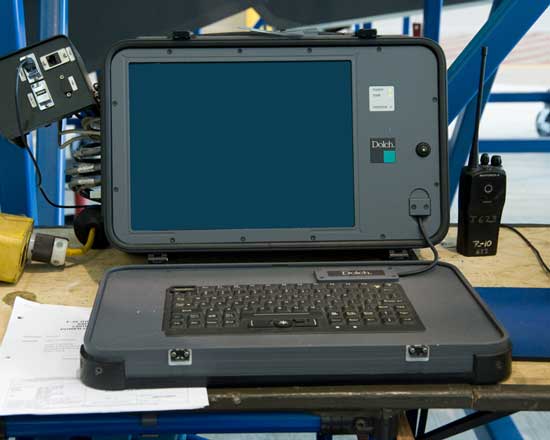
The test version of the laptop to be used as part of the maintenance management regime on the F-35 (Credit: Lockheed Martin)

SLD:  A key impact of the F-35 is to reduce significantly the amount of touch labor necessary to operate the plane.  The USCM, for example, expects at least a 30% reduction in touch labor. Why is that so hard for people to grasp and to understand that this will lead to significant cost savings?

(Read here General Trautman’s discussion of the change.)

Paramore: My personal opinion is that the reason it doesn’t appear is because people – and bureaucracy in general – don’t like to see the human factor go away.  They like to see a stable workforce. When in reality, we’re helping the economy by reducing the manpower effort on a smart airplane.  And that’s what we have is a smart airplane.

SLD:  And I think we’re confusing touch labor hours with manpower. You really want to put your manpower into an optimal support function.  It’s not just measured by number of touch hours.

And the shift from paper to digital will have a significant impact as well. Maintenance manual, the old cards, QAs, you know the approach.  Will there still be a big maintenance manual sitting around?  Do you still need that analog?

Paramore: No.  Actually the air system that’s being developed will shift this paradigm.  It is not just an aircraft it is a new air system.

Performance-based logistics system, the maintenance management system, the supply chain system, and the tech data system are all parts of a new maintenance paradigm.

The tech data system – joint tech data is what it’s called, or JTD – is all electronic.  This whole system is logistics control number based.  If you work on an F-16 or an F-15, then you’re familiar with what’s called the MIDAS system, which is system, sub-system, sub-sub-system and then task number ID.

Same sort of concept applies, but not to that same flow.  Theirs was a strictly logical LCN structure, if you will.  The MIDAS system was basically lined up with all parts of the system shown in the system structure.

The F-35 system is a physical structure, which says if you have a hydraulic part attached to an engine, you’re going to find that part under the engine system LCN tree, not underneath the hydraulic system because it’s attached to the engine.  It’s a physical structure.

SLD: It’s a function of being part of the engine.

Paramore: Right.  But the system is still the same.  You just click a link to your joint tech data; you search down and say I want to remove this hydraulic pump.  You find the LCN for the pump in the tree and you go click, and it opens up, and it has all hyperlinks to your input conditions.

It will say that you must take this panel off.  You must de-service hydraulics.  Whatever is required, it tells you in the input conditions, and then it goes through all the steps just like a regular job guide did, under the MIDAS system.

SLD: Would this be a hand or a laptop computer operating the software?

Paramore: It will be on the PMA (Portable Maintenance Aide). Basically, it’s a rugged laptop. In the next version of ALIS that we’re releasing this fall, you’ll be able to sync the PMA to the ALIS system.  You will tell it what jobs you’re working, pull them over to your laptop, and it has the JTD already stand-alone on that PMA as well.

SLD: So now I’m flying back.  I’ve done a mission, and I’ve expended my ordnance and returning. Something is not synced.  I’m flying into the base. You guys already will have a signal from the airplane into the whole data-linked network of maintenance supply — how then does that process work?

Paramore: The system (aircraft) reports the current condition of the aircraft systems and operation to the pilot in the air. For any less than normal conditions the pilot is alerted via the Integrated Caution and Warnings (ICAW). The more severe the condition the higher alert level its awarded.

If it’s a high one, you’ll get it immediately.  Other lower level alerts these will be reported based on severity level. As the pilot gets closer to base, and is in the return-to-base mode, the system will datalink all system reported discrepancies and health status to the maintenance management system.

You want to report everything to the maintenance crew.  The plane is going to do the same thing.  It’s going to report back to us, and in the end — we’re not there quite yet — we will know it on the ground via data link before you ever get to the ground.

And we’ll know that we’ve got, as an example, a hydraulic leak.  We won’t know what part of the system is leaking in the hydraulics yet, but we’ll know the pilot’s coming back with a caution or a fault that says that the hydraulic system is not fully serviced.

SLD: There is a cultural dimension to the maintenance aspect.  You bring in new aircraft that is in a very, very different CONOPS.  It has very different CONOPS for the maintenance, and if the managers try to reduce it to what a 4th generation maintenance regime looks like or a legacy regime, going to lose the advantage of what really this aircraft is about.

Paramore: You’re absolutely right.  And it’s one of the things that, from a [NAS Patuxent River] perspective, a double handful of us here have been approaching it with an end game perspective, even for SDD.

We always keep asking how we’re going to do it in endgame, because while we may be SDD, we know that we feed downstream.  We’re feeding the guys, the maturity of different programs and different applications inside a sea of different modules.

One of these is what you were talking about is, AFRS, the Aircraft Fault Recording System.  This AFRS comes with a solution set as well as what we call the HRC, which is our “fault.”  If you’re an F-16 pilot or F-15 pilot, that was your MFL or your PFL, you’re Pilot Fault List or your Maintenance Fault List item.

So we have an HRC, which is a Health Reporting Code for a system.  And, for example, if an actuator sends out its HRC code and says, “I have this problem,” then when we pull that into the CMMS system, when the AFRS solution sets are built, that’s kind of like your old troubleshooting tree you were talking about.  It’s all electronic.

The system will say you have a HRC.  And the system will suggest you start with this AFRS solution set No. 1.  And you go through the tree to troubleshoot it.  It will then ask you, “did this fix your problem?” And if you click on “no,” then it says, okay; let’s try this solution set.  And you go down through it, and if it says, did this fix your problem; you go “yes.”

Now you’ve done two things.  You’ve not only gone through a troubleshooting tree electronically that you otherwise had to do with paper in the past, you’ve also started to solidify the data in the system because you told the system via feedback.  Yes, this fixed my problem.

So when that HRC pops up again, as it starts to build up these number of recurrences to say this fixed my problem, then it’s going to bypass option No. 1 and go straight to No. 2 as your solution set.

So it’s going to almost be smart thinking for solution recognition for parts that go bad, based on the HRC code.

SLD: There is a significant advantage as well to having software driven regime such as describing.  Namely, significant savings of training time as you do shifts in maintenance protocols, which are not embedded in the software itself.

Paramore: Yes, absolutely.  Being an avionics maintainer for many years, I know that every time we used to roll software, it required additional study to find out the capabilities of the software and what it gave us for troubleshooting.  Because if you didn’t know the capabilities that were added, for example fire control radar, then you wouldn’t be able to troubleshoot when the pilot came back and said, I did this and I got this, and that wasn’t what I expected.
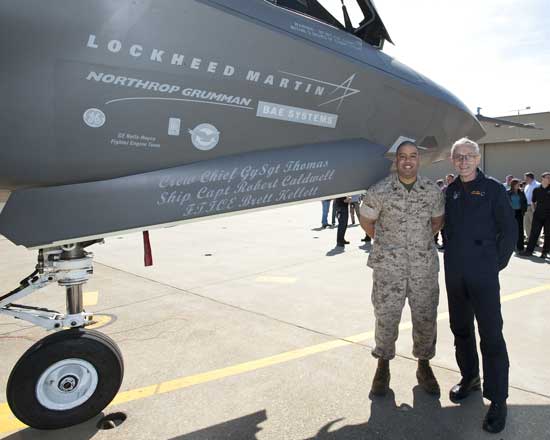
Gny Sgt Thomas, Pax River Maintenance Chief, with an F-35.  (Credit: JPO)
Gny Sgt Thomas, Pax River Maintenance Chief, with an F-35. (Credit: JPO)

On this airplane, you won’t have that because when the software rolls, you’ll run the I-BIT.  The I-BIT will tell you if the system is working the way the software is designed to work.  So there won’t be a lot of this troubleshooting like we had to do like that.  It will come down to, I need to replace this component or I don’t need to replace it.

SLD: Again this is a significant cultural revolution, which requires adapting organizations to what the technological advances can enable for a new maintenance paradigm.

Paramore: It is analogous to the shift of going from Windows to Macs.  And if you fail to open your mind, you’ll fail the transition.  Because, you know, everybody is used to their little PC running Windows, doing it the way they’ve always done it, the way they always want to do it.

It is more like Apple than Windows.  Windows shifts through a series of new systems, XP to Vista to Windows 7. Now we’re in an Apple-like world, where you can run 64-bit apps in a true 64 environment and screaming past everybody else.

SLD: Could you describe the software upgrade process, which you are using in the logs approach?

(Click to read about how revolutionary such an upgrade approach is in the evolution of military aviation.)

Paramore: Lockheed has been using modular software design for awhile.  And the benefit of modular software design is the ability to get more out of the applications run by the operating system, without having to update the entire operating system.

Why would you buy six different applications for your home computer and not run the updates for them?  Or, why would you download several apps from the app store and not run the updates on them when it says you’ve got ten updates to perform?

So, why would you run update requests for the entire operating system when only two apps needed updates?

SLD: So the great modernization of the F-35 is somebody at a console doing code and changing something and then airplane can actually move into its next generation, its next type model series, and you can mobilize or modernize that airplane by just playing with the software.

Paramore: Absolutely. So you don’t have to build a new airplane.

And, you know, when you have different subsystems on the aircraft, they don’t all have to be updated.  For lack of a better way of putting it, the communications between the two modules have to be changed.  The communication architecture or, basically, the language of the two modules has to communicate in the same output language.

But as far as the core software running inside a subsystem, the software could be updated independently as long as the other system knows what to expect as an output from that system or knows what to input into that system.  That’s the only other change that would need to be made.
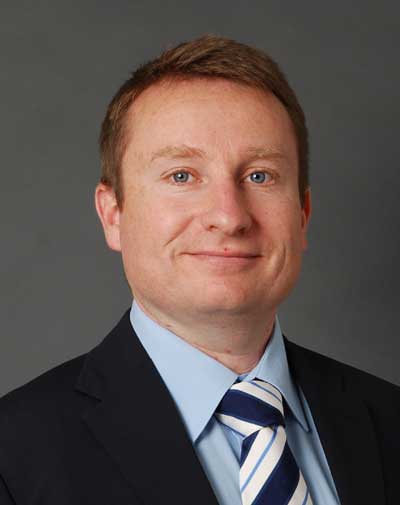
Hans Tino Hansen

Hansen (Credit: SLD)

Biography

Hansen (Credit: SLD)

Hans Tino Hansen is founder and CEO of Risk Intelligence. He specialises in intelligence, terrorism, insurgency, organised crime and piracy as well as contingency planning. He led the development of the “Four Circles Model” for understanding the impact of and inter-relation between terrorism, insurgency, organised crime and piracy. He has advised a number of companies and governmental organisations at management level since the founding of Protocol in 2001 and as Risk Intelligence since 2007.

From 1997 to 2001 he was CEO of East and Central European Advisors (ECEA). Partly in parallel, 1996-1998, he was President of the European non-governmental organisation for young future leaders, Young Europeans for Security (YES); from 1994-1996 he served as Secretary General.

He holds a master’s degree in economics from the University of Copenhagen. Prior to his studies he served in the Danish Army for two years and later in the army reserve as a mortar platoon commander.

He has contributed to books on maritime security and is regularly consulted as an expert commentator by the international and Danish media.

The Honorable Bill Anderson

Biography

Anderson

William C. “Bill” Anderson is President and Chief Executive Officer of Anderson Global Innovation Group, Inc.; a Berlin, Maryland based firm specializing in energy technology commercialization, environmental sustainability, defense, real estate asset optimization and business development.  Bill is also Chief Executive Officer of Generations Property Group, a family-owned real estate management firm serving Maryland’s Lower Eastern Shore.  He currently serves as an Operating Partner at Pegasus Capital Advisors L.P., a New York City based private equity firm, Bill also holds several senior advisory positions in organizations serving the defense, aerospace, sustainability and energy markets.

Most recently, Bill was appointed by President George W. Bush and confirmed by the United States Senate to serve as Assistant Secretary of the United States Air Force for Installations, Environment and Logistics, and the Air Force’s Senior Energy Executive, based at the Pentagon in Washington, DC.  As Assistant Secretary, he led an organization with responsibilities that included installations, military construction, base closure and realignment; environment, energy, safety and occupational health issues, and all logistical matters.  For his efforts, Bill was presented the Decoration for Exceptional Civilian Service and the Presidential Award for Leadership in Federal Energy Management.

Born in Syracuse, N.Y., Bill is an honors graduate of Washington College in Chestertown, Md., and earned his law degree with honors from Syracuse University. He has also studied in the master’s program for international business at the University of Miami. Bill is a member of the Maryland and Florida Bars.

Bill previously served in a variety of financial and tax consulting positions at Merrill Lynch & Co., Inc., Arthur Anderson & Co., and Ryder Systems, Inc. He then joined the General Electric Company holding a variety of positions, including Tax Counsel, General Counsel and Director of Environmental and Quality Affairs for General Electric’s electrical products business in Europe. He returned to the U.S. as their General Manager and Senior Counsel, Environmental Health and Safety.

An avid bicyclist, he organized the U.S. Air Force Cycling Classic, an internationally sanctioned annual pro cycling event in Arlington, VA, and currently serves in an advisory capacity to the race promoters.  Bill continues his commitment to our veterans and their families by serving as a member of the Board of Directors of the Raisin Hope Foundation, an organization focused on raising awareness of traumatic brain injuries and supporting survivors of TBI, including our wounded warriors.

Emerging Alliance, Part IV

07/13/2011
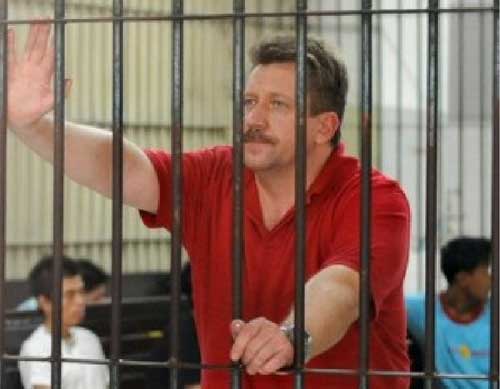
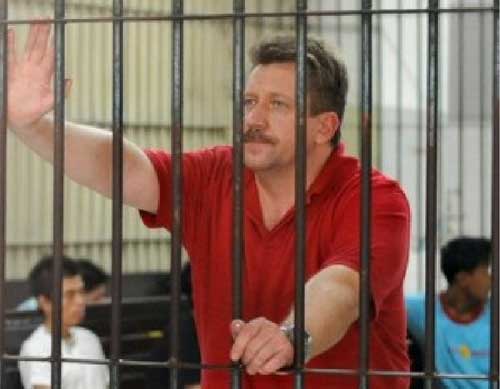
(Credit: http://www.opinion-maker.org/2010/11/us-bouts-victor-bout/)

Criminalized States and Terrorist-Criminal Pipelines

By Douglas Farah

Senior Fellow, Financial Investigations and Transparency

International Assessment and Strategy Center

Adjunct Fellow, Americas Program, CSIS

http://www.ndu.edu/press/emerging-alliances.html

07/13/2011 Viktor Bout: A Case Study in the New World Order

07/05/2011 – Viktor Bout, a former Soviet military intelligence official, became one of the world’s premier gray market weapons merchants, able to arm multiple sides of several conflicts in Africa, as well as both the Taliban and Northern Alliance in Afghanistan. But of particular interest here is his relationship with Taylor and how he made that connection, and the different, interlocking networks that made that relationship possible.

(Credit: http://www.opinion-maker.org/2010/11/us-bouts-victor-bout/)

Bout made his mark by building an unrivaled air fleet and arms procurement operation that could deliver not only huge amounts of weapons but also sophisticated weapons systems and combat helicopters, to armed groups. From the mid-1990s until his arrest in Thailand in 2008, Bout armed groups in Africa, Afghanistan, Colombia, and elsewhere.[1]

Bout’s relationship to Taylor and the West African conflicts in Liberia and Sierra Leone sheds light on how these networks operate and connect with criminal states, and the symbiotic relationships that develop.

Sanjivan Ruprah, a Kenyan citizen of Indian descent who emerged as a key influence broker in several of Africa’s conflicts, introduced Bout into Taylor’s inner circle, a move that fundamentally altered the supply of weapons both to Liberia and to the RUF in Sierra Leone, Taylor’s vicious proxy army controlling important diamond fields. One of the favors Ruprah and Taylor offered Bout was the chance to register several dozen of his rogue aircraft in Liberia.

Ruprah had taken advantage of operating in a criminal state and used his access to Taylor to be named the Liberian government’s  Global Civil Aviation Agent Worldwide in order to further Bout’s goals. This position gave Ruprah access to the aircraft and possible control of it.[2] “I was asked by an associate of Viktor’s to get involved in the Aviation registry of Liberia as both Viktor and him wanted to restructure the same and they felt there could be financial gain from the same,” he has stated.[3]

Bout was seeking to use the Liberian registry to hide his aircraft because the registry, in reality run from Kent, England, allowed aircraft owners to obtain online an internationally valid Air Worthiness Certificate without having the aircraft inspected and without disclosing the names of the owners.[4]

Through his access to aircraft whose ownership he could hide through a shell game of shifting registries, as well as to the arsenals of the former Soviet bloc, Bout was able to acquire and transport a much-desired commodity – weapons — to service clients across Africa, Afghanistan, Colombia and elsewhere. The weapons — including tens of thousands of AK-47 assault rifles, Rocket Propelled Grenades, tens of millions of rounds of ammunition, anti-aircraft guns, land mines and possibly surface-to-air missiles – were often exchanged directly for another commodity, primarily diamonds, but also coltan and other minerals.

Bout mastered the art of leveraging the advantages offered by criminal states, registering his aircraft in Liberia and Equatorial Guinea, purchasing End User Certificates from Togo and other nations, and buying protection across the continent. For entrée into the circles of warlords, presidents and insurgent leaders, Bout relied on a group of political fixers like Ruprah.

The exchange of commodities such as diamonds for weapons moved illicitly in support of non-state actors was largely not punishable because, while the activities violated United Nations sanctions, they were not specifically illegal in any particular jurisdiction.  This vast legal loophole still remains intact.[5]


[1] Details of Bout’s global operations can be found at: Douglas Farah and Stephen Braun, Merchant of Death: Money, Guns, Planes and the Man Who Makes War Possible,” John Wiley and Sons, Hoboken, NJ, 2007. In November 2010 Bout was extradited to the United States to stand trial for allegedly planning to sell weapons to a designated terrorist organization. See: Chris McGreal, “Viktor Bout, Suspected Russian Arms Dealer, Extradited to New York,” The Guardian, November 16, 2010, accessed on December 28, 2010 at: http://www.guardian.co.uk/world/2010/nov/16/russian-arms-dealer-extradited

[2] UNSC S/2000/1195, op. cit.

[3] Ruprah email to author for the book Merchant of Death, op cit., p. 159.

[4] Farah and Braun, op cit. p. 159; and UNSC S/2000/1225 paras. 142-143.

[5] Farah and Braun, op cit.

The Littoral Combat Ship and the Newly Enabled ARG

07/12/2011

A New Capability for the USN-USMC Team

By Robbin Laird and Ed Timperlake

07/12/2011 – The USN is buying the LCS but its Con-Ops remain to be developed.  No platform fights alone, and this asset is best understood in terms of the synergy which can be brought to it by how it is connected to other combat systems.  The clear partner is the newly configured Amphibious Ready Group or the ARG, built around the F-35B.

These two forces – the LCS and the newly configured ARG – can be conjoined and forged into an enlarged littoral combat capability.  But without the newly configured ARG, and the core asset, the F-35B, such potential is undercut.

This is a good example of how buying the right platform – the F-35B – is part of a leveraging strategy whereby greater value is provided for the fleet through the acquisition of that platform.

In a time of fiscal stringency, good value acquisitions need to be prioritized.  Such acquisitions are able to leverage already acquired or in the process of being acquired capabilities and provide significant enhancement of capabilities.

They are high value assets, both in terms of warfighting and best value from an overall fleet perspective.

A newly configured USMC ARG is emerging from several new assets:

  • The new ARG built around the LPD 17 has a larger deck to operate from, with modern C2 capabilities.
  • The F-35B can be launched as a 360 degree presence asset to do electronic warfare, C4ISR and preparation for kinetic or non-kinetic strike.
  • The CH-53K can take off from the amphibious ships and carry three times the cargo of a CH-53E, to include 463L pallets (normally used in KC-130s).
  • The USMC Ospreys can support insertion operations with speed and range.

What the newly equipped ARG does is provide a significant shaping function for the President.  And this shaping function allows significant flexibility, any hard 3000 foot surface is available for the Navy/Marine amphibious forces to seize and hold. This world class uniquely American battle capability is a redefinition of the dichotomy between hard and soft power.

And such capability in turn draws upon the decade of innovation which the USAF has engaged in in shaping the Air Dropping Revolution. As the commander of the Tanker Airlift Control Center (TACC) underscored:

Question: When you put that data out there about air dropping trends, it’s impressive in and of itself, but when you think of the CONOPS implications they are significant as well. I don’t even need to use roads to actually start inserting a force. Interestingly for the Marines when they’re looking at the amphibious ready group (ARG) and what they could do with the future ARG, with their MC-130Js that can land in 3,000 feet or less, the Ospreys and the B’s that they could put basically on almost any paved highway worldwide.  They could be anywhere in the world, and then people say, “Well how would you supply them,” and I would say, “Well what do you think we’ve been doing in the last ten years?” So if we marry up this revolutionary air dropping capability with projection of force from the sea, we could have a much more flexible and powerful insertion force if we wanted to.

General Allardice: I agree.  Our new air dropping capabilities can be used to support our global operations in new and innovative ways.  And honestly, innovation is really the essential takeaway.  Through collaboration we are able to optimize the performance of the global mobility enterprise and orient it toward the effect we need.  There will always be a tension between capacity and requirements, but we have found a way to manage it that allows us to respond rapidly and address those tensions in ways that would be much more difficult without the processes we have in place.

The USN-USMC amphibious team can provide for a wide-range of options for the President simply by being offshore, with 5th generation aircraft capability on board which provides 360 situational awareness, deep visibility over the air and ground space, and carrying significant capability on board to empower a full spectrum force as needed.

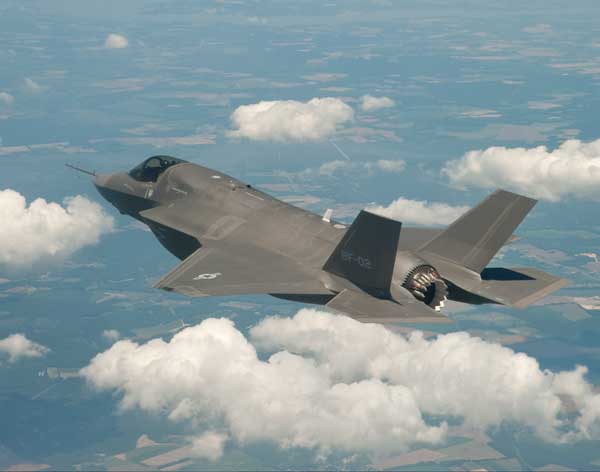
F-35B in Supersonic Flight Test (Credit: Lockheed Martin)F-35B in Supersonic Flight Test (Credit: Lockheed Martin)

Now add the LCS.  The LCS provides a tip of the spear, presence mission capability.  The speed of the ship allows it to provide forward presence more rapidly than any other ship in the USN-USMC inventory.

It was said in fighter aviation “speed is life” and in certain situations the LCS can be paid the same complement.  The key is not only the ships agility and speed but it can carry helicopters and arrive on station with state-of-the art C4ISR capabilities to meld into the F-35B combat umbrella. Visualize a 40+ knot Iron Dome asset linking to Aegis ships and the ARG air assets.

Inserting an LCS into the Maersk Alabama incident can see an example of the impact of speed.  As one naval analyst put it, the impact would have been as follows:

  • LCS at 45kts would have been on scene in less than 7 hours (6.7), or 37% sooner than a ship transiting at 28 kts.
  • LCS fuel consumption for such a sprint 40% less than the 28 kt sprint.
  • LCS would consume less than 23% of her fuel capacity in such a sprint.
  • A helo launch within 150 nautical miles from Maersk Alabama puts helo overhead within four hours (4.3) from the time of the initial tasking.
  • Two H-60’s permits LCS to maintained a helo overhead Maersk Alabama for a sustained period of time.
  • With a response time of four hours the probability of thwarting a piracy attack is increased—especially if the naval ship is called upon the first realization of the targeted ship’s entry into piracy infested waters.
  • If an LCS was tasked to respond when Maersk Alabama encountered the first group of pirates craft on 7 April 2009, it would have arrived on scene well in advance of the attack on 8 April and may well have prevented it.

And if you add the LCS to the USN-USMC amphibious team you have even more capability and more options.  As a senior USMC MEU commander has put it:

You’re sitting off the coast, pick your country, doesn’t matter, you’re told okay, we’ve got to do some shaping operations, we want to take and put some assets into shore, their going to do some shaping work over here.  LCS comes in, very low profile platform.  Operating off the shore, inserts these guys in small boats that night.  They infill, they go in, their doing their mission.

The LCS now sets up — it’s a gun platform.  It’s a resupply, refuel point for my Hueys and Cobras.
Now, these guys get in here, okay.  High value targets been picked out, there is an F-35 that’s doing some other operations.  These guys only came with him and said hey, we have got a high value target, but if we take him out, we will compromise our position. The F-35 goes roger, got it painted, got it seen.  This is what you’re seeing, this is what I’m seeing.  Okay.  Kill the target.  The guys on the ground never even know what hit them.

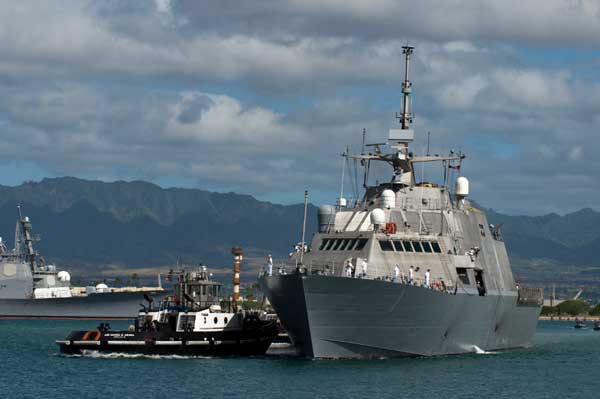
USS Freedom (Credit: USN)USS Freedom (Credit: USN)

In World War II the Imperial Japanese Navy Admirals were said to call the US PT, or Patrol Torpedo Boats—“Devil Boats”—The LCS is not a PT boat but the LCS ocean presence with 21st Century capabilities may make it a modern “Devil Boat” to vex any enemy combat action.

Similar to the PT boats of WWII the LCS by itself has limited staying power; connected to the ARG, the LCS announces presence and is connected to significant full spectrum combat capability.

Several LCS’s could be deployed with Osprey and F-35B cover.  The F-35B provides the 360 degree multiple of hundreds of miles coverage.  The LCS becomes a node in the combat system of the F-35 and any weapons on the LCS can be cued up by the F-35B.

With the new aviation assets, the Marine Expeditionary Unit (MEU) can be split at sea allowing it to cover hundreds of miles more than historical operations with unexpended speed and maneuverability..  And adding an LCS to each of the disaggregated elements can further enhance the presence and combat functions of the MEU.

An Osprey pilot has already indicated that Ospreys have already allowed the splitting of the Marine Expeditionary Unit (MEU) at sea.

I saw so much potential for the short take-off vertical landing attack aircraft, fixed-wing aircraft and the V-22 working together. In the future, I would have those two, the V-22 and F-35 working very closely together and even for extended operations when you add the refueling piece. The paring of these two aircraft are far better than paring the V-22 with any of the helicopters.

Osprey in Afghanistan (Credit: USMC)

Because of speed, range. And not only that. It’s the endurance of the aircraft itself. Basically you might say once it’s flying, it’s flying. And we had a lot of missions that required flight time above six hours, which is very taxing for the jet guys and for us, it is as well, but maybe not so bad because we can trade off in the cockpit. The fact is that you can have airborne assets, both as a package as well as a trap for sensitive site exploitations, being airborne all at the same time for hours at a time to respond to something that happens in the AOR. It will give you the maximum flexibility for response time down to something like thirty minutes, depending on where it is. And then sanitize the scene from there and then everybody returns home. It’s a capability that I’m not going to say it’s been overlooked but it just hasn’t been utilized like that.

The LCS-ARG team cannot only leverage each other’s capabilities, but can lay the groundwork for a significant robotics revolution.  The new maritime capabilities built around robotic vehicles, on the sea, under the sea, and over the sea, can be launched and managed by either LCS’s or LPDs.

As the Prospective Commander of the LPD-24 noted, “We have a lot more space of carrying robotic assets.  And can work effectively with the LCS.  We can easily work with the LCS, especially with her different mission capabilities.  And if she needs to change out mission capabilities, we have the cargo space to fulfill her mission.”

And in an interview with the retired head of NAVAIR, Admiral Dyer now COO of iRobot provided a sense of how this team could work with the robotics revolution:

At iRobot, we have a vision of integrated Unmanned Air Vehicles (UAV’s), Unmanned Ground Vehicles (UAV’s) and Unmanned Underwater Vehicles (UUV’s). A way I like to think about that is to envision a littoral combat ship that shows up off the coast of some bad guy’s country.  Let’s take a look at how different that will be compared to the way we do it today:

Let’s consider UUVs, which I think are one of the most exciting developmental areas that are underway.  UUV’s are, by the way, the area where autonomy is needed more than anywhere else. Why? Well, while you’ve good radio frequency bandwidth when you’re airborne, you have very little bandwidth when communicating with UUVs.  Underwater, you’re limited to acoustic modems for un-tethered operations. An acoustic modem is slower than your first dial-up PC connection to the web. But as you start to introduce more autonomy, you start to tremendously increase the utility of unmanned underwater systems. Autonomy is important for the future of all robots, but critically important for UUVs.  That is what iRobot is building at our unmanned underwater systems group in Raleigh-Durham, North Carolina. But let’s continue with this Navy ship showing up with a Navy/Marine Corps team on an adversary’s littoral during the next decade.  The preparation for entering that battle space will be tremendously improved in many ways by unmanned systems.

I worry that the Navy has not taken full notice of the IED threat. Our Navy’s interest in and focus on maritime IEDs (mines) is episodic and our attention has always been short. Unmanned systems will offer new capabilities at sea, just as unmanned ground robots have for ground forces.

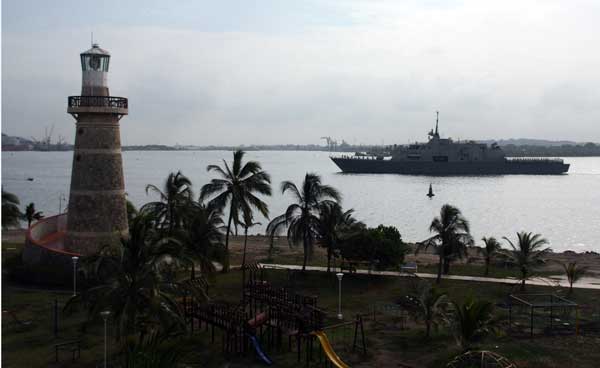
USS Freedom in Transit (Credit: USN)USS Freedom in Transit (Credit: USN)

When asked how one would deliver such capabilities into the battlespace, the airborne assets of the LCS and the ARG were highlighted:

I believe UUV’s offer great potential but there are challenges.  The prime challenges for UUVs are range and power,area coverage. UUVs have the disadvantages of being relatively slow and of limited search duration. So you can’t efficiently transit them; you have to deliver them to the area of interest. At iRobot, we’re coming at this problem with our Ranger program, which we’re funding atop some basic work sponsored by the Office of Naval Research. We are designing a Ranger UUV that’s “A-size.” “A-size” means it fits into a sonobouy launcher. And there are literally thousands of tubes out there on multiple patrol and tacair platforms. Marry the capability to air-launch with swarm capability and you cut out the transit time, greatly reduce the power requirement and introduce UUVs directly into the area of interest.

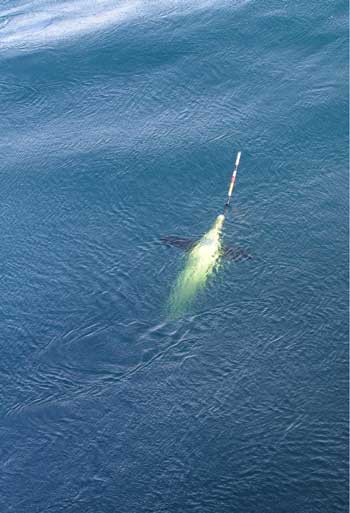
Irobot's Sea Glider (Credit: Irobot)

Using swarm techniques, which DARPA has funded iRobot and others to develop; you start to see the operations research numbers get much, much better. This isn’t something that’s awaiting better batteries and more power; it’s awaiting further development of a new concept.

No platform fights alone, but often when the LCS gets discussed it is discussed only alone, but it has very little staying power in and of itself, as has been clearly noted by a senior USN Admiral in discussing the approach to LCS sustainment.

Question: The LCS is really a collaborative ship, so you’re doing collaborative con-ops and the sustainment approach is part of those collaborative con-ops. It seems that what is crucial for a new built platform, whether it be air or whatever, is that you’re doing in terms of maintenance from the initial shaping of the con-ops. So presumably the relationship of the LCS to other ships is a key part of the distance support and not just to the shore.

Admiral McManamon: Part of what the exploration is doing is shaping the build as we get new information from the maintenance efforts. For the initial deployment for USS Freedom, much of what we are doing is ringing out the basic mechanics, the engineers, being able to put the ship in the water, being able to communicate with other ships, being able to talk to an operator or air assets, etx : all this has been extremely successful from February to the end of April this first year. And from this deployment we start to shape standards of performance. She was able to do the connectivity essential to distance support; she was able to operate in ways that took advantage of a 2,800 ton ship going 40 plus knots.  As one of our commanders indicated just last week, there’s this whole psychological power to itself for a 2,800 ton ship to go after a go-fast and actually be able to sustain in, keep up and take it down, which we simply can’t do in the current environment with regular navy ships.

But did I design and build LCS simply to run after a cigarette runner?  No.  But does it give me that capability when I need it?  Yes, and as we now understand that capability and that connectivity necessary to do the con-ops, I think that’s exactly what we’re moving forward with to shape future ships and operations.

And the glue which generates LCS-ARG synergy are the aviation assets on the two entities, notably the Osprey and F-35B which have the speed and range to create a moving 360 degree combat and presence bubble over an operation.  Without that glue, these platforms become disaggregated and vulnerable.  Linked together, the resulting synergy creates a force multiplier effect.

And such a multiplier effect can have a significant deterrent effect.  General “Dog” Davis, the Commander of the 2nd Marine Aircraft Wing at Cherry Point, North Carolina, underscored such an impact when discussing the newly enabled ARG.

I’m Muammar Gaddafi.  I’m whoever, and I’ve got an ARG with this new gear embarked – and I can’t help but think its going to change the way I view that force.  That ARG can reach out and touch me from long range, landing high-end infantry forces deep inside my territory, and do so with a speed that twice as fast as anyone else can.   Our MEUs have never been used as effectively as they are today.  These new capabilities are going to make them exponentially more potent and useful to our nation’s leadership.

The F-35Bs give the new ARG a very high-end air superiority fighter, that’s low observable if I want it to be.  I can roll from Air to Air to Air to Ground quickly and be superior to all comers in both missions.  That’s bad news for our adversaries.  I can use the F-35s to escort the V-22s deep into enemy territory.  With those V-22s we can range out to a 400-500-mile radius from the ship without air refueling.  I can go deliver Marines deep in the enemy territory or wherever and do it at 250 miles an hour, so my speed of action, my agility is exponentially increased, and I think if you’re a bad guy, that would probably give you a reason to pause.  It’s a very different animal that’s out there.    We are good now, but will be even more so (by more than a factor of two in the future).

I also have significant mix and match capability.  And this capability can change the impact of the ARG on the evolving situation.  It is a forcing function enabled by variant mixes of capability. If I wanted to strip some V-22s off the deck, to accommodate more F-35s – I could do so easily.  Their long legs allow them to lily pad for a limited period of time — off a much large array of shore FOBs – while still supporting the MEU.   It’s much easier to do that in a V-22 than it is a traditional helicopter.

I open up that flight deck, or I can TRANSLANT or PAC additional F-35s.  If I had six on the deck and I want to fly over another six or another four, we could do it rather quickly.  Now the MEU has ten strike platforms.  So if I need to have a TACAIR surge for a period of time, that deck provides a great platform for us.  We’ve got the maintenance onboard that ship, so we can actually turn that Amphib very quickly from being a heliocentric Amphib to a fast jet Amphib. Conversely, I could also take the F-35s off, send them to a FOB and load it up with V-22s, 53Ks, or AH-1Zs and UH-1Ys.

Flexible machines and flexible ships.  The combination is exceptional.

We will have a very configurable, agile ship to reconfigure almost on a dime based on the situation at hand.  I think the enemy would look at the ARG as something completely different from what we have now. I think we have to change the way we do things a bit in order to allow for that, but I think we will once we get the new air assets. The newly enabled ARG, or newly whichever the term you’re using, will force our opponents to look at things very differently.  We will use it differently, and our opponents are going to look at it differently.

Finally, being connected to the newly enabled ARG can intelligently facilitate LCS modernization.  The LCS can carry a range of assets, from missiles, to helos, to unmanned assets, to a complement of distributed “cyber warriors” all of which can much more potency by being part of the ARG team.  The F-35B can perform the function of the battle manager, without the presence of large USAF aircraft, or a carrier presence.  This is truly a combat revolution in the making.

VMAQ-4’s High Tempo Mission

07/11/2011

07/11/2011: Marine Tactical Electronic Warfare Squadron 4 arrived in Afghanistan in early May. Their mission is complicated and secret, but Sgt Andrew Milner visited them and several Marines provided insights, and those Marines include Lance Cpl. Antonio Felix – Marine Tactical Electronic Warfare Squadron 4 (VMAQ-4), Plane Capt., Collateral Duty Inspector and Lt. Col. Marlin Benton – Marine Tactical Electronic Warfare Squadron 4 (VMAQ-4), Squadron Commanding Officer.

Credit: Defense Media Activity USMC: 06/04/2011

Russian Bulava SLBM Will Enter Service Next Year

By Dr. Richard Weitz

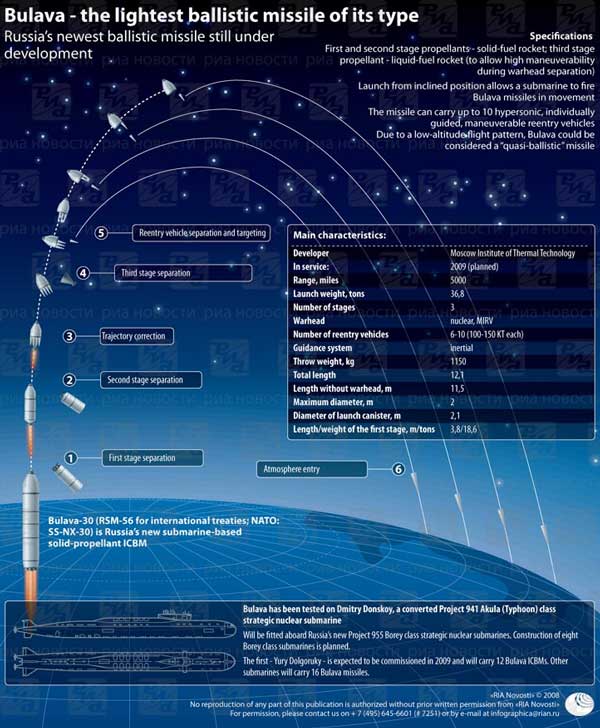
07/11/2011 – The recent successful launch of Russia’s RSM-56 Bulava (NATO code name SS-NX-30) Submarine Launched Ballistic Missile (SLBM) may finally mark a turning point for this troubled weapons system.

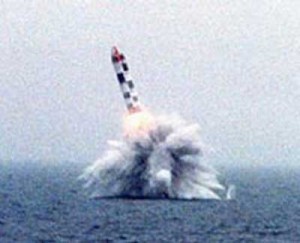
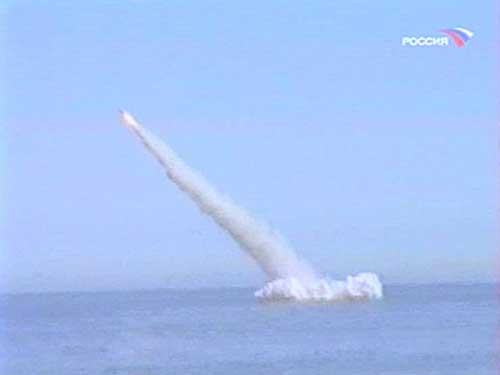
On June 28, a Bulava left a submerged next-generation Borey-class submarine, the Yuri Dolgoruky, and flew 6,000 kilometers from the White Sea to the Kura test range in Russia’s Far East Kamchatka region. Three days later, Defense Minister Anatoly Serdyukov announced that the Bulava will enter into serial production next year. Russian military sources indicated that they would conduct four additional tests of the missile before placing the Bulava into service by the end of 2011.

The Bulava (Russian: Булава; “mace” in English) is designed to carry 10 maneuverable and independently targeted (MIRVed) nuclear warheads, with a destructive power of some 100-150 kilotons each, a maximum range of some 8,000 kilometers. On paper, the Bulava’s advanced missile defense countermeasures, solid-fuel propellant, small size, light weight, rapid speed, maneuverability, and other capabilities make it a superior deterrent to anything in Russia’s existing SLBM arsenal.

(Credit: http://defenddeterrence.com/news/?p=695)(Credit: http://defenddeterrence.com/news/?p=695)

Unfortunately, the Bulava’s terrible test record has resulted in its remaining a paper system for years beyond 2006, its originally scheduled date for entering into service. More than half of the missile’s 15 test launches failed, sometimes spectacularly.

The repeated failures of the Bulava test flights proved an embarrassment for the Russian defense industry at a time when the Russian government was trying to reestablish Moscow’s claims to great power status.

The Bulava represents one of the few major Russian weapons systems developed after the Soviet Union’s collapse. It is probably also the most expensive military research and development program in Russian history. One experienced Russian analyst estimates that the Bulava, combined with the new Borey-class submarine to launch it, recently consumed 40% of Russia’s defense budget.

The Baluva’s problems result from two primary factors. The first is the mistaken if understandable Russian government decision to award the original contract to the wrong design firm and then follows its bad advice. The second was more serious mistake of continuing weaknesses in Russia’s military-industrial complex, especially production, quality control, and systems integration problems.

In 1998, the Russian Security Council awarded a development contract for a new SLBM to the Moscow Institute of Thermal Technology (MITT), led by the well-respected missile-designer, Yuri Solomonov, after the government had abandoned its program to develop an earlier SLBM, the SS-NX-28 (D-19M) Bark. The Bark, designed by the rival Makeyev Design Bureau, had experienced three successive failures during test launches and its development costs were soaring.

(Credit: http://defenddeterrence.com/news/?p=695)

Yet, while the MITT had earlier developed the successful ground-based RT-2PM Topol (SS-25 Sickle) and the RT-2PMU Topol-M (SS-27) land-based ICBMs, it had never built a SLBM. Solomonov argued that his team could save considerable time and money (both in short supply because of the Bark debacle) by incorporating many of the innovative features already developed for the Topol-M into the Bulava program.

The most important innovations were the missile’s ability to accelerate rapidly soon after launch, a capacity designed to overcome any U.S. post-boost phase missile defenses.

The Russian government heeded Solomonov’s advice regarding the Bulava. Russia’s budgetary woes in the 1990s caused policymakers to try to save money by standardizing the research  and development of the production of ballistic missiles, regardless of whether they were land-based or launched at sea.

The design of this three-staged SLBM is similar though not identical to the Topol-M.  Russian officials also followed Solomonov’s recommendation to proceed rapidly to sea-based trials rather than conduct extensive initial land-based testing. Such “ground testing”—especially sophisticated computer-aided modeling of a missile or other aerospace vehicle that could locate potential flaws before conducting an expensive and, if failed, embarrassing test flight—is standard procedure for American and European missile design firms, but is rarer in Russia due to the lack of modern infrastructure and funding.

The intent was to accelerate the Bulava’s deployment and minimize its development costs, which had begun to exceed the initial budget. These government decisions and development shortcuts may have contributed to the missile’s recent problems.

Besides the overly ambitious design schedule, problems of production, quality control, and systems integration—coordinating the input of the dozens of independent subcontractors involved—was as a major reason for the Bulava’s difficulties. The large number of failures was due to a variety of problems rather than a single cause, making it difficult for the designers to correct the problem. Some failures affected the first stage, others occurred later in flight, while some difficulties arose even before launch. It looks as if different subcontractors provided defective equipment or material or inadequate service for many of the tests, meaning that correcting the defect from the previous launch did not prevent different problems from arising the next trial launch.

Furthermore, the Votkinsk Plant State Production Association where the missile was assembled and manufactured was also experiencing poor industrial production standards, quality control, and obsolete equipment. A factory manager at the Votkinsk plant stated on average 83% of the equipment was worn out and that 50 billion rubles were needed through 2020 for modernizing the factory’s equipment. Votkinsk also suffered from a lack of young specialists to replace the experienced staff who was retiring without mentoring a team of successors.

More generally, the design of the Bulava has to be compromised because the decline in Russia’s military-industrial base meant that many desired parts were no longer available. Vladimir Vysostsky, a senior Russian Navy official, officially explained Bulava’s issues as the consequence of a “deep, elementary dysfunction in the technical industry for… strategic missiles.”  C.H. Kovalyova, the creator of the Akula submarine, has said that a lack of certain necessary support structures is contributed to Bulava’s mishaps.

Successive failures due to a variety of problems led an increasing number of Russian defense analysts and officials to consider abandoning the project despite the 100 billion rubles already spent on the system.

Nonetheless, the Russian government felt it had to persist with the Bulava because the weapon has been designed to work with Russia’s next-generation Borey-class (Project 955) ballistic missile launching submarine (SSBN). Since 1996, the nuclear-powered Borey has been the only strategic submarine under production in Russia. The Russian Navy has been waiting impatiently for these boats since the existing fleet of Delta and Typhoon SSBNs are exhausting their service lives as they undertake their so-called “deterrence cruises” through the Arctic and Pacific Oceans.

One Project 941 Akula-class Typhoon, the Dmitriy Donskoy, has been serving as a specially modified test platform for most of the Bulava launches pending completion of the first Borey-class ship. The first Borey-class SSBN, the Yury Dolgoruky, has begun sea trials and conducted the successful June 28 launch. The second, the Alexander Nevsky, is at the final stages of construction at the Sevmash Machine Building Enterprise shipyard in northern Russia. The Russian Ministry of Defense plans to build at least six additional Borey ships, with the third and fourth also already under construction at Sevmash. Although the Yuri Dolgoruky is designed to carry as many as 12 Bulava SLBMs, the next three Borey ships will have 16 launch tubes able to accommodate the Bulava missile.

The Russian military is considering designing the remaining four Borey SSBNs to launch as many as 20 Bulavas. The Russian government plans to manufacture at least 150 Bulava SLBMs. The Russian military intends the Borey-Bulava combination to serve as the foundation of Russia’s nuclear triad until 2040. If the Bulava does not work, these billion-dollar Boreys will have nothing to fire.

The most popular alternative proposal was to retrofit the Borey to carry the R-29RM Sineva-class ballistic missile, another recently developed Russian SLBM. Although not as advanced as Bulava (the Sineva uses liquid rather than solid fuel and lacks some of Bulava’s defensive capabilities), Sineva is a capable modern missile that has an impressive launch record.

(Credit: http://warfare.ru/?linkid=1715&catid=265)(Credit: http://warfare.ru/?linkid=1715&catid=265)

Yet, fitting the Borei to carry Sineva missiles would be expensive and time-consuming. Although Russian government and academic experts supporting the government’s general military reform program argue that their country faces no immediate military threat and therefore has time to undertake a comprehensive if challenging  defense restructuring, the Russian military has steadfastly rejected the Sineva option or other alternatives.

Russian defense managers may have recalled Soviet experience when, in some cases, Russian weapons that had a long and tortuous development process ended up working well despite their early struggles. The R39 (SS-N-20 “Sturgeon”) was a Soviet SLBM project which began development in 1971, failed more than half its initial test flights, and was stuck in development for 12 years. Nevertheless, its problems were eventually worked out and the R39 served well in the Soviet and Russian Navy until 2004. The fact that the Bulava introduces path-breaking technologies into Russia’s SLBM force made that country’s defense managers expect that there would be many initial test failures.  As Vice Admiral Oleg Burtsev wrote in July 2009: “Bulava is a new rocket; in the course of its development we will encounter various setbacks… nothing new happens quickly.”

Another theoretical option would be for Russia to get out of the nuclear weapons business entirely. Yet, eliminating nuclear weapons enjoys little support among the Russian national security elite, who see Russia’s nuclear weapons as their ultimate instrument of defense, deterrence, and global influence.

Shortly after NATO commenced bombing Libya, Prime Minister Vladimir Putin made a special trip to the Votkinsk factory where the Bulava is produced. Putin used the occasion to remind its workers that Russia’s nuclear weapons shielded their country against a similar attack by Western powers. In his words, “they bombed Belgrade, Bush started a war in Afghanistan, then under a pretext, an entirely lying pretext, started a war in Iraq, liquidated the whole Iraqi leadership, now they’ve started to bomb Libya… today’s situation once again confirms the correctness of what we are doing to strengthen the defense capabilities of our country, and the new program of governmental arms-building is intended to achieve this.”

Although Russian designers may finally have gotten the Borey-Bulava combination to work, this success may prove exceptional. The Russian government devoted enormous sums to this one very important project, and cannot undertake a comparable effort with all its desired military systems. This limitation partly explains why Serdykov had to deny recent media reports that the Russian government planned to build an aircraft carrier in the next decade.

It also explains why Russian leaders are willing to buy expensive foreign weapons systems like the Mistral-class amphibious assault ship. Russian defense companies, having not yet recovered from the traumatic breakup of the Soviet-era military-industrial complex, are still incapable of building such a complex weapons system in a timely manner.

Emerging Alliance, Part III

07/08/2011
(Credit: http://www.justaskjillrenee.com/naomi-campbell-blood-diamonds-and-charles-taylor/)

Criminalized States and Terrorist-Criminal Pipelines

By Douglas Farah

Senior Fellow, Financial Investigations and Transparency

International Assessment and Strategy Center

Adjunct Fellow, Americas Program, CSIS

http://www.ndu.edu/press/emerging-alliances.html

The Case of Charles Taylor in Liberia

07/08/2011 – Liberia under Charles Taylor offers several important lessons in this context.

At the height of his power from 1998-2002, Taylor allowed transnational organized crime groups from Russia, South Africa, Israel and Ukraine to operate simultaneously in a territory the size do the state of Maryland. At the same time, the terrorist groups Hezbollah and al Qaeda were economically operational in Liberia, raising money for their parent organizations through associations with criminal groups. Most of the criminal activity revolved around the trading in diamonds extracted in neighboring Sierra Leone, and Liberian timber. In 2000, al Qaeda operatives entered the diamond trade, using Hezbollah-linked diamond smuggling networks to move the stones and handle the proceeds. The relationship lasted until just before Sept. 11, 2001.[1]

(Credit: http://www.justaskjillrenee.com/naomi-campbell-blood-diamonds-and-charles-taylor/)

This was possible largely because the Taylor government pioneered to a new level of sophistication the model for the criminalized state where the government was an active partner in the criminal enterprise. The president, directly engaged in negotiations with the criminal groups, authorized specific lines of effort for those actors, provided protection and impunity through the state, directly profited from the enterprises and co-mingled those funds with other state revenue streams, erasing the distinction between the state, the criminal enterprise and the person of the president.


A key to the model was the government control of key points of interest to criminal organizations and others operating outside the international legal system for which they were willing to share their profits. These included, among others: the ports of entry and exit, insuring those whom he Taylor wanted to protect could enter and leave unimpeded; the passport registry, giving access to the issuing of passports, including diplomatic passports, and non-existent government titles with  accompanying immunity, to those authorized to do business; control of the law enforcement and military inside the country to insure that the volatile internal situation did not affect the protected business operations; and access to the resources that could be profitably exploited without fear of violence or unauthorized extortion.

When he became president, Taylor, building on the extensive relationships he forged during his years in the bush, developed ties to organized criminal groups and terrorist organizations that allowed him to procure hundreds of tons of weapons from a broad range of groups and individuals. He also enriched himself. According to a 2005 study of Taylor’s finances, he generated about $105 million a year in extra budgetary revenue to which he had direct access, some of which was moved through accounts opened in his name in New York banks and European financial institutions.[2]

Taylor was, in effect, not president of a country but controlling what Robert Cooper has called the “pre-modern state,” meaning territory where:

… chaos is the norm and war is a way of life. Insofar as there is a government, it operates in a way similar to an organized crime syndicate. The pre-modern state may be too weak even to secure its home territory, let alone pose a threat internationally, but it can provide a base for non-state actors who may represent a danger in the post-modern world … notably drug, crime and terrorist syndicates.[3]

Taylor’s rule proved valuable to arms traffickers. The same Hezbollah operatives that aided al Qaeda’s diamond buying venture in Liberia were able to acquire significant amounts of sophisticated weapons for Taylor and his allies through a series of transactions with Russian arms dealers based in Guatemala and operating in Nicaragua and Panama. The primary facilitator of the deals was a retired Israeli officer living in Panama, who had a personal relationship with the Hezbollah operative seeking the weapons. Both had worked for Mobutu Sese Seku, the long-ruling head of Zaire (now the Democratic Republic of Congo). The Israeli provided the dictator with security while the Lebanese operative moved his diamonds to the black market.[4]

The ability of Hezbollah financial handlers to deal with a retired Israeli officer who has access to weapons while their respective organizations were waging war against each other in their respective homelands demonstrates just how flexible the pipelines can become.

In addition to this arms flow, Taylor used his illicit proceeds to buy a significant amount of weapons from the former Soviet republics, which were procured and transported by Viktor Bout, a Russian arms merchant dubbed the “Merchant of Death” by European officials.


[1] For details and supporting documentation on these weapons deal and al Qaeda’s dealing in the blood diamond trade see: Douglas Farah, Blood From Stones: The Secret Financial Network of Terror, Broadway Books, New York, 2004. See also: International Consortium of Investigative Journalists, “Making a Killing: The Business of War,” The Center for Public Integrity, 2003. A comprehensive analysis of the possible ongoing al Qaeda activities in West Africa is provided by the Special Court for Sierra Leone, “Charles Taylor’s Influence and Destabilization in West Africa: Guinea-January 2005,” marked “extremely sensitive,” in possession of the author.

[2] For a more complete look at this network, see “Following Taylor’s Money: A Path of War and Destruction,” Coalition for International Justice, May 2005. The author was the lead investigator for that report.

[3] Robert Cooper, “Reordering the World: Post-Modern States,” The Foreign Policy Centre, April 2002, p. 18.

[4] Farah, Blood From Stones: The Secret Financial Network of Terror, op cit.