In an effort to be in compliance with GDPR we are providing you with the latest documentation about how we collect, use, share and secure your information, we want to make you aware of our updated privacy policy here
Enter your name and email address below to receive our newsletter.
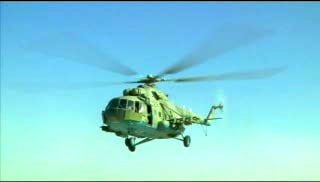
06/12/2011 – Prior to a mission, Afghan and U.S. Airmen equip an AAF MI-17 helicopter with 57mm rockets for the first time, allowing the Afghans to provide for their own mission security without reliance on ISAF aircraft for assistance in Kandahar Province, Afghanistan
06/11/2011 – At last year’s Airbus Military Trade media event, Richard Thompson, head of Airbus Military Services, provided an overview to the evolving services approach:
In terms of concepts that we are developing, we’re moving from what has been for the last year’s traditional product support, all the usual things that you associate with a traditional product support—the MRO, the technical support, the technical publications, configuration management, continuous air worthiness support for the fleet, training services, spares and material support—we also are moving into helping our customers with urgent operational requirements, modifications, upgrades, role changes of aircraft once they are in service, et cetera—those kind of support services, and what we called our FISS, which is the Full In-Service support concept, which is effectively a performance-based logistic support service on a power by the hour type—on a flight/hour service type arrangement, where we wrap up a whole series of services into a single contract that guarantees the support the customer requires over a period of years, and he pays accordingly to the number of flight hours that he flies.
Richard Thompson is now head of Airbus Military, UK and Philippe Galland, who has many years of experience in services, and is now Head of Airbus Military Services provided the presentation at this year’s Trade Media event.The focus of his presentation and the discussion was upon the effort to move beyond traditional product support towards more complete service support. Galland argued that Full in Service Support or FISS is of growing significance for customers in a time of fiscal constraints.
Among the advantages of FISS are the following:
Fixed budgeting with no risk
No need for repeat contracts for spares and repairs
Stock levels are optimized to fleet usage
A contract guarantee spares level availability
Optimization of the maintenance model
Customer mainly focuses on mission success while Airbus Military guarantees the fleet availability.
He provided an example of a mission support contract with the Spanish customs service given to Airbus Military. Here the contract covers complete in service support for the service’s C212 S-200 fleet of six aircraft. It is a two-year contract, which is renewable.
There is an Airbus Military joint venture with a service provider (INAER), which provides for:
Material management
Maintenance
Fleet management
Fleet civil airworthiness certification and transfer to civil register
Flight operation (INAER)
Provides for aircraft retrofits as requested.
The bulk of the briefing focused on the evolution of service approaches built around the entry into service of the two new core platforms being built by Airbus Military, namely the A330MRTT and for the A400M. Customers for both platforms have no single support model in mind. The different models will vary across the customer base.
With regard to the tanker, he noted that:
The MRTT model for support and service is a good example of the variety of customer requests we can handle. We have the 4 different customers to deliver to this year. And they are asking us different models. We can be the fuller support contract manager, a contractor, or we can be a sub-contractor to local contractor.
He noted that support builds upon the commercial A330 experience. Three of the four current customer nations have A330s in their major national airlines with flight operational and engineering experience.The models of support for the A330MRTT range from traditional airline-like models in the UAE to highly sophisticated Public Private Partnership models in the UK Future Strategic Transport Aircraft FSTA model.
With regard to A400M, this will be an a la carte approach as well. But from the Airbus Military perspective, the challenge will be to “keep the global approach concept whereby one develops a common set of ISS services applicable for all customers whilst providing ISS arrangements established on a Nation-by-Nation basis, with the benefit of optimizing the overall ISS services development.” With regard to one example, France, Galland detailed the proposed approach. Airbus Military has developed a joint French-UK support services proposal built around a mission success concept. A national training proposal has been provided for French MOD. The proposed MRO provider would be SIAE (Service industrial de l’aéronautique or SIAé) with the initial training provided at Airbus Military Seville Training Center. And a joint venture has been established by Airbus Military with Thales to provide for total training for the aircraft.
Galland noted that the British and French are working together towards a joint service approach to the aircraft.“It’s very fortunate that the two nations have been able to come together for A400M support. Because then, we can conserve energy, in particular, on the management of the spares pool.”
06/09/2011 – Second Line of Defense’ Robbin Laird sat down with Gilles Kepel in Paris and had a wide-ranging discussion on trends in the Middle East. At the heart of the discussion was a clear argument that any simplistic assumption that there is an Arab Spring should be challenged.
History was moving again in the Middle East, but the dynamics of change are quite different in each part of the Arab Middle East. As Kepel put it: “Although people were expecting a domino effect from events in Tunisia, the dynamics should not be interpreted that way.”
Kepel divided the discussion of three distinct dynamics of change. The first involved North Africa with a focus on Tunisia. The second focused on Saudi Arabia. The third focused on Syria.
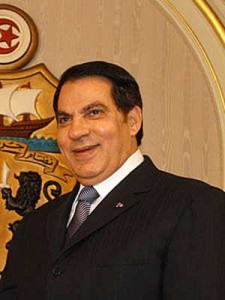
Zine El Abidine Ben Ali
Tunisia
With regard to Tunisia, Kepel emphasized that is was the coalition of the protestors with the urban middle class, which has made change in Tunisia possible.
The slogan of the Tunisian revolt was “Dégagé, go, leave.” By which was meant the need to get rid of the corrupt ruler of Tunisia.
He was after all a cop and he was extorting everybody. He could not start a business in Tunisia that could reach a certain level without having one of his in-laws on the board.
Tunisia is a place where you have an urban, educated elites, that decided one day that they would join forces with the poor. And that coalescence created the revolution.
The Army played a key role in the process and when the Army refused to support the ruler, his days were numbered.
I have been to Tunisia many times, and the ones who invited me were the military. The military was the only place where you can talk. They had some freedom, as opposed to the university, to the press, which were totally suppressed.
The current situation is that “the Tunisian revolution, which is now temporarily, under the control of the young entrepreneurial middle class. If they can deliver, then will stay on the front line. The issue is whether or not they can, because the economy is in shambles.”
In addition to the economic situation, there is pressure from the insurgency in Libya. Berbers who live in both Tunisia and Libya are a key pressure group within Tunisia itself.
And it’s mainly Berbers who are very, very strong Tunisia and Libya who have decided to oust Ben Ali, who considered them as non-existent. There is something in the making in Tunisia and Libya driven by the Berbers.
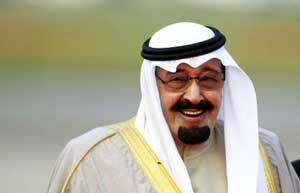
King Abdullah
Saudi Arabia
Kepel underscored the necessity of change in Saudi Arabia, but the difficulties to do so. Internal dynamics within the regime are part of the challenge, and the pressures from Yemen are another.
Saudi Arabia is between the hammer and the anvil. The hammer is Iran. The anvil is Yemen. The Yemenis population is more numerous than the indigenous Saudi population. The Saudi’s are very, very worried about the future of Yemen and the pressures of disintegration from Yemen upon Saudi Arabia.
The Saudi system won’t last. When King Abdullah came back, from Morocco after he had had surgery, in New York, he opened the coffers and gave $37Billion, with a “B”, dollars to the populace, and added another $70 Billion, with a “B”, three weeks later. And this hundred billion thing illustrates the discrepancy between governance and capacity of the system, and the expectations.
The generational shifts within the royal family will play a “forcing function” role in driving change.
Now, they have the 2nd generation, i.e. you have full brothers and half brothers, it’s complicated enough.
The third generation will mean that you have cousins. And can you keep sufficient level of cohesiveness within the ruling family or not?
If not, you have to think of a different way of managing the system. And this is a big, big issue for the future.
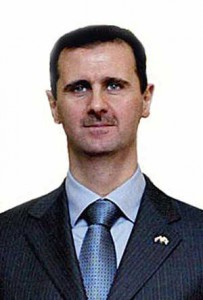
President Bashar al-Assad
Syria
The third area discussed was the area dominated by the Israeli-Arab conflict, ranging from Iraq to Jordan. The fragmentation of Iraq with the invasion of Iraq as well the potential for Syrian fragmentation provides a spill over effect into the region.
Assad, the father, was able to turn Syria from an area which was everyone’s geopolitical or ethnic playground into a regimented state, similar to what Saddam had done in Iraq. Assad used a leading role in the confrontation with Israel to pressure other states in the region such as Saudi Arabia into giving him support.”
But the process of change in Syria will not be like Tunisia or Egypt where the role of the Army leadership is so central and where “they’re a reflection, to some extent, of their societies.”
In Syria, the efficient part of the army is entirely otherwise than in Egypt. Air Force, Special Forces, tanks, and the like. The ones who were sent to Lebanon to man the check points were in rags or your average soldier. Those guys don’t even have weapons; if they have weapons they have no ammunition.
And, so there is no chance that the hard core Syrian army staged a process to push Bashar al-Assad, the son, out. Or if they say that, it’s because they think he’s too weak and he makes too many concessions.
The Sunnis, which make up more than 70% of the Syrian population, with the Alawites are the pre-dominant Shia group, are reluctant to follow the protestors. This is quite unlike the situation in Tunisia.
The Alawites at worst will go back to their mountains, which is where they lived under the French mandate in Syria, when the state of the Alawites, was partially emerged into French Syria. And every village there is lined with weapons with ammunition.
The Damascus bourgeoisie know this and fear that it’s going to be the end if this happens. That you know, they will be killed before they kill the others.
Syria may be in a situation of major turmoil for quite sometime, because there is, as of now, no one really that can bridge the gap between the two. And the Alawites possess strong men who are aware that the Sunni middle class is worried. Therefore, they are not going to yield.
Bashar al-Assad, the man is very decent, personally. He’s a young, well-educated, Europeanized person, London educated; I spent some time with him in Paris, soft spoken. Listens to you, talks, exchanges ideas but he has to play the role for which he was designed by the system. He has Hamlet’s qualities, and so this is where we are now. But I’m an optimist—a no nonsense optimist.
06/10/2011 Marines with Lima Battery, Battalion Landing Team, 2nd Battalion, 2nd Marine Regiment, 22nd Marine Expeditionary Unit conduct riot control training for the final exercise in the non-lethal weapons course at Stone Bay aboard Marine Corps Base Camp Lejeune, N.C. The 22nd MEU is a multi-mission capable force comprised of Aviation Combat Element, Marine Medium Tilt Rotor Squadron 263 (Reinforced); Logistics Combat Element, Combat Logistics Battalion 22; Ground Combat Element, Battalion Landing Team, 2nd Battalion, 2nd Marine Regiment; and it’s command element.
Credit: 22nd Marine Expeditionary Unit Public Affairs, 2/17/11
06/09/2011: The core advantages of the Osprey – speed and range – are highlighted every time VIPs show up in Afghanistan and want to cover as much ground in as short a time. In these two photos, Secretary of Defense Gates used the Osprey in such a manner. Here the Osprey carrying Gates and the backup Osprey are both shown.
In the first photo, an E-2C Hawkeye assigned to Carrier Airborne Early Warning Squadron 125 approaches the flight deck of the Nimitz-class aircraft carrier USS Carl Vinson. Carl Vinson and Carrier Air Wing 17 are conducting maritime security operations and close-air support missions in the U.S. 5th Fleet area of responsibility.
In the second photo, an F/A-18F Super Hornet assigned to Strike Fighter Squadron 81 is recovered aboard the Nimitz-class aircraft carrier USS Carl Vinson.
In the third photo, the Nimitz-class aircraft carrier USS Carl Vinson conducts flight operations while underway in the Arabian Gulf.
In the final photo, an F/A-18F Super Hornet assigned to Strike Fighter Squadron 22 approaches the Nimitz-class aircraft carrier USS Carl Vinson.
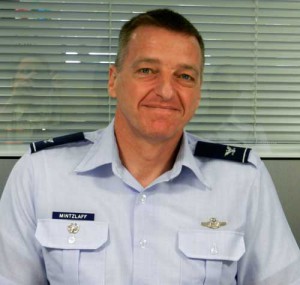
Col. Mintzlaff During the Interview, April 2011 (Credit: SLD)
06/08/2011 – During the roundtable at Tanker Airlift Control Center (TACC) the challenge of maintaining discipline in the system was a key focus for discussion. The airlift system and the multi-modal approach reinforce one another in trying to deal with the demand side of the logistics supply chain. The predictability of this system and the performance of this system are inextricably intertwined with the demand side.
If the demander has confidence in the system, requests for supply will be closer to what he actually needs. If he does not, distortions enter the system and demand goes up significantly.
Col. Mintzlaff discussed what he called the key requirement for maintaining discipline in the system.
Col. Mintzlaff: There’s a lot of collaboration across the TACC. From the execution piece, they do all the work, and for me, the challenges are maintaining discipline in that system so that when I say this is got to move; it’s got to move. And you’ll get both extremes. You’ll get it where everything works and it moves, and you’ll get another case where it needs to move now, it’s all ready to go and in reality it may not be.
You have to maintain the discipline in the system. Is it approved? If it’s something outside of the COCOM, through OSD, is it approved? Is it funded? Is it authorized to move?
To keep discipline in that system is a challenge because airlift can often be an emotional thing. I need my “something” and I need it now. Or in the case of a humanitarian type of operation, they need it and they need it now. It still needs to work through the wickets.
Another challenge for me is maintaining a common site picture with people. I think if people understand what’s taking place at a given time, there is a logical answer to take some of that emotion out of play.
SLD: In other words, there’s a process and procedures approach
Col. Mintzlaff: Yes, there is a process and procedures approach. How come my airplane is broken for three weeks and I’m on a C5? As it bubbles up, eventually it gets to the senior. So you’re the person there to try to be the peacemaker or, you’re right, this is wrong, we need to fix it. And you go, hey what’s going on? Let’s get a plane out there, because planes eventually break.
And now, where do you make the decision to rescue it, which is a use of assets that could be applied somewhere else? And where do you say, well, it’s going to be fixed? It sounds like a clean issue, but a lot of times the airplanes are going to be fixed at noon. And then noon comes and well, no, it’s really going to be 2:00. And then maybe it’s going to be 4:00.
SLD: Or maybe ten days later
Col. Mintzlaff: Yes. Ten days later you’re going “well, when is this thing going to be fixed?”
SLD: Planning and execution are hardly the same things.
Col. Mintzlaff: I would say if everything went according to all of the plans that everybody makes, we would have the most boring job in the world. Unfortunately, all the plans that they make fall apart for various reasons. Weather affects us in various ways. Nobody can control that. You can have a crewmember get ill. Anything that delays the mission from the original plan continues to have an effect.
Aeromedical evacuation needs to move somebody right now so we need to take another aircraft out of the system.
We have many things to consider. Many times a plan will come to us. We need to do this. When we delve further into the plan we find the crew can’t do it because they don’t have enough duty day left. Maybe diplomatic clearances aren’t sufficient, depending upon where they’re coming from.
Many different pieces have to go into that puzzle. And that’s when having the senior on the floor really helps out because sometimes those hard decisions have to be made.
What are we going to stop? What are we not going to stop?
I’ve talked to many disgruntled people. “How come I’m sitting here with my C5 broken at ‘name the place’? And I’ve watched, in fact, somebody else that was on this airplane with me, another airplane came and picked them up and took them home. How come I’m still here?”
These are the situations where we tried to get it done. We were given the plan, and we worked that plan, and we worked the modifications. Sometimes we modify the modifications.
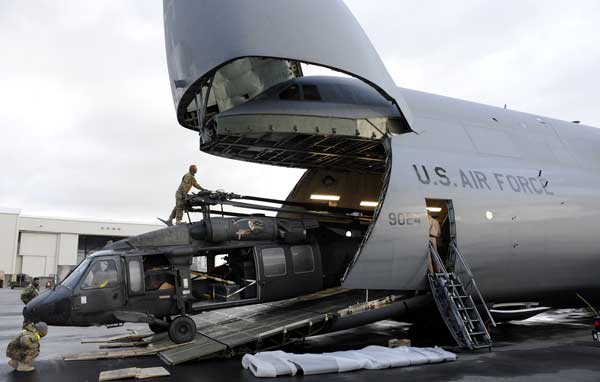
Soldiers spot a UH-60L Blackhawk while it is being loaded onto a C-5 Galaxy, Mar. 2, 2011, at Kandahar Airfield, Afghanistan. The Blackhawk upload was part of a change out; the old helicopters are being replaced by new airframes. (Credit: US Air Force, 3/4/11)
SLD: Clearly, the planning mechanisms are one thing. But it seems to me really what we’re talking about is risk management, risk communication. Trying to make hard choices.
Col. Mintzlaff: And it drives back to that discipline question. If you know you need it soon enough, you put it on a boat. We’ve made great strides working multimodally. And it helps ensure only those things that really need to be there overnight get there in time.
SLD: You’re trying to take demand off the system by moving it to the multimodal system.
Col. Mintzlaff: We can relieve some of the pressure to the extent with which we can complement our normal delivery with the ships. But the ships are going to take a longer time to get there.
SLD: You have to have metrics that give you a pretty good predictability on what you’re actually going to need. This leads to another problem, which is I’m the guy out in Afghanistan; I’m going to overbuy. Remember the just-in-time boys; how we were going to have just enough stuff and we’ll save all this money in maintenance? But, in fact, what you just described is why I wouldn’t do that; why I would buy more because I can’t rely on your air asset to necessarily be there.
And I think you probably have already looked at numbers from how much did people order in a Desert Storm versus how much they’re ordering here.
Col. Mintzlaff: It’s better now. But there’s still a ways to go. But yes, instead of ordering four, maybe they’re ordering two.
I think the point I would make was if it doesn’t need to go by air, don’t send it by air, so that if you order one, you get one. It needs to be reliable and predictable, and that’s what we’re really trying to do through the multimodal approach.
SLD: That’s a culture change for the supply chain.
Col. Mintzlaff: It is changing. You’ve gone from four or five to ordering two.
SLD: The key is as you say discipline so that there is predictability in the delivery system, and you are using air where it is most appropriate.
Col. Mintzlaff: Once you get something that’s predictable and reliable, whether it takes three weeks or it takes a day that person on the ground says it’s going to take me three weeks, so I’m going to plan for three weeks. Where it’s rough is when it’s a week, a week and a month, and he just doesn’t know.
SLD: And your point is if the part can come by sea, he’s better off having some predictability on that delivery.
Col. Mintzlaff: Or by air. Depending on what it is and when it needs to be there. If it needs to be there in 30 days, a ship might sail in 28.
I would make two points. One is if you predict out far enough, you can move it on the ship and get it there. The other piece would be the reliability part. If you’re sitting in the Philippines and you know that when you order a part it’s going to take 24 days to get there, or 14 days to get there from the time I order until I get it in my hand, then you start to build your processes around that. Where you fail is when one time it’s there in a week, or two or three times, and then it’s 24 days. Now he doesn’t know what to do. Now he’s ordering more than he needs.
SLD: So then you get distortion and behavior affecting the demand side
Col. Mintzlaff: And that’s really one of the things we’re trying to ensure, especially in this neck of the woods, is reliability. It’s going to come every so often, and plan on it.
SLD: Well, that’s very interesting. So trying to take the advantage of your fleet management interacting with a more reliable logistics supply chain management.
Col. Mintzlaff: If you’re sitting on the ground, would you rather know what you ordered is going to be there in two weeks, come high water? Or that you simply can not be certain of the delivery date? That is why we are focused on building greater discipline in the delivery system.
06/09/2011: During the Airbus Trade Media event in Spain in mid-May, Commandant David Spieles of the French Air Force provided an overview of how the French Air Force used the C-235 and their plans for the evolution of the fleet. The core point really revolved around the relative ruggedness of the aircraft and the ability to maintain the aircraft in austere locations.
In response to an SLD question, Spieles indicated that the normal deployment to an austere location would be two months. And to support the aircraft, they would take five mechanics, and carry with them 2-3 tons of spare parts.Spieles indicated that for the French “it is a worldwide asset. You can find everywhere in the world, including in the Caribbean.”
As an air transport, it can hold up to 44 pax or up to 4 pallets of 10,000 lbs. standard. It can carry 28 paratroopers and three jump masters, or 32 VIP seats of civilian standards. And as a Medevac transport it can carry the stretchers and equipment for 12 wounded. The range of operation of the aircraft can cover most of Europe which when placed on the world map means that it can cover most of the regions to which it is deployed. In other words, it has good range for the missions for which the French Air Force is tasking it.It is a rugged aircraft. And its readiness rate is around 70%. The average flight hours per year per aircraft are around 550 and for the pilots around 290 per year,
It has been used in a variety of overseas operations starting with Rwanda in 1996 and is currently being used to support the Libyan operation as well, but not over Libyan territory. It can operate well off of unpaved strips but requires a minimum landing area of 1000 meters by 30 meters.The officer discussed the very specific French approach to using the aircraft to support French helicopter ground refueling in austere locations. He concluded by noting that currently they have 19 C-235-200s in the fleet and plan to add eight. This fleet will be used as a complement of the A400M fleet to provide for tactical capabilities.