In an effort to be in compliance with GDPR we are providing you with the latest documentation about how we collect, use, share and secure your information, we want to make you aware of our updated privacy policy here
Enter your name and email address below to receive our newsletter.
04/27/2011 – When the Department of Homeland Security (DHS) was established in March 2003, enhancing U.S. cyber security was designated as one of its primary goals. In signing the legislation creating DHS in November 2002, President George W. Bush said “the department will gather and focus all out efforts to face the challenge of cyberterrorism….[and] will be charged with encouraging research on new technologies that can detect these threats in time to prevent an attack.”
After several years passed without major DHS action, however, observers concluded that the Department had failed to meet its important cybersecurity responsibilities and was insufficiently prepared for emergencies. “On paper at least, the DHS is responsible for overseeing information security across the federal government. But for most of its existence, the agency’s leadership on such issues has been conspicuous by its absence. Even where it has tried, its efforts have been less than successful.”
October 2010 marked the seventh annual National Cybersecurity Awareness Month sponsored by the Department of Homeland Security. Americans can follow a few simple steps to keep themselves safe online. By doing so, you will not only keep your personal assets and information secure but you will also help to improve the overall security of cyberspace. (Credit: http://www.dhs.gov/files/programs/gc_1158611596104.shtm)
In June 2006, a report by the Business Roundtable identified three major “cyber gaps”: no clear warning indicators that a cyberattack was occurring, uncertainty who would lead efforts to restore damaged U.S. critical infrastructure, and the absence of dedicated resources to support such post-attack recovery efforts. The CSIS Commission on Cybersecurity for the 44th Presidency recommended that the president formally revoke DHS’s limited authority to coordinate cybersecurity because, never having cyber authority over the U.S. military, intelligence community, and law enforcement agencies, the department could not perform this coordination role effectively.
Instead, in recent years DHS has made addressing the cyber security issue a higher priority and earned greater support within Congress for keeping DHS as the lead civilian agency in this area. Under the Obama administration, DHS has made cybersecurity one of its five most important mission areas in the first ever Quadrennial Homeland Security Review (QHSR). The DHS Fiscal Year 2012 Budget Request submitted in February 2011 requests for $57.0 billion in total funding, $47.4 billion in gross discretionary funding, and $43.2 billion in net discretionary funding. One of the six missions concerns cyber security:
Mission 4: Safeguarding and Securing Cyberspace – By statute and presidential directive, DHS has the lead for the Federal Government to secure civilian government computer systems and works with industry and state, local, tribal and territorial governments to secure critical infrastructure and information systems. DHS analyzes and reduces cyber threats and vulnerabilities; distributes threat warnings; and coordinates the response to cyber incidents to ensure that our computers, networks, and cyber systems remain safe.
Major programs in this mission area include:
Federal Network Protection: $233.6 million is requested to expedite the deployment of EINSTEIN 3 to prevent and detect intrusions on computer systems and to upgrade the National Cyber Security Protection System, building an intrusion detection capability and analysis capabilities to protect federal networks.
Federal IT Security Assessments: A total of $40.9 million in requested funds will support the Department’s efforts to strengthen Federal Network Security of large and small agencies by conducting an estimated 66 network assessments to improve security across the Federal Executive Branch.
Cybersecurity Workforce Needs: $24.5 million is proposed to provide high-quality, cost-effective virtual cybersecurity education and training to develop and grow a robust cybersecurity workforce that is able to protect against and respond to national cybersecurity threats and hazards.
Cyber Investigations: The FY 2012 Budget continues to support cyber investigations conducted through the Secret Service and ICE, targeting large-scale producers and distributors of child pornography and preventing attacks against U.S. critical infrastructure through Financial Crimes Task Forces.
Cyber Mission Integration: The FY 2012 request includes $1.3 million to enable DHS to coordinate national cyber security operations and interface with the U.S. Department of Defense’s (DOD) National Security Agency (NSA) at Fort Meade, Maryland. This funding will support a landmark memorandum of agreement signed by Secretary Napolitano and Secretary of Defense Robert Gates that aligns and enhances America’s capabilities to protect against threats to critical civilian and military computer systems and networks.
Cybersecurity Research: The FY 2012 request includes an increase of $18 million for the Comprehensive National Cybersecurity Initiative to support research and development projects focused on strengthening the Nation’s cybersecurity.
At present, DHS has the lead to secure federal civilian systems, sometimes described as the “dot-gov” domain. Through its National Infrastructure Protection Plan, DHS works with critical infrastructure and key resources (CIKR) owners and operators—whether private sector, state, or municipality-owned—to bolster their cyber security preparedness, risk mitigation, and incident response capabilities.The National Security Agency (NSA) has the greatest capabilities of any cyber organization within the U.S. government; it plays a key supporting role for both DHS and DoD, but its role in the protecting critical private sector infrastructure remains contested.
In January 2008, DHS launched its Comprehensive National Cybersecurity Initiative (CNCI) as the department’s main program to secure the online presence of U.S. government’s civilian agencies. The initiative aims to strengthen federal cyber defense by consolidating thousands of Internet connection points across agencies into a more manageable number of trusted Internet connections.
DHS is also responsible for implementing data traffic monitoring systems to detect nefarious activity and stop it before cyber attacks get out of control. Some of its goals include shoring up our network vulnerabilities by reducing and consolidating the government’s Internet connections, establishing better defenses through the development and deployment of modern network intrusion detection and monitoring systems, and improvement of the government’s collaboration with a private sector who owns more than 85 percent of U.S. critical infrastructure.
One element of CNCI involves reducing and consolidating the number of external connections federal agencies have to the Internet through the Trusted Internet Connections Initiative. This effort allows the department to focus its monitoring and eventually prevention efforts into limited and known avenues through which traffic must flow, while also establishing baseline security capabilities and validating agency adherence to those security capabilities.
Second, DHS is deploying Einstein 2 to these trusted Internet connection points. Einstein 2 uses passive sensors to identify when unauthorized users attempt to gain access to those networks. Einstein 2 already provides visibility into nearly 180,000 events a month.
Third, building upon enhanced situational awareness, DHS is testing the technology for the third phase of Einstein: an intrusion prevention system that will provide DHS with the ability to automatically detect malicious activity and disable attempted intrusions before harm is done to critical networks and systems.
Fourth, CNCI aims to strengthen DHS partnerships with the private sector and non-federal entities. A pilot program enables mutual sharing of cybersecurity information, working with private sector partners in the financial sector, the Department of Defense and the Financial Services Information Sharing and Analysis Center. Another pilot program brings together state fusion centers and private sector owners and operators of critical infrastructure to provide secret-level classified cybersecurity information.
A final element is to increase the number of federal workers in the DHS National Cybersecurity Division. In 2010, DHS aimed to hire 1,000 cyber experts but could only find and attract some 300 suitable candidates. Facing a similar shortage, the military services are considering extending the normal three-year rotations to keep network security specialists in their billets for a longer period.
Future DHS priorities are to expand Einstein’s capabilities, develop the DHS National Cyber Incident Response Plan in collaboration with the private sector and other key stakeholders to facilitate a unified national response to a significant cyber event, and increase the security of the automated control systems that operate elements of the U.S. national critical infrastructure.
DHS representatives argue that it is more efficient for one department to oversee the protection of both physical and virtual critical infrastructure in the US private sector, which fits in well with the department’s “all-hazards” approach. For example, when the DHS conducts an assessment of critical infrastructure sector, it examines the facilities doing physical and cyber infrastructure at the same time. DHS has co-located its cyber watch centers in the National Cybersecurity and Communications Integration Center which coordinates many physical response activities. They further claim that DHS is well-suited for responding to cyber threats since, like terrorist threats, the cyber threat environment is constantly changing.
Still, doubts persist. Critics cite the department’s mixed record at countering terrorist threats and protecting the U.S. critical infrastructure from physical disasters such as Hurricane Katrina. The Federal Information Security Management Act (FISMA) of 2002 uses a paper-based reporting system that takes up time that agencies should be using to protect their networks through more real-time continuous monitoring.
The Einstein system is controversial. It is an Internet traffic monitoring technology which records data flows in and out of federal networks, helping analysts identify irregular data patterns. Current Einstein technologies require significant analytical support, but DHS plans eventually to release a third-generation Einstein deployment that would automate the system’s data pattern analysis. Given delays releasing the first and second generation Einstein systems, it is not clear that DHS can remain on schedule to have Einstein 3 deployed by 2013 even though it employs technologies similar to those used by the Department of Defense.
The fundamental problem is that, at present, DHS has responsibility to protect all non-defense, public sector and private sector networks from cyber attack but lacks sufficient authority to accomplish this mission. The department has broad authority within the civilian government space to set requirements for other agencies. But DHS does not have direct enforcement authority over those departments and agencies, which has raised issued in particular cases. For example, DHS experienced difficulty in obtaining responses regarding the scope of the Conficker worm attack from different departments and agencies.
In addition, the U.S.-CERT program which is charged with monitoring the security of civilian cyber networks does not have the enforcement authority that it needs to ensure that agencies comply with its recommendations and mitigation guidance. U.S.-CERT also does not have the authority to compel agencies to deploy technology for determining in real time if a cyber attack is taking place. Sometimes the other agencies cannot meet DHS requirements for valid reasons, such as when they are constrained by their limited resources. But sometimes the other agencies just ignore DHS since it is a relatively weak department that lacks a means to punish them—such as by withholding funds—for non-compliance.
According to media reports, the White House has drafted legislation to significantly enhance DHS oversight over all civilian agency computer networks. the 100-page document is going through interagency review. It reportedly would give DHS many, if not all, of the same authorities for the .gov networks that the Defense Department has for the .mil networks.
For example, DHS would enjoy the same broad hiring authorities as the Defense Department, including the right to make direct hires, establish compensation rates, and pay additional benefits and incentives. Furthermore, the draft legislation would give DHS a major role in cybersecurity-related procurements. Given the large volume of cybersecurity software purchased by the federal government, DHS could use this market power to establish and raise de facto standards in the software industry.
The bill would also authorize the Secretary of DHS to determine what is critical infrastructure, assess audit systems for cyber resilience, and empower third-party accreditors and evaluators to assess the cybersecurity requirements of private sector owners and operators of critical information systems. A senior accountable official would have to sign and attest that owners and operators of critical infrastructure have developed and implemented effective cybersecurity measures. Third-party evaluators would then review and cross-check these measures.
See further coverage of cybersecurity and the Department of Homeland Security.
4/21/2011 – With a population of more than 180 million people and being a potential gateway for Central Asian and western Chinese trade, Pakistan is a very interesting developing market. But with problems of insurgency groups and state stability, it has not yet realized its geopolitical and economic potential.
The sheer scale of insurgency activity in Pakistan as a whole underlines the need for caution when operating either inland or at sea. While the number of concrete attacks on port facilities and ships is relatively low the number of security incidents in 2009 has surpassed 2,100 nationwide.
This article looks at the overall security situation in Pakistan’s maritime area, the specifically at the main port areas, and suggests that the overall security of the maritime sector will be strengthened if development of trade and business is able to bring about visible economic improvements for the coastal communities
Security Overview
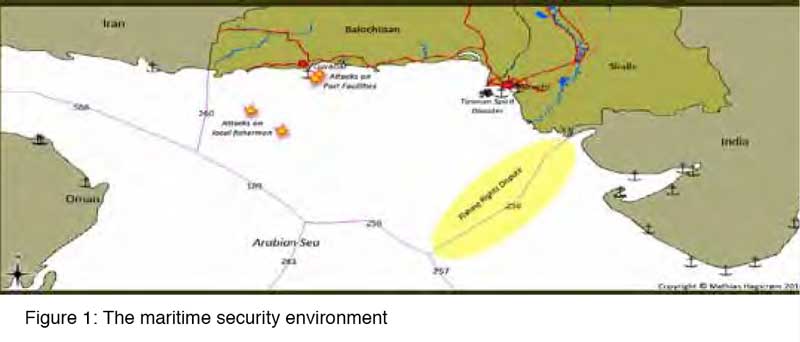
(Credit: Risk Intelligence)
While piracy in Pakistani waters and along the coast is non-existent, there are still pressing security considerations in relation to the risk of maritime terrorism and attacks on ships and port facilities by insurgency groups.
These considerations are complicated by bureaucratic inefficiency and wider corruption and fraud. As well, the dispute with India over maritime boundary 258 and the resulting struggle over fishing rights have both the Indian and the Pakistani coast guards engaged in capturing foreign fishing vessels.
Piracy
While the official Pakistani position is that there are no incidents of “robbery at sea” in Pakistani waters, the media has covered several incidents. The reason why these incidents are not registered by Pakistani authorities is that they are interpreted as part of a local conflict, and the authorities therefore abstain from classifying the incidents as robbery at sea. This practice of not registering security incidents on smaller vessels makes it impossible to estimate the extent of the problem and makes it harder to pinpoint developing security issues.
The Pakistani navy and coast guard are, however, engaged in reducing both piracy and armed robbery at sea. In 2009 Pakistan hosted a conference on sea piracy and engaged in a major naval exercise with China with a focus on combating piracy. The Pakistani coast guard is also engaged in combating drugs and other types of trafficking with increasing military presence in Pakistani as well as international waters.
These engagements are part of the Combined Maritime Forces (CMF) that was established in 2002, born out of Operation Enduring Freedom and consists of three dozen ships from Australia, France, Germany, Italy, Pakistan, Canada, Denmark, Turkey, the U.S. and U.K., as well as other naval forces and personnel from several other nations.
CMF is divided into three task forces: the CTF 150 commanded by the Pakistani Navy Rear Admiral Zafar Mahmood Abbasi is engaged in counterterrorism, the CTF 151 task force is responsible with combating piracy including activity at the horn of Africa, and the CTF 152 is engaged with combating trafficking.
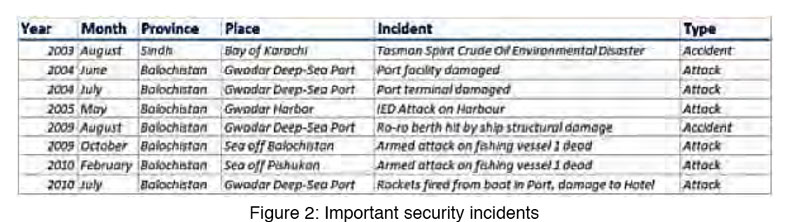
Pakistan has experienced eight notable maritime security incidents in the past 10 years; two of these have been accidents. These are, however, not the only security risks in relation to maritime security. Inland port connectivity and supply lines such as roads, rail tracks, power lines and oil and gas pipelines have all been repeatedly targeted in order to disrupt the working of the ports, with limited success.
The most severe disruption on trade relating to the Pakistani ports has been several incidents of ambushes, direct attacks and torching of NATO/ISAF supply convoys in route from Karachi to Afghanistan.
Terrorist and Insurgency Groups
The problems with terrorist and insurgency groups should not only be seen as limited to northern Pakistan. Al Qaeda, Pakistani Taleban (the Tehrik-i-Taliban), separatist movements and other militant groups do have the capability to execute terrorist attacks within the maritime and the shipping sectors. Al Qaeda has already demonstrated its maritime capabilities by executing the attacks on the USS COLE in 1999 and the 2002 attack on the French registered vessel LIMBURG. Business Monitor International classifies Pakistan with danger rating “red” and with a terrorism score of 35 where 100 signifies most unlikely place for terrorism to hit, surpassing the Philippines and other Asian countries with high risks of terrorism.
(Credit: Risk Intelligence)
Gwadar deep-sea port has experienced direct attacks on port facilities in 2004 and Gwadar Harbor in 2009. The Balochistan Liberation Army (BLA) has also in recent years targeted critical infrastructure in relation to inland port connectivity. From 2004 to 2009, Balouch insurgency groups launched approximately 471 attacks on infrastructure such as oil pipelines, roads, power grid and telecommunications. While terrorists and insurgents mainly target critical infrastructure the safety of road travel to and from the ports is also influenced by sectarian violence, unrest and criminal activity.
Pakistani Authorities
Corruption is widespread in Pakistan and entails both the private as well as the public sector with Pakistan scoring 2.4 in Transparency International’s corruption perceptions index (CPI). There have been recent reports on corruption in Gwadar, Qasim and Karachi ports and Pakistani media has reported deep-seated corruption within the Trading Corporation of Pakistan (TCP) that deals with imports and exports on behalf of the government of Pakistan and deals directly with shipping companies. The Port Qasim Authority (PQA) has also been highlighted as a “golden egg of corruption” in the Pakistani media and prime example of corrupt government organizations in Pakistan.
Corruption poses a significant threat to goods and costs and it also poses a threat to human security in terms of imprisonment or violence. The ports of Pakistan are investing in technical equipment in order to tighten security, but corruption can seriously undermine these efforts.
Pakistani observers speculate that corruption has played a significant role in bypassing security. The 2003 environmental disaster of the TASMAN SPIRIT illustrates other security concerns when operating in Pakistani waters and dealing with authorities. The detention of the ship’s crew shows that there is a significant risk of criminalizing the crew in relation to security incidents by the Pakistani authorities and a willingness to use detention of crewmembers to pursue political agendas.
Trafficking
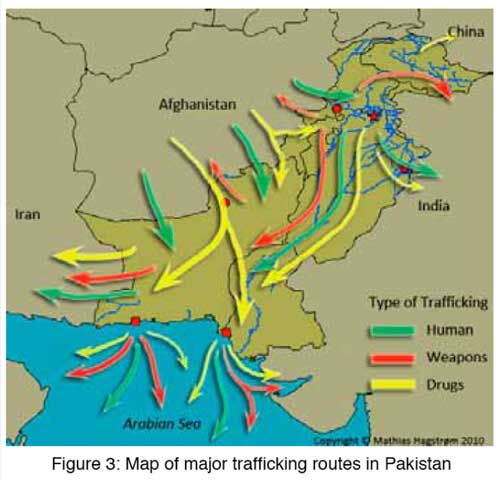
The risk of trafficking of weapons, drugs or people is present in all ports of Pakistan. According to the World Bank, both Gwadar and Karachi ports are major hubs in international drug trade. The risk of stowaways is also significant; Afghans are the largest nationality of stowaways that embark from the ports of Pakistan. Pakistan joined the Prevention and Control of Human Trafficking Ordinance in 2002 and has registered 1,826 cases of trafficking between 2003 to 2006.
Pakistan is also a significant producer of small arms. It is estimated that there are more than 18 million illicit small arms in the country and a substantial amount of these are exported each year. Pakistan is also struggling with the vast problem of drug trafficking, mainly from Afghanistan. Pakistan tries to deal with this issue at a number of difference levels with their contribution to Coalition Task Force, CTF 152.
(Credit: Risk Intelligence)
Sindh Province and Karachi Area Ports
Sindh has experienced clashes between ethnic groups since the partition of British India in 1947. Night travel is not always possible due to risk of robbery, but rail and pipeline security is good in general, making the overall inland port connectivity relatively stable and safe.
The transportation networks of Sindh are today the main route for reaching the markets of Afghanistan, Western China and Central Asia and is relatively safe to use compared to other transportation networks in Pakistan. While the number of attacks has been increasing from 2006, Sindh remains one of the most peaceful provinces of Pakistan.
Sindh and Karachi are of vital importance for the Pakistani economy. Karachi is therefore a high-level target for insurgency groups where a relatively small successful operation could jeopardies Pakistan’s economy and trade relations with the rest of the world.
Karachi is the financial capital of Pakistan with a population of 15.5 million people and is served by the two ports Port Qasim and Karachi port. Karachi lies in the Indus delta in the Sindh province. Travel warnings have been issued by many Western governments emphasizing the need for caution by business travellers, but taking into account the size of the population and the types of attacks, Karachi remain a relatively safe city for the international traveller.
Overall, the Karachi ports are vulnerable to terrorists picking soft targets such as ships or port facilities. The Pakistani authorities are aware of these risks, however, and have a major interest in properly securing the ports.
Port Qasim Authority has been working with Transparency International in order to solve its problems with corruption. Soft targets like oil tankers and container ships are at the time of writing extremely lucrative for terrorist and insurgency groups. Such a target would be devastating for the Pakistani economy and commerce and would further destabilize the already volatile State of Pakistan.
In the province of Sindh where Karachi is located, separatist and sectarian groups have a key interest in such operations that could further the destabilization of Pakistan and thereby strengthening their agendas. There are no immediate security risks of campaigns of terrorism or other violent actions against the ports of Karachi. There are, however, heightened risks of isolated security incidents related to political, sectarian and other types of violence.
The ports of Karachi are high value targets, and with the latent risk of violence and terrorism in Pakistan isolated security incidents are a significant security concern.
Port Qasim
Port Qasim is one of the country’s busiest ports consisting of a four-berth multipurpose terminal, a two-berth container terminal, a one-berth liquid chemical terminal, and a one-berth oil terminal. The port is managed by the Port Qasim Authority (PQA) and consists of terminals and industrial zones covering an area of roughly 12,000 acres.
Large investments have recently been made to strengthen security mainly in terms of improving vessel tracking systems and establishing an Integrated Cargo Container Control (IC3), the first of its kind in Pakistan.
In order to tighten security in relation to terrorism a number of road blocks and barriers have been established throughout the port. Video surveillance and patrols by security teams are some of the initiatives the PQA has implemented in order to heighten security. However, a recent incident with theft of 5,000 truckloads of sand has sparked speculation about the general level of security.
Karachi Port
Karachi is the former capital of Pakistan and Karachi port is the historical seaport. The industrial harbor consists of two wharfs each with its own container terminal of two berths. The East wharf has 17 berths while the west wharf has 13.
Additionally, there are three liquid cargo berths and a combined naval and civil shipyard. A fishing harbor and smaller boatyards also adds to the traffic in the harbor. The Karachi Port Authority administers Karachi port, with a port security force in charge of security.
Karachi port utilizes many of the security measures that are also present at Port Qasim with video surveillance and vessel tracking systems. Karachi port has established a central port operation center where both security and administrative tasks are administrated and coordinated.
An intelligence report published just after the insurgency attack on the Pakistan National Army headquarters in Islamabad on 10 October 2009, expressed a high risk of terrorist attack on the port of Karachi. The report states that insurgents have been scouting for maritime targets and security weaknesses in the port and warns about a possible attack on various port installations. While the Karachi police and the Pakistani navy have confirmed a heightened security level it should be mentioned that the whole port area is only covered by a single police station.
Pakistan media has reported that the port security force is ill equipped to counter any terrorist attack. Another issue that raises security concerns is an ongoing conflict between the port security force and Karachi Port Authority on labor rights, and this is an issue that is currently being dealt with by the Sindh High Court. Port officials have reported that the security protocol is significantly heightened when ships from the EU navigate the port where these are escorted by gunboats. In September 2010 the World Bank endorsed a US$115.8 million port improvement project aimed at expanding capacity and institutional strengthening.
Balochistan Province and Gwadar Deep-sea Port
The province of Balochistan is the Pakistani side of a much wider territory covering parts of Afghanistan and Iran. Balochistan is the largest province of Pakistan and is covered by vast deserts, mountains and rough terrain and is the least populated province of Pakistan. Today, Balouch separatist movements are active again, adopting guerrilla tactics of targeting critical infrastructure, local government, police, and military. While the number of civilian casualties is still high, the tactics applied by insurgency groups in Balochistan is significantly different than in other parts of Pakistan.
Since 2004 Balochistan has experienced 30% of the security incidents of Pakistan, which makes it one of the most unstable provinces only surpassed by the North frontier province. A network of oil and gas pipelines connects Gwadar port with these resources and these are frequently targets of the BLA.
In relation to the wider Gwadar development project, there are heavy investments in road and rail links. These infrastructures connecting the port of Gwadar have become lucrative targets due to a relative low risk and the possibility to disrupt movement, trade and supply lines. While Balouch insurgency groups seem to favor pipelines as a target, road and rail connectivity to Gwadar is also at risk.
There persists a strong mistrust towards foreign and non- Balouch involvement in the province. Within Balouch nationalist communities, Pakistani and foreign involvement is seen as Punjabi colonization. Since 2004 there has been a steady increase in security incidents. While Gwadar remains quite safe for the most part, the port is a significant symbolic target. Like is the case with the ports of Karachi there is a risk of an isolated terrorist incident, but with the activity of BLA and other separatist groups there is also a risk of a longer sustained campaign against Gwadar deep sea port.
Gwadar Deep-sea Port
Ten years ago Gwadar was a small and dusty fishing town in Balochistan. Today it is a thriving and developing port city with a population of 53.000 people. The development of Gwadar has been far from easy and has also added fuel to the ongoing conflict between Balouch nationalists and Pakistani authorities. The security incidents tend to concentrate around urban and industrial development and non-Balouch persons.
While security incidents in Gwadar are much fewer than in Karachi there is a significant difference in the nature of these incidents. While Karachi has a large amount of political and sectarian violence the incidents in Gwadar seem more focused on the presence of non-Balouch activities and investments. This should be taken into consideration when operating in Gwadar and wider Balochistan where hiring non-Balouch labor or being foreign can increase the risk of becoming a target to Balouch insurgent groups.
Gwadar deep-sea port is located on the tip of a narrow peninsular. It has three multipurpose berths and one service berth. The deep-sea port is close to two fishing harbors and a military installation belonging to the Navy of Pakistan. The first ship anchored at Gwadar deep-sea port in March 2008. The port is run by the Port Singapore Authority (PSA), which won the bid for a 40-year contract.
This year the PSA started the initial survey for phase two, a US$932 million Gwadar development project adding an additional nine berths to the port on its completion.
In its development phase and short existence, Gwadar deep-sea port has already had a number of security incidents.
On 3 May 2004, 3 Chinese engineers were killed and 11 others wounded in an IED attack and the following month the port itself was the target of a coordinated attack. One of the port facilities was damaged along with a police checkpoint, a government building and the construction site of an international hotel. Again, on 10 July 2010,
Chinese engineers were the suspected targets of a BLA rocket attack launched from a small boat in the port; no one was hurt in this incident. The port has also suffered from numerous blackouts due to the BLA’s successful operations targeting pylons and power lines connecting the port.
In August 2009 the first accident happened at the port when a vessel collided with the ro-ro, berth creating structural damage to the port. The PSA was accused of trying to cover-up the incident and downplay the damage caused.
Pakistani authorities are very security conscious when it comes to Gwadar and a naval base is situated on the same peninsular as the deep-sea port. It has also been reported that the Chinese are supporting the Pakistani military with intelligence in relation to Balouch separatist groups.
Due to security risks and insufficiently developed infrastructure connecting the port, Gwadar has not yet attracted a lot of international shipping traffic.
Future Developments: Stability and Trade
Many scholars on Pakistan warn about the likeliness of a state collapse but such predictions have been articulated many times before without anything happening.
There exists an invisible glue that keeps Pakistan together, not as a real nation state but as the place where very different ethnic, religious and political groups struggle to coexist.
But being a country without a common national identity brings about serious security challenges. The maritime sector has so far been relatively unaffected by these problems.
The increasing activity of Balouch separatist groups and their focus on targeting critical infrastructure, airports and ports and harbor facilities should not be taken lightly. Other groups like Al Qaeda also pose a continued threat to the maritime sector although single security incidents seem more likely than an actual campaign against the maritime sector.
It is still the local civilian and business sectors that are most affected by security incidents. Police and military are to some extent directly targeted but also experience a high number of attacks when protecting potential main targets.
Comparing Balochistan and Sindh, it is clearly two different types of security issues.
Balochistan experiences some of the classic security problems associated with guerrilla warfare whereas Sindh sufferers from political, ethnic and religious unrest.
The ports of Karachi are not as much at risk of local security incidents as is the case with Gwadar deep-sea port. The abilities of insurgency groups operating nationwide and their ability to operate in Karachi should not be underestimated.
In July 2010 Pakistan was hit by severe floods following the monsoon rain. The UN estimates that over 2,000 people were killed and 17-21 million people injured or rendered homeless due to the floods. While the ports only suffered minor damage the connecting infrastructure was badly hit. It is estimated that 2,433 miles of highway and 3,508 miles of railway was affected with damage exceeding US$280 million and setting back Pakistani development for years to come.
The areas worst affected have been Sind and Punjab provinces while the infrastructure in Balochistan was hit less severely. The major supply lines are open again, however, including the two important NATO routes to Afghanistan through Chaman and Torkham. Pakistani authorities state that there are again 2,000-3,000 NATO supply trucks on route to Afghanistan on any given day.
Despite the floods and the general unrest in Pakistan, investment is being made in order to fulfill its potential as a gateway for trade. Pipelines connecting Iran to the port of Gwadar are in development and road links through Afghanistan to the central Asian republics are also in the making. If just some of these projects succeed they will generate increased traffic to Gwadar and Karachi ports.
Such developments will help to strengthen overall port security but also makes the shipping industry a more high value target. The overall security of the maritime sector will be strengthened if development of trade and business is able to bring about visible economic improvements for the coastal communities. This would undermine support of insurgency and terrorist groups in the local communities and improve security not only for foreign investors
04/20/2011 – In the aftermath of several weeks of bombings above Libya, it might be of interest to attempt to decrypt two key events which happened as this operation was being conducted:
The “pole position start” of the French Air Force as a direct support to political action.
the shift of command of the operation to NATO, even though a Franco-British alternative solution could have been considered.
An Unusual Operational Tempo
When reviewing the March 19th strikes, one needs to apprehend, first and foremost, the notion of operational tempo, i.e. the rhythmus of a political-military pulse which air power’s inherent characteristics, such as reversibility, reactivity, and effective range, manage to initiate in a sequenced order.
On March 19th, the action played out in less than 7 hours:
At 11 a.m.: while the Carrier Battle Group warms up in Toulon, four Rafale fighters in air defense configuration take off from Saint Dizier airbase. They are supported by air tankers from Istres and one AWACS from Avord airbase.
At 12:30 p.m.: at the Elysée palace, the French President opens an international meeting about Libya, two days after Resolution 1973 was signed in New York.
At 1:00 p.m. : the four Rafale fighters are on site and patrol above Benghazi to enforce the no-fly-zone. They are filmed and broadcasted on TV channels all over the world.
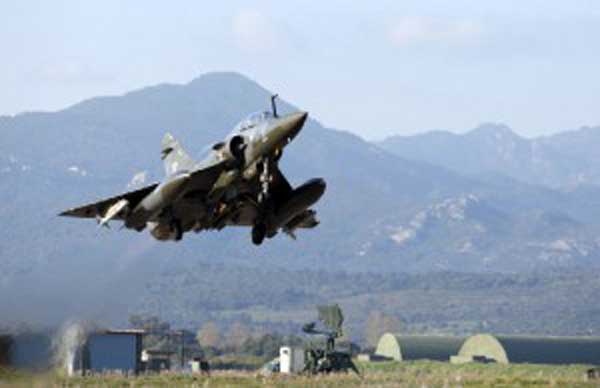
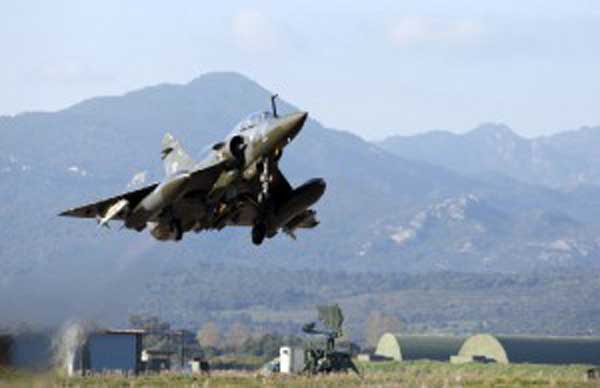
At 2:00 p.m.: two Rafale and two Mirage 2000D fighters in close air support configuration take off respectively from Mont de Marsan and Nancy airbases.
At 5:00 p.m.: French aircrafts destroy several of Gaddafi’s troops’ armored vehicles on the outskirts of Benghazi, disrupting the encirclement of the Cyrenaica’s capital. Half an hour later, after leaving the international meeting, the French President can communicate on his decision and the first results which stem from it.
A Good Synchronization of Assets
What do such a string of events and tempo demonstrate?
– First of all, there has been a highly accurate synchronization between political actions and aerial operations, displaying in a minimum amount of time a strong and loud signal of determination and credibility, in less than 48 hours after the UN resolution.
– What is also palpable here is an effective planning capability and the ability to conduct an operation, which involved the President’s personal chief of staff with his accurate operational expertise, the Joint Chief of Staff and the Air Force. Indeed, the latter was able to perfectly adapt to the mission, while, along with the navy and Army, it is going through a major restructuring and manpower reduction.
– The importance of the Air Defense Command and Air Operations should also be highlighted: it is currently headed by General Desclaux, who, under the guidance of the Army’s Chief of Staff, planned and controlled these first air operations on his own.
There is none of NATO’s “big machinery” here. But without this command center located at the Balard base in Paris and supported by Lyon Mont Verdun-based air operations center, these French operations could never have been carried out. Finally and mostly, this string of events on a short loop basis stressed the coherence between all involved assets: ranging from the investments made to equip Lyon Mont-Verdun’s – where all European air forces are trained for air operations – to the determined choice of multirole capabilities illustrated by the « Rafale equation » and its armaments which aim at replacing all existing French air platforms. The operational result is a product of thirty years of investments driven towards a major and crucial imperative: France’s strategic autonomy and operational sovereignty.
This string of events on a short loop basis stressed the coherence between all involved assets: ranging from the investments made to equip Lyon Mont-Verdun’s – where all European air forces are trained for air operations – to the determined choice of multirole capabilities illustrated by the « Rafale equation » and its armaments which aim at replacing all existing French air platforms. The operational result is a product of thirty years of investments driven towards a major and crucial imperative: France’s strategic autonomy and operational sovereignty.
A Strategic Autonomy To Preserve
Such observations open the floor for a more poliotical dimension, i.e. the question of operational etiquette. Without NATO, it has been heard and said, no complex air operations would have been possible and therefore no alternative to its role exists.
The French and the British do however own first rate and NATO-certified command-and-control centers at the strategic, theater and service (in this case air) levels. As a matter of fact, the “all-in-one NATO solution” might not be the one, as soon as the alliance steps out of its original mission, which remains the collective defense on the European continent.
The systematic use of NATO as a universal crisis manager raises some questions, and not only in the Muslim world. That’s why the Common Security and Defence Policy will be, in actual fact and increasingly so, a proper answer to these kind of operations, in areas where balances matter to us and imbalances concern us.
Among the European Union’s agora, the political consensus mays not always be easy to achieve, but no less after all than within NATO (Ankara’s veto comes to mind). Let us not forget that EU’s operations can be executed via a “capable and volunteer” core (like the French-British alliance in the case of Libya), so long as European countries give themselves the meanss to conduct long term operations independently from the USA, in case the latter so not want to be involved. It’s probably not enough the case yet, and one can only stress out the importance for nations to master Command-and-Control (C2) assets.
Once again, the issue is not to assess March 19th’s political choice: it is about reminding the obvious truth which is that, whatever the future operational and political scenarios, autonomy stands from funding. French forces currently lack air tankers and armed UASs. In addition, French land-based, sea-based and air-based capabilities closely depend on the quality of training (in this case, the pilots’ training is at stake, but the same reasoning applies to infantrymen or sailors). Finally, these events highlight the necessary subordination of support to operations.
Whatever the future operational and political scenarios, autonomy stands from funding. French forces currently lack air tankers and armed UASs. In addition, French land-based, sea-based and air-based capabilities closely depend on the quality of training (in this case, the pilots’ training is at stake, but the same reasoning applies to infantrymen or sailors). Finally, these events highlight the necessary subordination of support to operations.
Credibility has a cost and this cost needs to be understood as an investment. As NATO is taking over the control of the Libyan skies, this is the very first lesson learned from the French Air Force strategic autonomy.
04/19/2011 – The Obama Administration has come to power at a global turning point. The President has underscored the importance of working with allies and shaping a new global engagement for the United States.
At the same time, he has emphasized the need to enhance global collaboration to deal with terrorism with a global reach. And he has underscored the importance of expanding the US engagement in the global trading and economic system. He has clearly articulated the objectives of building a new role for the United States in an evolving multi-polar world.
No service is more important to this vision than the USCG. The USCG is at the vortex of commercial, law enforcement and military activities. It is tasked with a multi-mission focus in support of the protection of the homeland, securing global trade, protecting against terrorist threats at sea, interdicting the sea-borne drug trade, assuring the safety of shipping, and participating in global collaboration in securing the global commons. At the same time, with the global financial downturn, the USCG like other US agencies is to do this with constrained resources.
Yet the Administration is significantly cutting back on the USCG and its capabilities. Two cutters are to be retired from the Pacific; OMB seeks to stop the acquisition of new cutters at 4 rather than the 8 or 9 that the USCG needs; and the Maritime Patrol Aircraft numbers are to be cut significantly.
None of this makes sense unless the desire is to reduce maritime safety, security and custodianship is the strategic objective. The cost to the US economy will be significant. The Pacific fleet will not be able to provide adequate coverage for fisheries protection and this alone will guarantee the loss of billions of dollars of fishing commerce.
No area reveals a greater gap between the rhetoric of the Administration and its actions than the fate of the USCG and its missions. This gap must be closed for security, defense, and economic reasons. It is difficult to cover territory, enforce laws and provide with security with missing assets. The USCG does a great job but disappearing assets means significantly reduced safety, security and economic support to the nation.
As the Department of Homeland Security budget documents emphasizes:
The Coast Guard provides agile, adaptable, and ready operational capabilities to serve the Nation’s maritime interests. Throughout the U.S. maritime domain, the Coast Guard provides a recognized maritime presence in carrying out its safety, security, and stewardship roles. It is also the only DHS organization and Armed Service that can operate assets for both law enforcement and military purposes within and beyond U.S. territorial limits. This presence, supported by a military command, control, and communications network, gives the Coast Guard both prevention and response capabilities for all threats.
The Coast Guard can augment forces from the local level to a national or international level of involvement, regardless of the contingency. In responding to domestic disasters and emergencies, the Coast Guard can also accept and integrate assistance from DoD and other federal agencies. Moreover, the Coast Guard can flow its unique capabilities and authorities to DoD for national security contingencies. As both a military service and law-enforcement agency, the Coast Guard “straddles the seam” separating the federal government’s homeland-security and homeland-defense missions.[1]
Great statement but where is the beef?
Providing for this sort of flexibility with limited resources within a constrained budgetary environment is challenging. To do so requires shaping highly connected forces around capable multi-mission assets. Connectivity is central to effective knowledge shaping action; multi-mission assets are necessary to execute on the basis of that knowledge in a variety of different circumstances. And without the physical assets able to operate in a more effective connected environment, enhanced connectivity will not lead to effective action. An ability to cover territory with aviation assets to work with surface assets, whether ships or on-shore capabilities is central to success for the maritime security and safety team, of which the USCG is the crucial anchor.
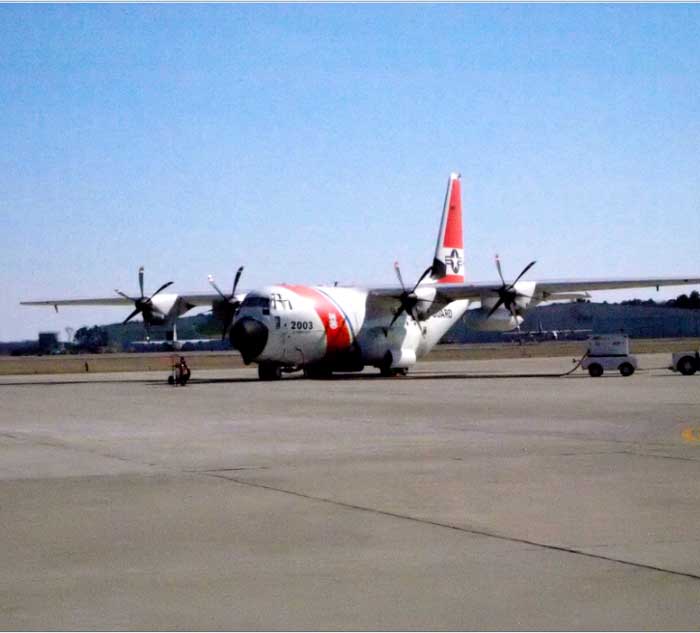
The USCG C-130 as Seen in Elizabeth City Air Station (Credit: SLD)
The maritime patrol aircraft, the C-130s and the helos form together the surveillance, lift and action team, which provide significant capabilities to extend the reach of the USCG and joint surface assets. With the new platforms, which are being introduced into the USCG, the MPAs, the upgraded C-130s and networked enabled helo assets, the capability to work with the joint team is significantly enhanced.
And in an era of financial stringencies making use of joint assets, USN and US Air Force for the USCG, and vice versa is essential. The new connectivity-enabled air assets allow this to happen.
But it will not happen if you do not have the platforms; and you do not have the modern integrated systems. Enhanced connectivity is not an excuse not to buy platforms; it is the multiplier of the networked enabled new platforms being acquired.
The Connectivity Enhancer
Prior to the 9/11 attacks, the USCG had crafted a new approach to acquisition called Deepwater, which was forged upon the requirement to dramatically recapitalize ageing physical assets with limited resources. The acquisition of surface, shore and air assets were to be integrated with common C4ISR tools and approaches to provide for interoperability across the range of stakeholders in maritime safety and security.
The goal was to provide C4ISR systems, largely rooted in the use of commercial and government off-the-shelf procurement, as the backbone for an integrated service. A new central nervous system would allow for fewer, but more capable, physical assets. The events of 9/11 accelerated this approach and demanded new capabilities. Deepwater was redirected by new requirements. The USCG was tasked with handling newly defined maritime security threats. Its evolutionary approach was disrupted by the need for surge requirements to deal with new threats.
Deepwater critics have focused on problems with the acquisition of some assets – largely patrol boats and, to some extent, the new National Security Cutter. The USCG responded by shaping a new acquisition directorate to subsume Deepwater.
But lost in the shuffle has been the significant success of several shore and aviation assets as well as the core C4ISR systems and the effort to provide interoperability with its civil, commercial and military partners. The addition of a classified network, the upgrade of Inmarsat communications, the deployment of an automatic identifications system, the upgrade of law enforcement radios and other systems have greatly improved the USCG’s capabilities.
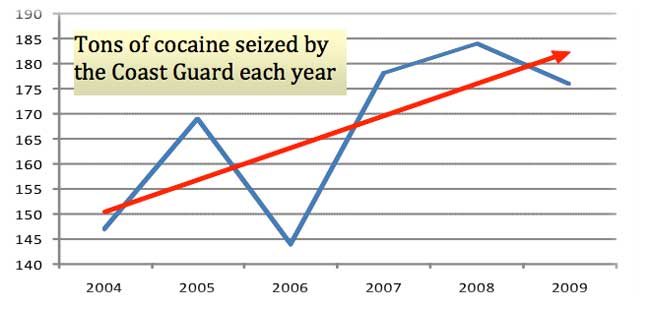
Illustrative of the impact is the role the new capabilities have played in a variety of USCG missions, including interdiction of drug trafficking. The Coast Guard combats drug trafficking in the Caribbean, Gulf of Mexico and Eastern Pacific—their work accounts for more than 50% of all cocaine seizures each year. The service also stops thousands of illegal migrants thereby avoiding billions of dollars annually in social services. At the same time, they aid persons and vessels in distress, saving lives and minimizing injuries. In addition to trained personnel, accomplishing these challenging missions requires technology—electronic charts that integrate with radar, computerized planning and tracking systems, infrared-detection gear, all weather day/night cameras and secure channel radios.
Multi-mission stations, cutters, aircraft and boats linked by communications networks permit effective operations. Electronic systems enable coordinated tactics, integrated intelligence, multi-agency interoperability and common situational awareness necessary to fulfilling statutory missions.
(Credit: SLD)
A good measure of success of technology implementation is the continued increase in cocaine seizures. New communications systems, coupled with the latest in electronic sensor technology, are credited with making drug trafficking intelligence rapidly available and improving target tracking, thereby achieving effective prosecution of criminal activities. These systems, deployed across multiple types of assets allow for interoperability of electronic equipment and commonality of software. Operators are able to transmit and receive classified and unclassified information to and from other assets, including surface vessels, aircraft, local law enforcement, and shore facilities. The electronic network is the glue that permits them to work together to effectively achieve a common purpose—a true force multiplier.
A common architecture deployed across multiple types of assets allows for commonality of equipment and software systems and supportability of the entire Coast Guard enterprise. In general, the Deepwater C4ISR architecture ensures an open systems approach for design and implementation, providing a web enabled infrastructure. Its architecture adapts to technology insertion and enables the progression to future Coast Guard wide C4ISR architectures.
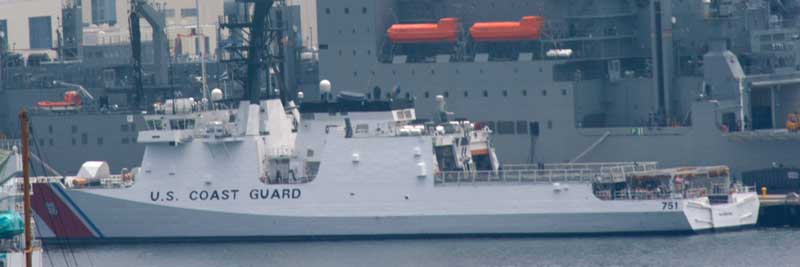
The first National Security Cutter, USCGC BERTHOLF, has passed all TEMPEST and information assurance requirements culminating in the authority to operate. Indeed, Lockheed Martin one of the partners in Deepwater was specifically cited in a Coast Guard letter of appreciation dated Jun. 24. Delivery of the second National Security Cutter, USCGC WAESCHE, also received an excellent C4ISR evaluation and the ship was accepted with no C4ISR trial cards. Systems include electronic charts that integrate with radar, computerized planning and tracking systems, infrared-detection gear, all weather day/night cameras and secure channel radios.
Multi-Mission Platforms and the C4ISR Advantage
The Coast Guard has accepted delivery of missionized HC-130J Long Range Surveillance Maritime Patrol Aircraft. The aircraft’s new mission equipment and sensor packages are designed to deliver enhanced search, detection and tracking capabilities to perform maritime search and rescue, maritime law enforcement and homeland security missions. The aircraft modifications include installation of belly-mounted surface search radar, a nose-mounted electro-optical infrared sensor, a flight deck mission operator station and a mission integrated communication system. The mission system installed on the HC-130J is derived from the same software series developed for the mission system pallet onboard the HC-144A maritime patrol aircraft
The Coast Guard has also accepted mission system pallets for their new HC-144A “Ocean Sentry” Medium Range Surveillance Maritime Patrol Aircraft. This roll-on, roll-off suite of electronic equipment enables the aircrew to compile data from the aircraft’s multiple integrated sensors and transmit and receive both classified and unclassified information to other assets, including surface vessels, other aircraft, local law enforcement, and shore facilities.
At the heart of all these platforms is a common command and control system. It provides system interoperability as well as commonality for savings in maintenance and training. C4ISR system software reuse across Coast Guard platforms is significant. The same 100% common software between air platforms is also 41% common with the software on the National Security Cutter. The suite on the National Security Cutter leverages nearly 75% of the code from the Navy’s latest Aegis baseline while the air suite is 80% common with Navy’s P-3 Aviation Improvement Program. The command and control system is not only compatible with across the Coast Guard’s land, air and sea assets. It is also interoperable with the Navy and 117 federal agencies.
In ports and coastal areas, one of USCG’s most significant capability enhancements clearly is shaping a robust connectivity capability for the USCG and its maritime and security partners. It is a fundamental building block in improving the Coast Guard’s ability to maintain maritime domain awareness focused on meeting the needs of decision makers engaged in operations at sea, ashore, and in the air.
In spite of such developments, the Coast Guard has insufficient new assets—much of the fleet is wearing out at an ever-increasing rate. Modern communications and electronic systems are needed so that new and aging assets can be deployed effectively. And the aviation assets are not being modernized at a sufficient rate to enable to the USCG to have the reach necessary to act upon the newly acquired information generated by new C4ISR systems.
The Maritime Patrol Aircraft at the Center of the Enterprise
Too often when one thinks of a maritime service, one thinks largely of ships. Yet in a 21st century maritime enterprise, data, communications, and integrated air and surface systems are really at the heart of effective operations. The Administration is seeking within the Department of Defense to organize a more effective integration of the USAF with the USN; at the heart of this new air-sea approach is a core recognition of the role of integration of air and surface assets in mission success.
The USN has underscored the central role which it new maritime patrol aircraft and unmanned vehicles (MMA and BAMS successively) will play in maritime operations. Illustrative of this connectivity contribution by the USN’s aviation fleet was the following comment made by RADM Brooks.
The MMA will be a rapidly deployable force capable of operating independently in the far reaches of the world’s oceans or in coordination with naval, joint, or allied forces. Its superior connectivity ensures MMA a major role in FORCEnet as a key airborne node. MMA’s projected state-of-the-art communications and data links have the potential to act as sensors and provide the airborne node necessary for the Navy’s network-centric C4ISR architecture of the common undersea and common operations pictures. This capability will enable real-time, multi-channel command, control, communications, and intelligence links combined with onboard sensing, quick-look analysis, data fusing, and data dissemination to deliver timely information to naval, joint, or allied decision makers.[2]
And US forces have discovered in Iraq and Afghanistan the central role which aviation assets – manned and unmanned – can play for successful operations of ground forces. The USMC concept of the MAGTF – the combined air and ground force – is being replicated to a considerable extent as the US Army works with the US Air Force in shaping joint concepts of operations.
The USCG uses its aviation assets in a similar manner. The aviation assets – helos and MPAs – exist as an extension of the ground and surface fleet capabilities. Indeed, for the 21st century USCG much like for the 21st century US military overall, air assets extend the reach, range and capability to act of the surface assets. For the USCG this means a simple truth: a surface ship without the long reach of an MPA or a UAV cannot see very far. By extending the sight and reach of a ship or a fleet, the ability to act and to protect US equities and interests are significantly expanded.
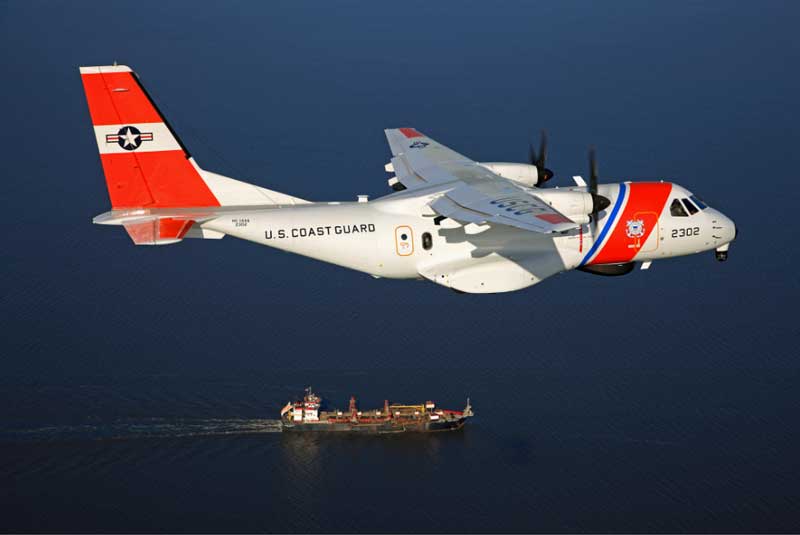
The New MPA Provides Significant Savings in Operational Costs, a Significant Expansion in the Ability of the Fleet to Execute Missions and Carries New C4ISR Systems to Benefit the USCG, the Joint and Coalition Forces (Credit: EADS)
With the addition of the multi-mission pallets to the MPAs, and with the ability to integrate the information gained by those systems within shipboard operations and decision making, notably with the new USCG cutter, the MPAs become especially significant extenders of fleet activity. Without this extended reach, drugs may well enter the US, illegal immigrants may well not be seen, and illegal shipping with whatever consequence may enter US waterways. Inadequate resources leads to the inability to acquire assets with clear consequences for reduced ability for the USCG to see and act on that knowledge to protect the US homeland or forces operating abroad.
The new MPA’s concept of operations is essential as well to the functioning of the 21st century USCG. The new MPAs are significant enablers for the legacy and modernized fleet. The best way to think about this is simply a simple Venn diagram in which the surface asset occupies one Venn circle, and the MPAs provide a second Venn circle significantly expanding the range of operation, and hence the ability to execute missions.
The con-ops typically depends on the mission and is essentially the same as the HC-130. Part of this calculation is the determination of proper track spacing (distance between search legs), which is a function of the size of the target (man in the water would require a very small track spacing for example), sea state, visibility, cloud cover, etc. Night searches are done if the target is thought to be capable of detection by radar, possess radio or signaling equipment. Typically a ship would be controlling one or more MPA/helicopters and continuously updating which areas have been searched and the results. Of course this function can be done by a shore station as well. The primary purpose the ship is involved at all is to be available as a helo platform and/or to launch a boarding party, engage the target if hostile or to recover survivors.
However, the C-144 can do more than just pass target position information or provide vectors. It has the ability to take photos and download them. So the ship can have information on the number of people aboard the target craft (good to know if they are bad guys) and perhaps even information on arms.
Finally fixed-wings are often required to loiter over targets or follow them until a surface can intercept. Endurance is critical here and a major shortcoming of the HU-25. The HU-25 has about 4 hours of endurance regardless of the altitude. It can fly much further high up than down low, but 4 hours is what you get. The HC-144 can provide ten hours.
The role of the MPA as a force enhancer can be seen in several examples.
The first example is the July seizure of cocaine mentioned earlier.
Late Wednesday night (July 10, 2009), the crew of the National Security Cutter Bertholf conducted the cutter’s first drug bust and disrupted a major drug smuggling operation in international waters. Two suspected drug smuggling boats, four suspected smugglers and a bale of cocaine were seized as evidence some 80 miles off the coast of Guatemala. The incident began when a group of four suspicious ‘pangas’ were spotted by a maritime patrol aircraft and alerted the Bertholf. A Coast Guard helicopter launched from the cutter and a marksman aboard was able to shoot out the engines of two speedboats and fire warning shots at the other two during the pursuit as bales were being thrown overboard from all four boats. Shortly after, Bertholf’s interceptor boats apprehended two of the boats and detained the four people onboard.[3]
The New USCG Cutter and the New MPA Provide a Significant Capability Leap and Replace Disappearing Assets (Credit: SLD)
The con-ops described in this operation is typical of an integrated air-to-surface operation. Obviously, all of the assets described are necessary to mission success, but the MPA as spotter and tracker is clearly at the heart of such success.
An additional example underscores the significance of the ability of the USCG through its new connectivity solutions to work with other US aviation assets to achieve mission success. Here the example is that of a 2008 drug seizure in the Pacific where a USN MPA was central to mission success.
USCG Commandant Allen wrote:
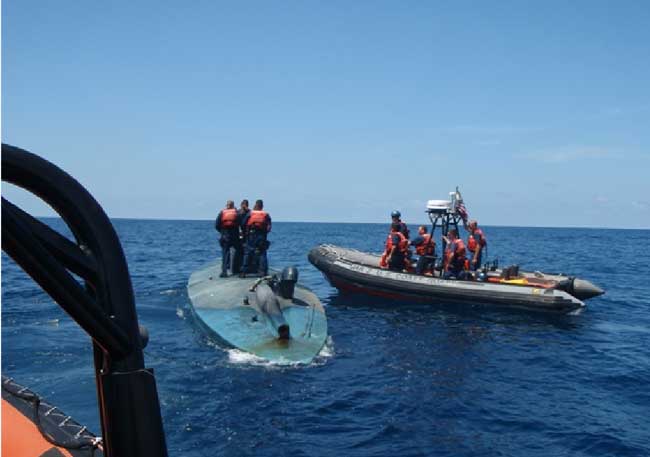
I’m proud to tell you that over the past five days, Pacific Area Coast Guard units, with the help of our U.S. Navy and interagency partners, seized over 14 tons of cocaine from two Self-Propelled Semi-Submersible (SPSS) vessels in the Eastern Pacific Ocean. On 13 September, a Navy maritime patrol aircraft (MPA) detected an SPSS in international waters and vectored a Navy ship, with a Pacific Area Law Enforcement Detachment (LEDET), to intercept it. After conducting an unannounced nighttime boarding, the LEDET discovered 7 tons of cocaine. Then on 17 September, another Navy MPA detected an SPSS and vectored the cutter MIDGETT to investigate. MIDGETT’s boarding team subsequently discovered an additional 7 tons of cocaine….The interoperability between Coast Guard and Navy assets has never been more effective.[4]
Finding a Semi-Submersible at Sea and Then Prosecuting Effectivley is a Challenging Task, Something the Drug Smugglers are Counting on for their Mission success. (Credit: USCG)
MPAs are not only central to extend the reach of surface ships but as multi-mission assets can operate alone to provide for independent actions, ranging from C4ISR missions on their own for the benefit of DHS decision-makers or as lift assets able to move goods and personnel as they did in the case of dealing with the aftermath of Hurricane Katrina.
With flood waters from the Mississippi River threatening several Midwestern states in June 2008, the U.S. Coast Guard put one of its newest aircraft in the air to survey the damage and to assess the condition of vital shipping lanes. The HC-144A Ocean Sentry flew over flooded portions of eastern Iowa and northeast Missouri on 19 June 2008. Though its initial operational capability was still six months off, RAdm. Joel Whitehead, Commander Coast Guard District Eight, selected the HC-144A because he believed this fixed-wing, turboprop aircraft’s longer ranges, slow flying speeds, and passenger capacity best suited the needs of the mission. Also affecting its selection over other Coast Guard aircraft was the limited availability of HU-25 Falcon jets, the aircraft the HC-144A will eventually replace.
The mission took senior Coast Guard officials, including RAdm. Whitehead and maritime industry representatives, on a flight to observe the extent of the flooding. The shipping industry representatives flew along to gain a better understanding of how the floods would impact shipping and commerce along the Mississippi River and its tributaries in Iowa and Missouri. The Ocean Sentry’s ability to fly at slower speeds allowed for more effective aerial assessment and increased time on scene.[5]
And in a crisis like the Haiti rescue effort, the lift and logistical capabilities of the USCG becomes central to the national response. Although useful to have UAVs flying over the island, better intelligence is not worth much without the lift and logistical capability of aircraft, like the USCG C-130s and MPAs.
The Challenge of Moving Forward
The legacy fleet is in extremis and the need to provide the new aircraft, which are built around significant improvements in costs of maintenance, is essential to ongoing USCG operations. The CG initially bought 41 HU-25A aircraft, of which 36 were operational. The operational fleet size was reduced in the early 1990s by Admiral Kime to fund expansion of the Marine Safety Program. The very high cost of maintaining the HU-25 (especially the engines) has been a significant burden on USCG operations. Currently the HU-25 fleet is being reduced as C-144s are brought on line. The current fleet is only 18 aircraft, 14 operational and 4 support aircraft. The CG has made minimal investment in the HU-25 over the past several years to save money. For example, the aircraft is limited to FL230 (service ceiling is FL420) because the CG elected not to invest in an upgraded IFF several years ago.
(Credit: EADS)
The new USCG MPA’s are the lead acquisition in the Deepwater program. The Deepwater program was built around USCG assessments of an integrated approach to executing core USCG missions. This assessment was shaped in the mid-1990s and then re-casts in the wake of post 9/11 assessments. The core approach was that an integrated C4ISR capability would allow the USCG to avoid a costly one for one replacement approach for its obsolescent assets. By integrating the replacement assets, less numbers of each particular asset would be required.
Although the execution of the Deepwater program was flawed, the underling approach remains sound. Yet the C4ISR funding for the USCG is on a downward trajectory, and the numbers of the replacement assets are going down not up. This is the worst of all possible worlds. The C4ISR, which enabled the acquisition of less numbers of platforms, is underfunded, and the result is not more platforms being acquired but less!
The only result of this will be a significant shortfall in the ability of the USCG to perform its missions, with a security shortfall and various negative consequences such as more drugs getting into the United States, more illegal immigrants with possible health hazards unnoticed, more arms trafficking from sea successfully entering the United States and so on. Failure to recapitalize the USCG is not a funding game; it is a pulling apart of the network, which protects the United States. Holes in the net are ways through for forces creating negative consequences on US territory.
In the original Deepwater schema, the USCG was projected to acquire 35 new MPAs, as well as 6 high altitude endurance organic UAVs. The UAVs were cancelled, although the USCG and DHS are looking at ways to supplement or replace the cancellation.[6] With this cancellation, organic airborne ISR was reduced and with it, the number of MPAs should logically go up by some function of the 6 cancelled UAVs, so that the number might now approach 40 MPAs.
The program is on track and on budget. The HC-144A Ocean Sentry is a derivative of the European Aeronautics and Defense Systems (EADS) CASA CN-235-300 twinturbo medium cargo/transport aircraft. It is fitted to carry sensors, search radar, and an advanced communications suite. Forming the Ocean Sentry’s nerve center is the Mission Systems Pallet (MSP) that integrates all the aircraft’s systems with a two-place operators’ station inside the cargo compartment. The MSP is a roll-on/roll-off suite of electronic equipment that allows the aircrew to compile data from the aircraft’s multiple sensors and transmit that data to other participants in the operational area.
As the USCG describes the new MPA:
This fixed-wing turbo prop aircraftprovides invaluable on-scene loitering capabilities and perform various missions,including maritime patrol, law enforcement, Search and Rescue (SAR), disasterresponse, and cargo & personnel transport. The Mission System Pallet is a roll-on, roll-off suite of electronic equipment that enables the aircrew to compile datafrom the aircraft’s multiple integrated sensors and transmit and receive bothclassified “Secret”-level and unclassified information to other assets, includingsurface vessels, other aircraft, local law enforcement and shore facilities. Withmultiple voice and data communications capabilities, including UHF/VHF, HF, and Commercial Satellite Communications (SATCOM), the HC-144A will beable to contribute to a Common Tactical Picture (CTP) and Common OperatingPicture (COP) through a networked Command and Control (C2) system thatprovides for data sharing via SATCOM. The aircraft is also equipped with avessel Automatic Identification System, direction finding equipment, a surfacesearch radar, an Electro-Optical/ Infra-Red system, and Electronic SurveillanceMeasures equipment to improve situational awareness and responsiveness.[7]
The new MPA is the product of a blend of several mature technologies, produced by the best defense and aerospace companies in the world. In other words, it is a mature product, in initial production with no problems to be anticipated in either continued production or ramp-up of production.
Starting with delivery in 2003, eight new MPAs have been delivered through the end of 2008 along with three mission pallets. MPAs nine through 11 are to be delivered in 2010 along with mission system pallets four through twelve. The MPA baseline fielding plan called for 16 additional MPAs to be delivered by 2014 for a total of 36.
Unfortunately, there is a reported delay in the program by senior DHS acquisition officials.[8] The proposal is to have a break in production after the deliveries in 2010. Such a delay to save near term acquisition monies will come at the expense of needed capabilities. An interruption in production will not be matched by an interruption in the threat environment facing the United States, or in the “normal” challenges facing the USCG. A funding delay is a further opening in the security net around the United States. An interruption in production is penny wise and pound-foolish.
To quote the DHS budget document:
The Coast Guard embraces a culture of response and action, with all of its personnel trained to react to “All Threats, All Hazards.” In many cases, Front-line operators are encouraged to take action commensurate with the risk scenario presented, without needing to wait for detailed direction from senior leadership. This model enables swift and effective response to a wide variety of situations.[9]
But it is difficult to provide “swift and effective response” with missing capabilities. And the absence of capabilities means simply put an enhanced probability of threats not being met today and augmented tomorrow.
[1] Budget in Brief (2010), Department of Homeland Security, pages 82-83.
[2] RADM Richard E. Brooks, USN, “The Multi-Mission Maritime Aircraft and Maritime Patrol and Reconnaissance Force Transformation,” Johns Hopkins APL Technical Digest (Volume 24, Number 3, 2003), p. 240.
[6]Unmanned Aircraft Systems Program Update (Homeland Security, USCG, 2009).
[7] “Coast Guard Takes Delivery of First Mission Systems Pallet for its HC-144A “Ocean Sentry” Maritime Patrol Aircraft,” USCG Press Release, March 11, 2008.
[8] “Coast Guard Seeks to Avoid HC-144 Production Break,” Defense Daily (September 14, 2009).
04/ 19/2011 – The Convention on the Prohibition of the Development, Production, Stockpiling and Use of Chemical Weapons and on their Destruction (commonly referred to as the Chemical Weapons Convention and abbreviated as the CWC bans the development, production, acquisition, stockpiling, transfer, and use of offensive chemical weapons (CW).
States Parties to the CWC are also prohibited from threatening, or engaging in, military preparations to use chemical weapons. These provisions apply universally in terms of time and place. The Convention is of indefinite duration and aims for comprehensive coverage of all global activities potentially related to chemical weapons. Its regulations encompass government and private sector activities as well as chemical weapons storage facilities (CWSFs), chemical weapons production facilities (CWPFs), and chemical weapons destruction facilities (CWDFs).
All States Parties to the CWC are obliged to declare any stockpiles of chemical weapons they hold, including their number and type, and any facilities that store, produce, or destroy them. These declarations describe the location of any CWSFs as well as the location and characteristics of any CWPFs. Each State Party commits to eliminate all the chemical weapons in its possession, under their jurisdiction or control, or that it might have abandoned in another country, normally at designated CWDFs, which are subject to regular on-site oversight by the Organization for the Prohibition of Chemical Weapons (OPCW).
The States Parties are required to destroy any CWPFs or, as permitted by the CWC, convert them to non-military uses. Furthermore, they must declare chemical industry plants that annually produce, process, or consume “scheduled” toxic chemicals and their precursors in quantities above certain CWC-specified amounts. They also must provide information on certain other chemical production facilities (OCPFs) that produce large quantities of discrete organic chemicals (DOCs).
The CWC mainly applies to assembled unitary chemical weapons such as artillery projectiles, mortars, air bombs, rockets, rocket warheads, and spray tanks; chemical weapons agents stored in bulk; binary munitions that only become dangerous when their two components are combined; and recovered chemical weapons munitions. The CWC does permit the use of small quantities of chemical weapons for non-offensive purposes such as research, medicine, and the development of CW defenses.
The Convention allows a State Party possessing chemical weapons some latitude in their choice of elimination methods—which must destroy the chemical warfare agents, the conventional explosives used to detonate the weapons, and some dangerous metal parts—with the exclusion of ecologically unacceptable techniques such as burying them in land, dumping them in bodies of water, or dispersing them in an open pit.
The enormous quantity and sophistication of the chemical weapons in the United States and Russia makes only two types of CW destruction techniques practical: high temperature technologies like incineration, and low-temperature technologies like hydrolysis followed by treatment of the resulting reaction masses.
In the United States, the Johnston Atoll Chemical Agent Disposal System (JACADS) served as a prototype plant to develop a “base-line” incineration technology that was then applied to a number of chemical destruction facilities: Tooele (TOCDF), Anniston (ANCDF), Pine-Bluff (PBCDF) and Umatilla (UMCDF).
Public pressure against the environmental consequences of incineration led the U.S. government to also launch an Assembled Chemical Weapons Assessment program to develop several low-temperature elimination technologies as an alternative to the base-line incineration technology.
These technologies, constantly under development, typically involve processes that neutralize the agent at the main destruction facility while the generated hydrolisates are irreversibly disposed at off-site commercial Treatment, Storage and Disposal Facilities (TSDF), which are also subject to OPCW verification. The United States has used this low-temperature technique at three large facilities to eliminate agents stored in bulks: Aberdeen Chemical Agent Disposal Facility (ABCDF), Newport Chemical Agent Disposal Facility (NECDF) and Pine-Bluff Binary Destruction Facility (PBBDF).
The U.S. government has also decided to apply the alternative low-temperature elimination technique at the two remaining U.S. CWDFs under construction: hydrolysis followed by biodegradation at Pueblo, Colorado and hydrolysis followed by Super Critical Water Oxidation at Blue Grass, Kentucky. These two facilities are at an early stage of construction.
From 2006 to April 2010, the U.S. Army Chemical Materials Agency also ran a separate Non-Stockpile Chemical Materiel Project at the Pine Bluff Explosive Destruction System (PBEDS), located at Pine Bluff Arsenal, Arkansas., to destroy recovered munitions such as 4.2-inch mortars and German Traktor rockets captured during World War II.
The remaining 10% of the U.S. stockpile will be destroyed by the two CWDFs currently under construction in Pueblo, Colorado, and Blue Grass, Kentucky, through a separate U.S. Army Element Assembled Chemical Weapons Alternatives program, using either the incineration or agent neutralization destruction methods.
The original CWC timetable specified that, five years after its entry into force, states with declared chemical weapons had to eliminate 20% of their stockpiles. After seven years, they were required to destroy 45% of their CW arsenals. Ten years after entry into force, the States Parties had to eliminate all their chemical weapons in a verifiable and irrevocable manner.
Yet, by the original April 2007 deadline, only about a quarter of all declared CW stocks had been eliminated. The convention provided for a one-time extension of as long as five years beyond the April 2007 destruction deadline.
On December 8, 2006, the CWC Conference of State Parties (CSP) granted the following extensions: South Korea to December 31, 2008; India to April 28, 2009; Libya to December 31, 2010; and both Russia and the United States to April 29, 2012, the maximum permissible extension. The CSP also extended the intermediate destruction deadlines for Albania.
When the CWC entered into force in April 1997, the United States possessed approximately 30,000 tons of chemical nerve and blister agents. The U.S. Army Chemical Materials Agency took charge of destroying 90% of this total, consisting of 28,350 tons of blister (mustard) and nerve (VX and sarin) agents. It eliminated 50% of the original stockpile by December 2007 and 60% by April 2009. On July 1, 2010, the Agency announced that it had incinerated or chemically neutralized 75% of the U.S. chemical agent stockpile, or 22,958 tons of chemical agents and more than 2.1 million chemical munitions.
In his presentation to the CSP on November 29, 2010, Ambassador Robert P. Mikulak, the U.S. Permanent Representative, said that the United Sates had “destroyed more than 81% of our Category 1 chemical weapons, which includes the destruction of over 82% of our chemical rockets, the destruction of 96.6% of our nerve agents, and the destruction of all of our binary chemical weapons. The United States has also destroyed all of our former chemical weapons production facilities.” Ambassador Mikulak estimated that the United States will have eliminated 90 percent of its original stockpile by the April 2012 deadline.
According to the U.S. Army Chemical Materials Agency, as of March 16, 2011, the United States had destroyed 85 per cent of its original stockpile of 27,768 tons of declared offensive CW, including all advanced binary weapons. The Agency reports the following chemical agent destruction status for each facility:
100 percent of stockpile at the Aberdeen, MD Facility neutralized
98 percent of stockpile at the Tooele, UT Facility destroyed
100 percent of stockpile at the Johnston Island Facility destroyed
93 percent of stockpile at the Anniston, AL Facility destroyed
70 percent of stockpile at the Umatilla, OR Facility destroyed
100 percent of stockpile at the Pine Bluff, AR Facility destroyed
100 percent of stockpile a the Newport, IN Facility neutralized
The Tooele Chemical Agent Disposal Facility and the Anniston Army Depot in Alabama are expected to eliminate their entire stockpiles by October 2011. The Army would complete its CW destruction efforts in December 2011 at the Umatilla Chemical Depot.
The Army now calculates that its chemical elimination effort will cost approximately $24 billion in total. The U.S. CW disposal program, when first envisioned in 1985, was expected to be finished within a decade and cost roughly $1.8 billion. The United States has already spent more than $22 billion eliminating its stockpiles. Recent estimates place the total cost of destroying all U.S. chemical weapons on accordance with the CWC at approximately $36 billion.
The States Parties have not decided what sanctions to apply, if any, when the United States or another CW-possessing country misses its extended deadline due to environmental, financial or other reasons unrelated to deliberate efforts to renege on their obligations. In April 2008, Director-General Pfirter had suggested that the States Parties might convene a Special Session of the CSP to decide next steps.
But in October 2009, the OPCW Executive Council asked chairman Jorge Lomónaco Tonda to commence informal discussions on how and when to start consultations on states that could not meet their “final extended deadlines” for CW elimination. At the June 29, 2010 session of the Executive Council, Ambassador Mikulak called for “a political solution, not a technical change or an amendment to the Convention.”
In theory, the other CWC members could apply penalties to countries that fail to meet their CW destruction deadlines or that fail to comply with their Article VII obligations. These might include limiting their voting rights at OPCW meetings or preventing the organization from employing citizens from those countries. The most severe punishment would entail imposing sanctions that would prohibit them from importing or exporting certain chemicals.
Thus far, however, the other States Parties have been content to receive evidence—through such measures as their national budget allocations for CWC-related tasks as well as their hosting routine inspections—that these lagging countries are making progress towards eventual elimination of their CW stockpiles and incorporation of CWC obligations into their domestic legislation, even if at a slower pace than desired.
In separate comments in December 2009, both the current and future director-generals of the OPCW downplayed the damage that these missed deadlines would inflict on the international chemical disarmament regime. Pfirter argued that “we need not…make the ultimate success of the treaty dependent on any particular date.”
Ahmet Üzümcü, who succeeded Pfirter as the OPCW Director-General on July 25, 2010, expressed his belief that the two governments’ commitments to eliminate all their chemical weapons was “unwavering.” Üzümcü termed the reasons for the delays as “more technical…than political.”
After informal consultations with the Russian government, Pfirter confirmed on June 29, 2010 that Russia would join the United States in missing its April 2012 deadline. However, he said he felt reassured that both countries were seeking to meet their commitment to “the key goal of achieving the total and irreversible destruction of their declared stockpiles.” He added that Moscow and Washington “have consistently shown their resolve to abide by their commitments under the Convention, and I for one have no doubt that they will continue to stay on track.”
Shortly before the transition in office from Pfirter to Üzümcü in July 2010, both OPCW director-generals commented further on the issue. Pfirter called the missed deadline “regrettable” and an “unfortunate circumstance,” but he quickly added that he was “nevertheless confident that both countries will continue to work hard in order to fulfill their CW disarmament obligations at the earliest and that the Organisation’s response to these events will remain balanced and constructive.” Üzümcü offered similar evenhanded comments, reaffirming the importance of meeting the objective of complete elimination, but indicating a lack of alarm at a further delay in reaching that goal:
“Complete destruction of all chemical weapons stockpiles by possessor states is a primary objective of the Convention. During my visits to the United States and the Russian Federation, I was impressed by their determination to fulfill their obligations as well as the dedication and professional skills of those who run the demilitarization programs. These are indeed costly, labour-intensive and hazardous activities. Tremendous financial, human, and material resources have been allocated. We must maintain our efforts until every single chemical weapon is destroyed. We don’t know yet the exact level of destruction to be reached by April 2012. It will certainly be significant. If however the process cannot be completed, this will be due, I am convinced, to technical reasons. I am encouraged to see that consultations on this issue have already been underway under the leadership of the Chairman of the Executive Council. Our focus must be to keep the momentum, to highlight the unprecedented success of the CWC regime, and to preserve its credibility.”
An overly stern response by the OPCW for the expected U.S. delay would be unfair given that financial and technical challenges as well as environmental and safety considerations are causing the delay, rather than a desire to retain chemical weapons.
Along with Russia, the United States has no reason to retain chemical weapons since it has more readily usable conventional weapons and more powerful nuclear weapons. It would also be unwise to sanction the United States since any sanctions would not accelerate the elimination timetables. It would also undermine the generally non-confrontational CWC-related deliberations have been characterized by consensus and compromise for over a decade.
Although the Executive Council’s rules of procedure allow for two-thirds majority voting on substantive issues and simple majority voting on procedural questions, the consensus principle is so strong that the Council has taken only one vote in its entire history, on an administrative matter.
A satisfactory compromise might be to exempt both countries from additional sanctions in exchange for continued extraordinary transparency and confidence-building measures, such as their current practice of receiving visits by Executive Council representatives to CW dismantlement sites, perhaps supplemented by additional inspections. This would demonstrate the willingness by all sides to prioritize chemical weapons elimination, while also recognizing the very real difficulties involved in achieving it.
The Prospective Commander of LPD-24 Discuss the Future
An Interview with Commander Darren W. Nelson
Commander Nelson at the Christening of the USS Arlington (Credit: SLD)
04/19 /2011 – At the christening of the LPD-24, the USS Arlington, the SLD team had a chance to talk about the new ship and its impact on the ARG. prospective commander of LPD-24, Commander Darren W. Nelson.
SLD: Let’s just talk to this whole evolution of the ARG and the ship. What excites you about it?
Commander Nelson: Well, some of the things that excite me on this ship is just the way she looks. It’s a very sweet design. It reduces a radar cross-section. We took the concept off of the DDG, and applied it here. So that provides more protection for us; it’s harder for us to be seen by the bad guys, which makes it very nice.
We have enhanced cargo space. On previous amphibious ships USMC space was limited. On this ship they have more space for men and equipment. The Marines do not want to be told “you can’t bring that howitzer or the HUMVEE. There is not room enough.”
SLD: When we interviewed the 15th MEU Commander, “Ozzie” Osborn, he made the point “I had to leave a lot of stuff home, because I can’t take it on the ship”.
Commander Nelson: With the LPD 17, we have a dramatic increase in our capabilities to carry more cargo, more vehicle space, and our flight deck is huge. We’re able to launch and recover two MV-22 Ospreys at the same time. Of course, the Osprey’s a whole different animal, with significant capabilities to expand what we can do.
The size of the footprint for the flight deck is significant. And, of course, we can handle the CH-53Es or Ks. We can land four CH-46s at one time.
Also, the LPD 17 represents a significant increase in the C2 capability available to the ARG. I have the communications capabilities of an LHD with this ship.
SLD: In many ways, this ship is not in any way a linear replacement for earlier amphibious ships.
Commander Nelson: You are right. It is truly the next generation. Even if you look at the amount of Marines we can carry aboard this ship it is a qualitative shift. I was an Executive Officer on an LSD, we carried 350 Marines; we had 300 sailors.
And we were packed. This ship is set up for 700 Marines, and it has a surge berthing of up to 800 That’s on top of the 365-person crew.
In effect, you are giving the new commander much more mission flexibility. You are giving him the capability to “say yeah, we need to take a few extra mission guys, or something like that, and we will be able to put them aboard our ship.
SLD: How will you work with the new Littoral Combat Ship?
Commander Nelson: We can easily work with the LCS, especially with her different mission capabilities. And if she needs to change out mission capabilities, we have the cargo space to fulfill her mission.
04/12/2011 – Since the end of the Cold War, the improved political and economic relationship between Beijing and Moscow has affected a range of international security issues. China and Russia have expanded their bilateral economic and security cooperation. In addition, they have pursued distinct, yet parallel, policies regarding many global and regional issues.
Yet, Chinese and Russian approaches to a range of significant subjects are still largely uncoordinated and at times in conflict. Economic exchanges between China and Russia remain minimal compared to those found between most friendly countries, let alone allies.
Although stronger Chinese-Russian ties could present greater challenges to other countries (e.g., the establishment of a Moscow-Beijing condominium over Central Asia), several factors make it unlikely that the two countries will form such a bloc.
The relationship between the Chinese and Russian governments is perhaps the best it has ever been. The leaders of both countries engage in numerous high-level exchanges, make many mutually supportive statements, and manifest other displays of Russian-Chinese cooperation in what both governments refer to as their developing strategic partnership.
The current benign situation is due less to common values and shared interests than to the fact that Chinese and Russian security concerns are predominately directed elsewhere.
Although both countries have experienced a geopolitical resurgence during the past two decades, Chinese and Russian security concerns are not directed at each other but rather focus on different areas and issues, with the notable exceptions of maintaining stability in Central Asia and constraining North Korea’s nuclear activities.
Most Chinese policy makers worry about the rise of separatist movements and Islamist terrorism in western China and about a potential military clash with the United States in the Asia-Pacific region, especially regarding Taiwan and the contested maritime regions of the South China and East China Seas.
In contrast, most Russian analysts see terrorism in the North Caucasus, maintaining influence in Europe, and managing security relations with Washington as the main security challenges to their country.
Neither Chinese nor Russian military experts perceive a near-term military threat from the other’s country. The Russian government has even provided sophisticated navy, air, and air defense platforms to the Chinese military, confident that the People’s Liberation Army (PLA) would only employ these systems, if at all, against other countries. In addition, China and Russia have resolved their longstanding border disputes as well as contained their rivalries in Central Asia, the Korean Peninsula, and other regions.
Since the Soviet Union’s disintegration in the early 1990s, China and Russia have resolved important sources of their Cold War-era tensions. Through protracted negotiations, the two governments have largely solved their boundary disputes, which had erupted in armed border clashes in the late 1960s and early 1970s. The stoking of anti-Chinese sentiment by politicians in the Russian Far East impeded the ability of Russia’s first President, Boris Yeltsin, to make substantial progress during the 1990s in demarcating the Russia-China border. These politicians sought to rally local support by accusing Moscow of planning to surrender territory to Beijing. By the mid-2000s, Yeltsin’s successor, Vladimir Putin, managed to centralize sufficient political power in the Kremlin to ignore these local sentiments. Furthermore, Russia and China have demilitarized their lengthy shared frontier through a series of arms control and disarmament measures.
Chinese and Russian leaders share a commitment to a philosophy of state sovereignty (non-interference) and territorial integrity (against separatism). Although Russian and Chinese leaders defend national sovereignty by appealing to international law, their opposition also reflects more pragmatic considerations—a shared desire to shield their human rights and civil liberties practices, and those of their allies, from Western criticism.
Chinese and Russian officials refuse to criticize each other’s foreign and domestic policies in public. They also have issued many joint statements calling for a multi-polar world in which no one country (e.g., the United States) dominates. During the past few years, their leaders have commonly blamed American economic mismanagement for precipitating the global recession.
They regularly advocate traditional interpretations of national sovereignty that exempt a government’s internal policies from foreign criticism. Beijing and Moscow oppose American democracy promotion efforts, U.S. missile defense programs, and Washington’s alleged plans to militarize outer space.
The two countries strive to uphold the authority of the United Nations, where the Chinese and Russian delegations frequently collaborate to dilute resolutions seeking to impose sanctions on Burma, Iran, Zimbabwe, and other governments they consider friendly. In July 2008, they finally demarcated the last pieces of their 4,300-km (2,700 mile) frontier, one of the world’s longest land borders, ending a decades-long dispute.
Chinese and Russian officials have expressed concern about the efforts by the United States and its allies to strengthen their ballistic missile defense (BMD) capabilities. Their professed fear is that these strategic defense systems, in combination with the strong American offensive nuclear capabilities, might enable the United States to obtain nuclear superiority over China and Russia.
Both governments have also expressed unease regarding U.S. military programs in the realm of outer space. Russian and Chinese experts claim that the United States is seeking to acquire the means to orchestrate attacks in space against Russian and Chinese reconnaissance satellites and long-range ballistic missiles, whose trajectories passes through the upper atmosphere. In response, the Russian and Chinese governments have proposed various arms control initiatives purportedly aimed at preventing the militarization of space.
For example, the Russian and Chinese representatives have unsuccessfully sought for years at the UN Conference on Disarmament to negotiate a treaty on the “Prevention of an Arms Race in Outer Space,” which would seek to prohibit the militarization of outer space. More recently, China and Russia have submitted a joint Space Treaty to the Conference on Disarmament in Geneva, which would impose legal constraints on how the United States could use outer space. They have sought to link progress on other international arms control initiatives to the adoption of these space limitations.
The bilateral defense relationship has evolved in recent years to become more institutionalized and better integrated. As befits two large and powerful neighbors, the senior military leaders of Russia and China now meet frequently in various formats. Their direct encounters include annual meetings of their defense ministers and their armed forces chiefs of staff. Since 1997, they have also organized yearly “strategic consultations” between their deputy chiefs of the general staff. In March 2008, the Chinese defense minister established a direct telephone line with his Russian counterpart, the first such ministerial hotline ever created by China and another country. In December 2008, the chiefs of the Chinese and Russian general staffs created their own direct link.
Senior Russian and Chinese defense officials also typically participate in the regular heads of government meetings between Russia and China, which occur about once a year as bilateral summits. They also confer frequently at sessions of multinational gatherings, such as at meetings of the SCO, which host regular sessions for defense ministers. Contacts are even more common among mid-level military officers, especially those in charge of border security units and military units in neighboring Chinese and Russian territories.
Russian and Chinese military experts also engage in regular direct discussions related to their functional expertise such as communications, engineering, and mapping. Substantial academic exchanges also regularly occur. More than 1,000 Chinese students have studied at over 20 Russian military academies since 1996. The two defense communities conduct a number of larger exchanges and engagements. The best known are the major biennial military exercises that they have been holding since 2005, but smaller-scale engagements also frequently occur.
Chinese and Russian leaders also have developed shared perspectives and independent offensive capabilities regarding governmental activities in the cyber domain. The two governments have been developing their information warfare capabilities and now possess an extensive variety of offensive and defensive tools in this domain.
Furthermore, recent revelations regarding Chinese cyber-espionage activities suggest the extent to which Chinese operatives have penetrated Western information networks. In Russia’s case, cyber attacks against Estonia, Georgia, and other countries illustrate the extensive offensive capabilities available to that country’s forces. Russia’s hybrid August 2008 campaign against Georgia was particularly effective in disabling Georgia’s infrastructure as well as demonstrating a potential capacity to inflict widespread physical damage.
Both countries appear to have already conducted extensive surveying of U.S. digital vulnerabilities and to have prepared targeted campaign plans to exploit U.S. network vulnerabilities if necessary. Although these offensive and defensive preparations are being conducted independently, the Chinese and Russian governments are collaborating, along with other Eurasian allies in the SCO, to deny Internet resources to civil liberties groups and other opponents of their regimes.
Central Asia perhaps represents the geographic region where the security interests of China and Russia most overlap. Although China and Russia often compete for Central Asian energy supplies and commercial opportunities, the two governments share a desire to limit potential instability in the region. They especially fear ethnic separatism in their border territories supported by Islamic fundamentalist movements in Central Asia. Russian authorities dread the prospect of continued instability in the northern Caucasus, especially Chechnya and neighboring Dagestan. China’s leaders worry about separatist agitation in the Xinjiang Uighur Autonomous Region.
The shared regional security interests between Beijing and Moscow have meant that the newly independent states of Central Asia—Kazakhstan, Kyrgyzstan, Tajikistan, Turkmenistan, and Uzbekistan—have become a generally unifying element in Chinese-Russian relations. Their overlapping security interests in Central Asia have manifested themselves most visibly in the Shanghai Cooperation Organization (SCO).
Since its founding in 2001, the SCO has essentially functioned as a Chinese-Russian condominium, providing Beijing and Moscow with a convenient multilateral framework to manage their interests in Central Asia. At present, Kazakhstan, Kyrgyzstan, Tajikistan, and Uzbekistan are also full members, while India, Iran, Mongolia, and Pakistan have observer status in the organization.
Yet, this harmony between Beijing and Moscow arises primarily because the Chinese leadership considers the region of lower strategic priority than does Moscow, which still considers Central Asia an area of special Russian influence. China’s growing interest in securing Central Asian oil and gas could lead Beijing to reconsider its policy of regional deference.
Despite their improved relationship, China and Russia have not formed a mutual defensive alliance and still tend to pursue distinct, if largely parallel, policies regarding many issues. Personal and economic exchanges between China and Russia remain minimal compared to those found between most large countries in Europe and North America.
The most noteworthy development in their bilateral defense relationship has been the sharp decline of Russian arms sales to China in recent years. The ongoing improvement in the quality and quantity of China’s national defense production confronts Russian officials with a difficult choice. Until now, the Russian government has refused to sell its most sophisticated weapons systems—such as long-range ballistic missiles, strategic bombers, or air and missile defense systems—to the PRC for fear that such weapons could disrupt the balance of power in East Asia.
The Russian government has also declined to sell China weapons—such as advanced land warfare weapons or tactical air support aircraft—that could assist the PLA in a ground war with Russia. Instead, Russia has transferred advanced weapons mostly for naval warfare and air defense. Moscow’s restraint has meant that Russian arms sales to Beijing have been insufficient by themselves to enable China to defeat the more technologically advanced militaries of Taiwan, Japan, or the United States.
Now the growing prowess of China’s indigenous defense industry has decreased Beijing’s interest in purchasing low-quality Soviet-era weapons from Moscow, leaving the PLA interested in only the most advanced Russian weapons. The Russian government has thus far declined to sell such weapons for fear the Chinese might copy their technology and use it to design weapons that Chinese firms could then sell to potential Russian customers at lower prices, in addition to the above concerns regarding Russia’s national defense.
This transformation has meant that bilateral defense-industrial ties between China and Russia have gone from being the foundation of their new post-Cold War partnership to a major irritant.
Russian officials are similarly reluctant to transfer their best nuclear energy technologies and other knowledge products that could allow lower-cost Chinese manufacturers to displace Russian exports from third-party markets. The rest of their bilateral energy relationship remains equally problematic. The two sides repeatedly announce grandiose oil and natural gas deals that, until recently, have failed to materialize. Russian energy firms try to induce European and Asian customers to bid against one another. Although this approach enhances Russian bargaining leverage, it reinforces Chinese doubts about Russia’s reliability as a long-term energy partner.
The two governments remain suspicious about each other’s activities in Central Asia, where their state-controlled firms compete for oil and gas. Chinese officials have steadfastly refused to endorse Moscow’s decision to recognize Abkhazia and South Ossetia as independent states, which Russia pried from Georgia during the August 2008 war. At the societal level, ties between ordinary Chinese and Russians remain minimal despite years of sustained efforts by both governments to promote humanitarian exchanges and the study of the other country’s language. Chinese criticize the failure of the Russian government to ensure the safety and respect the rights of Chinese nationals working in Russia. Russians in turn complain about Chinese pollution spilling into Russian territory and worry that large-scale Chinese immigration into the Russian Far East will result in large swaths of eastern Russia becoming de facto parts of China.
After many years of false hopes and frustrated deals, China and Russia have made only modest progress in establishing their long-anticipated energy partnership. Notwithstanding China’s efforts at energy supply diversification over the past decade, it was not until 2009 that Russia became China’s fourth largest oil supplier, providing 7.8% of China’s imports in 2009, up from 6.3% in 2008. This figure is now rising further thanks to the opening of the Eastern Siberia–Pacific Ocean oil pipeline on January 1, 2011. Still, this low figure is surprising because the two countries would appear to be natural energy partners. Furthermore, negotiations over a direct natural gas pipeline remain stalled due to disagreements over what price China will pay for the gas. Russia has carved out only a small share of China’s expanding nuclear energy sector.
Given the geographic proximity between the two nations, the fact that Russia is the world’s largest oil producer, and the fact that China is the world’s largest energy importer and fastest growing economy, it would seem that Russia and China would have aligned sooner. Russia’s oil and natural gas deposits, some of the largest in the world, lie much closer than the more distant energy reserves of the Persian Gulf and Africa. Oil and gas from these regions can only reach the PRC through international waters vulnerable to interdiction by foreign navies and sea pirates, whereas Russian energy can enter Chinese territory directly without having to pass through third-party territories. Some energy-exporting Central Asian countries also enjoy these advantages, though Chinese policy makers act warily in this region given Moscow’s traditional dominant regional position, which generally guarantees an important role for Russian companies in the exploitation and especially transportation of Central Asian oil and gas.
Despite these advantages and other mutual incentives to increase bilateral energy cooperation, Chinese-Russian energy cooperation has been surprisingly limited. Technical obstacles, pricing conflicts, inadequate transportation infrastructure, and mutual suspicions have historically kept Chinese purchases of Russian energy at relatively low levels. Frequent delays in shipments on the part of the Russians and attempts to leverage the competing interests of the Chinese, Asian, and European markets off each other have prevented Chinese policy makers from regarding Russia as a reliable long-term supplier. In assessing energy relations between the two countries, it is important to distinguish concrete contracts from mere declarations of intent. Many of the bilateral agreements reached in recent years—often described as memoranda of understanding or framework accords—aim merely to signify interest as well as gain leverage regarding third parties, such as Japan and Europe.
Despite their 2008 boundary agreements, tensions regarding the Russian-Chinese border periodically reappear, such as when the Chinese government first learned that two Russian coast guard ships had sunk a Chinese-owned freighter off its coast on February 15, 2009. Revelations about the incident produced sharp protests in the Chinese media, which ran stories recounting how Czarist Russia had seized the land from a weak China during the 19th century and citing examples of how contemporary Russians mistreat Chinese nationals. Nationalist politicians in both countries can mobilize people behind extremist platforms using racism and ethnic hatred.
Their trade imbalance is another source of tension. The decline in Russian arms purchased by China in recent years has shifted this balance significantly against Russia. Before 2007, Russia racked up steady surpluses from large deliveries of energy, arms, and other industrial goods. Since then, the terms of trade have shifted markedly in the PRC’s favor due to a decline in Chinese purchase of weapons systems and other high-technology items. At present, Russian exports to the PRC consist overwhelmingly of raw materials, especially natural resources like oil and timber. Oil deliveries alone often account for half the value of all Russian exports to China. When prices of these commodities collapsed in 2008, Russia ran a $13.5 billion trade deficit with China. The resurgence in energy prices in the past year has now returned Russia’s surplus, but Moscow policy makers are eager to reduce their dependence on volatile raw material exports by reviving the PRC’s purchase of high-value industrial goods and services. China could address this source of tension by purchasing more Russian weapons and high-technology products.
Mutual investment is another lagging area of cooperation that has attracted the attention of both governments. In 2009, the PRC’s direct (non-financial) investment in Russia amounted to only $413 million, which itself represented a 73.5 percent growth over the previous year. By the end of 2009, China’s accumulative non-financial direct investment in Russia was only $2.02 billion. Most Chinese non-financial capital flows into Russia’s textile, timber, and raw materials sector. The parties have drafted, but not yet implemented, a Sino-Russian Investment Cooperation Plan, designed to increase their mutual cooperation in investment and financing. The Russian government is particularly eager to secure Chinese investment to help achieve their goal of modernizing the Russian economy. In addition, Russian officials want Chinese firms to participate in the government’s plans to sell Russian state-owned shares in hundreds of large companies. Through this partial privatization, Russian officials hope to receive an influx of cash at a time when surging government spending and weak revenues are pushing the budget into deep deficit. One factor likely limiting Chinese interest is that the privatization process could take five years to implement and the Russian government will still retain majority ownership and therefore control over most of the companies.
Despite their mutual concern about American strategic ambitions, the governments of China and Russia have not undertaken any widespread collaboration in this area. For example, they have not pooled their military resources or expertise to overcome U.S. ballistic missile defense (BMD) systems by, for instance, undertaking joint research and development programs to create shared anti-BMD technologies. Nor have they coordinated pressure against other countries in Europe or Asia to abstain from deploying U.S. BMD assets, even in Central Asia or Northeast Asia, regions that border Chinese and Russian territories.
In East Asia, China and Russia share a concern regarding the evolving political, military, and economic situation on the Korean peninsula, which borders both countries. In these dimensions, the two governments have thus far pursued largely independent but parallel policies toward both North and South Korea. In terms of influence, Beijing enjoys a more dominant role, while Moscow often struggles to maintain even a supporting position. Their policies towards Japan and Taiwan are also not well integrated. Beijing considers its ties with these countries as among its most important bilateral relationships, whereas Moscow manages its relations with both states almost as an afterthought.
In the Middle East, the governments of China and Russia have also followed parallel but typically uncoordinated policies. They both want to sell Iran weapons, nuclear energy technologies, and other products. In addition, Beijing and Moscow have defended Tehran at the Security Council while warning against any Iranian ambitions to acquire nuclear weapons. In addition, they both opposed the U.S.-led invasion of Iraq but have shared concerns that an early American military withdrawal from that country could lead to an increase of Islamic militarism throughout the Middle East, which could disrupt China’s energy supplies and reinvigorate the Muslim insurgency in southern Russia. Thus far, however, neither country has sought to make issues related to Iran or Iraq major areas for bilateral Sino-Russian cooperation or significant points of confrontation with Washington.
More recently, China and Russia have declined to coordinate their policies regarding Libya or other manifestations of the Arab Awakening despite common fears of contagion, dislike of Western military intervention on humanitarian grounds, and concerns about losing valuable commercial opportunities. Sino-Russian cooperation in the Libyan War has thus far predominately consisted of their government officials’ citing each other’s opposition to Western interference.
The limits of foreign-policy harmonization between China and Russia are also visible in South Asia, where the two governments have adopted divergent positions on critical issues. For instance, despite the recent improvement in Chinese-Indian relations, Russia’s ties with New Delhi still remain much stronger than those between China and India. Persistent border disputes, differences over India’s growing security ties with the United States, competition over energy supplies, and other sources of Sino-Indian tensions have consistently impeded realization of the vision of a Moscow-Beijing-New Delhi axis that has periodically arisen over the past decade, especially when Russian Prime Minister Yevgeny Primakov visited New Delhi in 1998.
The Russian military has begun to cite China’s growing military potential as a reason why Russia needs to acquire more warships and retain tactical nuclear weapons (TNWs) despite U.S. pressure to negotiate their elimination in the next round of the strategic arms talks. It is difficult to sustain a major conventional military force in the Russian Far East, but TNWs can help compensate for shortages in numbers. The Commander in Chief of the Russian Navy, Admiral Vladimir Vysotsky, has also cited Beijing’s interest in the Arctic as a reason to field a larger fleet. (Russian strategists often describe control over the Arctic region as a vital national interest and fundamental for sustaining Russia’s great power status in the 21st century). Until recently, Russian analysts were confident about maintaining military superiority over China for at least the next decade, but recent displays of growing Chinese defense capabilities, combined with a more confrontational manifestation of Chinese diplomacy, appear to be causing the same unease in Russia as in other countries.
Shaping a Cultural Shift From the “Legacy” Mindset
04/12/2011 – Recently, Second Line of Defense talked with Lieutenant-General Dave Deptula (Retired) about the opportunity to leverage new Vth generation aircraft to gain dramatic increases in capability and enhanced savings by retiring several specialized ISR assets. Based on such a shift, a cultural change could be implemented that re-looked at the entire ISR enterprise. And such an approach should shape how the next generation bomber is thought of and designed.
[slidepress gallery=’deptula-interview’]
SLD: We’ve got a decade ahead where we can shape the transition, if we’re really focused on it. A decade from now, we get all the F-22s and F-35s working together, and shaping next generation weapons and Remotely Piloted Vehicles. We can get there, but we have to invest smartly.
General Deptula: In the context of being able to manage this transition, one has to change the basis of how warfare is conducted and how we value the systems we buy. We don’t want to keep investing in the past. We need to shift what we use as a measure of merit for systems acquisition.
One of the reasons the F-22 was terminated, and why folks are now going after the F-35, is that a predominate measure of “merit” is individual unit cost to a degree greater than the spectrum of capabilities that these aircraft provide. If you look at where technology is allowing us to go with putting panoply of different capabilities on one aircraft, one begins to see that individual unit cost, while one measure of merit, pales in comparison to the value that you get in investing in these 5th generation systems. With multi-mission capabilities on a single aircraft that can penetrate contested airspace and accomplish solely by themselves what it would take many conventional aircraft to achieve the same effect — if they could even do it at all — you achieve much greater cost-effectiveness than by any other means.
For both the F-22 and F-35, the perceptions of what they are capable of accomplishing have been distorted by what we call them. We still use nomenclature that’s left over from the last century to describe our aircraft. We call these aircraft “fighters,” when in fact they perform much more than what is nominally accomplished on a traditional “fighter” mission. The termination of the F-22 buy at less than half its military force requirement was driven primarily because it was wrongly perceived by the senior-most leadership in the Department of Defense as a “niche” airplane.
It was not recognized that what these aircraft allow us to do is to penetrate denied airspace, collect data that cannot be acquired in any other way, translate that data into decision quality information, and then act upon that information by applying either kinetic or non-kinetic effects. To be able to do that using the notion of force packaging would cost much, much more and would involve many more legacy aircraft — if they could even achieve the same effects. So F-22s and F-35s are economically very cost-effective relative to alternatives if you evaluate their capability in the context of extracting information and using it to achieve a decision advantage. We need to move beyond using traditional concepts of operation for 5th generation aircraft that are well beyond simply an evolution of the last generation of “fighters.”
The challenge is getting a very conservative institution like the Department of Defense to understand and embrace the transformational nature of these systems. They provide the capability to put together a concept of operations where you distribute these systems and the information that they provide in a honeycomb-like architecture to achieve effects well beyond what is possible with legacy aerospace systems.Today our forces packages rely on critical nodes, any one of which if acted upon by an adversary, could collapse the effectiveness of the entire structure.
A distributed aerospace architecture enables execution of an operational plan in a way that it can’t be impeded by any few nodes being acted upon. It’s a different way of thinking about how to conduct warfare and may enable us to achieve advantages so significant that they provide a conventional deterrent stronger than anything we have possessed in the past.
SLD: The approach you’re describing is asymmetrical aimed at defeating a state adversary who would be looking at the old linear operation, and secondly, by being distributed, it actually allows you to deal with one of our greatest concerns, which is the capacity of non-state actors to be disperse. So ironically, it’s better for dealing with non-state-to-state environments as well as traditional state actors. It’s better for dealing with a more fluid, COIN kind of environment as well.
General Deptula: Absolutely. The way we’re achieving desired effects on the east side of the AFPAK border — from what I read in the Washington Post and New York Times — is very effective. It is effective because this particular type of adversary that we’re going against has no way of impeding the combination of knowledge and force application that is being applied against them. I think that defines the term “asymmetric.” It is getting rather boring hearing pundits talk about how our adversaries are the ones that are fighting asymmetric war and have an asymmetric advantage — we have them too, and we’re using them to great benefit. Isn’t it interesting that we’re achieving our greatest degree of success against Al Qaeda by capitalizing on a kind of ISR-strike complex where we have a significant advantage over non-state actors? We need to replicate that capability across our entire force.
The current focus on achieving “savings” by slashing funding for what “conventional wisdom” views as secondary systems that are enabling to distributed operations — critical components like data links on F-22s — or pushing them so far out into the modernization cycle that, for all intents and purposes you’re not going to fund them, neuters a capability that may give us a dislocating advantage.Having all of your players connected via a secure jam resistant low probability of intercept data link is key to countering the challenges of adversary electronic combat and identification. Today operators still spend a significant amount of their communications time and brain cells building situation awareness.
Additionally, we take for granted that we are going to be able to operate in a permissive “comm jam” free environment. HAVE QUICK II and secure are ok, but anyone who has ever flown in a Red Flag knows they don’t work for long periods of time. The technology is 30 years old, and it simply just can’t keep up. We need more focus today on the criticality of getting a modern highly integrated capable data link system for all of our aircraft. We have a long way to go in educating decision makers that they have to shift the paradigm that they have become accustomed to understanding the American way of war, and leverage the capabilities inherent in 5th generation aircraft.
SLD: I think it’s a cultural shift more than a paradigm shift because basically many folks keep the ’91 scenario in their mind as how you use air power. Even though as you pointed out, we’ve actually shifted the approach, certainly with UAVs, but we’ve not accepted that the Predator revolution is exponentially implemented by F-22s and F35s, if we empower the proper concepts.
You were talking about individual unit cost as the way by which people destroy the capability to fund the fleet that makes any sense, but the real point is there’s no fleet concept. If I take a fleet concept that says these F-22s and F-35s allow me to do a very different kind of operation, get rid of a lot of assets, get better logistic savings, but if you don’t take a fleet approach, you’re never going to get there. And if you don’t take a fleet approach that says this is not 1991, that the only way I use these things would be 1991. Well 1991 isn’t around anymore.
General Deptula: There is a tendency to segregate ISR in the old culture of using specialized platforms. We can no longer afford to solely rely on specialized aircraft that are very vulnerable in a modern air environment. We can leverage fifth generation aircraft to evolve beyond specialized aircraft that are expensive to maintain and represent the past not the future in accomplishing ISR. We need to embrace concepts to exploit that advantage. We need to look at designing command and control architectures and institutions to become much, much more survivable. If we can’t achieve the cultural shift required to optimize these multi-mode-nodal assets for conducting strike and ISR, and if the military continues to use traditional serial approaches for battle management we will waste money and become more and more vulnerable.
SLD: The other part of this is people have completely forgotten the stealth enterprise and then you hear the notion that “well stealth won’t last forever,” but none of us are arguing that. We’re arguing this can work for 10 to 15 years for sure, and even then; there are other ways to deal with degradation of stealth. The point is that the legacy aircraft have no real stealth.
General Deptula: Stealth or low observability won’t last forever? So what does that mean? That we shouldn’t build low observable aircraft? That we should go back and buy additional 4th gen aircraft of 40 year old design because their unit costs are less than 5th gen aircraft? That’s seeking false economy because those aircraft are not survivable in advanced integrated air defense environments. Stealth isn’t just about preventing early detection — every piece of the kill chain is degraded by low observability.
Furthermore “stealth” is not a product — it is a characteristic. Far from being subject to fading away as a characteristic, if one takes into consideration the fact that 90 percent of what will be known in 50 years has yet to be discovered, low observable characteristics will most likely grow in capacity and capability, not decrease. So why wouldn’t we continue to capitalize on the advantages of reducing signature in all appropriate areas of the frequency spectrum? Doing so will continue to yield advantages for us relative to increasingly capable adversary air defense systems. The notion of limiting investment in stealth is representative of old think from the last century, and a culture that embraces the notion that we only need a handful of stealth aircraft because they’re “silver bullet” systems, and once we can kick down the door, we’ll be able to accomplish military activity freely. That era has passed. No smart adversary will allow the “door to get kicked down,” because technology, networking, and proliferation are enabling very robust and capable air defense systems.
SLD: How does the new approach affect the role of large ISR aircraft?
General Deptula: Large apertures to accomplish ISR will continue to have a role to play depending on the character of conflict, the threat environment, and the information requirements for a particular contingency. However, large ISR aircraft may not always have to be used — or need to be used — as they have been in the past. Particularly as we move to more distributed operations where ISR is more and more integrated and becomes ubiquitous across the battlespace.
Today, JSTARS is valued principally as a source of ISR. With respect to AWACS, with modern AESA radars air combat systems like F-22 and F-35 can provide the degree of situation awareness on-board that for previous generations of aircraft required AWACS. Tactics today include using F-22s operating in roles that used to be the sole purview of AWACS.
SLD: This should also affect thinking about the next generation bomber. You obviously backfit the F-22 with some of the F-35 modernization. You take that whole experience over the next decade with the combat systems on the 35 and 22. You’re then migrating that out to the bomber, and the bomber is subsuming, in effect, not only a bomber but AWACs, Joint Stars, and whatever else you want, where you’re getting a common airframe.
General Deptula: Right. Capitalizing on the ISR capabilities now enabled by modern technology and integrating those capabilities with a long-range high payload strike aircraft design may reduce the need for one-for-one recapitalization of JSTARS and AWACS. Technology is allowing integration of multiple functions on single airframes to a degree that if pursued will enable distributed operations and the introduction of CONOPS that are very much different than those we used in the past by force packaging types of aircraft that by necessity possessed segregated functions.
Essentially we need to embrace fundamental change involving three principal elements and their interactions with one another:
(1) advanced technologies that, because of the new capability they yield, enable
(2) new concepts of operation that produce order-of-magnitude increases in our ability to achieve desired military effects, and
(3) organizational change that codifies the changes in the previous elements or significantly enhances our ability to execute our national security strategy. This will require a conceptual and cultural shift that will be difficult to achieve, but the potential is dislocational in terms of strategic and operational impact.