Managing the Transition

05/17/2011

Captain Kent “Torch” Whalen on the Evolution of the Air Arm
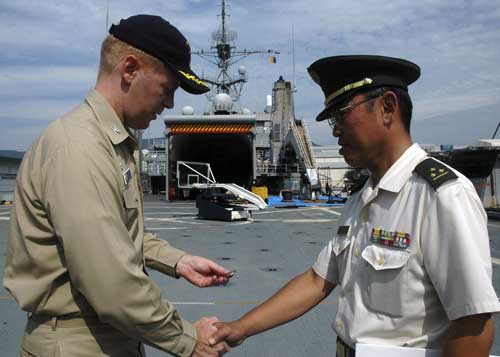
Here Captain Whalen is seen in his role as Commander of the amphibious transport dock USS Juneau presenting a coin to Captain Yasuhiro of the Japanese Ground Self Defense Force (Credit: USN, http://bit.ly/iXASHx)Here Captain Whalen is seen in his role as Commander of the amphibious transport dock USS Juneau presenting a coin to Captain Yasuhiro of the Japanese Ground Self Defense Force (Credit: USN, http://bit.ly/iXASHx)

05/17/2011 – During the late March visit to San Diego to the Naval Air Force, U.S. Pacific Fleet, Second Line of Defense sat down with Captain Whalen to discuss evolving approaches to maintenance as well also the challenge of managing the transition from older to new aircraft.   The interview was wide-ranging and provided insightful perspectives from a pilot (initially trained on the A7 and then flew the Hornet for 17 years), and amphibious driver (the USS JUNEAU and USS DENVER) and the soon to be commander of the USS CARL VINSON.  With such a breadth of experience, Whalen provided a sense of the challenges facing the evolution of the fleet.

SLD: Could you provide a perspective on the basic approach to air fleet management?

Captain Whalen: The readiness piece here is significant.  We run the Defense Readiness Reporting System – Navy for the Naval Air Force.

SLD: For the Pacific?

Captain Whalen: No, both.  East and West.  I have a counterpart with a staff on the East Coast at Commander Naval Air Force Atlantic (CNAL).  We are working under a single ACOS structure regarding policy.

The idea behind DRRS was that we could get all the services on the same reporting system, a joint system. The idea is they can talk with each other and be displayed with each other in a common approach and the Combatant Commanders and senior leadership could view all forces readiness in a similar format.

Right now, money is the biggest thing we’re paying attention to, I think, from a readiness standpoint.

SLD: How do you use the DRRS-N tool?

Captain Whalen: With the DRRS piece, we have a type model series class desk officer.  So there’s one guy that’s the Helo guy, there’s a Hornet guy, there’s an E2 guy, etc.

SLD: They’re platform-specific.

Captain Whalen: Right.  And they oversee that platform for the Airboss (Commander Naval Air Forces).   They stay up to date on the community issues and future developments and assist the Type Wing Commodores and squadrons with any readiness questions they may have.

SLD: How do the age of the fleet and the challenges of managing the age of the fleet affect readiness and the challenges of transition?

Captain Whalen: Well, that’s a very good question.  The Airboss will tell you that transitions are the most important thing we’re doing.

From old airframes to relatively new airframes every type model series has a transition in progress.  The E2-C to the E2-D.  Legacy Hornet to the Super Hornet.  Quantum Leap, Hornet to JSF, helicopters are transitioning.  The Prowler to Growler.  So, we’re transitioning everything to something newer and more capable.  And it’s obviously costly, but it is crucial to set Naval Aviation up for success down the road.
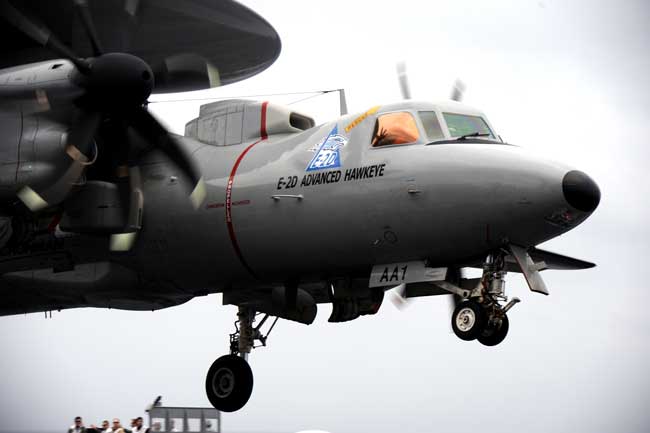
An E-2D Hawkeye assigned to Air Test and Evaluation Squadron 20 completes a "touch-and-go" exercise aboard the aircraft carrier USS Harry S. Truman. The "D" model is aboard Harry S. Truman for carrier suitability testing before delivery to the fleet. Harry S. Truman is supporting fleet replacement squadron carrier qualifications. (Credit: USN Visual Service, 2/3/11)An E-2D Hawkeye assigned to Air Test and Evaluation Squadron 20 completes a “touch-and-go” exercise aboard the aircraft carrier USS Harry S. Truman. The “D” model is aboard Harry S. Truman for carrier suitability testing before delivery to the fleet. Harry S. Truman is supporting fleet replacement squadron carrier qualifications. (Credit: USN Visual Service, 2/3/11)

SLD: With the stated requirement to keep 10 air wings available to the fleet, the challenge of managing the transitions must pose a significant challenge as well as the age of things like the much older Hornets.

Captain Whalen: If you look at the curves on the number of airframes available, we’ve basically got three lifecycle lines out there.  We have the Legacy Hornet, the Super Hornet and then the JSF ramping up.

And we have to try to make sure there’s at least a minimum number of strike fighters to man ten air wings to go forward and run our contingency plans.  We need to make sure that as the Legacy phases out we have enough Supers and JSF to meet the requirement, and then when the Supers start declining we have enough JSF to get the job done.

Do we take the Legacy out earlier and put more into Supers or do we try to accelerate JSF? That’s been where we spend some of our time trying to manage those numbers and those three curves.

SLD: It’s X plus Y plus Z equals your ten air wings.

Captain Whalen: Right. And there is another piece to the puzzle, namely TAI.

Our tac air integration (TAI) piece with the Marine Corps, where they contribute strike fighter squadrons to the air wings, is part of the evolving solution.  We’re doing that now, and we’re investigating increasing the level of participation of the USMC on our large deck carriers.

Historically, and I flew with the marines and a USMC air wing when I was a department head, they’ll contribute a Hornet squadron to the air wing, and they’ll come and train with us, and they’ll deploy with us, and then go back home when the deployment’s over.

But we’re going to try to expand their role as we manage strike fighter shortfall issues.  They can help us fill those potential holes in our force structure, if you will, down the road.

How many would they contribute and how many do we need?  We don’t need so many Marine squadrons that we have to stand down Navy squadrons.  That is not very effective use of the resources we currently have.

We know how many Navy squadrons we’ll have out there, and we can take some more Marine squadrons, potentially.  Are they willing to contribute those?  The equation is being worked.

SLD: What does the F-35C bring to the party? What does the F-35C bring to the carrier deck?

Captain Whalen: I think the ability to flow anywhere we need to go.  The F-35C is a  multi-threat platform able to respond to all the different mission areas that we’re prepared for.  We’re a self-contained unit, we defend ourselves, we project power where needed.  Just like you’re seeing in various corners of the globe.

It brings, obviously, newer technology, but more stealth, if you will.  We have some of that, but not as much as we’d like to have.

It brings a lot more capability in terms of smart weapons and ease of operability, performance is improved from where we are currently. The fifth generation’s the whole next step.

And there is significantly more room for growth.  The Legacy Hornet was built out.  Its data buses couldn’t take any more improvements.

And so, Super Hornet came along, changed and improved in a number of ways.  One of them was the architecture and electronic backbone that allowed us to add new radars and those kinds of things. But it is limited as well in terms of growth.

The JSF is the next step in that realm and brings 360-degree coverage with the latest and greatest technologies.

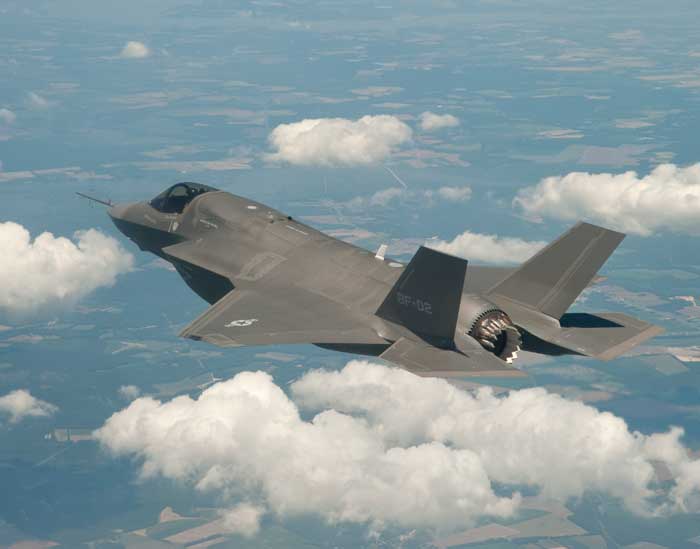
F-35C in Flight (Credit: Lockheed Martin)

SLD: You are about to go to the USS Vinson and command this ship.  How might we going forward gain more flexibility in mixing and matching our sea base capabilities, with aviation as a key connector?

Captain Whalen: I don’t want to give the impression that we’re tied necessarily to doing it the same way we’ve always done it.  There’s some discussion here in the building about how do we deploy differently.  For 40 years, we’ve loaded aboard and deployed for six months, all together and it all came back.  Is there a better way to do that?  Is there a smarter way to sail the carrier and join the air wing or pieces of it?  What are the right pieces?

SLD: Mix and match more effectively?

Captain Whalen: Make it a little more customized, if you will.

SLD: You mentioned earlier you concern about the industrial base and our ability to maintain the fleet.  Could you comment on this challenge?

Captain Whalen: My experience observing during two shipyard periods on the east coast where we were in Newport News in the dry dock, and then we were down around the corner in Portsmouth suggests our industrial base is at risk.

The loss of our industrial capacity, the skilled welders, the machinists, the shipyards in general, is going to be a real problem in the future.  I think if you were to ask them, and I don’t know if you visit with them or not, but they (shipyard leadership) would tell you they have a very hard time finding and retaining talented and skilled workers.

So much so that we would come in on the carrier and they would pull workers from other projects, and other items to focus on the carrier or maybe focus on the submarine.

At our base in Lakehurst, New Jersey they’re building the EMALS (electromagnetic aircraft launch system) and the advanced arresting gear.  But they also maintain the legacy catapult and arresting gear systems.  One of the facilities they have at Lakehurst is a large in-house job shop, if you will.

It makes a significant number of the critical components for our current systems, filled with lathes and milling machines and welders.  We maintain this facility to make these critical components for our arresting gear and cats that can’t be routinely manufactured by industry to the tight tolerances were looking for.

But we’re not, I don’t think, as a nation producing the skilled people to the rate we’re going to require to maintain the fleet down the road.
Accenture: Offshore Outsourcing Has Not Worked

05/16/2011
(Credit:

By Richard McCormack

Originally published in Manufacturing News, April 29, 2011

05/16/2011 – The strategy embraced over the past decade by U.S. manufacturing companies to shift production to countries with cheap labor may no longer be appropriate, according to a consulting firm that has been a big promoter of offshore outsourcing.

“Companies are beginning to realize that having offshored much of their manufacturing and supply operations away from their demand locations, they hurt their ability to meet their customers’ expectations across a wide spectrum of areas, such as being able to rapidly meet increasing customer desires for unique products, continuing to maintain rapid delivery/response times, as well as maintaining low inventories and competitive total costs,” according to Accenture analysts John Ferreira and Mike Heilala, who head the company’s North American Manufacturing practice.

Having surveyed 287 manufacturing companies, Accenture found that 61 percent are considering moving some of their manufacturing back to their home market. Ferreira and Heilala describe this as being a “secret shift” and a “quiet trend.”

Many manufacturing companies that shifted production offshore “likely did so without a complete understanding of the ‘total costs,’ and thus, the total cost of offshoring was considerably higher than initially thought,” write the two analysts. “Part of the issue is that not all costs of offshoring roll up directly to manufacturing; rather, they impact many areas of the enterprise.”

Companies have found that managing their supply operations from afar has weakened their “overall operational planning, forecasting and general flexibility, while in some cases also driving up costs with the need for complex network management,” according to Accenture. “In some cases, this situation has limited the companies’ competitive advantage causing limitations on growth and revenue.”

Almost half of the companies Accenture surveyed said they are facing issues regarding poor cycle and delivery times and product quality due to offshored manufacturing and supply operations. There have also been “dramatic” increases in many of the costs that first enticed them to move their production overseas. “Those seemingly initial cost savings are no longer so big,” according to Ferreira and Heilala. “They are, in fact, diminishing as transportation, commodity cost and in-country labor rates rise and exchange rates change.”

Seventy-three percent of the companies have seen significant increases in supplier material costs and component prices. Fifty-seven percent have experienced cost increases associated with logistics and transportation; 36 percent have seen price increases for overhead and administrative functions; 31 percent have been impacted by exchange rate differentials; 26 percent have had to build up their inventories as a means to buffer supply chain disruptions; and 25 percent have seen increases in the cost of quality.

Other areas that are increasing in costs include material handling and warehousing; packaging; value-added taxes, customs and duties; product qualifications; customer service costs; procurement staff costs such as broker fees; and increased tooling costs. “These cost pressure issues are arising at a time when customer requirements for agility, speed and capability are becoming more challenging,” say the Accenture executives.

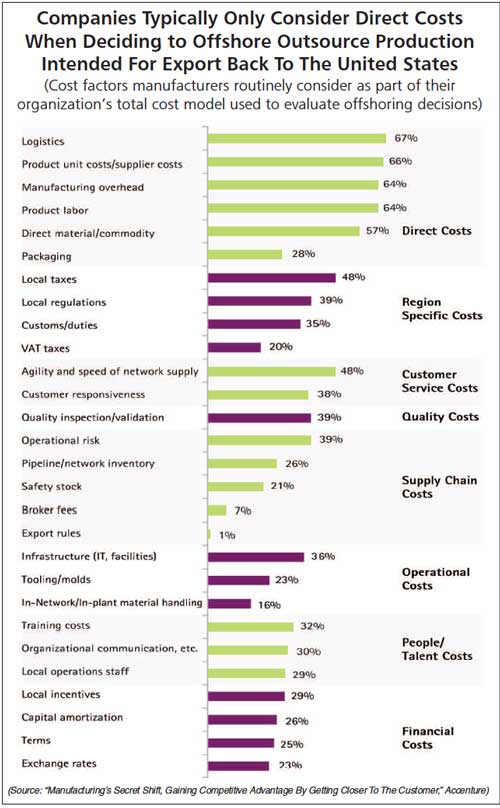
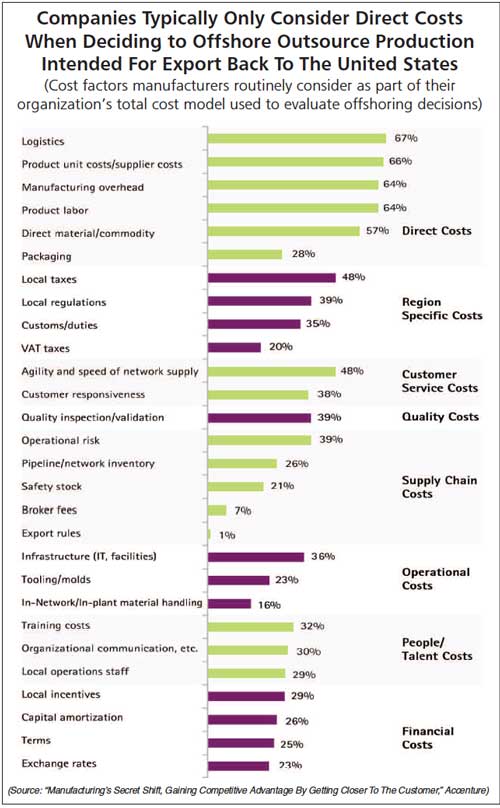
Companies have not done a good job of determining the true cost of offshoring. They tend to look only at direct costs, such as logistics, product unit costs, supplier costs, manufacturing overhead, labor, material and packaging costs. But there are many other costs that have not been considered when shifting production to a foreign country, such as local taxes, regulations, customs duties, VAT taxes, the agility and speed of suppliers to respond to customer demand, poor quality inspection and validation, operational risks, inventory, safety stock, broker fees, infrastructure costs, tooling and mold costs, networks needed for plant material handing, training costs, organizational communications costs, local operations staffing, capital amortization, terms and exchange rate fluctuations.

(Credit: Accenture)(Credit: Accenture)

“The overreliance on direct costs to the exclusion of other legitimate cost factors distorts the business case for offshoring and likely many decisions to offshore were incorrectly made,” say Ferreira and Heilala.

The direct costs upon which the initial decisions were made are also changing. Labor represents only 5 to 10 percent of the total cost of most goods, so it’s no longer a driving consideration for moving production. Rising transportation and energy costs and less favorable exchange rates are also working against companies’ original calculations for savings.

“It is becoming increasingly clear that the physical location of supply and manufacturing operations can have a significant impact on competitiveness,” say the Accenture analysts.

Although bringing production back to the United States may not represent the lowest-cost approach to production, providing customers with their own specific SKUs “in a timely fashion may be more important,” says Accenture. Companies like BMW, Siemens Energy, Nissan and Electrolux have all made large production investments in the United States in order to better serve American customers. The moves by these large firms “add more credence to the fact that companies are in fact aggressively rebalancing supply to be closer to customer demand,” say Ferreira and Heilala in their report “Manufacturing’s Secret Shift, Gaining Competitive Advantage by Moving Closer to the Customer.” “

Over the next three years, nearshoring shifts appear poised to continue but different companies will take different directions. Most important, the direction manufacturers take will be highly dependent on both the customers’ requirements and on the product itself — more customized products or those with less stable or difficult-to-predict demand patterns will require increasingly better matched supply to demand location.”

Here is how Accenture defines offshoring:

“There are many different definitions to offshoring. We define it as the act of separating manufacturing and supply operations away from demand sources — to regionally separate locales. Some have moved operations offshore to support offshore demand; however, this is not really offshoring. It is really an effort to get closer to one’s customers and support regional growth. Moving operations offshore only to later import the goods back into a region to fulfill demand is offshoring.”

John Ferreira can be reached at jo*************@*******re.com. Michael Heilala’s e-mail address is Mi***************@*******re.com.

Russia’s ROKAF Connection

05/06/2011
By Dr. Richard Weitz

05/052011 – South Korea is an attractive defense market due to its large economy and justifiable need for military equipment to defend against a North Korean threat. The United States is the main supplier of imported weapons to the Republic of Korea Armed Forces (ROKAF). The ROK bought almost one billion dollars worth of U.S. arms in FY2010.

Yet, in addition to European defense companies, Russia also has sold the ROK many weapons and will likely continue to do so. In addition to oil and gas, weapons represent one of the few items that South Korea can logically purchase to help balance its own high-technology exports to Russia. Meanwhile, despite common misconceptions, Russia no longer sells weapons to North Korea.

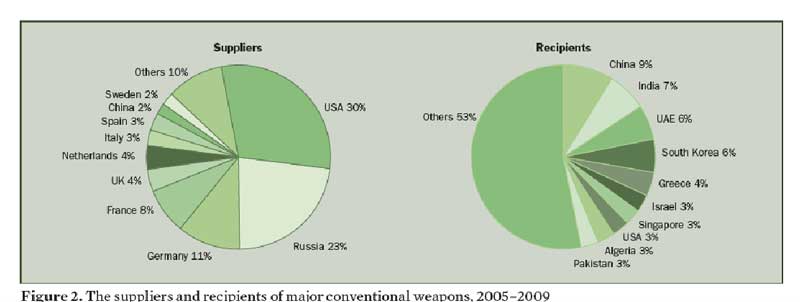
(Credit: http://www.sipri.org/databases/armstransfers/recent_trends/SIPRI_AT_Fact%20Sheet_2010)(Credit: http://www.sipri.org/databases/armstransfers/recent_trends/SIPRI_AT_Fact%20Sheet_2010)

The Russian-South Korean defense trade arose after the Cold War. The Russian Federation began supplying tanks, combat vehicles, military helicopters, and other defense equipment to the South Korean armed forces as partial payment of the $2 billion debt to the ROK that Russia inherited from the former Soviet Union.

The debt originated in 1991, when the Roh Tae-woo administration extended $1 billion in bank loans and a $470 million commodities loan as a reward for Moscow’s recognition of the ROK government the previous year. The subsequent collapse of the Soviet Union and the impoverishment of the new Russian Federation made it impossible for Moscow to repay the loans in cash.

The first two so-called “Brown Bear” arms-for-debt swap deals were negotiated in 1995 and 2003. Under their terms, Russia provided the ROK armed forces with Soviet-era T-80U main battle tanks, METIS-M anti-tank missiles, BMP infantry fighting vehicles, Kamov Ka-32 transport helicopters, and Murena-E hovercraft. Although South Korea had originally planned to purchase 80 tanks, the ROK ended up buying only 35 T-80U tanks. South Korea also received 70 BMP-3 Infantry Fighting Vehicles from Russia. The Republic of Korea Army (ROKA) uses these Soviet-era weapons primarily to simulate a North Korean opposing force in training exercises. Ironically, the T-80U and BMP-3 are more advanced than their DPRK counterparts. North Korea’s most advanced main battle tank is the ‘Pokpung-Ho’ (Storm), which is believed to be based on the Soviet-built T-62 tank. The DPRK’s main infantry fighting vehicle is the BMP-1 IFV, which is 20 years older than the models Russia sold South Korea.

The ROKA has no need to incorporate these Soviet-made tanks and infantry fighting vehicles into its regular order of battle since the ROK Armed Forces possess more than 1,500 domestically manufactured K-1 and K-2 main battle tanks and hundreds of ROK-made K21 Infantry Fighting Vehicles.

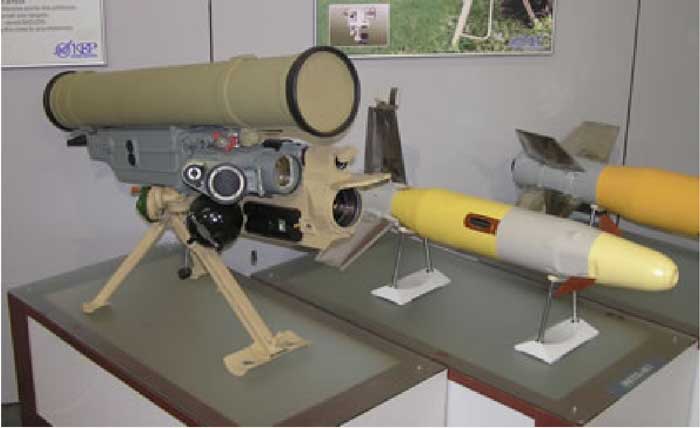
(Credit: http://defense-update.com/products/m/Metis-M.htm)
Metis-M Antitank Missile (Credit: http://defense-update.com/products/m/Metis-M.htm)

In contrast, the Igla Man Portable Air Defense Systems (MANPADS) as well as the short-range portable Metis-M antitank missiles have entered into regular service with the ROKA. The capabilities of these two Russian imports are closer to these of the infantry-launched guided missiles the ROKA has acquired from the United States and ROK domestic suppliers.

As part of the “Brown Bear” debt for weapons swap arrangements, the ROK Navy (ROKN) received seven Ka-32 transport helicopters. The Navy uses them primarily for combat search-and-rescue missions. The ROKN also bought three Project 12061 Murena E hovercraft from Russia. These craft, built at Khabarovsk, can carry payloads of 45 tons and move at a speed of 50 knots on the basis of its Zorya Mashproekt MT70 gas turbine engine and UGT 6000 turbines. The Murena E can be deployed from the ROKN’s Dokdo landing platform helicopter warships. The hovercrafts have been fitted with American-made navigation systems. Despite being less advanced than the U.S.-made LCAC, the Murena E has a potential amphibious role for transporting the Republic of Korea Marine Corps (ROKMC) in either Korean Peninsula contingencies or for overseas peacekeeping missions.


The more recent Russian weapons sales to South Korea look to deviate from this model. Instead of another arms-for-debt swap, South Korea is interested in buying Russian defense items outright, with new money.


Murena E (Credit: http://gov.khabkrai.ru/invest2.nsf/Images/Export/$FILE/Olimpia.jpg)Murena E (Credit: http://gov.khabkrai.ru/invest2.nsf/Images/Export/$FILE/Olimpia.jpg)

In addition, the ROK no longer wants to purchase mostly complete and somewhat dated turn-key weapons systems. Instead, South Korea aims to acquire some of Russia’s most sophisticated military equipment and technologies, which can then be incorporated as elements and subsystems into ROK-built platforms.

For example, since 2007, the ROK has been discussing the possible purchase of Russian-made submarine fuel cells, long-range radar systems, and technologies designed to defend electronics against an electromagnetic pulse (EMP). Meanwhile, Russia has agreed to repay its remaining $1.3 billion debt in cash rather than in kind over the next decade.

The reason for Seoul’s new defense technology sourcing strategy regarding Russia is that, as in China, South Korea’s own domestic defense industry has improved to the point that ROK firms can often research, develop, and manufacture weapons systems as good as those available from Russian defense exporters.

The ROK defense industry has benefited from an infusion of financial resources, human talent, and dual-use technologies derived from South Korea’s strong civilian industries. The ROK boasts world class and internationally competitive shipbuilding, automobile, and aerospace companies.

Furthermore, the ROK government has sought to develop the country’s defense sector through various programs and legislation. For example, the Defense Reform 2020 legislation seeks to help develop the ROK’s indigenous capabilities by increasing the percentage of funds allocated to defense research and development.

In addition, acquiring some Russian systems would create more problems than they are worth. Russian weapons systems like the Mi-28N Havoc attack helicopter and Su-30MK Flanker strike fighter are incompatible with South Korea’s NATO-standard arsenal.

The ROK aims for strong joint service and multinational interoperability with Western partners in its weapons purchases. The ROK government lobbied hard to secure recent approval in the U.S. Congress for an elevation of South Korea’s status to that of a NATO Plus Four category ally for U.S. arms purchases, a step above the more common Major Non-NATO Ally category.

Another limit on ROK purchases of complete Russian weapons systems is that Russia’s arms industry has yet to overcome some of the major difficulties it has experienced since the disintegration of the integrated Soviet military-industrial complex. Although Russian firms can manufacture good subsystems, the fielding of complex integrated weapons systems like aircraft carriers and submarine-launched ballistic missiles has proven especially problematic.

Russian defense firms found it extraordinary difficult to manage the transition from the Soviet command economy to a post-Soviet environment characterized by considerably reduced domestic defense demand and the widespread prevalence of free-market conditions in which defense companies find themselves competing with other Russian firms for orders, supplies, and human resources.

Bad government and industry practices have compounded the problem by making it difficult to implement plans to manufacture large numbers of advanced conventional weapons. The country’s military-industrial sector still suffers from limited domestic orders and extensive overcapacity. Purchases for the Russian Army and Navy have been increasing, but they have not been able to sustain all of Russia’s military production capacity.

Russia’s military manufacturing facilities also desperately require modernization. The deep nature of these problems has recently led the Russian government to buy some of the most complex and sophisticated major conventional weapons systems from foreign countries, including large Mistral-class amphibious assault ships from France and unmanned aerial vehicles from Israel.

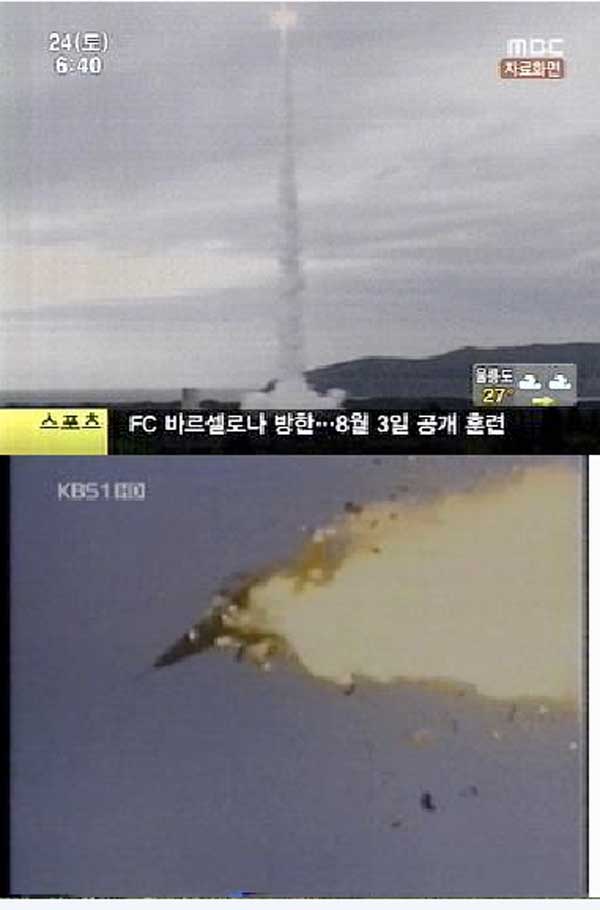
Photos of Successful Intercept by the South Korean System based in part on S-400 Technology (Credit: http://defenceforumindia.com/showthread.php?t=12683&page=1)

ROK defense firms are also incorporating Russia’s traditionally leading-edge surface-to-air missile (SAM) technologies into their own systems. Samsung Thales, a joint venture between the ROK heavy industry conglomerate Samsung Group and French electronics defense contractor Thales Group, is developing a medium-to-long range surface-to-air missile, the M-SAM Cheolmae-2, for the ROK military. The system is designed to engage both ballistic missiles and aircraft. The M-SAM will use S-400 missile technology provided from the Almaz Antey Joint Stock Company, including proprietary information from the S-400’s multifunction X-band radar. LG Corp’s missiles’ guidance systems are expected to also use Russian design elements.

As in other cases, Russia’s armed sales policy regarding the Koreas could conflict with its political-military strategy for the region. The immediate purpose of South Korea’s missile defense systems is to counter the several hundred short-range ballistic missiles North Korea has aimed at Seoul and Pusan, South Korea’s two largest cities.

The Russian government has no objection to the ROK’s using Russian and other air defense technologies to counter this threat. When the DPRK made evident preparations to resume missile testing in early 2009, the Russian military itself announced that it had deployed advanced missile defenses nearby to counter any DPRK missiles heading toward Russian territory, including the S-400, the most advanced SAM in use by the Russian armed forces. President Dmitry Medvedev has cited North Korea’s missile launches as well as its nuclear weapons tests as a “concern for us” given that, “We are located in close proximity to this country.”

But South Korea’s close alliance with the United States means that ROK missile defenses could also help defend U.S. forces in South Korea and perhaps elsewhere from missile attack. Russia’s main concern is probably that the ROK will seek to integrate its missile defenses with those of the United States and Japan.

The North Koreans would likely respond by further expanding their own missile arsenal, which in turn could threaten Russia directly, through an errant missile launch landing on Russian territory, and indirectly, by leading to further missile defense cooperation between the United States and its East Asian allies.

The resulting missile defense network could then help counter the offensive missile forces of China and Russia. Foreign Minister Sergey Lavrov made these Russian concerns evident when he visited Seoul in April 2009, telling the media that, “I hope that no one would … use the situation around North Korea to set up alliances, build missile defense networks or announce an intention to possess nuclear weapons.”

The benefits from this increased defense cooperation could also be used to increase the capacity of the U.S. ballistic missile defense systems planned for deployment in Europe. Although NATO and Russia have formally agreed to consider collaborating on missile defense, many Russian policy makers still worry that the U.S. missile defense systems in Europe can be used to degrade the credibility of Russia’s nuclear deterrent.

Another Russian concern is that South Korea is seeking U.S. permission and assistance to develop and deploy its own strike weapons, including a longer-range ballistic missile that could reach targets in Russia as well as China and North Korea. Currently an agreement with the United States prevents the ROK from deploying ballistic missiles with ranges longer than 300 kilometers or with a payload greater than 500 kilograms.

South Korean officials are now seeking permission to deploy ballistic missiles with a range of 1,000 kilometers and a payload ceiling of 1 ton. Although relations between Russia and South Korea are currently their best in history, Russian defense planners would need to consider the increased threat to the Russian Far East should they ever deteriorate again. Indeed, the military technology South Korea has recently been seeking and acquiring from Russia indicates Seoul’s interest in developing its power projection capabilities

Since South Korea has attained the capacity to manufacture armored vehicles, artillery systems, and other basic weapon and communications systems, and since Russia’s shipbuilding capabilities have deteriorated, ROK military leaders will likely be most interested in purchasing Russian niche capabilities in the areas of heavy transport aircraft and air defense systems.

Ambitious Russian development projects like the 5th generation PAK-FA fighter are not suitable for South Korea’s expeditionary ambitions because of they are unlikely to be interoperable with the armed forces of the United States and key U.S. allies, with which any regional ROKAF deployment would have to operate.

As part of its developing power projection capacity, South Korea might resume purchasing select turn-key Russian weapon systems, in this case a Russian-made heavy transport aircraft. For example, the Antonov An-124-100M-150 is capable of carrying a 120-ton payload for more than 5,000 kilometers in its 36m X 6.4m X 4.4m cargo compartment. Chartered An-124s has already been heavily used by the NATO-led International Security Assistance Force (ISAF) in Afghanistan. U.S. forces in Iraq also have employed the Antonov An-124 to carry outsized payloads like self-propelled artillery and MRAP vehicles

(Credit: http://www.airliners.net/photo/0612942/)

To improve performance in areas like navigation and make the planes more interoperable with NATO, South Korea is likely to modify any Russian military transport planes it purchases by equipping them with Western avionics.

The Russian-ROK arms trade first arose as a logical means to liquidate a Cold War-era monetary debt. It has since developed as a means for the ROK to acquire certain niche capabilities. Two other considerations that might also lead to further South Korean purchases of Russian weapons could include a desire to gain negotiating leverage with other foreign arms suppliers and an incentive to help sustain good relations between Russia and the ROK, especially in the complex negotiations with Pyongyang.

State Department Goes on Cyber Offensive

05/05/2011

By Dr. Richard Weitz

05/05/2011 – Under Hillary Clinton, the U.S. State Department has made a major effort to promote international Internet liberties, including the freedoms of expression, association, and assembly online. Taken together, these rights comprise what Secretary Clinton has called the “freedom to connect.”

The Department faces both foreign and domestic impediments to its policies. The State Department has been divided by vigorous debates over which projects it should support through its grants and whether to view the Internet primarily as a weapon to topple repressive regimes.

The Global Challenge of Cybersecurity (Credit: Bigstock)The Global Challenge of Cybersecurity (Credit: Bigstock)

The State Department is playing a leading role in a global coalition of governments committed to advancing Internet freedom. This commitment was highlighted at the Internet Governance Forum in Vilnius, Lithuania in September 2010 and in a cross-regional statement on Internet freedom sponsored by Sweden in the Human Rights Council in June 2010. The Department will issue up to $30 million in grants funding this year to increase open access to the Internet and support digital activists.

In addition, the State Department advances Internet freedom as an economic issue in multilateral forums and in bilateral relationships. In September 2010, Secretary Clinton launched the Women initiative – a public-private partnership led by the Global Women’s Initiative designed to close the global gender gap in mobile phone adoption.

The U.S. Agency for International Development (USAID) executes a program to build the security capacity of foreign media and civil society organizations. Last year, the State Department launched Civil Society 2.0 to build the technical capacity of civil society organizations to accomplish their missions through the use of telecommunications technologies. Civil Society 2.0 seeks to match these organizations with technology tools and tech-savvy volunteers to raise digital literacy, strengthen NGOs’ information and communications networks, and amplify the impact of civil society movements.

As part of the Civil Society 2.0 program, the United States, through the State Department, has held several Tech@State meetings and a TechCamp in Santiago, Chile, on topics ranging from mobile money to blogger training to using technology after natural disasters. The Department also partnered to launch the first Apps4Africa competition with local partners in the region, challenging applicants to use digital technology to connect to their communities and develop innovative solutions to shared problems.

The Secretary’s 21st Century Statecraft initiatives complement the Department’s work to advance Internet freedom. They partner private and civic sectors in foreign policy initiatives, thereby bringing new resources and partners together, using connection technologies to pursue more innovative diplomacy. Internet freedom is a prerequisite for allowing technology to build these open platforms for innovation in diplomacy and development.

The Department also promotes international efforts to strengthen global cybersecurity by building capacity in developing countries, promoting interoperable standards, and enhancing international cooperation to respond to cyberthreats.

The Department leads administration efforts to develop an international strategy for cyberspace. The new Office of the Coordinator for Cyber Issues, led by Christopher Painter, formerly senior director for cyber security at the NSC, will integrate work across the Department and with other agencies regarding cybersecurity and other cyber issues.

The new Cyber Coordinator could perform a role based on the precedent of the State Department’s counterterrorism office, where a coordinator forges partnerships with other governments and provides coherence to U.S. international strategies. Unless strongly supported by the Secretary, the Coordinator will find it difficult to lead the Department’s disparate cybersecurity initiatives and act as the primary liaison to the White House Cybersecurity Coordinator.

The Challenge of Managing Cyber-Chaos (Credit: Bigstock)The Challenge of Managing Cyber-Chaos (Credit: Bigstock)

The State Department’s Internet freedom campaign faces two challenges — one internal, the other foreign. The State Department has been divided internally by vigorous debates over which projects it should support through its grants and whether to view the Internet primarily as a weapon to topple repressive regimes.

Domestic critics of the Department’s approach argue that it needs to take a bolder approach and support a few key projects with breakthrough potential rather than disperse funding too widely. A report by the Republican minority of the Senate Foreign Relations Committee said that State’s performance has been so cautious about financing Internet freedom initiatives that another agency, the Broadcasting Board of Governors, which oversees Voice of America and Radio Free Europe, should assume the lead role in this area. The Republican-led House, criticizing the Department for not spending last year’s disbursement of $30 million more quickly, cut the State Department’s proposed fiscal year 2011 budget for Internet freedom by one-third, to $20 million.

Critics on the left accuse the State Department of hypocrisy for supporting the free flow of information, except when it involves the secret U.S. cables made public by WikiLeaks. Secretary Clinton has argued that, in addition to being a public space, the internet is also a channel for private communications. To fulfil that function, there must be protection for confidential diplomatic communications online: “The United States could neither provide for our citizens’ security nor promote the cause of human rights and democracy around the world if we had to make public every step of our efforts. Confidential communication gives our government the opportunity to do work that could not be done otherwise.”


The Challenge of Building the Cyber Eye to Protect Networks (Credit: Bigstock)

The State Department’s support for Internet freedoms is constrained by its responsibility to conduct the overall diplomatic relationship with all foreign governments in a way that maximizes U.S. security and economic interests. When an important U.S. ally or trade partner engages in repressive Internet policies, the Department will at best issue quiet protests. Instead of confronting the government of an important country like China directly, the State Department prefers to place its bet on time and economic incentives to induce these governments to change their polices eventually.


As Clinton put it, “We believe that governments who have erected barriers to internet freedom, whether they’re technical filters or censorship regimes or attacks on those who exercise their rights to expression and assembly online, will eventually find themselves boxed in. They will face a dictator’s dilemma and will have to choose between letting the walls fall or paying the price to keep them standing, which means both doubling down on a losing hand by resorting to greater oppression and enduring the escalating opportunity cost of missing out on the ideas that have been blocked and people who have been disappeared.”

The Department also balances the need for Internet freedoms with a desire to enhance Internet security. Observers credit the State Department with being the only U.S. government agency that has achieved near-real-time situational awareness by employing what the Department calls “continuous monitoring.” It enables cyber defenders to minimize their vulnerability by quickly protecting their systems when a new threat or vulnerability is discovered. State Department managers update their threat assessments on a daily basis, not monthly or quarterly like most agencies, and can quickly tell when a computer network has not received a needed software patch.

The Department cooperates with other countries to fight transnational cybercrime. It funds the building of cyber capabilities in foreign law enforcement agencies. The Department led the campaign within the U.S. interagency to ratify the Budapest Cybercrime Convention, which sets out the steps countries must take to ensure that the Internet is not misused by criminals and terrorists. When foreigners are suspected of engaging in cyberattacks and cybercrime against the United States, the State Department will lodge protests and try to get those involved punished or at least shut down.

Cyber Crime is Part of the Dark Side of Globalization (Credit: Bigstock)Cyber Crime is Part of the Dark Side of Globalization (Credit: Bigstock)

But the Department can do little when these cyberattackers enjoy the support and sanctuary of foreign governments. Often a foreign government will arrest and visibly punish a few lower-level people, or shut down one malicious website, while allowing other, normally better connected cybercriminals to function unmolested.

The State Department confronts other international obstacles to realizing its Internet goals. Freedom House’s newly released publication, “Freedom on the Net 2011: A Global Assessment of Internet and Digital Media,” shows how governments have tried diverse and deviously creative tactics to control and repress websites, blogs, and email messages that they consider threatening.

Some of these new Internet restrictions are a reaction against the growing use of sophisticated social networking software applications such as Facebook, YouTube, and Twitter, which are now giving ordinary users—including social and political activists—networking tools previously available only to Internet Service Providers (ISPs). These social media are being credited with helping organize and galvanize pro-democracy movements across the Arab world.

Authoritarian regimes face the arduous challenge of maximizing the economic benefits of the Internet while negating its ability to disseminate information outside government control. The Internet has already demonstrated its potential to overcome traditional media controls and provide their domestic opponents with a mechanism to mobilize supporters and propagate anti-regime messages. Many other opposition movements reside in exile and rely on the Internet to remain engaged in their home countries as well as appeal for international support for their cause.

According to Freedom on the Net 2011, repressive governments have reacted to the growing spread of Internet access and user-generated content by blocking and filtering Internet sites associated with political opponents, using legal intimidation to force ISPs to remove threatening content, and arresting users for posting comments or information that the government considers threatening. If necessary, the authorities have employed cyberattacks and misinformation to shape the information landscape in ways unfavorable to human freedoms. Whereas in the past the authorities would provide ISPs with regularly updated blacklists of banned sites, now the use of more sophisticated filtering technology that searches for a rapidly updated list of banned keywords is becoming more common.

The report notes that even in basically democratic countries, state controls can impede Internet freedoms through unwarranted legal harassment, de facto censorship, and government-supported surveillance. The targets of their content controls are often appropriate, such as sites involving child pornography, violating intellectual property, or inciting violence, but all too easily they spill over to disrupt access to legal or legitimate political or social information. Many regulations deviate from international human rights standards, the rule of law, and the principles of necessity and proportionality. All too often, what is censored is arbitrary and unjustified, yet the censorship process offers few effective means of appeal.

The State Department has tried to overcome these foreign challenges through various means. U.S. diplomats have raised cases of imprisoned bloggers, journalists, and online activists at the highest levels of government, and taken a public stand on their behalf. The Bureau of Democracy, Human Rights and Labor issued more than $5 million in grants in 2010 to support access to information and secure communications on the Internet and mobile devices.

In March 2010, Under Secretary for Democracy and Global Affairs Maria Otero and Under Secretary for Economic, Business, and Agricultural Affairs Robert Hormats convened the first meeting of information technology companies to discuss ways in which the private sector and government can work together to advance Internet freedom.

On April 20, the State Department announced that the State Department will invest $28 million in grant funding to help Internet activists around the world. Department officials termed the move a major step toward protecting the fundamental rights of activists working in nations that deny or censor access to the Internet and those who use the Internet in their human rights work. Some of these funds will finance programs like circumvention services, which enable users to evade Internet firewalls by routing their traffic through proxy servers in other countries. Other funds will support training for human rights workers on how to secure their e-mail from surveillance or wipe incriminating data from mobile phones if they are detained by the police.

Dan Baer, deputy assistant secretary of State for democracy, human rights, and labor, told Bloomberg that software to help pro-democracy activists avoid detection online has developed under the program and has spread rapidly through Iran and Syria. The Department has also already trained more than 5,000 people around the globe to build and use firewall circumvention software through an “underground railroad” type system.

Unfortunately, the available circumvention tools have displayed a limited ability to counter state controls of the Internet, mostly in countries whose people enjoy a high degree of computer literacy or whose governments use relatively unsophisticated blocking techniques. For other nations, their best hope lies in fomenting the kinds of social revolutions that are sweeping the Arab world today—using the Internet when they can, but other means when they must.

Shaping Manufacturing for Sustainability: The Eurocopter Approach (2)

05/03/2011

05/03/2011 – Following the interview with Alain Rolland, where the Senior VP outlined the core approach of Eurocopter in shaping its approach to manufacturing for sustainability, SLD visited the factory to view some concrete examples of the approach.Pierre Maret, the head of the Development Center for Excellence, focused on the shift in the design of the Puma to the Super Puma as a core example of the evolution of the product for enhanced sustainability. And as well he provided a tour of the” Plateau” teams whereby development and manufacturing engineering approaches are correlated through concurrent engineering.

(For the earlier interview see https://www.sldinfo.com/?p=16682).

Maret provided a very clear example of the core point of Rolland.  Rolland had emphasized:

The key is to reduce the number of parts necessary to operate the aircraft; less parts, more reliability, less maintenance.  Getting the dynamic systems and components simplified is a key part of the process. Reducing the number of parts is beneficial in many respects, notably safety as well.  If you reduce the number of moving helicopter parts, you reduce the risk of failure and enhance safety and reliability.

Maret focused on the Puma versus the Super Puma main rotor system in terms of key parts simplification.  He showed the key linkage between the rotors and the motors for the Puma and highlighted the bearings, the interfaces and the lubrication device, which provided a key link.

Building the Super Puma Credit: Eurocopter

Then he showed the same linkage for the Super Puma.  Bearings and lubrication devices had been eliminated along with the interfaces with a significant reduction in moving parts.  Obviously, less parts, removing the bearing joints etc. replaced by elastomeric joint provided a simpler, cleaner system with significant gains in reliability and maintainability.  This is a clear example of why new platforms can be significant advances in terms of reliability and sustainability over older platforms.

SLD: Could you explain the basic approach to manufacturing for sustainability?

Maret: The basic principle is to reduce the interfaces.  So in terms of design, it’s to integrate as many functions as possible.  So, it’s what we intend to do more and more. Instead of single function parts, we tried to integrate many, many functions on the same part. And this is possible because of advanced technology.

SLD: The approach is to remove several parts that were individual before but now are simplified into manufacturing a single part.

Maret: Yes.  An example of simplification and its result can be seen with the Tiger gearbox. We have integrated the bearing raceway directly on the gear shaft.  So the raceway of the bearing is machined directly onto the gears.

SLD: And it used to be a separate part?

Maret: Yes. Thank to this design, inner ring, nut and locking devices have been deleted.. By such a design, you avoid fretting corrosion between the bearing and the shaft.  So thanks to that, you can increase the time between overhaul and you increase the reliability.

SLD: So, you’ve removed several parts that were individual before, so you’re manufacturing a single part.

Maret: Yes. So we reduce the interfaces, which significantly reduces reliability problems.  To do that, it was necessary to integrate bearing suppliers technology and to develop a special heat treatment such as deep nitriding technology.You do this in order to increase the hardness and practical strengths of the parts, both for raceway and tooth for the gears. And the technology of the bearing supplier is now integrated into our business process. Moreover, in order to increase the reliability and safety specs, this heat treatment allows being able to run after total loss of lubrication in the gearbox.  So thanks to this heat treatment, it’s possible to run with a long time without oil.

SLD: We are talking about the Tiger; is it the same for civilian helos?

Maret: We use the same technology for military, as well as civil aircraft.

SLD: We are now looking at Puma versus Super Puma main rotor hub technology. How much parts simplification from the 1970s to early 1990s?

Maret: We have reduced by a factor of about 3 the number of parts in the Super Puma compared to the original Puma. Fast-forward to the Super Puma and you have a totally different situation.  You do the repairs external to the system; you do not have the same breakdown of parts requirements. You have significantly reduced the parts and the interfaces, which mean those items no longer have to be maintained.

SLD: Could you describe the engineering process, which supports manufacturing for sustainability?

Maret :We use a “Plateau” system or a concurrent engineering approach. To create a simplified product requires complex integrated engineering.  So, we integrate more and more functions, but to say the design is more and more simple, but on the other hand technology needed programs are more and more complex. We design and at the same time, we design the process. So we build teams around functions that design improvements, the process and integrated with manufacturing innovations as well.  You have to produce to output to see the outcome that you want to get.

Gamechanger : The Evolving Amphibious Ready Group

05/02/2011

An Interview With General “Dog” Davis


Flight deck crew members prepare an MV-22 Osprey with Marine Medium Tiltrotor Squadron 266, 26th Marine Expeditionary Unit, for take off during flight operations aboard USS Kearsarge, April 23, 2010. (Credit: 26th MEU)Flight deck crew members prepare an MV-22 Osprey with Marine Medium Tiltrotor Squadron 266, 26th Marine Expeditionary Unit, for take off during flight operations aboard USS Kearsarge, April 23, 2010 (Credit: 26th MEU)


05/02/2011 – Recently, Second Line of Defense looked at the role of the ARG and the evolution of the ARG in the years ahead.  A key point was that the newly empowered ARG with an Osprey, F-35B, and CH-53K helo would become a gamechanger. The flexibility of the ARG was laid out by the former 15th MEU commander, “Ozzie” Osborn.  The evolving role of the ARG was discussed by Vince Martinez. The USMC planning for a newly configured ARG was discussed by Ed Timperlake.  And the capabilities of the newly empowered ARG was introduced by Robbin Laird. We argued that “[the] force can of course secure an airfield for humanitarian airlift; the picket fence of the F-35s replace the AWACs and can guide coalition airpower into Libyan airspace to support agreed upon missions.  The USAF does not need to move a large air operation into place to send combat air; the USN does not need to move a large aircraft carrier battle group into place to prepare to strike Libya.

What the newly equipped ARG does is provide a significant shaping function for the President.  And this shaping function allows significant flexibility and, is in fact, a redefinition of the dichotomy between hard and soft power. The USN-USMC amphibious team can provide for a wide-range of options for the President simply by being offshore, with 5th generation aircraft capability on board which provides 360 situational awareness, deep visibility over the air and ground space, and carrying significant capability on board to empower a full spectrum force as needed.”

The evolution of the ARG and its impact on national security policy was discussed during a March 2011 interview with General “Dog” Davis. General Davis is currently the Commander of the 2nd Marine Aircraft Wing at Cherry Point, North Carolina. His last position was in the Pentagon as Deputy Assistant Commandant for Aviation. He has two sons, both currently serving in the USMC.


SLD: How would you describe the changes, which the new aircraft provide to enhance the capabilities of the ARG?

General Davis: I would start with the impact of the Osprey.  The range and speed of the Osprey create a whole different situation in terms of the radius of operational impact of the ARG. Let me give you an example of what I am talking about.

We are still scratching the surface in the art of the possible with MV-22s.  From the deck of an amphibious ship they quadruple the ranges we have been able to fly from those decks at twice the speed we have been accustomed to in the past.   The MV-22 changes all the equations in the Med, the Persian Gulf and will do the same when we start deploying that machine on our MEUs to the Pacific.  For each of our MEUs, we tether 2 KC-130Js and send them overseas whenever the scenario calls for them.

Lately, they have been called for a lot.  Add in a KC-130J, that can lift from a short or austere field and provide fuel for our MV-22s, AV-8s and CH-53Es, and we expand the “reach” of our MEUs exponentially.  We took off last month ago with four V-22s and two C-130s, to practice a self deploy to Central America.

We are looking at trying to train with the Belize military, have our infantry use their Jungle Training Center, and wanted to check the profiles on a training mission.  With the internal fuel load we had on the C-130s and what we had even without even fuel bladders in the V-22s, we could have topped them off once over Key West and flown all the way to Belize and landed in the Jungle Warfare Training Center, dropped off our Marines then binged out to the international airfield (or joined on the tanker for a top off and headed home).   From North Carolina to Belize would have been about a five and a half hour flight.

What is really interesting is on this training mission, we took off with four v-22s, but one had a problem.  It had to turn around after takeoff.  We joined three with the tankers over New River and proceeded south.  The fourth turned around, landed at New River, got another airplane, took off and joined us over Gainesville, Florida, and hit the tankers.

We were all doing about 200/210 miles an hour in behind the tankers going down there, and in this case, about 10,000 feet.  This guy got another airplane, got it turned up, launched and caught us.  You wouldn’t be able to do that in a conventional helo.  I had never seen that before in my life. I thought that was pretty special. So if I launch off a ship off the coast of North Carolina, it’d been easy to get the Marines and all their gear for the Jungle Warfare Training Center over 700 miles away.   That’s operational reach with potentially strategic impacts.  We did another tanker mission a week later with 7 MV-22s flying non-stop from 29 Palms to New River in about 8 hours time at 17,000’.

SLD: How important will it be to get the larger ship, LPD 17, as the launch deck for the new aircraft?

General Davis: We just finished SPS 11, which is Southern Partnership Station 11, which is Special Purpose MAGTF.  They’re getting ready to offload today. We visited this SPMAGTF in Belize, and they did a fantastic job, but they were limited in how much they could do by the fact they didn’t have aircraft with them on their ship.   The Gunston Hall is a smaller ship whose flight deck wouldn’t accommodate  aircraft at sea for an extended period of time. You could land them on there but you couldn’t sustain them.

With the LPD-17, I’ve got command and control, and I’ve also got a flight deck where I can take some of the bigger airplanes aboard and go operate.  It is absolutely key to have the LPD-17 in numbers.  It’s a fantastic vessel and it offers the nation a capability that is in very short supply (as compared to the demand).


Flight of BF-2 (Credit: Lockheed Martin)Flight of  BF-2, second F-35B  (Credit: Lockheed Martin)


SLD: Let us look at the Libyan scenario and flash forward to the newly enabled ARG. Could you talk to that a little bit to that scenario?

General Davis: Currently we have C-130s flying in the Libyan situation. If I could pair those C-130s with the F-35Bs, I can provide multi-mission support and be available for other operations. You have an EW capability resident in the F-35 that no one else does that can actually help jam and support those platforms flying from point A to point B.  You put a Next Gen jammer on the F-35B, now you’ve got a very high end EW/jamming capability.  We can use it for self-protect – but also to protect our assault support assets and grunts on the ground in a way we have never been able to in the past with organic MEU assets.  For many years our MEUs have not had an aviation EW capability.  With the introduction of the F-35B to the FMF, we will now have that capability and it will change the way we view those MEUs and open the aperture into a much wider range of missions, expanding the utility of what is already a very capable and utilitarian force – the MEU.

You’ve also got a very high-end air defense capability with F-35Bs.   VLO, fantastic radar and SA, and state of the art air to air weaponry – that’s a big difference than what we can offer today.  Add in that tethered KC-130J, and you have an even greater capability.

Flight of BF-3 (Credit: Lockheed Martin)

SLD: The ARG is a shaping function force.  How will adversaries look at this role in the future?

General Davis: I’m Muammar Gaddafi.  I’m whoever, and I’ve got an ARG with this new gear embarked – and I can’t help but think its going to change the way I view that force.  That ARG can reach out and touch me from long range, landing high-end infantry forces deep inside my territory, and do so with a speed that twice as fast as anyone else can.   Our MEUs have never been used as effectively as they are today.  These new capabilities are going to make them exponentially more potent and useful to our nation’s leadership.

The F-35Bs give the new ARG a very high-end air superiority fighter, that’s low observable if I want it to be.  I can roll from Air to Air to Air to Ground quickly and be superior to all comers in both missions.  That’s bad news for our adversaries.  I can use the F-35s to escort the V-22s deep into enemy territory.  With those V-22s we can range out to a 400-500-mile radius from the ship without air refueling.  I can go deliver Marines deep in the enemy territory or wherever and do it at 250 miles an hour, so my speed of action, my agility is exponentially increased, and I think if you’re a bad guy, that would probably give you a reason to pause.  It’s a very different animal that’s out there.    We are good now, but will be even more so (by more than a factor of two in the future).

I also have significant mix and match capability.  And this capability can change the impact of the ARG on the evolving situation.  It is a forcing function enabled by variant mixes of capability. If I wanted to strip some V-22s off the deck, to accommodate more F-35s – I could do so easily.  Their long legs allow them to lily pad for a limited period of time — off a much large array of shore FOBs – while still supporting the MEU.   It’s much easier to do that in a V-22 than it is a traditional helicopter.

I open up that flight deck, or I can TRANSLANT or PAC additional F-35s.  If I had six on the deck and I want to fly over another six or another four, we could do it rather quickly.  Now the MEU has ten strike platforms.  So if I need to have a TACAIR surge for a period of time, that deck provides a great platform for us.  We’ve got the maintenance onboard that ship, so we can actually turn that Amphib very quickly from being a heliocentric Amphib to a fast jet Amphib. Conversely, I could also take the F-35s off, send them to a FOB and load it up with V-22s, 53Ks, or AH-1Zs and UH-1Ys.    Flexible machines and flexible ships.  The combination is exceptional.

We will have a very configurable, agile ship to reconfigure almost on a dime based on the situation at hand.  I think the enemy would look at the ARG as something completely different from what we have now. I think we have to change the way we do things a bit in order to allow for that, but I think we will once we get the new air assets. The newly enabled ARG, or newly whichever the term you’re using, will force our opponents to look at things very differently.  We will use it differently, and our opponents are going to look at it differently.

DHS Grapples with Cyber Threats

04/27/2011

By Dr. Richard Weitz

04/27/2011 – When the Department of Homeland Security (DHS) was established in March 2003, enhancing U.S. cyber security was designated as one of its primary goals. In signing the legislation creating DHS in November 2002, President George W. Bush said “the department will gather and focus all out efforts to face the challenge of cyberterrorism….[and] will be charged with encouraging research on new technologies that can detect these threats in time to prevent an attack.”

After several years passed without major DHS action, however, observers concluded that the Department had failed to meet its important cybersecurity responsibilities and was insufficiently prepared for emergencies. “On paper at least, the DHS is responsible for overseeing information security across the federal government. But for most of its existence, the agency’s leadership on such issues has been conspicuous by its absence. Even where it has tried, its efforts have been less than successful.”


October 2010 marked the seventh annual National Cybersecurity Awareness Month sponsored by the Department of Homeland Security. Americans can follow a few simple steps to keep themselves safe online. By doing so, you will not only keep your personal assets and information secure but you will also help to improve the overall security of cyberspace. (Credit: http://www.dhs.gov/files/programs/gc_1158611596104.shtm)


In June 2006, a report by the Business Roundtable identified three major “cyber gaps”: no clear warning indicators that a cyberattack was occurring, uncertainty who would lead efforts to restore damaged U.S. critical infrastructure, and the absence of dedicated resources to support such post-attack recovery efforts. The CSIS Commission on Cybersecurity for the 44th Presidency recommended that the president formally revoke DHS’s limited authority to coordinate cybersecurity because, never having cyber authority over the U.S. military, intelligence community, and law enforcement agencies, the department could not perform this coordination role effectively.

Instead, in recent years DHS has made addressing the cyber security issue a higher priority and earned greater support within Congress for keeping DHS as the lead civilian agency in this area. Under the Obama administration, DHS has made cybersecurity one of its five most important mission areas in the first ever Quadrennial Homeland Security Review (QHSR). The DHS Fiscal Year 2012 Budget Request submitted in February 2011 requests for $57.0 billion in total funding, $47.4 billion in gross discretionary funding, and $43.2 billion in net discretionary funding. One of the six missions concerns cyber security:

Mission 4: Safeguarding and Securing Cyberspace – By statute and presidential directive, DHS has the lead for the Federal Government to secure civilian government computer systems and works with industry and state, local, tribal and territorial governments to secure critical infrastructure and information systems. DHS analyzes and reduces cyber threats and vulnerabilities; distributes threat warnings; and coordinates the response to cyber incidents to ensure that our computers, networks, and cyber systems remain safe.

Major programs in this mission area include:

  • Federal Network Protection: $233.6 million is requested to expedite the deployment of EINSTEIN 3 to prevent and detect intrusions on computer systems and to upgrade the National Cyber Security Protection System, building an intrusion detection capability and analysis capabilities to protect federal networks.
  • Federal IT Security Assessments: A total of $40.9 million in requested funds will support the Department’s efforts to strengthen Federal Network Security of large and small agencies by conducting an estimated 66 network assessments to improve security across the Federal Executive Branch.
  • Cybersecurity Workforce Needs: $24.5 million is proposed to provide high-quality, cost-effective virtual cybersecurity education and training to develop and grow a robust cybersecurity workforce that is able to protect against and respond to national cybersecurity threats and hazards.
  • Cyber Investigations: The FY 2012 Budget continues to support cyber investigations conducted through the Secret Service and ICE, targeting large-scale producers and distributors of child pornography and preventing attacks against U.S. critical infrastructure through Financial Crimes Task Forces.
  • Cyber Mission Integration: The FY 2012 request includes $1.3 million to enable DHS to coordinate national cyber security operations and interface with the U.S. Department of Defense’s (DOD) National Security Agency (NSA) at Fort Meade, Maryland. This funding will support a landmark memorandum of agreement signed by Secretary Napolitano and Secretary of Defense Robert Gates that aligns and enhances America’s capabilities to protect against threats to critical civilian and military computer systems and networks.
  • Cybersecurity Research: The FY 2012 request includes an increase of $18 million for the Comprehensive National Cybersecurity Initiative to support research and development projects focused on strengthening the Nation’s cybersecurity.

At present, DHS has the lead to secure federal civilian systems, sometimes described as the “dot-gov” domain. Through its National Infrastructure Protection Plan, DHS works with critical infrastructure and key resources (CIKR) owners and operators—whether private sector, state, or municipality-owned—to bolster their cyber security preparedness, risk mitigation, and incident response capabilities. The National Security Agency (NSA) has the greatest capabilities of any cyber organization within the U.S. government; it plays a key supporting role for both DHS and DoD, but its role in the protecting critical private sector infrastructure remains contested.

In January 2008, DHS launched its Comprehensive National Cybersecurity Initiative (CNCI) as the department’s main program to secure the online presence of U.S. government’s civilian agencies. The initiative aims to strengthen federal cyber defense by consolidating thousands of Internet connection points across agencies into a more manageable number of trusted Internet connections.

Homeland Security Secretary Janet Napolitano (Credit: http://homelandsecuritynewswire.com/napolitano-asserts-dhs-cybersecurity-leadership)


DHS is also responsible for implementing data traffic monitoring systems to detect nefarious activity and stop it before cyber attacks get out of control. Some of its goals include shoring up our network vulnerabilities by reducing and consolidating the government’s Internet connections, establishing better defenses through the development and deployment of modern network intrusion detection and monitoring systems, and improvement of the government’s collaboration with a private sector who owns more than 85 percent of U.S. critical infrastructure.

One element of CNCI involves reducing and consolidating the number of external connections federal agencies have to the Internet through the Trusted Internet Connections Initiative. This effort allows the department to focus its monitoring and eventually prevention efforts into limited and known avenues through which traffic must flow, while also establishing baseline security capabilities and validating agency adherence to those security capabilities.

Second, DHS is deploying Einstein 2 to these trusted Internet connection points. Einstein 2 uses passive sensors to identify when unauthorized users attempt to gain access to those networks. Einstein 2 already provides visibility into nearly 180,000 events a month.

Third, building upon enhanced situational awareness, DHS is testing the technology for the third phase of Einstein: an intrusion prevention system that will provide DHS with the ability to automatically detect malicious activity and disable attempted intrusions before harm is done to critical networks and systems.

Fourth, CNCI aims to strengthen DHS partnerships with the private sector and non-federal entities. A pilot program enables mutual sharing of cybersecurity information, working with private sector partners in the financial sector, the Department of Defense and the Financial Services Information Sharing and Analysis Center. Another pilot program brings together state fusion centers and private sector owners and operators of critical infrastructure to provide secret-level classified cybersecurity information.

A final element is to increase the number of federal workers in the DHS National Cybersecurity Division. In 2010, DHS aimed to hire 1,000 cyber experts but could only find and attract some 300 suitable candidates. Facing a similar shortage, the military services are considering extending the normal three-year rotations to keep network security specialists in their billets for a longer period.

Future DHS priorities are to expand Einstein’s capabilities, develop the DHS National Cyber Incident Response Plan in collaboration with the private sector and other key stakeholders to facilitate a unified national response to a significant cyber event, and increase the security of the automated control systems that operate elements of the U.S. national critical infrastructure.

DHS representatives argue that it is more efficient for one department to oversee the protection of both physical and virtual critical infrastructure in the US private sector, which fits in well with the department’s “all-hazards” approach. For example, when the DHS conducts an assessment of critical infrastructure sector, it examines the facilities doing physical and cyber infrastructure at the same time. DHS has co-located its cyber watch centers in the National Cybersecurity and Communications Integration Center which coordinates many physical response activities. They further claim that DHS is well-suited for responding to cyber threats since, like terrorist threats, the cyber threat environment is constantly changing.

Still, doubts persist. Critics cite the department’s mixed record at countering terrorist threats and protecting the U.S. critical infrastructure from physical disasters such as Hurricane Katrina. The Federal Information Security Management Act (FISMA) of 2002 uses a paper-based reporting system that takes up time that agencies should be using to protect their networks through more real-time continuous monitoring.

The Einstein system is controversial. It is an Internet traffic monitoring technology which records data flows in and out of federal networks, helping analysts identify irregular data patterns. Current Einstein technologies require significant analytical support, but DHS plans eventually to release a third-generation Einstein deployment that would automate the system’s data pattern analysis. Given delays releasing the first and second generation Einstein systems, it is not clear that DHS can remain on schedule to have Einstein 3 deployed by 2013 even though it employs technologies similar to those used by the Department of Defense.

The fundamental problem is that, at present, DHS has responsibility to protect all non-defense, public sector and private sector networks from cyber attack but lacks sufficient authority to accomplish this mission. The department has broad authority within the civilian government space to set requirements for other agencies. But DHS does not have direct enforcement authority over those departments and agencies, which has raised issued in particular cases. For example, DHS experienced difficulty in obtaining responses regarding the scope of the Conficker worm attack from different departments and agencies.

In addition, the U.S.-CERT program which is charged with monitoring the security of civilian cyber networks does not have the enforcement authority that it needs to ensure that agencies comply with its recommendations and mitigation guidance. U.S.-CERT also does not have the authority to compel agencies to deploy technology for determining in real time if a cyber attack is taking place. Sometimes the other agencies cannot meet DHS requirements for valid reasons, such as when they are constrained by their limited resources. But sometimes the other agencies just ignore DHS since it is a relatively weak department that lacks a means to punish them—such as by withholding funds—for non-compliance.

According to media reports, the White House has drafted legislation to significantly enhance DHS oversight over all civilian agency computer networks. the 100-page document is going through interagency review. It reportedly would give DHS many, if not all, of the same authorities for the .gov networks that the Defense Department has for the .mil networks.

For example, DHS would enjoy the same broad hiring authorities as the Defense Department, including the right to make direct hires, establish compensation rates, and pay additional benefits and incentives. Furthermore, the draft legislation would give DHS a major role in cybersecurity-related procurements. Given the large volume of cybersecurity software purchased by the federal government, DHS could use this market power to establish and raise de facto standards in the software industry.

The bill would also authorize the Secretary of DHS to determine what is critical infrastructure, assess audit systems for cyber resilience, and empower third-party accreditors and evaluators to assess the cybersecurity requirements of private sector owners and operators of critical information systems. A senior accountable official would have to sign and attest that owners and operators of critical infrastructure have developed and implemented effective cybersecurity measures. Third-party evaluators would then review and cross-check these measures.

See further coverage of cybersecurity and the Department of Homeland Security.

(In addition, the late Jack Wheeler developed a thoughtful approach to cyber con-ops.)

A Cautionary Tale Of Outsourcing To China

James Fellowes

By Richard McCormack

Originally published in Manufacturing & Technology News.

04/27/2011 – Thousands of American companies that have moved production to China to take advantage of cheap labor might want to consider a case study that is unfolding for a U.S. manufacturing company. Fellowes Inc., one of the world’s largest makers of office and personal paper shredders, is witnessing the destruction of its business, as its large Chinese manufacturing plant has been shut down by its joint venture manufacturing partner.

The company’s Chinese joint venture firm has barred 1,600 employees from entering the plant, stolen all of its proprietary manufacturing production equipment and forced the venture into bankruptcy. The contracts Fellowes signed with its Chinese production company meant nothing. For Fellowes, there is no such thing as rule of law in China.

The Itasca, Ill.-based company has lost $168 million worth of business and is no longer able to produce personal shredders for the world market. It has taken its case to Chinese courts, to no avail. It has pleaded with members of Congress and federal agencies, with no results.


James Fellowes, Chairman and Chief Executive Officer (Credit: http://www.fellowes.nl/Fellowes/site/aboutus/about_executive.aspx)
James Fellowes, Chairman and Chief Executive Officer


Fellowes entered into the joint venture in China in 2006 with a company called Shinri to build a factory in southern China to manufacture inexpensive shredders. Shinri is part of a large holding company called New United Group owned by the Zhou family. Fellowes and Shinri produced shredders bearing Fellowes’ brand and incorporated Fellowes’ proprietary product and process technology. The shredders were produced exclusively for sale to Fellowes and its subsidiaries. Under the agreement, Fellowes owned the tooling and intellectual property used to manufacture the shredders in the factory. The joint venture manufacturing facility had 120 Chinese suppliers.

“For over three years, this engagement resulted in a very productive relationship, with Shinri manufacturing and shipping our goods to Fellowes’ locations throughout the world,” says James Fellowes, a third-generation chairman and CEO of Fellowes Inc. “Shinri enjoyed a 100 percent-plus return on investment for each of the years and this return on investment was always paid on time.”

But in 2009 everything changed when the leadership of the Chinese company shifted to another Zhou brother. Over the next year, the Chinese company “gradually attempted to usurp control [of our operations] in direct violation of the joint venture agreement,” Fellowes told a recent hearing of the House Foreign Affairs subcommittee on Asia and the Pacific. “Shinri methodically imposed unreasonable requirements on Fellowes in an effort to extort more profit and ultimately control the global shredder business in direct violation of our contract.”

(Credit Photo: http://www.fellowes.nl/Fellowes/site/aboutus/about_executive.aspx)

Shinri insisted that Fellowes assign its 100 percent-owned tools to the joint venture. It required that Fellowes assign 100 percent of its engineering capability and its 100-percent owned Chinese sales division to the joint venture. It told Fellowes it must increase its prices immediately by 40 percent. It told Fellowes that it had to unilaterally contribute over $10 million to the joint venture and if it didn’t “then Shinri would close down our operation as the legal representative of the joint venture,” says James Fellowes. “When Fellowes refused these illegal demands Shinri proceeded to destroy our business.”

Starting on August 7, 2010, Shinri started to obstruct shipments of shredders from the factory, forcing the joint venture to stop production. “It placed security guards and trucks at the gates to prevent the entrance of our people, the shipment of our goods and the transfer of our wholly owned assets,” says Fellowes. “They expelled Fellowes’ appointed management personnel at the facility and they illegally detained Fellowes’ injection molded tools. This ultimately led to the bankruptcy of the joint venture.”

James Fellowes immediately flew to Changzhou to meet with Chinese government officials. “They sympathized with our plight but they were either unable or unwilling to force our Chinese partners to open our factory or facilitate a purchase of the joint venture by Fellowes. The cumulative impact of these actions is an economic loss totaling over $100 million to Fellowes.”

Fellowes has recently learned that Shinri is planning to compete directly against it in the shredder business using Fellowes’ custom molding tools “that represent the embodiment of Fellowes’ engineering investment and intellectual property,” says the company CEO.

The court in China has gotten involved: It has initiated proceedings to liquidate the joint venture and auction the assets “to satisfy the debts of the joint venture” — suppliers who are demanding that unpaid invoices be paid, according to Fellowes. “The sale of Fellowes’ tooling and our finished goods inventory to anyone other than Fellowes would be a direct violation of our intellectual property rights. The immediate release of our tools is of great concern for us today. We have been restricted from these tools for eight months and that has greatly hampered our ability to recover.”

Fellowes wants to bring these tools back to the United States so that it can re-establish a manufacturing operation in Illinois. It is “working around the clock to retool our products and bring up new factories,” says Fellowes. “We hope the U.S. government will act to protect the rights of American companies like ours.”

After James Fellowes’ testimony, subcommittee chairman Don Manzullo (R-Ill.) said that he has been involved in Chinese trade issues for a decade, and there is a growing number of similar cases involving American companies. “I see China going backwards,” Manzullo said. “I have never in my life in any Congress seen so many complaints over outrageous stealing of intellectual property and making a folly over the rule of law. They are going in the opposite direction based upon the complaints coming in.”

There have been plenty of Chinese officials who have gone to law schools in the United States, Manzullo noted. “They know the rule of law. They are just not interested in enforcement because they don’t have the same principles of private property that we do. It’s an entirely different culture.”

Manzullo said another company in his district, Aqua-Aerobic Systems Inc., a wastewater treatment firm, had a similar experience in China. That company was in the process of installing a wastewater treatment plant in China “and somebody there locally stole everything, even wiped out their website,” Manzullo said.

“At one time, we had a working relationship with the Chinese embassy” in Washington, D.C. Manzullo said. “We no longer do. We have written five letters to the ambassador of China. Each time, he has refused to answer those letters. Before, with prior ambassadors, we have asked them to come into the office. With the case of Aqua-Aerobics, we showed them the evidence and the Chinese government became actively involved in that litigation with our Commerce Department. The litigation ended up favoring the American company. . . If the ambassador from China wants to just blow off members of Congress, which he has been doing over the last several months, that to me is no indication of a breath of fresh air going through that country.”