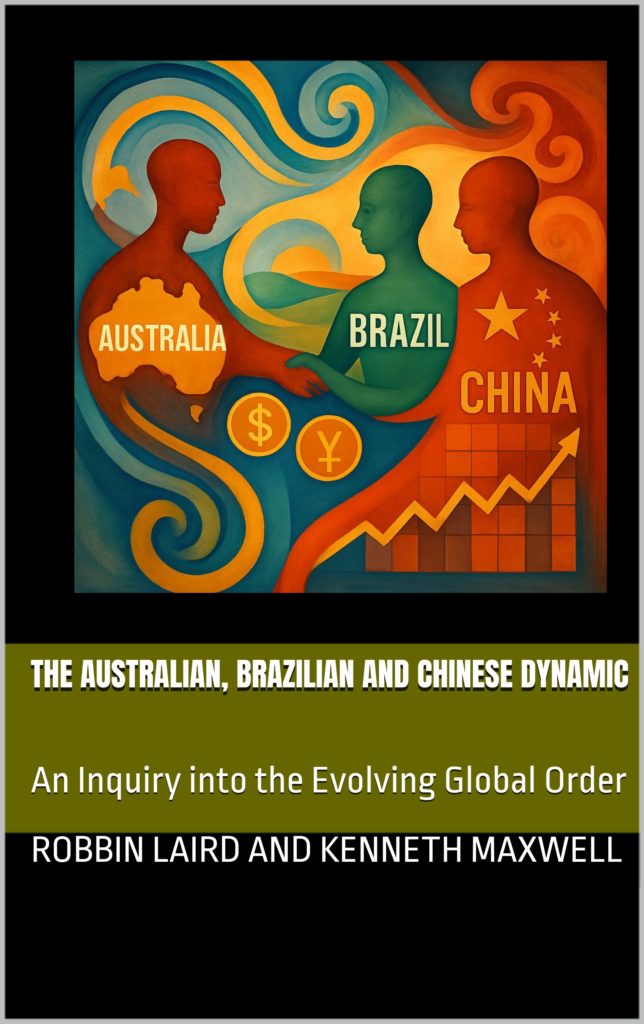
By Robbin Laird
Australia faces a strategic contradiction that reveals much about the complexities of navigating major power competition in an economically interdependent world. While Canberra signs billions in critical minerals agreements with Washington to counter Chinese dominance, Australian mines majority-owned by Beijing-backed firms continue supplying raw materials vital for China’s hypersonic missiles and nuclear programs. This isn’t just policy incoherence. It’s a case study in how economic dependencies can undermine strategic positioning.
The contradiction is stark. In October 2025, Prime Minister Anthony Albanese and President Donald Trump announced a $13 billion critical minerals framework designed explicitly to “curb China’s dominance over supply chains.” The agreement pledges over $3 billion in joint investments within six months to advance projects valued at $53 billion. Australia positioned itself as America’s “partner of choice” for breaking Beijing’s stranglehold on rare earth processing.
Yet simultaneously, Australia supplies China with 41 percent of its zirconium imports, a critical mineral China itself admits creates “severe challenges to resource security.” Zirconium’s applications aren’t limited to bathroom tiles. Its high melting point above 1,800 degrees Celsius makes it indispensable for nuclear fuel rod cladding and the extreme temperatures endured by hypersonic missiles traveling at five times the speed of sound. China’s National University of Defense Technology explicitly identified zirconium allocation as “a critical issue for ensuring national security and advancing military technological progress.”
This isn’t theoretical vulnerability. Russia has tested hypersonic missiles including the Zircon against Ukrainian civilian targets throughout the war. Data obtained by Four Corners shows that since Russia’s 2022 invasion, zirconium exports from China to Russia have surged more than 300 percent, reaching nearly $70 million in the year to February 2025. The ultimate parent company of one Australian miner sent over $5 million worth of zirconium to Russia during that period, with the largest buyer being CMP—an arm of Russia’s state-owned Rosatom that produces cladding for nuclear fuel rods and alloys for hypersonic missiles.
The question isn’t whether Australia knows about these supply chains. The question is why Canberra simultaneously enables and claims to counter them.
China’s approach to securing zirconium access demonstrates sophisticated understanding of supply chain vulnerabilities. Rather than relying solely on imports, Beijing-backed companies became major shareholders in the two Western Australian mines producing the mineral.
Image Resources, listed on the Australian Stock Exchange, has China’s LB Group as its largest shareholder, approved by Australia’s Foreign Investment Review Board in 2015. China receives 100 percent of Image Resources’s production through LB Group subsidiary purchases. The LB Group’s annual reports detail eleven pages of Chinese government support, including payments for “strategic emerging industries” and development of nuclear-grade zirconium sponges.
Image Resources hasn’t been shy about the military applications. Its 2024 annual report explicitly stated that zirconium can be used in “nuclear energy, jet engines, rockets and hypersonic vehicles.” In 2017, CEO Patrick Mutz told a trade publication that Image Resources’s primary customer was “one of the only companies, if not the only company in China, licensed to produce nuclear-grade zirconium sponge.”
The second major source is the Thunderbird Mine near Broome, where FIRB approved Chinese company Yansteel purchasing a 50 percent share in 2020. Like Image Resources, Thunderbird sells 100 percent of its production to China. The federal government went further than merely approving Chinese ownership. It gave Thunderbird a $160 million concessional loan from the Northern Australia Infrastructure Facility in 2022, a key factor in bringing the mine into production.
The NAIF’s promotional materials for this taxpayer-backed loan made no mention of defense applications for zirconium, saying only that demand would grow from “construction, advanced manufacturing and renewable energy.” This omission is telling. Either Australian officials didn’t understand what they were financing, or they understood perfectly and proceeded anyway.
Defence Minister Richard Marles doesn’t believe tighter controls are needed. His reasoning reveals the intellectual framework or lack thereof behind Australia’s approach: “There are other sources of zirconium from around the world, such that Australia withdrawing from the zirconium market would not mean the military use of zirconium would also stop.”
This logic deserves scrutiny. By this reasoning, no single country should ever implement export controls on anything, since alternative sources theoretically exist. It’s the nonproliferation equivalent of arguing that one person’s vote doesn’t matter because elections have many voters. The argument ignores cumulative effects, strategic signaling, and Australia’s particular position as the world’s largest producer supplying 41 percent of China’s imports.
Marles continued: “China is our largest trading partner on the one hand, and our biggest source of security anxiety on the other. And that’s just the way the world is.” This formulation treats the contradiction as inevitable rather than as a policy choice. But “that’s just the way the world is” isn’t strategy, it’s resignation dressed up as realism.
David Kilcullen, military strategist and former adviser to the U.S. Secretary of State, offers a different perspective: “I think it’s really important for us to have an understanding of where our minerals go… it’s appropriate to be applying those [controls] to things that might be used for nuclear or missile production.” Jennifer Parker, a former naval officer at ANU’s National Security College, puts it more bluntly: “We need to ask a lot of hard questions about what we are trading, who we’re trading it with, what does that mean for their capability, and what does that mean for our vulnerabilities.”
The challenge of tracking end-use becomes exponentially harder when dealing with China’s military-civil fusion doctrine. This policy explicitly integrates civilian industries with military applications, making the distinction between commercial and defense purposes deliberately opaque. As Kilcullen notes: “Everything now, not only in nuclear technology, but writ large, is dual use. That’s particularly true of nuclear capability. [China’s military-civil fusion doctrine] puts commercial companies and commercial tech development under the control of the military.”
Australia’s current regulatory framework requires companies to declare end users when exporting raw mineral sands to China, but this creates only the illusion of control. The trade remains lightly regulated, and once materials enter China’s processing network, tracking becomes functionally impossible. There’s no meaningful distinction between zirconium processed for “civilian” nuclear power plants and that used in military nuclear programs or weapons systems.
The October 2025 U.S.-Australia framework agreement embodies both the potential and contradictions of allied critical minerals cooperation. Beyond the headline $13 billion commitment, specific projects include:
- U.S. Export-Import Bank financing of $2.2 billion for RZ Resources’ Copi Project, unlocking up to $5 billion in total investment, the first U.S.-backed Australian minerals venture in over a decade
- U.S. Department of War backing for a 100-metric-ton-per-year gallium refinery at Alcoa’s Wagerup facility in Western Australia, developed with Japanese participation
- Australian government commitment of $100 million equity investment to the Arafura Nolans project in the Northern Territory, expected to supply about 5 percent of global rare earths once operational
- These are substantial commitments. Yet they exist alongside the continued flow of Australian minerals to China for military applications. The partnership with Washington emphasizes moving “up the value chain” through domestic processing and manufacturing rather than just extracting raw materials. But as John Coyne of ASPI notes, success requires “specificity, execution and discipline”, precisely what Australia’s dual-track approach lacks.
The framework’s phased approach starting with rare earths (particularly neodymium, praseodymium, dysprosium and terbium for permanent magnets and high-temperature alloys) before expanding to lithium, nickel, cobalt, graphite and vanadium is strategically sound. Global demand for these magnets is projected to double to nearly $12 billion by 2030. But without controlling where Australian raw materials flow, building this value chain may simply create more sophisticated inputs for Chinese processing that ultimately serves Beijing’s strategic objectives.
Australia’s minerals diplomacy extends beyond the bilateral U.S. relationship. India-Australia engagement on critical minerals has “evolved and expanded” through the 2022 Australia-India Critical Minerals Investment Partnership, which removed tariffs on key Australian exports under their Economic Cooperation and Trade Agreement. By March 2023, five priority projects (two lithium, three cobalt) had been identified for joint due diligence.
The Quad Critical Minerals Initiative announced in July 2025 signals more coordinated efforts among Australia, India, Japan and the U.S. to reduce reliance on China. Yet as Alice Wai of ASPI observes, India’s initiatives remain “fragmented… through project-specific deals rather than a truly integrated, long-term framework.” This fragmentation mirrors Australia’s own contradictions.
The challenge for multilateral approaches is that they require genuine alignment of interests and coordinated policy implementation. When Australia simultaneously supplies China with materials for its military buildup while partnering with the US and allies to counter Chinese dominance, it sends mixed signals that undermine coalition cohesion. Economic nationalism and industrial policy may now be bipartisan features of US politics, but Washington will notice when allies’ actions contradict declared intentions.
What alternative approach might Australia pursue?
Several policy levers exist:
- Production mandates and advance-purchase agreements: The U.S. Department of War’s $400 million investment in MP Materials, with guaranteed minimum prices nearly double China’s market rate, demonstrates how industrial policy can shield producers from market volatility and strategic manipulation. Australia could extend similar mechanisms to allied producers, creating demand certainty that attracts private capital. A 10-year advanced-purchase program for refined oxides and magnet components would convert Australia’s resource advantage into industrial capability while ensuring outputs serve allied rather than adversarial strategic objectives.
- Enhanced export controls: Despite the military applications of zirconium, current Australian regulations remain light-touch. Requiring demonstrated civilian end-use with verification mechanisms, restricting exports to entities with known military connections, and implementing much stricter penalties for violations would signal that Australia takes its strategic position seriously. The argument that “other sources exist” ignores Australia’s market position and the cumulative effect of coordinated allied action.
- Ownership restrictions: FIRB approved Chinese majority ownership of zirconium mines during a different strategic era. Revisiting these approvals and implementing stricter guidelines for future investments in strategic minerals would prevent adversaries from controlling supply chains at the source. Joint ventures should require genuine capability transfer, with intellectual property, skills and downstream value remaining in Australia.
- Processing requirements: Exporting unprocessed ore generates limited returns and no resilience. Requiring domestic processing before export would create high-skilled jobs, expand national income, and provide visibility into end-use. Regional clusters integrating infrastructure, energy, digital networks and workforce planning could compete with established Asian producers.
- Regional mineral corridors: Rather than isolated projects, Australia should develop integrated corridors (such as through Darwin) with pre-structured offtake, pricing and traceability frameworks aligned to U.S. standards. This could expand into wider Indo-Pacific partnerships with Japan, South Korea and India, leveraging each country’s strengths in processing, industrial capacity and market demand.
The minerals contradiction raises a fundamental question about Australia’s strategic positioning: Is Canberra attempting to have it both ways because policymakers genuinely believe the economic and security tracks can remain separate, or because acknowledging the contradiction would require difficult choices about lost revenue and Chinese economic retaliation?
The evidence suggests the latter. China is Australia’s largest trading partner, and minerals exports generate substantial wealth. Implementing serious controls would invite Beijing’s displeasure, likely triggering targeted economic coercion as Australia experienced during the 2020-2021 trade restrictions. The political calculus appears to be that maintaining profitable trade while rhetorically supporting allied strategic objectives offers the path of least resistance.
But this calculation ignores several realities.
- First, the economic benefits of current arrangements accrue primarily to mining companies and their shareholders (including Chinese state-backed entities) rather than generating broad-based Australian industrial capability or employment.
- Second, dependence on Chinese demand creates vulnerability to precisely the economic coercion that controls are meant to avoid.
- Third, contradictory policies undermine Australia’s credibility with allies whose support matters enormously for deterrence and defense.
Most fundamentally, the approach reflects confusion between economic interdependence and strategic vulnerability. Interdependence can stabilize relationships when mutual; it becomes vulnerability when asymmetric. Australia’s current policy maximizes asymmetric dependence. China can easily source zirconium elsewhere or develop alternatives, while Australia becomes dependent on Chinese demand with limited alternatives. The strategic objective should be making Australia indispensable as a producer whose industrial strength reinforces partnership security, not as a supplier of raw materials that fuel adversarial military capabilities.
In short, Australia’s rare earth minerals policy embodies the tensions facing middle powers navigating great power competition in an economically integrated world. The contradictions aren’t unique to Australia, similar dynamics exist across allied nations struggling to balance economic interests with security imperatives. But Australia’s position as both a major minerals producer and a frontline state in potential Indo-Pacific conflict makes the stakes particularly high.
The October 2025 U.S.-Australia framework provides strong scaffolding for building resilient supply chains, but outcomes depend on execution and discipline. If Canberra continues supplying raw materials for Chinese and Russian military programs while simultaneously claiming to be Washington’s partner of choice in breaking Beijing’s critical minerals dominance, the contradiction will eventually become unsustainable.
The real measure of success won’t be diplomatic announcements or headline investment figures. It will be whether Australia develops complete value chains with domestic processing and manufacturing, whether exports serve allied rather than adversarial strategic objectives, and whether economic policy aligns with rather than undermines security strategy.
As Defence Minister Marles observed, China is simultaneously Australia’s largest trading partner and biggest source of security anxiety. But this isn’t “just the way the world is”: it’s the result of policy choices. Different choices could create different realities. The question is whether Canberra has the strategic clarity and political courage to make them before contradictions foreclose options entirely.
The alternative to choosing is having the choice made for you by Beijing’s expanding military capabilities, by allied frustration with Australian free-riding on security while profiting from adversarial trade, or by crisis that reveals dependencies as vulnerabilities. In strategy, as in life, you can’t serve two masters. Australia is learning this lesson in real time, with its rare earth minerals serving as the test case for whether middle power hedging remains viable in an era of sharpening great power competition.
Sources
Coyne, John. “How to implement US minerals deal: create Australian industrial capability.” The Strategist, Australian Strategic Policy Institute, 23 October 2025.
Wai, Alice. “India–Australia engagement on critical minerals is evolving and expanding.” The Strategist, Australian Strategic Policy Institute, 7 November 2025.
Wai, Alice. “US and Australia deepen critical minerals engagement to counter China.” The Strategist, Australian Strategic Policy Institute, 5 November 2025.
Grigg, Angus, Alex McDonald, and Will Nicholas. “Australia supplying China with critical mineral vital for hypersonic missiles and its nuclear program.” ABC News, 2 November 2025.
For my latest book on Australian defence which is now in e-book and paperback as of January 15, 2026:
And our book on a look at middle power positioning in our book to be published later next year: