


By Robbin Laird
The Sir Richard Williams Foundation seminar of 23 April 2026 brought together practitioners, analysts, industry leaders and allies to confront a deceptively simple question: what does it actually mean to exploit Australia’s strategic advantage, not in a decade, but now?
“Fight Tonight” was not a slogan but a stress test. It was applied to platform readiness, training pipelines, industrial capacity, space architecture, intelligence integration, munitions stockpiles and, crucially, the honesty with which government explains the strategic situation to its own citizens.
The program framed four themes: building combat mass and depth across domains; generating tempo; enhancing industry and the national support base; and surviving to operate through redundancy and dispersal. Presentations made clear that these are not sequential objectives but simultaneous requirements under a tightening timeline.
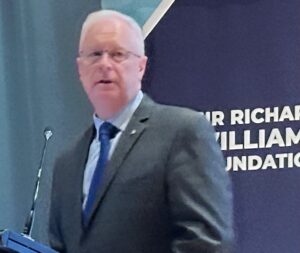
The Strategic Clock
Mike Pezzullo, former Secretary of Home Affairs, delivered the day’s most arresting intervention: Australia is preparing for the wrong war on the wrong timeline. The dominant ten-year planning horizon embedded in most defence documents simply does not match the window of strategic risk.
Pezzullo traced his own reckoning back to Anzac Day 2006, when serving as Deputy Secretary for Strategy he read highly classified intelligence on PLA developments and put a single question to then-CDS Air Chief Marshal Angus Houston: does the classical Defence of Australia model still work?
That model, codified in the 1987 Dibb white paper, assumed focus on the northern approaches, ready U.S. enablers and a militarised Indonesia as the most plausible challenge, not a global peer competitor contesting U.S. access. By 2006, he had concluded the framework was breaking down as the PLA built the means to push the Americans back.
In Pezzullo’s judgment, much of the ensuing twenty-year warning time has been squandered. The 2026 National Defence Strategy, with its recapitalisation agenda and aspiration toward a more independent maritime and strike capability by the mid-2030s, is not wrong in what it attempts but it is not the force Australia needs ten months from now. His ten-month clock is anchored in the intelligence record: Admiral Philip Davidson’s 2027 window assessment, consistent warnings from Admirals Aquilino and Paparo, and former CIA Director William Burns’s 2023 statement that Xi has directed the PLA to be ready to give him a military option on Taiwan by 2027.
Pezzullo assigns around a ten percent probability to the actual use of force, blockade, quarantine or assault, but notes that the most opportune period runs through the March–April 2027 weather window, roughly ten months from the seminar. His prescription was pointed: commission a genuine national war book, restructure diplomacy around a coalition fight in which the United States and China are the principal antagonists, and produce a ten-month readiness plan in parallel with ten-year recapitalisation.
Air Power and Fighting Depth
Air Marshal Stephen Chappell, Chief of Air Force, offered the most comprehensive account of how Australia’s advantages can be converted into deterrent airpower. His framework, building fighting depth, ran from geography and basing through human capital, technical investment and national aviation potential to allied integration.
Geographically, Chappell encouraged thinking of Australia not as a single island continent but as an archipelago, drawing on the work of Andrew Carr. An archipelago is defended by disaggregation, dispersal and distributed operations, the logic underpinning RAAF posture and exercises such as Bronze Crocodile, which develops runway repair and airfield recovery at Townsville, and Point Group Rising, which reconnects the force to the reality that bases are the core of the weapon system.
On human capital, Chappell was emphatic: the RAAF is a tier-one force, and he offered evidence rather than rhetoric. An E-7A Wedgetail deployed at short notice into a two-way range in the Middle East, with crews sheltering under air raid sirens before regenerating airpower. The Air Warfare Instructors Course, running since 1954, produces graduates who hold their own with the best at Nellis. An Air Mobility graduate captained a C-130J into Tel Aviv between ballistic missile barrages to evacuate more than a hundred Australians and New Zealanders.
Technically, the F-35A, Super Hornet and Growler fleets remain at the leading edge. The MQ-28 Ghost Bat has now demonstrated its credentials as a genuine combat system by firing an AMRAAM and shooting down a target. The National Air Power Council, co-chaired by Chappell and his transport counterpart, is designed to harness the broader national aviation ecosystem, some 50,000 Australians and approximately 2,200 airfields, into a coherent airpower resource.
AIRCDR Matthew McCormick, Commander Air Combat Group, gave the practitioner’s view from inside the force. The long transition following F-111 withdrawal is over. ACG has moved into spiral upgrading, with the F-35 as its backbone and the focus shifting from standing up platforms to maximising their effect. The tri-national Joint Simulation Environment at Pax River is central: RAAF pilots arrive confident and leave appropriately “recalibrated,” and at the most recent event the ACG team achieved the highest score of the year against a field dominated by U.S. weapons school students and instructors. In an era where fighter kill ratios against peers are closer to two-to-one than the ten-to-one of the Top Gun era, this matters.
Lessons from Active Theatres
Justin Bronk of RUSI brought the perspective of someone who walks airbases under fire and draws operational conclusions from live conflict. Across Ukraine, Operation Epic Fury in the Gulf and the Indo-Pacific, he interrogated the evolving balance between integrated air and missile defence (IAMD) and precision strike.
In Ukraine, Bronk challenged the mythology of “cheap mass.” Achieving meaningful effects against defended targets may demand 250–400 one-way attack UAVs per strike, at US$30,000–50,000 each, carrying warheads in the three-to-six pound range. Against hardened or high-value targets of the kind that matter in an Indo-Pacific scenario, such systems are, at best, decoys and enablers that increase the probability of kill for high-end munitions; they do not replace ARGMs, PRSMs and other standoff weapons.
In the Gulf, Bronk cautioned against overstating Epic Fury as an IADS-busting triumph. The United States executed an accomplished strike campaign, but much of the opponent’s IAMD architecture had already been systematically degraded by Israeli operations in 2024–25. More instructive were the limits of coercive leverage: making a fight existential by signalling regime change closes off negotiated off-ramps and incentivises hardline resistance rather than compromise.
Bronk’s starkest warning concerned stockpiles. Gulf partners expended more than 2,000 PAC-3 interceptors during the campaign at around US$6 million per round. SM-3s for U.S. forces run to roughly US$43 million each, and standard “shoot-shoot-look” protocols mean expending the equivalent of an F-35’s cost per incoming threat. Most Western air forces, Australia included, cannot afford to field defensive stockpiles at that scale while simultaneously buying the offensive long-range strike that actually deters. The implication is a greater emphasis on passive defence: hardening, dispersal and rapid sortie generation, rather than false comfort in exquisite but unaffordable interceptors.
His strategic bottom line was crisp: defence buys time but offence denies the adversary’s theory of victory. The force that survives to generate sorties and deliver precision effects is the force that shapes the operational calculus.
Maritime Power in Transition
Rear Admiral Matt Buckley, Acting Chief of Navy, spoke from three decades at sea, much of it in submarines. Deterrence, he argued, is not a single platform but an integrated all-domain effect generated by persistent posture and credible lethality. Availability and lethality must be held together: a lethal ship that is not available does not deter, and an available ship without credible lethality invites challenge.
On any given day around half the fleet is at sea: as Buckley spoke, 23 ships and more than 1,600 sailors were deployed, and his weekly readiness brief rarely shows fewer than ten ships underway. This is readiness as practised behaviour, not a planning assumption. The Enhanced Surface Combatant Lethality Program has integrated Tomahawk, NSM, SM-6 and the Aegis Baseline 9 upgrade onto the Hobart class, transforming them from presence platforms into serious contributors to joint deterrence.
The Navy must nonetheless grow by roughly 25 percent in people and platforms within a decade, approximately 4,000 personnel, into increasingly complex systems. Buckley’s confidence rests on people: the night before the seminar he was informed that a young Australian nuclear technician, in only her second year, had recorded the highest score ever for her category at U.S. Nuclear Power School, a performance the Americans are putting on a plaque.
Space, Industry and the Alliance
Space is no longer a distant frontier; it is essential infrastructure already under daily pressure. Jeremy King of Lockheed Martin Australia and New Zealand stressed that any force that loses assured space access loses the ability to integrate joint effects at scale: an F-35 without resilient space-derived communications, navigation and ISR is a diminished platform, and a joint force without space is joint in name only. The proliferation of counterspace programmes from three nations in 2018 to at least thirteen tracked in the 2026 Secure World Foundation report makes resilience by design, allied architectures and deliberate industrial integration non-negotiable.
Harvey Wright of Optus Satellite highlighted how collapsing launch costs and the dominance of commercial satellites, now roughly ninety percent of objects on orbit, have transformed the strategic equation. His framework centred on sovereign control of critical ground infrastructure, delivery at commercial speed rather than multi-year procurement tempo, and targeted investment in key technologies with Australian firms and research institutions: the logic of distributed resilience applied to space.
Industry speakers Kris Christensen of BAE Systems and Richard Morris of Northrop Grumman brought the readiness debate to the factory floor. Christensen’s war-footing workshops use back-casting from a 2027 crisis to ask what workforce, business and capability decisions leaders will wish they had made in 2026. Readiness, she argued, is threefold: workforce readiness (people, clearances, surge capacity), business readiness (the ability to contract and decide at speed), and capability readiness (spares, tooling, local suppliers). If it cannot be sustained, it is not really a capability.
Morris argued for reversing the traditional mission–mass–manufacturing–margin logic. In a zero-warning world, margin must come first because it sustains industry at all. Profits fund investment; investment builds factories; factories generate combat mass. The proliferation of FPV drones in Ukraine emerged from industrial actors making practical, profitable decisions at scale, not from mission-first procurement doctrine. Australia’s distinctive advantage is the current influx of primes from the United States, United Kingdom, Europe, South Korea and Japan seeking global production capacity. Seen through a margin-first lens, this is a strategic asset that can embed Australian industry inside global supply chains before crisis arrives.
The alliance dimension threaded through Colonel James Landreth’s remarks as USINDOPACOM’s liaison to HQJOC and through Bronk’s munitions warning. The U.S.–Australia alliance is an asymmetric advantage adversaries cannot replicate, built over a century and manifested in deeply integrated operations, logistics and intelligence. Australia as theatre provides distributed logistics that mitigates tyranny of distance, and posture initiatives. from Marine Rotational Force Darwin to enhanced bomber rotations and Talisman Sabre, translate geography into operational reality.
But as Justin Bronk underscored, the comfortable assumption that the United States can always act as “arsenal of last resort” has eroded, as even close allies such as Estonia and Finland now discover in delayed deliveries and public caveats. For Australia, Bronk’s guidance could not have been clearer: the munitions available on day one of conflict are effectively the munitions available for the duration. Buy as many as you can, as fast as you can.
Advantage as Active Work
Taken together, the 2026 Williams Foundation seminar portrayed a country with genuine strategic advantages that require constant work to exploit and can be rapidly eroded by complacency, underinvestment or institutional slowness. Geography is a fact but not a strategy. Partnerships are a foundation but demand maintenance. Recapitalised forces are a starting point that must be organised and operated to deliver integrated combat power at the moment of decision.
Across domains, the outlines of an answer emerged. Geographically, dispersal, distributed operations and agile combat employment convert continental depth into resilience. The human dimension benefits from sustained investment in a tier-one workforce capable of extraordinary performance when circumstances demand. Technically, spiral upgrades, autonomous systems like Ghost Bat and integrated space architectures extend reach without exhausting scarce human capital. Industrially, a margin-first logic and integration into global supply chains build sovereign capability before crisis. In intelligence and space, disciplined foundational work and allied-by-design architectures turn data into decision advantage and fragility into resilience.
Over all of this hangs Pezzullo’s challenge: the clock is wrong, and someone must say so. “Fight Tonight” is not a metaphor. It is a standard against which Australian readiness must now be honestly measured.
Australia’s Strategic Geography and the Defence of Australia: A Conversation with Dr. Andrew Carr