

By Robbin Laird
In the early 2000s, a billion-dollar Predator drone circled over a combat zone, its high-definition cameras capturing perfect imagery of enemy positions below. On the ground, a Special Forces operator, weighted down with 80 pounds of gear and under enemy fire, was effectively blind. He knew the drone was overhead, but he couldn’t see what it saw. Instead, he relied on shouted radio coordinates, trying to construct a mental picture of the battlefield while bullets snapped overhead.
It was a perfect encapsulation of military dysfunction: 21st-century technology in the sky, World War II communications on the ground.
The solution didn’t emerge from a defense contractor’s engineering lab after years of development and billions in procurement funding.
Instead, it came from a Chief Warrant Officer named Manuel who asked the most dangerous question possible in military bureaucracy: “If the drone can see it, why can’t I?”
Rather than wait for the official answer which would have involved submitting requirements, waiting perhaps a decade for a properly encrypted secure system, and navigating endless procurement reviews, a major named Greg Robbins went to his local Radio Shack. He bought analog TV parts, jury-rigged a receiver using a Panasonic Toughbook laptop, pinned some antennas to his tactical vest, and hacked the drone’s video feed. It worked immediately. Ground operators could suddenly see what the Predator saw, cutting out the deadly middleman of verbal descriptions.
This improvised system became ROVER (Remotely Operated Video Enhanced Receiver), a crucial capability that spread throughout the force.
This story, detailed in my new book “Lessons in Military Transformation,” captures something fundamental about how real innovation happens in military organizations and why it so often doesn’t. My work isn’t standard military history written from archives and official documents. It is a ongoing set of field reports, the product of decades spent visiting air bases, aircraft carriers, and maintenance hangars, talking to the practitioners who turn wrenches and fly missions rather than the theorists who populate Washington conference rooms.
The Innovation Protector
The Radio Shack hack reveals grassroots ingenuity, but there is another crucial element: what one might call the “innovation protector.” Brilliant ideas from the field routinely get crushed by bureaucratic antibodies unless someone with real authority shields them. In this book, that protector is former Air Force Secretary Michael Wynne, whose tenure from 2005 to 2008 became a case study in both the necessity and the fragility of disruptive leadership.
Wynne operated with a personal intensity rare among Pentagon officials. His brother Patrick, a pilot, had been shot down in Vietnam, not just by “the enemy” in some abstract sense, but specifically by a sophisticated Russian surface-to-air missile sold to North Vietnam. That detail shaped Wynne’s entire worldview. While the defense establishment in the mid-2000s focused obsessively on counterinsurgency, fighting enemies without air forces in places like Iraq and Afghanistan, Wynne fixated on peer competitors. He understood that even when America wasn’t directly fighting sophisticated adversaries, their technology was what killed American personnel. He tried to pivot the Air Force back toward high-end warfare preparation when the entire apparatus wanted more armor on Humvees.
One incident defines Wynne’s approach. He walked into a briefing on the Joint Unmanned Combat Air System (J-UCAS), a revolutionary concept for a stealthy autonomous combat drone designed to penetrate sophisticated air defenses. The program managers announced they wanted to pause development to integrate mid-air refueling capabilities. On its face, this seemed reasonable, range matters. But Wynne recognized it for what it was: requirements creep, the number one killer of military innovation.
The prototype hadn’t even proven it could fly autonomously in combat. Mandating refueling capability at that stage meant adding enormous weight, complex fuel systems, extensive new software, and fundamental structural changes. They were gold-plating a concept to death before it could even get off the whiteboard, prioritizing a peripheral process over core capability.
Wynne picked up the briefing binder and threw it across the table. It slid down and hit one of the principals. He said simply, “Come back when you have something to say about the airframe,” and walked out.
Nonetheless or perhaps because he was a protector of innovation, Wynne was eventually fired by Defense Secretary Gates, ostensibly for complex reasons but fundamentally for speaking truth to power.
He kept insisting on preparing for great power conflict and building more F-22s when leadership wanted every dollar focused on the immediate wars. He was right, but right too early, the classic tragedy of visionary leadership in sclerotic institutions.
From Crisis Management to Chaos Management
Traditional military thinking assumes peace as the baseline state. Crises erupt, you surge forces to fix the problem, then return to stability. This worldview implies that stability is the natural order of things.
Those days are over.
We’ve entered an era requiring chaos management and accepting that the environment is permanently turbulent.
You’re not trying to fix it and return to some imagined stable state. You’re trying to operate effectively within persistent instability.
The V-22 Osprey exemplifies this shift. When it emerged, the press savaged it. It crashed in testing. It cost enormous sums. Critics asked why the Marines needed this complicated tilt-rotor aircraft when helicopters were cheaper. They saw it as just a faster helicopter, a marginally improved truck.
But that wasn’t the point. When Marines actually deployed it to the Pacific, they realized it wasn’t a truck at all: it was connective tissue. Its speed and range fundamentally changed battlefield geometry. Captain Medlin, an officer I interviewed last year at 2nd Marine Air Wing, offers a vivid comparison: old warfare resembles a Walmart Supercenter, while distributed operations resemble mom-and-pop stores.
The Walmart model means building massive bases like Bagram in Afghanistan, everything in one place, incredibly efficient, with fuel, ammunition, communications, even fast food franchises. But against a peer competitor like China or Russia, such bases are giant targets. One missile volley ends your operation.
The alternative distributes everything: fuel on this island, ammunition on that one, a temporary runway on a third. If the enemy hits one node, the network survives. This is wildly inefficient in the traditional sense which is precisely why it’s called chaos management, not efficiency management. You deliberately trade efficiency for survivability.
This only works if personnel can think independently. You cannot run a distributed network with rigid, top-down rulebooks. Which brings us to the cowbells. Major General Swan, then commanding 2nd Marine Air Wing, actually handed out physical cowbells, literal clanging bells, I know for I have one, to reward improvisation. If a maintainer ignored the manual to get a jet operational faster, he received a cowbell. It was both humorous and deadly serious: a tangible signal from leadership that output mattered more than bureaucratic process. In chaotic environments, people waiting for permission to act are already dead.
You need a culture actively incentivizing intelligent rule-breaking.
But you can’t just declare that chaos is acceptable and expect success. Marines at Marine Aviation Weapons and Tactics Squadron One (MAWTS-1) in Yuma, Arizona, created “the innovation triangle.” In most military organizations, testers work in Maryland, the schoolhouse operates in Florida, and operational pilots fly from Virginia. The feedback loop takes years.
At MAWTS-1, they’re neighbors. The school, testers, and operational squadrons co-locate. If a tactic fails on a morning flight, the instructor knows by lunch and testers are working on fixes by dinner. They train for what they call “the physics of combat”, not PowerPoint scenarios, but actively practicing failure. They assume radios will be jammed, logistics won’t arrive, and plans will collapse on contact with the enemy.
In chaos management, the plan never survives that contact.
The Digital Revolution and the Rise of Purple Shirts
Parallel to cultural transformation runs technological revolution. Squadron HMLA-267 took H-1 platforms, Hueys and Cobras with DNA from Vietnam, and gave them digital brain transplants. They look like old helicopters but function as flying server nodes, sharing targeting data and seeing what F-35s see. The pilot isn’t just a shooter anymore; he’s an information manager.
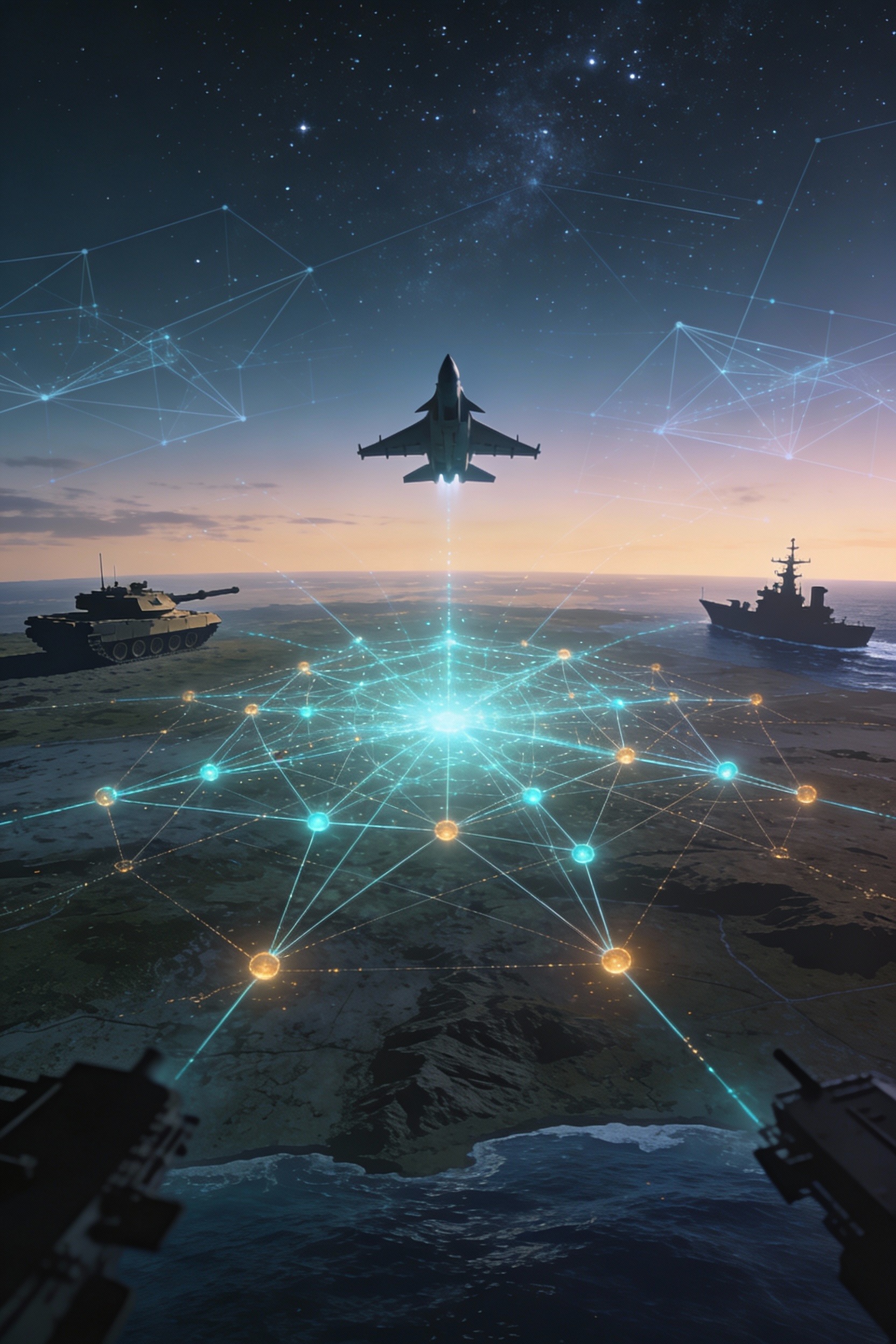
This crystallizes in the kill web. Traditional warfare relied on the “kill chain” with find, fix, track, target, engage. Linear, sequential, like old Christmas lights: if one bulb burns out, the whole string goes dark. If your forward radar gets jammed, you can’t shoot.
The kill web is a mesh network. If your radar fails, the shooter instantly pulls targeting data from a drone, ship, or satellite. The path to target changes dynamically. You can’t break the chain because there isn’t a single chain to break. The F-35 serves as quarterback, sucking up data from everywhere and distributing it to everyone.
In an Israeli operation called Operation Rising Lion, Israeli pilots among the world’s best refused to fly into contested airspace without F-35s leading, not because they needed its weapons but its sensors. The F-35 managed the web, making older F-15s lethal by telling them exactly where to look without activating their own radars.
But this creates cultural upheaval. If the network is the real weapon, the pilot pulling the trigger isn’t necessarily the most important person anymore. Vice Admiral Miller noted when I visited him at the Navy Air Boss that next war will be won or lost by “purple shirts” or the MISR (Maritime Intelligence, Surveillance and Reconnaissance) officers.
On aircraft carriers, purple shirts are traditionally fuel handlers, not the personnel who receive medals. But MISR officers are “warrior solution architects.” We’re shifting from the right side of the kill chain (target and engage, the Top Gun stuff) to the left side (find, fix, track). In modern warfare, finding the enemy is far harder than killing them. If you can find a Chinese carrier, you can sink it. The challenge is finding it in a massive ocean while they jam your sensors and hide in noise.
This completely inverts traditional hierarchies. Fighter pilots who’ve spent careers as gods of the air wing must accept they’re nodes on a network. The intelligence officer who isn’t even airborne might be calling plays. This isn’t a software problem: it’s a status problem. If pilots don’t trust Intel officers to guide the fight, the F-35 becomes an expensive paperweight.
The Synthesis
Bringing it together: from thrown binders to Radio Shack hacks to Pacific mom-and-pop stores to the rise of purple shirts, technology proves almost secondary to behavior. Transformation isn’t a destination you reach or a product you buy. It’s an evolutionary behavior, not a revolutionary event.
You can purchase F-35s, but running them with a Walmart mindset ensures defeat. As one deep dive participant noted, you can buy the world’s best electric guitar, but if you don’t know jazz, you can’t improvise. We’re entering a jazz era of warfare. Crisis management was classical music, perfectly following written notes. Chaos management is jazz: know your instrument, listen to the team, improvise when the rhythm changes.
This circles back to the Radio Shack moment. We spend millions on platforms and argue endlessly about defense budgets. But the most dangerous weapon system discussed here wasn’t the stealth fighter. It was the mindset of a major with a Radio Shack receipt and the audacity to fix a billion-dollar failure with a soldering iron.
The ultimate question isn’t whether we can build better technology.
It’s whether we’re building systems that allow that major to exist and thrive, or bureaucracies that ensure he gets fired for trying.
By spending decades with practitioners rather than theorists, it is clear to me that there is a persistent gap between Washington’s elegant plans and operational reality. The Radio Shack hack, the thrown briefing binder, the cowbells, the refusal of Israeli pilots to fly without F-35 sensor coverage, these aren’t anomalies to be dismissed. They’re data points revealing fundamental truths about how complex organizations actually innovate under pressure.
The tragedy is that we already know what works. We’ve seen it demonstrated repeatedly. The challenge is that what works often violates established protocols, threatens existing hierarchies, and makes people uncomfortable. Michael Wynne got fired. The ROVER system was developed outside official channels. The digital transformation of old Huey helicopters happened because maintainers and pilots refused to accept that legacy platforms were obsolete.
Military transformation isn’t simply about buying the next generation of technology.
It’s about creating conditions where the people closest to problems have authority to solve them creatively.
It’s about leaders willing to throw binders and award cowbells.
It’s about accepting that permanent turbulence is the new normal, not an aberration from peacetime stability.
The next war won’t be won by whoever has the best PowerPoint presentations. It will be won by whoever can manage the chaos.
And managing chaos requires jazz musicians, not orchestra players following a score.
It requires Radio Shack majors with soldering irons, not procurement specialists with five-year timelines.
The technology will follow.
The question is whether the culture can evolve fast enough to use it.