

By Robbin Laird
When visiting Bahrain some years ago, I made a point of seeing the Portuguese fort.
Standing inside those ancient walls, looking at the stonework — Arab foundations overlaid with Portuguese military engineering — I was struck by a simple but powerful thought: the strategic logic that drove a small European nation to project power across half the globe in the early sixteenth century has never really gone away. It has simply changed uniforms.
Kenneth Maxwell, my long-time colleague and collaborator, helped me understand what I was actually looking at. His analysis of the Portuguese presence in the Persian Gulf cuts through centuries of accumulated strategic thinking to reveal something foundational: the Portuguese did not merely discover trade routes. They invented the modern concept of the maritime choke point as an instrument of geopolitical power.
The Portuguese achievement was extraordinary by any measure. Beginning with Vasco da Gama’s arrival at Calicut on the Malabar coast of India in May 1498, within three decades a nation of perhaps a million and a half people had established a fortified trading network stretching from Mozambique and East Africa through Goa, Ceylon, and Malacca, all the way to Macao and eventually Nagasaki. They accomplished this not through overwhelming numbers — they never had those — but through a ruthless concentration of superior military technology at carefully selected geographic nodes.
The first Viceroy of India, Dom Francisco de Almeida, articulated the strategic doctrine with remarkable clarity in a letter to King Manuel. Sea power, he argued, was everything. Fortresses on land were secondary. Control the sea lanes and the trade would follow. Lose the sea and nothing else would matter. It was one of the earliest and most lucid expressions of what we would today recognize as a maritime-centered theory of strategic competition.
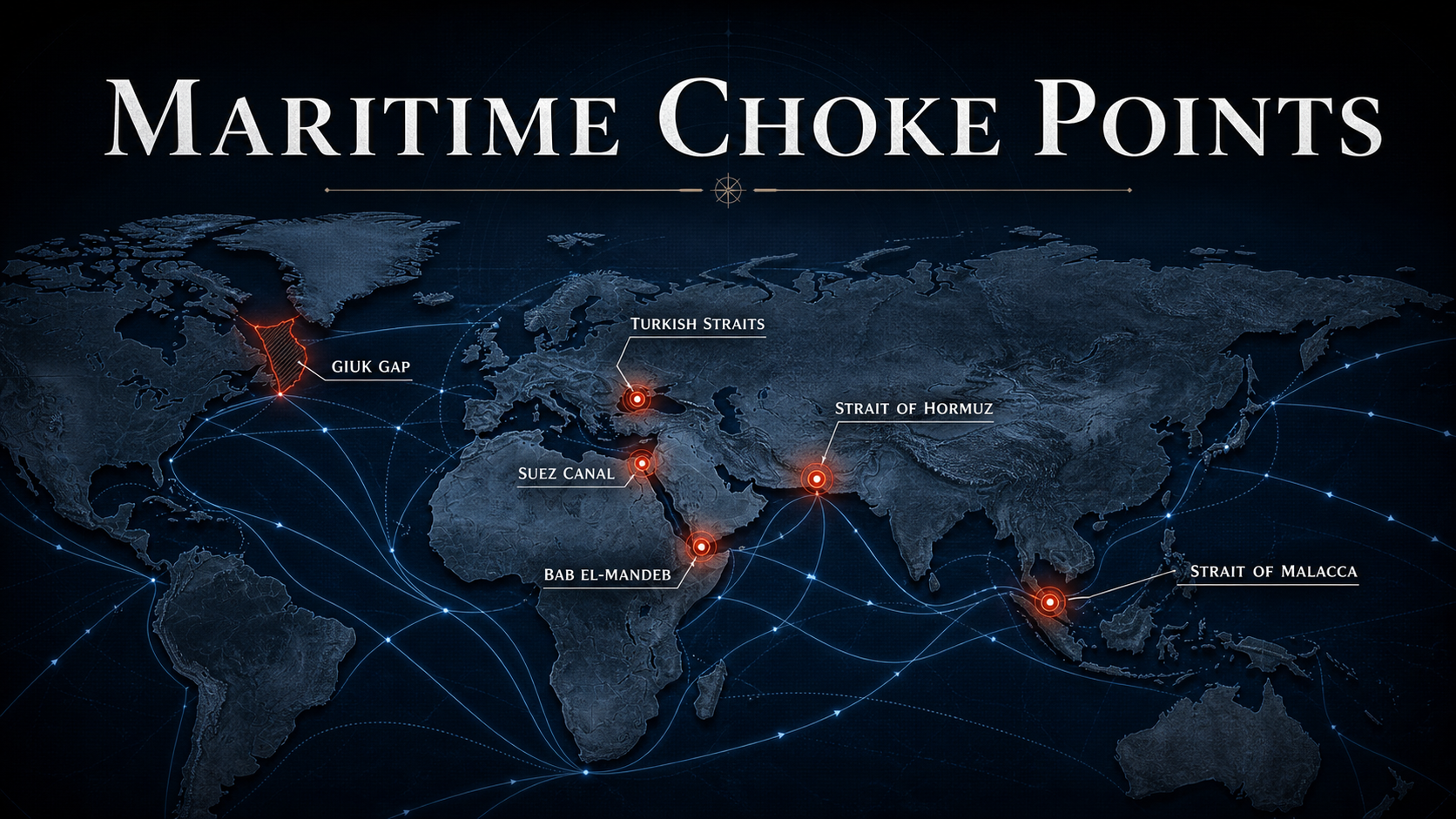
What Maxwell identifies as the Portuguese most enduring contribution is their systematic identification and exploitation of maritime choke points. Hormuz at the entrance to the Persian Gulf. Malacca commanding the passage between the Indian and Pacific Oceans. Aden at the mouth of the Red Sea, though here they ultimately failed, unable to dislodge the Ottomans who seized it in 1538 and held it for nearly a century.
The logic was elegant and ruthless in equal measure. Control the narrow passage and you control the trade. Control the trade and you control the revenue. Control the revenue and you can sustain the entire enterprise. The Portuguese enforced this system through a combination of fortified bases and what they called cartazas, essentially licenses to operate, granted to allies and denied to enemies. It was a protection racket backed by cannon, and for a generation it worked.
At Hormuz, the customs house they controlled sat at the crossroads of Iranian, Arab, and Indian commerce. Overland routes connecting the Indian Ocean to Europe through Basra, Baghdad, Aleppo, and Tripoli all passed through or adjacent to Portuguese-controlled checkpoints. At Bahrain — first reached by the Portuguese fleet in 1514, fortified by 1521, and held until the Safavid Shah Abbas expelled them in 1602, they commanded the Gulf’s internal trade routes. At Muscat, defended by a handful of Portuguese officers and locally recruited auxiliaries, they maintained the most strongly fortified base on the Arabian peninsula from 1508 until 1650.
The Portuguese enterprise was ultimately a thalassocracy — a sea-based empire that by its nature could never fully dominate the land. The great continental powers of the era, the Ottomans, the Safavids, the Mughals, operated on a different strategic plane. Portuguese control was always thin, always dependent on local cooperation, always vulnerable to the moment when a land power chose to contest the shore.
That vulnerability was the system’s structural flaw. When Shah Abbas allied with an English flotilla in 1622, some two thousand Portuguese were expelled from Hormuz. The choke point they had held for over a century changed hands. When the Omanis of the al-Ya’ruba dynasty moved on Muscat in 1650, that fell too. The Dutch and the English East India Companies, learning from and improving upon the Portuguese model, eventually replaced the original architects.
What makes Maxwell’s analysis so compelling for anyone thinking about contemporary maritime strategy is precisely this durability of the underlying template. The Strait of Hormuz remains today one of the world’s most consequential maritime chokepoints, with roughly a fifth of global oil supply transiting its waters. The Strait of Malacca remains the primary shipping corridor connecting the Indian and Pacific Oceans, the strategic waterway at the center of Indo-Pacific competition. Aden and Bab-el-Mandeb remain flashpoints.
The Portuguese did not simply find these places on a map.
They recognized their strategic logic, built physical infrastructure to exploit it, and established a pattern of great power competition over maritime access that has never ended.
Standing inside that fort in Bahrain, you are standing inside an idea that is still very much alive and still very much contested.
The Portuguese in the Persian Gulf: Hormuz, Bahrain and Mosul