By Robbin Laird
In August 2026, off Joint Expeditionary Base Little Creek-Fort Story, Virginia, a Navy-industry team quietly solved a problem that has constrained every discussion of unmanned maritime systems I have written about for the past several years: how do you keep an autonomous vessel on station without a person ever touching it?
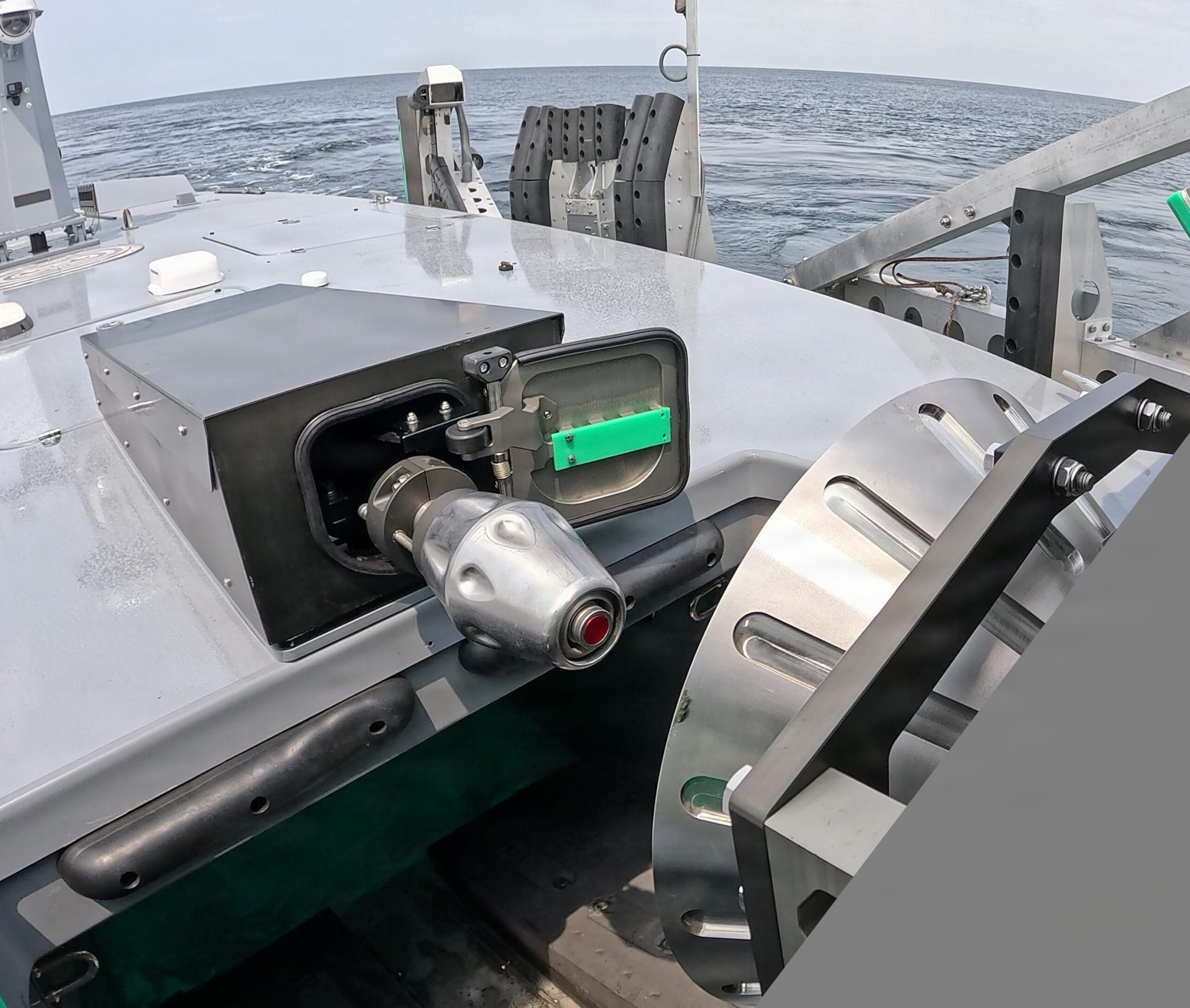
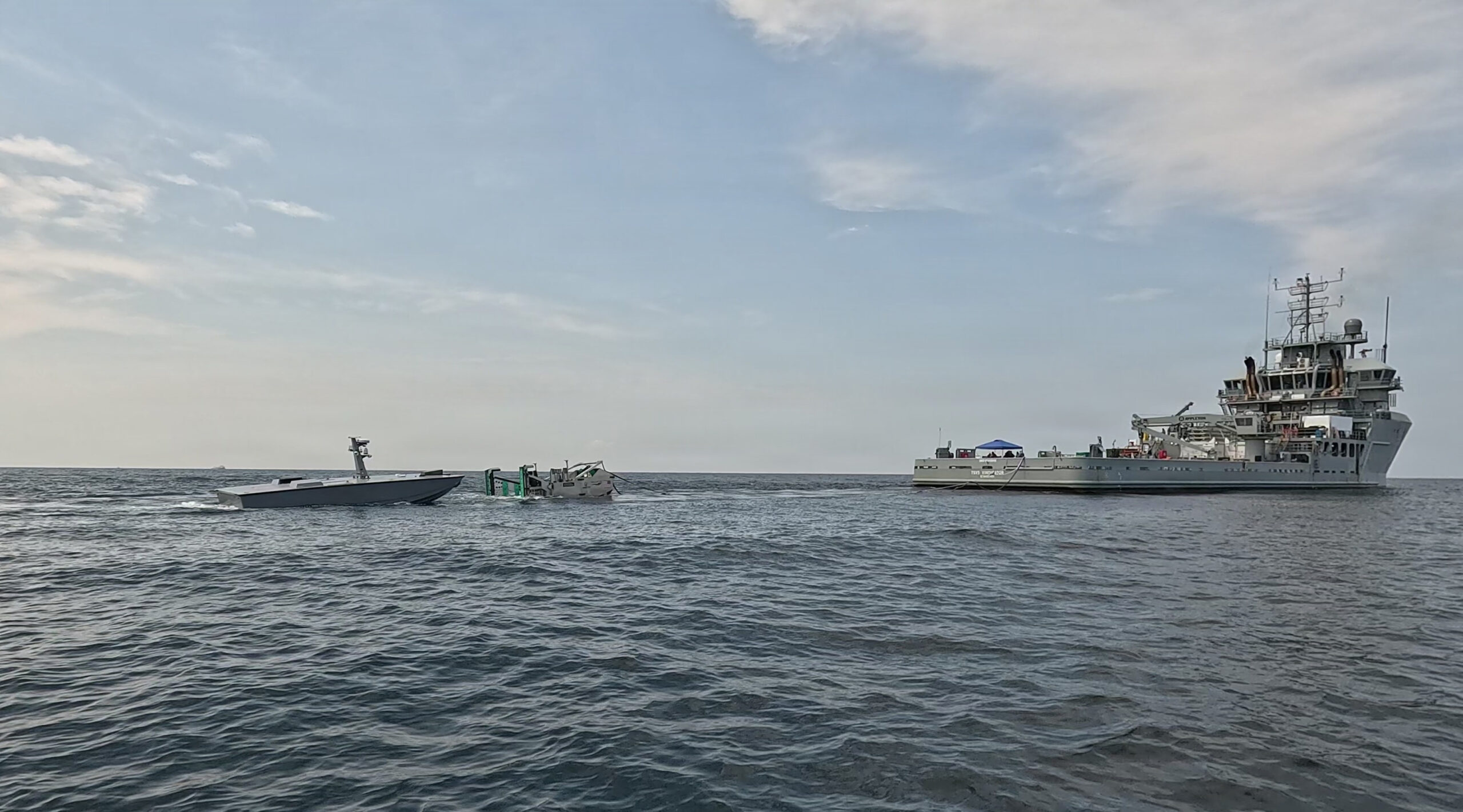
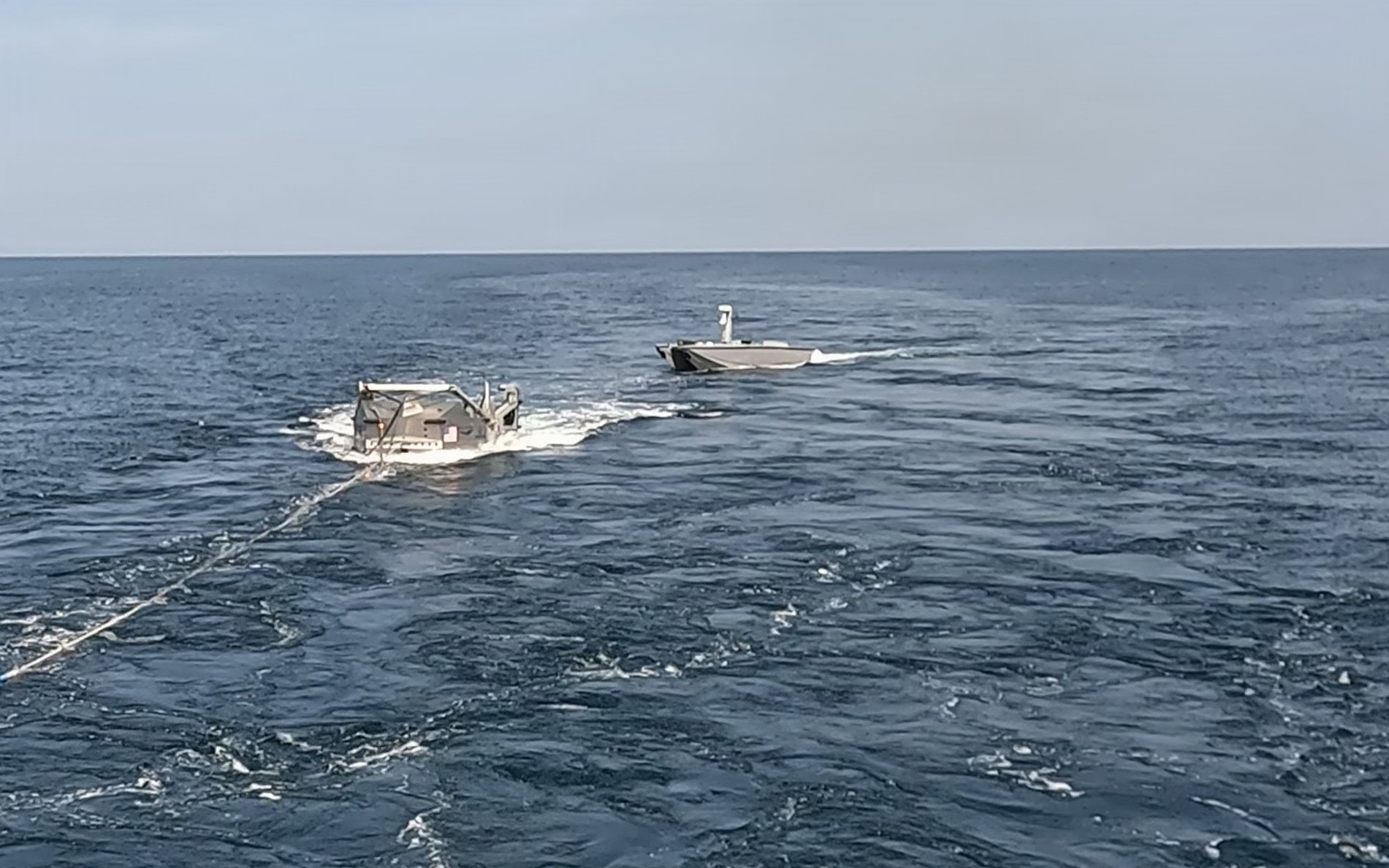
According to a Defense Visual Information Distribution Service report by Latasha Chavez, engineers from Naval Air Warfare Center Weapons Division’s Blue Water Instrumentation office (BWI), together with Maritime Tactical Systems Inc. (MARTAC) and the Israeli firm Sealartec, ran a demonstration in which a robotic towed connector repeatedly captured, refueled, and released an unmanned surface vessel at sea. The USV was MARTAC’s Navy-owned T38. The connector was Sealartec’s towable capture and connection device (TCCD), towed behind the training support vessel USNS Vindicator. Over the course of the demonstration and the days leading up to it, the system completed roughly one hundred connection cycles and transferred 400 gallons of fuel to the T38, moving from concept to on-water testing in seven months.
That is a modest-sounding technical milestone. It is also, I think, the missing piece in an argument I have been building across a shipbuilding book and a running body of work on what I call the maritime kill web: the argument that a fleet built around autonomous systems only works if those systems can be logistically sustained without reverting to the crewed-ship model they were meant to reduce dependence on.
The Problem Underneath the Demonstration
Spencer Holloway, director of BWI’s Future Capabilities Office, framed the immediate driver in operational terms tied to his own program: NAWCWD’s hypersonic and precision long-range fires testing increasingly requires data-collection assets distributed across flight profiles that extend thousands of miles beyond fixed test ranges. Every one of those distributed sensor nodes is a vessel, and every vessel that has to break off station and return to port for fuel opens a gap in coverage, loses the redundancy the test architecture is built on, and interrupts the mission it exists to support.
That is the test-range version of a problem I have been describing in warfighting terms. In the chapters I have been drafting on maritime logistics, the core argument is that a mesh fleet built from unmanned surface and undersea nodes does not eliminate the sustainment burden that navies have always carried: it relocates it. A single large combatant with organic fuel, water, and stores can loiter for weeks. A distributed mesh of smaller autonomous platforms, whatever it gains in numbers, dispersal, and expendability, inherits a much higher frequency of resupply events, and each of those events was, until recently, an argument for keeping a crewed vessel or a crewed boat team in the loop somewhere in the chain.
Ronald Raymer, branch head for capability, innovation, science and technology integration at U.S. Fleet Forces Command, said as much when he described what unmanned refueling actually buys the fleet: greater reliance on unmanned vessels instead of manned ones, the ability to push USVs into higher-threat areas without risking manned vessels and personnel, and the ability to distribute capability into an area without paying for large, expensive manned platforms to carry that capability there. That is a fair summary of the mesh-fleet argument stated from the operator’s side rather than the analyst’s side, and it is worth taking seriously precisely because it came from Fleet Forces Command rather than from a program office selling a system.
Closing the Loop
I spent a fair amount of the logistics chapter in the current shipbuilding manuscript working through Military Sealift Command’s hybrid-fleet planning and the Marine Corps’ terminal-distribution problem or the last tactical mile of getting fuel, parts, and stores to a dispersed force ashore or afloat. What was an answer to the equivalent last-mile problem for an unmanned surface vessel: who, or what, meets the USV at sea and keeps it fueled without a boat crew doing a manual connection?
The TCCD is a first answer to that question, and it is worth being precise about what kind of answer it is. This was not a one-off proof of concept; it was, by Sealartec CEO Amitai Peleg’s account, close to a hundred connection cycles run in quick succession, which is the kind of repetition count that starts to look like a maturing capability rather than a demonstration stunt. And critically, it was still a remotely operated process. Peleg was explicit that the next step on Sealartec’s roadmap is a fully autonomous architecture in which the USV approaches the refueling device, communicates through automated protocols, and maneuvers itself into position, removing the human operator from the loop entirely.
That distinction matters more than it might appear to at first. In the framework Ed Timperlake developed around payload utility or the idea that a mesh fleet lets a force buy target acquisition and target engagement separately rather than bundling both into a single exquisite platform is the same logic of disaggregation applies to sustainment. A refueling connector that still requires a human in a control loop is a labor-saving device. A refueling connector that a USV can find, dock with, and disengage from entirely on its own is a mesh-fleet node in its own right: a fixed or towed asset with its own autonomy stack, its own sensing, and its own role in the overall system architecture. Under that framing, BWI and Sealartec are not just solving a refueling problem; they are adding a new class of actor to the mesh, one whose only job is to extend the on-station time of every other actor in it.
The Mesh Gets a Fuel Line
This connects directly to the MARTAC thread I have been building since my interview with Tom Hanson, MARTAC’s Chief Information Officer, about what it actually takes to turn a collection of unmanned surface vessels into a functioning mesh rather than a fleet of boats operating independently. Hanson’s argument rested on the idea that platform autonomy is only half the problem; the harder half is the architecture that lets platforms behave as nodes in a system rather than as separate assets each requiring their own dedicated attention.
Fuel is the most basic form of that dependency. A mesh fleet that can share sensing, share track data, and hand off tasking across nodes but still requires each node to individually break formation and steam back to a pier is not yet a mesh in the operational sense. It is a set of independently sustained platforms that happen to talk to each other.
What the Little Creek demonstration adds is a sustainment layer that does not require the mesh to break its own formation to feed itself. A USV that can be met, refueled, and released by a towed or forward-positioned connector, ideally with decreasing human involvement over time, is a USV that can remain part of the mesh’s operational picture through the entire cycle rather than dropping out of it during transit to and from port.
It is also worth noting who assembled the contracting architecture that let this happen quickly: the Littoral Combat Ship Mission Modules Program Office and the Navy’s Portfolio Acquisition Executive for Robotics and Autonomous Systems provided the contracting support that let BWI bring MARTAC and Sealartec together, while Naval Surface Warfare Center Dahlgren and Carderock Divisions sponsored the event alongside Fleet Forces Command.
That is a fairly wide coalition of offices for what is, on paper, a fueling hose. It suggests the Navy itself understands this less as a niche instrumentation fix for one test office and more as infrastructure that several different USV-dependent programs will eventually need.
Testing Infrastructure as a Preview of Operational Infrastructure
There is a pattern worth flagging here that recurs throughout the history of naval unmanned systems: capabilities built first to support test and evaluation ranges have a tendency to migrate into operational use once they are proven. BWI’s stated mission is supporting hypersonic and precision long-range fires testing, an unglamorous, instrumentation-focused mandate that rarely makes headlines on its own.
But the requirement driving this refueling work, the need to keep distributed sensor and data-collection assets on station across flight profiles spanning thousands of miles, is structurally identical to the requirement facing an operational mesh fleet trying to maintain persistent coverage across a contested littoral or a blue-water approach.
Holloway’s own language underscores this. He described the underlying challenge as applying “more broadly” than the immediate test mission, framing the test-range use case as an instance of a general problem rather than the whole of it. That is consistent with how BWI’s own roadmap is structured: the next milestone is described as an end-to-end autonomous refueling demonstration combining rendezvous, approach, capture, fuel transfer, disconnection, and return to mission as a single evolution which is to say, the full logistics cycle of an autonomous vessel, tested as one continuous sequence rather than as isolated steps. The near-term work Holloway described, reducing command-and-control latency for precise maneuvering and integrating next-generation local positioning systems, is exactly the technical foundation an operational mesh fleet would need regardless of whether the vessel being refueled is collecting hypersonic flight data or standing picket duty in a contested strait.
Where This Fits in the Larger Argument
There is the broader question of how legacy hulls and unmanned systems can be combined into a maritime mesh, and the hardest part of building an autonomous fleet is rarely the platforms themselves. USVs, UUVs, and their sensor packages have matured quickly and are reasonably well understood.
What has lagged is the connective tissue: the command-and-control architecture, the launch-and-recovery infrastructure, and as this demonstration makes clear the sustainment infrastructure that lets those platforms operate as a persistent system rather than as a rotating set of assets cycling in and out of maintenance and refueling.
The wolfpack USV tactics I have written about in the context of Crimea and the Taiwan Strait depend on exactly this kind of persistence. A USV wolfpack’s value against a logistics fleet or an amphibious approach is a function of how long it can maintain pressure and how quickly a depleted node can be replaced or refueled without abandoning the patrol pattern. Karl Van Deusen, MARTAC’s senior vice president, made a version of this same point when he described the value of testing in an operational environment: it let the team identify improvements and refine concepts of operation for unmanned maritime systems generally, not just for the T38 specifically. That is the right level at which to read this demonstration, not as a single-platform fix, but as a concept-of-operations proof point for the entire class of vessel.
Peleg’s closing observation is also worth taking at face value rather than as boilerplate enthusiasm. He noted that defense organizations talk constantly at industry conferences about wanting to adapt to the pace of commercial technology development and operate more like agile startups, and that BWI did not just talk about that posture but demonstrated it, moving from concept to on-water testing of a novel refueling architecture in seven months.
Whatever one thinks of the broader acquisition-reform conversation, a seven-month timeline from concept to repeated at-sea demonstration is fast by any standard the surface fleet has historically operated on, and it is fast in a way that matters specifically because unmanned systems programs live or die on whether the enabling infrastructure can be fielded at the same pace as the platforms themselves.
What the Numbers Actually Tell Us
It is worth dwelling for a moment on the specific figures in the report, because they say more than they appear to at first glance. A hundred connection cycles and 400 gallons transferred over a handful of days is not, by itself, an impressive quantity of fuel, a single crewed patrol craft could take on more than that in one pierside stop. The number that matters is the cycle count relative to the timeline: roughly a hundred discrete capture-refuel-release evolutions completed in the run-up to and including a single demonstration event, on a system that had existed only as a concept seven months earlier.
That ratio is the real signal. Early-stage maritime autonomy programs typically struggle to accumulate repetitions quickly, because every failed docking attempt, every damaged connector, and every schedule slip against a range window costs weeks rather than days to recover from. A hundred cycles in a compressed window suggests a connector design and a control process robust enough to fail safely and reset quickly at sea which is precisely the operational property that separates a laboratory curiosity from a fieldable piece of infrastructure.
It is also the property that will matter most as the system moves toward the fully autonomous docking Peleg described, since an autonomous vehicle attempting its own approach and capture needs a connector that tolerates the inevitable early failures of an immature guidance algorithm without becoming a hazard to the vessel or the connector itself.
The Coalition Behind a Fuel Line
I noted above the range of Navy offices that assembled the contracting architecture for this event, and it is worth returning to that list because it tells us something about how the Navy itself is categorizing this capability. The Littoral Combat Ship Mission Modules Program Office and the Portfolio Acquisition Executive for Robotics and Autonomous Systems are not organizations built around fueling infrastructure; they are organizations built around getting unmanned and modular systems into the fleet faster. Their involvement in enabling this contracting relationship suggests the Navy sees at-sea refueling less as a niche instrumentation requirement specific to BWI’s hypersonic test mission and more as a piece of common infrastructure that any USV program will eventually need.
That reading is reinforced by the sponsorship list. Naval Surface Warfare Center Dahlgren Division and Naval Surface Warfare Center Carderock Division sponsoring an event run out of a weapons division air warfare center, in coordination with Fleet Forces Command, is an unusually wide institutional footprint for what remains, technically, a single test event involving one connector and one USV.
Programs do not typically attract that breadth of sponsorship unless multiple stakeholders already see a use for the underlying capability in their own portfolios. Fleet Forces Command’s presence in particular signals that this was read by at least part of the operational Navy, not just the test and acquisition community, as a fleet-relevant capability rather than a range-support tool.
The Missing Piece, Named
For several years now, the analytical work I have done on the mesh fleet has treated sustainment as the open question rather than the solved one. Command and control, sensor fusion, and even weapons integration for unmanned maritime systems have advanced faster than the unglamorous problem of keeping a small unmanned hull fed with fuel over an extended deployment without a crewed vessel standing by to do it.
What happened off Little Creek in August is the first demonstrated answer I am aware of to a question the mesh-fleet argument has been carrying as an assumption rather than a proven capability. A capital ship in my framework functions as a payload-utility manager, orchestrating target acquisition and target engagement across a distributed set of nodes rather than providing both itself. A refueling architecture like the TCCD is what lets those nodes stay in the mesh long enough for that orchestration to matter.
Without it, the mesh fleet is a concept that works until the fuel gauge runs low. With it, for the first time, there is a demonstrated path to a mesh that can feed itself.
The Navy story published on September 2, 2026 can be found here.