

By Robbin Laird
When the Valdai Discussion Club opens its twenty-third annual meeting on September 28, it will not be on the Black Sea coast. Invitations initially named Sochi, but organizers told participants in late August that the meeting was moving to the Moscow region, and two sources told the Financial Times that Russia’s Federal Protective Service insisted on the change. The organizers’ website now lists the Moscow region, September 28 to October 1, under the theme “Responsibility for the Future: The Limits of the Possible or Possibilities Without Limit?”
A change of venue is a small thing. A discussion club is not an army, and a conference is not a campaign. But for two decades Valdai has been the most consistent instrument through which Vladimir Putin speaks to the world’s foreign-policy elites, and instruments reveal the hand that holds them. Where the Kremlin stages its outreach, and what forces it to change the stage, says something about the confidence, priorities and vulnerabilities of Putin’s Russia in 2026.
Two clarifications keep the analysis honest. Valdai has not always met in Sochi. The Club’s own record shows Moscow hosting in 2020 and 2022, with Sochi the venue in most other years since 2014. The 2020 meeting came in a pandemic year. What distinguishes 2026 is the reason, and the reporting points to drones. The security explanation also rests on anonymous sources, not on an official Russian statement. It is nonetheless highly plausible, as the rest of this article argues.
A Stage Built for Openness
The Club dates to 2004. Political scientist Sergei Karaganov was among its founders. It was never an ordinary think-tank gathering. Fiona Hill and Clifford Gaddy of Brookings, after attending the 2011 meeting, described it as an initiative of officials and analysts in and around the Kremlin, financed through the state news agency, which brought roughly forty foreign experts, academics, journalists and politicians to Russia each year. They added that Putin was the one government figure foreign participants met every year. Scholars of Russian influence have framed it as a soft-power effort to win goodwill among Western intellectuals, create networking opportunities between Russian and Western elites, and provide a testing ground for the Kremlin’s foreign policy initiatives.
The design was clever. Putin got hours of unscripted-looking exchange with people who write, teach and advise on Russia, and the guests got access that most governments do not offer. In the Club’s own telling, it moved in 2014 away from explaining Russia to the world and toward shaping the global agenda. That was also the first of six consecutive Sochi meetings. Putin’s much-cited 2014 address there came months after the annexation of Crimea and the start of the Donbas conflict.
Sochi mattered as scenery. Its Olympic-era polish, subtropical calm and proximity to Putin’s own residence gave the event a message before anyone spoke: this is a confident country that can host the world’s experts by the sea and tell them, at leisure, how the international order is changing. The venue was part of the argument.
What Weitz Saw in Sochi in 2016
Richard Weitz’s reporting for Second Line of Defense from the 2016 meeting shows the machinery at work. He spent four days at the annual Valdai Conference in Sochi, attended by Putin and other senior Russian officials as well as more than one hundred foreign experts, many of them former high-level officials or long-time Russia specialists. He came to Sochi after weeks of meetings in Moscow at institutions ranging from the Gorbachev Foundation and Moscow State University to the Russian International Affairs Council. Valdai was one node in a larger system of engagement, and the system had several layers.
The plenary as message delivery. The meeting fell in the last days of the American presidential campaign, and Putin used it to address the election directly. Weitz reported that Putin pledged to work with whomever Americans elected while making plain his preference for Trump as a future interlocutor. Putin also offered a sociological argument. In his view, citizens of even the most advanced democracies feel a growing gap between their interests and the elite’s vision, and when the establishment loses a major vote it blames Russian propaganda. Weitz added that Russian speakers on the “Democracy 2.0” panel accused U.S. media and other establishment institutions of helping Clinton. The piece was published on November 5, three days before the vote. The Kremlin’s framing of the American election reached Western readers through a Western analyst, before the ballots were counted.
The plenary as grievance narrative. In the closing session Putin listed the alliance’s war against Serbia, the Iraq invasion, the Libya intervention and Western missile defenses as the events that ruined relations with the West. The core of the complaint was that Russia had expected equal dialogue and received unilateral solutions instead. Weitz also captured a subtler move on the Europe panel. Putin said Russia regretted the animosity and wanted a strong Europe, and accused NATO leaders of talking up the Russian threat to sustain military budgets, noting that NATO’s population was more than four times Russia’s. Weitz noted that the sincerity of the pro-Europe statements could be questioned. That was a fair reading, and it is the kind of skeptical filtering that gives Valdai reporting its value.
The panels as wedge-building. Weitz found that pessimism about Europe’s global power potential was pervasive at the conference, with many speakers, Russian and otherwise, describing a continent in generation-long decay. Karaganov, in Weitz’s account, advocated that Russia build deeper ties with Asia and Eurasia, which he believed would eventually make Russia a more attractive partner for Europeans. Some Europeans in the room noted that Russia had been able to circumvent the EU as an institution and cultivate good relations with key European leaders across left and right. The Kremlin was listening as well as speaking. It was mapping which European constituencies were open to it.
The closed sessions as reality check. On domestic questions, Weitz reported that Putin declined to discuss his retirement plans, that most experts expected him to run again in March 2018, and that Russian officials in closed sessions argued the economy could thrive without political transformation, citing Singapore and China. He also reported that a former Russian official argued that constraints on civil society were seriously limiting the country’s development. In a separate piece on the sanctions debate, he recorded that the Russian economy shrank by about 3.8 percent in 2015, that nearly half of the federal budget came from oil and gas export revenue, and that sanctions had restricted access to Western financing.
Taken together, the 2016 meeting was a platform, a listening post, a cultivation mechanism for relationships with former Western officials, and an amplifier, because every guest who writes carries the message home. The Weitz articles are the proof of concept. An American analyst attended, filed and published in Western channels, and the Kremlin’s argument about Trump, NATO and Europe entered the Western debate with his skeptical annotations attached. The Kremlin got its message across and paid nothing for the distribution.
From Persuading the West to Instructing the Rest
The rhetoric changed long before the venue did. Al Jazeera’s analysis of the 2022 meeting noted that from the mid-2000s to the early 2010s Putin would spend hours answering questions about Russia’s democratic development and openness to the world, whereas the 2022 speech in Moscow was radically different, dominated by complaints about the West. By 2025 the stance had hardened into doctrine. The 22nd meeting carried the theme “The Polycentric World: Instructions for Use.” One analysis from the New Eurasian Strategies Centre argued that multipolarity, which once implied a search for a new balance with the West, had become a political justification for breaking off relations altogether, with Putin proclaiming a “post-global” era of managed chaos.
Karaganov’s own trajectory tracks the shift. In 2016 he was telling Weitz’s audience that an Asian pivot would eventually make Russia more attractive to Europe. In the years since the full-scale invasion he has become one of Moscow’s most prominent advocates of a harder nuclear posture toward the West. The Club’s audience has changed with it. The 2016 event courted Western opinion leaders, while the 2025 event addressed an audience for whom Western approval is optional and Western rules are an imposition. Valdai’s target moved from persuasion to instruction, and from the West to what Moscow calls the global majority.
That is the frame in which the 2026 move should be read.
What the Move Symbolizes
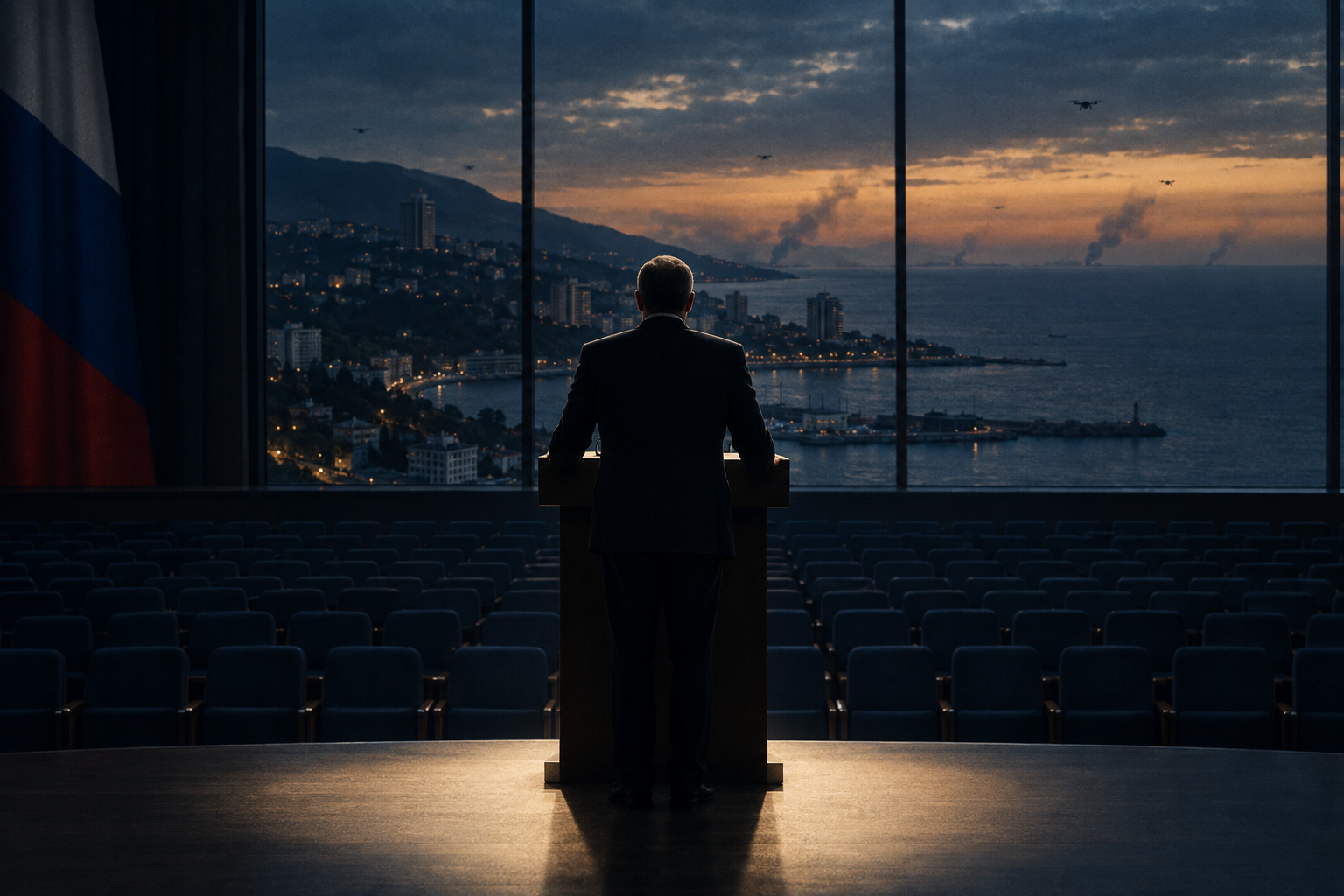
First, the geography of Russian normalcy is shrinking. Sochi was the place where the Kremlin could stage normalcy. That is no longer easy. Ukrainian forces have repeatedly struck targets on Russia’s Black Sea coast, including an oil refinery in Sochi, and on the evening of September 9 Ukrainian sea drones attacked the Sochi waterfront, injuring about 30 people. The Russian Telegram channel Astra also reported fires at two fuel depots in and beside the resort after overnight drone strikes, as relayed by Euromaidan Press, which also reported attacks on Russian air defenses in the city. The Russian president’s own travel tells the story. Before the full-scale invasion, in 2021, Putin visited Sochi 24 times; he has been there only twice in recent years, and not at all since the previous Valdai in October 2025. A resort that its owner cannot safely visit is a poor venue for showing the world that everything is under control.
Second, the leader’s mobility has become a strategic variable. In the language we use at SLD, the Ukrainian deep-strike campaign resembles a kill web more than a kill chain. It combines cheap long-range drones, sea drones, persistent reconnaissance and rapid iteration, all aimed at seams and soft spots and not at any single exquisite target. A defender facing a distributed offensive system has to choose where to concentrate its protection, and it cannot protect everything. A four-day conference bringing the head of state, senior ministers and around a hundred international guests together in one place is precisely the kind of concentrated, high-value node that a security service will not leave exposed. Foreign Minister Lavrov, Deputy Prime Minister Novak and Putin aide Oreshkin are expected to participate. The Federal Protective Service’s judgment reflects a simple assessment that the Moscow region is better defended than a Black Sea resort.
The protection is relative, however. President Zelensky has confirmed Ukrainian long-range strikes that damaged two major Russian logistics sites in the Moscow and Tambov regions. Moscow is safer than Sochi only in degree. The relocation shows a regime spending scarce defensive capacity on protecting its own theater.
Third, security has overruled communications. Organizers had invited guests to Sochi, and the change came in late August, for an event that has to be planned across a year. That is improvisation at the top of a highly choreographed system, and it shows the ordering of priorities. When the protective service and the propaganda service disagree, the former wins. Euromaidan Press notes that Putin has spent much of his time in Moscow, St. Petersburg and his residence near Lake Valdai, with more trips east of the Urals, areas farther from Ukraine’s long-range drone reach. That is one outlet’s interpretation, but it is consistent with the pattern. The Kremlin’s calendar is now shaped by the range of the adversary’s weapons, and no amount of stagecraft outweighs that.
Fourth, the outreach machine still runs, and that is part of the message. The reported guest list is about 120 guests representing approximately 40 countries. The comparison with the more than one hundred foreign experts Weitz counted in 2016 is rough, since the 2026 figure may include Russian participants. But the order of magnitude is similar. Ten years, a full-scale invasion and one of the most sweeping sanctions regimes in modern history later, Moscow can still assemble a global audience for its leader. Any analysis that reads the relocation as a sign of collapse misreads it. Russia’s outreach infrastructure is resilient. What has changed is the setting, which looks less like a resort and more like a fortress.
Fifth, the theme becomes ironic. A meeting about “responsibility for the future,” staged in a hardened venue because the war has reached the leader’s summer retreat, carries a message no program committee intended. The Kremlin wants to talk about the limits of the possible in a multipolar world. The venue tells the guests where the limits of its own security currently lie.
Reading the Meeting
There is a case against over-reading, and it deserves a hearing. Moscow has hosted Valdai before. Putin has always spent most of his time in and around the capital. A Moscow-area location is easier for ministers and for logistics, and the Kremlin may present it as a simple convenience. All of that is true. But the FT’s sources point to the protective service insisting, and the Sochi strikes are documented. The most economical explanation is also the most likely one.
For observers, the meeting itself, running from September 28 to October 1, offers several tests. The first is whether Putin’s final-day address and question-and-answer session, traditionally held on the last day, keep their customary length and looseness or are trimmed. The second is how he frames the drone campaign, as terrorism, as escalation by Western sponsors, or not at all. The third is the guest list, and above all whether any sitting Western officials or prominent former ones appear, since those are the guests who made the 2016 meeting such a rich source for Weitz. The fourth is how much the Russian organizers reveal about the security perimeter. A meeting that used to advertise openness may this year hide its own logistics.
The larger point is about what kind of power Putin’s Russia now projects. In 2016 the Kremlin used Valdai to argue with the West, to court it, divide it and explain its grievances to it, and Weitz’s reporting captured a leader confident enough to speculate about American sociology in public. In 2025 the club was used to announce a world in which Western opinion barely mattered. In 2026 the venue itself concedes something the speeches will not: a war launched to restore Russia’s place in the world has brought the world’s drones to the edge of the president’s own resort. Valdai will go on. The Sochi era, which staged a confident Russia by the sea, is over.
Sources
Meduza, “Financial Times: Valdai Club meeting moved from Sochi to Moscow region over threat of Ukrainian strikes” (Sept. 15, 2026). https://meduza.io/amp/en/news/2026/09/15/financial-times-valdai-club-meeting-moved-from-sochi-to-moscow-region-over-threat-of-ukrainian-strikes
Euromaidan Press, “Putin moves Valdai forum from Sochi” (Sept. 15, 2026). https://euromaidanpress.com/2026/09/15/putin-moves-valdai-forum-from-sochi/
Mezha, “Russia Moves Valdai Forum From Sochi to Moscow Region.” https://mezha.net/eng/news/d1b2591e_russia_moves_valdai/
UNN, “Putin moved the Valdai forum from Sochi to Moscow due to the threat of Ukrainian drones.” https://unn.ua/en/news/putin-moved-the-valdai-forum-from-sochi-to-moscow-due-to-the-threat-of-ukrainian-drones-ft
Richard Weitz, “Putin’s Perspectives on Working with the Next Administration,” Second Line of Defense (Nov. 2016). https://sldinfo.com/2016/11/putins-perspectives-on-working-with-the-next-administration/
Richard Weitz, “Perspectives at the Valdai Conference on Russia, Europe and the United States,” Second Line of Defense (Nov. 2016). https://sldinfo.com/2016/11/perspectives-at-the-valdai-conference-on-russia-europe-and-the-united-states-what-will-be-impact-of-the-coming-to-power-of-president-elect-trump/
Richard Weitz, “Valdai Conference Insights on Russia’s Political and Economic Development,” Second Line of Defense. https://sldinfo.com/2016/11/valdai-conference-insights-on-russias-political-and-economic-development/
Richard Weitz, “The Russian Sanctions Debate at the Valdai Conference,” Second Line of Defense. https://sldinfo.com/2016/11/the-russian-sanctions-debate-at-the-valdai-conference/
Fiona Hill and Clifford Gaddy, “Putin’s Next Move in Russia: Observations from the 8th Annual Valdai International Discussion Club,” Brookings. https://www.brookings.edu/articles/putins-next-move-in-russia-observations-from-the-8th-annual-valdai-international-discussion-club/
“Valdai Discussion Club” (meeting history by year; soft-power scholarship), Wikipedia. https://en.wikipedia.org/wiki/Valdai_Discussion_Club
“2014 Valdai speech of Vladimir Putin,” Wikipedia. https://en.wikipedia.org/wiki/2014_Valdai_speech_of_Vladimir_Putin
Al Jazeera, “Putin wants the world to forget Ukraine” (Nov. 2022). https://www.aljazeera.com/opinions/2022/11/3/putin-wants-the-world-to-forget-ukraine
New Eurasian Strategies Centre, “Valdai 2025: Betting on a long war with the West” (Oct. 2025). https://nestcentre.org/valdai-2025/
Under Southern Eyes, “Vladimir Putin’s Valdai Speech (2025): how to live in the emerging polycentric world” (Oct. 2025). https://undersoutherneyes.edpinsent.com/vladimir-putins-valdai-speech-2025/