

By Robbin Laird
Canada can credibly become a more consequential middle power, but not merely by declaring one. The Carney government has moved faster than recent governments on defence spending and EU cooperation; however, Canada still lacks the export infrastructure, industrial capacity, military readiness, and execution machinery required to turn ‘optionality’ into durable power.
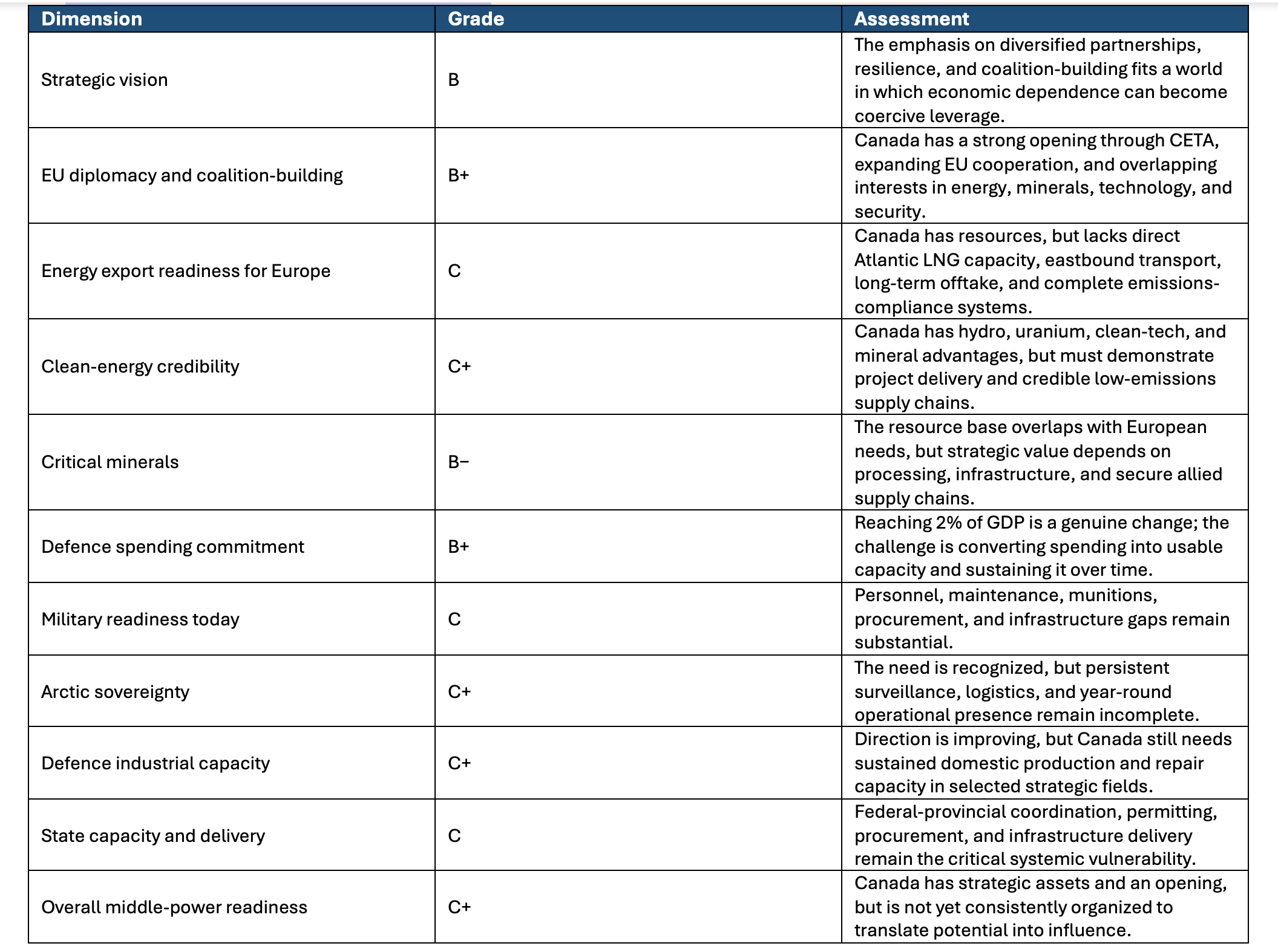
Bottom line: Canada earns a C+ today, with a plausible B/B+ trajectory by the early 2030s only if Ottawa makes hard, expensive, long-term choices and delivers projects on time. The largest immediate gap is not diplomatic ambition. It is implementation.
Executive Snapshot
- A capable middle power must be difficult to coerce, useful to allies, able to defend its territory, and reliable in delivering energy, critical materials, military capability, and diplomatic commitments.
- For Europe, Canada’s credible near-term energy role is diversified supply, global LNG swaps, uranium, critical minerals, and clean-energy technology, not rapid, large-scale direct LNG shipments from an Atlantic terminal.
- For defence, reaching NATO’s 2% benchmark is an important fiscal break with the past, but money must become trained personnel, munitions, maintained platforms, Arctic infrastructure, and deployable formations.
- Canada’s strategic vulnerability is state capacity: slow procurement, difficult federal-provincial coordination, project-delivery delays, and insufficiently durable industrial policy.
What a Middle-Power Role Requires
A serious middle power does not seek to match the United States, China, or Russia militarily. It develops leverage by making itself strategically useful and politically reliable. In a more coercive and multipolar environment, Canada must be able to:
- Make itself economically difficult to coerce.
- Supply allies with strategically valuable goods: energy, minerals, advanced technology, food, finance, and defence production.
- Defend its territory especially the Arctic and contribute credible forces to collective defence.
- Build coalitions with the EU, United Kingdom, Japan, Australia, South Korea, and other like-minded partners.
- Deliver policies and projects across electoral cycles.
This is broadly consistent with the Carney government’s objective of diversified trade, energy, technology, and security partnerships. But influence depends on usable capacity. Europe will value Canada not for potential resources alone, but for dependable, competitively priced, lower-emissions supplies and demonstrable military contributions.
Energy: Becoming Useful to Europe
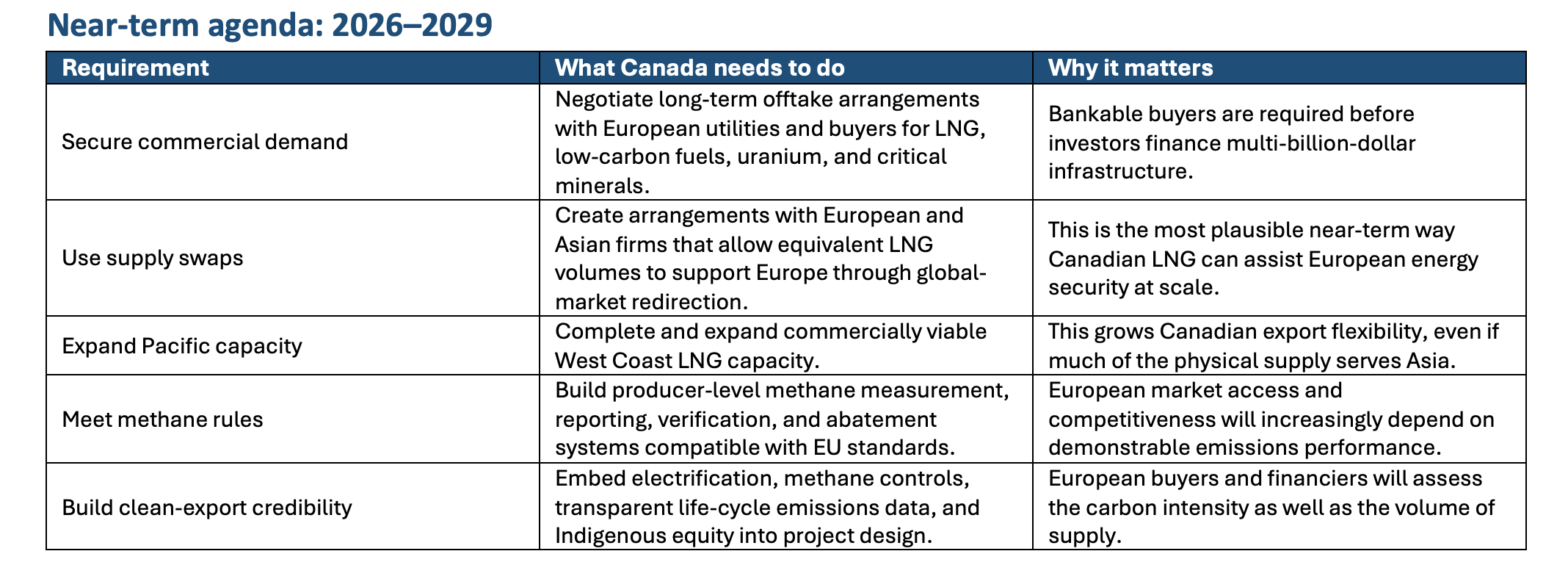
Canada is an energy producer whose infrastructure is oriented toward the United States and the Pacific. It does not currently have an operating Atlantic-coast LNG export terminal capable of directly loading major quantities of Canadian gas for Europe. Existing and developing LNG capacity is concentrated on British Columbia’s Pacific coast, which is commercially better positioned to serve Asian markets.
Accordingly, a Canada–EU energy partnership should be defined initially as a portfolio: LNG and gas where commercial and credible; cargo swaps; uranium and nuclear-fuel cooperation; critical minerals; clean electricity and technology; and lower-emissions energy supply chains.
Medium-term agenda: 2028–2035
If Canada wants to become a major direct energy supplier to Europe, it needs an Atlantic strategy rather than a West Coast strategy alone.
That requires the following:
- An Atlantic export corridor capable of moving Western Canadian gas reliably to an Atlantic liquefaction terminal.
- A commercially viable Atlantic LNG terminal with port logistics, storage, liquefaction, power supply, financing, and long-term contracts.
- A predictable permitting compact: firm schedules, clear federal-provincial accountability, early Indigenous partnership, and decisions robust enough to survive judicial review.
- Indigenous ownership and consent-based partnerships, including meaningful equity, revenue sharing, contracting opportunities, governance roles, and workforce development.
- Electricity and emissions infrastructure, including electrified liquefaction where viable, methane control, and credible carbon management.
- European co-investment, export-credit support, and long-term commitments so that European partners share capital risk.
Do not define energy too narrowly
Canada’s strongest offer to Europe is likely a strategic-supply portfolio rather than one LNG megaproject. It should include LNG where viable; uranium and nuclear-fuel cooperation; hydroelectricity and grid technologies; hydrogen, ammonia, and e-fuels where demand and economics are proven; carbon-management technology; and critical minerals such as cobalt, copper, graphite, lithium, nickel, and rare earth elements. Strategic power requires more than raw-material exports: Canada should prioritize domestic processing, refining, battery-material capacity, and allied supply-chain agreements.
Energy grade: C. Canada has resources, institutional stability, preferential trade access through CETA, and a willing European partner. But it lacks the Atlantic export infrastructure, eastbound gas transport, methane-compliance systems, and customer-backed project pipeline needed to describe itself as a major direct energy supplier to Europe.
Defence: Turning Spending into Capability
The government’s achievement of NATO’s 2% of GDP defence-spending benchmark in fiscal year 2025–26 represents a substantial departure from the long-standing pattern of deferral. However, a spending benchmark is not readiness. The decisive test is whether funds turn into trained personnel, functioning platforms, stockpiles, resilient bases, secure communications, and deployable formations.
Canada has also aligned with NATO’s higher 2035 investment objective: 3.5% of GDP for core defence and 1.5% for defence- and security-related resilience. Meeting these objectives will require a multi-year institutional rebuilding effort rather than a one-year spending surge.
Arctic and maritime power
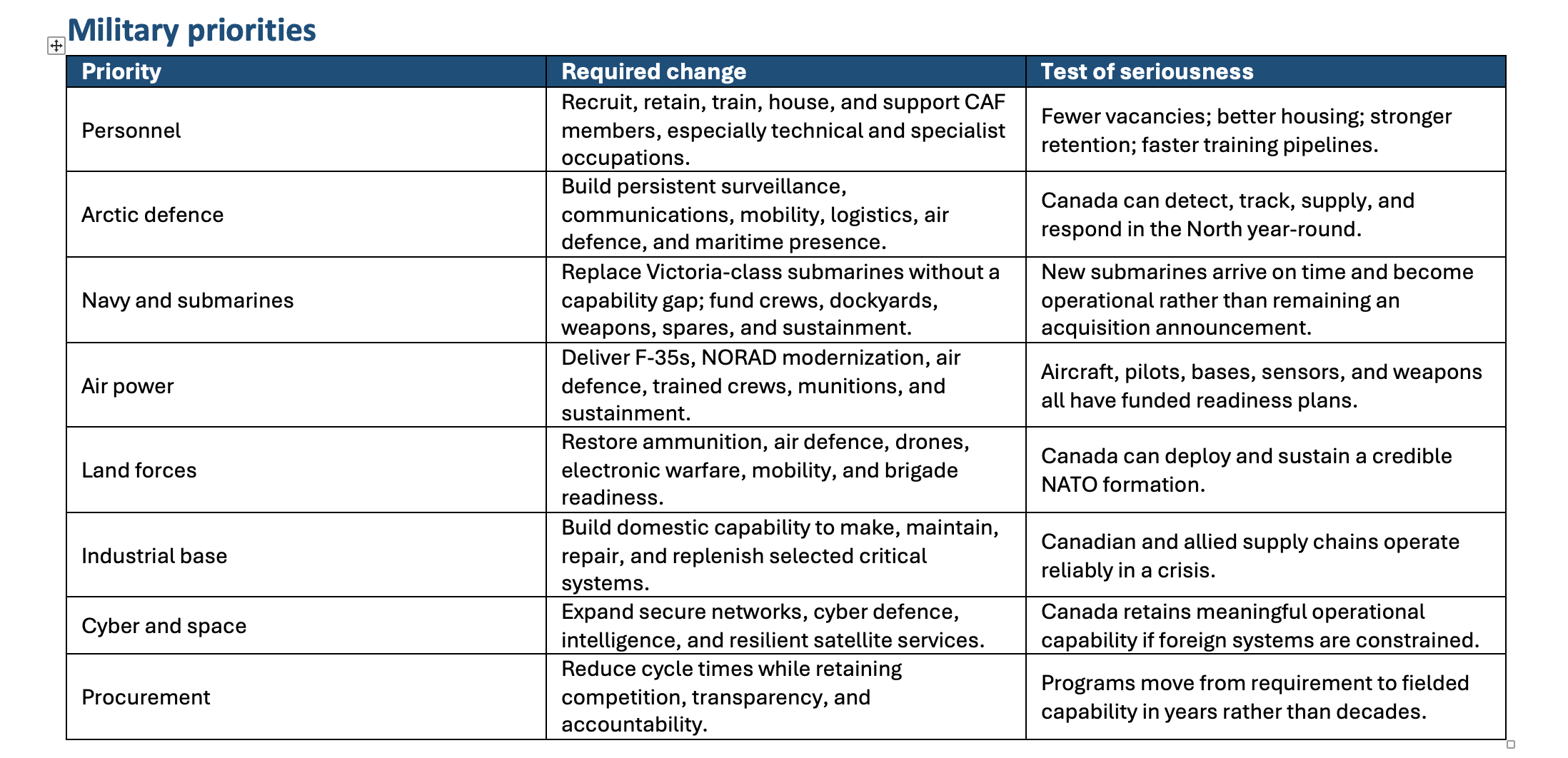
The Arctic is the clearest test of Canadian sovereignty. Canada needs persistent domain awareness, radar, satellites, underwater sensors, drones, intelligence fusion, and secure data links, plus dependable northern logistics: ports, airfields, fuel, warehouses, repair capacity, ice-capable vessels, and prepositioned supplies. It also needs air and missile defence integrated with NORAD, a navy able to sustain operations in the Atlantic, Pacific, and Arctic, and deep domestic maintenance and munitions capacity.
Submarines are particularly important because they provide surveillance, deterrence, intelligence, sea denial, and coalition credibility. The government’s preferred-supplier decision for a modern submarine fleet is therefore important, but an operational capability in the 2030s will depend on trained crews, maintenance facilities, weapons, infrastructure, and uninterrupted program execution.
A readiness-first approach
Canada should apply a simple rule to every major defence acquisition: fund the four M’s, manpower, maintenance, munitions, and mobility, at the same time as the platform. Past underinvestment repeatedly produced hollow capability: equipment without sufficient trained personnel, spare parts, ammunition, operating funds, or readiness days.
Defence grade: B− for intent; C+ for fielded capability. The fiscal and procurement shift is significant, but repairing the Canadian Armed Forces will take years of reliable budgets, recruitment, retention, maintenance, industrial investment, and disciplined delivery.
Middle-Power Report Card
A Practical Government Agenda
- Publish a Canada–EU Strategic Supply Plan. Set ten-year targets for energy, uranium, critical minerals, refining, clean technology, defence production, research, and investment. Identify projects, partners, approvals, financing, and milestones.
- Make an Atlantic-energy decision by 2027. Determine whether an Atlantic LNG/hydrogen/ammonia corridor is commercially viable and supported by durable Indigenous partnerships. If it is not, say so clearly rather than imply rapid direct supply to Europe.
- Adopt an EU-compatible methane regime now. Require measurement, reporting, verification, and mitigation throughout oil and gas supply chains so exporters can meet Europe’s tightening import expectations.
- Fast-track with legitimacy. Use one-window federal decisions, early Indigenous equity options, transparent schedules, intergovernmental coordination, and legally robust environmental assessment.
- Make the CAF readiness-first. Prioritize people, housing, training, maintenance, ammunition, and availability rates alongside headline platform acquisitions.
- Protect the submarine program. Build crews, dockyards, maintenance workforces, weapons stocks, and basing arrangements now, before the first hulls arrive.
- Concentrate industrial policy. Choose sectors where Canada can become indispensable: Arctic systems, aerospace sustainment, munitions, drones, sensors, secure communications, naval/submarine sustainment, and advanced materials.
- Measure performance publicly. Publish a quarterly middle-power readiness dashboard covering export capacity, approvals, methane performance, defence recruitment, equipment availability, stockpiles, Arctic infrastructure, and procurement milestones.
Final Judgment
Carney’s diagnosis is stronger than Canada’s present capabilities.
Canada possesses the raw ingredients of a consequential middle power: energy, critical minerals, an educated population, advanced capital markets, democratic legitimacy, Arctic geography, and participation in NATO, the G7, Five Eyes, the G20, CPTPP, and CETA.
But middle-power influence in an age of multipolar authoritarianism will be earned through reliability: reliable energy, reliable supply chains, reliable military contributions, reliable Arctic control, and reliable political follow-through.
Announcements, memoranda of understanding, preferred-supplier decisions, and proposed projects are not equivalent to operating assets.
Canada can move from a C+ to a B/B+ by the early 2030s, but only if it makes difficult choices early, builds durable partnerships with Indigenous peoples and provinces, funds capabilities across their full life cycle, and delivers enough real capacity that allies plan around Canada rather than merely applaud it.
Selected Sources: This article draws on public material from the Government of Canada, European Commission and EUR-Lex, Canada Energy Regulator, Canadian Trade Commissioner Service, NATO-related Canadian defence documents, and contemporaneous reporting on Canada–EU energy and defence cooperation. Key source categories include the EU–Canada energy cooperation page; EU Regulation 2024/1787 on methane emissions; Canadian 2026 defence and procurement releases; CETA trade guidance; and reporting on Canadian LNG infrastructure and European market access.
On middle power theory, see the following: