

By Robbin F. Laird
When I met Alvin Toffler during my time at Columbia, Future Shock was already one of the defining books of its era. It had given a name to something many people felt but could not articulate: the sense that change itself had become a force acting on us, not simply a series of events happening around us. Toffler defined future shock as “too much change in too short a period of time,” and he argued that the resulting “shattering stress and disorientation” was not a private failing but a social condition.
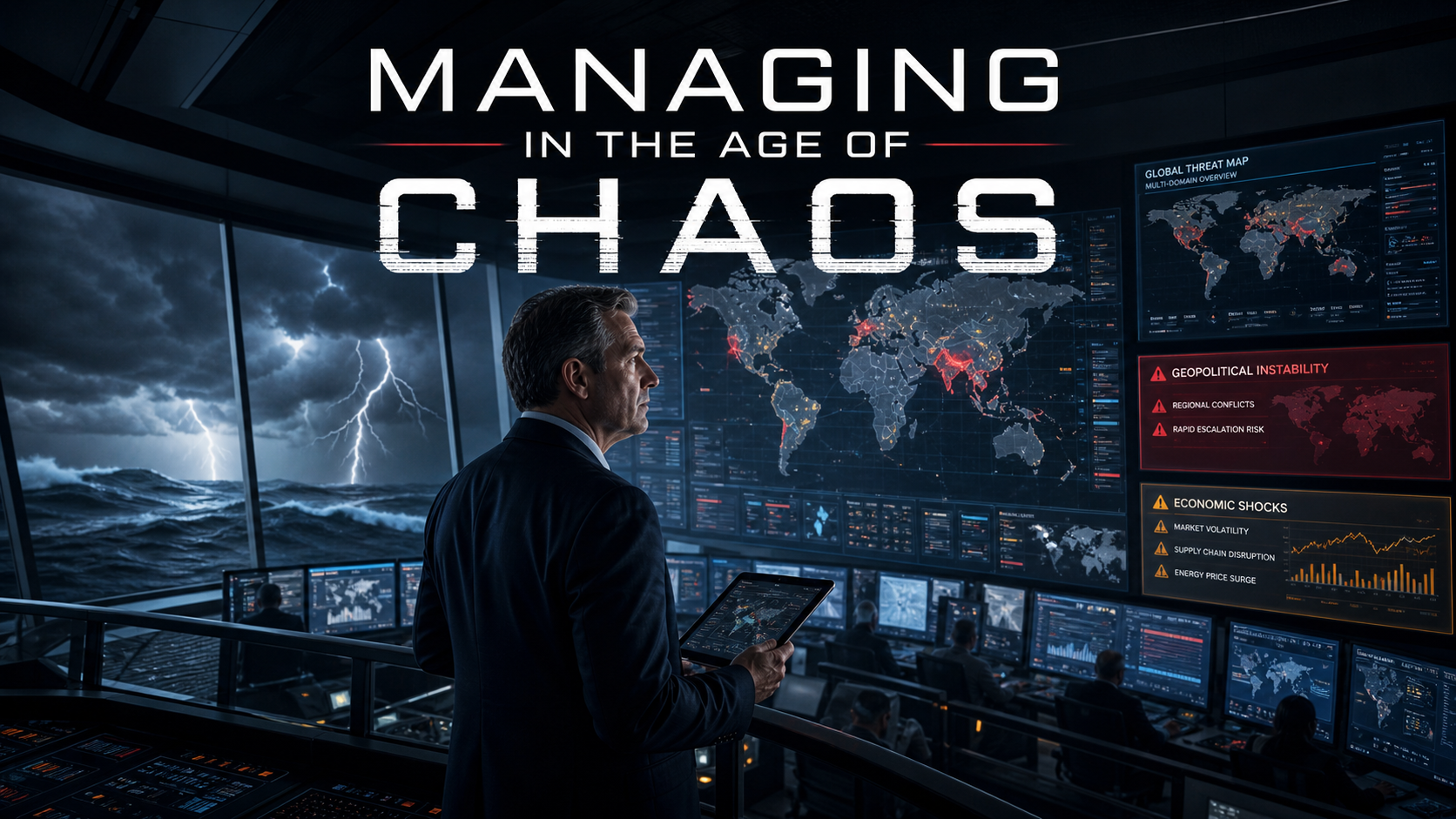
More than half a century after the book appeared in 1970, I find that its central question has not gone away. It has migrated. It has moved from the living room and the workplace into the war room, the ministry, the alliance headquarters, and the boardroom of the defense industrial firm. In my recent books, The Age of Chaos: Democratic Strategy, Kill Web Warfare, and Authoritarian Power and Mastering Chaos: Shaping a Way Ahead for Chaos Management, I have tried to take that question seriously in our own time.
I do not claim to have written the contemporary Future Shock. That would understate Toffler and overstate what any single body of work can accomplish. My claim is narrower and, I think, more useful: I have carried one of his central questions into the world of contested international order and practical leadership. Toffler asked what happens when the pace of change exceeds our capacity to absorb it. I ask what it takes for institutions to keep thinking, deciding, and acting when the very frameworks through which they understand the world are themselves in flux.
The Question Toffler Got Right
It is easy to remember Future Shock as a catalogue of novelties: disposable products, transient relationships, mobile careers, the rise of what Toffler called “adhocracy” in place of fixed bureaucratic structures, and the flood of data he described as “information overload.” Those images captured the imagination of millions of readers, and many of them have aged remarkably well. Anyone who has lived through the smartphone era, the collapse of trusted information intermediaries, and the arrival of generative AI can recognize the world he sketched.
But the enduring insight of the book was not a forecast of particular technologies. It was a claim about a relationship. Toffler argued that human beings, and the societies they compose, have an adaptive range. Within that range, change can be absorbed, interpreted, and turned to advantage. Beyond it, change produces disorientation, withdrawal, overreaction, and poor judgment. The problem was not change as such. The problem was the gap between the rate of change and the capacity to adapt to it.
That formulation is why the book still matters. Technologies date quickly; relationships between pressure and capacity do not. And it is precisely that relationship which now defines the strategic environment that democratic leaders confront.
Toffler also understood something that is often forgotten about his work: he was not merely a diagnostician of anxiety. Future Shock was concerned with how individuals and institutions might enlarge their adaptive range, how societies could build what he called stability zones, and how governance could become more anticipatory. He was asking not only “what is happening to us?” but “what can we do about it?” That constructive impulse is the part of his legacy I most want to carry forward.
Toffler and the Military Imagination
There is a second reason Toffler’s work connects to mine, and it is less widely appreciated outside defense circles. Alvin and Heidi Toffler became important figures in the American military’s thinking about transformation. Senior Army leaders, including Chief of Staff General Gordon Sullivan and TRADOC commander General Frederick Franks, turned to the Tofflers for insight as the Army wrestled with what came to be called the revolution in military affairs.
Their 1993 book, War and Anti-War, argued that “the way we make war reflects the way we make wealth.” As economies moved from industrial mass production to knowledge-based production, they contended, warfare would follow. Several of their themes were later taken up by proponents of network-centric warfare, who embraced the idea that military power flows from the way a society creates its prosperity.
I spent much of my career inside that debate, working with military services and defense organizations as they tried to turn the promise of information-age warfare into actual capability. Some of that promise was realized. Some of it was oversold. The networks of the 1990s and 2000s were conceived largely in an environment of Western technological dominance, permissive airspace, and adversaries who could not contest the electromagnetic spectrum or space. The assumption, often unspoken, was that information superiority would belong to us.
That assumption no longer holds. The war in Ukraine has become, in my judgment, the first full-scale laboratory of what I call kill web warfare: distributed sensors, commercial satellite constellations, artificial intelligence, uncrewed systems, and digitally networked command structures combined into an operational model in which connectivity and adaptation shape the character of combat. Democratic ISR grids and indigenous intelligent mass have challenged platform-centric force design. But the kill web is contested on both sides. Each adaptation produces a counter-adaptation, often within weeks rather than years.
Toffler anticipated that nonlinearity. In a later interview he observed that in a period of enormous economic and social turbulence, “non-linearity increases,” and “small inputs can have enormous outputs.” That is a fair description of the drone war over Ukraine, where inexpensive systems iterated in small workshops have shaped outcomes that would once have required expensive platforms produced over decades. It is also a fair description of the strategic environment more broadly.
So the line from Toffler to my work runs not only through Future Shock but through the Tofflers’ influence on military transformation. My forthcoming book on lessons in military transformation, from the RMA to the drone wars, is in part an attempt to assess what that earlier intellectual moment got right, what it missed, and what we must now learn.
From Acceleration to the Contest over Order
If Toffler’s subject was the stress produced by accelerating change, my subject in The Age of Chaos is what happens when that acceleration coincides with the breakdown of an international order.
For more than three decades after the end of the Cold War, Western strategic thinking rested on the assumption that the international system had entered a phase of durable stability. The language of a “rules-based international order” trending toward liberal norms implied that disturbances were temporary and that the system’s underlying direction was settled. That language no longer describes the world democratic leaders actually have to navigate. It describes an assumption that has been operationally falsified by events.
We are not living through a passing disturbance. We are living through a systemic transition from one global order to another whose destination is still contested. That is what I mean by the Age of Chaos. The term does not signify the absence of order. Power continues to operate, institutions continue to function, and alliances endure. But the frameworks that once bound them together are dissolving faster than new ones can be constructed.
Here my argument departs from Toffler’s in an important way. In Future Shock, change is largely a structural force, driven by technology and the transition to what he called super-industrial society. In the Age of Chaos, change is also a field of action. Other actors are deliberately shaping it.
Russia, China, Iran, and North Korea are constructing what I describe as a multi-polar authoritarian architecture. It is not a formal alliance with shared treaties or ideological manifestos. It is a flexible ecosystem of mutual accommodation in which economic, military, technological, and diplomatic resources are exchanged in ways that reduce vulnerability to Western pressure. Its effectiveness lies in its adaptability. These states are not merely experiencing turbulence; they are exploiting it, and in some cases generating it.
At the same time, middle powers such as Australia, Japan, Poland, and Brazil have acquired a weight in shaping outcomes that would have been far less likely in the bipolar or unipolar eras. Their technological alignments, supply-chain decisions, and security partnerships will help determine whether the system hardens into rival blocs, remains fragmented, or moves toward some form of competitive coexistence.
This is the decisive shift in the problem. Toffler asked whether we could keep up with change. The Age of Chaos forces a harder question: who will shape the emerging order while others are still struggling to understand it? Disorientation, in this environment, is not only a psychological cost. It is a strategic vulnerability that adversaries can identify and exploit. A democracy suffering from something like future shock is a democracy that cedes initiative.
From Crisis Management to Chaos Management
The practical core of my argument is a distinction between crisis management and chaos management.
Traditional crisis management assumes that a crisis is a discrete event within an otherwise stable system. Leaders mobilize resources around a defined problem, restore the previous equilibrium, and then stand down. The crisis is resolved and filed away. That model served Western institutions reasonably well for much of the late twentieth century.
In the Age of Chaos, its premise no longer holds. Crises no longer arrive one at a time. They overlap, interact, and amplify one another. Economic shocks reshape security policy; technological competition reshapes alliances; regional wars reverberate through global markets and supply chains. The very tools that connect the system, including digital networks, global supply chains, and AI-enabled platforms, simultaneously destabilize it.
Chaos management begins from a different starting point. There may be no stable equilibrium to return to. The task of leadership is to treat turbulence as the operating condition, not the exception, and to shape the environment continuously rather than merely react to individual shocks.
That is why I open Mastering Chaos with a blunt proposition: you cannot plan your way through genuine chaos. The question facing senior leaders is not whether they will encounter complex, unpredictable situations in which the parameters of the system itself are shifting. They will. The question is whether they have built the organizational capacity to function effectively within them.
If Future Shock described the strain on the individual, chaos management focuses on the design of the organization. That is the most important difference in emphasis between Toffler’s work and mine.
Building Adaptive Capacity Deliberately
Toffler wrote about enlarging our adaptive range. In Mastering Chaos, I try to specify what that means for military services, government ministries, critical infrastructure operators, and firms in disrupted markets.
I frame adaptive capacity around three pillars.
The first is intellectual flexibility. Organizations must be able to treat strategy as a living hypothesis rather than a sacred text. That means building the habit of revising assumptions when evidence changes, recognizing patterns under uncertainty, and acting on provisional maps while the terrain is still shifting.
The second is institutional resilience. Most organizations unconsciously optimize for efficiency under stable conditions. That optimization makes them brittle when the environment shifts. Resilience requires accepting a measure of redundancy, preserving organizational memory, and designing structures that balance an enduring core of capabilities with a flexible surge capacity that can be reallocated as conditions change.
The third is social cohesion. Under pressure, organizations do not fail only because they lack information or resources. They fail because trust breaks down, because people stop listening across hierarchies and functions, and because shared purpose dissolves. Coordinating rapidly under extreme pressure depends on relationships built before the pressure arrives.
Underneath those pillars are cognitive skills that can be trained: adaptive thinking, pattern recognition under uncertainty, emotional regulation and stress tolerance, and collaborative sensemaking across distributed teams. I argue that leaders capable of these skills, whom I call chaos navigators, are not simply born. They are forged through realistic simulation, structured reflection, and organizational follow-through.
The key word is “deliberately.” It is not enough to urge people to be comfortable with uncertainty. Institutions must decide to invest in adaptive capacity, to measure it, to develop people for it, and to protect it from the constant pressure to optimize for yesterday’s conditions.
One of the most important shifts I ask leaders to make is in strategic planning itself. Traditional planning asks, “What will happen?” and prepares specific responses. In chaotic environments, that approach fails because the parameters are moving. The better question is, “What capabilities do we need to adapt to whatever happens?” That shift changes investment decisions, organizational structures, and the way success is evaluated.
This is, in a sense, a quiet amendment to the futurist tradition Toffler helped create. Futurism was often associated with forecasting. But forecasting cannot carry the burden of preparation when the system itself is in transition. Preparation must rest instead on the capacity to recognize changed conditions quickly, revise assumptions honestly, coordinate action, and retain strategic direction.
The Human Layer
Toffler’s great achievement was to put the human being back at the center of discussions of technological change. He insisted that change was not experienced by economies or abstractions but by people with finite capacities.
I believe that insight is essential for strategy as well. States, militaries, and alliances are composed of people whose perceptions, fears, and aspirations shape how they respond to systemic change. Strategic analysis that ignores this human layer often produces recommendations that look coherent on paper but fail in execution.
That is why my books place so much emphasis on listening as an operational capability. The adaptive organizations I have studied, from Marine Corps units experimenting with forward, distributed impact forces to allied navies integrating maritime autonomous systems, cannot function if their leaders treat communication as one-way messaging. Empathy, in this context, is not sentimentality. It is the ability to understand how partners, subordinates, and adversaries perceive the same turbulent environment and to adjust plans and narratives accordingly.
Whether the issue is Pacific allies recalibrating their policies toward China or Ukrainian commanders improvising under fire, genuine listening is a prerequisite for effective action. It is also how organizations absorb change without being broken by it. In that sense, the leadership dimension of my work is a direct descendant of Toffler’s humanism.
What I Would Not Claim
An honest account of this intellectual relationship requires some restraint.
First, Toffler’s canvas was broader than mine. He wrote about family, work, education, culture, and the texture of everyday life. My work is concentrated on strategy, military transformation, institutions, and leadership. I am extending one of his lines of argument, not replacing his account of social change.
Second, I should not suggest that Toffler merely diagnosed a problem and that I am supplying the solution. He was already thinking about how societies could adapt, and no leadership framework can promise mastery over a genuinely chaotic environment. “Mastering chaos” is a stance and a discipline, not a guarantee.
Third, the Age of Chaos is a description of a transition, not a prophecy of permanent disorder. Periods of systemic transformation are often remembered less for their uncertainties than for the choices that shaped their outcomes. The generation of leaders that navigated the early Cold War faced a future that was equally uncertain, and the institutions they built defined the strategic landscape for decades. Our moment presents a comparable test. My case for adaptive capacity does not depend on believing that chaos will last forever. It depends on recognizing that no one can safely assume when, how, or on whose terms a new and more stable order will emerge.
The Question That Remains
When I think back to meeting Alvin Toffler, I am struck less by the specific predictions in Future Shock than by the seriousness of the question he posed. He asked what happens to people and societies when the future arrives faster than they can make sense of it. He refused to treat that as merely a technological question, and he refused to treat it as hopeless.
My own work returns to that question from a different vantage point: decades of engagement with commanders, planners, and officials across allied democracies who are trying to adapt institutions, forces, and industries in real time. From that vantage point, the challenge looks like this. Democratic societies retain enormous adaptive capacity. Their political openness, technological creativity, and alliance networks remain formidable strategic assets. But those advantages cannot be taken for granted. They must be cultivated through sustained investment in industrial resilience, technological innovation, institutional reform, and leadership development.
Toffler warned that change could overwhelm us. The Age of Chaos adds that others are working to ensure that it does. The answer is neither nostalgia for a settled order that no longer exists nor faith that technology alone will restore our advantage. The answer is to build the judgment, resilience, and shared purpose needed to act when the frameworks through which we once understood the world are themselves changing.
That is not the end of Toffler’s argument. It is, I hope, one of its continuations.
Source Notes
- Definition of future shock and Toffler’s coinage of “information overload”: NBC News obituary of Alvin Toffler
- Future Shock (1970), co-written with Heidi Toffler; “shattering stress and disorientation,” super-industrial society, information overload, and adhocracy: Future Shock overview
- The Tofflers’ influence on Army RMA thinking, including Generals Sullivan and Franks: The Tofflerian Paradox
- War and Anti-War (1993), “the way we make war reflects the way we make wealth,” and its influence on network-centric warfare: S. Army, “Is the conduct of war a business?”
- Toffler on nonlinearity and “small inputs can have enormous outputs”: Catholic Exchange interview with Alvin Toffler
- Robbin F. Laird, The Age of Chaos: Democratic Strategy, Kill Web Warfare, and Authoritarian Power (Second Line of Defense, 2026), Introduction and Forewords by Lt. Gen. (Ret.) Pasquale Preziosa and Dr. Kenneth Maxwell.
- Robbin F. Laird, Mastering Chaos: Shaping a Way Ahead for Chaos Management (Second Line of Defense, 2026), Introduction and Foreword by AVM (Retd) John Blackburn.