

By Robbin Laird
Mike Wynne, the 21st Secretary of the Air Force, died this past weekend. He was my boss, my colleague and my friend, and he was one of the very few people I have known who understood how to lead, and how to drive, real military transformation.
“If you are ever involved in a fair fight, it is the result of poor planning.” That sentence became known as the Wynne Doctrine, and it is easy to hear it as swagger. It was the opposite. It was a statement about responsibility.
A fair fight is one whose outcome is in doubt, and when the outcome is in doubt, young Americans pay for that doubt with their lives. Mike believed a leader’s first duty was to make sure it never happens: through technology, through organization, through the unglamorous work of logistics and sustainment, and through the discipline to think years ahead of the adversary. Technological and organizational superiority were not luxuries to him. They were the conditions of national security.
That conviction shaped everything he did. It drove his insistence on asymmetric advantage in acquisition priorities, force structure and operational doctrine, from sensor integration and distributed targeting to the resilience of supply chains. And he held that airpower must never be treated as static. It had to be continually re-normed through the integration of technical, operational and doctrinal advances.
For five years I met with Mike roughly every six weeks, first when he was the Pentagon’s senior acquisition official and then as the 21st Secretary of the Air Force. It was the most significant professional relationship of my career, and it put me closer than anything else ever did to the levers by which American defense policy is actually moved.
What made those conversations valuable was not rank. Mike came to the Pentagon as an engineer and a businessman. He graduated from West Point in 1966, served seven years as an Air Force officer, and finished as an assistant professor of astronautics at the Air Force Academy. He then spent decades in industry at General Dynamics and Lockheed Martin, running space businesses, and later worked in venture capital. He had launched satellites and managed armored vehicle divisions. He knew how technology travels from a drawing board to a flight line, and where it gets stuck along the way, which is something most defense leaders never learn firsthand.
He was also direct and generous. Those who worked for him describe a leader who said so when he disagreed with a subordinate, and who then came back afterward to ask what they had seen that he had not.
Eyes to the heavens
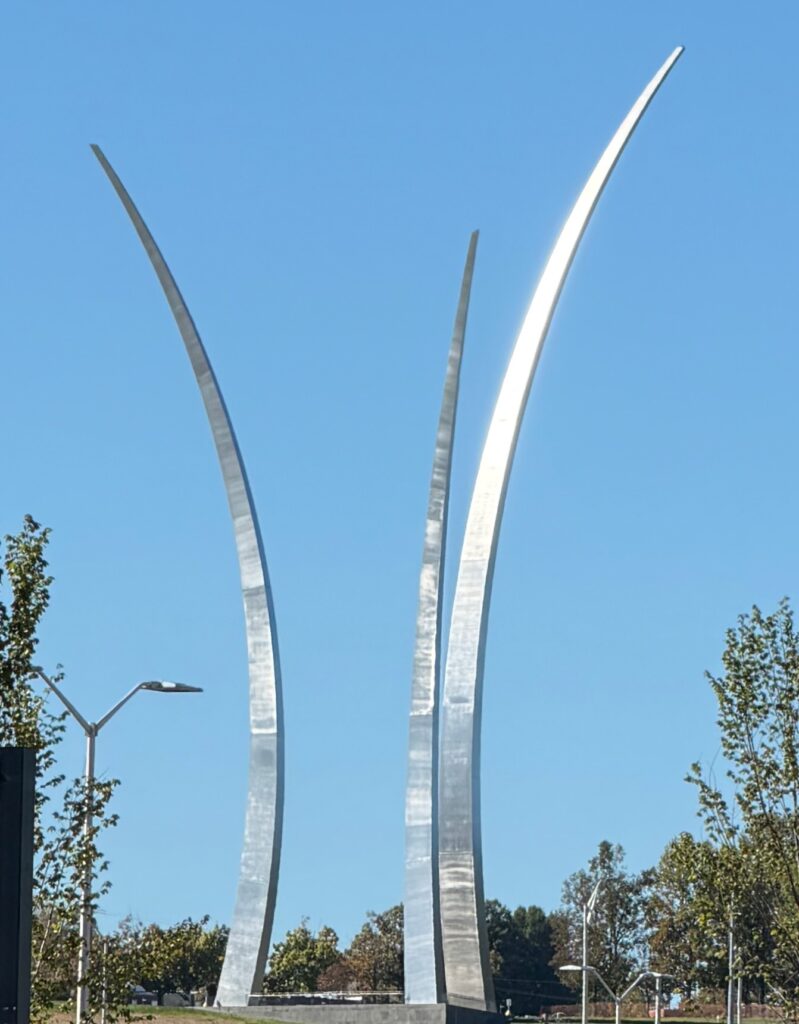
The Air Force Memorial in Arlington was dedicated on October 14, 2006, during his tenure, before roughly 30,000 people. Its three stainless steel spires, between 201 and 270 feet tall, rise like the contrails of the Thunderbirds in a bomb-burst maneuver. Only three of the four contrails appear. The missing fourth is the missing man formation, the salute Airmen give their fallen at funeral flyovers.
The effort behind it was long. The Air Force Memorial Foundation was incorporated in 1992, fourteen years before the dedication, and Mike carried the project across the finish line. The day after the dedication, he laid a wreath beneath the spires for the Airmen who did not come home.
The memorial asks the visitor to lift their eyes from the ground to the heavens, and that is exactly the kind of man he was. He began as a teacher of astronautics. He spent his industrial years building the means to reach orbit. He never stopped looking up and ahead, past the current budget and the current war, toward what airpower and space power would have to become. Everyone who had the chance to work with him remembers that.
What he built
He became Secretary in November 2005, when American attention was fixed on counterterrorism and stability operations in the Middle East, and the risk was institutional complacency about comprehensive modernization. Mike refused that complacency. His agenda was broad, and in several areas it ran years ahead of the department around him.
The combat cloud. He championed the F-22 and F-35, but his larger idea was to turn the Air Force into an intelligence-driven, networked system capable of rapid adaptation and dominance at the tactical and strategic levels. That anticipated today’s emphasis on distributed lethality and multi-domain operations, now fundamental doctrine across NATO and allied air forces. Before fifth-generation aircraft were even deployed, he was already thinking about autonomous aircraft working alongside manned ones, which is exactly what we are now hoping to achieve.
Cyberspace. He rewrote the Air Force mission statement to include “sovereign options” and “cyberspace,” and stood up the first dedicated cyber command in the service, despite resistance from within the Department of Defense. His foresight in cyber, information assurance and electronic warfare gave much of the conceptual foundation for the Pentagon’s current approach to multi-domain integration.
Sustainment. Because he understood engineering, he understood logistics. He pushed unique identification and RFID tracking for supply transparency, performance-based logistics contracts, a modernized and interactive Defense Acquisition Guidebook, and life-cycle cost accountability for program managers, all while the department was fighting in Iraq and Afghanistan.
Breaking the logjam. On the Joint Unmanned Combat Air System, he insisted on operationally relevant capability and would not let the program sink into technical debates over aerial refueling. He was known for dramatic gestures that communicated urgency and set priorities.
Energy and allies. Alarmed by the vulnerability of supply chains, he led the Air Force toward synthetic and alternative fuels, working with British and French collaborators and with industry. On the F-35 he made sure European partners such as Italy were inside the program, through offsets and industrial workshare, which multiplied its strategic value far beyond American borders.
The power of the implementor
Mike’s deepest conviction about innovation was that ideas do not survive bureaucracies on their own. They need champions. He made it a personal mission to find people with promising ideas and protect them, often intervening directly to cut through gridlock and giving cover to those willing to advance disruptive ideas, at personal and professional risk to himself.
He built informal mentorship networks, opened direct access for scientists and engineers, and held regular meetings between senior leadership and working-level technical experts. Those who worked with him say the same thing again and again: his support could be the difference between a project that stagnated and one that transformed the force. He made scientists his “right hand” and endorsed them publicly, which fostered respect and accessibility in the Air Force’s technical community.
He spoke of “the power of the implementor,” and he meant it. Innovation, in his view, was never a solitary act. It was a team endeavor that required organizational alignment, resources and shared conviction. He invested in the careers of others, and he celebrated and shared credit. He combined organizational force with human empathy, and the result was a climate of psychological safety in which colleagues felt free to speak candidly, challenge assumptions and solve problems creatively.
An ending, and a lost decade
His tenure ended on June 20, 2008. On June 5, Secretary of Defense Robert Gates had accepted the resignations of Mike and the Air Force Chief of Staff, General T. Michael Moseley, citing a decline in the Air Force’s nuclear mission focus and performance. The episodes behind that judgment were the 2006 mistaken shipment of Minuteman III components to Taiwan and the 2007 flight of a B-52 that carried six nuclear-armed cruise missiles across the country without anyone realizing it. Mike disputed the framing of the investigation that followed. The official reason and his dissent both belong in the record.
My own view, which I have set out in my writing, is that the forced removal of Wynne and Moseley fits a long and uncomfortable heritage. Billy Mitchell argued that bombers could sink battleships and was not rewarded for it, and the Japanese later proved him right. Air Chief Marshal Dowding built the integrated system that won the Battle of Britain and was shuffled into retirement without recognition the moment it was won. Systems thinkers who see the next fight get in the way of institutions comfortable with the last one.
What followed troubles me. From 2008 to 2018 there was no real focus on great power competition while the Chinese and the Russians built their capabilities for exactly that. It was a lost decade, and no one can be certain it will ever be made up. I have also argued that the twin removal was part of the strategic shift that led, years later, to the “Blitzkrieg Withdrawal” from Afghanistan.
What Mike saw has since become the common language of the profession: distributed lethality, multi-domain operations, autonomy alongside manned aircraft, the combat cloud. Those of us who were there know where those ideas came from.
What he leaves us
Mike’s story is a practical education for anyone who wants to drive change inside a large, risk-averse organization.
- Technical competence and business acumen let a leader judge opportunities and risks for himself.
- Championing others and creating access breaks the bottleneck of bureaucracy.
- Direct engagement, clear priorities and accountability are what turn change into practice.
- International partnerships multiply the effectiveness of innovation.
- Investing in culture pays lasting dividends in resilience, adaptability and creative problem-solving.
Underneath those five lessons sits the one in his doctrine. Superiority is not an accident and it is not a gift. It is the product of planning, done years before the fight, by leaders willing to be uncomfortable now so that Airmen are never in a fair fight later.
I will miss him as a boss, as a colleague and as a friend. The three spires in Arlington reach toward the sky, and that is how he would want to be remembered: eyes to the heavens, and always looking ahead.
I am publishing this on Second Line of Defense, a website started in the wake of Wynne’s firing and to which he contributed many insightful articles. It is in many ways and reflection of his work and his influence on me.
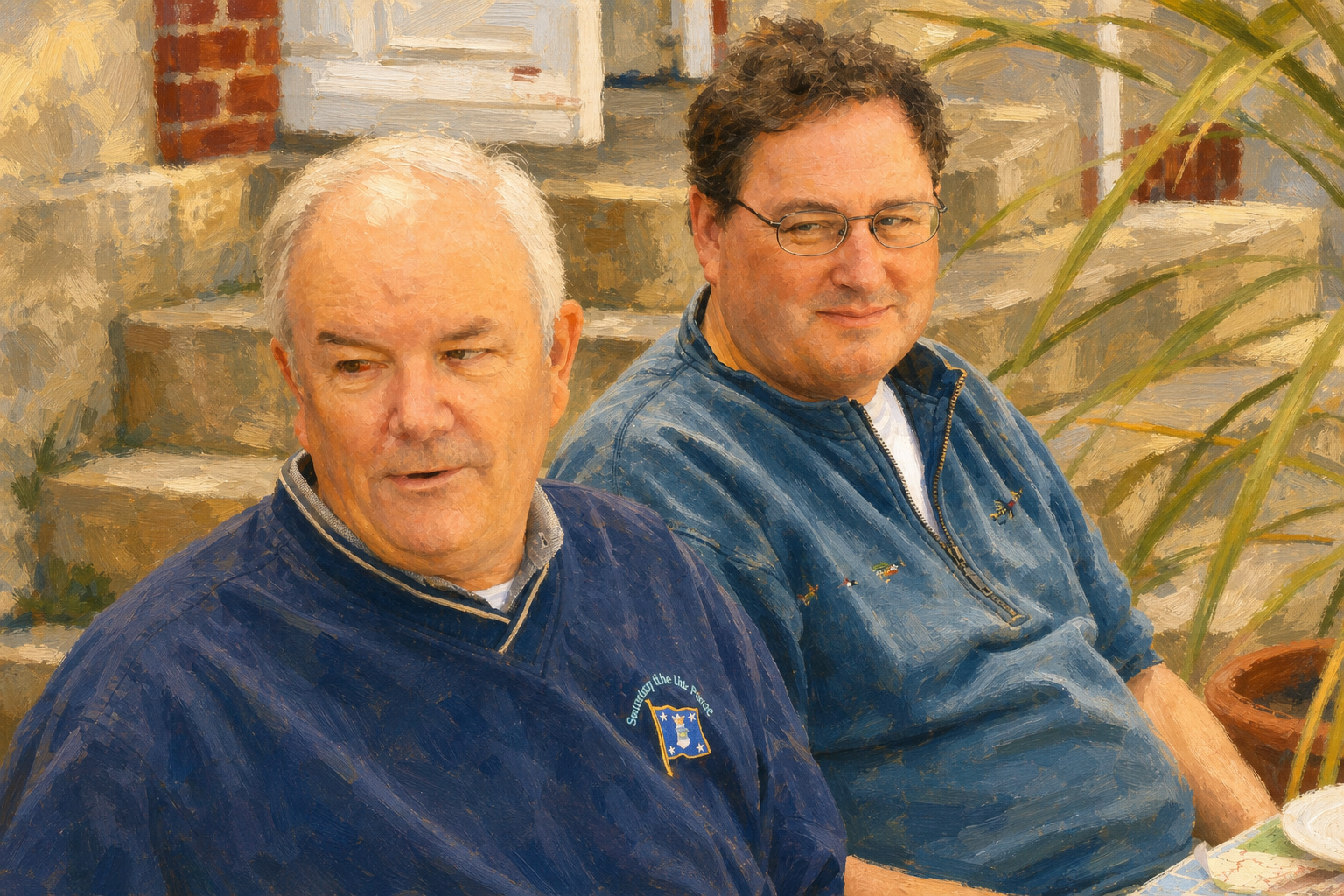
The featured photo is from a 2008 visit to Normandy with me on the right.
Sources:
- Robbin Laird, “How to Become an Airpower Leader?”, Part III, Chapter 3, Navigating Change (forthcoming)
- Robbin Laird, America, Global Military Competition, and Opportunities Lost: Reflections on the Work of Michael W. Wynne (2025), foreword by Lt. Gen. (Ret.) David Deptula