

By Robbin Laird
On Oct. 20, The Insider published an investigation into the chemistry behind Russia’s explosives. Its central finding was stark: for the plasticizers, binders, acids and stabilizers Russia’s defense plants need, Chinese companies supply virtually all of them and in most cases also manufacture them. The Roshal Plasticizer Plant bought sebacic acid from China’s Farmasino and told customs it was for dioctyl sebacate, a binder for RDX and HMX plastic explosives. The Azot-Vzryv group bought polyisobutylene from Nanjing E-Strong through Nartas LLP, a Kazakh intermediary in Almaty. Azot-Vzryv has long supplied the Sverdlov Plant in Dzerzhinsk, which The Insider describes as virtually the only Russian producer of RDX-based military high explosives.
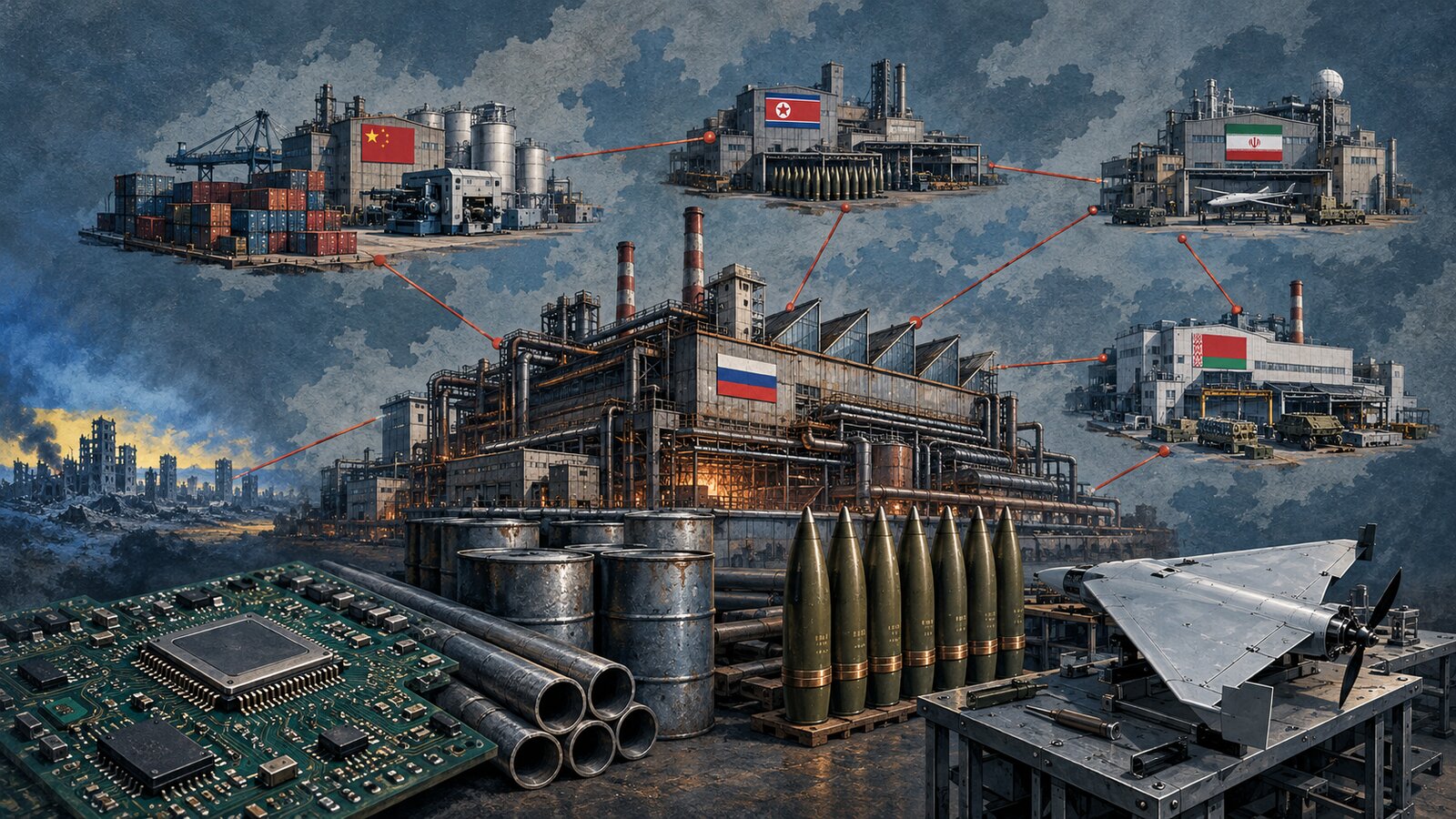
These details matter in their own right. Their larger significance lies in what they illustrate. Russia is not sustaining its war through one benefactor. It is drawing on a multi-polar authoritarian supply chain. China provides industrial depth. North Korea provides mass, in shells, missiles, soldiers and workers. Iran provided the drone design that Russia has since industrialized, and Iran is now a recipient of Russian munitions. Belarus functions as an adjacent factory floor. Intermediaries in Central Asia, the Caucasus, Türkiye and the Gulf provide the commercial and financial connective tissue.
A recent CSIS and George W. Bush Institute report uses the shorthand CRINK for China, Russia, Iran and North Korea, and notes that these states are not in a formal alliance but increasingly enable one another to evade pressure and sustain conflicts. That observation is the right starting point. The task is to understand how the network works, because its shape determines what can be done about it.
A Network, Not a Bloc
A bloc has a center that can be pressured. A network has nodes, and each contributes according to its own comparative advantage and its own interests. Beijing seeks a Russia that does not lose, without paying the price of open belligerence. Pyongyang seeks hard currency, combat experience and technology. Tehran sought a strategic partner and now needs one to rebuild. Minsk has tied its regime’s survival to Moscow. The intermediaries mostly seek profit.
That structure makes the network hard to disrupt and hard to see. Much of what flows through it does not look like an arms transfer. It moves as chemical trade, machine tools, electronic components, labor contracts, student visas and technology exchanges. Each piece can be explained away individually. Together they form a war economy that extends well beyond Russia’s borders.
China: The Industrial Depth
China is the backbone of the network, and the scale is measurable. A September 2026 policy brief by economists Tatyana Deryugina and Oleksandr Shepotylo found that Chinese exports to Russia across 85 core dual-use product codes rose from about $265 million a month before the invasion to about $525 million a month after it, a 98 percent increase. The same brief reports that China supplied more than 60 percent of the CNC machine tools Russia imported in 2023–2024, that drone-component exports roughly tripled to about $300 million a month by mid-2026, and that Ukrainian intelligence found Chinese parts made up an estimated 60–65 percent of the electronics in a Geran-2 drone recovered in 2025.
Two findings in that brief deserve particular attention. First, the relevant supply is overwhelmingly China’s own production going directly to Russia. The six commonly cited third-country hubs together added only about $20 million a month in dual-use exports to Russia, less than one-tenth of the increase in China’s direct exports. Second, the trade is cheap for Beijing. In 2025, the core dual-use flow was worth about $6 billion, roughly 6 percent of China’s exports to Russia and less than 0.2 percent of its exports to the world. China accounted for about 58 percent of everything Russia imported in the first four months of 2026.
The Insider’s chemical investigation fills in a layer that trade aggregates can obscure. China accounted for 87 percent of Russia’s chemical imports in the first quarter of 2025, though that figure does not separate civilian from military use. Earlier reporting tracked a parallel pattern in propellants: Chinese nitrocellulose exports to Russia, negligible before 2022, reached about 1,300 tons in 2023. Western equipment also reaches Russian munitions plants through Chinese channels. As Reuters reported in August 2025, the Biysk Oleum Plant, which produces TNT and HMX, obtained Siemens automation equipment through a Russian intermediary that sources from Chinese resellers, with no evidence that Siemens knew where it ended up.
Beijing’s official line is that it provides no lethal weapons and strictly controls the export of dual-use items, including drones. On Oct. 19 it announced further controls, effective Nov. 18, on specialized drone engines, brushless motors, electronic speed controllers and carbon-fiber blades. RFE/RL notes, however, that Moscow has been barely affected by earlier Chinese restrictions and that Chinese firms bypassing them to supply Russia rarely face prosecution. Ukraine, by contrast, has worked hard to reduce its exposure, cutting China’s share of its imported drone parts from nearly 90 percent at the start of 2024 to 28 percent in the first eight months of 2026. Chinese export policy is formally even-handed. In practice, it bears hardest on the side without a “no limits” partnership with Beijing.
North Korea: Mass and Manpower
If China supplies depth, North Korea supplies mass. Ukrainian military intelligence (HUR), as summarized by the Institute for the Study of War, estimates that North Korea provides 25 to 40 percent of current Russian artillery ammunition, has delivered more than 600 artillery systems, including Koksan 170mm self-propelled guns and 240mm rocket launchers, and has sent more than 100 KN-23 and KN-24 ballistic missiles. The cumulative estimate for 152mm shells reached about 15 million by March 2026. South Korea likewise reports more than 15 million rounds and more than 16,000 North Korean personnel dispatched to Russia since October 2024.
The relationship is deepening, not plateauing. In August, a HUR official told Reuters that a North Korean missile unit of about 90 personnel was deploying to Russia’s Voronezh region within the 112th Missile Brigade, with Russia expecting up to 120 missiles and six launchers. North Korean labor has also moved into Russia’s industrial base. The Multilateral Sanctions Monitoring Team estimated that Russia hosted 15,000 to 30,000 North Korean workers as of the end of 2025, some disguised as students, and Ukrainian intelligence estimates cited by CSIS put up to 12,000 at the Alabuga drone complex.
North Korea is not only a supplier. It is a learner. Seoul assesses that Pyongyang may be improving missile accuracy through battlefield data, and the CSIS report warns that technicians returning from Alabuga will bring mass-production drone experience back to Pyongyang, posing a new challenge for South Korea, Japan and U.S. forces in the Indo-Pacific. The war in Europe is, in effect, training a Pacific adversary.
Iran: From Supplier to Recipient
Iran’s contribution was foundational. Russia could not initially meet its own demand for long-range strike drones, and its answer was to manufacture the Iranian-designed Shahed on Russian soil. What began as a licensed import has become an industrial program Russia now owns. Ukrainian intelligence estimates that Russia is producing about 4,000 jet-powered Geran-4 and Geran-5 drones a month, alongside roughly 2,000 Geran-2s. Those are Ukrainian estimates and should be treated as such, but the direction is clear: the design came from Tehran, and the scale and refinement came from Russian factories under combat pressure.
The flow has now reversed. After the U.S. and Israeli strikes on Iran, a European government document cited by NBC News indicated that Russia was shipping explosives, ammunition and drone parts across the Caspian Sea to help Iran replenish its stocks, on a route Western navies cannot interdict. In October, Bloomberg reported, citing a Western official, that Russia is providing missiles to Iran, and that Iran had preserved enough missile and drone production capacity to rebuild its arsenals during the pause in strikes.
This is the clearest evidence that the network is multi-polar rather than hub-and-spoke. Russia is both consumer and supplier. Technology Iran transferred to Russia, improved through combat in Ukraine, can return to the Middle East. The Caspian functions as an interior sea for the network, linking the European and Middle Eastern theaters through a corridor outside Western maritime reach.
Belarus: The Adjacent Factory
Belarus has been integrated into Russia’s defense-industrial base to an extent that makes it, functionally, an extension of it. BELPOL, a group of former Belarusian security officers, claims that more than 500 Belarusian defense enterprises are working for the Russian army, producing artillery ammunition, Grad rockets, microchips, tank optics and components for Iskander and S-400 systems. More specifically, the Legmash plant is expanding its capacity while producing components for 122mm Grad rockets for final assembly in Russia, and a new Belarusian ammunition plant scheduled to begin operations in December is designed to produce up to 180,000 152mm shells and 270,000 122mm rockets a year.
The Connective Tissue
The intermediaries are the network’s capillaries. Nartas LLP in Almaty, routing a Chinese explosives binder to a Russian supplier, is a small but telling example. Eurasian Economic Union membership gives Kazakhstan and Kyrgyzstan open borders with Russia that remove customs scrutiny on intra-bloc trade, which circumvention networks can exploit.
The evidence here calls for precision. The Deryugina and Shepotylo brief finds that most of the 2022–2023 surges through third-country hubs have largely reversed under Western enforcement. Türkiye’s exports of core dual-use goods to Russia are at about 14 percent of their peak, while Kazakhstan remains the one hub where a sizeable flow persists, at about four times its pre-invasion level. Transit hubs matter, but they are not where the bulk of the problem lies.
Finance is where the intermediaries matter most. The EU’s 21st sanctions package in July listed 27 third-country entities, including 14 in China (four in Hong Kong), four in Türkiye, three in Kyrgyzstan, and two each in India, Kazakhstan and the UAE, and introduced a dedicated ban on third-country crypto-asset services along with designations tied to the A7 payments network and its new links to Africa. The 20th package in April had already targeted banks in Kyrgyzstan, Laos and Azerbaijan. The list underlines a further point: the authoritarian core relies on permissive commercial space in states that are not authoritarian partners at all.
What the Network’s Shape Means
Several implications follow. These are my assessments, built on the reporting above.
- Sanctions were designed for a narrower problem. Enforcement has concentrated on finished weapons and high-end electronics. The war is being sustained by chemistry, machine tools, labor and payment channels, much of it moving through ordinary commerce. An ammunition war is, at bottom, a chemicals war.
- Strikes and sanctions are coupled. The Insider notes that the more effectively Ukrainian drones hit Russian chemical plants, the greater Russia’s dependence on imports becomes. Nevinnomyssky Azot is the case in point, with Chinese supply covering part of the gap. Ukraine’s long-range strike campaign achieves its full effect only if the import substitutes are also closed off. That is kill-web logic applied to economic warfare: kinetic and non-kinetic effects have to be integrated against the same target set.
- The decisive node is China, and China pays little. If the hubs carry less than a tenth of the dual-use increase, pressure on Almaty or Bishkek cannot substitute for pressure on Beijing. At less than 0.2 percent of China’s global exports, this trade costs Beijing very little to sustain. Changing that calculation means raising the cost through financial measures against the banks and firms involved, at a price Western governments have so far been reluctant to pay.
- The learning loop is the long-term threat. North Korea is gaining missile-accuracy data and drone-production know-how. Iran is receiving Russian munitions refined in combat. China is watching how its components perform and how Western sanctions are enforced. The war in Ukraine has become a shared laboratory for the network, with consequences for the Korean Peninsula, the Gulf and the Western Pacific.
- A ceasefire would not dissolve the network. Russia and Ukraine have signaled willingness to resume U.S.-brokered talks, likely in Abu Dhabi around mid-November, but deep disagreements remain. Even a settlement would leave in place the expanded Alabuga complex, the new Belarusian shell plant, North Korean production lines and the supply relationships that feed them. A pause would become a period of regeneration, as it has for Iran.
- Ukraine’s own exposure is part of the equation. Ukraine still relies on China for thermal-camera sensors and lenses, battery cells, motor materials and some microelectronics. A Western response that does not build allied supply chains for those components leaves Kyiv competing with Moscow for the attention of the same Chinese factories.
Conclusion
The West tends to frame the problem as Russia plus helpers. The more accurate picture is a distributed authoritarian production system with Russia at its operational center: Chinese industrial inputs, North Korean mass, Iranian design now flowing back as Russian supply, Belarusian factories, and intermediaries that keep goods and money moving. It has no treaty and no headquarters, which is precisely what makes it resilient.
Countering it requires the West to think in network terms as well. That means treating chemical precursors, machine tools and payment channels as seriously as missiles, integrating sanctions with strike campaigns, accepting that the critical node is in Beijing, and recognizing that what is learned in Ukraine will not stay in Ukraine.
Sources
The Insider, “Chemical brother: Russia’s production of explosives and ammunition is heavily dependent on Chinese chemicals” (Andrey Zayakin, Oct. 20, 2026): theins.press/en/inv/298502
Tatyana Deryugina and Oleksandr Shepotylo, “China’s Support for Russia: Implications for Sanctions and Policy,” Policy Brief #4, Economists for Ukraine (Sept. 2026): econ4ua.org
Victor Cha and Joseph Kim, “Human Rights Abuses in Drone Production at Yelabuga,” CSIS and George W. Bush Institute (Oct. 14, 2026): csis.org; bushcenter.org
Yonhap, “N. Korea could bolster drone capabilities through workers at Russian factory” (Oct. 14, 2026): en.yna.co.kr
Institute for the Study of War, “Korean Peninsula Update, July 14, 2026”: understandingwar.org
Reuters, “North Korean missile unit deploys in Russia for Ukraine war, Kyiv says” (Aug. 5, 2026): reuters.com
Ground News aggregation of Yonhap/Reuters reporting on North Korean deployments: ground.news
Militarnyi, “Russia Ramps Up Geran-4/5 Jet Drone Production to 4,000 per Month”: militarnyi.com
Ground News aggregation of NBC News reporting on Russian shipments to Iran: ground.news
Iran International, “Russia is providing missiles to Iran – Bloomberg” (Oct. 10, 2026): iranintl.com; Ground News aggregation of Bloomberg reporting: ground.news
Militarnyi, “Belarus Expands Facility Producing Components for Russia’s Grad MLRS Ammo”: militarnyi.com
Ziare.com, BELPOL interview on Belarusian defense industry (in Romanian): ziare.com
Economies.com, “The Central Asian corridor boosts Russia’s wartime trade”: economies.com
European Commission, “EU adopts 21st package of sanctions against Russia” (July 23, 2026): finance.ec.europa.eu
European Commission, “Questions and answers on the 20th package of sanctions” (April 23, 2026): ec.europa.eu
The Diplomat, “The West Indulges China in Its Backing for Russia Against Ukraine” (May 2026): thediplomat.com
RFE/RL, “Ukraine Cuts Chinese Drone Dependence, But Critical Gaps Remain” (Matthew Fulco, Oct. 2026): rferl.org
Associated Press, “The not-so-secret vulnerability in Ukraine’s drone arsenal? Chinese technology”: apnews.com
Lansing Institute, “China’s Declared Neutrality vs. De Facto Involvement in the Russia-Ukraine War” (April 28, 2025): lansinginstitute.org
Associated Press via WSB Radio, “Ukraine and Russia eye new peace talks” (Oct. 24, 2026): wsbradio.com
Reuters on the Biysk Oleum Plant (Aug. 8, 2025), as cited in the original In Brief input.