

By Robbin F. Laird
When I arrived at Columbia University in 1969 to begin my doctoral studies, the university was home to one of the nation’s leading centers for the study of the Soviet Union. I took classes with Marshall Shulman and Seweryn Bialer, and I became a graduate assistant to Zbigniew Brzezinski, who was then directing Columbia’s Research Institute on Communist Affairs. In 1970 he published Between Two Ages: America’s Role in the Technetronic Era. For a young graduate student trying to understand how political systems change, that book was not simply another text on the reading list. It was a demonstration of how to think about a world in transition.
Brzezinski’s claim was bold. Advanced societies, he argued, were “entering an age in which technology and especially electronics hence my neologism ‘technetronic’ are increasingly becoming the principal determinants of social change, altering the mores, the social structure, the values, and the global outlook of society.” The industrial age was giving way to something new, and the political institutions, ideologies, and international arrangements built for the old age would be strained by the arrival of the new one.
More than half a century later, I find that the question at the heart of that book has not gone away. It has sharpened. In my recent books, The Age of Chaos: Democratic Strategy, Kill Web Warfare, and Authoritarian Power and Mastering Chaos: Shaping a Way Ahead for Chaos Management, I have tried to work through what happens when a technological transformation of the kind Brzezinski described coincides with the breakdown of an international order.
I do not claim to have written a sequel to Between Two Ages. That would overstate my work and understate his. My claim is narrower. Brzezinski asked how the United States and its partners could shape an era in which technology was transforming societies faster than political institutions could adapt. I ask what it takes for democratic institutions to keep thinking, deciding, and acting when that transformation has become a field of contest, and when adversaries are using the same technologies to shape the emerging order on their terms.
The Question Brzezinski Got Right
It is easy to remember Between Two Ages as a set of forecasts. Some of them were remarkable. Brzezinski described the coming post-industrial society as “a society that is shaped culturally, psychologically, socially, and economically by the impact of technology and electronics—particularly in the area of computers and communications.” He anticipated a world-wide information grid and wrote that “for the first time in history the cumulative knowledge of mankind will be made accessible on a global scale—and it will be almost instantaneously available in response to demand.” Anyone living with the internet, the smartphone, and generative AI can recognize that world.
But the enduring insight of the book was not a prediction of particular technologies. It was a claim about a paradox. “The paradox of our time,” he wrote, “is that humanity is becoming simultaneously more unified and more fragmented.” The technetronic revolution, in his account, “marks the beginnings of a global community; on the other hand, it fragments humanity and detaches it from its traditional moorings.”
That formulation is why the book still matters. The same forces that connect the world also destabilize it. Brzezinski rejected Marshall McLuhan’s image of a “global village,” with its suggestion of shared tradition and intimacy. A more appropriate analogy, he argued, “is that of the ‘global city’—a nervous, agitated, tense, and fragmented web of interdependent relations.”
I can think of no better short description of the strategic environment democratic leaders face today. Global supply chains, digital networks, commercial satellite constellations, and AI-enabled platforms bind states together while simultaneously creating new vulnerabilities, new dependencies, and new instruments of coercion. Interdependence has not produced harmony. It has produced the global city: dense, connected, and deeply unsettled.
Brzezinski also understood that technological change was not politically neutral. It would advantage those political systems capable of adapting to it and punish those that could not. That proposition became the foundation of my own early scholarly work.
From the Technetronic Thesis to Technocratic Socialism
The thesis of Between Two Ages, as Brzezinski later summarized it, was that the United States “was plunging headlong into a new postindustrial (technetronic) age, while the Soviet Union remained bogged down in the mid-industrial phase.” In the book he argued that “because of the doctrinal incapacity of the Soviet political system to respond to the internal needs of social innovation,” broad accommodation with the West “would inevitably cause far-reaching internal political instability in the Soviet Union and in Soviet-dominated Eastern Europe.” He described a Soviet system whose bureaucratization and “dogmatic restraints on intellectual creativity and social innovation” had made it “the most conservative political and social order of the more advanced world.”
That was a striking judgment to make in 1970, at the height of Soviet military power and the early hopes of détente. It shaped the questions I took with me from Columbia.
With my friend and colleague Erik Hoffmann, I spent much of the late 1970s and 1980s studying how the Soviet leadership itself understood the challenge Brzezinski had identified. The Soviets had their own term for it: the “scientific-technological revolution.” In “The Scientific-Technological Revolution” and Soviet Foreign Policy, The Politics of Economic Modernization in the Soviet Union, and Technocratic Socialism: The Soviet Union in the Advanced Industrial Era, we examined how Soviet leaders and theorists tried to adapt their system through concepts like “developed socialism” and the scientific management of society.
What we found was that the Soviet leadership recognized the challenge, at least in part. They understood that the technological revolution was transforming economic and military competition. They tried to put science and technology to work for the renovation of their system.
But the system became less innovative over time, constrained by the very bureaucracy, nepotism, and repression that Brzezinski had identified as its doctrinal limits. The Farewell Affair of the early 1980s revealed how dependent Soviet weapons and computer programs had become on stolen Western technology rather than indigenous innovation.
Brzezinski provided the framework; our work tested it against the Soviet record. And the record largely vindicated him. The Soviet Union did not collapse simply because of its military burdens or the pressures of the Cold War. It collapsed in part because a closed political system could not generate the innovation the technetronic era demanded.
That lesson is not merely historical. Vladimir Putin’s war against Ukraine has driven a generation of Russian scientists and engineers abroad, recalling the decline of Soviet science that Andrei Sakharov warned against. Russia has moved from engagement with modern Europe to war with it, and in doing so has revived the Soviet pattern in spirit if not in territory.
From Transition to the Contest over Order
If Brzezinski’s subject in 1970 was the transition between two ages, my subject in The Age of Chaos is what happens when that transition becomes a contest.
For more than three decades after the end of the Cold War, Western strategic thinking rested on an assumption Brzezinski himself would have questioned: that the international system had entered a phase of durable stability, trending toward liberal norms. He was never comfortable with that assumption. His 1993 book, Out of Control: Global Turmoil on the Eve of the Twenty-First Century, warned against the optimism of the immediate post-Cold War moment and anticipated a world of fragmentation, rival power clusters, and identity-driven conflict.
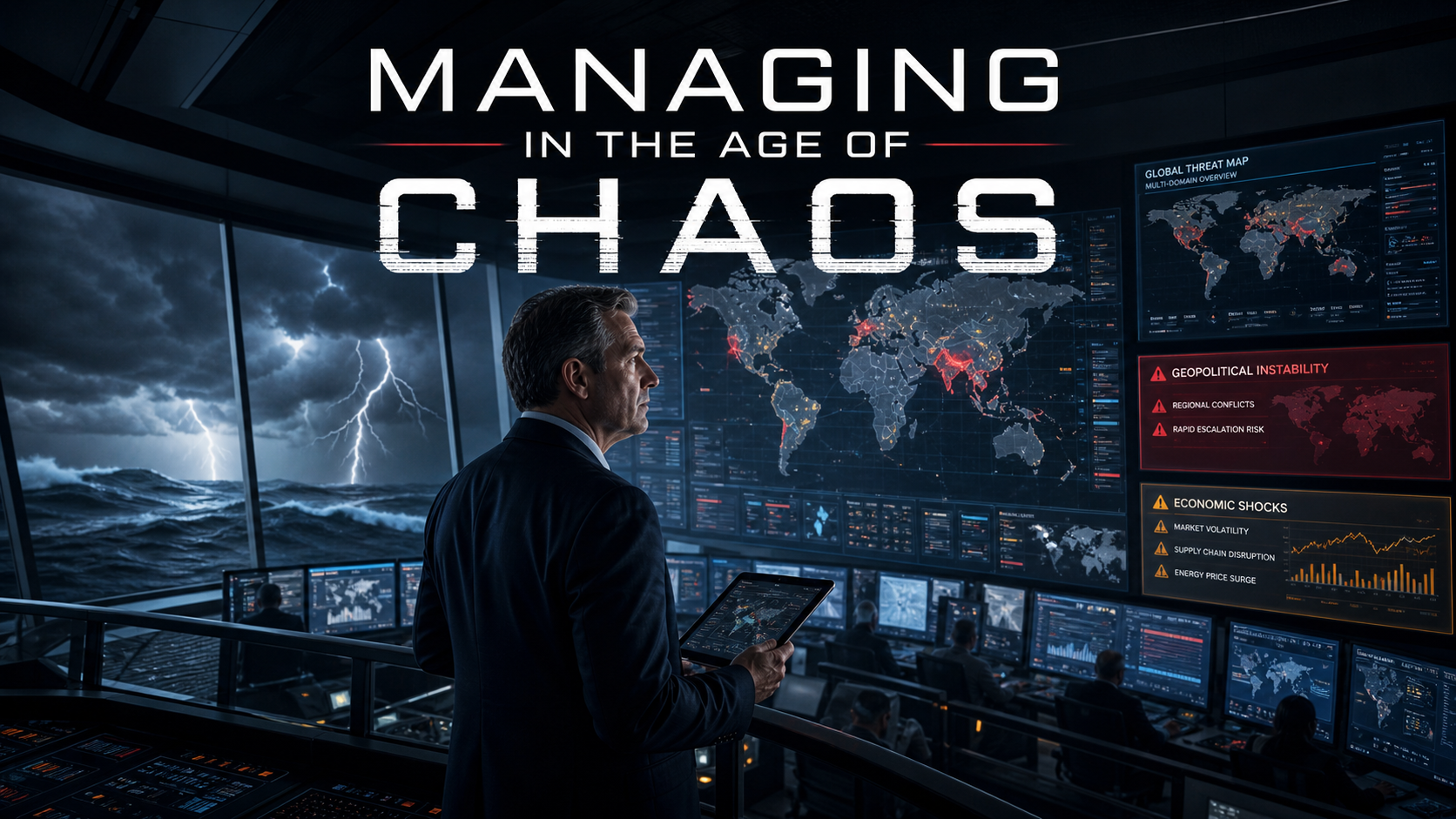
We are now living through a systemic transition from one global order to another whose destination is still contested. That is what I mean by the Age of Chaos. The term does not signify the absence of order. Power continues to operate, institutions continue to function, and alliances endure. But the frameworks that once bound them together are dissolving faster than new ones can be constructed.
Here my argument departs from Brzezinski’s in an important way. In Between Two Ages, he wrote that “it would be wrong to conclude that fragmentation and chaos are the dominant realities of our time,” and he saw “a global human conscience” beginning to manifest itself. He believed, on balance, that the technetronic revolution would eventually push humanity toward greater cooperation, even if the process would be painful and uneven.
I am less confident of that trajectory. The new global unity he described, as he acknowledged, “has yet to find its own structure, consensus, and harmony.” Half a century later, it still has not. And in the meantime, others have moved into that space.
Russia, China, Iran, and North Korea are constructing what I describe as a multi-polar authoritarian architecture. It is not a formal alliance with shared treaties or ideological manifestos. It is a flexible ecosystem of mutual accommodation in which economic, military, technological, and diplomatic resources are exchanged in ways that reduce vulnerability to Western pressure. These states are not merely experiencing the turbulence of the global city. They are exploiting it, and in some cases generating it.
The Authoritarian Technetronic State
There is one passage in Between Two Ages that I return to more often now than I did as a student. Brzezinski warned that, alongside the familiar threats to liberal democracy, another danger was emerging, “more directly linked to the impact of technology.” It “involves the gradual appearance of a more controlled and directed society.” Such a society, he wrote, would be dominated by an elite “whose claim to political power would rest on allegedly superior scientific knowhow,” and which would not hesitate to use “the latest modern techniques for influencing public behavior and keeping society under close surveillance and control.”
This passage is often quoted out of context, sometimes in garbled versions, as though Brzezinski were advocating such a society. He was warning against it. And the warning has proven more prescient than almost anything else in the book.
What Brzezinski did not fully anticipate, and what my work on the Soviet Union seemed to confirm, was that an authoritarian system might find ways to harness the technetronic revolution rather than be defeated by it. The Soviet Union failed that test. China under the Chinese Communist Party has taken it on directly, combining state-directed industrial policy, digital surveillance, and the absorption of global technology into a model that seeks both innovation and control.
That is the decisive shift in the problem. Brzezinski asked whether closed systems could adapt to the technetronic era. The Age of Chaos forces a harder question: what happens when authoritarian states use the tools of the technetronic era to compete directly with democracies for the shape of the emerging order? The answer to that question will not be determined by technology alone. It will be determined by which political systems can best combine technological capacity with adaptability, legitimacy, and the ability to build coalitions.
Technology, Warfare, and the Kill Web
There is a military dimension to this argument that runs through my work. Brzezinski’s technetronic era was defined by computers and communications. Those are precisely the technologies that have transformed warfare over the past three decades, first through the information-age concepts of the 1990s and 2000s and now through what I call kill web warfare.
The networks of the post-Cold War period were conceived largely in an environment of Western technological dominance. The assumption, often unspoken, was that information superiority would belong to us. That assumption no longer holds. The war in Ukraine has become the first full-scale laboratory of kill web warfare: distributed sensors, commercial satellite constellations, artificial intelligence, uncrewed systems, and digitally networked command structures combined into an operational model in which connectivity and adaptation shape the character of combat.
Brzezinski would have recognized the underlying logic. The technetronic revolution diffuses capability. It allows smaller actors to wield power once reserved for great states, and it allows inexpensive systems iterated in small workshops to shape outcomes that once required expensive platforms produced over decades.
But it also cuts both ways. Each adaptation produces a counter-adaptation, often within weeks rather than years. The kill web is contested on both sides.
The global city, in other words, has a battlefield. And the side that wins on it will be the one that adapts faster, not the one that owns the most impressive platforms.
From a Community of Developed Nations to Allied Architectures
Brzezinski was never content merely to diagnose. Between Two Ages concluded with a prescription. “A community of the developed nations must eventually be formed,” he wrote, “if the world is to respond effectively to the increasingly serious crisis that in different ways now threatens both the advanced world and the Third World.” He envisioned linking the United States, Western Europe, and Japan through a high-level consultative council, and he helped turn that idea into the Trilateral Commission, which he directed from 1973 to 1976.
Much of my own work since then has been an extended engagement with the practical problem behind that prescription: how democracies build working coalitions across regions. I have spent decades on NATO, on Franco-German and European defense cooperation, on the Nordic and Baltic states, and on Australian, Japanese, and broader Indo-Pacific security.
What has changed is the cast of characters. Brzezinski’s community of developed nations was essentially a trilateral concept: North America, Western Europe, and Japan. In the Age of Chaos, middle powers such as Australia, Japan, Poland, and others have acquired a weight in shaping outcomes that would have been far less likely in the bipolar or unipolar eras. Their technological alignments, supply-chain decisions, and security partnerships will help determine whether the system hardens into rival blocs, remains fragmented, or moves toward some form of competitive coexistence.
Brzezinski’s insight remains essential: no single democracy can manage the transition alone. But the architecture we need is less a council of the developed world than a network of networks, built from the bottom up through operational cooperation, shared industrial capacity, and trusted data. In that sense, the allied kill web is a direct descendant of his community of developed nations, rebuilt for a contested era.
The Global Political Awakening and the Human Layer
In his later work, Brzezinski came to emphasize a phenomenon he called the “global political awakening.” For the first time in history, he argued, virtually all of humanity had become politically active and politically conscious. That awakening, he observed, injects “intense emotions,” “conflicting historical narratives,” and “incompatible aspirations” into international politics. “In the past, the balance of power among states could be, to some extent, subject to rational calculations,” he said. Now “a great deal of ‘power’ reflects also the intensity of emotions and aspirations—and these are not susceptible to careful calculations.”
That is one of the most important strategic insights of the past half century, and it connects directly to what I call the human layer of strategy. States, militaries, and alliances are composed of people whose perceptions, fears, and aspirations shape how they respond to systemic change. Strategic analysis that ignores this human layer produces recommendations that look coherent on paper but fail in execution.
That is why my books place so much emphasis on listening as an operational capability. Brzezinski’s own approach, which I absorbed at Columbia, was to treat the international system as an evolving architecture and to take seriously how others see their own security and trajectories, not just how we wish they would. Whether the issue is Pacific allies recalibrating their policies toward China or Ukrainian commanders improvising under fire, that kind of disciplined attention to how others perceive a turbulent environment is a prerequisite for effective action.
From Strategic Vision to Chaos Management
Late in his career, Brzezinski wrote Strategic Vision: America and the Crisis of Global Power. When he discussed the book, he was careful to distinguish vision from blueprint. “When I say vision, I don’t mean a blueprint,” he explained. Large historical changes, in his view, are shaped by people who develop a strategic vision to a sufficiently compelling degree that they can begin to move events in its direction.
That distinction is close to the core of my argument in Mastering Chaos. You cannot plan your way through genuine chaos. Traditional crisis management assumes that a crisis is a discrete event within an otherwise stable system: leaders mobilize resources around a defined problem, restore the previous equilibrium, and stand down. In the Age of Chaos, crises overlap, interact, and amplify one another. There may be no stable equilibrium to return to.
Chaos management begins from a different starting point. The task of leadership is to treat turbulence as the operating condition, not the exception, and to shape the environment continuously rather than merely react to individual shocks. That requires strategic direction without rigid blueprints. It requires what I describe as adaptive capacity, built on three pillars: intellectual flexibility, institutional resilience, and social cohesion.
Brzezinski was a strategist of vision. My work tries to specify what institutions must do to sustain that vision under conditions of permanent turbulence: how military services, ministries, alliances, and defense industries can recognize changed conditions quickly, revise assumptions honestly, coordinate action, and retain strategic direction. If Between Two Ages described the challenge to nations, chaos management focuses on the design of the organizations that must meet it.
What I Would Not Claim
An honest account of this intellectual relationship requires some restraint.
First, Brzezinski’s canvas was broader than mine. Between Two Ages addressed the crisis of meaning in advanced societies, the future of ideology and religion, American education and institutions, and the relationship between the developed world and what he called the “global ghettos” of the developing world. My work is concentrated on strategy, military transformation, alliances, and leadership. I am extending one of his lines of argument, not replacing his account of historical change.
Second, Brzezinski was not always right, and he would not want to be remembered as an oracle. His expectation that “the concern with ideology is yielding to a preoccupation with ecology” captured something real about his time but understated the durability of nationalism, religion, and authoritarian ideology. His hope of eventually including “the more advanced European communist states” in a community of developed nations was overtaken by the collapse of those states, not their evolution. And the post-Cold War era showed how easily confidence in managed interdependence could become complacency.
Third, I should not suggest that The Age of Chaos is a refutation of his more hopeful view. It is a description of a transition, not a prophecy of permanent disorder. Brzezinski himself took heart from the fact that, in a politically awakened world, “hegemony by a single power is not attainable.” That applies to authoritarian aspirants as much as to anyone else. My case for adaptive capacity does not depend on believing that chaos will last forever. It depends on recognizing that no one can safely assume when, how, or on whose terms a new and more stable order will emerge.
The Question That Remains
When I think back to my years at Columbia, I am struck less by the specific predictions in Between Two Ages than by the seriousness of the question Brzezinski posed and the freedom he and Herbert Deane gave me to pursue my own version of it. My dissertation, Order Within Chaos: On Historical Change, was an un-dissertation-like attempt to understand how systems come apart and recombine. In retrospect, much of what I have written since has been a long continuation of that effort, carried out in very different contexts and under very different strategic skies.
Brzezinski asked how a society, and an alliance of societies, could shape a world being remade by technology faster than its institutions could adapt. He refused to treat that as a purely technological question, and he refused to treat it as hopeless. He believed that strategic vision, combined with coalition-building among like-minded nations, could steer the transition.
My own work returns to that question from a different vantage point: decades of field research with commanders, planners, and officials across allied democracies who are trying to adapt institutions, forces, and industries in real time. From that vantage point, the challenge looks like this. Democratic societies retain enormous adaptive capacity. Their political openness, technological creativity, and alliance networks remain formidable strategic assets, and history, including the Soviet case Brzezinski diagnosed so early, suggests that closed systems pay a price for their rigidity. But those advantages cannot be taken for granted. They must be cultivated through sustained investment in industrial resilience, technological innovation, institutional reform, and leadership development.
Brzezinski warned that we were living between two ages. We still are.
The difference is that the passage between them is now contested, and others are working to determine where it ends.
The answer is neither nostalgia for a settled order that no longer exists nor faith that technology alone will restore our advantage.
The answer is to build the vision, resilience, and shared purpose needed to act when the frameworks through which we once understood the world are themselves changing.
That is not the end of Brzezinski’s argument.
It is, I hope, one of its continuations.
Source Notes
- Between Two Ages: America’s Role in the Technetronic Era (Viking Press, 1970); the “technetronic” neologism and definition, the “global city,” the paradox of unity and fragmentation, the “more controlled and directed society,” Soviet “doctrinal incapacity,” the community of developed nations, “global ghettos,” and “ecology rather than ideology”: full text at the Internet Archive; Google Books record.
- Brzezinski’s rejection of the “global village” in favor of the “global city”: Time review, “The Fragmented Soul”.
- The world-wide information grid and “the cumulative knowledge of mankind” passage: European Journal of Transformation Studies, “Zbigniew Brzezinski and the ‘Real’ Revolution”.
- Brzezinski’s own later summary of the book’s thesis on the United States and the Soviet Union: Zbigniew Brzezinski, “Brzezinski’s Thesis,” New York Review of Books, 2004.
- The community of developed nations and the founding of the Trilateral Commission: Rockefeller Archive Center, Trilateral Commission records; Zbigniew Brzezinski, Wikipedia.
- Out of Control: Global Turmoil on the Eve of the Twenty-First Century (1993): Kirkus Reviews; New York Times review of Strategic Vision.
- The global political awakening and the role of emotion in power: Big Think, “Five Questions with Zbigniew Brzezinski”.
- Strategic Vision, vision versus blueprint, and the unattainability of single-power hegemony: Council on Foreign Relations, “A Conversation with Zbigniew Brzezinski”; Hachette Book Group.
- Erik P. Hoffmann and Robbin F. Laird, “The Scientific-Technological Revolution” and Soviet Foreign Policy (Pergamon, 1982): Elsevier; Technocratic Socialism: The Soviet Union in the Advanced Industrial Era (Duke University Press, 1985).