


By Robbin Laird
Canberra is paying for autonomy by retiring platforms whose jobs it intends to spread across a network, and the two items the press picked up, the C-27J transport fleet and the Huon-class minehunters, show both the logic and the risk.
Defence Minister Richard Marles says the government is reprioritising about A$5 billion of the Integrated Investment Program (IIP) over the forward estimates to make room for other planned investments.
The sums attached to those two items are small. The decisions behind them are not.
What Canberra moved
The reshuffle first surfaced with the 2026 National Defence Strategy and IIP on 16 April 2026; the government disclosed more detail on where the money comes from and goes, as ADM reported on 29 October.
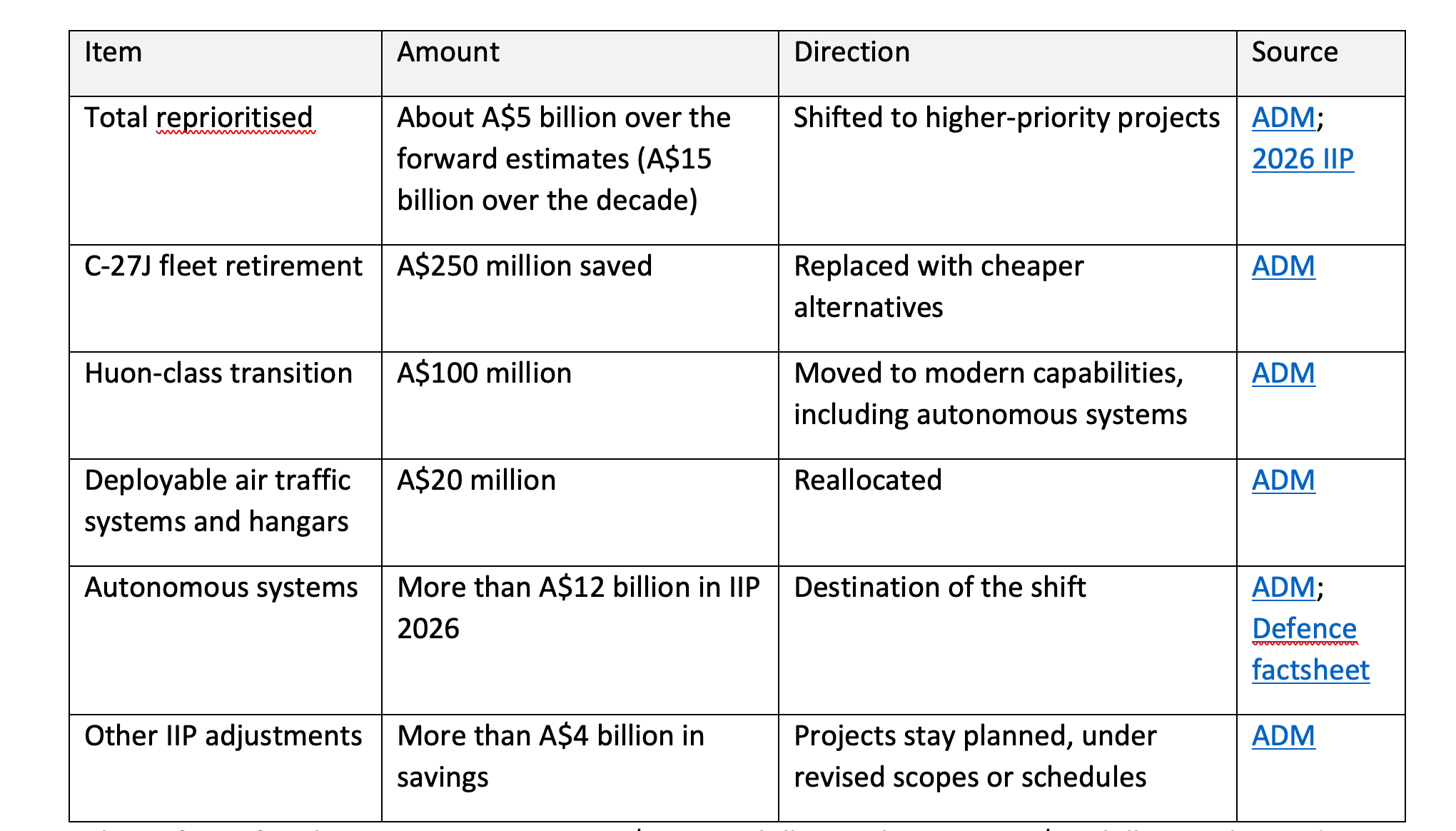
The Defence factsheet puts autonomy at A$12 to 15 billion, split as up to A$8.1 billion in the air domain, A$4.5 billion maritime and A$2.4 billion land. The C-27J and Huon items together come to A$350 million, about 7 per cent of the A$5 billion. ADM also reports that up to A$2.5 billion of the reallocation comes from adjusting facilities, infrastructure and logistics schedules, to prioritise northern bases and logistics networks, and A$600 million from within integrated air and missile defence, to accelerate procurement of effectors. Defence will not publish a full list of adjustments on national security grounds, so the A$5 billion cannot be fully audited from outside. The headline figure matters less than what the two named cuts say about direction.
Huon class: a bridge to autonomy, not a replacement
The A$100 million Huon line finishes a transition that was already under way. The navy is down to two of an original six Huon-class minehunters, HMAS Yarra and HMAS Diamantina, and suspended Project SEA 1905 in April 2024, the effort meant to replace them. SEA 1905 was announced in April 2019 at about A$1 billion, with two Arafura-based ships carrying modular unmanned systems; Exail and Saab Australia were shortlisted when it was dropped. The 2024 IIP already foresaw no like-for-like replacement, leaving port clearance to fly-away AUV teams.
What remains is a deployable capability built under SEA 1778 Phase 1, which Defence describes as crewed and uncrewed surface vessels paired with remote and autonomous underwater vehicles. The Chief of Navy has described the service as mid-transition from crewed to uncrewed mine countermeasures. Rear Admiral Stephen Hughes, Head of Navy Capability, told Naval News at Indo-Pacific 2025 that the current capability meets minimal viable capability, a risk profile the navy is willing to take. He says SEA 1905 is prioritised for the early 2030s and that he will not retire a minehunter until he can replace it.
The risk case is serious.
An ASPI Strategist analysis of 30 September asks “minimally viable for what?”, noting that autonomous systems can search, detect and classify but that two ageing minehunters and a limited deployable capability would struggle to protect Australia’s main ports.
A Baird Maritime republication adds that without motherships the autonomous systems have limited reach and endurance, and cites an August Australian National University National Security College analysis that flagged mine countermeasures as a gap in protecting seabed infrastructure.
C-27J: an orphan fleet with a Pacific job
The ten-aircraft C-27J fleet, operated by No. 35 Squadron at Amberley, was delivered between 2015 and 2018 to replace the Caribou. Government approved the purchase in May 2012 at up to A$1.4 billion. After the US cancelled its Joint Cargo Aircraft program and divested its fleet, Australia became an orphan operator of a modified variant, which narrows its sustainment pipeline.
The strategy replaces it with a commercial aircraft fleet for personnel and logistics transport across the Pacific, with options to keep sovereign airlift and surveillance support for Pacific partners through the Defence Pacific Air Program, plus work on northern air bases to improve resilience. The C-130J fleet grows from 12 to 20, with the first new aircraft expected in 2028.
The Chief of Air Force, Air Marshal Stephen Chappell, says circumstances have changed drastically since the C-27J was bought and that there will be no capacity gap, with the fleet flying on for at least a couple of years alongside one or more commercial options. No retirement date or replacement type has been announced.
Critics are not persuaded.
Steve Kuper calls the retirement a false economy. A Region analysis argues the aircraft is well suited to Pacific work because it can use short, unprepared strips that the C-130J and C-17A cannot, notes that availability has improved, and reports avionics obsolescence concerns, notably its Mode 4 IFF. One aircraft reported as under consideration is the ATR 72-600 in cargo configuration, carrying up to 9.2 tonnes; Air Data News expects such aircraft to lack some of the C-27J’s austere-field capability.
The kill web reading: does the function survive redistribution?
Both retirements follow one pattern: a platform that performed a function organically gives way to a network that performs it in pieces. The minehunter, a hull that sails into the minefield, becomes dispersed vehicles launched from elsewhere. The C-27J, one aircraft that is both short-field capable and integrated with Pacific partner air arms, becomes a split between the C-130J for hard missions and commercial aircraft for routine lift.
That is the kill web argument in its plainest form: value lives in the connections and the redundancy, not the hull count. The test is whether each function survives the redistribution.
The critics point to the same weak spots in both cases, and they are the nodes that autonomy depends on rather than the autonomous systems themselves:
- Sustainment and reach. Autonomous mine countermeasures need motherships and support to operate at range and endurance, the gap the Baird analysis names.
- Austere access. Commercial transports depend on infrastructure that the C-27J did not, which matters most in the Pacific places the Defence Pacific Air Program serves.
- Partner integration. A 2023 rotational deployment integrated the C-27J with Papua New Guinea’s sovereign PAC-750 aircraft and trained its air movements personnel at remote airfields. That relationship is built on a platform, not a network diagram.
Canberra’s wager is that cheaper mass, spread across more nodes, beats a small fleet of exquisite ones. The wager is defensible. Part of the reallocation, ADM reports, is meant to prioritize northern bases and logistics networks, so Canberra is investing in nodes, just not in these platforms.
Even so, the money moves before the replacements exist, and the gap between retirement and a fielded substitute is where the risk sits.
What to watch
- The C-27J replacement decision. Type, numbers, and a date, and whether it keeps sovereign support for Pacific partners.
- The retirement date. Some outlets report the fleet going by the end of 2026, while Defence has said the aircraft fly on for at least a couple of years.
- What the Huon money buys. Vehicles alone, or also the motherships and sustainment that give them reach.
- The fate of the last two minehunters, and whether SEA 1905 returns on the early-2030s timetable the navy has indicated.
- Delivery of the A$12 billion-plus autonomy line, measured in fielded capability rather than approved funding.
Sources
-
- Defence funding reallocated, Australian Defence Magazine
- 2026 IIP Overview factsheet, Department of Defence
- 2026 Integrated Investment Program, via GlobalSecurity
- Australia announces early retirement of C-27J fleet, The Aviationist
- RAAF to replace C-27J Spartan fleet with commercial aircraft mix, Australian Aviation
- Opinion: Don’t scrap the Spartans just yet, Australian Aviation
- Australia to retire C-27J Spartan fleet, Air Data News
- Australia plans to retire C-27J Spartan fleet, Militarnyi
- C-27J retirement, Asian Military Review
- Defence’s plans to retire C-27J early just don’t add up, Region
- ‘You guys have no idea’: Air Force blasted on planes, AAP via Country News
- Battlefield airlifter audit, Australian National Audit Office
- Extending a helping hand, Department of Defence, 10 October 2023
- Australian mine countermeasures approaches minimal viable capability, Naval News
- Maritime capabilities take lion’s share of Australia’s future defence investment, Naval News
- SEA 1905 Maritime Mine Countermeasures, GlobalSecurity
- RAN in transition from crewed to uncrewed mine clearance, Defence Connect
- Here we go again: mine countermeasures are Australia’s forgotten naval capability, The Strategist