


By Robbin Laird
The 30th Euronaval closed on November 6 at Paris Nord Villepinte with 713 exhibitors, up 45% from 483 in 2024, and a message that was easier to state than to deliver: Europe’s navies intend to build hybrid fleets, crewed hulls working with uncrewed systems, and they intend to buy European to do it.
Organizers reported 28,000 professional visits, 204 official delegations from 71 countries and 400 accredited journalists.
Rear Admiral Guillaume Merveilleux du Vignaux, the show’s General Commissioner, summed up the edition as “notably marked by the emergence of the concept of hybridisation, as well as an increased presence of drones across all domains.” He added that these trends, together with the growing integration of artificial intelligence, “will be at the heart of EURONAVAL 2028.”
Having followed the show day by day, I see five themes that outlast the news cycle:
- Drones have become an industry but not yet a fleet.
- France set the pace and the vocabulary.
- The crewed frigate remained the platform buyers actually funded.
- European industry began reorganizing around the hybrid fleet.
- And the fleet itself became a political issue in a presidential season.
Beneath all five sits a harder set of problems that no stand could solve: endurance, integration and people.
One caution frames everything below.
On the final day, Saab’s contract for Sweden’s frigates was the only signed contract in the day’s news.
Across the week, much of what was announced took the form of frameworks, memoranda, letters of intent and concepts. A record exhibitor count measures demand. It does not measure delivery.
Drones Became an Industry, Not Yet a Fleet
Organizers had expected 705 exhibitors, 40% more than in 2024, and the number of drone makers had tripled. Army Recognition’s video from the floor showed the range: Elbit presenting its underwater vehicle portfolio alongside its Seagull surface vessels; Croatia’s Shadow Nautics on the crewed patrol-craft side; High Eye’s Airboxer, a 32 kg unmanned helicopter already selected by the Royal Netherlands Navy; and Latvia’s NEWT21, founded in January 2025, which has delivered a surveillance boat to Ukraine and moved its FOG and RAY boats toward serial production. Army Recognition was careful to add that the Black Sea experience “does not independently establish the specific combat performance” of any single platform shown in Paris.
That caution is the right lens, because the floor mixed combat-proven boats with scale models of ships that may never be built.
Sorting the offerings by evidence rather than brochure gives a clearer picture.
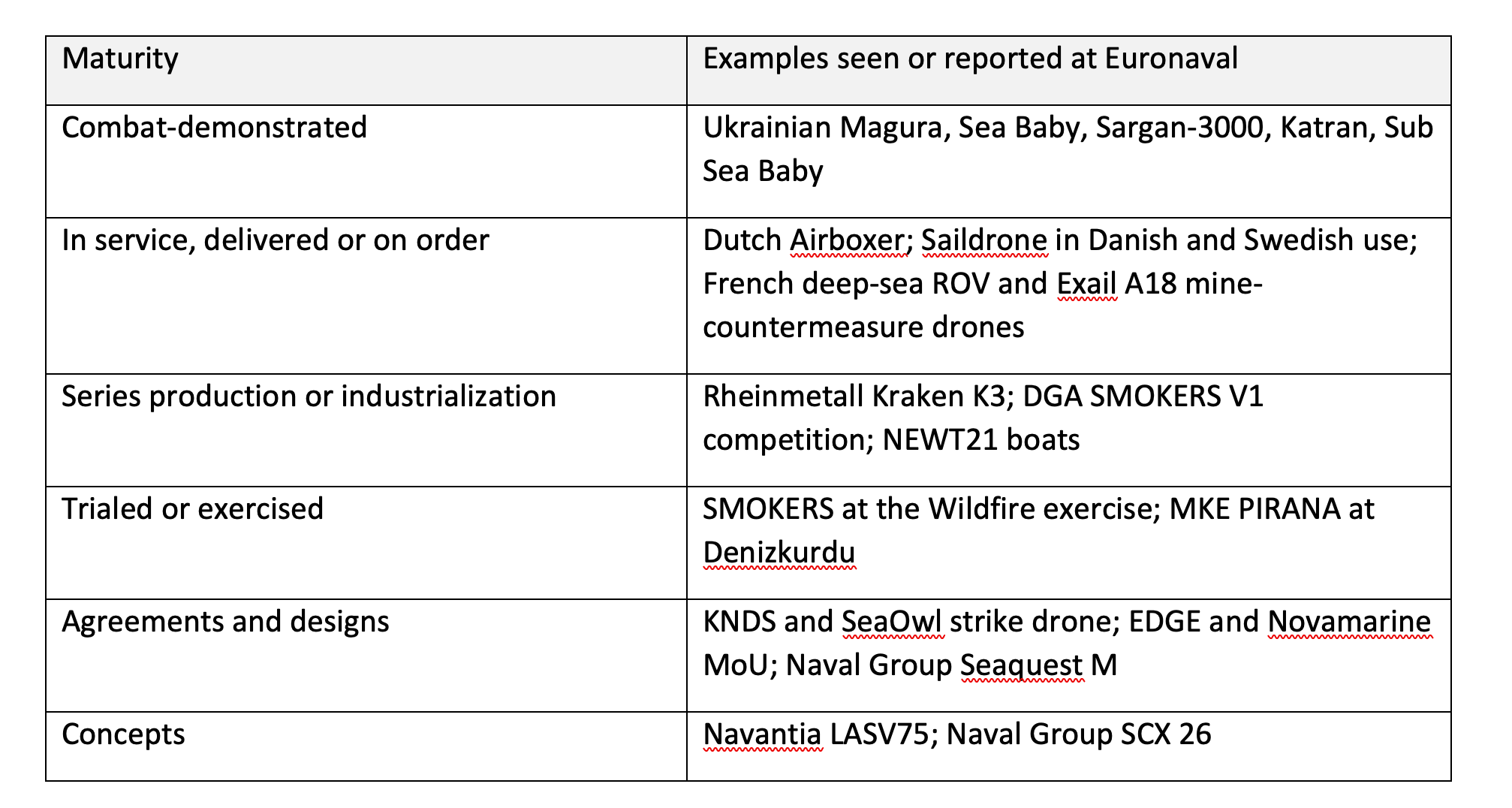
The top of the ladder is thin and the bottom is crowded.
Naval Group itself calls SCX 26 “a still highly theoretical ship concept,” and no French Navy program, schedule or cost exists for it.
Navantia UK’s 75-meter LASV75 has neither price nor order.
By contrast, the DGA showed SMOKERS V1, a 5-meter explosive boat built in-house in under six months, with three prototypes sailed during the Wildfire exercise off Toulon. It has opened an industrialization competition, with bids due December 4 and production envisaged at about 10 per year in peacetime, rising to 50.
France Set the Pace and the Vocabulary
Armed Forces Minister Catherine Vautrin opened the show by saying France had moved “from a logic of repair to a logic of rearmament.” She cited a draft 2027 defense budget of €63.4 billion, €6.5 billion more than in 2026, announced new Aster and Exocet orders, and urged buying European, naming Greece, Sweden, Belgium and the Netherlands as partners.
The centerpiece was a naval-drone pact with industry, modeled on France’s 2024 aerial-drone pact. It is a framework for matching the armed forces’ needs to what industry can supply, not a procurement. The money announced beside it went where risk is lowest: a second 6,000-meter ROV from LD Travocean, eight Exail A18 mine-countermeasure drones, and a second, larger unmanned combat underwater vehicle from Naval Group designed to stay in the water for weeks.
Around that core sit a DGA tender for a few dozen embarked long-endurance surveillance drones, requiring 100 nautical miles of range and five to ten days of endurance from Mistral- and Loire-class ships, and the DANAE effort on armed boats for base protection and escort. The French Navy was explicit that armed medium surface drones, the 37-meter Seaquest M class, are “later increments.” The near-term focus is endurance, secure connectivity and hull durability. Shephard reported that supplier contracts will require open architectures.
Industry answered in the same register. Naval Group said a drone must be “navalized, hardened, integrated into the platform and combat system, and fully interoperable,” and announced a 17,000-square-meter drone and underwater-weapons center at La Londe-les-Maures by the end of 2027. François Watteau of the DGA called the naval drone “the sword and the shield.” Vice-Admiral Éric Chaperon, now naval adviser to Thales, noted that navies have become “much more focused on the near future and what can be delivered immediately.” That sentence may be the best one-line summary of the show.
The Crewed Frigate Remained the Platform Buyers Funded
The FDI ran through the entire week. On day two the DGA decided to double the Aster cells on French FDIs from 16 to 32. On day three Naval Group showed a stretched version: an almost nine-meter section added amidships raises displacement by nearly 800 tonnes to about 5,400 tonnes and length to nearly 131 meters. The extra volume could hold more Exocet missiles, additional air-defense cells, A70 launchers for naval cruise missiles, more than 300 containerized loitering munitions, drone-control equipment, special-forces support and an admiral’s staff. Those are proposed configurations, not an order.
Day four went back to firepower. The DGA said it would soon sign with MBDA for the MdCN Mk2, a naval cruise missile with a range above 1,000 km and improved resistance to GNSS jamming, to be fired from FREMM frigates and Suffren-class submarines, with first deliveries from 2030. It also announced a framework for more Exocet MM40 Block 3C missiles, with a range of about 250 km and deliveries from 2029. Le marin noted that France’s own FDIs were not designed with silos for the MdCN and will be strengthened with Aster instead, while Sweden is considering the missile for its FDIs.
Sweden’s order was the only signed contract of the day. Saab will equip Sweden’s four FDI frigates with weapon-control systems, sensors, the RBS15 missile and other systems, worth about SEK 2 billion, with deliveries from 2027 to 2034. Even the lead ship’s first captain, Nicolas Guiraud, now Naval Group’s marketing director, was brought in to praise the inverted bow. His account should be read with that affiliation in mind.
The drone-centered designs share one logic with this repowering. Fincantieri’s 50-meter, six-crew Multi-Mission Modular Vessel, built around interchangeable 10- and 20-foot mission modules, and ST Engineering’s 150-meter Multi-Role Vessel, described as “manned brain, unmanned muscle,” are crewed hulls built to host uncrewed systems. The Royal Navy gave the idea a real demonstration the same day the show closed, announcing that British-made Nyan one-way strike drones had flown from HMS Queen Elizabeth for the first time, in mid-October trials alongside F-35Bs. Hybrid, in practice, means the crewed ship is the integrating node. Europe is arming the hulls it has already committed to before ordering new ones.
European Industry Began Organizing Around the Hybrid Fleet
Day two was about structure. Fincantieri, Navantia and Naval Group signed the consortium agreement for EPC2, the second phase of the European Patrol Corvette, with OCCAR present. EPC2 completes the design of a common Modular and Multirole Patrol Corvette. Separately, Navantia and Fincantieri signed heads of agreement for a 50/50 joint venture to act as prime for their national programs and for exports, running common design, purchasing and life-cycle support. Naval Group is reported to be studying whether to join, and French participation had been in doubt since earlier in the year.
Seabed protection drew its own national team. Seven Spanish firms led by Indra signed an agreement to develop SIPRIS, a sovereign system for continuous surveillance of undersea cables and critical infrastructure, combining fiber-optic anomaly detection, sonar, uncrewed vessels, aerial drones and satellite coverage, with field testing to begin immediately.
The supply chain showed the same pattern at the level of work packages. Naval Group signed 10 contracts with Greek companies for the FDI frigates, five for construction and five for support, plus two research memoranda. More than 75 Greek firms are now in the FDI supply chain. The second Greek frigate, Nearchos, was delivered on October 30, and the third, Formion, is due in December. This is what “buy European” looks like when it becomes industrial participation.
Others positioned for the drone era. Saildrone chose Norway’s Umoe Mandal to build its Surveyor locally for Northern European customers. Babcock signed an MoU with Everllence on propulsion for future Arrowhead 140 programs, and Exail joined Babcock’s ARMOR Force autonomy ecosystem. Fincantieri signed a joint venture agreement in Indonesia and a letter of intent with Denmark’s J.A. Solutions on containerized systems.
The pattern is consolidation and specialization: fewer duplicate designs, national teams for narrow missions, and dedicated capacity for drones. The caveat I raised on day two stands. Heads of agreement, consortium terms and field-test plans are not production contracts.
The Fleet Became a Campaign Issue
On day three, French presidential politics came onto the floor. Édouard Philippe, Bruno Retailleau and Marine Le Pen toured the halls, and L’Opinion also counted Éric Zemmour. Raphaël Glucksmann had visited the day before to make his case on sovereignty.
Frigate numbers became the shorthand for ambition. Philippe backed a fleet of at least 18 frigates, against the roughly 15 first-rank frigates the Navy plans to field from 2030, and said France must “massify” its conventional forces. Retailleau said France would need “18 or 21.” Le Pen said about a hundred vessels overall is “probably not enough” for the world’s second-largest maritime domain, while acknowledging budget limits, and added that “the drone is the sailor’s best friend.” She also repeated that she favors France eventually leaving NATO’s integrated command, and Philippe used his visit to attack her NATO position and Jean-Luc Mélenchon’s.
The candidates differed on NATO, not on whether France needs more naval mass. In the reporting I reviewed, none offered drones as a substitute for hulls. That fits what the industry floor showed: drones extend the fleet and do not replace its core. These numbers are pledges, not budgets. The test comes after the show, when the next president decides whether to fund 18 or more frigates.
The Hard Problems Are Not the Weapons
The most useful reporting of the week came from Navantia’s designers, via Navy Lookout. They argue that the hardest part of a large uncrewed ship is not weapons but a vessel that can stay in the North Atlantic for weeks with nobody aboard while remaining simple and cheap enough to build in numbers. Someone still has to clean strainers, change filters and reset breakers. The Royal Navy is seeking missile silos that stay ready for 30 days without human touch. Removing the crew moves cost and people ashore, into operations centers, software assurance and contractor support. And lessons from five- or six-meter Ukrainian boats, used for hours or days and redesigned in months, do not transfer directly to a warship expected to serve for years.
Integration is the second choke point. Officials in Paris stressed how hard it is to connect new drones to ships and submarines built decades ago. As one French Navy official put it, “A ship at sea moves a lot. All of the GPS-based systems need to take that into account.”
The demand signal still comes from the Black Sea. Ukraine’s explosive boats sank about a third of Russia’s Black Sea Fleet. The SBU’s Sea Baby now carries six to eight FPV drones, Katran boats act as miniature carriers, and the Sub Sea Baby struck an Improved Kilo-class submarine at its pier in Novorossiysk. In September, a Ukrainian Sargan-3000 reportedly became the first surface drone to destroy another in combat. Ukraine’s navy then led the red team at NATO’s REPMUS exercise and won all five scenarios. The lesson is adaptation speed.
The human element keeps returning. Lt. Col. Kochevenko, whose systems have worked under fire without GPS, said: “Technology is not what matters most. People are.” Sam Tangredi supplied the counterweight: drones “are tools in the tool kit… They don’t change the equation.” Both statements can be true. A hybrid fleet changes how the equation is solved, and it will be won by the navies that build the sustainment, integration and operator base alongside the hulls.
What to Watch Before Euronaval 2028
The real measure, as the week ended, is whether the 2028 show reports deliveries rather than intentions. Six markers will tell.
- Signatures and quantities. The MdCN Mk2 and Exocet Block 3C deals are announced but unsigned, with no disclosed quantities. MBDA’s Stratus RS strike missile still awaits a DGA development contract.
- Whether France stays inside the corvette structure. The EPC2 consortium and the Navantia-Fincantieri joint venture are the test of European consolidation.
- The first armed medium drones. Navy statements place them in later increments. Watch for the first ordered, not displayed.
- Serial production. The SMOKERS competition selects a manufacturer in 2027, and the La Londe drone center is due by the end of 2027.
- Fielded seabed protection. SIPRIS and the French seabed systems must move from field tests to operations.
- Funded mass. The 2027 presidential result will show whether the 18-frigate pledges become budgets.
Euronaval 2026 showed that naval autonomy has crossed from experimentation into industry.
It did not show that Europe has a hybrid fleet.
That fleet is an integration problem across hulls, drones, weapons, networks and people, and the navies that treat it that way will get there first.
Sources
- SLDinfo, Euronaval daily reports, Days One to Four, November 4 to 7, 2026.
- Elbit, Shadow Nautics, High Eye and NEWT21 coverage, Army Recognition video report; Navy Lookout on Navantia’s LASV75.
- Defense Arabia: EURONAVAL 2026 closes as largest edition in decades
- Breaking Defense: France investing in naval power
- Euronews: As maritime threats rise, France seeks to bolster Europe’s naval power
- Defense News: Saildrone and Umoe Mandal
- Defense News: MBDA Stratus RS
- Defense News: the FDI’s bow
- DGA: new MdCN standard
- Royal Navy: strike drones from HMS Queen Elizabeth