

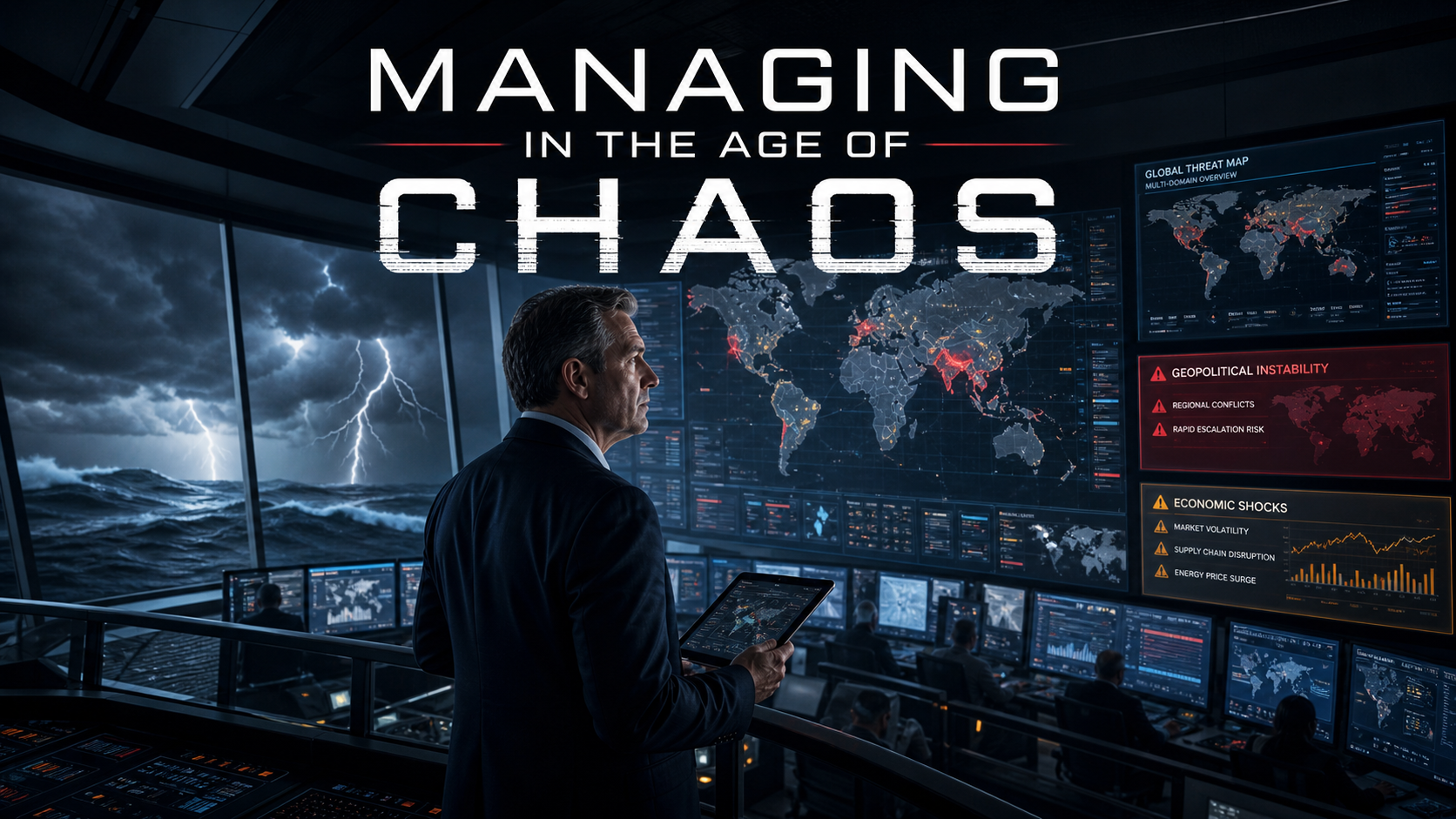
Are we so absorbed in managing disruption that we miss what is forming inside it?
It is the right question for my book called Mastering Chaos, and it sharpens the book’s argument.
A question worth taking seriously
After reading my article, “The Forces of Change: Why the Post-Industrial Thinkers of the 1970s Still Matter in the Age of Chaos,” Deborah Westphal commented that the article brought to mind Ilya Prigogine and Isabelle Stengers’ Order Out of Chaos, and that she has long found fascinating how new forms of order can emerge from instability.
Then came the challenge: are we so focused on managing the disruption around us that we miss what might be emerging from it?
What new relationships, structures, or possibilities are taking shape, and how might we influence where they lead?
She added that this was what she valued in the thinking of Alvin and Heidi Toffler: they were interested not only in how we adapt to change, but in how we recognize what is emerging and take part in shaping what comes next.
I want to answer that directly, because my central claim in my book Mastering Chaos: Shaping a Wa Ahead for Chaos Management is that you cannot plan your way through genuine chaos, invites exactly this objection. If the task is only to survive turbulence, we have set the bar too low.
What Prigogine and Stengers saw
Prigogine, a chemist who won the 1977 Nobel Prize, and Stengers, a philosopher of science, published Order Out of Chaos in 1984, with a foreword by Alvin Toffler. Their argument rests on a few ideas that matter well beyond physics:
- Dissipative structures. Systems pushed far from equilibrium do not simply fall apart. Some reorganize into new, stable structures that sustain themselves by exchanging energy with their surroundings, the way a flame or a living cell does.
- Instability as the source of novelty. Small fluctuations that a stable system would absorb can, in an unstable one, be amplified until the system tips into a new configuration.
- No guaranteed outcome. At those tipping points, more than one future is possible, and the path taken cannot be predicted from the starting conditions. History matters, and time runs one way.
Two lessons follow. Disorder is not merely the absence of order; it is the condition from which new order can form. And that new order is not automatically benign. Where it leads depends on what is present when the system tips, which is precisely why Westphal’s question about influence is the hard part.
What Mastering Chaos argues, and where it already points at emergence
The book starts from what I call the anarchy of the moment: tightly coupled systems, cascading disruption, and decision time compressed until detection, assessment, and response happen almost at once. Under those conditions, classic crisis management, which contains the problem, fixes the cause, and restores equilibrium, repeatedly fails. Charles Perrow’s “normal accidents” are a structural feature of such systems, not an anomaly. Even redundancy can mislead, because backups tightly linked to the primary system fail in the same way at the same time.
The answer is to build three pillars of adaptive capacity: intellectual flexibility, institutional resilience, and social cohesion. The book then trains four cognitive skills in leaders it calls Chaos Navigators: adaptive thinking, pattern recognition under uncertainty, emotional regulation, and collaborative sensemaking.
Read carefully, that is already a theory of emergence, though I did not label it that way:
- The introduction says the anarchy of the moment “is also generative. From the dissolution of old orders come the seeds of new ones.”
- Chapter One closes on “the search for pattern,” the idea that chaos unfolds within persistent structures of power and influence, and that those underlying currents are what leaders must learn to read.
- The Navigator chapter asks leaders to “detect weak patterns early,” to keep explicit tripwires that tell them when their working model is wrong, and to remember that “today’s noise may become tomorrow’s signal.”
- My own doctoral dissertation at Columbia was titled On Historical Change: Order Within Chaos. The question has followed me for a long time.
The gap Westphal identifies
But Debrah’s perspective suggests that my book leans toward the defensive. Most of its tools, including diagnostics, redundancy, core-and-surge structures, and mission command, are about staying coherent while the environment shifts. They are tools for adapting. Prigogine’s insight, and the Tofflers’ reading of it, asks for something more: noticing what is organizing itself in the turbulence and deciding whether to help it along.
That is the difference between a leader who keeps the organization alive through disruption and one who helps determine what comes after it. The two are not opposed. Resilience buys the time and the freedom to participate. An organization that is merely surviving has no spare attention for what is forming around it.
In my own field, several candidates for emerging order are visible now:
- Kill webs displacing kill chains. Forces are organizing around adaptable, networked ways of connecting sensors, shooters, and decisions, rather than fixed sequential chains built around platforms.
- Autonomous and uncrewed systems changing what mass means. Intelligent mass is beginning to substitute for exquisite scarcity, and it forces new thinking about ships, aircraft, and the industrial base that sustains them.
- Allies co-inventing their forces. Partners such as the Australian Defence Force and the U.S. Marine Corps are shaping concepts, training, and equipment together rather than one hosting the other.
None of these was ordered from above. Each took form in the gap left when an older arrangement stopped fitting. And each could still go several ways, which is the Prigogine point: the outcome depends on who shows up and what they do at the tipping point.
How leaders look for what is emerging
The book’s training tools can be pointed at emergence as readily as at survival.
Four practical moves:
- Add an emergence question to every simulation. The book recommends short, frequent micro-drills of about 30 minutes alongside large exercises. Add one inject that asks what new arrangement is forming, who benefits from it, and who is shaping it.
- Write tripwires for opportunity, not only for danger. Tripwires usually tell leaders when a working model has failed. A second set can say: if we see this relationship, this behavior, or this capability appear repeatedly, the pattern has changed and we should act on it.
- Protect the people at the edges. Weak signals come from the people closest to change. The book calls this signal protection: those who raise early concerns or surface uncomfortable data must not be marginalized.
- Put Navigators at the seams. The book advises placing them where systems meet, in alliances, joint ventures, and public-private interfaces. Those seams are also where new structures are most likely to form first.
The discipline underneath is the one the book already asks for: hold more than one interpretation, act on a provisional map, and revise it openly. Applied to emergence, it means being willing to say, “I think a new order is forming here, and here is how I could be wrong.”
Beyond managing
The book is dedicated to Tim Kilvert-Jones, who would have laughed at the idea of “managing” chaos. He lived in it, thrived in it, and made it meaningful. That is closer to what Debrah asks of us than the word management suggests.
Perhaps the honest summary is this: management gets an organization through chaos, and mastery means reading what chaos is producing and helping to shape it. The anarchy of the moment is real. The task is to be among those who help decide what grows from it.
Sources
- Robbin F. Laird, Mastering Chaos: Shaping a Way Ahead for Chaos Management (Second Line of Defense, 2026), including the Introduction, Part One, the Chaos Navigator chapter, and Part Three.
- Ilya Prigogine and Isabelle Stengers, Order Out of Chaos: Man’s New Dialogue with Nature, foreword by Alvin Toffler (1984). Publication details per Goodreads; the summary of its ideas is the author’s reading, not a quotation.
- Charles Perrow, Normal Accidents: Living with High-Risk Technologies, cited in Mastering Chaos.