

By Robbin Laird
There is a seductive fallacy embedded in how we talk about military technology. Every generation produces its own version of it. The airplane will make armies obsolete. Precision strike will end the fog of war. Network-centric warfare will lift the battlefield veil permanently. Each claim, when it arrives, carries the intoxicating logic of finality, the idea that this time, this breakthrough, will produce a stable dominance that the enemy cannot answer.
It never does.
And understanding why it never does is arguably the most important intellectual framework a defense professional can internalize. The lesson is not that technology is irrelevant. It is that technology is always in motion, always being answered, and that the side which survives and prevails is not the one that achieves a superior snapshot, but the one that learns to move through snapshots faster than its adversary.
Superiority as a Snapshot in Time
The insight I return to most frequently in thinking through these dynamics comes from Dr. Holger Mey, whose framing is deceptively simple: technological superiority is never a permanent status. It is a snapshot. What functions as a revolutionary edge today becomes the baseline expectation of tomorrow, and a catalogued vulnerability the day after. Military history, properly read, is not a progression toward a final state of dominance. It is a transient series of advantages, each one generating the conditions for its own erosion.
Traditional bureaucratic thinking is constitutionally allergic to this reality. Washington planning cultures seek what they call a stable end-state, a point at which the technology race is effectively won, acquisition lists are finalized, and the process concludes.
This is not merely wishful thinking. It is institutionally reinforced. Programs of record require stable requirements. Budgets require predictable timelines. The entire acquisition machinery is organized around achieving a fixed capability, then defending it.
The problem is that adversaries are not organized around your acquisition calendar. Genuine military transformation requires rejecting the stable end-state fallacy at the institutional level and replacing it with what the evidence actually shows: superiority is a transient moment of leverage within a continuous evolutionary process. Innovation is not a destination.
It is a temporary position that must be constantly reinvented as the adversary adapts. You are not acquiring a solution. You are joining a contested process of competitive co-evolution.
The Pendulum of the Spear and the Shield
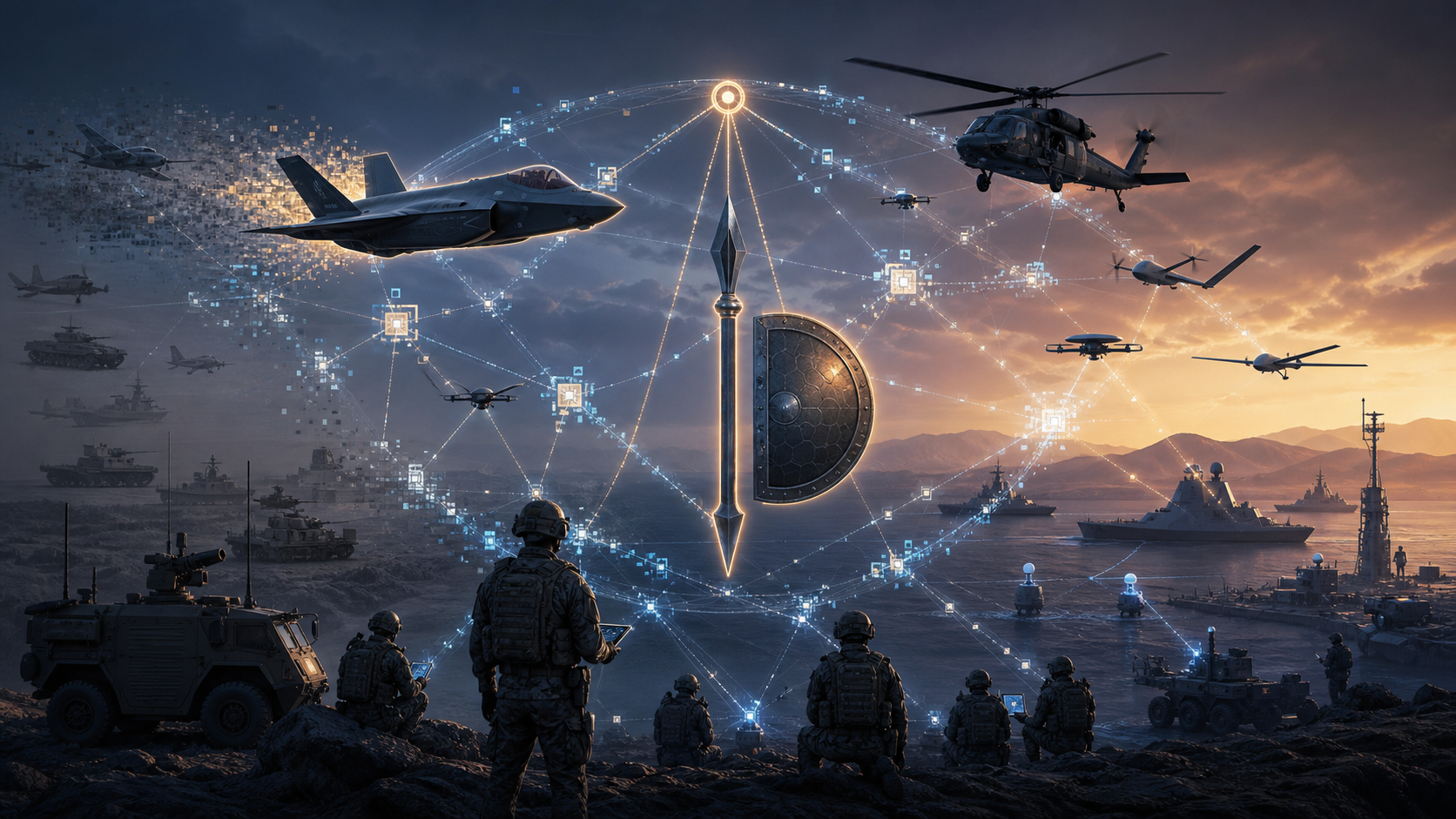
The structural reality of warfare is defined by what is perhaps the oldest competition in human conflict: the spear and the shield. Every offensive breakthrough triggers a defensive counter. Every defensive adaptation necessitates a new offensive evolution. The pendulum swings. What changes across eras is the speed of the swing.
Three contemporary examples illustrate the pattern with particular clarity. Air power proponents have argued for a century that domination of the skies translates to domination of the battle. The counter is advanced integrated air defense, sensors, missiles, layered systems, capable of denying access to the very airspace that air power requires. Precision strike theorists argued that the ability to find and hit any coordinate with near-perfect accuracy would break adversary will and capability. The counter has been concealment and dispersal: forests, urban canyons, secure landlines, pre-delegated authority, methods of remaining invisible and operational even when individual nodes are destroyed. Information dominance advocates argued that network-centric warfare would lift the fog of war entirely. The counter has been electronic warfare: jamming, decoys, and what might be called digital fog, deliberate disruption of the sensors the network depends upon.
Each of these is not a failure of the original technology. It is confirmation of the cycle. Precision strike is real. Information fusion is real. Air power is real.
But none of them terminate the competition. Each creates the conditions for the next adaptation.
Dr. Mey adds one further complication that should trouble anyone who has sat through a briefing on exquisite capabilities: quantity is a form of quality. A technologically superior air platform capable of engaging six targets simultaneously still faces a terminal problem when confronted by a seven-to-one numerical disadvantage. Technological edge is a force multiplier, but it can be overwhelmed by mass.
The balance between exquisite capability and intelligent mass is not a procurement question. It is a strategic one that the tactical cycle forces onto the table repeatedly.
From the Black Line to the Combat Cloud: Democratizing the Battlefield
Abstract principle becomes concrete in the evolution of how ground forces and airpower have learned—and repeatedly relearned—to share a common operational picture. The Marine Corps tradition, from the ridges of Korea through the jungles of Vietnam, was built around what practitioners called the black line analogy: you never let the airmen out of sight of the ground. The intimacy of the connection was enforced by physical proximity. The pilot and the Marine on the ground were operating in the same sensory world, even if communication was voice-only.
What changed that relationship fundamentally was a practitioner’s question. Chief Warrant Officer Manuel, watching full-motion video being pushed to an AC-130, asked the obvious question that the acquisition system had not yet answered: if the aircraft can see it, why can’t I? Major Greg Harbins turned that question into hardware, a prototype built from a Panasonic hard-book and components sourced from Radio Shack. The result was the Rover: the Remotely Operated Video Enhanced Receiver.
The Rover story is worth dwelling on because it illustrates the Tactical Cycle at the level of institutional behavior, not just technology. The breakthrough did not originate in a program office. It came from the field, bypassed the formal center entirely, and solved a life-or-death problem in real time. It was a bottom-up fix that the top-down system had not produced and might not have produced on any timeline relevant to the operators being killed in the gap.
The second transformation Rover produced was structural. It broke the vertical information hierarchy. Before Rover, the comprehensive picture was held at the top, generals had it, captains and lieutenants did not. Rover pushed that picture to the tactical edge. A captain on the ground could now see exactly what the pilot saw. Decision-making authority could follow the information, enabling a horizontal command structure where choices were made with higher fidelity closer to the fight.
Rover’s evolution into what is now called the Combat Cloud represents the full maturation of this logic. Information is no longer a one-way feed from platform to ground. It is a distributed mesh: any sensor, drone, jet, ground robot, can support any shooter. The force has moved from platform-centricity to what we have described as the kill web: an integrated, organic system where the value is not in any individual node but in the connectivity among all of them.
The H-1 and the Cognitive Transformation
The transformation of the H-1 platform, the Cobra and the Huey, from what was essentially a voice-driven weapons system into a digital node in a distributed kill web is one of the more instructive case studies in what genuine military transformation actually requires. It is not primarily a hardware story. It is a story about changing the mental furniture of the operators who fly the platform.
Units like HMLA-267 and its parent MAG-39, stationed at Camp Pendleton alongside the 1st Marine Division, have pioneered digital interoperability precisely because of their structural proximity to the ground combat element. The physical colocation of air and ground forced the kind of integrated thinking that geographically separated communities struggle to produce. The shift from voice-only operations to Link 16 integration delivered what the technology promised: targeting data pushed directly to the pilot’s glass cockpit, eliminating the ambiguity of long voice descriptions, compressing the kill chain, and enabling the H-1 to function not merely as a shooter but as a command and control node, managing autonomous drones, integrating fifth-generation data from the F-35, and contributing to the information architecture of the entire force.
But Major Jonathan Moss’s evolution from a traditional Cobra pilot to what might be called a digital warrior is more significant than the platform upgrade. It represents the cognitive shift that the Tactical Cycle ultimately demands: from platform mastery, the idea that excellence means flying the helicopter exceptionally well, to systems understanding, where the pilot manages information flows and node relationships across a kill web that extends well beyond the cockpit. This is not a marginal adjustment in how pilots are trained. It is a fundamental reconception of what the job is.
The Field Versus the Center: Where Transformation Actually Happens
The greatest obstacle to executing the Tactical Cycle is rarely the adversary’s technology. It is our own structural friction. Military evolution is a contested process between two entities with fundamentally different priorities and time horizons.
The Center, Washington, the acquisition bureaucracy, the program offices, operates on linear, risk-averse timelines. It focuses on programs of record, acquisition lists, and requirements documents. It sees technology as a fixed capability to be defined, procured, and fielded. The Field, operators, practitioners, the people who will die if the technology fails them, operates on the physics of combat. It solves problems through improvisation. It discovers applications that designers never intended and creates capabilities from commercial off-the-shelf components when the formal system cannot move fast enough.
What bridges these two worlds are what might be called lead users in the field and innovation protectors in the bureaucracy. The lead users are people like CWO Manuel and Major Harbins, practitioners close enough to the problem to see the solution and resourceful enough to build it. The innovation protectors are senior officials willing to use their institutional authority to shield promising work from bureaucratic strangulation.
Secretary Michael Wynne provided a canonical example of the second category. When program officials insisted on halting development of the Joint Unmanned Combat Air System to focus on air-refueling, a secondary problem that threatened to consume the schedule of the primary mission—Wynne threw a one-inch binder across the conference table, frisbee-style, and walked out. The message was clear: come back when you have something useful to say. This kind of principled contrarianism, the willingness to protect core innovation from being smothered by process—is not incidental to military transformation. It is necessary to it.
From Crisis Management to Chaos Management
The Tactical Cycle leads ultimately to a distinction that I consider the defining conceptual divide in contemporary defense thinking: the difference between crisis management and chaos management.
Crisis management is built on the assumption that conflict is a temporary disturbance. There is a baseline of stability. War is the deviation from it. The goal is to apply sufficient force or technology to restore equilibrium. This mindset generates a particular type of military planning, episodic, campaign-oriented, aimed at achieving conditions that allow a return to the pre-conflict normal.
Chaos management begins from a different premise: the modern world is in a state of persistent turbulence. There is no stable baseline to restore. The adversary is not pausing to allow us to catch up. Stability, in the old sense, is ephemeral. The military problem is not to achieve a final condition; it is to operate effectively within constant complexity and relentless adaptation. Transformation in this framework is not a project with a deadline. It is an organizational capacity, the ability to learn and adapt faster than the adversary across the full Tactical Cycle.
The implications cascade across every dimension of military organization. Doctrine, training, acquisition, command philosophy—all of them look different when the operating assumption is persistent turbulence rather than recoverable crisis. A force organized around crisis management optimizes for the decisive battle. A force organized around chaos management optimizes for continuous learning.
The Rover story and the H-1 transformation are not museum pieces. They are templates. They show what the Tactical Cycle looks like when it is working, when practitioners identify the gap, build the bridge, push the capability to the edge, and force the institution to catch up with what operators have already discovered. The alternative, when institutions defend programs of record against field-driven innovation, is a force that loses cycles. And in the current environment, losing cycles is not a recoverable condition.
Victory in the Tactical Cycle does not go to the side with the most expensive snapshot of technology.
It goes to the side that learns fastest within the chaos that moves through snapshots rather than defending them, that generates lead users rather than suppressing them, and that produces the institutional protectors willing to shield innovation from the gravitational pull of bureaucratic inertia.
Transformation is evolutionary, contested, and practitioner-led. That has always been true.
What the current era has changed is the cost of getting it wrong.