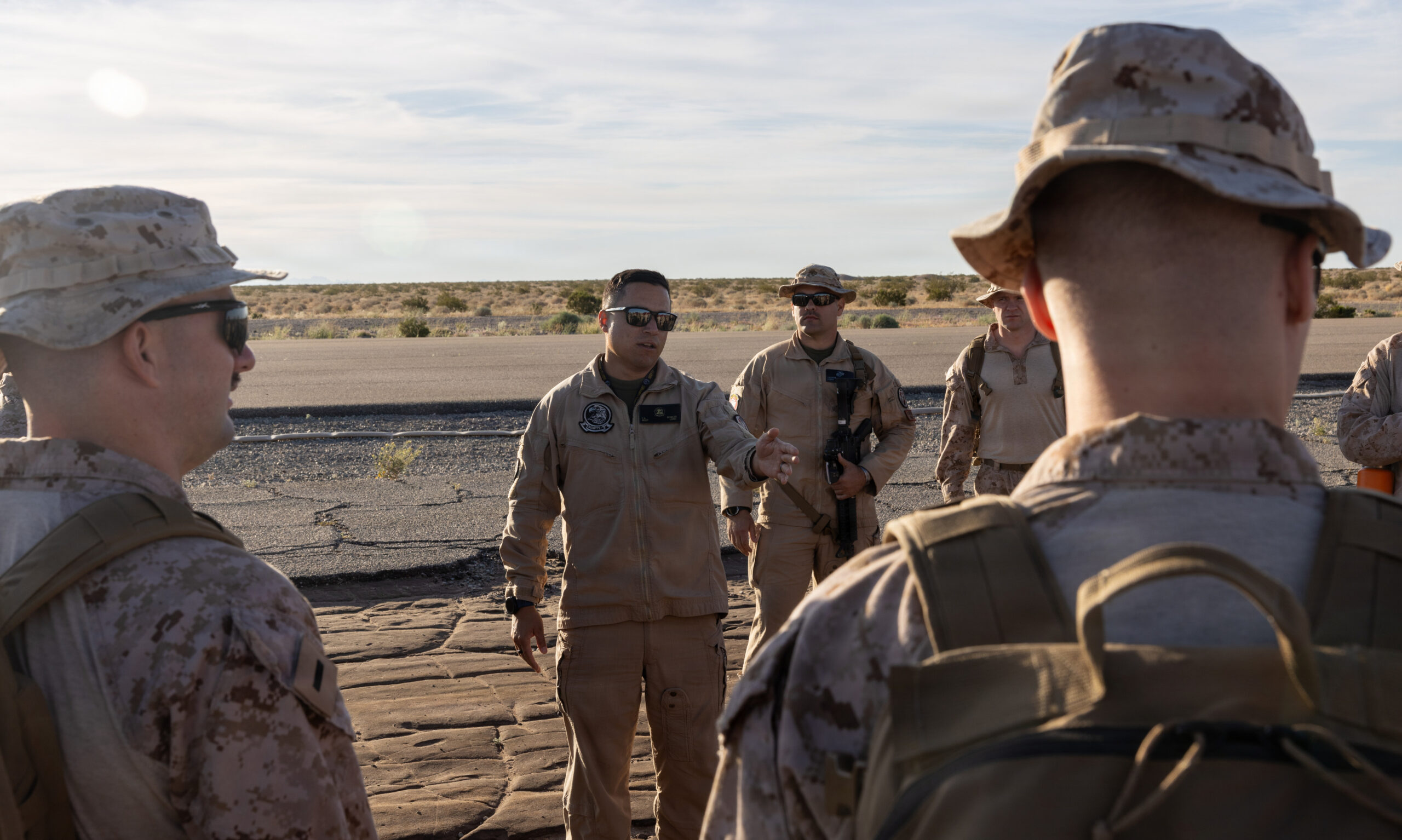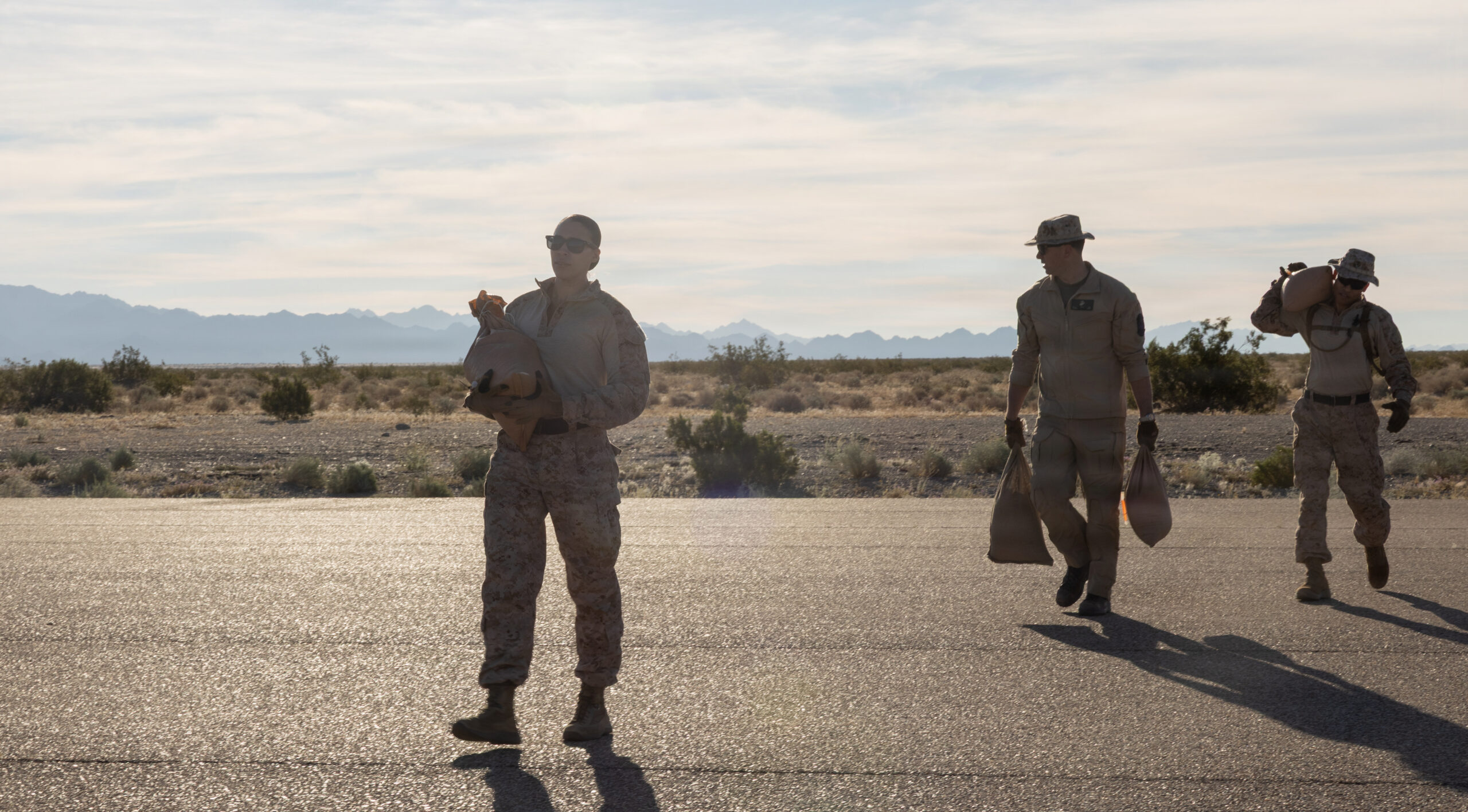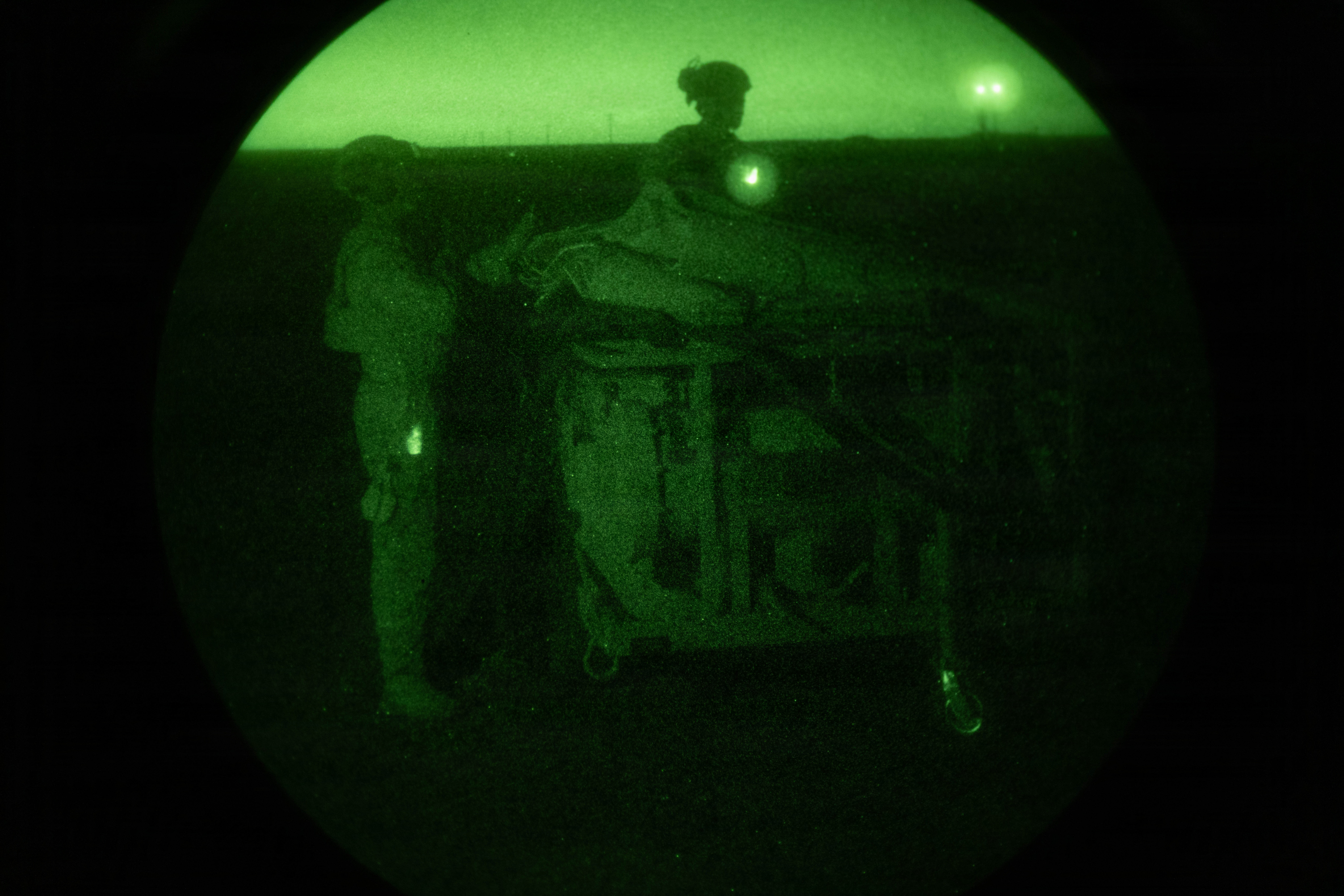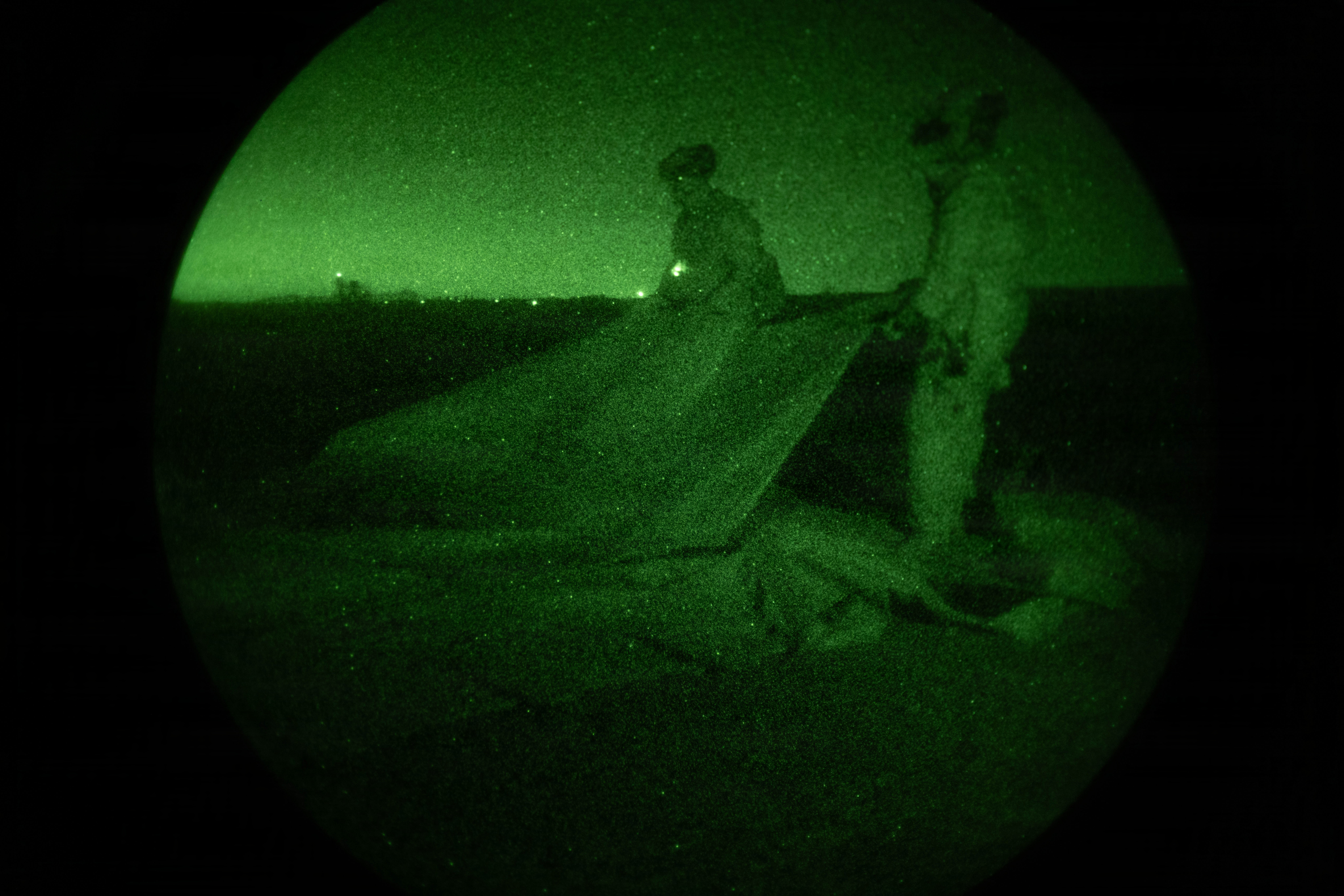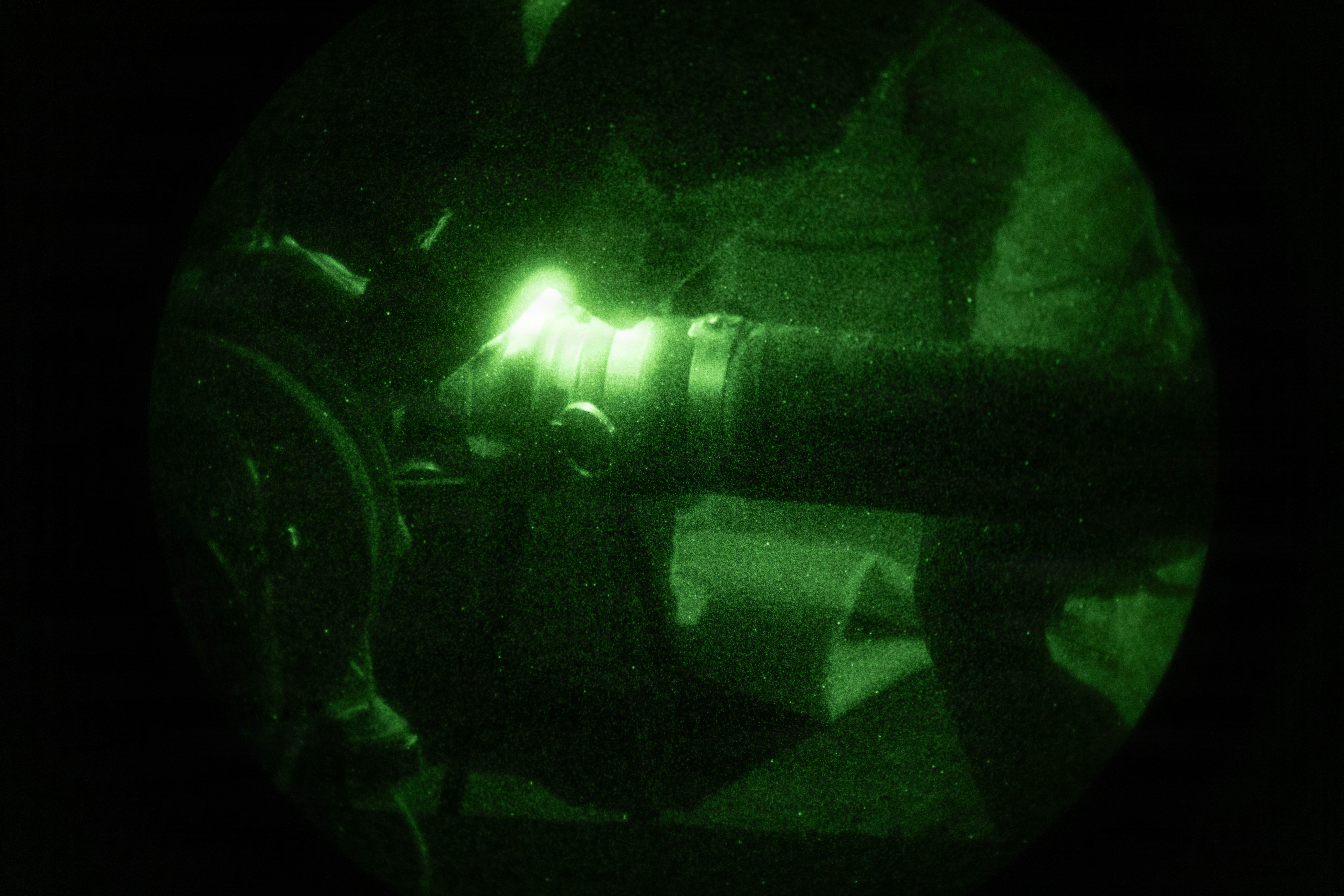
Three days after Marines with Marine Wing Support Squadron 373 laid AM-2 aluminum matting at Auxiliary Airfield II near Yuma, Arizona, a new team returned to the same site to build the next layer of the expeditionary airfield.
On March 17, 2026, personnel conducting the Forward Arming and Refueling Point practical application as part of Weapons and Tactics Instructor Course 2-26 set up a field fuel system on the surface their predecessors had constructed. The sequence is deliberate: WTI builds the expeditionary airfield from the ground up, one functional layer at a time.
A Forward Arming and Refueling Point is one of the most operationally critical capabilities in Marine aviation. It is the mechanism by which aircraft operating at extended range can be refueled and re-armed without returning to a main operating base, dramatically extending both sortie duration and the geographic reach of the aviation combat element.
In a distributed operations environment, the operational context the Marine Corps is designing for across the Indo-Pacific, the FARP is not a convenience. It is what makes sustained aviation presence at dispersed forward sites possible at all.
Measuring Before Fueling: The Surveyor’s Wheel
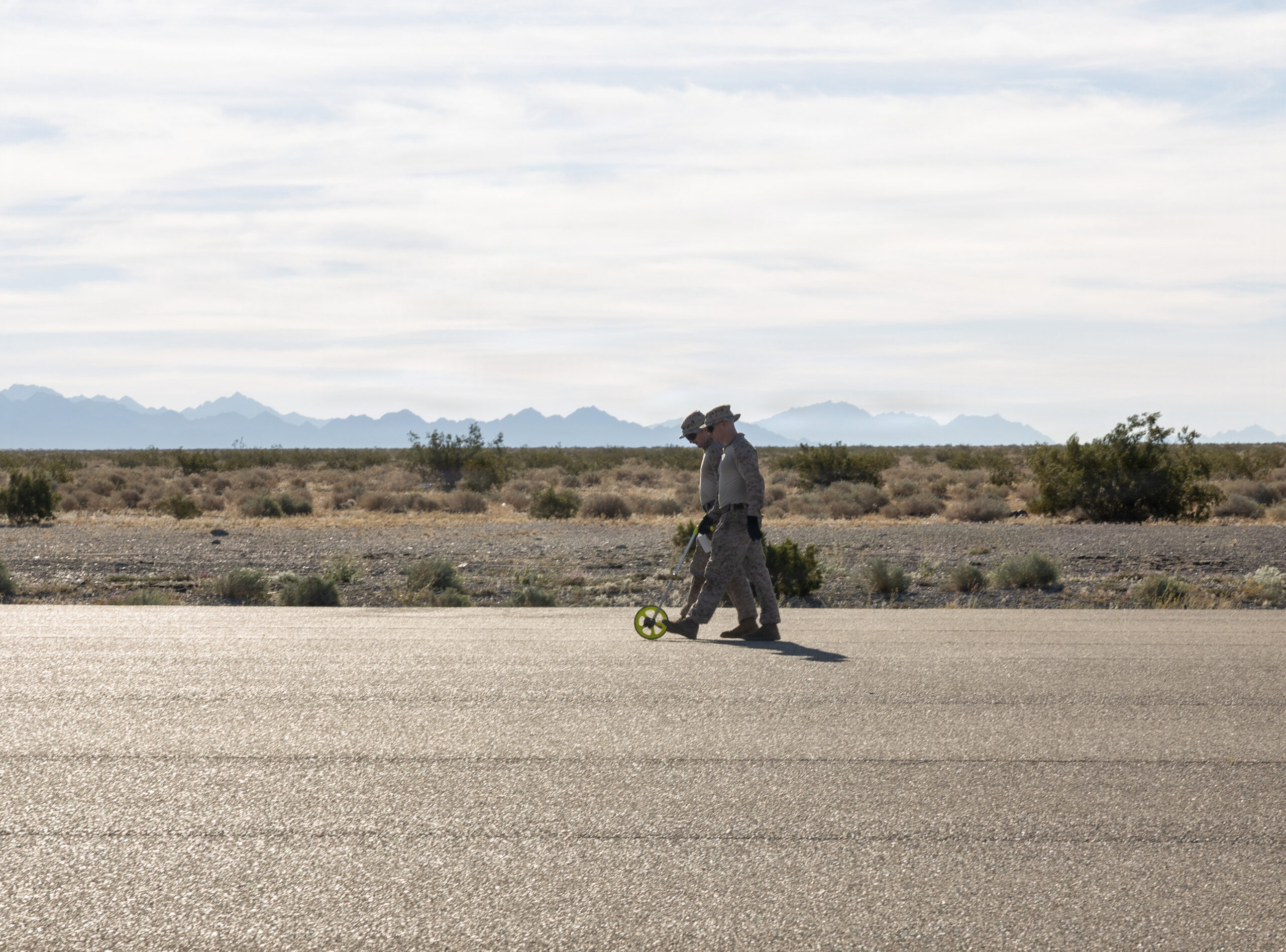
The evolution begins before any fuel line is laid. One image shows two Marines walking the runway surface at Auxiliary Airfield II with a surveyor’s measuring wheel, a simple but essential tool for establishing the precise standoff distances that govern FARP layout. The positioning of fuel points, hose runs, pump units, and aircraft parking spots relative to each other and to the runway edge is not arbitrary. It is specified by safety standards that account for fire hazard, rotor wash from incoming aircraft, and the clearances required for simultaneous multi-aircraft operations.
The image of two Marines walking an otherwise empty desert runway with a measuring wheel captures something that is easy to overlook in the more dramatic photographs that follow: the FARP begins with a plan, and the plan has to be accurate. A WTI student who has personally walked a runway measuring fuel point positions understands in a visceral way why those measurements matter when the first MV-22B comes in hot and low and needs to be turned around in minimum time.
The Equipment: Bladder, Pump, and Hose
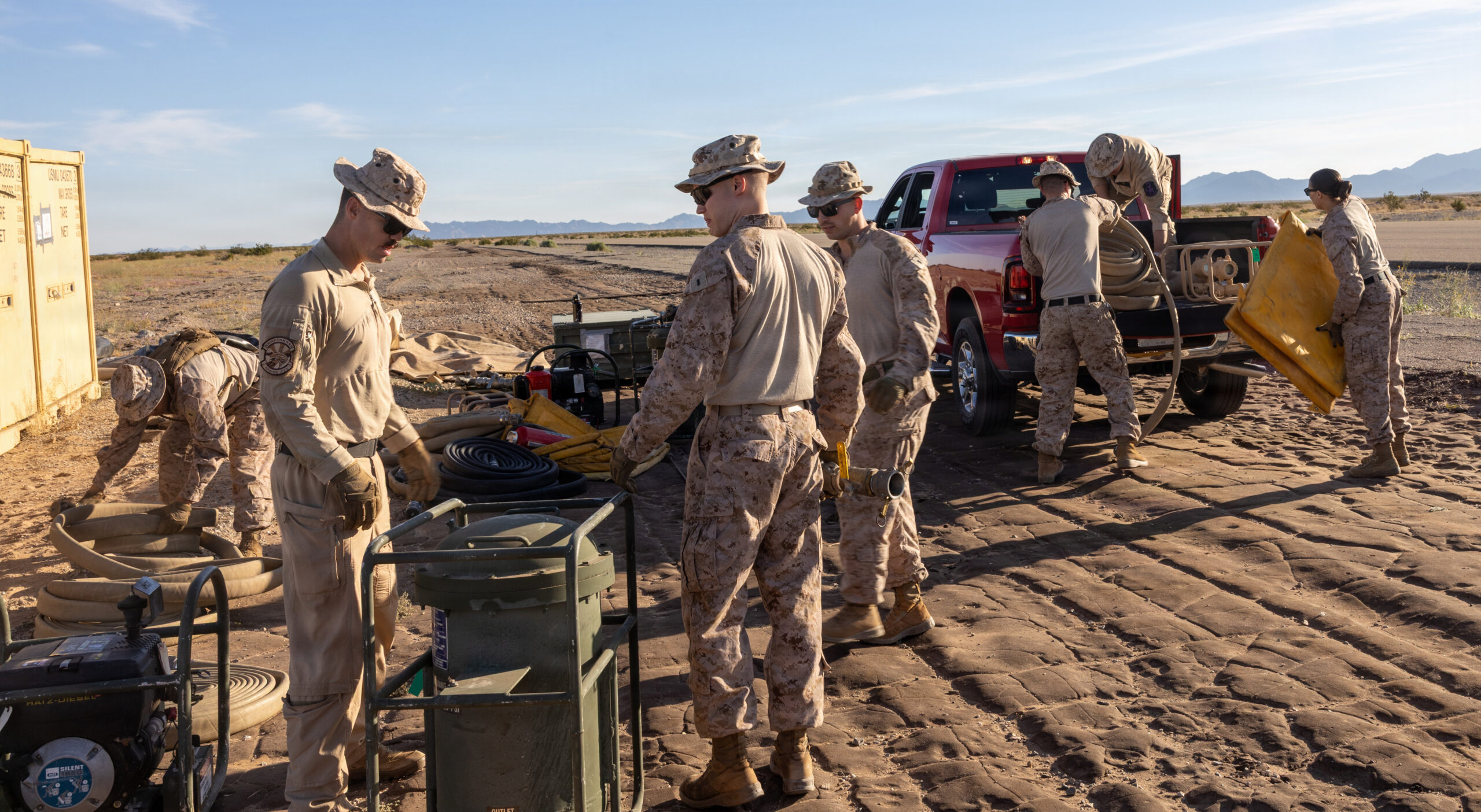
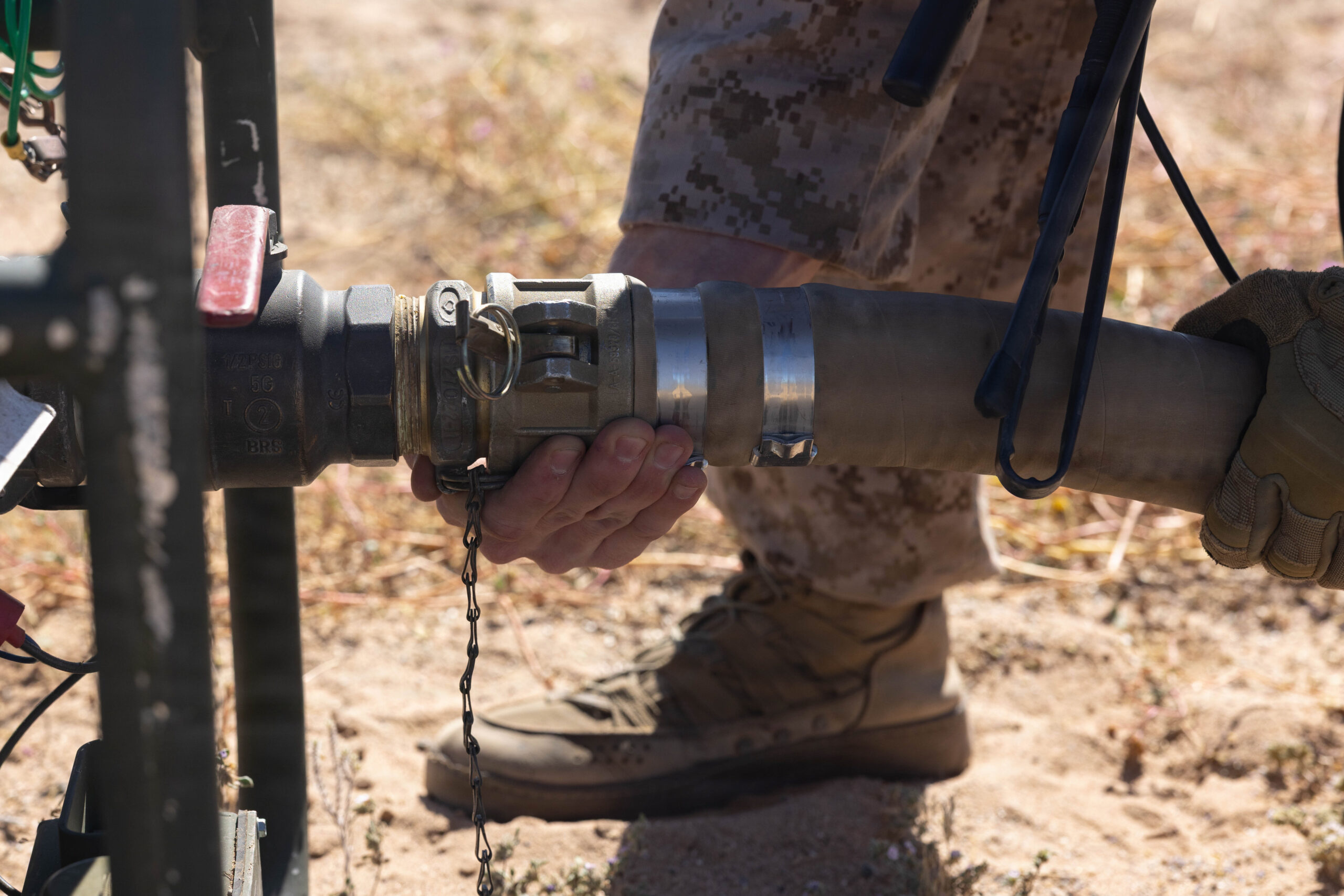
An image shows the FARP equipment being organized from a truck bed and ground layout: coiled fuel hoses, a portable pump unit, a collapsible fuel bladder in yellow fabric, and a Hatz diesel generator providing power to the pump. This is the core of a lightweight expeditionary fuel point, everything needed to move fuel from a storage bladder through a pump to an aircraft refueling nozzle, transportable in a small tactical logistics package and operable by a small team without fixed infrastructure.
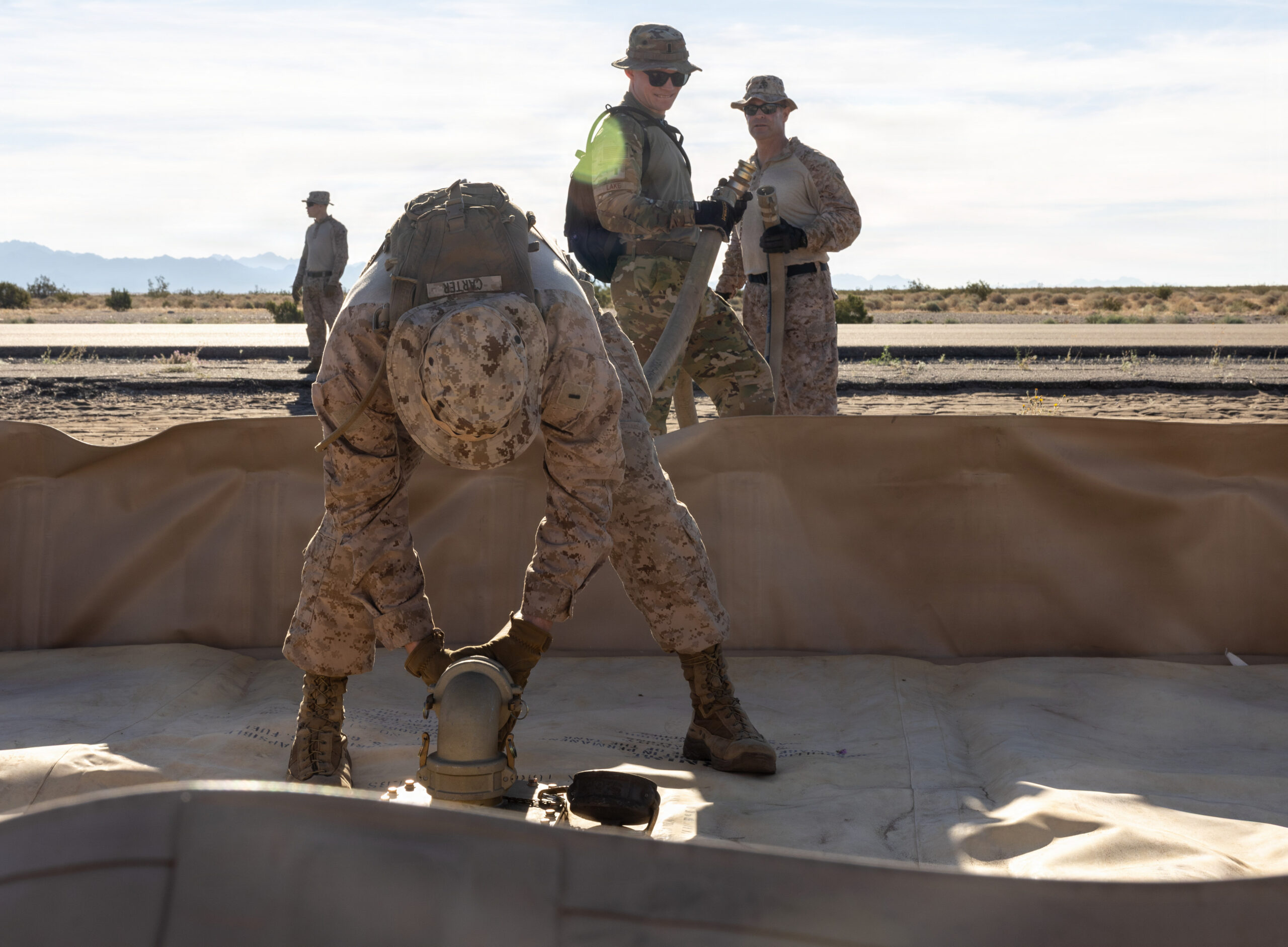
An Image shows Marine “Carter” inside the collapsed fuel bladder, connecting the inlet fitting at the base of the tank while an Air Force soldier in OCP holds the fuel hose in position. The collapsible fuel bladder, a fabric-walled tank that expands as it fills — is the storage node of the expeditionary fuel system. Its value is portability: it can be transported folded flat, positioned wherever the site survey dictates, filled from an external fuel source, and connected to the pump system that will push fuel to the aircraft. The work of connecting the inlet fitting is close, precise, and cannot be rushed, a fuel fitting improperly seated is a fuel leak, and a fuel leak at a FARP with aircraft running is a serious hazard.
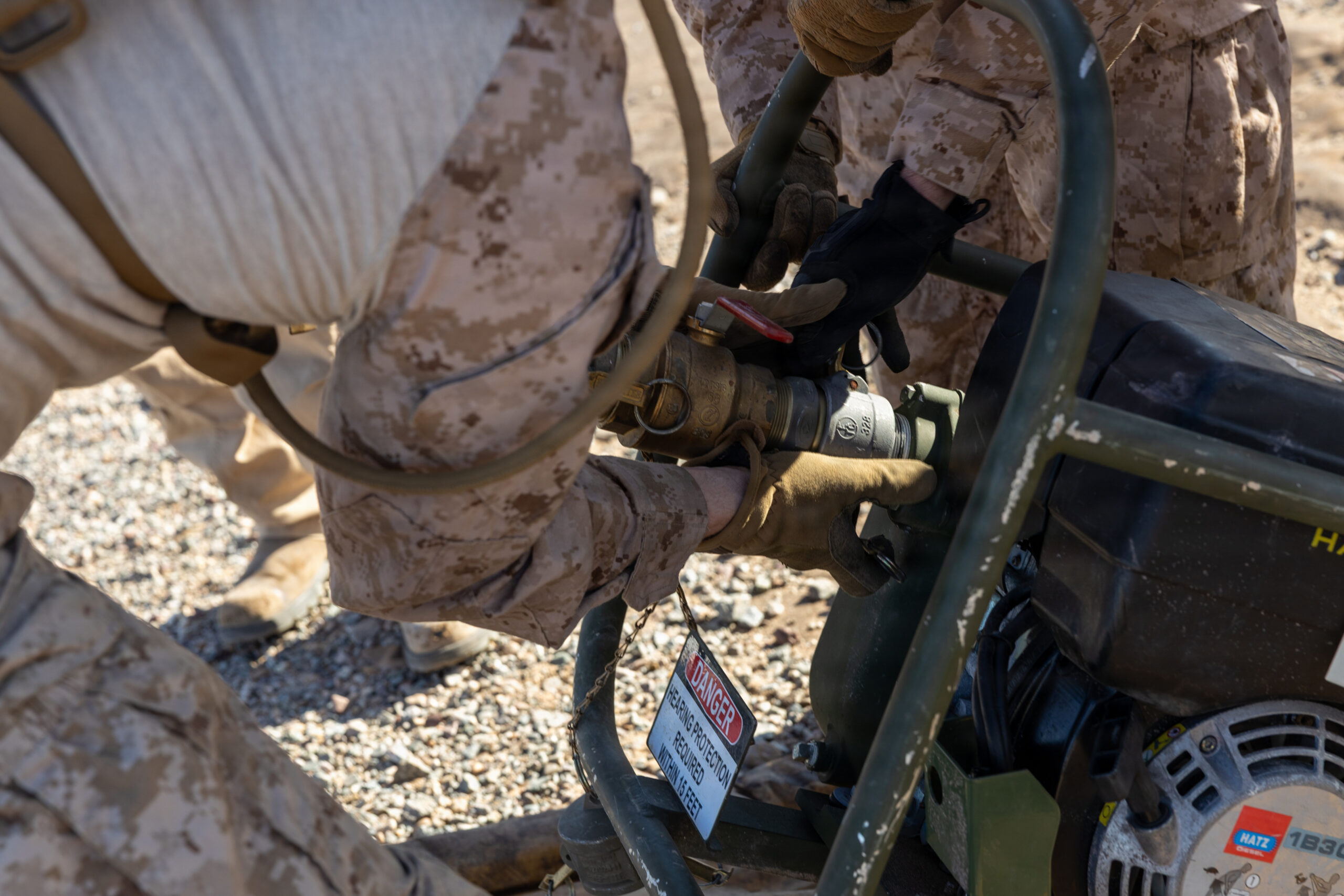
One iImage closes in on the pump valve connection: two sets of gloved hands securing a brass ball valve and hose coupling at the Hatz diesel pump unit, the “DANGER — HEARING PROTECTION REQUIRED WITHIN 15 FEET” placard visible on the pump frame. The precision of this image reinforces the same point as the safety wire close-up from the matting evolution three days earlier: at a FARP, as on the mat surface, every connection either meets standard or it does not. There is no middle state.
The Air Force Civil Engineer: 49th CES at Auxiliary Airfield II
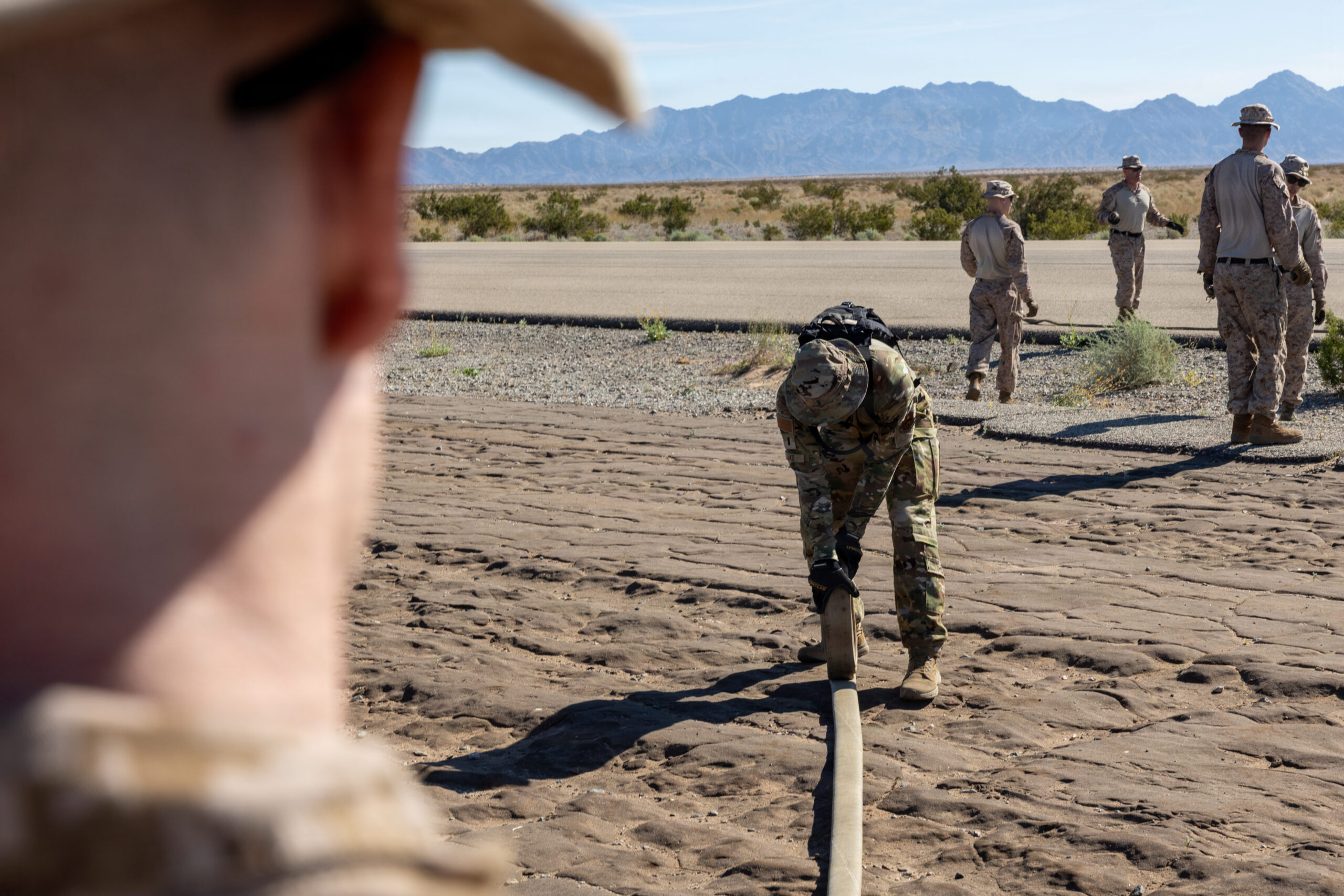
The most analytically significant detail in this set of photographs is who is rolling the fuel line. U.S. Air Force 1st Lt. Peter Lake is identified in the DVIDS caption as a Civil Engineer with the 49th Civil Engineer Squadron, based at Holloman Air Force Base, New Mexico. He appears in multiple images throughout the evolution, working directly alongside Marines on both the fuel bladder connection and the hose lay.
The 49th Civil Engineer Squadron is the expeditionary engineering unit supporting the 49th Wing at Holloman — an F-16 and F-22 wing whose civil engineers are trained in exactly the kind of expeditionary airfield construction and fuel system operations being practiced at Auxiliary Airfield II. Lake’s presence at WTI 2-26 is consistent with the Air Force’s ongoing integration into Marine Corps aviation training, and with the operational reality that in a major contingency in the Pacific, Air Force civil engineering assets and Marine Wing Support Squadron capabilities would have to work together to establish and sustain distributed forward sites.
The image of an Air Force civil engineer rolling a fuel line across AM-2 matting at a Marine-hosted WTI evolution is not a symbolic gesture of jointness. It is evidence that the two services are training together to a shared standard for the same operational requirement: the ability to fuel aircraft at austere forward sites without fixed infrastructure, under time pressure, with a small mixed team.
The FARP in the Distributed Operations Context
The operational significance of the FARP is most clearly understood against the backdrop of the Marine Corps’ Indo-Pacific operational design. The concept requires Marine forces to operate from a network of dispersed island and coastal sites, sites that cannot support fixed fuel infrastructure, that may be under threat, and that need to be established and dismantled rapidly as the operational situation evolves.
In this context, the FARP capability is what links the aviation combat element to its forward operating sites. An MV-22B tasked with a long-range insertion or a CH-53K moving equipment to a dispersed position needs fuel at range. The FARP team — a small number of personnel with a bladder, a pump, and hose — is what makes that refueling possible without the aircraft returning to the main base. Every sortie that can be turned at a forward FARP rather than returning to base extends the operational reach of the aviation element and reduces the signature and predictability of the operation.
The WTI student who connected a fuel inlet fitting inside a collapsed bladder in the Arizona desert, and who walked a runway measuring fuel point positions in the early morning light, will plan FARP operations with a precision and confidence that no classroom instruction alone can produce. That is the point of the practical application. That is the point of WTI.
The Sequence at Auxiliary Airfield II
Taken together, the matting evolution on March 14 and the FARP practical application on March 17 at Auxiliary Airfield II tell a coherent story about how WTI builds the expeditionary airfield concept into its prospective instructors. The surface comes first: the AM-2 matting provides the hardened, anchored platform that aircraft can operate from. The fuel system comes next: the bladder, pump, and hose lay that will sustain those aircraft through multiple sorties without a return to base.
Each evolution is joint. The Army first lieutenant was on his knees at the matting edge on March 14. The Air Force civil engineer was rolling fuel line on March 17. The Marine Wing Support Squadron personnel were present and working in both. This is not coincidental. The expeditionary airfield that the Marine Corps needs to establish in the Pacific will require exactly this kind of integrated, multi-service team working to a common standard under time pressure at an austere site.
WTI 2-26 practiced that team formation at Auxiliary Airfield II in the first week of March 2026. The photographs document it, one measuring wheel, one bladder fitting, and one rolled fuel line at a time.
WTI Events: The Engine of Marine Aviation Transformation at MAWTS-1