

By Robbin Laird
There are books whose relevance to the moment of publication is a matter of good timing, and there are books whose relevance was built in from the start because the argument they’re built on never stopped being tested.
The Unfinished Pillar belongs to the second category.
The book’s core material dates to the late 1980s and early 1990s, when the strategic architecture that had structured Europe for four decades was dissolving in real time. That original analysis asked a specific question: could Europe build a meaningful defense capacity of its own within the Atlantic Alliance, one that matched its economic and industrial weight? The question was shelved, not answered, as the Cold War ended and the “peace dividend” reshaped Western priorities for the next three decades.
The Unfinished Pillar is not a nostalgia project revisiting that shelved question.
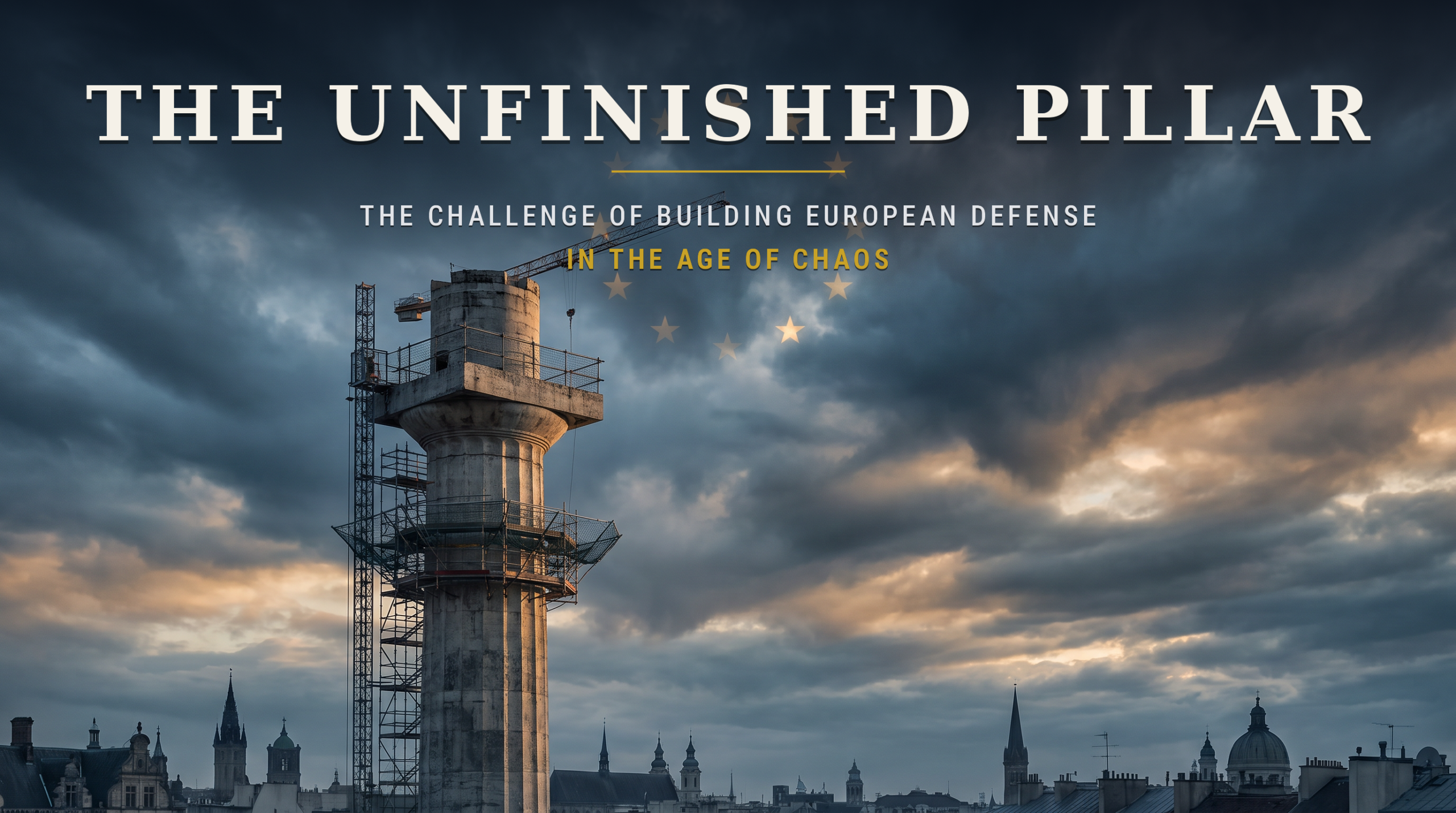
It is a three-part structure: the original 1991 strategic assessment, reproduced as it was written capturing what informed actors believed before they knew how the story would turn out set alongside a full rewrite that brings the analysis into the present, and framed by a retrospective assessment of what actually happened across the intervening thirty-five years.
The result is less a history of European defense cooperation than a controlled experiment in strategic foresight: what did the architects of European defense expect in 1991, what did they get, and why does the gap matter now that Europe is once again confronted with major war on the continent, nuclear coercion, and hard questions about the durability of the Atlantic relationship?
A Foreword From Someone Who Lived the Adaptation
The book’s foreword comes from General (ret.) Pasquale Preziosa, former Chief of Staff of the Italian Air Force someone who spent a career inside the institution the book is examining, watching NATO adapt to enlargement, counterterrorism, and expeditionary warfare, and then watching the strategic ground shift again after 2014 and 2022.
Preziosa’s foreword does something a conventional book introduction rarely attempts: it doesn’t just summarize the argument, it extends it.
His central claim is that the European “pillar” was never simply an unfinished institutional project interrupted at the end of the Cold War. Institutions survived and even deepened — NATO enlarged, the EU acquired security mechanisms unimaginable in 1991.
What eroded instead was the material and industrial substance behind those institutions: continental warfighting capacity, ammunition stocks, reinforcement infrastructure, the ability to generate and regenerate military power over time. Russia’s invasion of Ukraine didn’t create that gap. It exposed one that had been accumulating, unremarked, for a generation.
From there, Preziosa builds an argument with real teeth: that an alliance can adapt very effectively to one strategic environment and become less prepared for the next one at the same time. NATO’s post-2001 expeditionary transformation was genuinely successful and that very success shaped procurement, doctrine, and professional experience around an assumption that territorial war in Europe was remote. Successful adaptation, in other words, can be the mechanism that produces the next vulnerability.
He calls this an “adaptation debt” or a deferred strategic cost that stays invisible exactly as long as the environment keeps validating the assumptions built into it.
Why This Argument Travels Well Beyond Europe
What makes the foreword worth serializing on its own, separate from the book itself, is that Preziosa doesn’t stop at diagnosis.
He works through the practical implications: how the center of gravity within European defense has shifted from the Franco-German relationship toward a genuinely networked pillar, with the Nordics, Poland, and even Ukraine contributing distinct forms of strategic value; why NATO, the EU, and smaller coalitions need to be understood as functionally differentiated rather than competing for the same job; why deterrence has what he calls an “industrial clock” that political cycles rarely match and why the deepest form of strategic atrophy is cognitive or the quiet erosion of expertise and institutional memory that happens whenever a threat appears to recede.
The foreword’s final move connects directly back to a body of work readers here will recognize: the shift from crisis management — an approach built for a stable environment with contained, resolvable disruptions — to what Preziosa, drawing on the book’s own framework, refers to chaos management, where instability is structural rather than episodic and each crisis changes the conditions under which the next one unfolds.
Finishing the pillar, in this reading, was never going to mean arriving at a final institutional design.
It means building a permanent capacity to generate, regenerate, and reconfigure power as the strategic environment keeps moving.
What’s Ahead
Over the coming weeks, this series will work through Preziosa’s foreword section by section:
- The adaptation-debt argument and what it means for preparedness;
- The networked, post-Franco-German geography of European defense;
- The industrial and temporal dimensions of strategic power;
- The cognitive erosion that accompanies every peace dividend;
- And the case for why democratic systems’ real advantage lies not in diversity itself but in the capacity to convert that diversity into coherent action.
The series closes where Preziosa’s foreword closes with the argument that finishing the pillar was never about completing an architecture, but about acquiring the permanent capacity to keep adapting when the next transformation arrives, because it always does.