

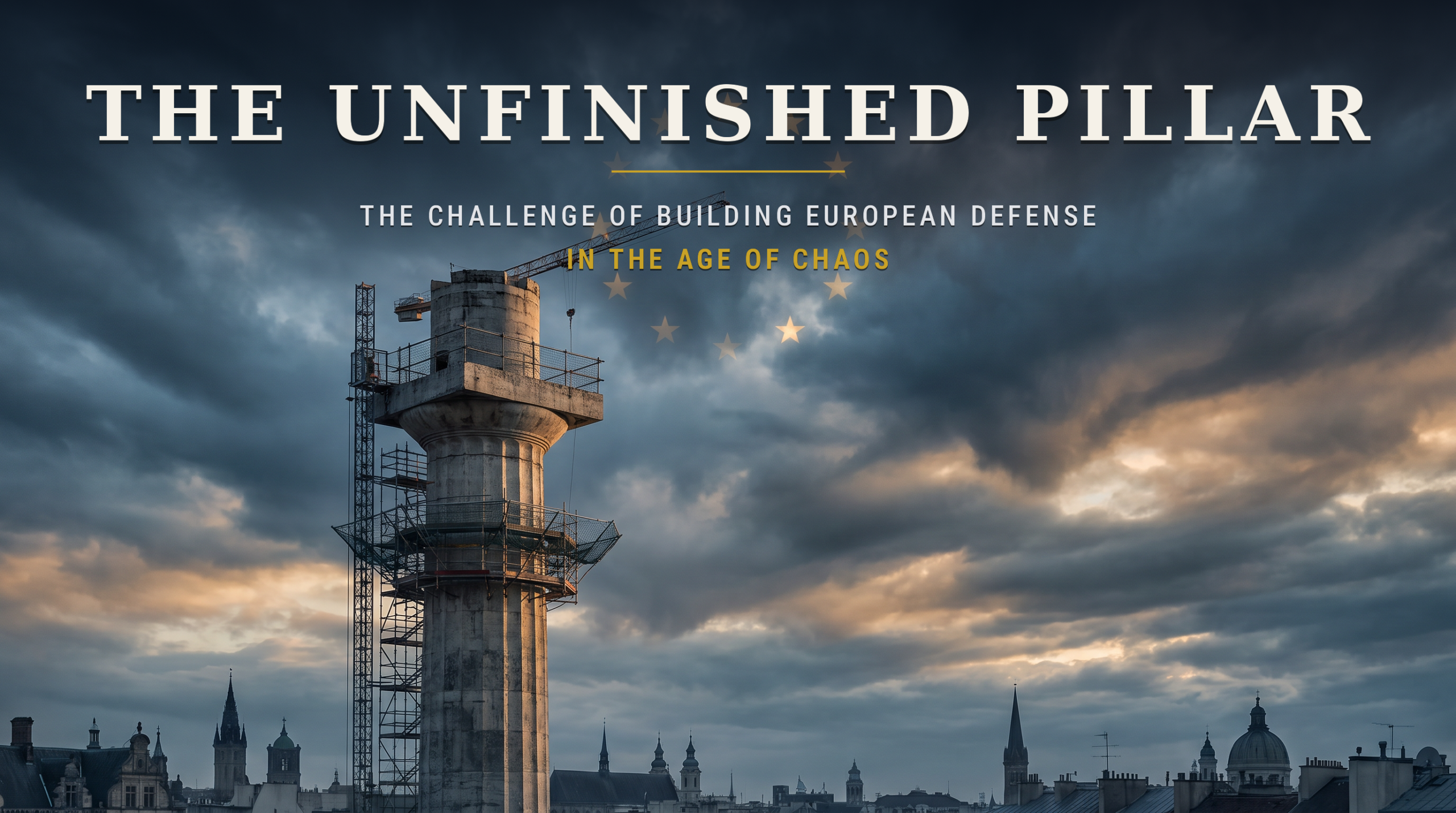
The first installment in this series on General Pasquale Preziosa’s foreword to The Unfinished Pillar takes up the argument that gives the book its title and its sharpest edge.
The unfinished character of the European pillar, Preziosa argues, was never primarily an institutional story.
It is a story about the growing distance between political structure and strategic capacity.
He argued that Robbin Laird’s original analysis dates to the last years of the Cold War, when the strategic architecture that had structured Europe for four decades was dissolving. The questions that produced it — how to build a meaningful European defense capacity within the Atlantic Alliance, how to convert economic and industrial weight into usable military power — have returned under conditions the original analysis could not have anticipated: major war on the continent, renewed nuclear coercion, and open uncertainty over how responsibilities within the Alliance will be distributed going forward.
What makes the book valuable, in Preziosa’s reading, is precisely that it isn’t a straight retrospective. It places the strategic imagination of 1991 — actors reasoning before they knew how events would unfold — directly beside the strategic reality that took thirty-five years to arrive. History, predictably, didn’t move in a straight line.
The European pillar was neither completed nor abandoned. NATO enlarged. Political consultation deepened. The European Union acquired security and defense mechanisms that would have been difficult to imagine at the outset of the 1990s.
And yet, across the same period, Europe allowed much of the military and industrial substance required for large-scale direct defense to erode.
That divergence. institutional adaptation running ahead of strategic completion, is the thread that runs through the whole foreword, and it’s worth sitting with before moving further into the series.
A Pillar That Adapted Well and Still Fell Behind
The post-Cold War Alliance adapted remarkably well to the missions it was actually handed: enlargement, crisis management, counterterrorism, stabilization, expeditionary warfare. What it didn’t do is convert that adaptation into the capabilities a different strategic environment would eventually require. Continental warfighting capacity, ammunition stocks, industrial depth, reinforcement infrastructure, the sheer ability to generate force over time, all of it declined even as European political integration continued to deepen.
Russia’s full-scale invasion of Ukraine didn’t create that gap. It exposed the accumulated consequences of a divergence that had been building for a generation, and forced the Alliance to adapt under the pressure of sustained war rather than on its own schedule.
Preziosa’s framing here is deliberately precise: the unfinished pillar is not an institutional project left incomplete at the end of the Cold War. Its unfinished character lies in the gap between political structures and strategic capacity between building institutions and being able to generate, sustain, and regenerate military power. Finishing the pillar today, in this reading, cannot mean completing the architecture imagined in the 1980s. It has to mean redefining what the pillar is for, under conditions radically different from the ones that produced the original design.
The Core Argument: Adaptation Is Not Preparedness
This is where the foreword makes its most consequential move, and the one that gives this installment its title. It would be easy to read Europe’s post-Cold War record as a story of failure to adapt.
Preziosa argues the opposite is closer to the truth, and more troubling for it: NATO adapted very effectively, just to one particular strategic environment, not to the one that eventually arrived.
The Alliance’s expeditionary transformation after 2001 was real. It became more deployable, more interoperable, and accumulated genuine experience sustaining multinational operations far from member territory. Those adaptations answered real strategic requirements of the period.
But they also shaped force structures, procurement priorities, logistics, command systems, training, professional experience, and political expectations around an assumption that territorial war in Europe was remote, that warning time would be sufficient, that supply chains would hold, and that high-intensity conflict against a peer competitor was increasingly unlikely.
None of those assumptions were unreasonable at the time they were made. That’s precisely the point.
The problem was never that NATO failed to change.
The problem is that an institution can become more capable and less prepared at the same time and that successful adaptation to a given set of conditions is not the same thing as adaptive capacity, the underlying ability to keep changing as the environment itself keeps moving.
The Cost of Optimizing for the Present
Preziosa calls this accumulated cost an adaptation debt: the deferred strategic price of optimizing for today’s requirements while allowing the capabilities, knowledge, infrastructure, industrial capacity, and organizational alternatives needed for other possible futures to quietly decline. Efficiency eliminates redundancy. Specialization reduces diversity. Institutional success reinforces the very assumptions that most need to stay open to challenge.
That debt is invisible for as long as the environment keeps validating the assumptions embedded in force structure, industrial policy, and doctrine. It becomes visible, and expensive, the moment those assumptions stop holding and by then the clock has already started on a much harder problem, because different parts of a strategic system move at very different speeds. Governments can shift policy in months. Military doctrine takes longer to absorb. Ammunition production lines, transportation infrastructure, industrial skills, procurement systems, reserve structures, and strategic culture can take years or decades to rebuild.
Strategic systems, in other words, have memory. Past choices remain embedded in factories, organizations, professional identities, supply chains, budgets, and expectations. When the environment changes, strategy doesn’t start from a blank page. It has to work through the accumulated material and institutional consequences of assumptions made years or decades earlier.
The shocks of 2014 and 2022, Preziosa suggests, shouldn’t be understood as moments when the strategic environment suddenly changed. They were moments when transformations already underway became impossible to keep interpreting through the assumptions of the previous order.
Next in the Series
The next installment picks up where this one leaves off: Preziosa’s treatment of strategy itself as a wager made before its consequences are known, and why the relationship between strategic options, compatible at one stage of a transition, harder to hold together as the system evolves, is the more demanding problem sitting underneath the adaptation-debt argument.