

By Robbin Laird
There are dates that carry weight beyond the events that fall on them, and September 11 is one of them.
For anyone born in the last sixty years, the date needs no elaboration: it means the destruction of the Twin Towers, the wounding of the Pentagon, the field in Shanksville, and the opening morning of what became a two-decade war.
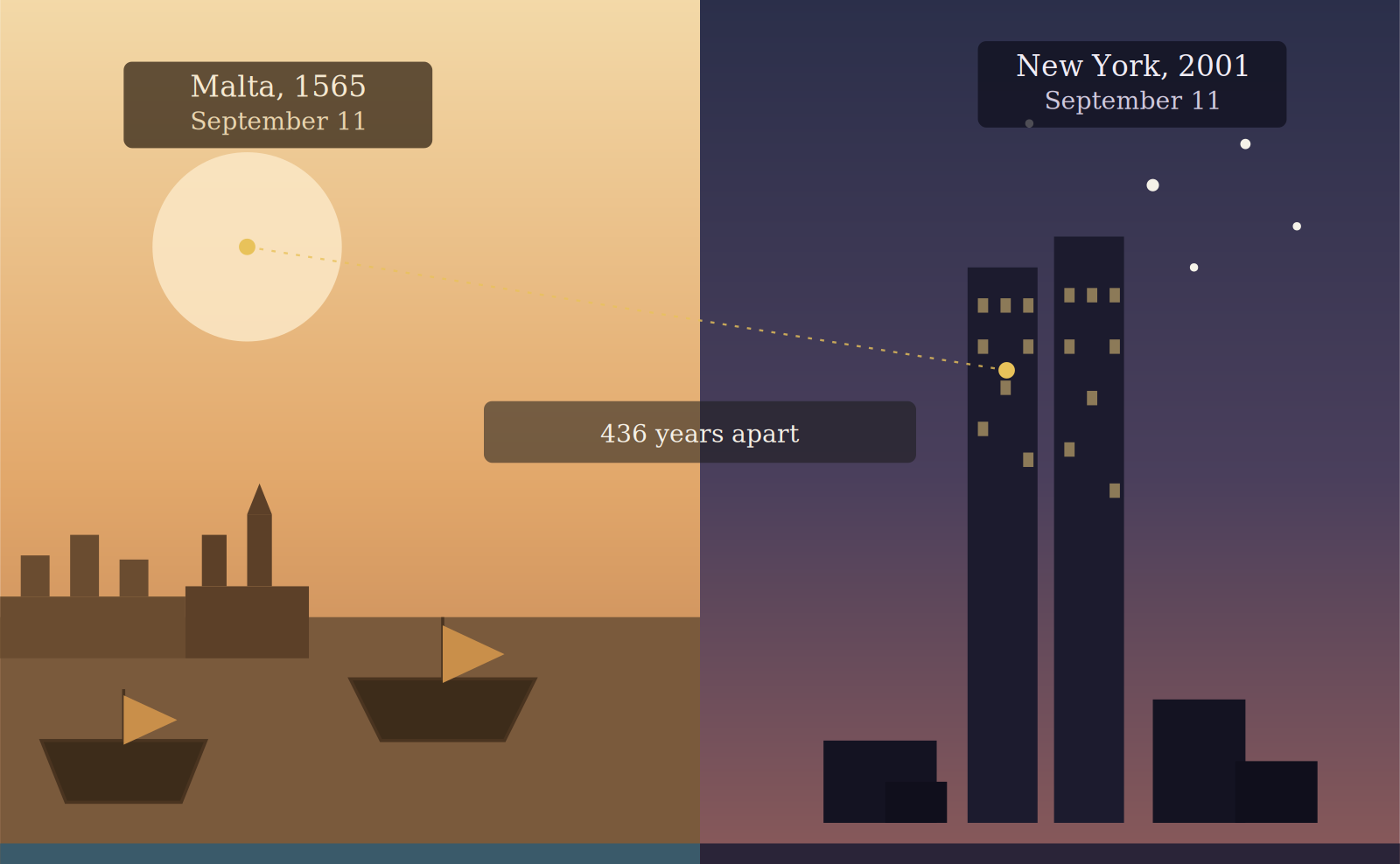
But September 11 has another entry in the ledger of Western history, one buried deep enough in memory that most people, even most students of military affairs, have never encountered it: September 11, 1565, the day the Ottoman fleet finally withdrew from the waters around Malta, ending the Great Siege that had begun almost four months earlier under Suleiman the Magnificent.
The coincidence of calendar dates is, on its face, just that: a coincidence. Nothing connects the Gregorian date on which a sixteenth-century armada limped out of Grand Harbour to the date on which nineteen hijackers boarded four American aircraft in 2001.
But coincidences of this kind are worth pausing on, not because they prove anything mystical about history, but because they offer a disciplined excuse to hold two moments side by side and ask what each reveals about the other about how civilizations under existential pressure behave, about what “victory” and “defeat” mean in protracted contests, and about how the West has narrated its confrontations with power projected from the eastern Mediterranean and beyond.
The Siege That Nearly Wasn’t Remembered
The Great Siege of Malta is one of those events that once occupied the same rank in European memory that Stalingrad or Midway occupy in twentieth-century memory, a battle understood, in its own time, as civilization-defining. Voltaire’s line that “nothing is better known than the siege of Malta” was not hyperbole for its era; it was simply true.
A tiny garrison of Knights Hospitaller and Maltese irregulars, numbering perhaps six to eight thousand, held out against an Ottoman expeditionary force several times its size, a force dispatched by an empire at the height of its Mediterranean reach, commanded by veterans of Rhodes and Preveza, intent on erasing the last forward base from which Christian corsairs harried Ottoman shipping lanes.
The siege was not won cleanly or early. Fort St. Elmo fell. The defenders were reduced to a fraction of their starting strength.
What broke the siege was not a single battle but exhaustion compounding exhaustion, the Ottoman force worn down by disease, by the death of its most capable admiral, Turgut Reis, by the onset of the sailing season’s closing weeks, and finally by the arrival of a modest relief force under Don García de Toledo.
By early September the outcome was no longer seriously contested, What remained was the mechanics of withdrawal. The fleet’s departure is variously dated across the surviving accounts, some sources have the bulk of it clearing Marsamuscetto Harbour on the 11th, others place the final ships gone by the 13th, but the 11th has become the date most consistently cited as the effective end of the siege, and it is the date inscribed on the modern commemorations Malta still holds each year.
What matters for this article is less the precise hour of departure than what the withdrawal represented: the first unambiguous check on Ottoman westward momentum in a generation, delivered not by a great power but by a militant religious order defending a rock the Ottomans themselves considered barely worth the name of island. It did not end the Ottoman-Habsburg contest for Lepanto was still six years away, Vienna still 118 years off but it broke a psychological spell. Suleiman’s fleets, until Malta, had seemed unstoppable. After Malta, they were merely formidable.
The Asymmetry Between the Two Elevenths
Here the comparison with 2001 becomes genuinely instructive, precisely because the two events sit on opposite sides of a strategic ledger. Malta 1565 was a siege, a sustained, symmetrical military campaign in which one organized state power attempted to physically seize territory from another organized power, using armies, fleets, and artillery arrayed in the conventional grammar of early modern war. It ended in a battlefield decision: the besieging force withdrew because it had been defeated in the field.
September 11, 2001 was not a siege in that sense at all. It was a single, asymmetric strike by a non-state actor, executed with the machinery of civil aviation rather than fleets or armies, aimed not at seizing ground but at producing psychological and economic shock disproportionate to the physical means employed. Malta was won and lost by attrition over 108 days; 9/11 was decided in roughly 102 minutes.
Malta’s outcome was legible immediately: the fleet sailed away, the siege was over. The strategic outcome of 9/11 took twenty years to fully play out, and arguably is still being adjudicated by the trajectory of Afghanistan, Iraq, and the broader reordering of American strategic attention that followed.
This asymmetry is the point, not an inconvenience to the comparison.
It illustrates how dramatically the character of civilizational confrontation has changed between the sixteenth and twenty-first centuries, from set-piece siege warfare, in which the defending side’s endurance was itself the decisive instrument, to a landscape in which a handful of operatives could compress centuries of siege logic into a single morning, and in which the “siege” that followed — the Global War on Terror — stretched not for four months but for two decades, fought without walls, without a Grand Harbour to defend, and without a single date on which anyone could say, as Malta’s defenders could say on the 11th of September 1565, that the enemy fleet had gone.
What the Convergence Is Useful for Analytically
It would be a mistake to lean on the date convergence for more meaning than it can bear. Suleiman’s Ottoman Empire and the ideology behind the 2001 attacks are not the same civilizational actor separated by centuries, and treating them as a continuous “East versus West” thread, a temptation some commentators indulged in the years after 2001, flattens histories that deserve to be read on their own terms. The Knights of St. John were fighting to hold a fortress island against an imperial navy; al-Qaeda in 2001 was a stateless network exploiting the very interconnectedness of the modern world that the Ottoman Empire never possessed and never needed.
Where the convergence earns its keep is as a discipline for thinking about resilience and about the deceptive comfort of “decisive” dates. Malta’s defenders got their decisive date, September 11, 1565, and even then the wider contest with Ottoman power ran on for more than a century afterward, through Lepanto, through the second failed siege of Vienna in 1683, through a slow Ottoman retreat that took generations to complete.
The lesson worth carrying into any assessment of the post-9/11 period is that single dates, however dramatic, rarely close a strategic contest; they open a phase of it.
The Knights of Malta understood this instinctively, Valletta itself, the fortified capital built in the years immediately after the siege with money that poured in from a grateful Christian Europe, was constructed not in celebration but in anticipation of the next assault.
The West’s institutional response after 2001, new intelligence architectures, new alliance postures, two decades of continuous operations, reflected the same instinct, however imperfectly executed: a victory, or a survival, is not an ending. It is an instruction to fortify for what comes next.
That, more than the calendar itself, is the convergence worth holding onto.