

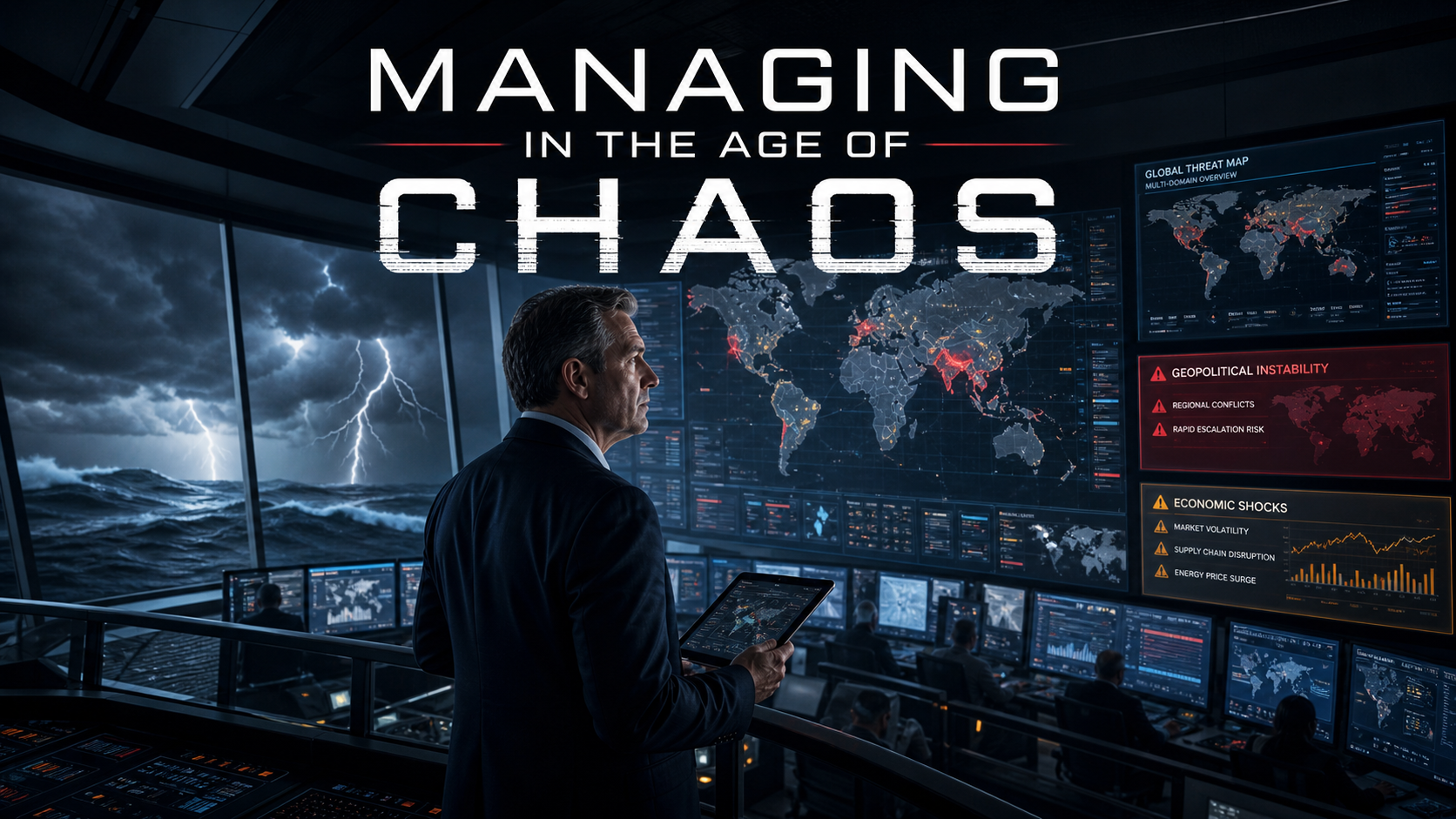
By Robbin Laird
When I published my recent piece carrying Alvin and Heidi Toffler’s thinking forward into today’s strategic environment, I hoped it would start a conversation.
I did not expect one of the most thoughtful responses to come from Deborah Westphal. Alvin Toffler recruited her to Toffler Associates in 1999, and she ran the firm as CEO from 2007 through 2018. Today she is CEO of the Karen Toffler Charitable Trust.
Her comment deserves to be quoted at length, because it captures what I was trying to say better than I said it:
“Their work was never simply about predicting what comes next. It was about understanding the forces of change, how they interact, and what those interactions mean for people and institutions.”
And further:
“Alvin and Heidi understood that we cannot anticipate every outcome, particularly when small changes can produce enormous consequences. And as they explored in Powershift, change also redistributes power, altering who has the knowledge, resources, and ability to act. That makes it important to learn to see emerging patterns, question assumptions, make connections across disciplines and experiences, and test our thinking through action.”
She also picked out the shift I believe matters most for anyone making strategy today: moving from asking “What will happen?” to asking “What capabilities do we need to adapt to whatever happens?”
That exchange made me want to step back from the Tofflers and look at the larger intellectual moment they belonged to.
From the late 1960s to the mid-1970s, a remarkable group of thinkers tried to understand the end of the industrial era and what would follow. Peter Drucker, Alain Touraine, Alvin and Heidi Toffler, Zbigniew Brzezinski and Daniel Bell came from different disciplines and often disagreed sharply. Taken together, though, they built the conceptual toolkit we still need for what I have called the age of chaos.
My argument is simple. We should read these thinkers not as forecasters to be graded on their predictions, but as analysts of the forces of change. Their real value lies in the questions they taught us to ask. Those questions matter more now than when they were first posed.
A Remarkable Five Years
The cluster of work is striking when laid out in sequence.
In 1969, Peter Drucker published The Age of Discontinuity. He identified four discontinuities reshaping economy, politics and society: new knowledge technologies, the move from an international to a world economy, a society of pluralistic organizations, and the rise of the knowledge society. The book is where he developed the idea of the “knowledge economy.”
That same year, the French sociologist Alain Touraine published La société post-industrielle, translated into English in 1971 as The Post-Industrial Society. It was one of the first book-length treatments of the concept.
In 1970, Alvin and Heidi Toffler published Future Shock, which sold millions of copies and gave the public a vocabulary for the human experience of accelerating change.
Also in 1970, Zbigniew Brzezinski published Between Two Ages: America’s Role in the Technetronic Era, prepared under the auspices of Columbia’s Research Institute on Communist Affairs.
In 1973, Daniel Bell published The Coming of Post-Industrial Society: A Venture in Social Forecasting, the book most closely associated with the term itself.
These were not members of one school. Bell, in a later interview, dismissed Future Shock with a pun, calling it “future schlock,” while acknowledging that Herman Kahn and the Tofflers had popularized ideas he had developed. Touraine, a man of the European left, emphasized conflict and domination where Bell saw a more orderly, technocratic transition. Brzezinski was a geopolitical thinker focused on America’s role in the world and the competition with the Soviet Union. Drucker was a management thinker focused on organizations and the people who work in them.
That diversity is the point. Read together, they triangulate the transition from several directions at once.
Westphal’s comment calls for making “connections across disciplines and experiences,” and this body of work shows what that looks like in practice.
Five Questions We Inherited
Each of these thinkers left us a question that remains central to strategic thinking today.
Drucker: What if the trend lines break?
Drucker’s core insight was that the real world had moved out from under the intellectual frameworks built to describe it. As a 1969 review in Commentary summarized his argument, these discontinuities “make it impossible to predict the future, because prediction inevitably involves a forward projection of current trends.” Yet unless we understand them, we cannot solve the problems in front of us.
That is the founding premise of chaos management. Strategic planning in Western defense establishments still too often extends today’s trends into tomorrow’s budget lines. Drucker warned more than half a century ago that the decisive changes are the ones that break trends, not the ones that continue them. The return of high-intensity war in Europe, the speed at which drones have reshaped the battlefield, and the collapse of assumptions about stable supply chains are all discontinuities in Drucker’s sense.
Drucker also posed a challenge that still defines the institutional problem: “To make knowledge work productive will be the great management task of this century, just as to make manual work productive was the great management task of the last century.” Swap “knowledge work” for “data-enabled operations” and you have the central challenge facing every military service trying to field AI-enabled systems today.
Bell: What is knowledge, and who uses it to decide?
Bell argued that post-industrial society would be organized around “theoretical knowledge as the axis around which new technology, economic growth and the stratification of society will be organized.” More useful today is his distinction among data, information and knowledge. Data describes the empirical world. Information organizes data into meaningful patterns. Knowledge is the use of information to make judgments.
That three-part distinction is exactly what gets lost in current enthusiasm about artificial intelligence. Data precedes AI, but judgment comes after it, and judgment is still a human and institutional act. A force that collects vast amounts of data without the organizational capacity to turn it into judgment has not entered the knowledge era. It has only digitized its confusion.
Touraine: Who controls the programming?
Touraine called the new order a “programmed society,” in which power rests on control over the production and processing of information. Domination works less through coercion than through what he described as a system that “seduces, manipulates, and enforces conformism.” Critics at the time noted that where Bell played down conflict, Touraine put alienation, tension and resistance at the center.
Touraine reads today like a guide to the information environment of the 2020s. Authoritarian states have built programmed societies in a far more literal sense than he imagined, combining surveillance, information control and industrial policy. Democracies face their own version of the problem through polarization, platform power and the fragmentation of shared facts. Touraine reminds us that the knowledge society is a contested field, not a neutral one.
Brzezinski: Can the world grow more connected and more fragmented at once?
Brzezinski, my mentor at Columbia, opened Between Two Ages with a sentence that has only grown more relevant: “The paradox of our time is that humanity is becoming simultaneously more unified and more fragmented.”He described a “technetronic” society shaped “culturally, psychologically, socially, and economically by the impact of technology and electronics, particularly in the area of computers and communications.”
He also saw that an electronically connected world would make populations more susceptible to mass mobilization, and that global problems would outrun the nation-state system. The contested global order we now live in, where connectivity spreads both cooperation and disruption, is the paradox he identified, playing out at scale.
The Tofflers: Can people and institutions keep pace?
The Tofflers defined future shock as “the shattering stress and disorientation that we induce in individuals by subjecting them to too much change in too short a time.” Alvin Toffler later described his trilogy as a progression: Future Shock looked at the process of change, The Third Wave at its direction, and Powershift at its control.
Powershift, the book Westphal singles out, is the one strategists should reread now. Toffler argued that power rests on a triad of violence, wealth and knowledge, and that the most important shift of all is “the hidden shift in the relationship between violence, wealth, and knowledge as societies speed toward their collision with tomorrow.”
That is a precise description of modern conflict. Cheap drones redistribute violence. Sanctions and industrial policy weaponize wealth. Information operations and AI contest knowledge. These three are no longer separate domains. They convert into one another continuously.
What They Missed
Honoring these thinkers means being clear about where their frameworks fell short.
First, much post-industrial thought carried a strong strain of technocratic optimism. A recent assessment of Bell notes that by treating theoretical knowledge and expertise as society’s organizing principle, he underestimated how much economic power and political interest would continue to shape who controls that knowledge and who benefits from it. The transition proved far less orderly than the technocratic version suggested.
Second, the word “post-industrial” encouraged a dangerous misreading in the West: that industry no longer mattered. The war in Ukraine has delivered a harsh correction. Munitions, shipbuilding, energy and mass production are once again strategic necessities. The age of chaos is not post-industrial in the sense of leaving industry behind. It demands that knowledge and industrial capacity work together. A society that can design advanced systems but cannot produce them at scale has learned only half the lesson.
Third, several of these thinkers assumed the transition would be led by advanced democracies. Brzezinski saw the Soviet Union stagnating because it could not master the computer age. He was right about the Soviet Union, but the next generation of authoritarian powers has learned to combine technological sophistication with centralized control. The knowledge era did not settle the competition between political systems. It intensified it.
None of this undermines the thinkers. It makes clear what we need to add.
The 1970s gave us the analytical frame.
The age of chaos supplies the conditions under which that frame must now be applied.
From Prediction to Capability
This brings me back to Westphal’s comment and the reframing she highlighted.
The post-industrial thinkers are often remembered as futurists, and futurists are usually judged by whether their predictions came true. That is the wrong test. As Westphal puts it, their work “was never simply about predicting what comes next.” The more useful test is whether they helped people and institutions build the capacity to act under conditions no one could fully anticipate.
By that standard, their legacy suggests four capabilities that any serious strategy for the age of chaos must develop. Each corresponds closely to what Westphal named in her comment.
Seeing emerging patterns. Drucker’s discontinuities and Brzezinski’s paradox of unity and fragmentation were attempts to perceive structure in change before it became obvious. Institutions need systematic ways to detect weak signals rather than waiting for strong ones.
Questioning assumptions. Every one of these thinkers challenged the dominant intellectual frameworks of their time. Organizations need the culture and the processes that allow assumptions to be challenged before reality challenges them.
Connecting across disciplines and experiences. The value of this generation lies in reading a sociologist, a management theorist, a geopolitical strategist and a pair of futurists side by side. Defense organizations, structured around platforms and services, are often poorly built for that kind of synthesis. The kill web, the integration of distributed forces into an interactive whole, is in part an organizational answer to this challenge.
Testing thinking through action. Theory alone does not build adaptive capacity. Experimentation, exercises and the rapid fielding and refinement of new capabilities are how institutions learn. The forces that have adapted fastest in recent conflicts treat operations themselves as a learning process.
The Human Dimension
The final point in Westphal’s comment may be the most important. She wrote that “so much of our ability to adapt depends on people, the relationships between them, and their willingness to learn from one another.”
That brings the argument full circle.
Future Shock was ultimately a book about people: what accelerating change does to individuals, families and communities. Drucker’s knowledge workers were people whose motivation, he insisted, had to come from within. Touraine’s concern was the human subject resisting the programmed society. Even Brzezinski, the most geopolitical of the group, worried about whether modern societies would lose their social and moral cohesion under the pressure of technological change.
In an era dominated by talk of autonomous systems, artificial intelligence and data, it is easy to lose sight of this.
But the side that adapts best in the age of chaos will not simply be the side with the most advanced technology.
It will be the side whose people can listen, learn, trust one another and act together under stress.
Social cohesion is not a soft add-on to strategy.
It is the foundation that makes adaptive capacity possible.
Conclusion
The post-industrial thinkers of the 1970s were writing about the end of one era and the uncertain beginning of another. That is where we are again.
The difference is that today’s transition is unfolding in a contested global order, under the pressure of war, with technologies that move faster than our institutions can absorb.
We do not need to agree with everything Bell, Drucker, Touraine, Brzezinski or the Tofflers concluded. They did not agree with one another.
What we need is their habit of mind: treating change as a set of interacting forces to be understood rather than a single future to be predicted, and treating the ability to adapt as the decisive capability.
Deborah Westphal’s forthcoming book, The Pulse of Tomorrow: How Future Shock Still Shapes Our World, scheduled for March 2027, promises to tell the story of how the Tofflers developed that way of thinking.
It arrives at the right moment.
As her comment on my article reminds us, the question is no longer what will happen.
It is whether we are building the people, institutions and relationships that can deal with whatever does.