In an effort to be in compliance with GDPR we are providing you with the latest documentation about how we collect, use, share and secure your information, we want to make you aware of our updated privacy policy here
Enter your name and email address below to receive our newsletter.
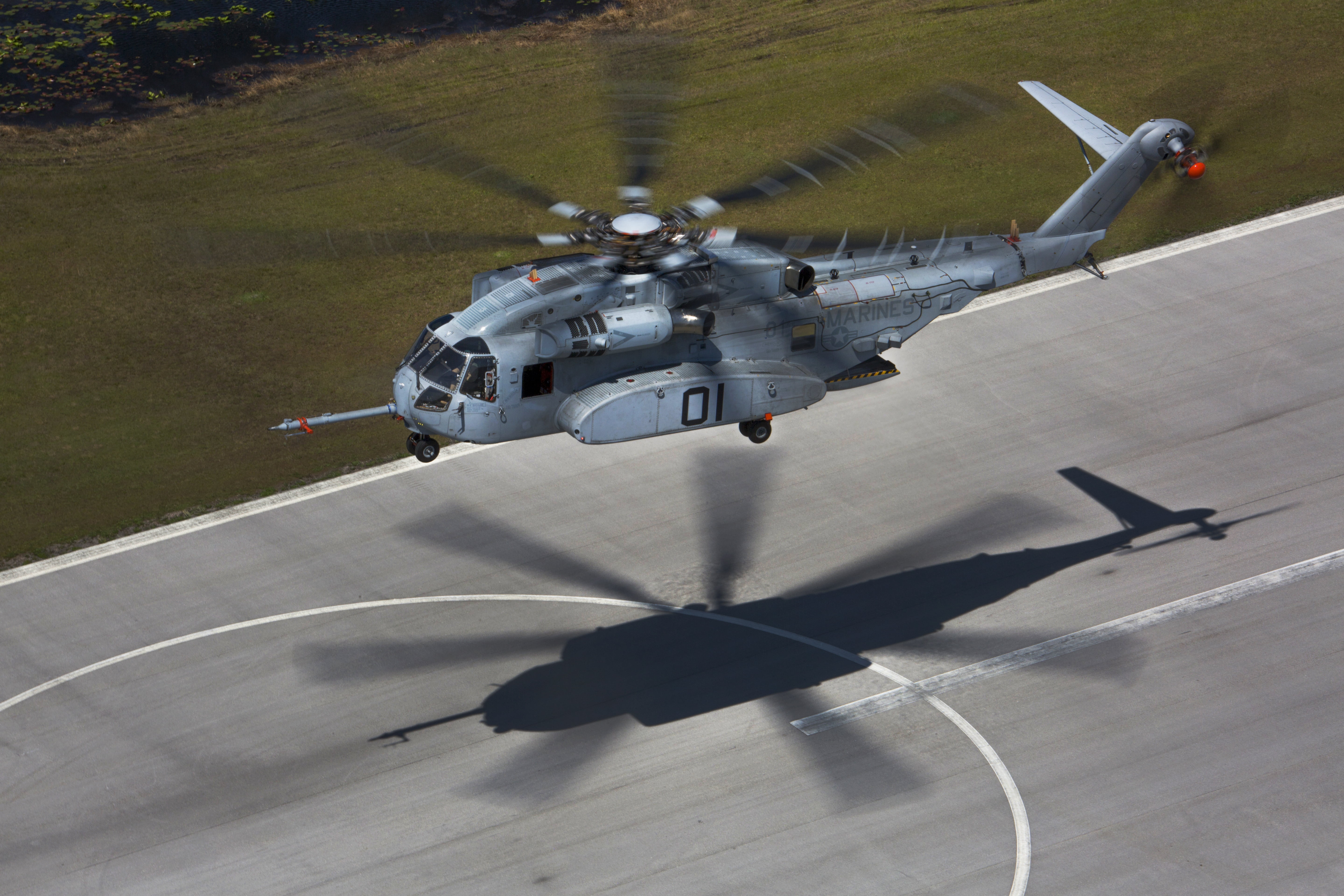
Last year, when visiting the Sikorsky West Palm Beach facility, I saw the CH-53K King Stallion being built, which is now in Europe and preparing to fly at the Berlin Air Show.
Next month, the first CH-53K will arrive in New River, N.C., for the U.S. Marines there to work through the maintenance procedures and protocols for the first operating squadrons.
I will be visiting New River this summer to spend time with the Marines as they validate publications and logistical support on the maintenance side of the equation.
One of the key attributes of the CH-53K is the maintainability to enhance the readiness and availability of the aircraft. Maintainers have been part of the design team for the K from the outset, and as a digital aircraft, the process will be quite different from working on a mechanical aircraft like the CH-53E.
As I visited New River at the dawn of the MV-22B Osprey era, it will be interesting to compare and contrast the Osprey launch experience with that of the CH-53K.
Recently, I had a chance to get an update on the CH-53K, and to talk about the upcoming milestone of the aircraft at New River with Lt. Col. Trimble, who has been involved with the standup of the program for some time.
And at the end of the year,he will receive his next command assignment, HMH-464, the Marine Heavy Helicopter Squadron 464, which is part of 2ndMarine Aircraft Wing, based at Marine Corps Air Station New River.
The CH-53K is coming at a key time in the evolution of the USMC. The Marines are working to shape a digital interoperable force, which can operate effectively as a distributed force.
The K is optimized for the digital interoperable (DI) transition, and is a crucial asset, able to move key parts of a distributed force into operational areas.
Indeed, a CH-53K force can support the Marines forward without needing to set up forward operating bases supported by transport going over roads under threat from IEDs.
Question: How would you characterize the impact of the coming of the K to the force?
Lt. Col. Trimble: I would start with a key point. It will be the only fully-marinized, heavy-lift helicopter capable of transporting 100 percent of the vertical MAGTF required to fulfill our role as “contact” and “blunt” layers per the National Defense Strategy.
The King Stallion will be able to transport up to 2 x armored HMMWVs, 2 x ECVs, or a JLTV out to 110 NM, enable the MAGTF to mass combat power, maneuver, and maintain resilient and agile logistics and maintenance while under persistent multi-domain attack.
The K can carry all of the heavy equipment of the MAGTF; the E cannot.
The K is the only heavy rotary wing, heavy-lift assault platform in the Department of Defense inventory. A heavy-lift rotary wing aircraft is defined by greater than 70,000 lbs max gross weight. It is a strategic asset, from our point of view.
Vertical lift transport is a key to not putting Marine Corps assets at risk from IEDs when operating on roads as well.
Additionally, the CH-53K maximizes ground combat power.
When we go ship-to-shore – say I have to go back-and-forth 10 times – if I could go back-and-forth five times carrying just as much, then it reduces my exposure to threat, and I give the ground combat element (GCE) or GCE commander the most combat power, faster.
Question: The K is a key element in reinforcing the ability of the USMC to operate as a digital interoperable force and as an effective distributed force.
How would you describe its role in those terms?
Lt. Col. Trimble: An often-forgotten aspect is delivering logistics and fuel ashore to support both ground and air platforms in order to sustain combat operations.
This is a key when conducting amphibious operations.
And because we can now take full 463L Pallets straight off a fixed wing airlifter, we can redistribute logistics support to a distributed force, faster.
The Marine Corps is task organized and we have already worked up for our squadrons our logistics support templates with regard to the K supporting a squadron as well.
And with regard to digital interoperability, the K is completely in line with the USMC digital interoperability requirements going forward in order to ensure complete compatibility with the digital interoperability requirement going forward.
This is the first aircraft born in the Marine Corps when digital interoperability is the standard.
Question: The software upgradeability part of the equation often gets overlooked, and missing the point that with a well-designed software system, modernization is fact built-in so to speak.
How do you view this part of the coming of the K?
Lt. Col. Trimble: It is a key part.
You do not have to change the boxes; you can change the cards and upgrade as need and opportunity arises.
And as we add foreign partners, they will make modifications for different systems, such as radios, and that will not require a major shift with regard to the software on the aircraft.
We clearly are focused on configuration control on the aircraft, and because we will be getting our aircraft over a four year period to stand up our first squadron, we will be able to have tight configuration control on the aircraft as well, which will help the upgrade process down the line.
The CH-53K will be declared IOCd in 2019 but the first operational squadron will prepare to deploy in 2023.
And that squadron will have a very mature aircraft, leveraging lessons learned.
Question: Is there anything else, you would like to add with regard to the impact of the coming of the K?
Lt. Col. Trimble: There is little question that the K as a fly–by-wire aircraft will have a major impact on safety, performance and support to the force.
The relative ease of flying the aircraft frees up the cockpit crew to manage the aircraft and the force onboard, rather than having to spend most of their time simply operating the aircraft.
This is a big change and will allow the cockpit crew to become key players in helping manage and support operations in the distributed combat space.
It will be about cockpit management rather than fly and hover.
Editor’s Note: For any foreign partner, which wishes to buy the K, they will have a key advantage of being able to bring their 463L pallets straight off of its airlift force as well. [1]
[1]“Airbus Military says A400M can carry a 33-ton payload 2,450 nm and its maximum 40-ton payload 1,780 nm. Normal cruise speed is Mach 0.68, equivalent to 390-kt. true airspeed (KTAS) in ISA conditions at 37,000 ft., the maximum normal cruising altitude for military operations. At average mission weights, the aircraft also will cruise at its maximum operating Mach 0.72 at 31,000 ft., equivalent to 422 KTAS. A typical payload might be 116 paratroops or 66 medevac patients. The A400M also can carry up to nine 463L cargo pallets, two Eurocopter Tiger attack helicopters or three armored personnel carriers.”http://aviationweek.com/defense/pilot-report-proves-a400m-s-capabilities
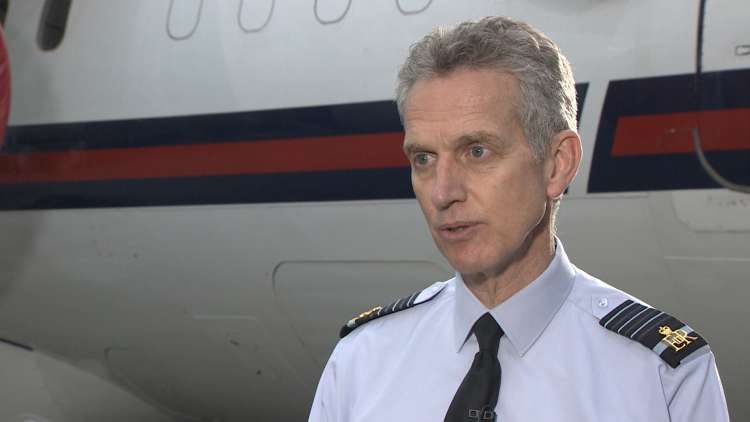
On the occasion of the coming 100thAnniversaries of both the RAF and the RAAF, Air Chief Marshal Sir Stephen Hillier, the Chief of Staff of the RAF addressed the Williams Foundation Seminar on the shift from the land wars to high intensity conflict and highlighted he saw the challenges and how best to deal with the challenge.
His presentation underscored that even though he was asked to speak about the challenge within the European theater, that in his view the challenges faced by both Australia and Europe are quite similar.
“You asked me to speak about high-intensity warfare in Europe.
“Perhaps I’ve not really provided that much of that specific geographical context.
“But then as I said right at the start, I don’t believe that what I’ve described can be bracketed within a particular geography.
“The challenges I’ve described are truly global and truly common to us all. I believe that airpower’s inherent characteristics and capabilities make it especially able to respond effectively to those challenges.”
A clear driver of the shift is that airpower advantage will have to be fought for and not assumed.
And his way ahead focused very much on leveraging what new platforms we are acquiring but to build out from them to shape new ways ahead to regain strategic advantage.
“But the asymmetric advantage airpower has given us for the last three decades at least, is narrowing.
“The integration into our air forces of fifth generation capabilities such as the F-35 Lighting will only redress the delta to a degree.
“Of equal importance in maintaining our combat edge is this ability to manage vast amounts of information, and make decisions more quickly and more accurately.
“Technological developments will be a key element in ensuring that the lever of the best possible output from our air and space platforms, but our C2 structures, processes, and approach to information sharing will be a decisive factor.”
“The human factor will remain incredibly important, but we should strive to maximize our people’s decision-making space by relieving them of the trivia.
“And perhaps most important of all, will be our allies and our cooperative efforts to establish the C2 and information-sharing architectures necessary to deliver decisive combat airpower to the right place at the right time.
“This has been our hallmark as air forces and should remain so well into the future if, together, we successfully address the challenges and seize the opportunities.”
The Air Marshal provided both an overview of the challenges as seen from his perspective as well as key elements for shaping a way ahead to deal with those challenges.
What follows is an unofficial transcript of his remarks.
I’m delighted also to be here at a time when the Royal Australian Air Force and the Royal Air Force are celebrating their anniversaries, and reflecting on our shared histories. In just 10 days’ time the Royal Air Force will be 100 years old. And it offers a moment to reflect on all that we have learned over the past 100 years and the need to look ahead at where we are likely to be in the future.
The focus of this seminar is on future high-intensity warfare, but I think it’s perhaps worth pausing for a moment to reflect on the extreme intensity of the warfare in which Britain and Australia and our airmen were engaged exactly a century ago; for they were fighting desperately to halt the German Spring Offensive of 1918.
And the scale of that battle has largely been overshadowed by the even greater scale of earlier First World War losses….
That was then, and I’m not about to suggest to you today that we’re likely to see a return to high-intensity warfare of that scale and that sacrifice. But we must accept the fact that the threats to our security and the costs of defending ourselves are rising faster now than at any time since the Cold War. And the Cold War was a period in which we understood the strategic context and our potential adversary pretty well. Things were constantly rather more predictable then than they are now.
It’s also rather more complex now, as has been well covered by the earlier presentations. And it’s this rapidly shifting strategic developments that make my task today of providing a vision of the future an especially challenging one. As is often said, prediction is hard, particularly about the future.
Now this audience is very well informed about what this new strategic environment looks like, not least from the conversations over the last few days. But let me offer some examples of how this feels at the moment from a British perspective. Just over two weeks ago, a foreign country, Russia, used military-grade nerve agent in an attempt to murder people on the streets of the United Kingdom.
Not only an extraordinarily aggressive and reckless act, but the first offensive use of a nerve agent in Europe since 1945.
Russia’s also illegally annexed Crimea, the first time since the Second World War that one sovereign nation has forcibly annexed territory from another in Europe. This is in addition to the appalling destruction, which has been visited on the Syrian civilian population by the Russian military itself, and the criminal activities of the Russian state under Putin in cyberspace and elsewhere; they’re well known.
So the post-Second World War consensus that has provided the basis of the rules-based international order and, I might say, peace in Europe, is being challenged and undermined. We must respond, collectively, to reassure our citizens that hostile acts by Russia against our countries, our interests, and our values, will not be tolerated. And closer to home here, we can see many of these same issues and concerns being played out in relation to, for example, North Korea.
So the world is becoming more complex, and threats emanating from state and non-state actors alike are becoming more insidious and unpredictable. And whilst I don’t claim for some supernatural foresight, these and other trends offer some useful insight into the operating challenges, which will confront in the near future. They will influence the character of combat and how we perceive and employ air capabilities into the future.
Now although I’ve been asked to speak about the future of high-intensity warfare in Europe, I’m very conscious, and I’m sure you are, that applying geographical boundaries tempts us to view things in terms that have limited utility in today’s geopolitical environment. Airpower doesn’t recognize such boundaries, nor do cyber or states. Our adversaries, certainly, do not. So we need to look at the world as it is, rather than how we might wish neatly to divide it.
If for example we were to look at Russia through a European lens alone, we would fail to see the links between what it does in Ukraine, the High North, the Eastern Atlantic, Syria, and East Asia; and in cyberspace. They’ve given us plenty of clues that their activities are connected. One example, a long-range bomber fight mounted, not only to irritate NATO, but to exercise military effects in Syria and promote Russian influence throughout the region. A flight in November of 2015, for example, Blackjack bombers making an 8,000-mile round trip around Western Europe, through the Straits of Gibraltar, fire cruise missiles at targets in Syria, and then route back via Iran to base in Russia.
And Iran’s activities across a wide arc through the Middle East, to the shores of the Mediterranean, are not designed to enhance Western influence and security. For the UK, this adverse influence presents a substantial challenge. Up to 92% of our natural gas imports originate from Qatar, and around a quarter of our crude oil comes from countries with coastlines along the Persian Gulf, commodities which are at constant risk of interdiction by Iran.
These myriad threats, which extend beyond traditional geographical boundaries, place an imperative on air forces to become ever more adaptable, resilient, and nimble, if we are to preempt threats and react decisively, perhaps over lengthy periods of time, in an increasingly time-constrained decision-making space. And we need to get rid of the notion that we can control conflict timelines in the way we’ve done over the last 30 years. As military planners, we need to treat every moment of peace as a period of grace to use to prepare as well as we can to meet the demands of the next major conflict.
That conflict may not arrive, I hope it doesn’t, but it will almost certainly arrive if we do not invest conceptually, physically, and morally in the capabilities that will deliver the required power to deter our adversaries. And to deter, you need to have, and be known to have, the capability and the will to fight. Indeed perhaps that will is the first and most fundamental requirement of high-intensity warfare.
So what does all this mean from a UK and an RAF perspective?
Well perhaps I could offer firstly another fundamental requirement of high-intensity warfare from our perspective, and that’s alliances. It’s already been touched on earlier today, but for the UK, NATO is fundamental. It gives us our decisive advantage. It’s not always easy to work with 27 other nations, but it’s something that we have that our adversaries don’t. Our adversaries are trying to undermine those coalitions and alliances. We collectively need to work hard to maintain them; they are our strength.
Turning to airpower, we’ve become rather used, I think, in the post-Cold War era, to the preeminent role of airpower, and combat airpower in particular, has constantly played in advance and protecting our national and multinational vital interests. Its key attributes of speed and reach, and I think it can be argued, the political advantage of impermanence, mean that the deployment of airpower has tended to be the first military response to international crises.
But our successes have imbued too much of our military thinking with the belief that control of the air, and of space, can be an assumed condition for interventions. British forces have not known what it’s like to operate without the freedom of maneuver conferred by persistence control of the air since the Falklands Conflict 36 years ago.
The world is changing.
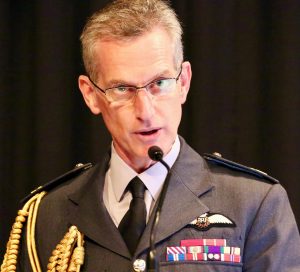
Air Marshal Hillier speaking at the Williams Foundation Seminar, March 22, 2018. Credit Photo: Second Line of Defense
Our strengths have been well and truly spotted by our potential adversaries. Everyone is waking up to the fact that control of the air and space is now contested to a degree that we have not witnessed since the late 1980s. Highly lethal long-range double-digit SAMs are proliferating, and operational fifth generation fighters are no longer the sole preserve of our allies. Indeed Russia have recently deployed an Su-57, its latest generation, to Syria.
And if evidence was needed of our potential adversaries’ increasing will to contest the air environment, it was provided in June last year, when Russia declared that coalition aircraft operating west of the Euphrates would be targeted, following the shooting down by a US Navy F/A-18 of a Syrian regime Su-22 that was itself targeting coalition forces.
So we need to get used to the idea that in any future environment, high-intensity warfare or not, control of the air is going to have to be fought for, and fought hard for, if we are to establish that vital freedom of maneuver.
The consequences of failing to achieve this foremost duty of air forces are severe. As Field Marshall Montgomery observed in the Second World War, “If we lose the war in the air, we lose the war, and we lose it quickly.” Nothing has changed since, except that today, we could freely substitute “air” with either “space” or “cyberspace,” or all three; the sense of the statement remains the same.
Now as airmen, we need to ensure that our joint force colleagues appreciate the importance of control of the air, and the implications for airpower mass and the apportionment of airpower effort….. Our political leaders and our joint colleagues have the right to expect their air forces to dominate the high ground as integral parts of the multi-domain capability range of air forces.
If airpower’s relevance and usefulness have never been greater, for this to remain the case into the future demands that we confront some of the emerging threats to its ascendancy. To maintain the combat edge in the Royal Air Force, we are implementing a strategy that will deliver the right technology, the right people, the right processes, to allow us to respond rapidly and decisively to changing threats at all levels of warfare.
We cannot rely on the freedoms that have made our air forces so successful in the recent past. Our potential enemies are becoming too adaptive to give us that luxury.
And we need therefore not only to innovate new technologies, but processes too.
But before I move on to how we might achieve this, it’s perhaps worth looking at the emerging challenges to combat airpower’s effectiveness further, in high-intensity warfare and more generally.
I’ve already mentioned the proliferation of advanced fighters, SAMs, counter-space, cyber, and electromagnetic threats. Our adversaries seek to offset our strengths by raising the potential cost of action, and restricting our freedom of maneuver, through the adoption of anti-access and area-denial capabilities.
Our adversaries also seek to degrade our air capabilities by taking advantage of the legal and ethical constraints placed on us by our values, which are pleasingly higher, but are still more restrictive, than those accepted by our opponents.
There are implications from all of this.
Hybrid warfare as we know will continue to be a significant feature of strategically contested environments, in which actors will see to blur the boundaries between peace and war and engagement of attributable and non-attributable activities below the threshold on force conflict. The theme today is clearly high-intensity warfare.
My question might be, how and when do we know we’re in one?
So against this strategic backdrop, we have to fight hard to maintain the asymmetric advantage that airpower has conferred on us for so long. But as we’ve discussed in great detail and quite rightly, important as pure combat capabilities will be, of equal and arguably now of greater significance, is the information platforms that collect, disseminate, and integrate as part of this greater information management whole.
One of the key ingredients of success in combat will be, as indeed it’s always been, to ensure that the right capabilities are in the right place at the right time. It will just be more so, much more so, in the future. Our successes will hinge on that decision superiority and being able to exploit technological opportunities.
The pace of that technological change is self evidently accelerating, and the most significant changes are likely to come from the rapid development of these new sensors; novel weapons, including directed energy; artificial intelligence; and automated and remotely operated systems.
I suspect that these developments are indeed likely to be most profound in the air domain, which has always been at the vanguard of technology. As airmen we shouldn’t be afraid of this challenge. The Royal Air Force tackled similar problems in the 1930s, which paved the way for the successful defense of our country during the Battle of Britain in 1940. Then as now, information superiority underpinned air superiority and by extension every military endeavor.
But this tsunami of information that ever more sophisticated systems generates presents a challenge that can only be addressed through vastly more agile and adaptable C2 architectures. Against that backdrop of increasing data volumes, the OODA Loop as we’ve discussed essentially is indeed spinning faster, and we’ve got to maintain that tighter, faster loop than our adversaries. We need C2 networks that are adaptable, distributed, secure, and assured.
The successful flow of information across joint and multinational boundaries demands that greater collaboration, automation, and integration must be achieved.
We know we need to adopt an information-centric rather than a platform-centric approach to our future capabilities.
This swift and accurate decision-making cannot be the sole preserve of C2 architectures and technological advances. Warfare will be, as it has always been, primarily a human activity, and the making of decisions primarily a human activity, particularly those that involve the use of lethal force.
The important aspects here are to ensure that humans are unburdened by the trivial and presented only with the decisions to which legally, morally, and intellectually they remain uniquely best suited to make.
Which brings me of course to our people, who are already outstanding, and who will continue to give us our decisive edge into the future. The challenge of senior leadership, of a certain generation like mine, is to give our people the opportunity, the freedom, and the incentives to think their way around the problems we face, and allow us to capitalize fully on their enormous powers of innovation.
And finally I would say again, that our successes will depend on like-minded allies sharing values and will as well as capabilities. Our potential adversaries struggle in this respect; I’m delighted that we do not.
So in drawing to a conclusion, we face a world, which is more challenging, and threatening than it has been for a generation. Air, space, and cyber power will remain at the forefront of political choice when our national, or collective interests are at stake.
But the asymmetric advantage airpower has given us for the last three decades at least, is narrowing.
The integration into our air forces of fifth generation capabilities such as the F-35 Lighting will only redress the delta to a degree.
Of equal importance in maintaining our combat edge is this ability to manage vast amounts of information, and make decisions more quickly and more accurately.
Technological developments will be a key element in ensuring that the lever of the best possible output from our air and space platforms, but our C2 structures, processes, and approach to information sharing will be a decisive factor.
The human factor will remain incredibly important, but we should strive to maximize our people’s decision-making space by relieving them of the trivia.
And perhaps most important of all, will be our allies and our cooperative efforts to establish the C2 and information-sharing architectures necessary to deliver decisive combat airpower to the right place at the right time. This has been our hallmark as air forces and should remain so well into the future if, together, we successfully address the challenges and seize the opportunities.
You asked me to speak about high-intensity warfare in Europe. Perhaps I’ve not really provided that much of that specific geographical context. But then as I said right at the start, I don’t believe that what I’ve described can be bracketed within a particular geography.
The challenges I’ve described are truly global and truly common to us all.
I believe that airpower’s inherent characteristics and capabilities make it especially able to respond effectively to those challenges.
Finally, again, you asked me to speak about these requirements of high-intensity warfare. The sense I think is that this refers to a potential future state. But perhaps I can offer the recent thoughts of Professor Malcolm Chalmers of the Royal United Services Institute in London. He said recently that the RAF is currently experiencing its longest period of high-intensity operations since the Second World War, especially in the fight against Daesh.
Well he’s right. We are busier than we’ve been for generations.
But that has to be a cause for concern.
Because if my current force is being pushed by a sustained fight against a terrorist organization, we have much work to do if we are to be technologically and in process and people, and resilience and sustainability, with much to do if we are to be ready to deal with the scale and the breadth of threats which we really mean when we speak about high-intensity warfare.
As was so rightly said in one of the earlier presentations, this is a national effort.
When journalists and many policy makers discuss an area like missile defense they often do so from the perspective of catalogue shopping.
What items in the catalogue are of interest?
And what do they cost?
This is often reflected in presenting the reporting and analytical focus on “order of battle” data.
It is an important component but only goes so far in understanding effective weapon employment and human dimensions of combat.
Traditionally with only an “order of battle” look/see at the Fires Center of Excellence at Fort Sill, one would identify the separable programs, and discuss their modernization strategies and how to make each key element better in terms of themselves and to add up a modernization bill. Each item in a “modernization catalogue” and putting it in a commercial analogy would add shipping costs and a service contract to keep the catalogue item in service during the covered period.
But the Air Defense Artillery (ADA) Proponent at Fort Sill internally does not have just an “order of battle” mindset. Of course, all technology in the ADA fighting inventory has to always respect the truism that all military technology is relative against a reactive enemy and the other truism “quantity has a quality of its own.”
All solders we engaged with at all ranks fully understand the imperative for cross cutting modernization that going on in ADA. Effective cross-cutting modernization better integrated with an appreciation for evolving con-ops development and ever improving all dimensions of Command and Controls including an artificial intelligence (AI) research effort can all shape a war winning transformation of core capabilities, rather than only focusing on stove piped platform modernization.
As we refocus on the challenges posed by peer competitors and engaging in higher tempo and higher intensity operations, it is often not just back to the future.
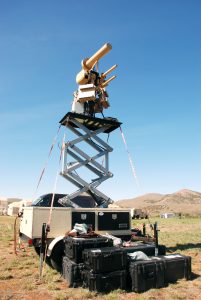
An anti-unmanned aerial vehicle defense system (AUDS) searches the skies of Fort Sill for UAVs, April 6, 2017 during the Maneuver Fires Integrated Experiment (MFIX). (Photo by Monica K. Guthrie)
Russia is not the Soviet Union. And China is not Mao’s PLA. There are lessons learned from the past and domain knowledge, which can be leveraged in the migration in back to the future to harvest the best but leave the rest, such knowledge is to be leveraged not slavishly copied.
We must also try and learn what we don’t know.
Effective military organizations around the globe respect what Secretary Rumsfeld once sagely focused on “the unknown unknowns”
Throughout the interview, he was very clear on the importance of breaking out of legacy patterns and thinking and finding ways to train for the future fight with the force you are crafting and respect what one doesn’t know.
“Our senior leadership, including myself, has never grown up in the combat environment which is now evolving rapidly. We need to unlearn as well as learn to shape an effective way ahead.”
The change is to effectively shape a future force structure based on where you need to go, rather than what you have inherited?
During our visit to Fort Sill, we experienced a Command clearly thinking through ways to deal with all of these challenges.
The Command is led by a soft spoken but clear leader in empowering his Command to think through how to break through to the next level, rather than training to the past. During our visit we had a chance to talk with Brigadier General Randall A. McIntire a couple of times and he set in motion an opportunity to talk with several members of his staff who provided us with a clear sense of the work underway to train with the force they have and the one which is emerging.
Brig. Gen. Randall McIntire, Air Defense Artillery School commandant, emphasizes the importance of air defense artillery to protect the maneuver force and preservation of key combat power at the Industrial Breakfast at Cameron University Jan. 31. (Photo Credit: Monica Wood
When visiting the Command, it strikes one that the ADA warriors have much in common with the US Navy’s silent service on a strategic deterrence patrol– always ready.
Sargent First Class Nicholas Martin and Sargent First Class Johnathan Pace put this point to us about their life as ADA warriors:
“Whether you’re stateside, whether you’re deployed for overseas, whether you’re in a combat zone, or you’re in a friendly nation, you have to be ready for action. No matter where I am, the question is the same: are we ready to start?
“Can we heat up the missiles now and fire them? Are we watching the skies correctly? Even if you’re in an area that’s not in a combat area, you’re always watching the sky, because in a scenario where nobody’s fighting, the air defense is still watching.
“There’s always been that intensity that if something kicks off, we’re the first ones to see it. We’re the first ones to react. And you’re on the line, they coming after you.”
Colonel David Baxter, Brigade Commander, 30th Air Defense Artillery Brigade, underscored as well the complexity of getting troops ready for the “always ready” mission set.
Col. David Baxter, 30th ADA, Fires Center of Excellence
“We require our operators to be extremely knowledgeable of threat and to understand the weapons systems.
“It’s not just a one man crew, it is three people who hone their skill sets together and have to think and operate as a rapidly responsive team.
“We have to be prepared at all times but the challenge is that our skill set is not developed overnight. It takes four to six months to develop what in my opinion would be a well-trained crew.
“By which I mean, a crew that is cognizant of the operating environment, of the enemy, of their weapons system, and that can perform. And it take more than one crew per battery. You have to build a minimum of three. You can only sit in the van for so long looking at the scope.”
And we learned during our visit that the Command has already been training for the transition from the land wars in the Middle East to a new global strategic situation.
For example, the Patriot batteries train to two core situations. The first being to prepare to the area of interest to where they are scheduled to be deployed with the simulators targeted on the real combat situation likely to face the operators.
Captain Matthew Ludemann a former Patriot battery commander and current staff officer in the ADA School with two deployments to the Middle East, underscored that there was a second type of training as well, namely for what they call Global Response Force or GRF scenarios. These scenarios are very flexible and involve preparing for rapid deployment to a crisis area, which might pop up worldwide. Here, they are training against a variety of threats and within a variety of scenarios.
In a 21st Century U.S. Army “back to the future” effort increased emphasis has been placed on ramping up Short Range Air Defense (SHORAD) for the U.S. Army forces. SHORAD initiatives for an Army on the move was a good example of a Command leveraging the past but not being captured by it.
The core competence in operating SHORAD in the U.S. Army resides in the National Guard. That competence along with those of the allies is being leveraged as the Army brings new SHORAD capabilities into the force.
Because the most urgent priority for SHORAD is in Europe, the Army made a clear decision to go with a wheeled vehicle to support the initial modernization efforts around SHORAD.
Rather than letting the vehicle choice and the historical battles over tracked versus wheeled vehicles derail the pace of progress, the Army has chosen a Stryker variant for the initial modernization efforts.
As BG McIntire put it: “We got the platform figured out. Now what is under debate today are the ornaments to be placed on the platform. And when we do that we will spiral develop the capability.”
One Army officer highlighted the role of the allies in rather blunt terms. “The Czech the Romanians, the Danes and the Germans have all kept their SHORAD capabilities operational. They have provided officers onto the NATO staff and when we deploy on operational maneuvers in Europe we have those officers with us providing their SHORAD expertise. And as for me, I learned from a Czech officer about SHORAD integrated into the maneuver force.”
116170fade1.05.0
A key challenge facing the Air Defense Artillery community as a more integrated approach to defense is shaped, and with it greater integration with offensive capabilities, is to focus on the network as an integrated weapon system.
A key driver of change here is working Patriot with THAAD integration via the new Integrated Air and Missile Defense Battle Command System (IBCS).
Here the focus is upon shaping a common operational picture to drive an integrated firing solution set.
As IBCS is continued to be tested and refined the ADA branch is also looking at how the military specialties will change as well. With the enhanced integration of THADD with Patriot envisaged under IBCS, there is a planned transition in the military specialties.
As one Army officer put it: “So instead of identifying oneself as a Patriot operator or a THAAD operator they will be radar operators or launch operators.”
And when the Army deploys IBCS, the Army has the opportunity to drive fundamental change in how it transforms and modernizes the force.
As BG McIntire put it: “This will allow us to componentize acquisition in the future. We can prioritize sensors or weapons and hang them on the network, rather than having to drive stove piped modernization of a particular defensive system. We need to ensure that every requirement we write for a future system is IBCS compliant in order to drive such a fundamental change.”
The goal for enhanced ground defense capabilities is to empower the joint maneuver force able to operate in the integrated battlespace. Again the Commanding General captures the forte of the American military as operating as a joint force globally.
“The goal is to be able to open up operational space for the maneuver force, whether led by the Air Force or the Army, and to be able to go into the objective area and dominate the adversary. We can debate forever what we think the multi-domain battle means. But at the end of the day, my tactics have to change and my ability to collarbone I the battlespace enhance with my other service mates.”
After important individual discussions with Sargent First Class Nicholas Martin and Sargent First Class Johnathan Pace, Colonel David Baxter, CW5 Eric Maul and CW5 Christopher Wehmeier, we were given the opportunity to discuss with ADA officers who had different weapon experience or a battle system connectivity focus during a round table.
These officers have operated Patriot, THADD, SHORAD for many years, but the focus was talking through the future of ADA not focusing simply on the platforms.
Our ground rules were not to try and capture individual quotes but let a free flow of ideas drive the understanding of the Air Defense Artillery team working together. So we are grateful to Captain Keller Howell, Captain Jessica Perales, Captain Andrew Clark, Lt. Col. Ron Niedert, Major Blake Seibold, and Lt. Col. James Reese.
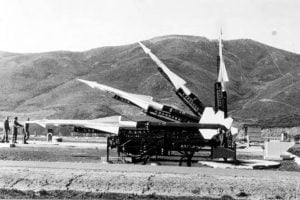
As the session ended the Fort Sill former combat officer now historian made a brilliant point about the challenges the U.S. Army faced in moving ADA into the missile age after World War II. In this case, as single innovative Army Officer drove that revolution and today the U.S. has a world class ADA community of innovative warriors at the cutting edge of technology by coming up with a way to develop the Nike missiles.
In August of 1944, Lieutenant Jacob W. Schafer submitted a memorandum proposing a new antiaircraft weapon system. His proposal which brought together rocket guidance, and radars linked to computers was evolutionary and catapulted U.S. as the leader of air defense. Bell Laboratories took on this initiative and LT Schafer lead the newly formed Nike project as an officer working with industry.
Nike Missiles deployed. Credit: US Army
After WWII the U. S. Army Air Defense witnessed the genesis of the missile age through its defense against V-1 and V-2 rockets. As Wernher Von Braun worked through Operation Paper Clip, the U.S. Military’s development into the rocket age, a young lieutenant was working through the scientific methods associated with missile defense.
At the heart of change is reworking how the Army will do maneuver warfare, with defense at the heart of reshaping the offensive and defensive relationship.
As BG McIntire put it and the officers at the round table fully grasped “We are reworking the tribal differences between those responsible for defense and those responsible for offense in the brigades. We need an integrated mix of offense with defense for the maneuver force to be effective in the conflicts we are likely to fight going forward.”
In short, the Air Defense Artillery is working the challenge posed by the question; “How do you shape a future force structure based on where you need to go, rather than what you have inherited?
We wish to thank BG McIntire and his staff for their time spent with us. This article could have not been written without their insights and forward looking vision while also capturing the current challenges faced by an Army team essentially at war since 9/11.
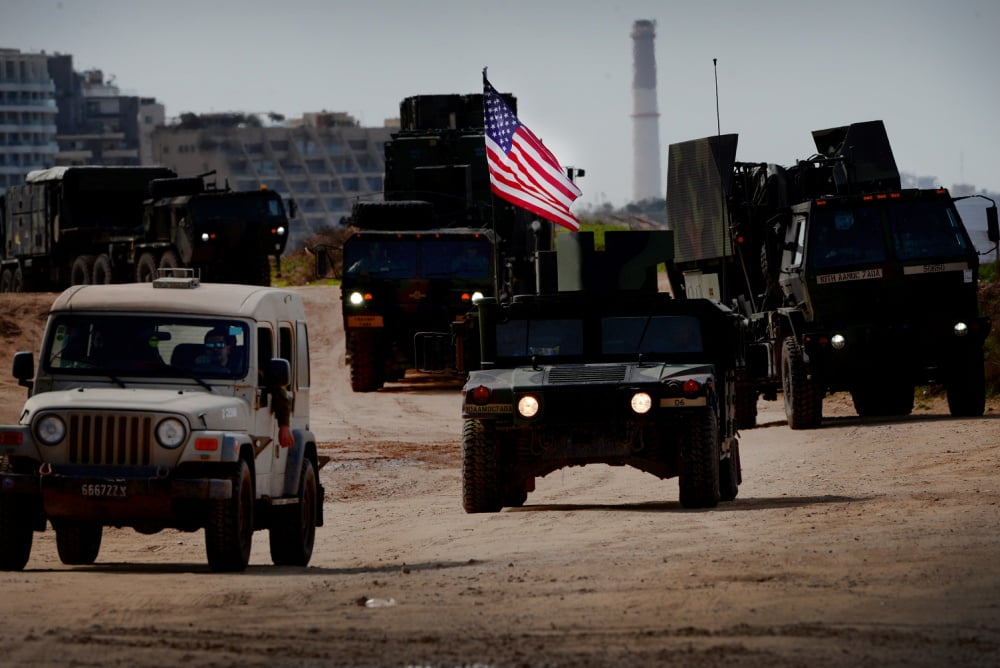
Editor’s Note: Featured photo shows U.S. soldiers from the 5th Battalion, 7th Air Defense Artillery Regiment, conduct emplacement and system validation for the MIM-104 Patriot air defense missiles battery at an Israeli exercise site during Juniper Cobra, Feb. 26, 2018. Juniper Cobra 2018 is a ballistic missile defense joint U.S.-Israel exercise that uses computer simulations to train forces and enhance interoperability. Air Force photo by Tech. Sgt. Matthew Plew
“Whether you’re stateside, whether you’re deployed for overseas, whether you’re in a combat zone, or you’re in a friendly nation, you have to be ready for action. No matter where I am, the question is the same: are we ready to start?” air defense Sergeants First Class Nicholas Martin and Jonathan Pace told us when we visited Fort Sill, home of Army air defense. “Can we heat up the missiles now and fire them? Are we watching the skies correctly? Even if you’re not in a combat area, you’re always watching the sky, because in a scenario where nobody’s fighting, the air defense is still watching.”
“There’s always been that intensity that if something kicks off, we’re the first ones to see it,” the sergeants told us. “We’re the first ones to react. And you’re on the line, they’re coming after you.”
For decades, enemy air defenses were the US military’s first target in a conflict. American air defenders know full well they will probably be the first target for a peer adversary.
For the rest of the story, see Breaking Defense where the story first appeared.
Note with regard to the C-RAM video:
ADA is the transformational part of that technology equation, while offensive ground based strike is the linear technology modernization part of that equation. Working integration, between innovation and modernization may require significant organizational change as well to get the outcomes desired.
During our discussion with the BG McIntire at Fort Sill in April 2018, he highlighted a success story the Army had in the Middle East in developing and deploying the Counter-Rocket Artillery Mortar (C-RAM) system within 11 months from the Warfighters call for a solution.
Soldiers and Sailors working together on the C-RAM system quickly developed capability from an existing Navy system, Phalanx – Close-in Weapon System, connected with Army command control systems.
The C-RAM system was designed to defeat the enemy’s incoming rounds launched at our friendly Forward Operating Bases (FOBs) in Iraq.
According to BG McIntire, they were effectively working integration of defense fires with offense fires within the Army just prior to a ramp off of the control of operations and response efforts from the US Military to the host nation Iraqi government.
“We already started working offensive and defensive fires with the C-RAM system. We linked C-RAM into a network of sensors by leveraging the field artillery sensors and the air defense radars and we were able to determine where the enemy rounds were coming from, the point of origin (POO).
“Then, we were able to effectively provide localized warning for our troops in the vicinity of the Point of Impact (POI), while intercepting the incoming round when it was appropriate to protect the defended asset.
“Simultaneously, we responded with an appropriate level of reaction force: counter-battery fire, Army attack aviation or local ground forces towards the launch point for further investigation or defeat.
“Now, we need to take these Fires concepts already demonstrated at the Tactical level and experiment with them at the Operational and Strategic levels.”
Recently, the new Under Secretary of Defense for Research and Engineering Dr, Michael Griffin, provided an overview at Hudson Institute on how he sees the role of science and technology in regaining U.S. strategic advantage in an increasingly contested strategic environment.
In an earlier speech, he noted that cutting edge technology for U.S. forces does not always come with a US passport.
This would suggest that the is open to broadening the aperture on how the Department might deliver change by working more closely with allies, and certainly a number of partner programs are staring one in the face which can drive change, whether the Patriot, the P-8, the F-35, Triton, etc.
Indeed, as NASA Administrator, he worked closely with European and Asian allies on space development issues.
His presentation provides a very insightful look at how the global competition has shifted since he was head of NASA.
He sees a clear need to reset how the US addresses the challenge of gaining strategic advantage from science and technology.
But the applied side of how this has done has changed in recent years.
We founded the website in the wake of the firings of Secretary Wynne and Air Force Chief of Staff, General T. Mosley, because bluntly, we believed that a focus on fighting the land wars would lead exactly to the situation which Dr. Griffin discussed.
Notably, Griffin starts by talking about the hypersonic challenge, one which we highlighted through interviews with Dr. Mark Lewis, again from the start of the website.
We would also note that Dr. Lewis worked closely with allies in this area when chief scientist of the USAF, in this case the Aussies, to shape a way ahead.
We could ask how the Department is addressing those kinds of working relationships as well in any reset envisaged by Dr. Griffin.
We welcome his warnings and his emphasis but would certainly caution him to not leap into the great unknown without embracing the change inherent in a number of key warfighting capabilities coming into view currently.
There is a clear opportunity to embrace change being driven by new systems coming into reality, but whose full impact will not be realized by continuing the calcified requirements processes which the Department shoves down the throats of industry and the warfighting community.
Triton, P-8, the F-35 and many others come to mind rather rapidly.
It is not about science and technology alone, or looking for great leaps ahead, it is about changing the business rules, which impede innovation, which can be driven by ALREADY being procured systems.
It is about changing the way when which DoD bureaucrats can get out of the way of combat driven innovation.
As Geoff Brown, former Chief of the Royal Australian Air Force observed about the United States Department of Defense and innovation:
According to Brown, “the systems are all there in the United States. The shoots are there for fundamental change. But the legacy approach is like a giant tree blocking out the sun for the shoots to grow.”
He pointed out that the notion that one would modernize AWACS is “simply amazing to me. With the fuel savings alone from replacing the AWACS fleet with Wedgetails a new fleet could be paid for in a few years. But that in the US system it is difficult to get a tradeoff from keeping the old legacy systems running and simply shutting them down; putting the new systems into the force; and leveraging them rapidly.
The new systems require new sustainment approaches.
“The F-35 provides a great opportunity for a very different sustainment system but with the Congressional mandated depots the opportunities for an innovative industrial-government partnership are severely constrained.”
As the Trump Administration looks to rebuild the force if the fundamental barriers are not addressed, “even 50-60 billion dollars more won’t correct the kinds of logistical shortfalls which the United States faces.
“I’m a little frightened for the future if the US forces keep going down the path they’re on at the moment.
And Brian Morra, a recently retired senior defense executive underscored as well the inherent opportunities within the US force, if DoD could better manage itself or reshape itself to align itself with the major strategic changes which its OWN new combat systems are introducing.
Given the steady progress being made by adversaries, reforming DoD’s acquisition process is no longer just a smart thing to do; it has become existentially vital.
The digital nature of new weapon systems like the F-35 makes multi-phased development and multi-modal budgeting feasible.
This approach bears some similarity to the spiral-development approaches used in the past.
However, a new approach will need to be qualitatively different than traditional spiral development.
The ability to upgrade new weapon systems primarily through software upgrades makes this new approach possible.
The new approach would have shorter upgrade cycles or modes, based on 3-5 year centers.
Budget planning will need to change since each new “mode” would blend acquisition and O&S monies. Each new mode would require a business case to support decisions to deploy funds.
This is a very different approach.
It would require different business rules and procedures than are currently employed by the DoD’s acquisition centers.
The obstacles to this kind of reform are not technical, although some will assert that technical issues are insurmountable. The real obstacles are DoD’s current business rules and acquisition policies and budgeting procedures.
The question is will we reform these procedures now, or will we only do so when we are confronted with a crisis?
The US aerospace and defense industry maintains proprietary control over its core capabilities.
This is a key challenge that DoD confronts that China (in the main) does not. In order to have affordable, multi-modal weapons system development, DoD will have to establish new business rules to enable proprietary sharing or compartmentation schemes that create the conditions for development across proprietary stove pipes.
The need is clear.
The DoD requires business rules appropriate for high-intensity acquisition to meet the rapidly evolving threats represented principally by China and Russia.
The growing importance of cyber and digitally-enabled systems means that DoD can no longer operate with industrial-age procurement and sustainment rules.
Fortunately, the transition to digital systems lend themselves to a new, multi-modal approach that will help the United States keep pace with evolving threats.
We welcome Dr. Griffin and his leadership in the Pentagon, and certainly hope that he can lead the way ahead in great leap technology and leveraged change.
Dr. Michael Griffin, Under Secretary of Defense for Research and Engineering
The USD(R&E) and the office s/he heads are charged with the development and oversight of DoD technology strategy for the DoD.
The post (or effectively the same post) has at various times had the titles Assistant Secretary of Defense for Research and Engineering (ASD(R&E)), or Director of Defense Research and Engineering (DDR&E).
The latter title has itself historically varied between the rank of Under Secretary and that of Assistant Secretary.
USD(R&E) is the principal staff advisor for research and engineering matters to the Secretary and Deputy Secretary of Defense.
In this capacity, USD(R&E) serves as the Chief Technology Officer (CTO) for the Department of Defense charged with the development and oversight of DoD technology strategy in concert with the
Department’s current and future requirements.
The goal of USD(R&E) is to extend the capabilities of current war fighting systems, develop breakthrough capabilities, hedge against an uncertain future through a set of scientific and engineering options and counter strategic surprise. USD(R&E) also provides advice and assistance in developing policies for rapid technology transition.
From 1987 until February 1, 2018, ASD(R&E) was subordinate to the Under Secretary of Defense for Acquisition, Technology and Logistics.
On February 1, 2018, the research and engineering were split into an independent office, with the head position being elevated from an assistant secretary to an under secretary level.
Earlier, Griffin was head of NASA under President George H. Bush.
The official biography for Griffin as indicated as follows:
Dr. Michael D. Griffin is the Under Secretary of Defense for Research and Engineering. He is the Department’s Chief Technology Officer, and is responsible for the research, development, and prototyping activities across the DoD enterprise and is mandated with ensuring technological superiority for the Department of Defense. He oversees the activities of the Defense Advanced Research Projects Agency, the Missile Defense Agency, the Strategic Capabilties Office, Defense Innovation Unit Experimental, the DoD Laboratory enterprise, and the Under Secretariate staff focused on developing advanced technology and capability for the U.S. military.
Mike was previously Chairman and Chief Executive Officer of Schafer Corporation, a professional services provider in the national security sector. He has served as the King-McDonald Eminent Scholar and professor of Mechanical and Aerospace Engineering at the University of Alabama in Huntsville, as the Administrator of NASA, and as the Space Department Head at the Johns Hopkins University Applied Physics Laboratory. He has also held numerous executive positions in industry, including President and Chief Operating Officer of In-Q-Tel, CEO of Magellan Systems, and EVP/General Manager of Orbital ATK’s Space Systems Group. Griffin’s earlier career includes service as both Chief Engineer and Associate Administrator for Exploration at NASA, and as the Deputy for Technology at the Strategic Defense Initiative Organization. Prior to joining SDIO in an executive capacity, he played a key role in conceiving and directing several “first of a kind” space tests in support of strategic defense research, development, and flight-testing. These included the first space-to-space intercept of a ballistic missile in powered flight, the first broad-spectrum spaceborne reconnaissance of targets and decoys in midcourse flight, and the first space-to-ground reconnaissance of ballistic missiles during the boost phase. Mike also played a leading role in other space missions at the John Hopkins University Applied Physics Laboratory and NASA’s Jet Propulsion Laboratory.
Griffin has been an adjunct professor at the University of Maryland, Johns Hopkins University and George Washington University, teaching spacecraft design, applied mathematics, guidance and navigation, compressible flow, computational fluid dynamics, spacecraft attitude control, estimation theory, astrodynamics, mechanics of materials, and introductory aerospace engineering. He is a registered professional engineer in California and Maryland, and the lead author of some two dozen technical papers and the textbook Space Vehicle Design.
He is a member of the National Academy of Engineering and the International Academy of Astronautics, an Honorary Fellow and former president of the American Institute of Aeronautics and Astronautics, a Fellow of the American Astronautical Society, and a Senior Member of the Institute of Electrical and Electronic Engineers. He is the recipient of numerous honors and awards, including the NASA Exceptional Achievement Medal, the AIAA Space Systems Medal and Goddard Astronautics Award, the National Space Club’s Goddard Trophy, the Rotary National Award for Space Achievement, the Missile Defense Agency’s Ronald Reagan Award, and the Department of DoD Distinguished Public Service Medal, the highest award which can be conferred on a non-government employee.
Griffin obtained his B.A. in Physics from the Johns Hopkins University, which he attended as the winner of a Maryland Senatorial Scholarship. He holds master’s degrees in aerospace science from Catholic University, electrical engineering from the University of Southern California, applied physics from Johns Hopkins, civil engineering from George Washington University, and business administration from Loyola University. He received his Ph.D. in aerospace engineering from the University of Maryland, and has been recognized with honorary doctoral degrees from Florida Southern College and the University of Notre Dame.
Mike is a 4000+ hour commercial pilot and flight instructor with instrument and multiengine ratings, and holds an Extra Class Amateur Radio license.
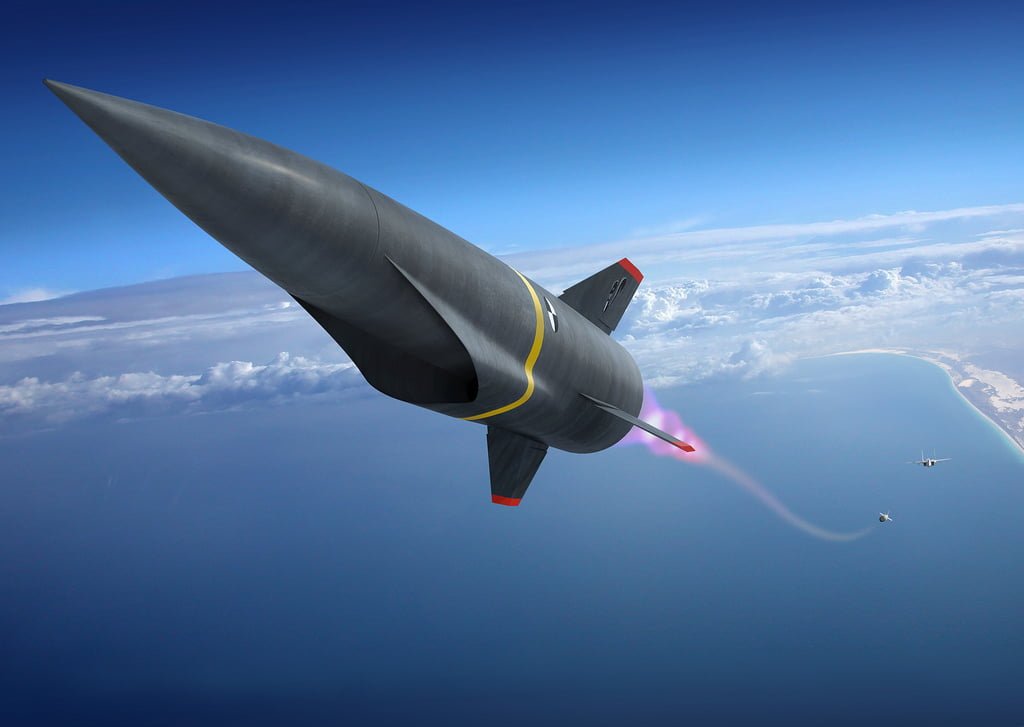
The photo above is an artist’s rendering of Lockheed Martin Skunk Work’s high speed strike weapons which was described as a “a hypersonic missile concept suitable for future bomber and fighter aircraft” Credit: Lockheed Martin
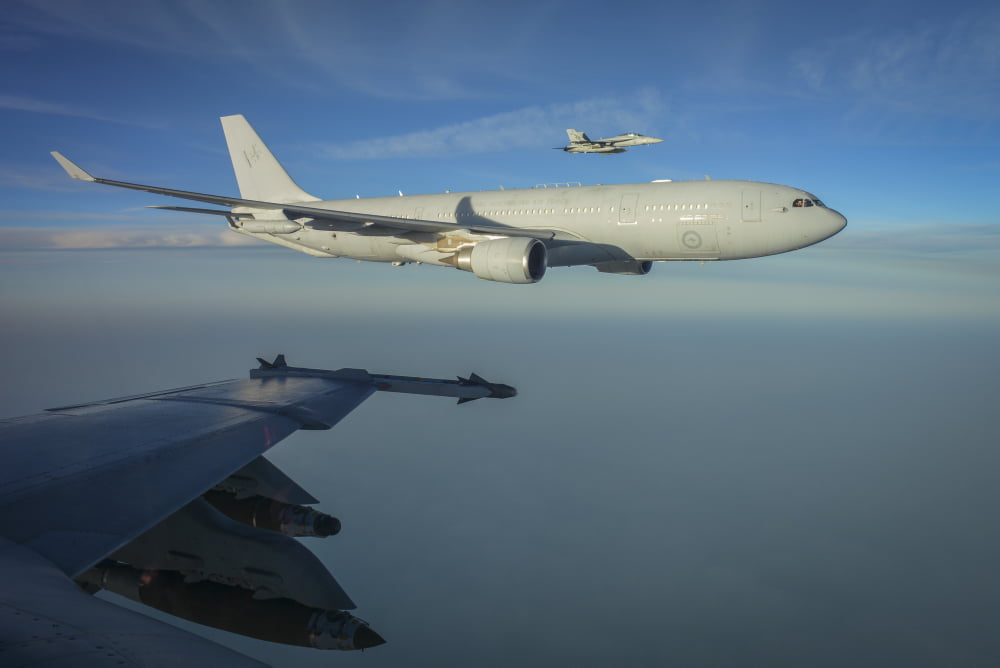
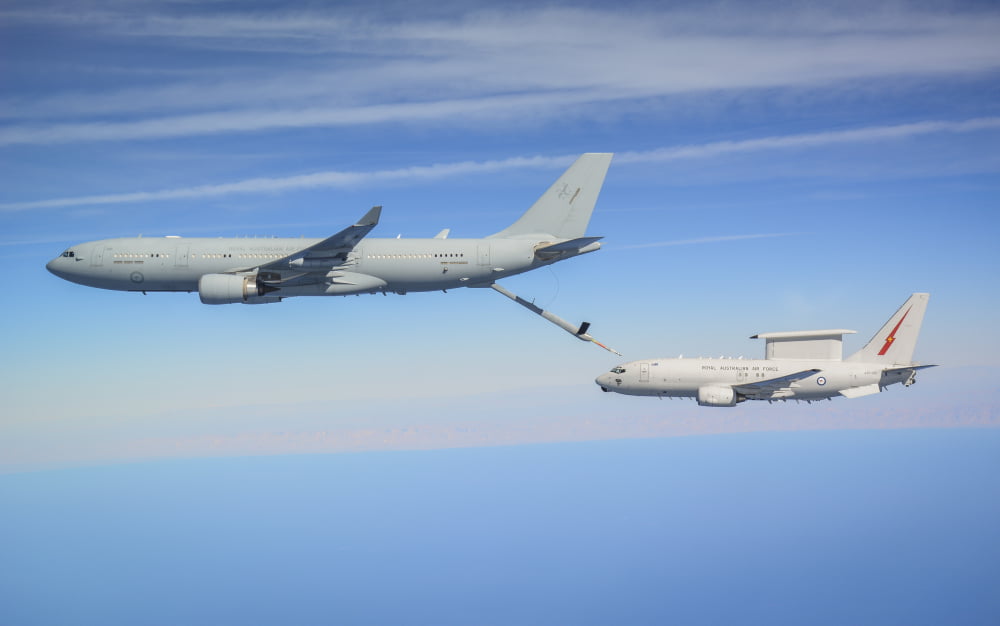
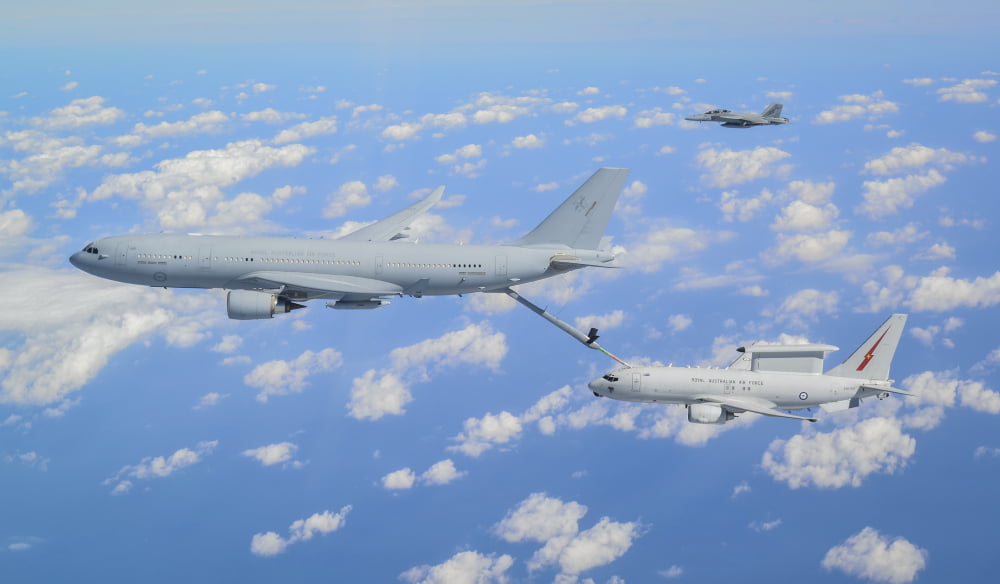
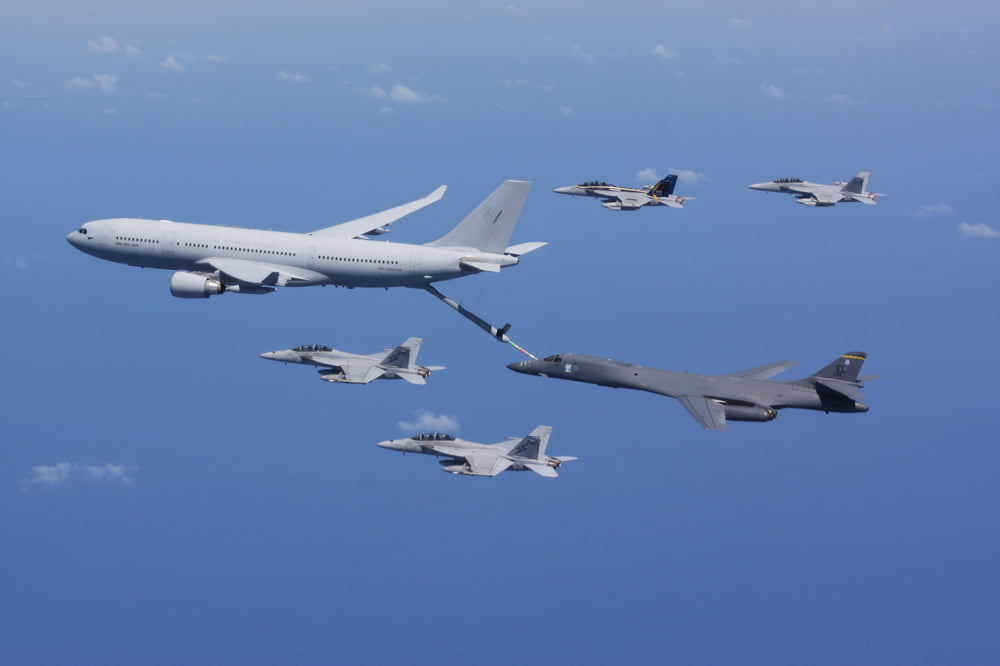
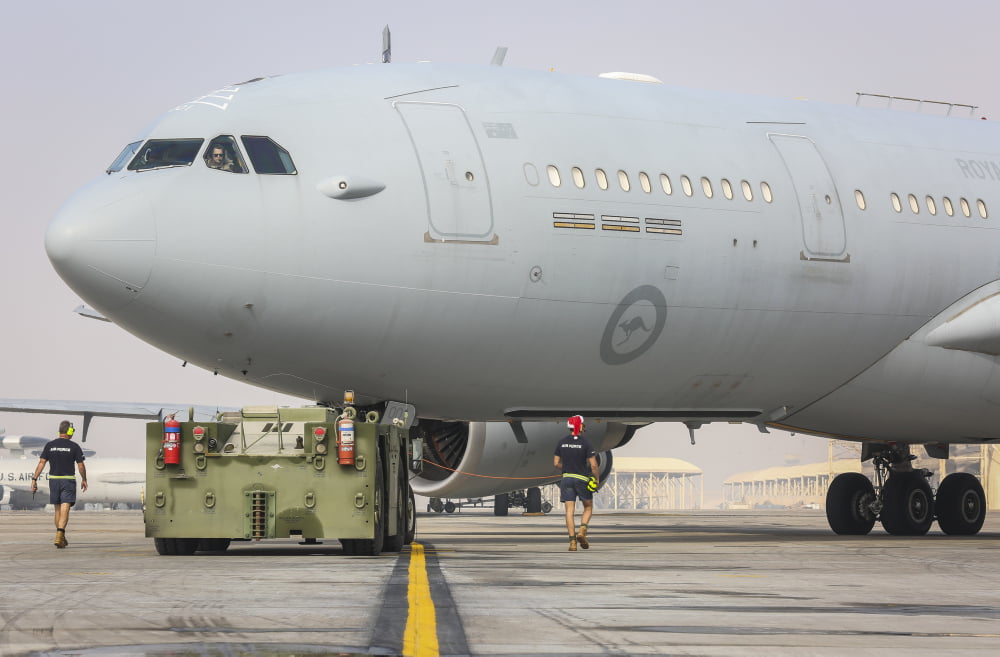
During my visit with Murielle Delaporte to RAAF Base Richmond we had a chance to discuss with the new Air Mobility Group (AMG) Commander his perspectives on the way ahead. We focused primarily upon the KC-30A as well as the introduction of the new C-27J into the RAAF.
A key point to underscore is that the RAAF, like the USMC, is focused on ramping up combat capability for the operational force, rather than being focused primarily on a process based approach which requires a long list of process-driven requirements.
It is an attitude of get the new equipment into the hands of the warfighter and let them work the operational innovation.
Air Commodore “K-9” Kourelakos underscored that the RAAF relies on a risk-management approach as the warfighters work through the use and evolution of new equipment, in order to get it into the force as rapidly as feasible.
“We do a good job of teaching our airmen and airwomen to think about risk management. As they’re going through hiccups and dealing with problems, they are asking a key question: “Can we actually do this? And to do so, what kind of risk are we taking?”
“If they think it is something really serious, they’ll put the flag up and highlight their judgment that we should not go ahead with a specific action.
“Put in clear terms, there’s a process view of life, and there’s an impact or effects view of life, and we are focused on giving the war-fighter an effects view of life.”
We discussed with the Air Commodore his sense of how the Group has evolved over the years and what the next steps will be moving forward.
He has been involved with RAAF C-130 operations from the start in the Middle East, and emphasized that the RAAF brought C-130s to the Middle East and operated them locally and have done so for more than 15 years.
They worked with allies and jointly work to sustain the force.
With the coming of the C-17 and then the KC-30A things changed fundamentally as the capability flew into theater and out again as the operational schedule and rhythm dictated.
He noted that with the KC-30A they brought a multi-function aircraft into the mix, not a narrowly specialized tanker.
This has meant that they have worked through ways to work the C-17 and KC-30A in support packages for the Australian Defence Force (ADF) in the Middle East and elsewhere.
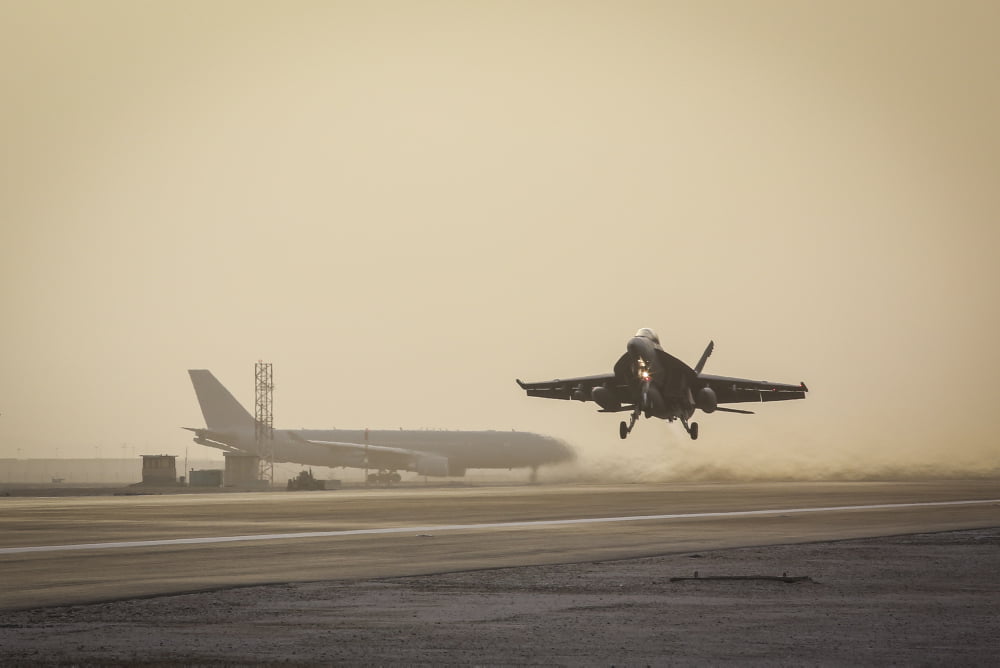
“We put the KC-30A into theater in what some would say was an early timeline, but given our effects-based approach, we deployed the aircraft and sorted through the challenges and got significant combat effect from deploying the aircraft prior to achievement of its Final Operating Capability.”
He underscored that the operational experience in the Middle East for the tanker crews has been very significant in shaping the next chapters for the tanker within the ADF.
“They learned how to function effectively in a dynamic area of operations.”
So what are the next chapters in the tanker story, from the perspective of the Commander AMG?
First, what is next in the Middle East?
“We have deployed a single tanker full-time for the past three years in the Middle East and we are shifting to a more periodic engagement and we shall work that operational challenge.
“The impact of continuing this engagement for a long time has yet to be seen or learned.”
115372fade1.05.0
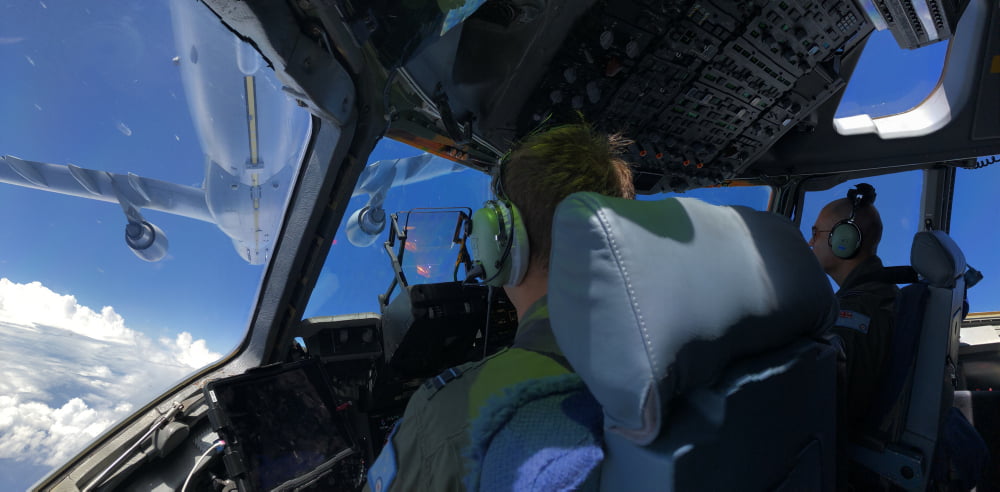
Second, the boom operations for the tanker will go up dramatically in anticipation of the F-35 operating in Australia.
This means that they are ramping up their certifications and training with small receivers like the F-16 in order to prepare for extensive support to the Aussie F-35s.
This tanking will be done largely over Australian territory and working through support of the F-35 will be a major effort over the next three years as the fighter comes on line in Australia.
Third, the RAAF is rapidly expanding the number of types of aircraft for which the KC-30A has clearances.
And this is seen by the RAAF as a key part of supporting allies in the region, notably PACAF.
“A key strategic objective of our alliance with the United States is our ability to be interoperable and with regard to tanking this means working the clearance process for tanking fighters and other aircraft.
“If you get into a high-end fight you need to leverage every advantage that you can in order to prevail.”
Fourth, a part of building out that combat advantage is the coming of the robotic boom to the KC-30A. In part it is a safety enhancement, functioning much like an auto-pilot, but it is a work in progress to sort out how the robotic boom will actually operate and be used by the RAAF.
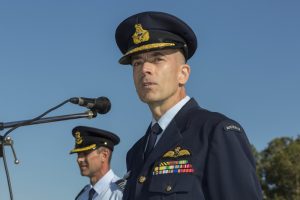
Incoming Commander Air Mobility Group, Air Commodore Bill Kourelakos, CSM addresses the parade.
But there is a clear combat advantage which will come with enhanced capability to fuel air assets more rapidly and safely.
“With a robotic boom, you are increasing your combat capability through enhanced efficiency.
“You can also achieve a reduction in maintenance as you work through ways to efficiently operate the the boom.
“What we are talking about is taking force projection to a new level.
“If you can have our fighters on station-longer and delivering combat effects, because you can tank them more rapidly, that will be a significant gain.”
“We are a small Air Force.
“If you look at the history of small air forces, they win or lose on the first day. You want to be ready for the first day.
We next discussed the C-27J and it should be noted that Air Commodore Kourelakos was the transition officer in charge of the C-27J effort.
He highlighted that he saw the C-27J as a very flexible aircraft able to land in Australia and in the periphery of Australia on a much wider range of airfields than even the C-130.
He told us that they have even practiced operating a C-27J on a highway.
The Special Forces have gotten the point of why this is a good capability for the ADF, but the RAAF is working the issue with the broader Australian Army.
They are engaged in the upcoming Hamel exercise and other events to familiarize the Army with its capabilities for operation on Australian territory or the periphery.
In our discussion later in the week with the Commander of Combat Support Group, we focused on the need to provide for more flexible basing within Australia to deal with the kinds of strike threats being posed by adversaries in the region.
Clearly, the C-27J could be part of the ADF’s response to shaping more mobility in the air combat force.
In short, the new Air Mobility Commander is focused on leveraging the lessons learned from the Middle East engagement and shaping a way ahead for the next round of innovation, one driven by developments in the Australian strategic neighborhood.
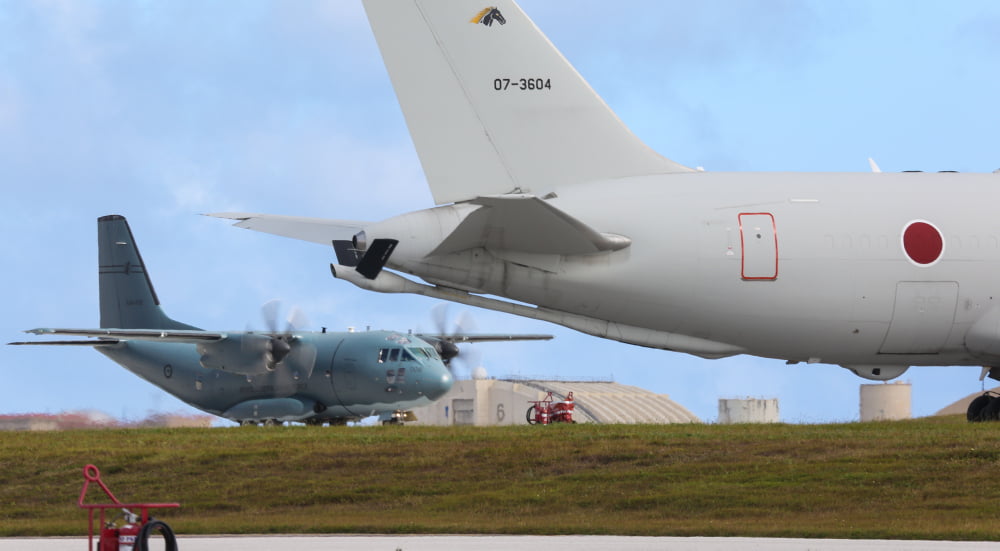
No. 35 Squadron C-27J Spartan taxies past a Japan Self Defence Force KC-767 as it arrives into Andersen Air Force Base, Guam to participate in Exercise Cope North 2018.
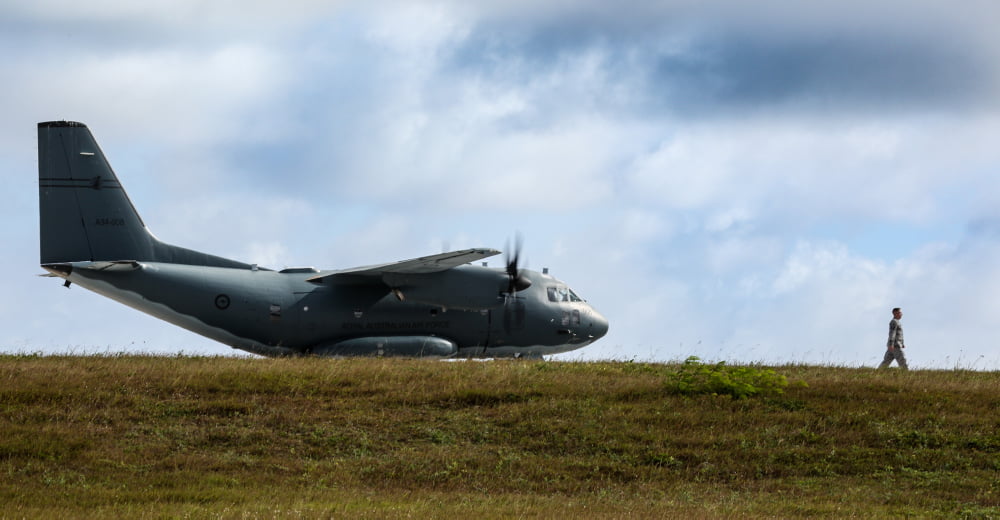
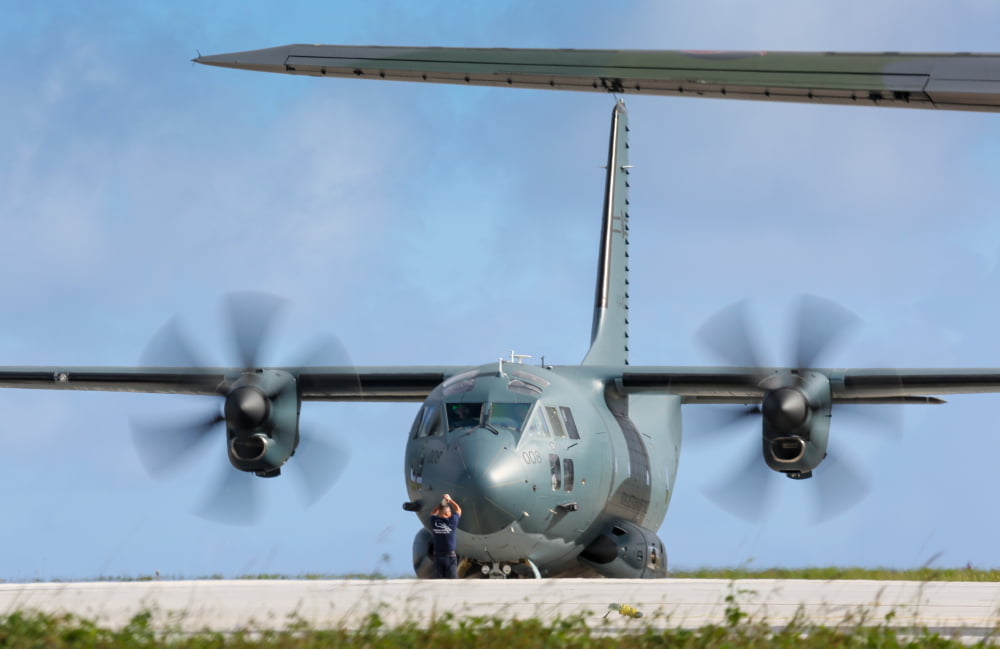
No. 35 Squadron C-27J Spartan arrives at Andersen Air Force Base, Guam to participate in Exercise Cope North 2018.
No. 35 Squadron C-27J Spartan arrives at Andersen Air Force Base, Guam to participate in Exercise Cope North 2018.
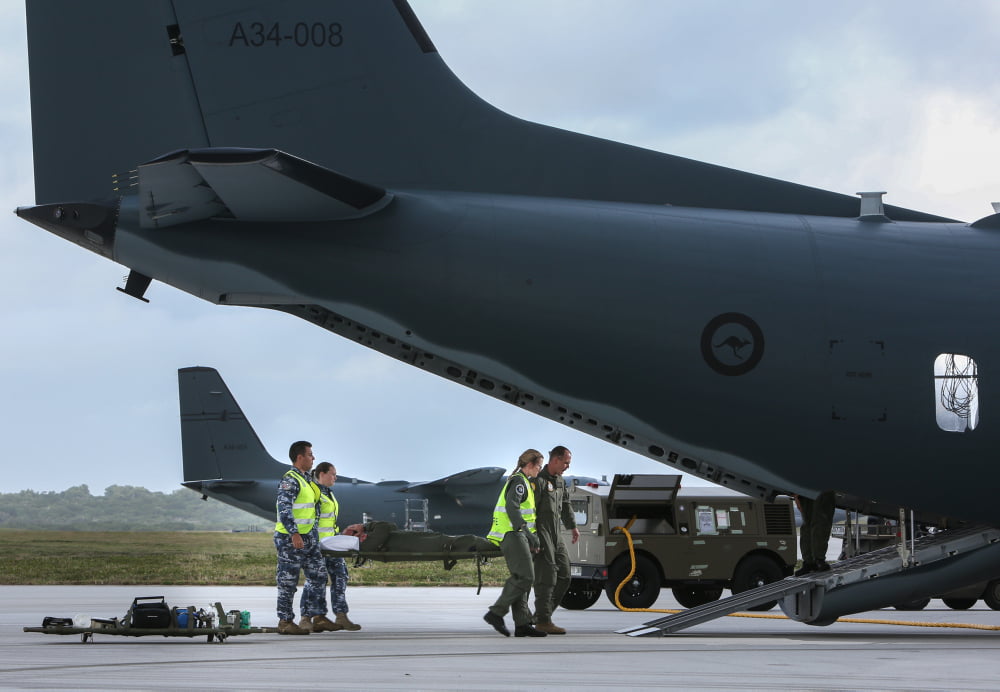
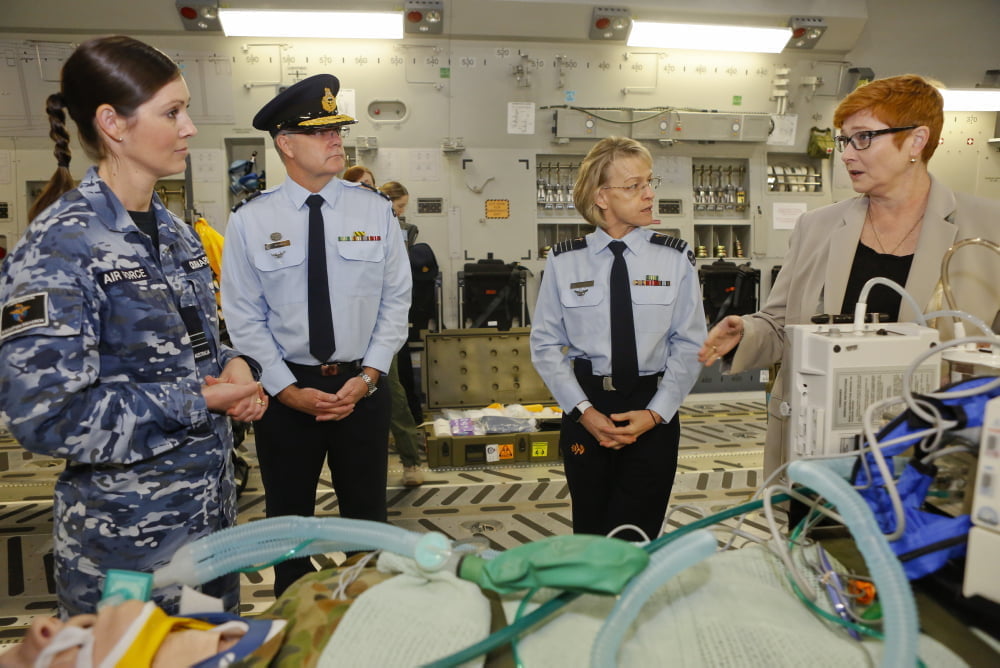
RAAF medical personnel conduct an Aeromedical Evacuation exercise on board a C-27J Spartan out of Andersen Air Force Base, Guam.
RAAF medical personnel conduct an Aeromedical Evacuation exercise on board a C-27J Spartan out of Andersen Air Force Base, Guam.
RAAF medical personnel conduct an Aeromedical Evacuation exercise on board a C-27J Spartan out of Andersen Air Force Base, Guam.
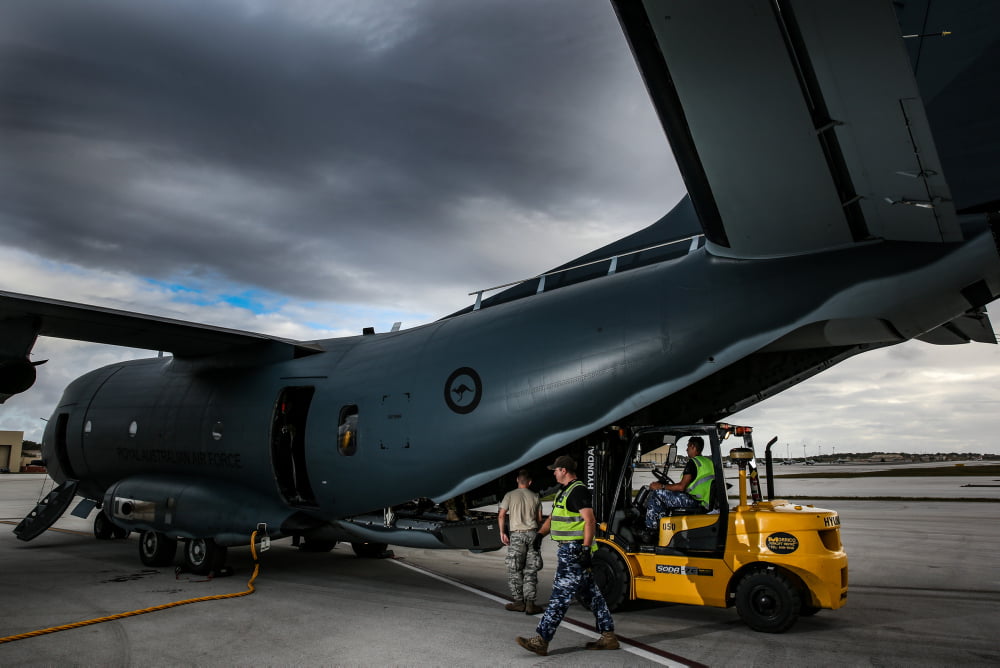
No. 35 Squadron C-27J Spartan is loaded by RAAF and USAF Air Load Teams prior to a mission at Andersen Air Force Base, Guam.
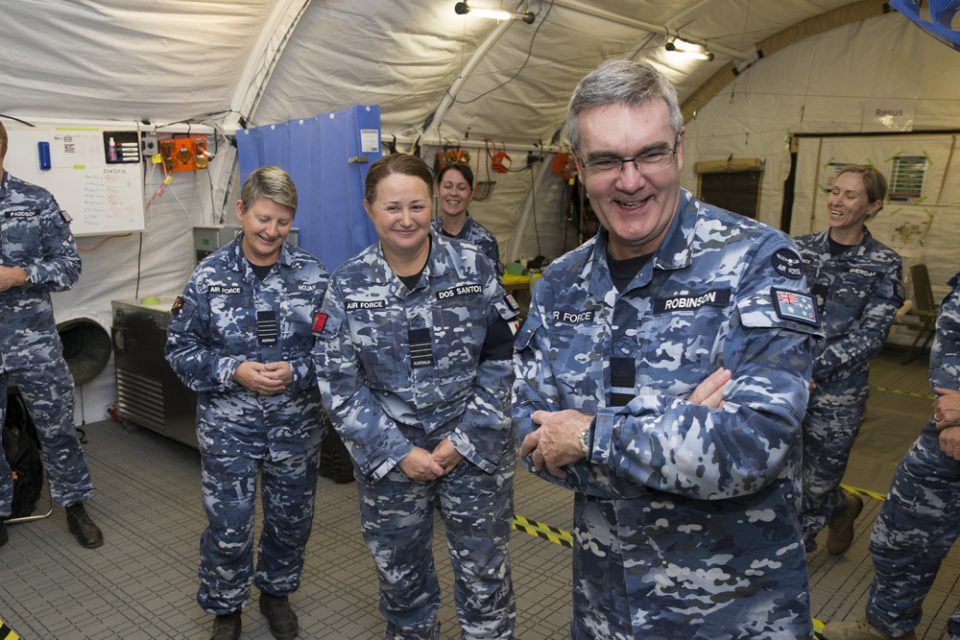
During our latest visit to Australia, we had a chance to talk with the Commander of the RAAF’s Combat Support Group, Air Commodore Ken Robinson at his office at RAAF Amberley. With a country of the size of the United States but only about 25 million people and a much smaller Air Force than does the United States, it is far to say that even operating domestically, the RAAF is an expeditionary air force.
This means that it has to work its own territorial support in ways that mesh effectively with support provided for out of area operations.
It means as well that effective logistical footprint and significant use of reserves is a key part of how Australia addresses air combat support. 25% of the RAAF’s rserve budget goes to CSG activities.
And given the engagement of allies coming to Australia to exercise with the ADF, consideration must be given to support for allies as well when they arrive and operate in the Australian continent.
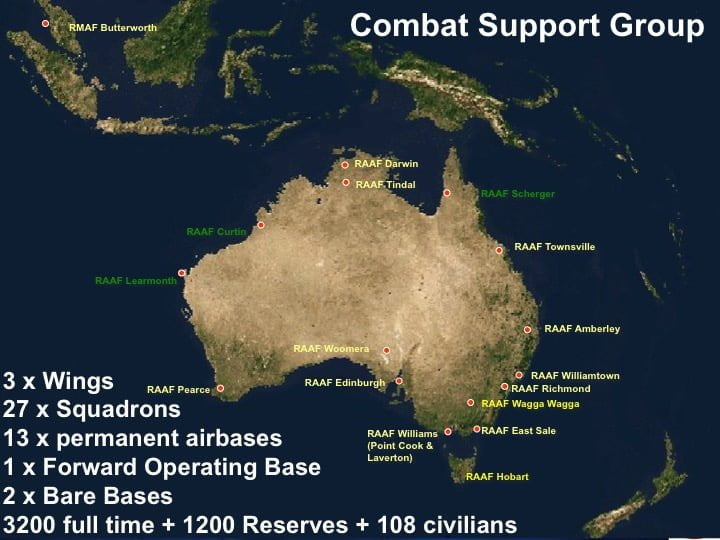
A sense of the scope of the challenge domestically can be seen in the graphic below which identifies the basic locations of the CSG correlated with the basing situation in Australia:
The demand side of growing threats in the region, and engagement in the Middle East, and elsewhere, has put significant pressure on resources.
And threats like North Korea and others in the region, are leading to considerations for mobile basing and ways to support movement of assets in times of crisis to maximize survivability while ensuring effectiveness.
This later point is somewhat a return to the past as the Aussies used mobile basing when facing the Japanese threat to Australia in World War II.
What mobile basing might mean in today’s world is a work in progress, but one which will need to deserve more attention going forward.
The basic structure of the CSG encompasses three wings with notably distinct yet complementary mission objectives.
The 96thWing focuses on fixed airbases. The National Support Base is comprised of 13 airbase squadrons and 15 aerodromes. And the baseline capabilities provided by this wing are: airbase C2, base support coordination, fuel storage and delivery, fire fighting and rescue, catering, cargo and pax handling, ground transport and ground equipment maintenance.
The 95thWing provides support for expeditionary airbases and is comprised of nine squadrons. The Wing provides key expeditionary capabilities: force generation, training and standards, tactual communications, force protection, airbase activation, airfield recovery, airfield activation, airfield recovery, airfield engineering, explosive ordinance disposal, deployable kitchens and online contingency response.
116049fade1.05.0
The Health Support Wing provides the support crucial to life support throughout the RAAF. The Wing has a number of capabilities, including various deployable capabilities, surgical teams, aeromedical evacuations, specialized health training and a key role for specialized reserves.
The personnel side of the Wings is a crucial part of providing effective support.
And here the Australian government has put in place a system to draw upon reserves whereby employers are incentivized to provide for flexibility for skilled personnel to serve.
There are both punitive and positive measures to ensure the flexibility of personnel being able to work in the civil sector but to serve in the RAAF as well. This is especially crucial with regard to the Health Support Wing that draws extensively upon Australia’s leading health practitioners in the civil sector.
The RAAF works closely with the USAF as well both in terms of cross learning with the USAF’s Contingency Response Groups as well as the USAF sorting through the growing demand for supporting mobile basing in the Pacific, in terms of flexibly moving away from an over-reliance on fixed basing in the region in times of crisis.
But as the Air Commodore pointed out, the two Contingency Response Groups in the USAF can focus full time on contingency response whereas the RAAF has to include that capability within the overall force.
We discussed at some length the challenge of rethinking mobile basing in times of crisis, which is a work in progress.
“We are having to reacquaint ourselves with some tasks and challenges which we parked to the side a bit while we were in the Middle East for so long.
“We did not have to worry so much about mobile basing to counter the principal threats in that theatre.
“The mindset is in transition now.”
This clearly is an Army and Air Force challenge.
“We are good at supporting maneuver with our tactical transport aircraft and Australia’s Army aviation capability, including the Tiger Reconnaissance Helicopter, but what we need to do is move to the next level of support to maneuver the most lethal part of our air power capability across a range of airfield options.”
Core capabilities such as providing fuel for air systems when operationalized for a mobile airbasing force on Australian territory are clearly different from supporting a fixed airbase.
For example, “expeditionary fuel capabilities is something that’s very much on the forefront of my mind. Lean and agile support packages to operate expeditionary airfields are also key, so that we can offer the best possible maneuver options to the aviators without tying down strategic airlift.”
The logistics side of enhanced support for Australian forces in Australia to deal with crisis contingencies is also a work in progress.
The Aussies rely on overseas support and training and that will continue in many ways, but there is a clear need to enhance domestic sustainability as well.
And that will encompass new ways to work with industry and to find ways to move personnel from the forces to industry and back again.
According to Air Commodore Robinson, the Air Force has introduced a type of service that allows for uniformed personnel to undertake industry placements.
This desire for closer engagement between Defense and industry is a work in progress, but clearly something, which the current Defense Minister is focused upon.
“When the Minister was visiting Amberley a couple of months ago, I was fortunate to brief her on how we are working closely with the local city council to set up a local defense industrial partnership between the base, the city council and defense industry.
“We can see the fit of such an initiative with government’s efforts to deepen the role of, and opportunities for, Australia’s Defense industry.”
Put simply and bluntly, “I have to make sure that our airbases in Australia can effectively function to satisfy an ever broadening range of operating concepts, whether from fixed or mobile airbases. And that will require both innovation and greater agility on the support side of the equation.”
It is clear that as the Russians and Chinese enhance their challenges to the liberal democracies, a key requirement for the liberal democracies will be an ability to mobilize under the threat of contested operations and to provide for resilient capabilities to defend the nation and ensure that the military forces can actually operate in times of crisis.
It does not appear that the liberal democracies are addressing this challenge with the seriousness and urgency that it deserves.
During the RAAF Airpower Conference 2018, Air Vice-Marshal (Retired) John Blackburn, a research fellow of the Williams Foundation, focused on a specific challenge facing Australia, namely energy security.
After his presentation, I had a chance to discuss Blackburn’s thinking and his sense of the approach necessary to shape a resilient energy structure for Australia.
In his view, energy security and national security are not separate domains but inextricably interconnected.
“There is an assumption that “business as usual” will provide for energy security in “peacetime.” However, this ignores the reality that we already operate in a contested space and “business as usual” is not what it was a decade ago. We are already in conflict with our competitors.
“Russia and China are reportedly doing a lot to infiltrate critical infrastructure systems. They’re effectively attacking western populations. We need to rethink our assumption that there is “business as usual” in “peacetime” and that when conflict breaks out we will address the issue of “business not as usual.”
He argued that there was a broad transformation of economies, of infrastructure technologies, of the evolution of supply chains, and climate change impacts, all of which are cross-cutting and creating a new strategic environment for defense and national security.
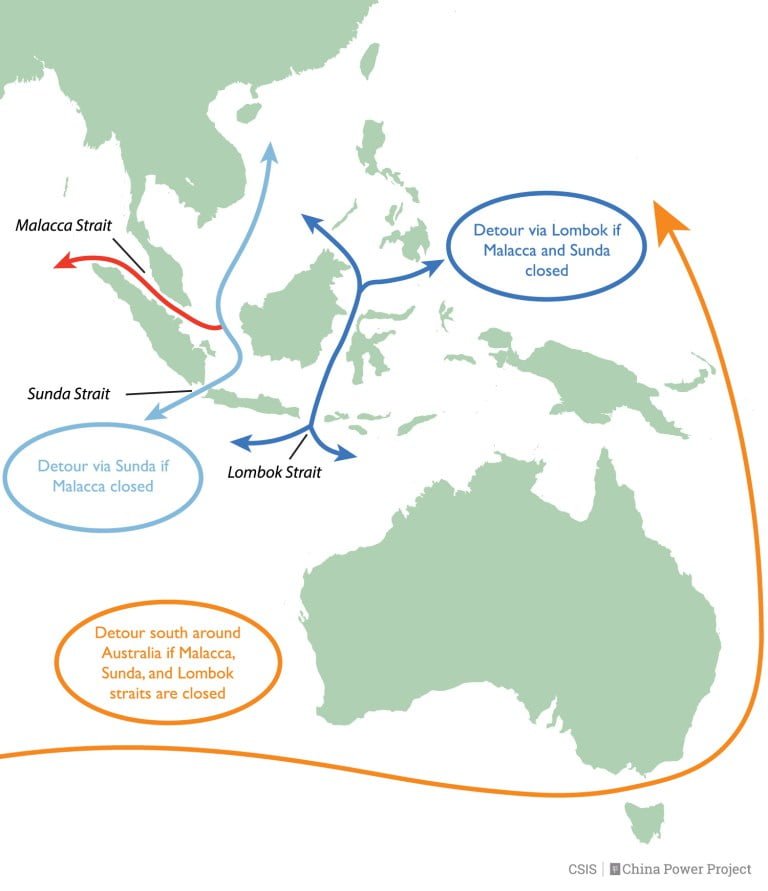
For Blackburn, the scenarios being treated by the Australian government with regard to disruption of energy systems are really rooted in the past. “What happens if we have a security problem in the South China Sea through which more than 50% of Australia’s refined fuel passes?” The extant National Energy Security Assessment published in 2011 does not address such issues.
Rather than taking a classic market view of energy supply, there needs to be a national security template which would assume disruptions can well be rooted in conflict among adversaries and provision needs to be made now with that in mind.
“The Australian based oil industry maintained that we shouldn’t be using conflict scenarios to look at our energy security. This makes no sense for the world in which we live as opposed to the world we might wish to live in.”
For example, several of the owners of energy generation and supply are nationalized companies outside of Australia delivering energy to Australia. A foreign government owned firm is certainly not interested in addressing Australian national security interest.
“Industry focuses on reliability of supplies which is not all the same thing as security of supply. This leaves our military forces and our broader national security very vulnerable.
“For example, some of the contracts to Defense, for delivery of fuel to our northern bases, our most important bases in terms of defense, were issued under a clause called “best endeavors only.”
“In effect it is a situation in which industry can say: “We’ll try and get you the fuel there but if it doesn’t happen, sorry.”
“That’s the sort of contract we had in place when I did my fuel supply security studies.
“When reliability of supply fails in a commercial operation, it is costly and inconvenient. When security of supply fails for a force in conflict, it is fatal.”
Blackburn discussed the Defense White Paper and highlighted that the assumption clearly is that the market will provide energy throughout the needs cycle for defense.
But he contrasted this optimistic assumption with the results of a recent review, which the International Energy Agency did of Australia’s energy policies.
“And it is a stark contrast to what the government’s 2015 Energy White Paper and in effect it condemns our energy security policies generally. In the absence of a realistic, security based, Energy Policy in Australia, it not a surprise that there’s also no Defense operational energy strategy or policy .”
The other thing the IEA has said is that we’re the only IEA country which is a net importer of oils that relies completely on commercial stock holdings to meet our obligations as an IEA member country, but we don’t mandate what the stock holdings should be.
As a result, Australia cannot meet its IEA member obligations; i.e. Australia is the only member country that doesn’t meet its stock holding obligations.
“The IEA Report also highlights that our oil stocks are at an all-time low. There are no strategic oil stocks and we don’t require the industry to maintain certain levels like the Europeans do. This raises the fundamental question of whether business as usual can meet core Australian security and defense needs.
“What’s business as usual?
“Is it “business as usual” today where there are cyber-attacks on our energy systems, parts of our supply chains are being nationalized and the supply chains are changing rapidly.
“Is that the same “business as usual” as we had 10 or 15 years ago?
“No it’s not.
“It’s fundamentally changed in the last five to eight years.
“And we need a policy which not only recognizes the new strategic reality but builds our energy capabilities to meet our core needs for a national security point of view.”
The real hook in the IEA report though was this statement, which said, “It’s less clear how the country (Australia) would respond in the event of a serious oil supply disruption leading to market failure.” In other words the IEA says, “We don’t know/ can’t see what you’ve got planned, in cases of serious market disruption.”
“I can give the IEA an answer. There’s nothing planned. There is no plan B in this market. If it doesn’t work … bad luck.”
The market is not designed for security.
“We’re unique amongst developed countries in the world in that we do not address security of supply. And yet we’re at the end of a very long supply chain.
“We have a 95% dependency on the maritime trade for our imports compared to the world average, which is 65%.”
He argued for the need for a system wide design in Australia to address the energy security issue in a comprehensive manner.
Something similar to what the RAAF has done with Plan Jericho is needed for an all of government approach to energy security.
“What could happen if we took the Plan Jericho design thinking on a system level from the military and applied it to all the separate energy components in this country?”
He noted that the pieces of the energy equation are spread throughout the government and throughout the country. “What could we do to integrate all of this to improve its resilience, its security, the economics of doing it, and give us more flexibility in the system?”
For Blackburn, as new energy technologies are introduced the country needs to take a systems view. As an example, Blackburn cited the case of hydrogen as an emerging energy component which could support the development a system approach.
“What I have read is the possibility of the excess power generated by new technologies such as solar and wind, being stored and transformed through a medium such as hydrogen.
“The stored hydrogen could be used to generate electricity through gas turbines, to produce ammonia, to supplement methane gas networks, to power transport utilizing hydrogen fuels cells or for emerging export markets such as to Japan.
“If you take this approach, you have the choice of time and product depending on what, when and where you need it. Use of new energy technologies under a systems design approach could provide key parts of a scalable, resilient, affordable and secure energy system for Australia.
“The market won’t come up with this design by itself; it needs Government leadership. Defense could play a key role in prompting the Government to shift to a system wide design approach to ensure redundancy and security of supply based on its recent experience in trying to address the design of the integrated force.
“I argue a fifth gen force needs a fifth gen energy system. Whilst Defense’s use of energy is evolving, it needs to transform along with the wider national energy system. We must have an energy strategy to fuel an energy policy.
“Without one, we’re just running around like headless chooks (Australian for chickens).”
Photo Credit: Crew members of China’s South Sea Fleet taking part in a drill in the Paracel Islands in the South China Sea in May. Source: STR / AFP – Getty Images