Building the Weapons Enterprise for 21st Century Operations

01/19/2011

01/19/2011 – In mid-October 2010, Second Line of Defense visited Eglin AFB and the Air Armaments Center.  During the visit, SLD sat down with Major General Davis who is finishing his tour at AAC and has been nominated for his third star and the command at the Electronic Systems Center at Hanscom AFB.

 

General Davis (Credit: SLD)


SLD: You’re finishing your tour at the AAC and what do you feel are the most important achievements during your time here, especially in supporting the warfighters in Iraq and Afghanistan?

Major General Davis: I came here with this perceived notion that we — the USA — had gotten behind in our weapons planning and development activities compared to our platform development. I guess in some ways this turned out to be true.  For the AORs we are fighting in today — for the operations the AF and coalition forces are conducting today — there is hardly a weapon being used today that hasn’t been significantly modified is some way.  In many cases the weapons we are using today are being employed in a very different scenario than they were originally designed for.

And the Air Armament Center team has been very good at adapting something that was believed to be the perfect solution five years ago, to the entirely new situation of today’s combat.  They’ve demonstrated an inherent flexibility, engineering-wise, test-wise, production-wise, to be able to take some of these weapons and give the folks that are in Afghanistan just what they need.

In at least in a couple of these cases — one in the Afghanistan AOR, one in another part of the world — we probably not could have anticipated how the weapons were going to be eventually use.  But we have other situations where I think if we had followed the right disciplined approach, we could have anticipated needing the weapon that we’re now working in a quick reaction mode to deliver ASAP.  We could have anticipated that this weapon was going to be needed now, or very close to now, if we had done things a little bit differently, five or six years ago.  This process must start with future target set playing a key role in leading the design process.  The process must not start with a set constraints defined by specific legacy platform dimensions.

(See an example of this development with the Small Diameter Bomb 1 Block 9.)

As we go forward on limited budgets our next challenge we will have to do a much better job of anticipating what the next need is going to be.  How we get limited funding for what the next weapon requirement will be—a requirement that probably is not part of today’s battle—will be a real big challenge in the very constrained budget future.

SLD: One way to look at it is that weapons that you’ve modified here for use in Iraq and Afghanistan are really a function of investments made 30, even 40 years ago in the weapons enterprise?  And I think folks tend to forget that you do have to make a significant investment for anything to last 30 or 40 years, that you can then leverage that investment.

So you’re making an investment, then you’re leveraging the investment, and so that’s an important characterization.  And then the other issue, it seems to me that you’re raising, is, can we be smarter in anticipating future needs as we lay down new baselines for new weapons?


Major General Davis: What we’re seeing is we’ve got to do a couple of things.  First of all, we absolutely have to realize that the weapons we’re going to build today have to anticipate tomorrow’s battles — in other words they will be used differently that originally designed and they must be flexible enough to adjust.  Today we’re building a weapon that is in essence a very small sensor and attack platform that’s got to go find its own target and in some cases, delineate the target from various confusers.  It’s got to be able to do its mission often without GPS and in all kinds of weather.  Tomorrow’s weapons must be flexible enough to be effective in a constantly changing threat environment.

The threats are getting very, very intelligent and so, what used to be considered an acceptable level of investment for weapons may not provide what we need in the future.  Yesterday’s weapon investment levels may not give us the capability to counter the threats that are growing out there today.

And this is the really challenging part the interesting part.  Some of the threats that we have to deal today — using very interesting and creative methods –are already appearing on operational threat systems today.  It is not just a future concern.  Five years from now, they’re going to be evolved even further into the next generation, particularly, in the air-to-air jamming systems.  We are already a little behind the timeline we need to track to be able counter some threats.

So it’s hard for most folks in this day and age to appreciate the level of investment that’s got to go into a new weapon program—because that weapon is now essentially a small airframe with a complete radar system, with a complete sensor system, a complete guidance system and a contains autonomous targeting capability.  It is no longer just a missile or just a bomb.  Our challenge, again, is meeting these needs with level or decreasing investment budget.

It’s interesting to see that when the Russians started building their new aircraft, touted as a 5th generation aircraft, they also started to develop the new weapons that would go with it at the same time.  We’re not quite there yet in our airframe/weapons development processes.  Our weapons are often have to play catch-up after the airframe gets built — in other words, the bay size, the dimensions you have to fit into, are fixed and this makes it difficult to optimize a weapons for a mission.


We have an opportunity to do better, as we look into what’s probably coming on the horizons out there in this thing called a “family” of long range strike systems.  We have an opportunity to drive synergy from the start – and really, if you did this the right way, instead of defining your platforms and what platforms you need, you go figure out what your target set is that would help define what the effect you need really is and could quite possibly help define the size and shape of the platform.

That would help define what the weapon you needed is.  That would help define what the platform size needed to be and what the platform characteristics would be. So as I mention the process must start with target set and work its way to the platform bay design.  This is hard concept for most of us engineer and pilot types to accept.

If we can shape that process now, as we’re getting into new systems like the next gen platform, or the next generation bomber — if we can do this a little bit more effectively then maybe, maybe sometime in the future, senior leadership won’t have to ask, “How come we couldn’t anticipated this five or ten years ago?”

SLD: Let me ask you a final question.  As we were about to build the F-35, and we have the F-22 in small, but significant numbers, where are the weapons for these platforms?  The F-35 is really a 360-degree operational airplane and we really haven’t built the weapons yet for the 35 or the 22.  In fact, one way to understand the F-35 is that it is the first airplane able to operate in 360 space and to manage that space with its integrated combat weapons enterprise.  We clearly need to shape weapons strategy with this in mind.


Isn’t there an opportunity to build a weapon’s enterprise that could be highly synergistic with this stealth platform that could allow one to also think about, to use your phrase, the other assets that you might add?  The remotely piloted aircraft and even support from surface ships and working with the long range strike platform.  Isn’t that an opportunity to, as one builds towards the new aircraft, think beyond that to kind of a modular approach to get an effective outcome?

Major General Davis: I think there’s a lot of opportunity now because as I mentioned — in the past we’ve had to build weapons to match the hard confines of existing aircraft weapons bays.  We are doing that today with the F-22 and the F-35.  Or there are other cases where we built the aircraft around existing operational weapons.  The F-35 was built around weapons like the JDAM and AMRAAM.

In the future I believe, the networks and interactions between an airplanes, or manned aircraft and UAVs, or aircraft/UAVs and ships on the sea will determine what weapons you are going to use and how they will be controlled. The weapons could be launched from a wide variety of airplanes and controlled through a variety of different nodes along the way –this will be a major factor in the kill chain of the future.
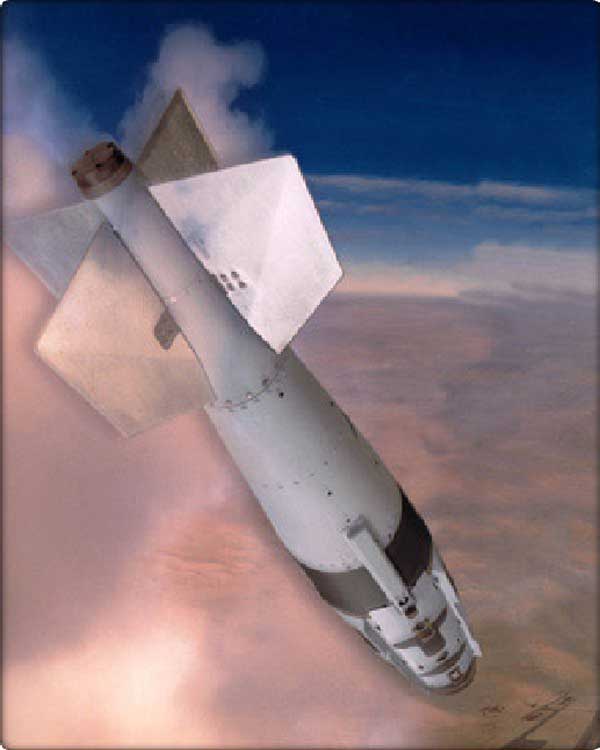
(Credit: http://www.boeing.com/defense-space/missiles/jdam/index.htm)Credit: http://www.boeing.com

We’re already started on what would be considered the next generation of weapons for both the F-22 and the F-35, and the only thing that we’re really constrained with right now is still weapon’s bay size but not much else.

The next gen bomber may be a different story, if we do the planning and requirements process correct, the bay will not be a limitation.  This will allow us to really see what is the next limiting component of the kill-chain technology.

So we will deal with the fifth gen platforms, the F-22’s, the F-35’s, and we’ll figure out how to shape the weapons enterprise.  We will shape an interactive system to make the weapon highly effective from the time it either gets information from the F-35, or the F-22, or is put in the battle space and picked up and controlled by another node in the grid — that node could be a Global Hawk, F-35, F-22, a regional Air Operations Center, or another platform acting as a picket battlefield airborne control.

There’s an unlimited set of options of how we will manage and employ the entire kill.  How we throw the weapon out of that bay is still somewhat constrained, but for the period from the time from launch to target destruction is still basically limited only by a clean sheet of paper.
 

Shaping Adaptive Innovation for the Warfighter

The Air Armament Center Functions as the Linchpin

An Interview with Randy Brown, Norma Taylor, and Wally Messmore

01/19/2011 – The Air Armament Center at Eglin AFB designs weapons for the U.S. and allied warfighters.  We earlier described a key effort to modify the Small Diameter Bomb to provide a weapon for the warfighter in Afghanistan.  The AAC has engaged in innovation not only in terms of technology, but in terms of delivering capability to the warfighter during the Iraq and Afghan operations.  A core need is for weapons with lower collateral damage both to allow weapons to be used closer to the operations of the warfighter and to reduce the threats to civilians.

During a visit to Eglin AFB in October, discussions were conducted regarding these efforts.  In a follow up interview, Second Line of Defense discussed with key officials in the center how they are accomplishing this core mission for the warfighter.

The two weapons under discussion are the Precision Lethality MK82 (BLU 129/B) and the SDB Focused Lethality Munition (FLM).  In White Papers accompanying this interview, the nature of these programs is presented in greater length.  For now, the core point is simply that the center has been working with the labs and the warfighters to shape a close proximity weapon with lower collateral damage.

The interview was conducted with Randy Brown, Director, Armament Directorate, Eglin AFB, Norma Taylor, Program Manager of the MK 82 Quick Reaction Capability (QRC), and with Wally Messmore, Program Manager assigned to the Air Armament Center Program Execution Group who worked on the FLM.


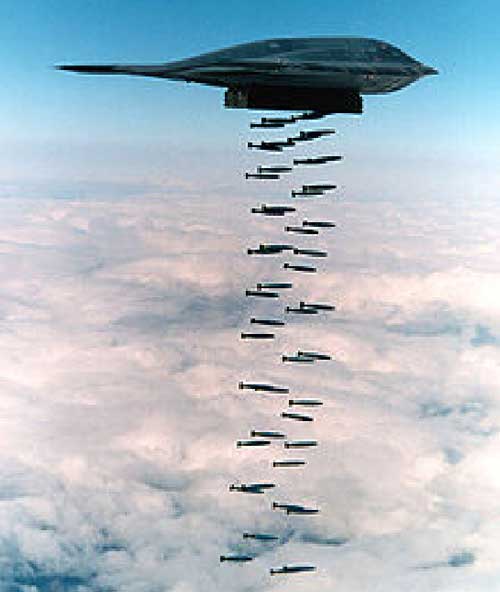
A B-2 Spirit dropping Mk 82 bombs into the Pacific Ocean in a 1994 training exercise off Point Mugu, California. (Credit: http://en.wikipedia.org/wiki/Mark_82_bomb)A B-2 Spirit dropping Mk 82 bombs into the Pacific Ocean
 in a 1994 training exercise off Point Mugu, California.
Credit: http://en.wikipedia.org


SLD: I think what the commonality for the two programs is that both of these were programs to develop close proximity weapons for the use of our forces in Afghanistan, and that you are working to give the forces a useable lower collateral damage weapon to be deployed on existing weapons. In both cases, we’re talking about a warhead modification.  Is that correct?

Randy Brown: That’s right.  We’re building a composite case warhead versus a steel warhead.  In the case of the Mark 82 there is different explosive fill in there as well, but they’re very similar between the two so the technologies really are very similar between FLM and on what Taylor’s doing.  It’s a little bit bigger warhead. BLU 129 is the nomenclature of the QRC warhead.

Norma Taylor: The BLU 129 is a form fit replacement for the standard MK 82 500-pound category warhead.  So in terms of weight and dimensions of the warhead, BLU 129 is equivalent to the MK 82.

SLD: How does the composite casing as opposed to steel affect the ability to deliver low collateral damage, and what’s the advantage there?

Randy Taylor: With our classic steel warheads today, a majority of the lethality and collateral damage effects are due to the fragmentation of the steel warhead.  With the composite warhead case, instead of producing those lethal fragments, it basically turns into composite dust, so to speak.

SLD: So the point really is that with the steel casing, you get fragmentation from the explosion itself, whereas the composite casing turns into dust, so you’re reducing significantly the fragmentation generated by the blast.  Is that the basic point?

Norma Taylor: That’s correct.  It’s a slightly different variant of the standard MK 82 explosive fill partly to help out with creating a warhead with similar weight to that of the standard MK82.  Since the composite cases are so light, we need to bring the weight of the warhead up to that of the MK 82 so that the JDAM and Paveway guidance kits can carry it with no problem. So, the fill is slightly remixed from that aspect of the consideration on lethality.

SLD: So you’re taking the tested JDAM, the tried and true JDAM, so to speak, which has a flight envelope with a certain weight on the warhead and you’re trying to replicate that weight so that you don’t have to do a lot of testing on flight deviation due to a different weight on the warhead.

Norma Taylor: Exactly

SLD: But that would be a crucial part of your ability to deliver the warhead in a very timely fashion.

Norma Taylor: That’s correct.


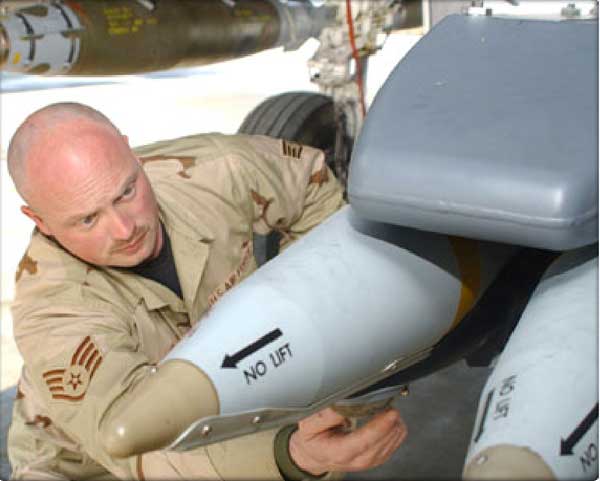
Loading Small Diameter Bomb (Credit: http://www.boeing.com/defense-space/missiles/sdb/index.html)


SLD: Could you talk a little bit first to the FLM process of going from the requirement to actually delivering the capability to meet that requirement in a fairly short period of a time?

Wally Messmore: We’ll start it back in the 2005 timeframe when the Air Force Research Lab was conducting research on this particular capability.  The labs were running a research and development program for the composite case and explosive fill technologies.  They got to a certain point of maturity that the war fighter elevated their interest in it, thus a requirement came out of United States Central Command Air Forces (CENTAF), now known as United States Air Forces Central (AFCENT).  So, in 2006 a requirement was then generated for the FLM weapon, and the acquisition approach chosen was to use a Joint Capability Technology Demonstration (JCTD).  This approach allowed us the kind of flexibility that you would need to fine tune the development and field a new weapon relatively quickly.

SLD: So the requirement was shaped by the availability of your technology demonstrated by the lab, that Central Forces Command saw the utility of that technology and then it was turned over to you to figure out how to develop this in a timely manner?

Wally Messmore: That is correct.

SLD: I presume that in this process you had to have a fairly open communication approach to determine best paths actually to deliver this capability in a fairly short period of time. How did you address that issue in terms of making sure that the industry and yourselves and the lab work on the same page in a very short period of time?

Wally Messmore: The requirement was expressed in a fashion that drove both lethality and the collateral damage requirements to fit into a 250-pound class weapon at the time, so the natural selection was a small diameter bomb. We worked with AFRL, with Boeing, who is the SDB I manufacturer, and with U.S. Central Command (CENTCOM), who ended up sponsoring the JCTD.


SLD: So at that point, several months had passed and now you’ve got the requirement pretty well established in terms of what CENTCOM wants and what the labs think is feasible to do, so that you got a feasible requirement so to speak. Now your task is to drive the feasible requirement into an actual reality of the bomb. Is that a fair way to characterize this process?

Wally Messmore: That is correct. However, there are some nuances that go along with a JCTD, which are slightly different than a standard program of record in that it’s a capability demonstration. For example, the requirements aren’t necessarily as firm as a traditional program.

SLD: So you have some flexibility in the JCTD to shape what the realistic requirements are?

Wally Messmore: Correct.

SLD: So essentially rather than establishing a set of tight requirements at the outset of what essentially is an experiment, the prototyping, you’ve got some real flexibility in terms of execution.  The key to do doing this in a short period of time is that you have flexibility in shaping how to achieve the outcome.  Isn’t that the point?  They’re giving you more flexibility to essentially shape the execution of the program.

Wally Messmore: That is correct.

SLD: That makes a lot of sense.  Well then let’s talk about the process for what is an open project, what is still the MK82. Is this a similar kind of process where you’re doing JCTD or how is this being approached to get a timely resolution of developing the weapon?

Norma Taylor: Yes sir, it’s a different process, but we are leveraging off the technology lessons learned from FLM.  For the Precision Lethality MK 82, again, the need came from a U.S. CENTCOM requirement that was validated in late January of this year.  The Air Force and Navy spent a couple months looking at their options to support the need for a 500-pound category low collateral weapon that could be easily integrated across the board on a variety of Air Force and Navy Aircraftraft and in March determined that basically the big brother to FLM was the appropriate option to pursue.

One of the differences is, as Messmore indicated, FLM used a technology demonstration program.  With the MK 82 variant, we went straight into a program of record with firm requirements that we really worked hard with the users to make sure that we were focused on the most critical requirements to them, and that helped set our threshold and helped set us in our design and our test program to be able to get out in the field very quickly.

So we have an acquisition category III quick reaction capability program, and again, it’s a very open communication where we’re constantly working with CENTCOM, with Air Combat Command, with the Navy and Marine Corps to understand how they employ weapons, and determine how we can meet those needs and get that done very quickly.

SLD: So going back to a statement you made shortly at the beginning of this conversation, the ability to talk to the users in the theater, in the area of operations, has been a critical capability for you to shape the most desirable outcome in the most repid fashion possible.  So that dialogue is really crucial for the process to work?

Norma Taylor: Absolutely correct.  We’ve teamed with the National Laboratories, in this case Lawrence Livermore National Labs.  They are the warhead designer and they’re the government agent for the warhead design from that aspect, and so they basically took the warfighter inputs and their technology from the earlier work and then applied it to the 500-pound variant.  From there we went to industry for support for manufacturing of the composite warhead cases.  The Aerojet Corporation was selected to support the case manufacturing for this very limited QRC activity.

SLD: When you refer to Livermore’s earlier work, you mean with FLM?

Norma Taylor: It’s both the earlier work with AFRL and the FLM activity.  Livermore was involved, as with AFRL in all those activities.


Lawrence Livermore National Lab (Credit: http://www.lasg.org/sites/llnl.htm)Lawrence Livermore National Lab
Credit: http://www.lasg.org

SLD: So this has allowed you at Eglin to be a center of excellence for migrating capabilities to lower collateral damaged bombs. You’re a low collateral damage bomb enterprise of excellence by following these processes, which have highlighted the ability to talk to the war fighter in the AOR, which has been a key driver for how to do define what you will then develop.

Norma Taylor: I think it’s two aspects. It’s a close relationship with the war fighter and it’s a close relationship with the technology developers in the laboratory and Lawrence Livermore.

SLD: So you’re kind of the linchpin between those two?

Norma Taylor: Correct.

Randy Brown: What Norma Taylor is demonstrating now is that they developed a very good and beneficial working relationship with Livermore, Industry, AFRL, and in the acquisition community to get a product out of the lab, onto the production floor and into the hands of the customer in the shortest amount of time, and that we’re acting as the integrator on this effort.

We’re taking off-the-shelf components and we’re integrating this technology into a capability.  But the unique thing here I think, which is different than what’s been done in the past, is we are in the middle of this.  We’re bringing it all together.  And in the end, it’s Taylor and her team that will deliver that full-up weapon system capability to the war fighter.


***

ANNEXES

The following white papers were provided to enhance understanding of the two programs by the AAC.


ANNEXE I
Evolution of Small Diameter Bomb I (SDB I) Focused Lethality Munition (FLM)

25 October 2010

The Focused Lethality Munition (FLM) is an ultra low collateral damage variant of the Small Diameter Bomb I (SDB I) weapon.  FLM exploits a composite warhead case and multiphase blast explosive fill developed and matured by the Air Force Research Laboratory Munitions Directorate during an 11-month period.  FLM’s warhead creates a more lethal near-field blast and eliminates the metal fragments from traditional warheads.  Additionally, with the exception of the warhead, FLM’s design utilized all existing SDB I common components, software, and aircraft interfaces which greatly enhanced the accelerated acquisition schedule of the FLM system.

In April 2006 US Central Command, based on US Central Air Force’s identification of an urgent operational need for a low collateral damage weapon, sponsored an out-of-cycle Office of the Secretary of Defense (OSD) Joint Capabilities Technology Demonstration (JCTD) to determine the military utility of FLM.  In August 2006, the SDB I Branch under the Armament Directorate at Eglin AFB, FL and Boeing entered into a contract arrangement for the integration and test of the FLM warhead into the SDB I Weapon System.

The JCTD acquisition strategy for FLM included a concurrent AFRL technology maturation as the SDB I Branch executed the FLM acquisition contract.  The SDB I Branch’s contract with Boeing had a segregated “off-ramp” to mitigate government risk if the new developed technologies did not prove viable.  The team jointly established detailed technology readiness “entrance criteria” for FLM maturity testing and performance assessments that had to be demonstrated prior to entering a formal Technology Readiness Review and transition of the technologies from AFRL to the FLM system.  The AFRL technologies proved successful and transitioned to the SDB I Branch and the FLM weapon system in March 2007.

Extensive testing occurred during the AFRL and SDB I Branch development effort including arena tests to characterize the warhead, penetration tests, design verification testing, static live fire tests against simulated targets, guided test vehicle flights to evaluate weapon accuracy, and live FLM flight testing to validate FLM’s weapon effectiveness.  The first 50 FLM weapons were delivered to the Air Force in March 2008, approximately two months ahead of schedule.  FLM met and/or exceeded all requirements established by CENTCOM.  The FLM program has transitioned to production and has delivered several lots of additional weapons.

The major players in the development of the Focused Lethality Munition JCTD were the OSD Office of Advanced Systems and Concepts, the AFRL Munitions Directorate, the SDB I Branch, The Boeing Company, Lawrence Livermore National Laboratory, Aerojet, and CENTCOM.  Open communication during weekly teleconferences with all key teammates and monthly reviews co-chaired by AFRL and the Miniature Munition Division leadership were critical to program success.


ANNEXE II
Evolution of Precision Lethality MK82 (BLU 129/B)

25 October 2010

The Precision Lethality MK82 (officially designated the BLU-129/B) is a Quick Reaction Capability (QRC) program directed to develop and field a very low collateral damage 500 pound class warhead.  BLU 129/B exploits both a composite warhead case and multiphase blast explosive (MBX) fill developed and matured by the Air Force Research Laboratory Munitions Directorate and Lawrence Livermore National Laboratory (LLNL).  Once completely developed, the BLU 129/B warhead will create a more lethal near-field blast and drastically reduce the quantity of metal fragments as compared to traditional warheads.  The BLU 129/B warhead matches the outer mold line and mass properties (with the exception of roll inertia) of a traditional MK82 warhead and, therefore, minimizes the effort required to integrate the munition with existing weapons systems.

In January 2010, the Joint Chiefs of Staff validated a Joint Urgent Operation Need (JUON) for a very low collateral damage weapon capable of immediate integration on aircraft currently certified to employ the MK82 series warheads.  In March 2010, the Office of the Secretary of Defense’s (OSD) Joint Rapid Acquisition Cell (JRAC) directed the Air Force, in collaboration with the Dept of Navy, to “rapidly develop, test and field the PL MK82, consistent with the urgency of the operational need, and the safety and risk inherent in weapons development.”   In August 2010, Air Combat Command (ACC) further identified the program requirements to include, as a threshold, compatibility with both the Joint Direct Attack Munition (JDAM) and Laser JDAM (LJDAM).  Additionally, ACC identified the F-15E, F-16 and A-10 as the threshold aircraft platforms and the need for 50 warheads to satisfy an Initial Operational Capability (IOC).

In May 2010, the Air Force Research Laboratory’s (AFRL) Munitions Directorate initiated a five month risk reduction program to mature the composite warhead case and MBX fill technologies to a readiness level sufficient to begin a rapid system development, test and fielding program.  AFRL completed the risk reduction program in October 2010 after developing the initial warhead design and demonstrating its performance characteristics by conducting two full scale blast arena tests and a target penetration test.

In August 2010, the Air Armament Center’s (AAC) Armament Directorate initiated a QRC program to finalize the warhead design, conduct design verification, system safety, aircraft integration and warhead performance testing (to include lethality arena and penetration tests), and field 50 warheads by the end of March 2011.  For an acquisition strategy, AAC entered an agreement with LLNL to finalize the warhead design and conduct design verification testing.  AAC selected the Aerojet Corporation to manufacture the initial warheads for aircraft integration, system safety and warhead performance testing.

Currently, the program is on track to complete all warhead design and fabrication activities along with the required development and operational tests to support both the delivery of the first 50 warheads as well as a favorable fielding recommendation by March 2011.

America and Huawei

Americans Grow Skittish In Business Dealings With China’s Big Telecom Equipment Company Huawei

By Vince Wade

From Manufacturing News (November 30, 2010, Volume 17, No. 19)

Report to Congress


01/19/2011 – When Sprint recently decided to scrap plans to buy next-generation cellular network technology from China’s Huawei and ZTE — two major players in the global telecommunications business — it did so primarily because the agreement was strongly opposed by the Pentagon. The Chinese companies were the lowest bidders in the multi-billion dollar deal. It didn’t matter.

The Department of Defense had help in its campaign to stop the deal from the United States-China Economic and Security Commission (USCC), a bi-partisan congressional advisory panel on the security implications of trade with China.

The USCC recently released its annual report, which says China’s rise as a major telecommunications player raises new concerns and risks for U.S. national security.

Ever since Huawei tried to buy the computer networking company 3Com, the Chinese telecom has been on the U.S. national security radar screen. Huawei, ZTE and Datang, another Chinese telecommunications manufacturer, have been cited for close ties between the Chinese military and that nation’s major business enterprises in the last three annual DOD reports to Congress on the state of China’s military.

Two USCC commissioners co-authored an op-ed piece in October in the  Wall Street Journal that was highly critical of Sprint’s plan to buy telecom gear from Huawei, the world’s second largest telecommunications equipment provider.

Michael Wessel and Larry Wortzel noted Ren Zhengfei the founder and president of Huawei is a retired general and former director of the Chinese People’s Liberation Army (PLA) military telecommunications research arm. That, they said, makes the Sprint-Huawei deal “very different” from other multinational business agreements.

Political opposition bubbled up from three U.S. senators and a representative demanding answers in view of Huawei’s enduring reputation as an espionage front for the PLA. Huawei has denied the accusation, to no avail.

The lawmakers signaled political trouble for the Sprint-Huawei deal with a publicly-released letter to the FCC asking for the agency’s “plans for ensuring the security of our nation’s telecommunications networks” in light of the deal, which also involved the purchase of equipment from ZTE, another suspected Chinese espionage front.

Senators John Kyl of Arizona, Susan Collins of Maine and Representative Sue Myrick of North Carolina, the signatories to the inquiry, are all Republicans. They were joined by Senator Joe Lieberman, an independent.

Huawei hoped to provide equipment for the fourth-generation (4G) nationwide cellular and wireless network. U.S. officials feared the Huawei equipment might be embedded with secret eavesdropping technology that would enable Chinese intelligence agencies to use U.S. cell phone and microwave towers as listening posts. Huawei was gearing up for a high-powered lobbying campaign when Sprint pulled the plug.

There are good reasons to suspect Huawei might pose a threat to U.S. national security. Company founder Ren Zhengfe distinguished himself as a technologist at a PLA telecommunications research institute. The company he founded in 1988 after he left the military had humble beginnings, but when Chinese policymakers decided telecommunications would be a national strategic priority, torrents of money suddenly flowed to Ren’s little enterprise. Ren recognized opportunity when he saw it and the PLA benefited significantly as Huawei grew stronger. Today it’s the world’s second-largest telecommunications company. Sweden’s Ericsson ranks first.

Huawei, based in Shenzhen, China, regularly and routinely denies espionage ties to the People’s Liberation Army, but its track record doesn’t help allay concerns.

In 2001, during the “no-fly zone” sanctions against Iraq, Huawei sold fiber optic equipment to Saddam Hussein to help strengthen command and control capabilities for Iraqi air defenses. That same year India’s intelligence service charged 185 Huawei technicians in Bangalore with providing telecom surveillance equipment to the Taliban in Afghanistan.

More recently, Huawei has been a key provider of advanced telecommunications in Iran, including military networking equipment for that country’s Revolutionary Guard. In 2009, Huawei set up a “unified” research lab with the Sharif University of Technology in Teheran. A press release from China’s embassy in Iran states: “Huawei will also provide training opportunities for universities and operators both in China and Iran.”

A 2003 weapons proliferation report by the Canadian Security and Intelligence Service cites Huawei as an example of a dual-use (commercial and military) technology vendor. The Canadian intelligence paper states: “A further level of complexity in their proliferation activity is that foreign firms seeking to do business with them may try to shield them from U.S. sanctions.”

Indeed, Sprint is not unique in its willingness to consider a business deal with a suspected Chinese espionage front company. Profits-before-patriotism is a chronic problem for U.S. national security watchdogs. When Huawei was providing technology for Iraq’s air defenses, the spotlight spilled over on Motorola.

Gary Milhollin, director of the Wisconsin Project on Nuclear Arms Control, testified in 2001 that while Huawei was beefing up Saddam Hussein’s air defenses, “Motorola had an export license application pending for permission to teach Huawei how to build high-speed switching and routing equipment — ideal for an air defense network.” Ironically, Motorola is now suing Huawei for intellectual property theft. In 2003, Cisco Systems sued Huawei for stealing computer code for the design of routers and switches. The suit was dropped when Huawei redesigned its equipment that bore a striking resemblance to the Cisco Systems gear.

The Clinton administration allowed Huawei to buy high-performance computers from IBM, Digital Equipment Corporation, Hewlett-Packard and Sun Microsystems.

Examples of U.S.-based companies seeking to cash in on the Huawei telecom juggernaut during the Bush administration include:

  • Lucent Technologies (now Alcatel-Lucent), which set up a joint research lab with Huawei;
  • AT&T which signed deals to “optimize” Huawei’s telecom gear;
  • IBM, which has a long-standing partnership with the Chinese company. IBM and Huawei even partnered in 2007 on something they call the Integrated Financial Services (IFS) program aimed at funding industrial globalization.

Washington’s concern over potential Huawei security compromises can be particularly puzzling after looking at the partnership Huawei has with Symantec, the Internet security firm that makes the Norton line of anti-virus products.

The Huawei-Symantec product line includes security “solutions” for video surveillance, documents, virtual private networks, and protection against DDoS (distributed denial of service) hacker attacks. An online brochure from Huawei-Symantec notes the joint venture on Internet security technology has R&D Centers in Beijing, Shenzhen, Chengdu and Hangzhou in China, and in Silicon Valley in California. Huawei and other Chinese telecom companies suspected of ties to military intelligence are so busy cross-pollinating technology in the globalization free-for-all that it’s easy to see why many global telecom high rollers argue, in effect, that resistance is futile.

Pakistan and the Afghan End Game

Almost half of the supplies to the 140
Dr. Richard Weitz (Credit: The Hudson Institute)

By Dr. Richard Weitz

12/22/2011 – Following the November 26 incident, the Pakistani government convened an emergency session of the Defence Committee of the Cabinet (DCC), Pakistan’s highest forum for defense policy consultation and coordination. The DCC decided to retaliate for the attack by closing Pakistan’s two Afghan border crossings at Chaman and Torkham to NATO’s supply convoys.

Pakistan also gave U.S. personnel 15 days to vacate an air base in Baluchistan used to assist drone attacks against insurgents and terrorists in northwest Pakistan. The Pakistani authorities also suspended certain joint activities, withdrew Pakistani liaison officers from the border coordination centers and NATO headquarters in Kabul, boycotted the December 5 Bonn conference, reinforced their Afghan border defenses, and launched a comprehensive review of Pakistan’s security cooperation with NATO and the United States.

Despite pleas from Afghanistan and other foreign governments, Pakistan boycotted the December 5 Bonn conference that was convened to secure diplomatic and economic support for the Kabul government as NATO withdraws its troops from Afghanistan in coming years. More than 50 countries sent representatives to the meeting, designed to underscore the international commitment to Afghanistan’s security and to reassure potential foreign investors. But Pakistan’s absence deprived the conference of most of its impact.

As the DCC demanded, all U.S. personnel left Shamsi Air Base in western Pakistan by December 11. The expulsion from Shamsi was neither unexpected nor a major loss.

Almost half of the supplies to the 140,000 members of the ISAF still pass through Pakistan. (Credit: Bigstock)

The CIA had earlier used its small airstrip in southwestern Pakistan extensively to launch drone attacks in northwest Pakistan, but the deteriorating relations between the United States and Pakistan led the United States to relocate its main drone bases to Afghanistan earlier this year. Pakistani officials had asked the United States to vacate the base on several previous occasions, but relented under pressure from Washington and the United Arab Emirates, which formally owns the base but has allowed the United States to use it.

For the past year, the United States has used the Shamsi base only as an emergency-landing zone for drone attacks cancelled due to weather, mechanical difficulties, or other problems.

The number of U.S. personnel based there had fallen to under a dozen by late November 2011. Gen. Martin E. Dempsey, the chairman of the Joint Chiefs of Staff, subsequently said that the United States has other options for “stationing aircraft and other resources around the region.” Asked about its impact, Dempsey explained that, “It’s a serious blow in the sense that the Pakistani government felt that they needed to deny us the use of a base that we’ve been using for many years” but he added that, “It’s not debilitating militarily.”

In fact, the drone strikes have been so successful in the past few years that most of the key al-Qaeda leadership targets in northwest Pakistan has been eliminated. Al-Qaeda leaders Ayman al-Zawahiri and his second in command, Abu Yahya al-Libi, are the last remaining high-value targets in the region.

Most importantly, there is no evidence that the Pakistani authorities have banned the use of the Predator surveillance and strike operations over their territory or stopped providing targeting data and other counterterrorist intelligence to the United States. The government has never ordered the Pakistani Air Force to shoot down the drones, which it could easily do.

Pakistan has benefited from the strikes against the militants because some of them wage terrorism against the Islamabad government. The Pakistani army claims it lacks the capacity to occupy and fight the insurgents and terrorists in some of the more remote tribal regions such as South Waziristan.

More worrisome is the fact that the Pakistani military has adopted less restrained rules of engagement in the Afghan-Pakistan border region.

In a command communiqué issued on December 2, Pakistani Army Chief Gen. Ashfaq Parvez Kayani authorized Pakistani forces to return fire in self-defense against any future acts of NATO “aggression” without requiring their superior’s approval. “I do not want there to be any doubt in the minds of any commander at any level about the rules of engagement,” Kayani said in the communique. “In case of any attack, you have complete liberty to respond forcefully using all available resources.”

The recent order is but the latest of several that have relaxed the rules of engagement in the border area.

After the earlier September 3, 2008 cross-border incident, the Pakistani army announced it would shoot any U.S. forces attempting to cross the Afghan-Pakistan frontier. On several occasions since then, Pakistani troops and militia have fired at what they believed to be U.S. helicopters flying from Afghanistan to deploy Special Forces on their territory, though there is no conclusive evidence that the United States have ever attempted another raid after the September 3 incident.

These Pakistani response measures may aim to strengthen the troops’ morale and reduce discontent with Kayani’s leadership, but they could lead to reciprocal escalation between NATO and Pakistani forces that stumble into an accidental firefight. In a concurrent move, the Pakistani military announced that it was strengthening its air defenses along the Afghan border. Capt. John Kirby, a Pentagon spokesman, acknowledged Kayani’s authority to reaffirm Pakistanis “right of self-defense,” Kirby added that, “We certainly respect that right of his. We have it as well.”

In addition to the risk of reciprocal escalation, another problem with Pakistan’s deploying more air defenses in border areas is that the weapons could fall into the hands of insurgents and terrorists there. They could then use these arms, or transfer them to terrorists who would use them, to shoot down civilian airliners as well as Western military aircraft.

For now, the Pakistani government has chosen not to terminate NATO’s use of Pakistani territory to send food, fuel, and equipment by ground transport to their ISAF contingents in Afghanistan. They have also refrained from closing the Pentagon’s use of a Pakistani airspace to convey some critical combat supplies, including ammunition, directly to air bases in Afghanistan. Shortages in transport planes and the high expense of air shipments preclude a major expansion of this airlift, but it is the main mechanism for delivering weapons and ammunition to the NATO forces in Afghanistan. U.S. Navy carrier aircraft also routinely fly over Pakistani airspace, through designated corridors, to strike targets in Afghanistan.

Instead of curtailing these essential logistical activities, Pakistani authorities have suspended the shipment of NATO supplies by ground transport to Afghanistan. On past occasions, the Pakistani authorities have temporarily closed only one of the two major crossing points into Afghanistan to NATO supplies. These earlier stoppages have lasted at most ten days and did not appreciably affect coalition operations. Last year, the Pakistani authorities closed only the Torkham crossing in the northwest Khyber tribal area. This time, they have closed both crossings, including the one at Chaman in southwestern Baluchistan province. Pakistan officials are also considering revising the terms of their transit trade agreement with Afghanistan, claiming that Afghan contractors were exploiting the agreement to move NATO supplies through Pakistani territory.

The present closure may also be designed to prevent the looting and burning of the trucks carrying NATO supplies that happened during the last blockade. Some of the arson was due to insurance fraud, but other burnings, which injured Pakistani drivers and security forces, were committed by extremists seeking to punish NATO. On this occasion, many trucks have prudently relocated to more secure areas.

Even so, hundreds of truck drivers are waiting at the port of Karachi and the Chaman terminal to deliver their goods to Afghanistan. They and other Pakistanis involved in the ground transport effort are suffering financial hardship since NATO only pays for supplies after the contractors have delivered them to their destinations in Afghanistan.

During the last few years, the ISAF coalition has developed additional supply routes through the countries north of Afghanistan. This Northern Distribution Network (NDN) has decreased the volume of food, fuel, and equipment shipped through Pakistan, but these northern routes cost more, are less efficient, and present their own problems.

Logistic bottlenecks prevent a rapid expansion of these alternative routes, especially during the harsh weather of the upcoming winter months. At present, many of the NDN transit countries exclude the transportation of weapons, ammunition, or other combat supplies through their territory.

As a result, almost half of the supplies to the 140,000 members of the ISAF still pass through Pakistan.

Each country is responsible for supplying its own forces in Afghanistan. The United States, which still has almost 100,000 soldiers in Afghanistan, ships more than 30 percent of its non-lethal supplies through Pakistan. Some other coalition members send a much higher percentage through that route.

The United States and other NATO countries cannot wait long for these supply lines to reopen. The U.S. Defense Department increased its stocks inside Afghanistan following the 2010 cross-border incident, but these stockpiles will be exhausted in a few months even if NATO forces slow the pace of their operations to conserve supplies.

Speculation is that the Pakistani government will permit these shipments to resume only after tempers have cooled and NATO agrees to some kind of concessions. It took apologies from U.S. and NATO leaders before the flows resumed after a less serious incident in 2010,when Pakistan closed one of its Afghan border crossings to NATO supplies for ten days after U.S. helicopters accidentally killed two Pakistani paramilitary soldiers.

Additional concessions will probably be required to overcome the current impasse given the higher number of Pakistani casualties and the other blows to the Pakistani-U.S. relationship in 2011.

RFID Technology: From Cattle Herds to Military Use

01/03/2011

By Kirsten Ashbaugh

**@*****fo.com


01/02/2011 – In September 2010, Second Line of Defense attended IDGA’s Military Logistics Summit 2010 in Vienna, VA.  At the conference, Dr. Robb Clarke of Michigan State University discussed RFID and other Auto-ID technologies and their role with supply chain optimization.


RFID, or Radio Frequency Identification, uses a system of readers and tags to store information about an object or product.  The technology is hardly new; one of its first uses was to identify cattle and livestock.  The system works when the reader sends out a signal to the tag, which, using the power generated from the reader’s signal, sends back a signal identifying its material or product.  Not all tags are equal:  passive tags, which are the cheapest, do not transmit active signals; semipassive tags, slightly more expensive, may be able to monitor qualities of the material, such as climate, but also do not transmit active signals; active tags, the most expensive of the three, have a power source and are able to continuously send active signals.


A passive RFID tag showing the embedded microchip (Credit: http://www.almc.army.mil/alog/issues/JulAug07/jav_hard.html)


RFID is already subject to a great deal of scrutiny and research; the implications of the technology are enormous for many industries.  As Dr. Clarke explained, food and pharmaceutical industries can use it for safety and sterility as well as identification; consumer industries may use it for marketing.  According to the Economist, smart sensors such as RFID are used in oil exploration and government systems such as public transportation, toll roads, and power meters.


The military recognizes the vast opportunities RFID and similar technology would afford.  RFID technology has the ability to answer these questions, Dr. Clarke says:

  • Where are (or aren’t) things?
  • How many are there?
  • Are they time sensitive?
  • Are they real?
  • How will this provide safety or security?

As with any form of automation, RFID saves time by automatically identifying the qualities of the characteristic by answering the above questions.  Improved efficiency will lead to faster and better responses to the needs of the warfighter.  Dr. Clarke lists the benefits of Auto-ID, including more accurate inventory, quick product recalls, increased safety, decreased product diversion, and verification of product authenticity, to which one could add efficiency gained from automation; more broadly, this all leads to enhanced asset-tracking.  RFID in a military sense would allow troops to track what supplies they have as well as the transportation of new supplies coming to them.  The US Army, working with the DoD, has begun to implement RFID, using the Radio Frequency In-Transit Visibility (RF-ITV) System—reportedly the world’s largest RFID-enabled asset visibility system—to track the identity, status, and location of cargo as it is transported (Defense Industry Daily).


Another field of the military that can and will benefit is medical care.  In the DoD’s FY 2007 Budget Estimates, there was a focus on using RFID “to improve the end-to-end visibility and tracking of medical supplies, resulting in enhanced medical care for the warfighter.”  There has also been discussion of whether RFID may be used to track the actual physical condition of soldiers coming into medical centers; according to Defense Industry Daily, the US Navy’s combat casualty care unit has used RFID to track casualties in Iraq, using RFID chips sewn into soldiers’ cuffs to track the wounded arriving for treatment at field hospitals.


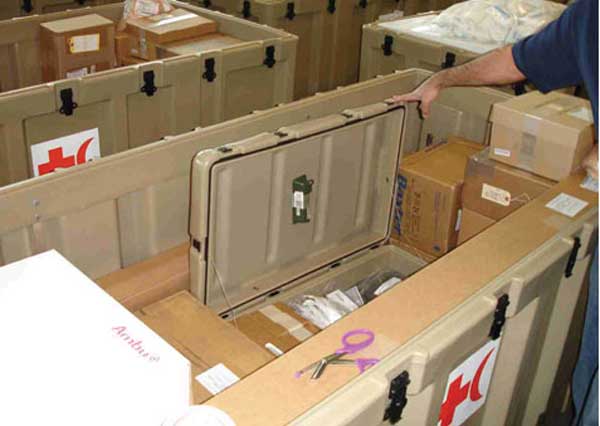
Testing the placement of sensor tags in medical sets (Credit: http://www.almc.army.mil/alog/issues/JulAug08/enhancelog_w_sensortech.html)

Testing the placement of sensor tags in medical sets (Credit: http://www.almc.army.mil/alog/issues/JulAug08/enhancelog_w_sensortech.html)

There are issues holding RFID back.  Because these are radio frequencies, Dr. Clarke points out that they will not penetrate water and they are affected by the shape of the material as well as what the material is made of or surrounded by, be it metal, plastics, glass, or paper.  They are limited to the distance over which the tag can draw enough energy from the reader.  Price can limit the implication; active tags, for instance, are considerably more expensive than passive tags.  Dr. Clarke also states that passive tags have a virtually limitless life, while active tags may require more maintenance or replacement of their power source.


One of the major concerns is over security.  RFID tags may be read by anyone, which means they may not just be read by their military owners but also the military’s enemy.  The Department of Defense certainly recognizes this concern; the great amount of research on RFID does include research into better security, such as cryptographic methods.


Defense Industry Daily also states that the DoD has not been able to achieve widespread implementation of the technology because of its inability to demonstrate to the return on investment, arguing that “it does not uniformly collect information on both the costs and benefits associated with implementation.”


With increased research on RFID, the military and other industries will benefit from the improved efficiency and accuracy of this technology.  Increased visibility of supplies means the warfighter will be better equipped—faster, more accurately, and at a lower cost than he previously was before.

Crafting Energy Security in the 21st Century: A German View of the Challenge

By Caroline Mükusch

01/02/2011 – Securing the availability of energy resources – namely oil and gas – in accordance with environmental sustainability is a key challenge of the 21st century.

(See treatment of the issue by the German Minister of Foreign Affairs)

Also, history shows that conflicts over resources are not new.  Whole epochs have been named after key resources:  the Stone Age, Iron Age or Bronze Age.  Wars have been fought about gold and diamonds.  It would be completely unrealistic to expect that shortages of energy or deterioration of energy security would not lead to conflicts of various intensities.

Energy affects the prosperity, social peace and security of states.  But more than that, it is a facilitator of the movement of goods; ideas; services; capital; information and people in all spaces – land; sea; air; space and cyber.  High-tech economies, such as the United States, Germany or Japan, demand a highly reliable energy system to meet their needs.  Only a secure energy supply guarantees the robustness of the nation’s economy and along with that its national prosperity and security.

In order to secure energy supply governments have to deal with risks and potential threats.  They have to take precautionary measures to be prepared for uncertainties.  What are these risks and potential threats to from the standpoint of German interests and security requirements?


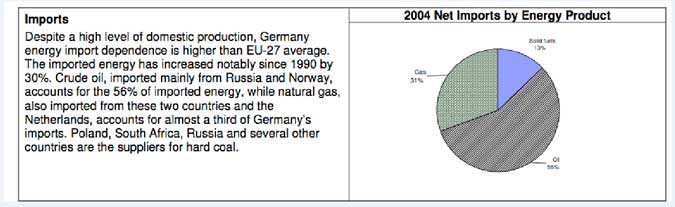
(Credit Graph: http://ec.europa.eu/energy/energy_policy/doc/factsheets/mix/mix_de_en.pdf)

Dependency

Germany is, in terms of oil and gas, an energy dependent country as it is importing 80 percent of its energy resources.  Almost 50 percent of oil and gas are coming from the Commonwealth of Independent States, primarily Russia; 30 percent from Norway and Great Britain; 15 percent from Africa and 5 percent from the Middle East (see Bundesanstalt für Geowissenschaften und Rohstoffe (2009): Energierohstoffe 2009, Hannover: BGR, p. 34. )

Obviously, a 50 percent dependency on Russia – despite all special relations – is no energy security at all.  While some top political leaders in Germany appear to believe in Germany’s special relationship with Russia to secure its energy supply, Russia, most recently at the Munich Security Conference in 2007, made it very clear that it plays according to the rules of geopolitics, interests and power

What happens, if Russia turns its energy supply to Germany off or more likely follows its own interests in determining the most desirable energy partners, in dynamic circumstances?

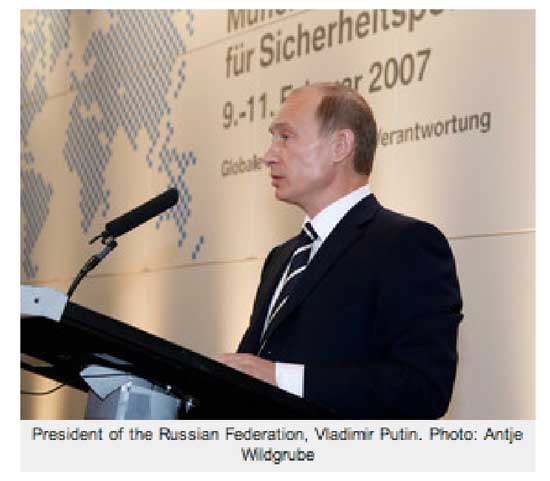
Vladimir Putin addressing the 43rd Munich Security Conference, 9 to 11 February 2007 (Credit Photo: http://www.securityconference.de/Conference-2007.268.0.html?&L=1)

Vladimir Putin addressing the 43rd Munich Security Conference, 9 to 11 February 2007 (Credit Photo: http://www.securityconference.de/Conference-2007.268.0.html?&L=1)

Competition

The competition for non-renewable energy resources as oil and gas is increasingly exacerbated by the energy needs of emerging countries of Asia has become a key driver in world energy markets.

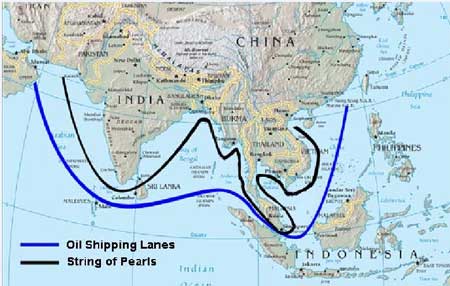
Being afraid of tight supplies and high prices that may constrain economic growth, China, the world’s fastest-growing economy – with an average growth rate of roughly 10 percent throughout the past 30 years – has been establishing a worldwide security network – the “string of pearls” – to ensure its energy needs. These strategic relationships along the sea lanes from the Middle East to the South China Sea are suggesting both a defensive and an offensive positioning to control strategic “chokepoints” protecting China’s energy interests. (Click here to see a list of the 12 fastest growing economies in 2010.)

Chinese "String of Pearls Strategy" (Credit Photo: http://www.china-briefing.com/news/2009/03/18/china’s-string-of-pearls-strategy.html)Chinese “String of Pearls Strategy” (Credit Photo: http://www.china-briefing.com/news/2009/03/18/china’s-string-of-pearls-strategy.html)

What happens, if Germany is lacking both, a vision and the instruments to deal with this new strategic constellation?  Or if German lacks the proper tools to work with partners and allies to secure the allied flow of energy supplies? Either one has the tools to do it alone or tools to contribute to a coalition, or simply hopes for the best.

Terrorist attack, piracy and natural disaster

Both, international and national energy systems, including energy producing, transporting and distributing systems and facilities, are widely spread, highly interconnected and, therefore, vulnerable to any planned attack or natural disaster.

Hitherto, the possibility of terrorist attacks on the world’s energy infrastructure does not generate the same level of attention as potential chemical, biological or nuclear terrorism.  Oil and gas markets are tight, with little spare capacity, and increasing in demand on the customer side. (See this hearing before the U.S. House of Representatives on terrorist threats to energy security.)

Of course, terrorists can strike almost anywhere in the world.  Beyond that, the risk of terrorism by both, state and non-state actors is hard to control.  To this end the increasing intertwining between piracy and terrorism is of particular concern as most of world’s oil and gas is shipped through narrow strategic chokepoints.

(See this article on terrorism at sea from Foreign Affairs; see also this Heritage Foundation article on maritime security.)

What is Germany’s comprehensive strategy to protect pipelines, global shipping chokepoints and harbors – the vulnerabilities of national and international energy systems – against terrorism, piracy and/or natural disaster?  What happens, if Germany does not have the appropriate capabilities to prevent terrorist attacks against national and international energy infrastructures, reduce the nation’s vulnerability to terrorism, accidents and natural disasters, minimize damage and assist in the recovery from such incidents, perform emergency planning for natural and manmade crises?

Wild Cards

Any situation can change at a moment’s notice, so can energy security.  Carl von Clausewitz observed in 1830, “everything […] is very simple; but even the simplest thing is difficult”.  Frictions can create enormous difficulties for the realization of any plan. (Aron, Raymond (1985): Clausewitz: Philosopher of War, Englewood Cliffs, New Jersey: Prentice-Hall, p. 418.) In fact:  Things do often turn out different than expected.  There are some wildcards for energy security:

Peak Oil:  The arrival of peak oil has been delayed by a couple of years through the economic utilization of unconventional resources.  There is still plenty of oil including:  However this “new oil” is – because unconventional – expensive; and the times of getting oil cheap and easy are running out.

Consequences of technological progress:  New technologies for instance producing energy from a broad scope of unconventional resources such natural gas, coal, biomass or kerogen in oil shale’s to liquid fuels or “heavy” oil. And reducing CO2 simultaneously producing energy (“Carbon Dioxide Reduction, Capture and Reuse” Initiative) could shift the global energy system including the role of current key energy players such as Saudi Arabia. (See Hon. Bill Anderson’s paper on carbon dioxide.)

Influence from global suppliers:  key energy countries – such as Pakistan, Iran, Azerbaijan etc. – have the potential to either provide a corridor for energy trades or to threaten exactly those energy trades.

Is Germany able to cope with trend-breaking or trend-creating events that are hard or even impossible to anticipate?

Although world’s economies ought to be less vulnerable to energy price swings in future than it was in the 1970s, a major disruption in global energy supplies still would have devastating effects on Germany’s prosperity and security.  (see page 39 of this CIA document on global trends of 2015)

The Germans have to, as former German president Horst Köhler stated in May 2010, “understand that in certain cases, in an emergency, military operations are necessary to protect our interests”.

For the rest of the world, Köhler stated the obvious.  For many Germans, he stated the unthinkable.  Under pressure Köhler resigned and now Germany runs the risk of failing to protect national interests and security.  One thing is for sure:  any inadequate management of the 21st century energy challenges on the national, regional and global level will not only jeopardize Germany’s prosperity and security but also its role and influence in world politics.

Therefore, Germany has to accept that energy security is a mix of geopolitics, national interests and power.  Because national security is no longer limited to purposes of national defense – as it was from German perspective between the end of World War II until 1989 – but to national interests, Germany’s national security policy needs to be adjusted to this reality.  “Today’s security policy must address new and increasingly complex challenges.  Effective security provisions require preventive, efficient, and coherent cooperation at both the national and international levels, to include an effective fight against the root causes”

(http://www.cfr.org/publication/11877/white_paper_on_german_security_policy_and_the_future_of_the_bundeswehr_2006.html, p. 5).

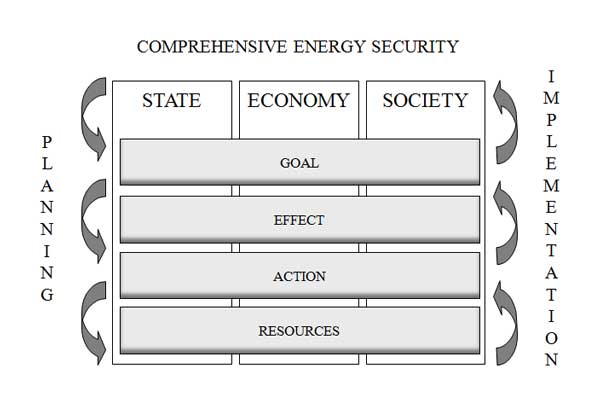
(Credit image: Caroline Mükusch)


As a result, all available instruments have to be integrated in a broader security and defense vision and to shape a more comprehensive set of policy tools in order to ensure economic viability and prosperity within Germany, Europe and with Europe’s friends and allies.

Energy security is a cross-section policy area interrelated to several other policy areas such as distribution of energy; energy efficiency; energy facility siting; energy system diversity and redundancy; regional energy policies; emergency management and response; technology policies; cyber-security issues; environmental policies; transportation policies; foreign and security policies as well as financial policies etc.  The government’s role in effectively preventing and responding to energy security risks and (potential) threats is crucial.

However, the institutional fragmentation of energy responsibility in Germany causes – due to the policy triangle of security, economy, and sustainability – a national energy trilemma:  Security of supply vs. economy; economy vs. climate protection; climate protection vs. security of supply.  All three issues cannot be resolved simultaneously.

That is why energy security ought to be all three – prevention, planning, and response.  Employing a comprehensive strategy for energy security requires at first conceptual consideration, but beyond that also massive efforts including a supporting national security institution – in Germany a “real” Bundessicherheitsrat – with a corresponding substructure and inter-agency competences completely focused on the clearly defined deliverables of German energy needs.

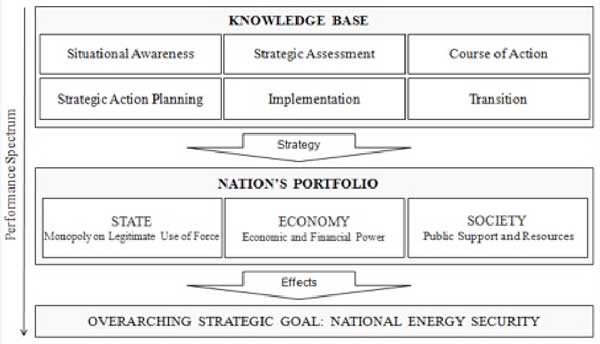
A comprehensive energy security concept emphasizes most notably the necessity of policy coherence on all levels, comprehensiveness of all instruments of crisis management, coordination in planning and a continuously assessment of the relevance of driving factors on the basis of a encompassing, holistic knowledge base.  The, for autumn this year expected new energy concept for Germany should be based on the following three elements:  Short-term:  Management and coordination of security of energy supply incl. setting the policy course for the medium- to long-term challenges.  Medium-term:  Capabilities to tare asymmetries in the international energy system. Long-term: Capabilities to shape (“design”) the governance of the international energy system.

(Credit image:(Credit image: Caroline Mükusch)

One of the most important elements of preparing for the possibility of disruptions is to understand the system’s immanent vulnerabilities.  Powerful planning capabilities would support the government’s effectiveness in

  • situational awareness of vulnerabilities including risks and potential threats;
  • dealing with unexpected strategic disruption;
  • identifying strategic objectives;
  • developing tactics achieving predefined goals and milestones;
  • developing methods of critical analysis and assessing long-term implications;
  • mobilizing adequate resources.

These capabilities are necessary for both, the implementation of policies appropriate to reduce vulnerabilities as well as risks and (potential) threats, and the enhancement of resilience of national energy security.  Political instability of key energy producing countries, the manipulation of energy supplies, the competition over energy sources, attacks on supply infrastructure, accidents and natural disasters as well as global trends such as climate change, demographic change shape the framework and nature of international and national energy security challenges.  Recognizing and assessing the likelihood of potential energy disruption or shortage will help to establish priorities and set a 21st century appropriate energy policy.  “Clearly, the first task is to gain acceptance of a more reasonable view of the future, one that opens possibilities rather than forecloses them”,[1] because the future is not that unexpected und unthinkable some may believe.

Caroline Mükusch has studied political science focused on international security.  Presently she is PhD student at the University of Cologne, Germany, working on energy security issues since 2008.  She is also working as consultant for the IABG Germany in the field of Security Studies of Critical Infrastructures.  She is our new German correspondent.