

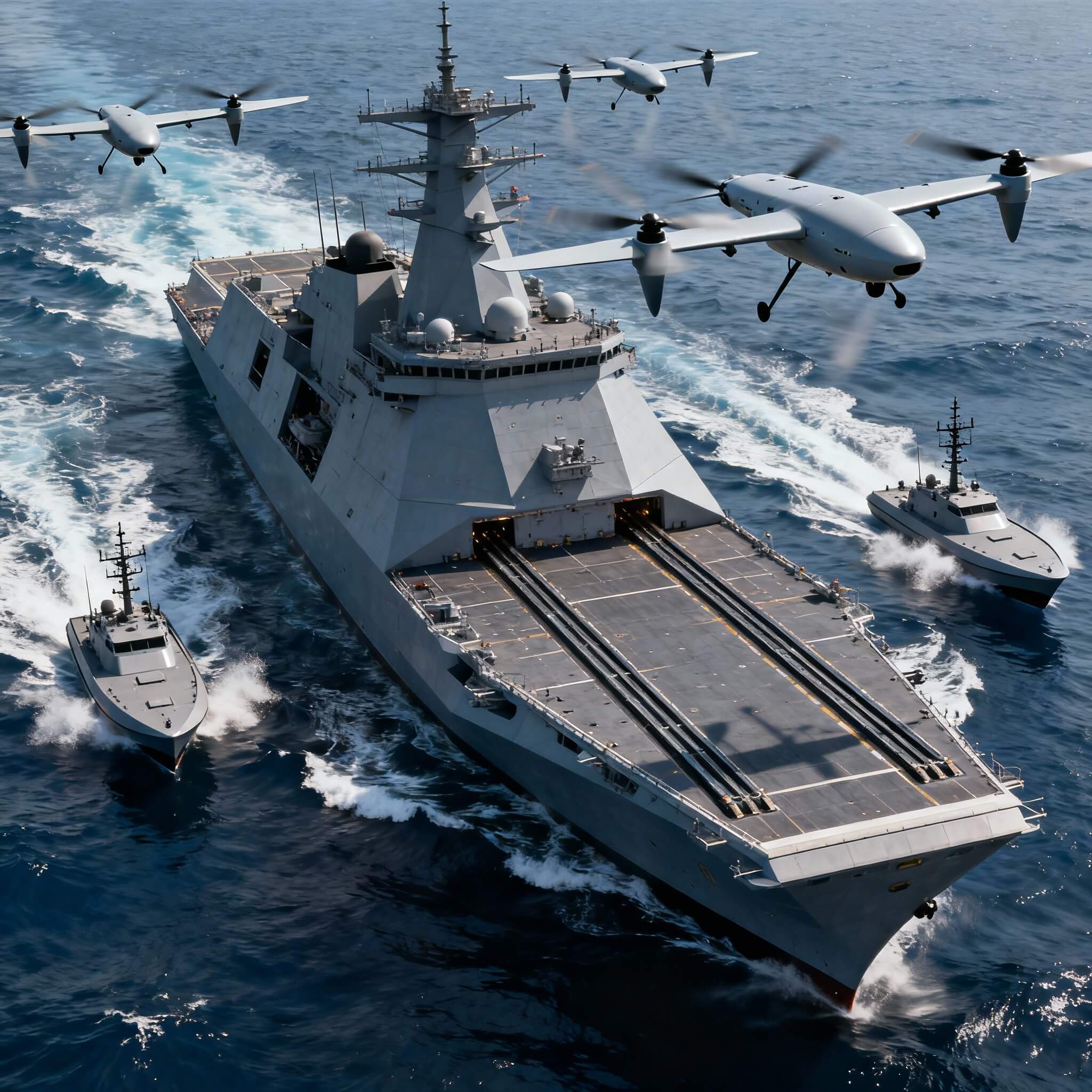
When defense analysts discuss “hybrid fleets” combining crewed and uncrewed systems, they inadvertently obscure what may be the most significant transformation in naval warfare since the aircraft carrier displaced the battleship. The term “hybrid” suggests simple addition where manned platforms plus unmanned platforms equals enhanced capability. This mathematical metaphor fundamentally misrepresents the revolution actually unfolding across the world’s oceans.
The reality is far more profound. Nations like Singapore and China are pioneering what might better be termed “mothership warfare” or a concept that creates genuine force multiplication through 360-degree operational integration across air, surface, and subsurface domains. Rather than merely adding unmanned systems to existing fleets, these motherships orchestrate autonomous assets in ways that fundamentally alter the calculus of maritime power.
This transformation represents multiplication rather than addition. A single mothership deploying coordinated swarms of unmanned aerial vehicles, surface vessels, and underwater drones can control maritime spaces far exceeding what traditional naval platforms could achieve. More significantly, this approach addresses the fundamental challenges facing modern navies: manpower constraints, operational costs, and the growing lethality of contested maritime environments where risking crewed vessels becomes increasingly untenable.
The Multiplication Principle
Traditional naval force structure thinking has always operated on linear relationships. More ships provide more coverage. More aircraft enable more sorties. More personnel allow more operations. This additive logic has governed maritime strategy for centuries, from the age of sail through the battleship era and into the carrier age.
The mothership concept breaks this linear paradigm entirely. Each autonomous platform deployed from a mothership is relatively inexpensive compared to crewed vessels, yet can pose significant threats to much more valuable enemy assets. More importantly, these unmanned systems can operate in contested environments where human-crewed vessels face unacceptable risks, maintain persistent presence for weeks without crew rotation, operate in coordinated swarms that overwhelm traditional defensive systems, and be rapidly replaced if destroyed, unlike capital ships requiring years to build.
Consider the operational mathematics: a single mothership costing perhaps $500 million can deploy dozens of autonomous systems collectively worth $50-100 million. If this distributed network can effectively contest or control a maritime space that would traditionally require a carrier strike group costing $15-20 billion, the multiplication factor becomes obvious. The force multiplier isn’t just about numbers. It’s about fundamentally changing the cost-benefit calculation that underpins naval strategy.
This multiplication principle also operates temporally. Unmanned systems don’t require crew rest, shift rotations, or periodic port visits for crew welfare. A mothership can maintain continuous surveillance and presence across vast ocean spaces by rotating autonomous assets while remaining on station for weeks. This temporal persistence creates a surveillance and response capability impossible to achieve with purely crewed platforms.
Singapore’s MRCV: The Integrated Mothership Model
Singapore’s Multi-Role Combat Vessel represents perhaps the most sophisticated realization of the mothership concept to date. Launched in October 2025, the MRCV demonstrates how a mid-sized power can leverage the mothership approach to overcome fundamental constraints while achieving world-class capabilities.
At 150 meters length and 8,400 tonnes displacement, the MRCV is Singapore’s largest warship, yet it operates with only 80 personnel, roughly half the crew of comparable frigates. This lean manning is achieved through comprehensive automation and an integrated command architecture that combines navigation, engineering, and combat systems management into a unified operational picture.
The MRCV’s 360-degree capability manifests across all maritime domains:
• Air Domain Integration: A flight deck accommodates multiple UAVs or a medium-lift helicopter, providing rapid-response investigation capability and extended surveillance reach. These aerial assets can be launched to investigate contacts detected by surface or subsurface sensors, providing visual confirmation and detailed intelligence before committing crewed assets. The integration of aerial platforms extends the mothership’s sensor envelope hundreds of kilometers beyond its physical position.
• Surface Domain Coverage: The MRCV deploys VENUS-series unmanned surface vessels through stern ramps using advanced Launch and Recovery Systems. These USVs provide persistent surface presence and can carry heavy sensor payloads for extended periods. Singapore’s MARSEC-USVs, operational since 2025, already demonstrate autonomous navigation through congested waters using AI-driven collision avoidance algorithms. The mothership serves as mobile base, command center, and maintenance facility for these surface assets.
• Subsurface Operations: Underwater drones extend the MRCV’s awareness below the surface, creating comprehensive maritime domain coverage from seafloor to airspace. Singapore is developing next-generation mine countermeasures systems specifically designed to operate from the MRCV platform, giving it multidomain operational capability that would traditionally require multiple specialized vessels.
• Command and Control Architecture: The MRCV’s true innovation lies in its “security clusters” or integrated teams combining unmanned surface vessels, unmanned aerial vehicles, and crewed platforms working under a unified hybrid command structure. An unmanned surface vessel might detect a contact of interest and begin tracking while transmitting data to the command center. An unmanned aerial vehicle could be launched to provide additional perspective and closer inspection. Only if the situation warrants human intervention would the manned mothership be dispatched, arriving with detailed information and clear evidence of any violations.
This orchestration creates force multiplication through intelligent task allocation. Each system type contributes what it does best, while the network effect of their integration produces capabilities far exceeding what any single platform could achieve. The MRCV essentially functions as a mobile command post controlling a distributed sensor and effects network across hundreds of square kilometers of ocean.
Geographic and Strategic Context
Singapore’s approach is driven by extraordinary geographic challenges. Situated at the crossroads of global trade routes linking the Indian and Pacific Oceans, Singapore depends almost entirely on secure maritime commerce. Over 130,000 vessels transit the Singapore Strait annually, making it one of the world’s busiest waterways. The mothership concept allows Singapore to maintain comprehensive maritime domain awareness across this vast responsibility area without proportionally expanding crew requirements.
The MRCV’s operational parameters reflect these requirements. With endurance exceeding 7,000 nautical miles, double that of Singapore’s Formidable-class frigates, and on-station duration exceeding 21 days, a single MRCV can maintain presence across vast Indo-Pacific spaces. Six MRCVs progressively replacing the Victory-class corvettes from 2028 onward will provide Singapore unprecedented operational reach throughout its areas of maritime interest.
China’s Mothership Development: Scale and Integration
While Singapore’s approach emphasizes quality, modularity, and international collaboration, China’s mothership development reflects different strategic imperatives and capabilities. Chinese naval modernization increasingly incorporates mothership concepts, though with distinct characteristics reflecting China’s geographic position, industrial capacity, and strategic objectives.
• Scale and Production Capacity: China’s shipbuilding industry can produce platforms and autonomous systems at scales impossible for smaller nations. This industrial advantage enables mass deployment of autonomous systems thereby creating the potential for overwhelming numerical superiority in contested spaces. Where Singapore might deploy a dozen unmanned systems from each mothership, Chinese platforms could potentially deploy dozens or hundreds.
• Integration with Shore-Based Networks: Chinese motherships operate as nodes within a broader integrated network that includes land-based sensors, missile systems, and command infrastructure. This creates layered defense in depth extending from China’s coastline across the first and second island chains. Autonomous systems deployed from motherships provide forward surveillance and targeting data for shore-based weapons, while also serving as expendable forward defense elements.
• Power Projection Focus: While Singapore’s MRCV emphasizes maritime security and sea lines of communication protection, Chinese mothership development appears oriented toward power projection and sea control in contested environments. This includes supporting amphibious operations, establishing sea control for carrier battle groups, and denying access to potential adversaries.
• Cost-Exchange Strategy: Chinese military planning emphasizes cost-exchange ratios that favor defense. Deploying relatively inexpensive autonomous systems that can threaten expensive Western capital ships aligns with broader Chinese military strategy. Motherships enable this approach by serving as mobile platforms for deploying and controlling these asymmetric assets.
360-Degree Warfare in Amphibious Operations
The mothership concept fundamentally transforms amphibious warfare by providing comprehensive domain awareness and control throughout all operational phases.
• Pre-Assault Phase: Days or weeks before an amphibious landing, motherships can deploy unmanned surface vessels to conduct covert reconnaissance of potential landing zones, gathering intelligence on beach gradients, underwater obstacles, and defensive positions. Unmanned aerial vehicles provide continuous wide-area surveillance, tracking enemy movements and positions. Unmanned underwater vehicles map submarine approaches, identify mine threats, and assess underwater obstacles—all without exposing crewed vessels to detection or attack.
• Assault Phase: During the actual landing, motherships remain at standoff distances, perhaps 50-100 kilometers offshore, while controlling autonomous assets that create protective envelopes around landing forces. Unmanned aerial vehicles provide real-time targeting data for naval gunfire support and close air support. Surface vessels establish screening positions that detect and engage threats. Underwater vehicles monitor for submarine threats. This distributed network creates layers of defense and situational awareness impossible to achieve with traditional naval forces alone.
• Post-Assault Phase: After securing initial beachheads, motherships provide persistent monitoring of secured areas through continuous autonomous patrols. They coordinate logistics support by managing unmanned cargo vessels. Defensive perimeters are maintained through autonomous systems that never tire, never require rotation, and can be positioned in high-risk areas without putting personnel at risk.
Throughout all phases, the mothership serves as the command nexus, receiving data from distributed sensors, synthesizing operational pictures, and directing both autonomous systems and crewed assets. Human judgment remains essential for legal authorities, rules of engagement decisions, and complex tactical choices, while autonomous systems provide the persistence, coverage, and risk distribution that make operations feasible.
Manned-Unmanned Teaming and Air Operations
The mothership concept extends beyond naval platforms to create powerful synergies with air operations. This integration represents a crucial dimension of 360-degree warfare that multiplies the effectiveness of both naval and air assets.
• Extended Sensor Networks: Motherships deploying autonomous systems create forward-deployed sensor networks that extend targeting and situational awareness for manned aircraft. Singapore’s F-15SG and F-35 fighters can leverage data from MRCV-deployed sensors, receiving targeting information from maritime assets operating hundreds of kilometers ahead of the aircraft.
• Distributed Targeting Architecture: By creating multiple sensor nodes across vast ocean spaces, motherships enable distributed targeting that makes the overall network more resilient. Destroying any single sensor platform doesn’t collapse the targeting capability for it merely reduces network density. This redundancy forces adversaries to expend far more resources attempting to achieve sensor denial.
• Combat Search and Rescue: Autonomous systems deployed from motherships provide immediate search and rescue capability when aircraft are downed. Unmanned assets can be rapidly deployed to locate and monitor downed aircrew while crewed rescue assets are vectored to the location, reducing the window of vulnerability for downed pilots.
• Forward Arming and Refueling: Future mothership concepts may incorporate capabilities to rearm and refuel unmanned aerial vehicles, effectively creating mobile forward operating bases that extend air operations far beyond traditional ranges. This could enable persistent air surveillance and strike capabilities in areas where establishing land bases is impossible or politically unfeasible.
Strategic Implications and the Changing Maritime Balance
The mothership revolution carries profound implications for naval strategy and the broader balance of maritime power.
• Democratization of Sea Control: Historically, effective sea control required expensive capital ships, battleships, then carriers, that only major powers could afford in significant numbers. Motherships deploying autonomous systems potentially democratize sea control by enabling smaller nations to effectively contest or control maritime spaces through distributed networks rather than concentrated capital platforms. Singapore’s approach demonstrates how mid-sized powers can achieve strategic effects previously reserved for major naval powers.
• Shifting Cost Curves: Traditional naval procurement operates on exponentially increasing cost curves: each new generation of warships costs dramatically more than its predecessor. The mothership model potentially reverses this trend by distributing capability across numerous inexpensive autonomous platforms controlled by moderately expensive motherships. While technology costs may increase, the overall force structure becomes more affordable and sustainable.
• Persistence and Presence: The ability to maintain continuous maritime presence without proportional crew expansion addresses fundamental challenges facing all navies. As recruiting and retention become more difficult globally, the mothership model offers a path to maintain or expand operational capability despite shrinking available personnel pools.
• Risk Distribution and Resilience: Traditional naval forces concentrate immense capability and vulnerability in individual platforms. A single carrier might embark 5,000 personnel and cost $13 billion; its loss represents catastrophic operational and human consequences. Mothership networks distribute capability across many nodes; losing individual autonomous platforms represents tactical setbacks rather than strategic disasters. This resilience fundamentally alters operational risk calculations.
• Decision Advantage: The real-time data fusion from multiple autonomous sensors across air, surface, and subsurface domains creates comprehensive operational pictures that enable faster, better-informed decisions. This decision advantage, understanding the battlespace more quickly and completely than adversaries, may prove as important as kinetic capabilities.
Challenges and Limitations
Despite its promise, the mothership concept faces significant challenges that will shape its ultimate effectiveness.
• Communications Vulnerability: Motherships controlling distributed autonomous assets depend on robust communications networks. Adversaries will prioritize disrupting these networks through electronic warfare, cyber attacks, and physical destruction of communication nodes. Developing resilient communications architectures that can function in degraded environments represents a critical challenge.
• Autonomy and Rules of Engagement: Autonomous systems operating with lethal weapons raise complex legal and ethical questions. International law requires human judgment for many military decisions, particularly regarding engagement authority. Balancing operational effectiveness with legal compliance while maintaining autonomous systems at tactical distances from human controllers presents ongoing challenges.
• Technology Maturity: While autonomous navigation and sensor systems are increasingly mature, many aspects of autonomous military operations remain developmental. AI systems for tactical decision-making, autonomous coordination between multiple platforms, and fail-safe mechanisms for degraded operations all require continued refinement.
• Adversary Adaptation: As mothership concepts proliferate, adversaries will develop countermeasures. These might include specialized anti-drone weapons, electronic warfare systems optimized against autonomous platforms, or tactics specifically designed to exploit autonomous system limitations. The mothership revolution will spark a continuous action-reaction cycle. There is always the reactive enemy to contend with.
• Integration Complexity: Integrating systems from multiple international sources as Singapore has done with the MRCV presents significant technical and cybersecurity challenges. Ensuring interoperability while maintaining security against cyber intrusion requires sophisticated system architecture and rigorous testing.
Conclusion: The Future of Maritime Power
The mothership concept represents far more than incremental naval evolution. It fundamentally reimagines how nations can generate and sustain maritime power in an era defined by ubiquitous sensors, autonomous systems, and increasingly lethal contested environments.
Singapore’s MRCV demonstrates that mid-sized nations can achieve world-class capabilities through intelligent integration of international expertise, modular design philosophy, and comprehensive automation. China’s approach shows how major powers can leverage industrial scale and integration with broader military networks to create layered maritime capabilities extending from coastal waters to distant oceans.
Both approaches share the central insight that multiplication rather than addition defines modern force development. The mathematics of maritime power no longer operate linearly. A single mothership orchestrating dozens of autonomous systems across air, surface, and subsurface domains can control maritime spaces that would traditionally require multiple specialized vessels with far larger crew requirements and operating costs.
This 360-degree warfare capability, simultaneous operations above, on, and below the sea surface, all coordinated through integrated command architectures that optimize allocation between human judgment and autonomous persistence, represents the genuine operational revolution that “hybrid fleet” terminology obscures.
As technology matures and operational concepts evolve, the mothership approach will likely become standard across navies globally. Nations will adapt the concept to their specific geographic, strategic, and resource contexts, but the fundamental principle, force multiplication through integrated orchestration of crewed platforms and autonomous systems, will endure.
The age of the mothership isn’t coming. It’s already here, transforming maritime strategy in ways we’re only beginning to understand. Those nations and navies that master this transformation will define naval power for the remainder of the 21st century.
The featured image was generated by an AI program and shows a notional mother ship launching various types of autonomous systems at sea.