

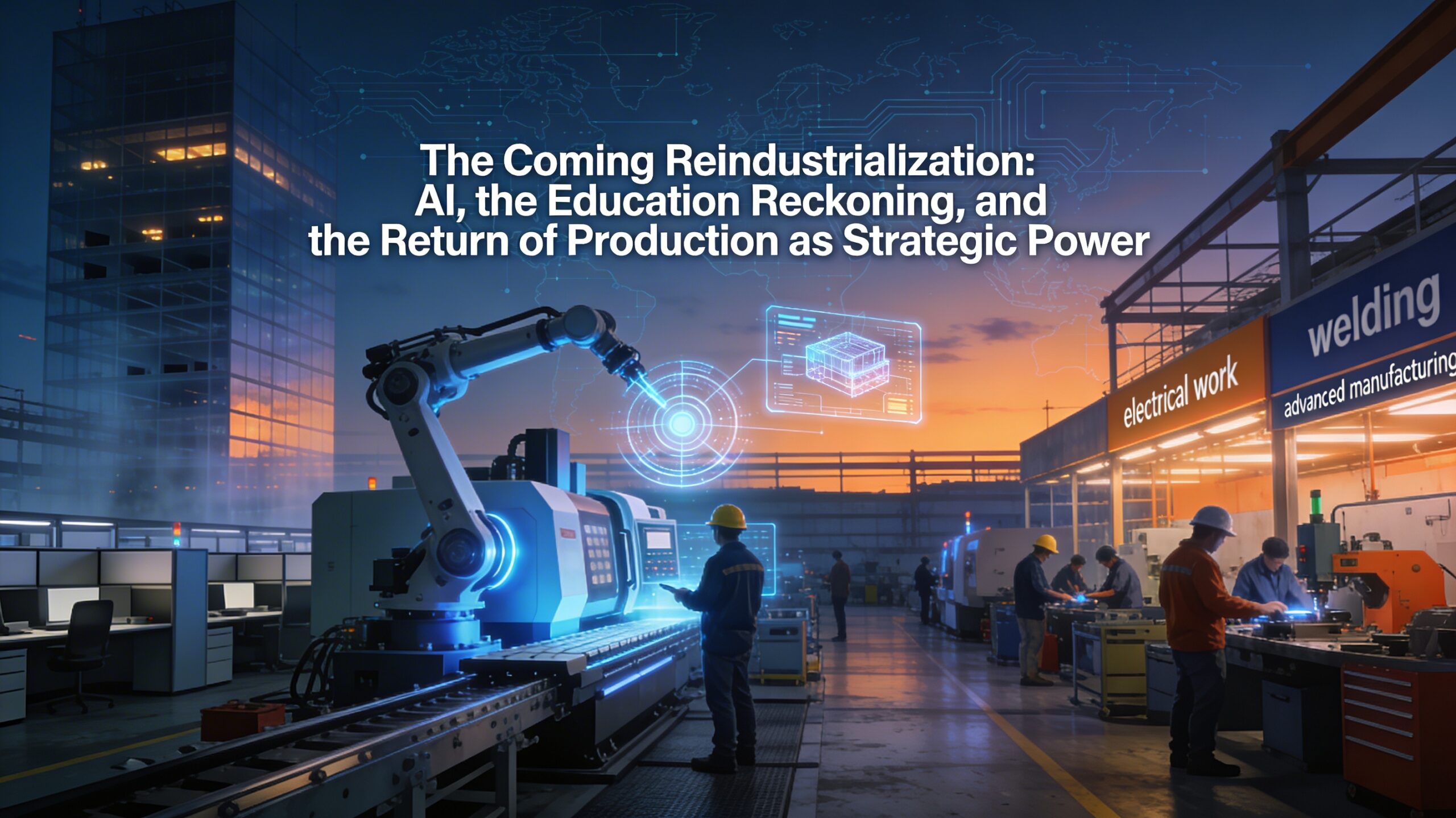
For three decades, the dominant narrative of Western economies has been one of deindustrialization, offshoring, and financialization. Manufacturing moved to Asia. Software and services became the prestige sectors. “College for all” became the default cultural script, and anyone who questioned it was accused of writing off an entire generation. The political class signed on enthusiastically, and the think tanks followed suit.
That narrative is now breaking down not because anyone decisively chose to abandon it, but because three converging forces are making it untenable. The advance of AI into white-collar work, the collapse of the economic case for traditional higher education, and the strategic imperative to reshore critical production capacity are all pointing in the same direction: toward a genuine reindustrialization of Western societies. This is not a nostalgic return to the smokestack era. It is the construction of a new, AI-enabled industrial base, one that may prove as central to Western power in the 21st century as steel and shipyards were in the 20th.
Understanding where this is heading requires moving past the slogans of both the old globalization consensus and the new industrial-policy enthusiasm. What is actually happening on the ground, in factories, trade schools, defense procurement offices, and corporate boardrooms, is more interesting, and more consequential, than either camp acknowledges.
AI and the White-Collar Disruption
For most of the postwar period, automation followed a familiar pattern: it displaced manual and routine work while leaving the professional and managerial world largely intact. White-collar workers watched blue-collar jobs disappear and drew the obvious lesson: stay in school, get the degree, enter the office, and you will be insulated. That insulation is now eroding fast.
Advanced AI systems are beginning to automate precisely the categories of work that once defined middle-class and upper-middle-class careers: document review, legal research, basic financial modeling, marketing copy, customer service, and a growing layer of managerial and analytical tasks. This is not a distant prospect. It is happening now, and the firms deploying these tools are not hiding it. They are advertising the productivity gains to their investors.
Economists at major financial institutions have begun estimating that a meaningful share of workers in advanced economies could lose their jobs outright to AI adoption, with many more seeing large fractions of their daily tasks automated away. Some AI leaders warn that as much as half of entry-level white-collar positions could be at risk within five years. Whether or not those projections prove precise, the direction is clear.
What is emerging is a “white-collar recession” structurally unlike past downturns. Companies are profitable and, in some cases, expanding. What they are not doing is hiring junior office workers at the rates they once did. AI allows firms to do more with fewer people, particularly at the entry levels where human labor once formed the apprenticeship pipeline into the professions. The consequence is that the traditional promise, study hard, earn the degree, enter an office, climb the ladder, is becoming less credible for younger cohorts. They know it. And they are adjusting their expectations accordingly.
This has two strategic implications that rarely get discussed together. First, AI is eroding the social foundation of the post-industrial settlement, in which a large professional class derived its economic security and cultural identity from desk-based knowledge work. Second, by automating cognitive routine, AI is highlighting the enduring scarcity of work that requires physical presence, tacit skill, and the capacity to integrate machines, materials, and people in complex real-world environments. In other words, AI is drawing attention back to the industrial and trades domains that Western elites have long taken for granted and often quietly disdained.
The Higher Education Reckoning
At the same time, the economics of traditional higher education especially in the United States have reached a breaking point. Student loan debt in the U.S. has climbed into the trillions of dollars. The tuition gap between trade-oriented programs and four-year bachelor’s degrees is often a multiple of three to five. For many students, the arithmetic simply no longer works: the debt burden is enormous, and the professional job pathways that once justified it are narrowing under the combined pressure of AI and globalization.
The response by younger generations is pragmatic rather than ideological. Surveys of Gen Z show rising respect for skilled trades and a growing share who believe a trade career can provide better economic security than a college degree. In one recent survey, more than 80 percent of respondents cited the advantages of the trades over office work, lower educational costs, lower debt, faster entry into the workforce, and the genuine possibility of self-employment and ownership. These are not the attitudes of people who have been talked out of ambition. They are the attitudes of people who are calculating their odds clearly.
Enrollment trends reinforce this picture. Institutions focused on vocational and technical programs have reported double-digit percentage growth, even as many traditional liberal-arts colleges struggle to sustain their numbers. Trade schools offer shorter, less expensive programs that lead directly to in-demand roles in construction, electrical work, welding, advanced manufacturing, and related fields. The market is voting.
AI is reinforcing the shift in a way that is rarely noted: as AI-driven tools eliminate entry-level roles in data entry, basic analysis, and customer support, young people are turning toward occupations that are harder to automate and that align with the physical infrastructure demands of a digital economy. Data centers, logistics hubs, renewable energy installations, and advanced factories all require electricians, mechanics, and technicians in large numbers. These are not jobs that can be moved to a server farm in Virginia or outsourced to a language model.
Taken together, these trends amount to a fundamental revaluation of practical skill. Where a college degree once functioned as a general-purpose credential signaling suitability for professional work, the labor market is now paying premiums for workers who can build and maintain the physical systems on which digital and service economies ultimately depend. That shift in relative value is not a temporary anomaly. It reflects something durable about what the economy actually needs.
Reshoring and the Strategic Logic of Production
The third major force driving reindustrialization is geopolitical, and it is the most consequential for defense analysts and policymakers. The offshoring wave of the past three decades created intolerable vulnerabilities in critical supply chains. COVID-19 exposed them dramatically. Rising tensions with China, the war in Ukraine, and the deliberate weaponization of trade and technology dependencies have made the strategic dimension impossible to ignore.
Governments in the United States and Europe have begun aggressively promoting reshoring, nearshoring, and “friendshoring” of production. The rhetoric has been matched, at least in part, by policy. In the United States, the CHIPS and Science Act is providing large-scale incentives to bring semiconductor and advanced manufacturing capacity back onshore. Recent data show hundreds of thousands of jobs announced as reshored in a single year, not all of which will materialize, but which collectively signal a real shift in corporate strategy.
Manufacturing is once again being treated as a national security asset rather than a neutral economic activity. Shorter supply chains, domestic control over critical inputs, and the ability to surge production in a crisis are being valued alongside cost efficiency, a combination that would have seemed eccentric to most business-school curricula a decade ago. The pandemic and Ukraine changed the calculation. The competition with China has locked it in.
What makes this reindustrialization distinct from previous episodes is the technology layer. Firms pursuing reshoring are simultaneously investing in AI, digital twins, cloud, 5G, and edge computing to make regionalized production cost-competitive with the globalized model it partly replaces. Surveys indicate that a majority of organizations pursuing reindustrialization report significant cost savings from the adoption of such technologies. The reindustrialized factory is not a revival of old plant. It is a highly automated, data-rich environment where human workers are orchestrating complex cyber-physical systems closer in character to a software operation than to a traditional assembly line.
This is where the kill web logic that I have argued for in the defense context has a direct civilian analogue. The distributed, networked, and resilient industrial base that strategic competition demands is not built by restoring centralized mass-production facilities. It is built by creating a web of interconnected production nodes, each capable of independent operation, each integrated into a larger system, that can absorb disruption and continue to function. The same principles that drive the shift from kill chain to kill web in military operations apply to the industrial economy that supports them.
A New Social Contract Around Work
The convergence of these three forces, AI’s assault on white-collar security, the economic deterioration of the traditional higher-education pathway, and the strategic imperative to reshore industrial capacity, points toward the outline of a new social contract around work and production.
The old prestige hierarchy that placed office work above skilled trades is being quietly overturned. As AI absorbs more of the routine cognitive tasks that filled white-collar time, the scarcity and value of work requiring physical presence, deep tacit knowledge, and hands-on problem-solving is rising. The trades and advanced manufacturing are increasingly seen not as fallback options but as frontline roles in sustaining national resilience. That is a significant cultural shift, one that has not yet been fully absorbed by the institutions, political parties, and media organizations that still largely reflect the old order.
The education-to-work pipeline is fragmenting and diversifying. Instead of a single, four-year degree followed by a linear professional career, individuals are moving through a series of shorter, targeted training programs, apprenticeships, and reskilling opportunities tied to specific industrial and technical roles. Governments and firms that recognize this shift are experimenting with new models of vocational education, public-private training partnerships, and lifelong learning frameworks better suited to an economy in which both technologies and strategic priorities change rapidly. This is promising, but it remains fragile and undersupported relative to the scale of the transition underway.
The geographic distribution of opportunity may also change. Reindustrialization and reshoring can create new industrial clusters in regions that lost factories and jobs during the great offshoring wave, potentially restoring a measure of social and political balance. But this is not guaranteed. The new industrial facilities are capital-intensive, highly automated, and often demand a smaller but more technically skilled workforce than the plants they are notionally replacing. If the skills gap is not addressed with seriousness and speed, reindustrialization could coexist with persistent local underemployment and the political frustration that follows.
Risks and the Requirement for Strategic Clarity
Reindustrialization is not inevitable, and it is not guaranteed to be broadly beneficial if it is mismanaged. There are at least three significant risks that policymakers and strategists need to take seriously.
The first is institutional lag. AI is advancing rapidly; reshoring projects are underway; but educational systems, credentialing frameworks, and cultural narratives still largely reflect the old paradigm. If schools and policy continue to push young people toward saturated professional tracks while failing to build genuinely attractive pathways into industrial and trade roles, the result will be social frustration rather than renewal. The mismatch between what the economy needs and what institutions are producing cannot be solved by rhetoric alone.
The second is distributional. The benefits of AI-enabled industry may flow disproportionately to capital owners and a small cadre of highly skilled technologists and managers, while the broader workforce finds itself in precarious gig work or intermittent project-based employment. A genuine reindustrialization that reinforces democratic stability needs to ensure that industrial jobs offer decent wages, real bargaining power, and genuine prospects for advancement. History suggests that this will not happen automatically. It requires deliberate policy choices and, in some cases, uncomfortable confrontations with corporate interest.
The third risk is geopolitical. Reindustrialization in the West is unfolding in a context of intensifying competition with China and other major powers. Policies framed as resilience and security in Washington, Brussels, or London will be read as containment or decoupling elsewhere. The risk is a fragmented global system in which overlapping industrial policies fuel inefficiencies, trade conflicts, and the consolidation of rival technological blocs. Navigating this environment requires deliberate strategy: building robust domestic capacity without collapsing the wider system into mutually hostile economic fortresses. That is a fine line, and it demands the kind of strategic clarity that has not always been evident in recent Western policy.
The Strategic Opportunity
Despite these risks, the current moment presents a genuine strategic opportunity for Western nations. The forces destabilizing the old order, AI’s disruption of white-collar work, the higher-education crunch, and the shock of geopolitical competition, can serve as catalysts for rebuilding a more balanced, production-centered economic model, if Western societies have the will and the institutional imagination to seize them.
If AI is treated not simply as a cost-cutting tool but as a complement to human capability in advanced manufacturing and critical infrastructure; if educational systems are reoriented toward flexible, high-status pathways into trades and industrial roles; and if industrial policy is pursued with a clear-eyed understanding of national security imperatives and alliance structures then the result could be a more resilient and coherent Western industrial base than the one that was allowed to atrophy over the past generation.
Such a base would underpin not only economic prosperity but also strategic autonomy: the ability to field advanced defense systems without dependence on foreign choke points, to sustain critical infrastructure under duress, and to adapt rapidly to technological and geopolitical shocks. This is not a secondary consideration. It is the central strategic challenge facing the Western alliance. Defense industrial capacity, the ability to design, build, and sustain the systems that modern warfare and deterrence require, depends directly on the broader industrial and skills base of society. You cannot have one without the other.
The West has been living off the legacy of its industrial might for a long time. The Cold War victory, the globalization dividend, and the dominance of the dollar and Western financial institutions all sustained a comfortable illusion that production could be delegated to others while the West kept the high-value cognitive work. That illusion is dissolving. The question now is whether Western societies can deliberately build a new, technologically sophisticated industrial foundation that matches the realities of AI, contested globalization, and shifting expectations of work.
The trends are opening the door. The convergence of AI disruption, educational economics, and strategic necessity is creating conditions that have not existed for decades. Whether Western governments, institutions, and societies walk through that door is a matter of political will, institutional imagination, and strategic clarity. The analysis is not especially difficult. The execution will be.
Note: My first professional publication was on post-industrial society and published in the UK journal Survey.
Across my career, I have treated post‑industrial society as a strategic condition that reshapes how power is generated, organized, and contested in advanced states. My early work on the “scientific‑technological revolution” and Soviet policy analyzed how large political systems try to harness science, complex management, and emerging information technologies to sustain military and economic power.
Later, I extended this to Western democracies, showing how networked economies, information‑rich but institutionally constrained politics, and globally distributed industrial bases change the possibilities for military transformation, mobilization, and alliance management. In recent years, I have returned to these themes in the context of industrial resilience, Ukraine, and great‑power rivalry, asking whether post‑industrial democracies can rebuild the strategic depth and organizational coherence needed to act effectively under sustained pressure.
I am publihsing a book next year entitled: Forces in Motion: Essays on the Transformation of Western Societies.