

For four decades, the Western defense establishment has pursued revolutions. The Revolution in Military Affairs promised to transform warfare through precision strike and information dominance. Network-centric warfare would lift the fog of war through seamless connectivity. Effects-based operations would allow strategic objectives to be achieved without traditional attrition. Each concept arrived with elegant briefing slides, confident timelines, and the implicit promise that American technological superiority could be systematically extended into perpetuity.
Each encountered the stubborn realities of operational forces, budgetary constraints, institutional resistance, and adversaries who declined to cooperate with the assumptions built into those concepts.
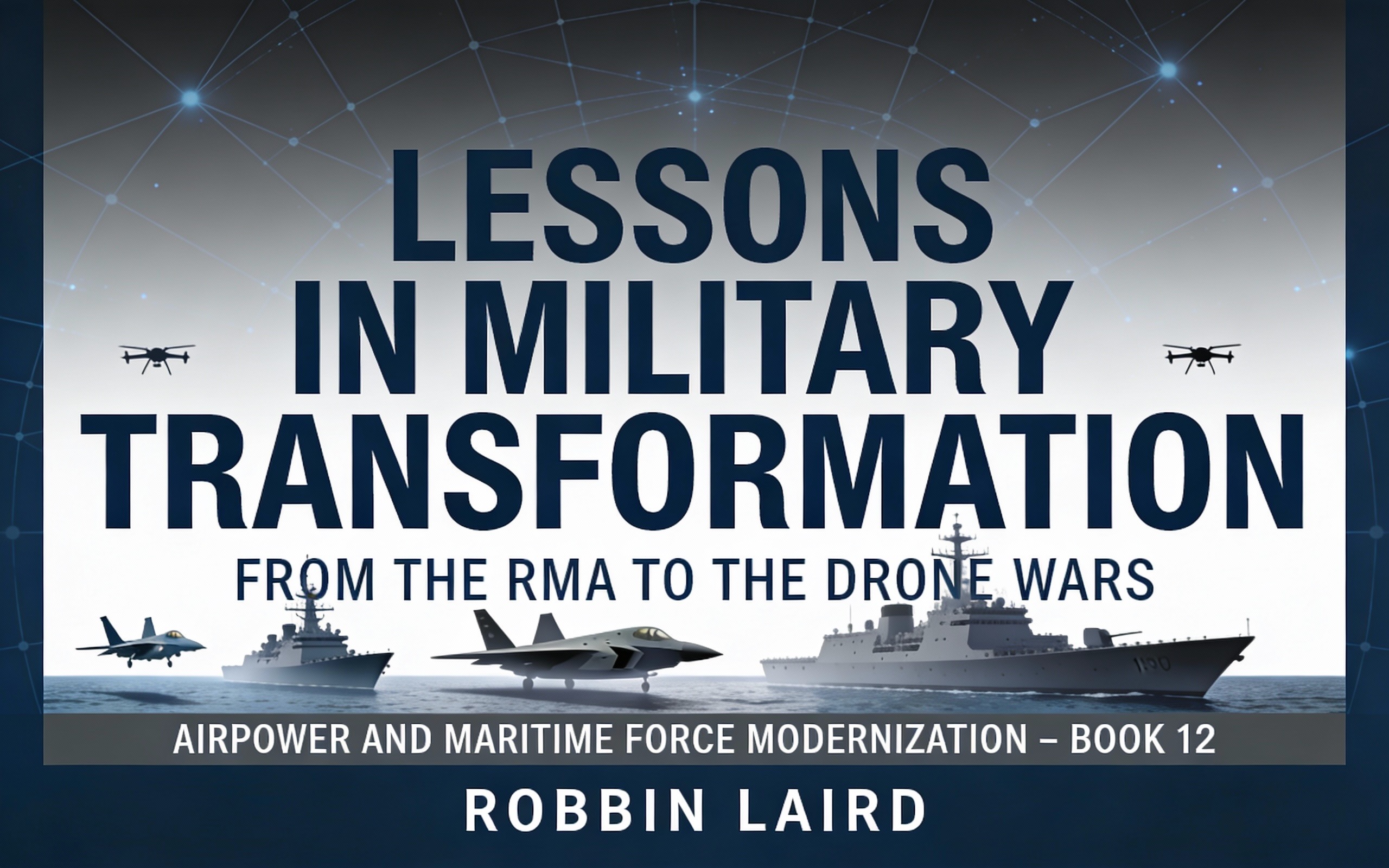
Lessons in Military Transformation: From the RMA to the Drone Wars — the twelfth book in my defense analysis series — examines what actually happened when these concepts left the Pentagon and entered the operational world. It draws on four decades of field research conducted not in Washington conference rooms or think tank seminars, but at operational bases where transformation occurs: in ready rooms, maintenance hangars, on flight decks, and during deployments where the distance between strategic concept and tactical reality becomes immediately apparent.
A Field-Grounded Counter-Narrative
The conventional narrative of the RMA and its successors has been told primarily by those who conceived these transformations, defense intellectuals, program managers, and strategic theorists operating within the Washington consensus. This book deliberately prioritizes those who implemented them: the practitioners who discovered what actually worked when elegant theories met operational friction.
That methodological commitment is not incidental. As Vice Admiral DeWolfe H. “Bullet” Miller, former Director of Navy Air Warfare, writes in his foreword, the analytical perspective built from practitioner interviews across decades and continents “is not findable in think tank products.” It is a perspective that can only be built through sustained engagement with the people who fly the aircraft, maintain the platforms, lead the squadrons, and adapt the doctrine when plans collide with reality.
Brian Morra, whose career spanned the Air Force’s doctrinal revolutions of the 1980s and 1990s through Desert Storm and decades of aerospace industry leadership, frames the book’s core tension directly: transformation is not the product of elegant theory, but of practitioners — in ready rooms, on flight lines, aboard ships — who discover through friction what theoreticians imagined in conference rooms. Technology placed in the hands of operators is, as he puts it, where “the real magic happens.”
That observation drives the book’s central argument: that the most significant military transformations emerge not from grand designs, but from practitioners solving immediate problems in ways that reshape entire operational ecosystems.
From RMA to Drone Wars: Continuity, Not Revolution
The journey the book traces, from the RMA through network-centric warfare to the contemporary drone wars, reveals less about revolutionary breaks than about persistent adaptation within complex systems undergoing continuous evolution.
The F-35 Lightning II represents not simply a fifth-generation fighter but a fundamental reconceptualization of the combat aircraft as a network node within distributed kill webs. Its value lies less in traditional performance metrics — speed, payload, maneuverability — than in its capacity to operate as an information hub, fusing sensor data and enabling distributed forces to prosecute targets collaboratively. That required not just technological innovation but cognitive transformation among pilots who had to transition from individual air-to-air engagements to managing information flows across networked forces.
The MV-22 Osprey emerged from developmental controversies and budget battles to become the connective tissue of expeditionary operations, enabling Marines to project force across distances that would have been operationally prohibitive with conventional helicopters. Yet its transformation of Marine Corps capabilities became fully apparent only when practitioners discovered applications that program designers had not anticipated using the Osprey’s range and speed to enable distributed operations across vast Pacific expanses, integrating it into complex air packages that blurred traditional distinctions between assault support and tactical aviation.
Autonomous systems have democratized precision strike capabilities that once required billion-dollar platforms and years of operator training. Small drones operating in collaborative swarms can now contest domains previously dominated by exquisite manned systems, fundamentally altering the economics of military competition. Yet this transformation builds directly on concepts developed during the RMA, the integration of precision weapons with real-time targeting, the networking of dispersed sensors and shooters, the compression of the sensor-to-shooter timeline. Understanding this continuity matters as much as recognizing the novelty.
The Case Studies
The book is organized not chronologically but conceptually, examining transformation through multiple lenses across seven parts.
Part Two opens with the RMA reconsidered, exploring how the concept that promised to transform warfare produced real innovations within specific operational contexts and how institutional resistance, adversarial adaptation, and resource constraints consistently narrowed the gap between concept and delivery.
Part Three documents airpower transformation in practice through a series of specific unit-level case studies. The 2nd Marine Air Wing’s transition from counterinsurgency to strategic competition illustrates what happens when Marines who spent two decades perfecting close air support in permissive environments must now operate across the tyranny of distance in the Pacific, against peer adversaries with sophisticated integrated air defense systems. MAWTS-1’s shift to strategic competition, the digital light attack revolution at HMLA-267, and the development of MISR capabilities for distributed decision-making all demonstrate how transformation occurs at the squadron and wing level, through practitioners who adapt formal concepts to operational realities.
The European dimension receives equal treatment. RAF Lossiemouth at the edge of the North Atlantic, Eurofighter modernization across European air bases between 2015 and 2017, and the intellectual contributions of European strategic thinkers to transformation concepts collectively illustrate that allied militaries are not simply consumers of American doctrine but active contributors to its evolution.
Part Four examines platforms as catalysts of transformation. The tiltrotor enterprise, spanning both the V-22 Osprey and the broader development of rotary-wing capabilities, provides a case study in how transformative platforms generate operational concepts their designers did not anticipate. The Osprey’s nacelle improvement program illustrates how sustainment itself has become a transformation challenge. The A330MRTT tanker, the Aegis global enterprise, the A400M airlifter, and the F-35 global enterprise all receive treatment as systems whose significance lies not in their specifications but in the operational ecosystems they enable.
Part Five addresses training, joint forces, and institutional friction perhaps the most underexamined dimension of military transformation. Steel Knight 2025, the 3rd Marine Air Wing’s campaign laboratory exercise, demonstrates how large-scale exercises have evolved from scripted events into genuine experiments in distributed operations. Italy’s International Flight Training School shows how modern pilot training has shifted from stick-and-rudder skill mastery to cognitive management of networked warfare, using Live-Virtual-Constructive environments that integrate actual flight with sophisticated simulation. The Australian Defence Force’s modernization challenge and the Coast Guard’s Deepwater program illustrate the structural difficulties that confront any organization attempting to transform while simultaneously maintaining operational readiness.
Part Six turns to the unfinished revolution, the drone wars, hypersonic weapons, and the strategic implications of autonomous systems that have disrupted assumptions about conventional deterrence. Ukraine demonstrates how networked autonomous systems enable small forces to contest domains previously dominated by industrial-age mass, using commercial quadcopters for reconnaissance and precision strike, maritime drones to threaten major surface combatants, and integrated sensor networks to prosecute targets across extended battlefields.
From Crisis Management to Chaos Management
Running through all of these case studies is a conceptual framework that the book develops and applies consistently: the shift from crisis management to chaos management.
Crisis management assumes an underlying stable state to which systems return after disturbances. The organizations built on that assumption and the doctrines, training methodologies, and command structures designed to support it are poorly suited to contemporary operational environments characterized by continuous turbulence.
Chaos management recognizes that the contemporary strategic environment does not return to stability after disruptions. Organizations must maintain effectiveness without expecting a stable baseline to be restored. This applies not just to military operations but to organizational adaptation more broadly in an era of accelerating technological change and strategic competition.
The Marine Corps’ transition from counterterrorism to strategic competition illustrates this dynamic with particular clarity. That transformation required not just acquiring new platforms but developing new cognitive frameworks for how to employ them, new organizational structures to enable distributed operations, and new training methodologies to prepare operators for contested environments fundamentally different from the counterinsurgency fights that shaped an entire generation.
Lieutenant General (Ret.) Pasquale Preziosa, writing from the perspective of a former Italian Air Force commander, extends this framework into its strategic dimension. His central argument — that transformation enlarges the space of political choice but does not predetermine how that choice should be exercised provides an essential corrective to the technocratic optimism that has historically accompanied American transformation narratives. Without strategic imagination to guide it, transformation risks becoming “directionless adaptation rather than purposeful evolution.”
Five Principles of Military Transformation
Across the book’s case studies, five principles emerge about how militaries actually transform when theory encounters practice.
First, platforms alone do not constitute transformation. How operators employ them within operational ecosystems determines their actual impact on military effectiveness. The F-35’s value is realized through the kill web it enables, not the specifications it achieves.
Second, training must evolve as rapidly as technology. The shift from individual skill development to cognitive management of complex networked systems represents a transformation challenge as significant as any platform acquisition program.
Third, adversaries adapt continuously. Transformation must account for competitive interaction rather than assuming technological superiority guarantees enduring dominance. Holger Mey’s warning against assuming adversaries will be “conveniently incompetent or cooperative” resonates across every case study in the book.
Fourth, the most successful transformations often emerge from evolutionary adaptation by practitioners rather than revolutionary replacement programs designed in isolation from operational realities. The practitioners who discovered how to employ the Osprey across the Pacific were not following a program plan; they were solving operational problems.
Fifth, the gap between strategic concept and tactical implementation creates opportunities for innovation that formal planning processes consistently miss. That gap is not a planning failure — it is the terrain on which real innovation occurs.
Significance
Lessons in Military Transformation arrives at a moment when the defense establishment is absorbing the implications of autonomous systems in Ukraine, reconfiguring force posture for strategic competition with China, and attempting to execute transformation programs across services whose institutional cultures were shaped by two decades of counterterrorism operations.
The book’s contribution is not to prescribe solutions but to build understanding from operational evidence to allow practitioners’ experience to reshape analytical frameworks rather than forcing reality to conform to preferred theories. In an era when the distance between Washington’s transformation narratives and operational reality has rarely been wider, that methodological commitment carries particular weight.
Dedicated to Secretary Michael Wynne, who championed fifth-generation fighters and advanced capabilities when the defense establishment remained focused elsewhere, the book reflects the principle its dedication invokes: if everyone is thinking alike, someone isn’t thinking.