By Robbin Laird
USS Lewis B. Puller (ESB-3) embodies a straightforward but strategically important proposition: if you want to keep the Strait of Hormuz open against the threat of mines, you put the mine-warfare force where the mines are likely to be laid. The expeditionary sea base brings aviation, unmanned systems, small craft, explosive ordnance disposal teams, and command-and-control together on a single, relatively low-cost hull positioned just outside the chokepoint, transforming mine clearance from a commuting activity into a persistent, on-scene campaign. That proposition has moved from theoretical to urgently operational.
Since early 2026, Iranian forces have laid mines in the strait and its approaches, U.S. forces have begun clearance operations using a combination of surface, subsurface, and airborne assets, and the Puller-centered sea-base concept has been stress-tested under real combat conditions for the first time.
This article describes the ship, explains its role in the mine-countermeasures mission, and offers a notional day-in-the-life of ESB-based operations to show how it compresses time and distance in mine prosecution. It also places the current crisis in a broader strategic context, one that analysts working in the mobile basing space had been developing well before Iran laid its first mine in 2026.
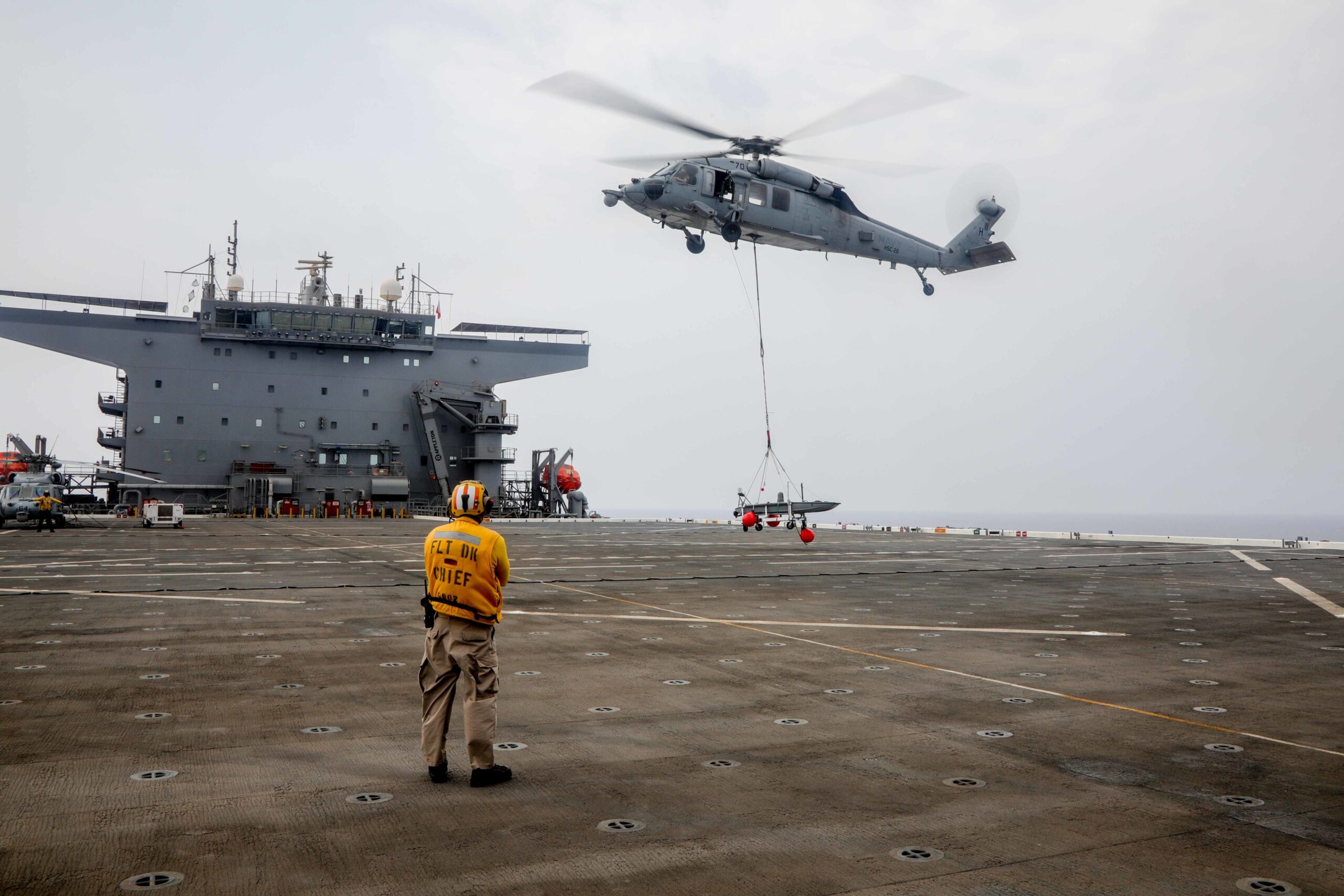
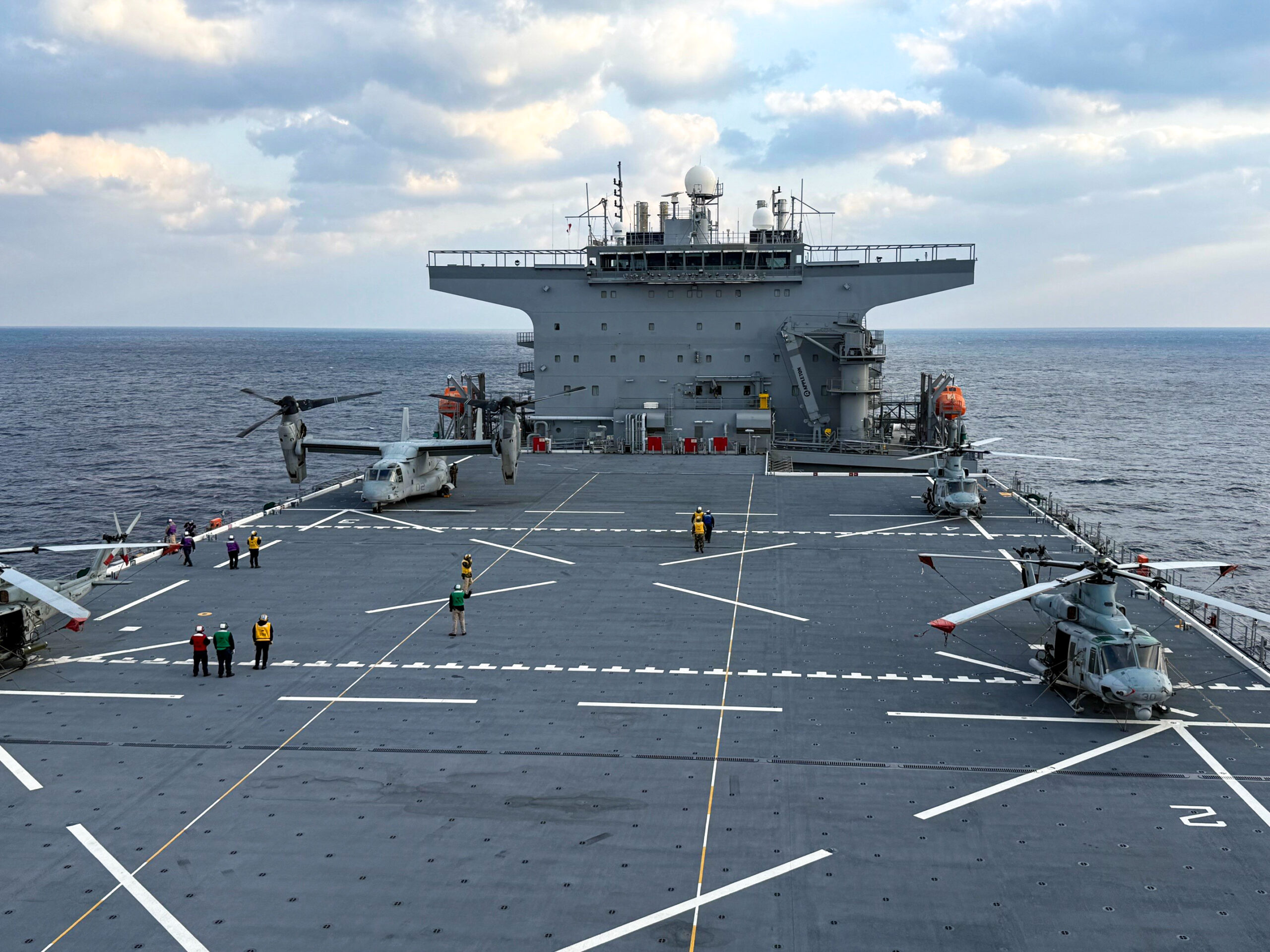
Lewis B. Puller is not a classic warship in the sense of a destroyer or frigate; it is a purpose-built sea base, derived from an Alaska-class commercial tanker hull and adapted to carry a large flight deck with multiple helicopter spots, a mission deck with cranes and handling gear, aviation support facilities, berthing for hundreds of embarked personnel, and significant fuel and stores capacity. Commissioned in Bahrain in August 2017, a decision driven by the evolving threat environment in the Fifth Fleet area of operations—the ship’s redesignation from USNS to USS underscored that it is not merely a logistics asset but an operational tool capable of sustaining combat support functions over time close to contested waters.
The Gulf and the Strait of Hormuz are tailor-made for this kind of platform. The geography is constricted, the threat is chronic, and the requirement is less about episodic high-intensity engagements than about day-in, day-out presence, surveillance, and readiness to respond to mines, harassment, or coercion. Puller’s hull form and systems are optimized for precisely this profile: long on-station periods at modest speed, with ample deck space for helicopters, small boats, and unmanned systems, and the ability to host detachments from multiple communities—mine warfare, special operations, maritime security, and aviation support on a single afloat base.
The strategic case for Puller in the Gulf is not simply a mine-warfare argument. It reflects a broader insight about how mobile basing works as a driver of crisis management and combat effectiveness for the joint and coalition force, an insight that Jim Strock, former Director of the Seabasing Integration Division at the USMC, had been articulating for years before the Hormuz crisis brought it into sharp relief.
Strock’s core argument, developed in conversations in January 2022, was that the shift from thinking about seabasing as a Marine Corps amphibious affair to thinking about it as a joint and coalition capability was the fundamental strategic innovation still waiting to be fully exploited. As he put it:
“The other part of mobile basing we worked on 10 years ago was the afloat piece. We were focusing on Navy and Marine Corps capabilities across amphibious ships, across maritime repositioning ships, across joint high-speed vessels, across a variety of connectors at the strategic, operational, and tactical level to move units around. And certainly, those assets today are key enablers for any sort of mobile basing concept of operations we would construct, but to expand this thinking to the joint or coalition force is really the new dimension that I don’t think anyone has seriously thought through—as well as finding ways to integrate fully those capabilities for the force design and operations of those forces.”
The Puller in the Gulf is a working example of exactly that integration challenge. It hosts not just Navy mine-warfare teams but special operations forces, EOD detachments, and aviation assets from multiple communities—functioning as what Strock described as a node within an operational network that can extend sea power ashore and deliver effects across warfighting functions. The ship is, in miniature, the kind of mobile base from which distributed, integrated operations become possible.
Strock also identified a critical insight about the value of sea control in an era of long-range fires: that the missile-strike force—carriers, submarines, destroyers—and the expeditionary force operating from interconnected sea bases are complementary capabilities, not competing ones. In his words:
“Sea control against adversaries that are relying on long-range fires to push our fleet back further is a key challenge. The carriers, the submarines, the DDGs provide significant firepower and can extend sea control in terms of firing solutions. But the expeditionary force based on the interconnected sea bases from which one can project an air and ground integrated force provides a very different but complementary capability to the largely missile strike force.”
The Puller at Hormuz illustrates this complementarity directly.
When destroyers USS Frank E. Peterson and USS Michael Murphy made the first transit of the Strait in the clearance phase of operations, they did not bring the mine-warfare enterprise with them—they created the conditions for it. The ESB was already there, already positioned, providing the persistent operational base that the strike force could lean on. This is the architecture Strock was describing: a layered mobile basing system in which the sea base provides the dwell time, the logistics depth, and the integrated command space that episodic strike assets cannot.
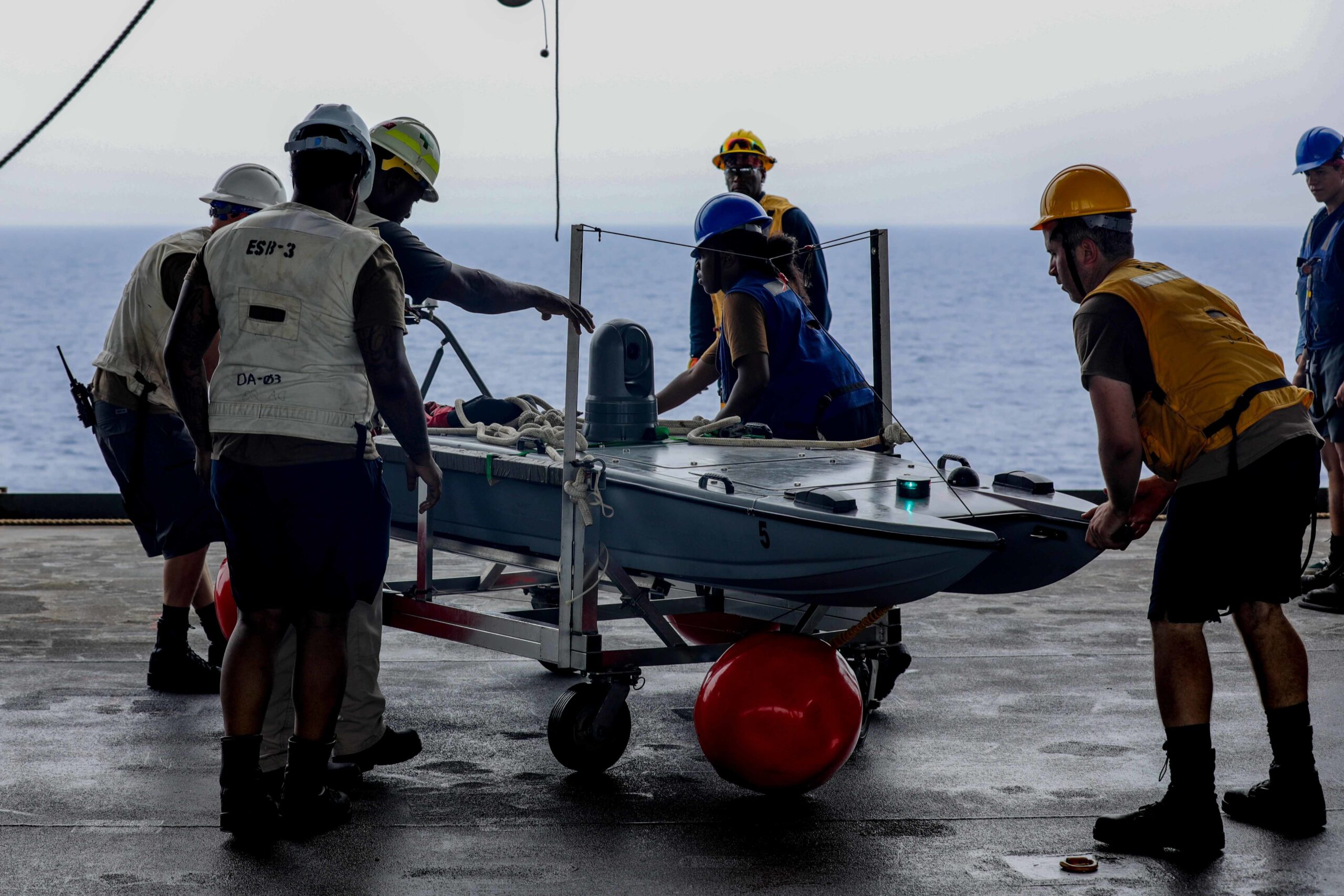
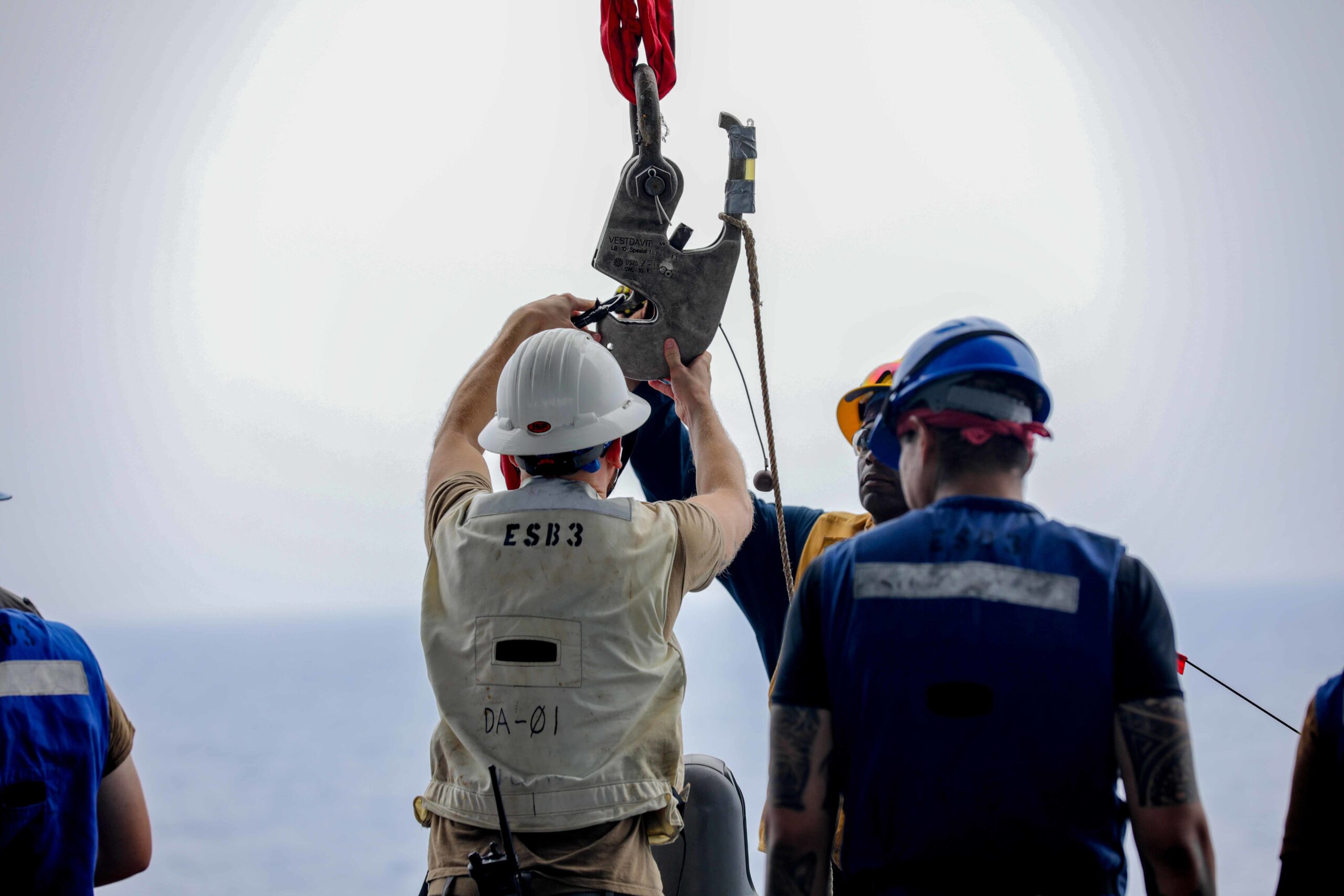
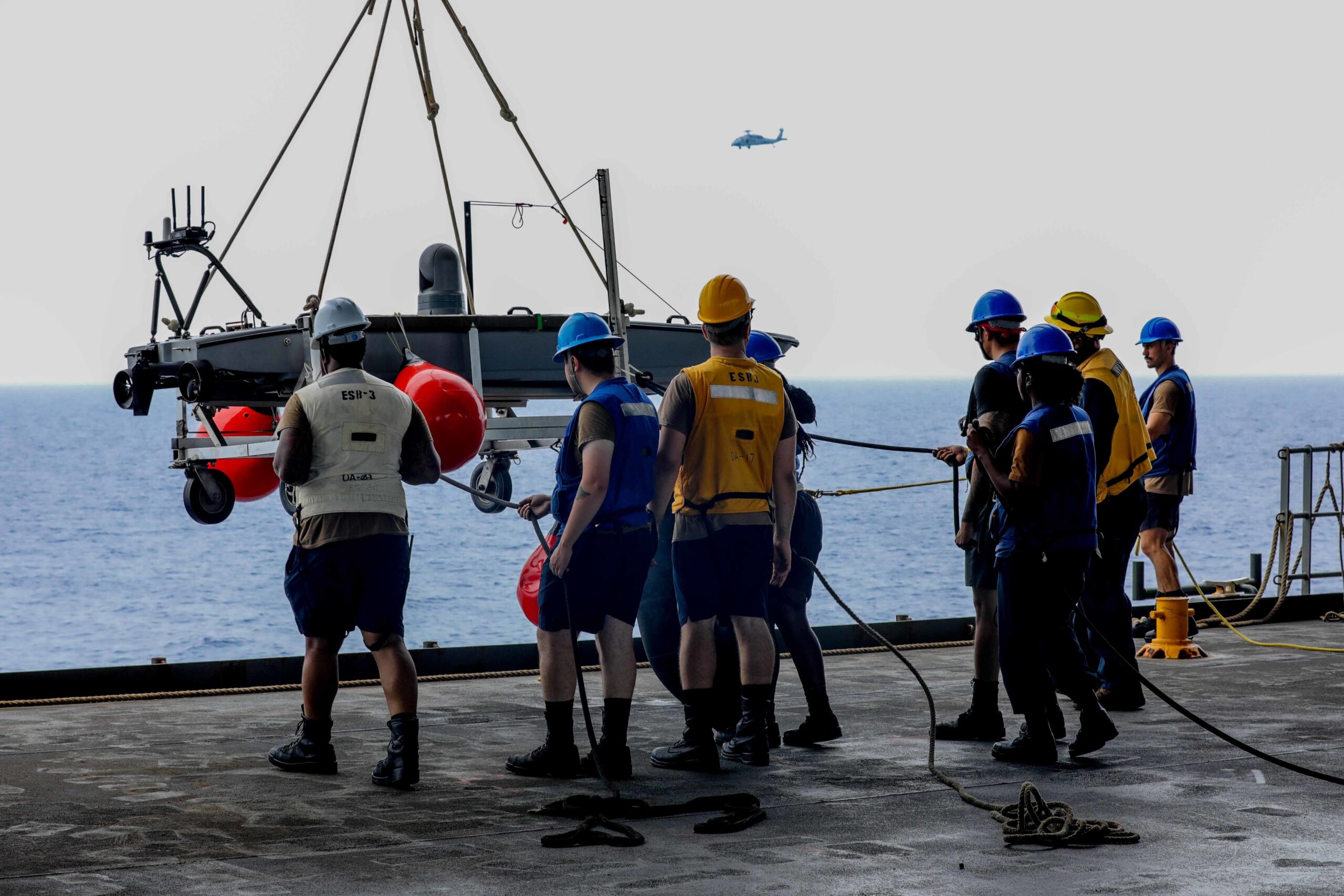
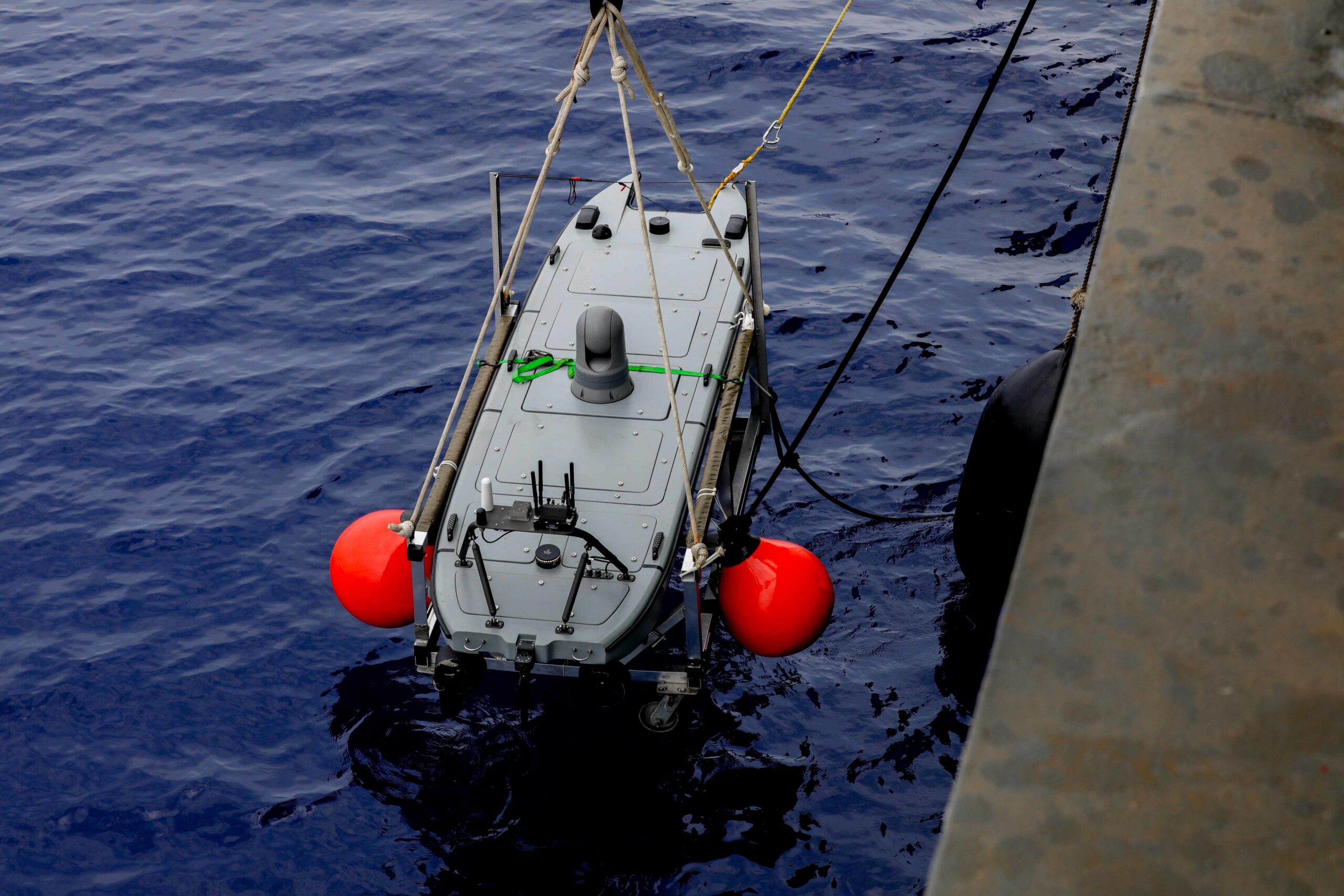
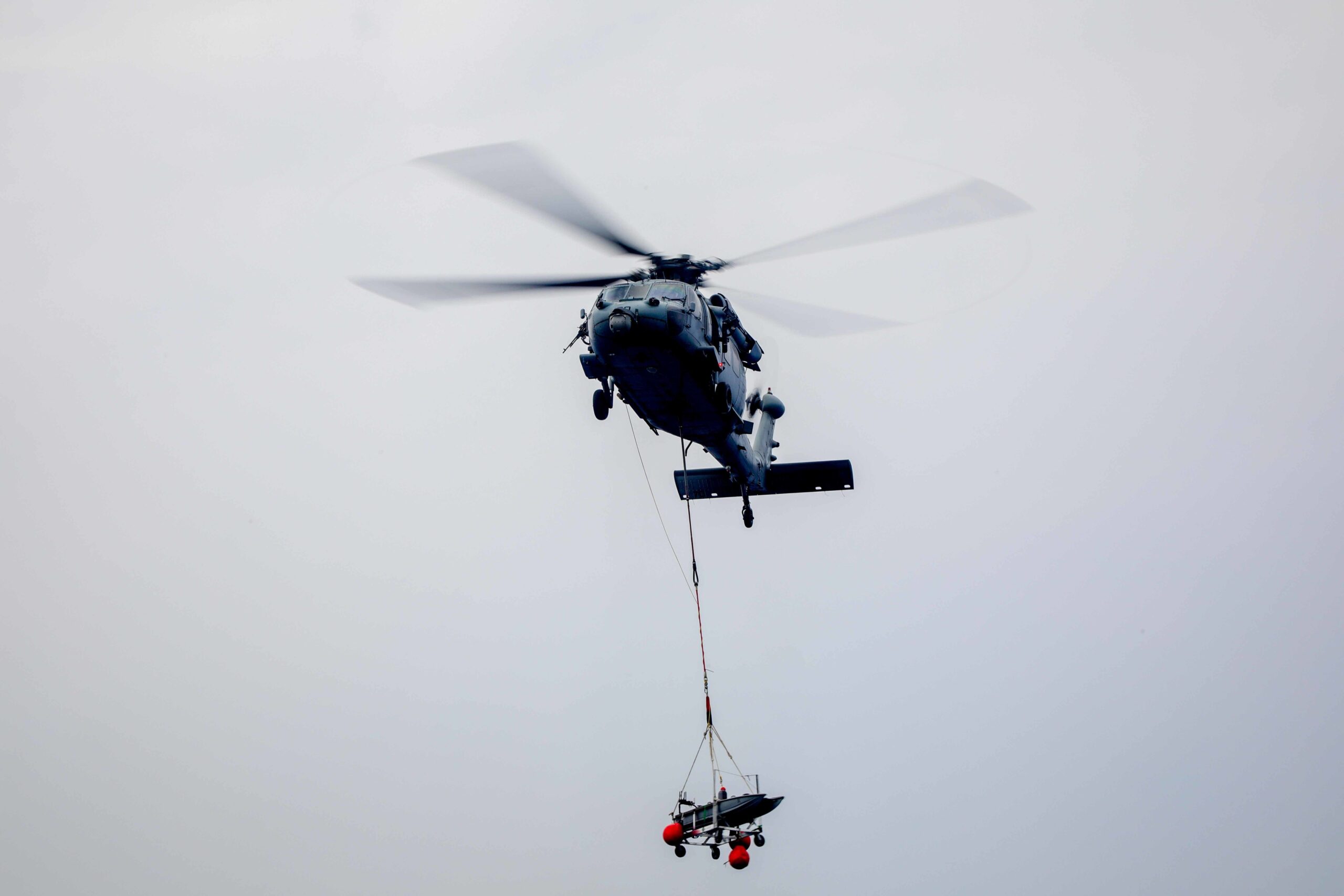
Strock also highlighted the significance of autonomous systems as emerging connectors within this framework: USVs, UUVs, and aerial systems that could serve as extensions of the sea base into the extended battlespace. That vision has become reality at Hormuz, where UUVs and USVs have been central to the mine-clearance effort, operating as sensors and neutralization platforms launched from and controlled aboard the ESB.
Before examining what Puller can do, it is essential to understand the institutional backdrop against which it now operates. The Navy dismantled its Mine Warfare Command in 2006, and in the years that followed, both surface and airborne MCM capabilities steadily eroded. The last four forward-deployed Avenger-class minesweepers—USS Devastator, Sentry, Dextrous, and Gladiator—were decommissioned in a ceremony in Bahrain in September 2025. The MH-53E Sea Dragon helicopter fleet, the historic backbone of airborne minesweeping, has dwindled to a single squadron and is scheduled for complete retirement by the end of 2027. The Navy’s planned replacement, Independence-variant Littoral Combat Ships carrying MCM mission packages—has been plagued by delays and readiness shortfalls.
When Iranian forces began laying mines in early 2026, the operational picture was stark. Of the three Independence-variant LCSs homeported in Bahrain with MCM mission packages, USS Canberra, Santa Barbara, and Tulsa, only Canberra was immediately available in theater; the other two were in Southeast Asia for scheduled maintenance. The four remaining Avenger-class vessels, homeported in Sasebo, Japan, were half a world away; USS Chief and USS Pioneer were tracked transiting toward the Middle East in mid-April only after hostilities had already begun. The Navy found itself scrambling to reconstitute precisely the capability it had spent two decades drawing down. Against this backdrop, the value of a persistent, forward-based platform like Lewis B. Puller becomes impossible to overstate.
The institutional lesson here is one Strock had identified in a different context years earlier: that the combat commanders’ actual needs in a crisis, distributed, integratable, forward-present force—are often poorly served by acquisition programs built around episodic high-end engagements. A persistent sea base requires persistent investment in the force packages it supports. The Hormuz crisis demonstrated what happens when those packages are allowed to hollow out.
Puller’s presence near Hormuz carries strategic weight that goes beyond its organic capabilities. It signals that the United States has prepositioned not just general-purpose naval power but specialized mine-warfare capability close to the chokepoint itself. Rather than relying on assets commuting from Bahrain or surging from Japan, the ESB allows helicopters, small boats, and unmanned systems to live forward in the area of operations, reducing warning times and shortening the decision cycle for any actor considering mines as a coercive tool.
That presence is also politically calibrated. An ESB, unlike a carrier or big-deck amphibious ship, is a relatively low-signature symbol: clearly a naval vessel associated with operations, but without the escalatory weight of a carrier strike group surge into the Gulf. The ship’s persistent, workmanlike posture, hovering near the Strait, launching helicopters and small boats, maintaining radar and UAS coverage, matches the message Washington often wants to send in these crises: resolve without theatrical escalation. In this sense, Puller is simultaneously a military enabler and a tool of competitive coexistence at sea.
The mobile basing literature captures this well. As Strock noted, the strategic importance of mobile basing rises precisely with the importance of complicating the adversary’s targeting solutions and force-projection targets. A sea base that lives near the chokepoint is harder to dismiss and harder to counter than one that commutes from a fixed port. Its mobility is itself a form of deterrence.
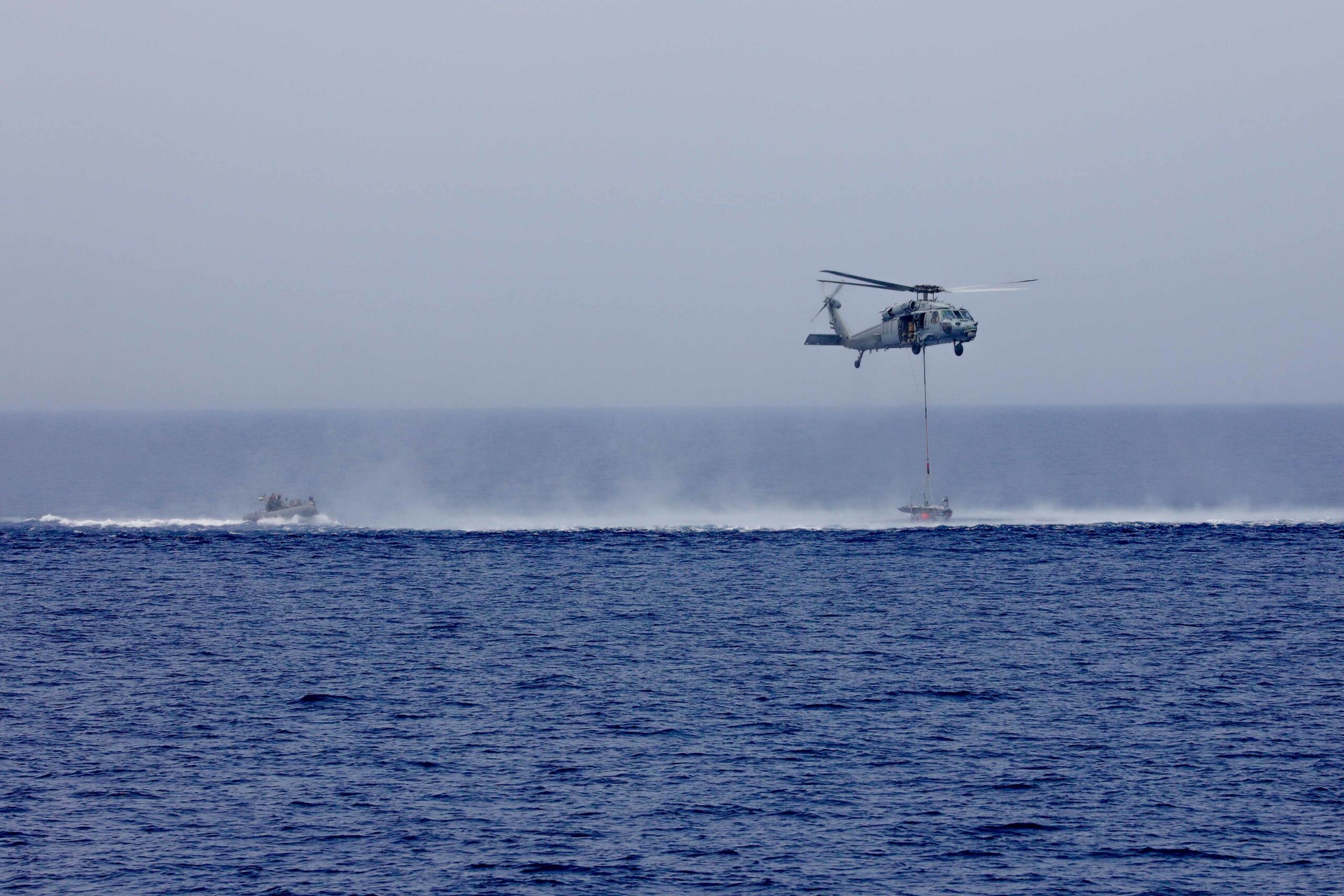
The core power of Puller in mine warfare lies in its function as a camp afloat for the entire mine-countermeasures stack. On its flight deck, the Navy can embark MH-53E Sea Dragon AMCM helicopters, which tow Mk 105 hydrofoil sleds or other airborne MCM gear; staging just outside the Strait, these aircraft cut transit time to suspected minefields dramatically compared to shore-based operations. On its mission deck and via its cranes, the ship can deploy small MCM craft, rigid-hulled inflatable boats, and unmanned surface vessels that tow influence sweeps or carry unmanned underwater vehicles for high-resolution sonar searches.
Layered above these are unmanned aerial systems, ScanEagle has been documented operating from Puller during Strait transits, that provide persistent surface coverage, track commercial traffic, monitor IRGC patrol activity, and cue surface and subsurface sensors to areas of interest. The ESB’s command spaces fuse data from these platforms and network it with the broader 5th Fleet MCM architecture: LCS-MCM ships, remaining Avenger-class minesweepers, coalition mine vessels, and supporting destroyers.
Because all of these capabilities are co-located, the ship collapses the find-fix-finish cycle. A UUV or USV detects a suspicious contact; that data is reviewed aboard Puller, where an MH-53E crew, an EOD detachment, and a small-boat team are within shouting distance of the analysts and planners. Decisions about classification, investigation, or neutralization can be made and executed within hours rather than days.
The MH-53E caveat bears emphasis. With the fleet reduced to a single squadron and retirement approaching in 2027, planners are transitioning toward MH-60S helicopters carrying the Airborne Mine Neutralization System (AMNS) and Airborne Laser Mine Detection System (ALMDS), and toward UUV-centric concepts that reduce human exposure. This is precisely the kind of connector evolution Strock had flagged as essential to keeping the seabasing enterprise relevant—new platforms that extend the sea base’s reach into the contested battlespace while reducing the risk to personnel.
Mine warfare is rarely the only mission in the Strait. Iran’s operational playbook blends mines with harassment of shipping, seizures, UAV overflights, and the threat or actual use of anti-ship missiles and fast-attack craft. Puller’s design acknowledges this reality. It can host special operations forces and VBSS teams, launch and recover their boats, and act as a staging base for interdiction operations, meaning that even while a mine-clearance campaign is underway, the same platform can support boardings of suspicious merchantmen, interdiction of weapons shipments, or rapid response to distress calls from commercial shipping.
This is what Strock had in mind when he argued that Naval Expeditionary Forces with evolving aviation capabilities should be able to operate across all the warfighting functions — C2, fires, maneuver, logistics, force protection, and ISR — from seabases. The Puller at Hormuz is doing exactly that, operating as a multi-function node in an integrated force rather than a single-mission platform.
Force protection for MCM operations has always been a challenge in contested areas: the slow, deliberate nature of sweeping makes minesweepers and AMCM aircraft vulnerable. By hosting security forces and coordinating closely with nearby destroyers or LCS escorts, Puller provides an on-scene protective umbrella for the delicate work of mine clearance. In the current conflict, with A-10s operating over the Strait and Arleigh Burke-class destroyers providing initial transit to establish clearance corridors, this layered protection concept has moved from doctrine to practice.
This operational cycle underscores three core contributions the ESB makes to mine warfare at Hormuz.
- First, it compresses distance: by putting the mine-warfare force on a hull that lives near the chokepoint, the Navy reduces transit time for all clearance assets and increases the fraction of each sortie spent in productive work.
- Second, it compresses time: co-locating sensors, shooters, and decision-makers means that detection, classification, and neutralization can occur within hours rather than days.
- Third, it reduces friction: integrated logistics, maintenance, and berthing shrink the overhead of sustaining a mixed force, allowing commanders to tailor the package—more helicopters one week, more unmanned systems the next without changing the basic platform.
But there is a broader lesson here that extends beyond mine warfare. The Puller at Hormuz is a proof of concept for the mobile basing vision Jim Strock articulated: a sea base functioning as a multi-mission node in a distributed, integrated joint force, positioned forward, sustaining operations across warfighting functions, and serving as a platform from which autonomous systems extend reach into the contested battlespace. The ship does not need to be glamorous to be decisive.
The 2026 Hormuz crisis has validated these contributions while simultaneously exposing the institutional gaps that have accumulated around them. With Avenger-class minesweepers retired or scrambling from Japan, with the MH-53E fleet in its final years, and with LCS-MCM packages absent from theater at the moment of greatest need, the burden on ESB-centered operations has been disproportionate.
The lesson is not that the ESB concept is flawed. It is that the sea base works best as the apex of a layered, sustained MCM enterprise—not as a partial substitute for capabilities that have been allowed to atrophy. Strock’s 2022 observation that the services had not yet seriously thought through how to integrate seabasing capabilities fully with shore-based and airborne mobile capabilities proved painfully prescient.
For a theater in which mines, harassment, and political coercion are likely to remain enduring features, Lewis B. Puller provides a way to anchor that enterprise at sea, near the point of friction. It will not launch strikes or appear in carrier strike group photographs. But by sustaining a quietly decisive presence at the chokepoint and by demonstrating in practice what mobile basing as a strategic capability actually looks like, it remains essential to any serious strategy for keeping the Strait open.
Featured image: An MV-22 Osprey assigned to Marine Medium Tiltrotor Squadron (VMM) 262 and UH-1Y Venom assigned to Marine Medium Tiltrotor Squadron (VMM) 262 land on the flight deck of the Lewis B. Puller-Class Expeditionary Mobile Base (ESB) USS John L. Canley (ESB 6) in the East China Sea, Jan. 30, 2025. In support of U.S. Indo-Pacific Command, Special Operations Command Pacific, in conjunction with Pacific Fleet, Pacific Air Force, Marine Forces Pacific and U.S. Cyber Command, conduct air and maritime operations in the East China Sea to increase joint force lethality and readiness and demonstrate peace through strength for a free and open Indo-Pacific. Naval Special Warfare provides maritime SOF capability to enable Joint Force lethality and survivability inside denied and contested areas. (Photo courtesy of U.S. Navy).
Bibliography
Eyer, Kevin. “The Crisis in Mine Countermeasures.” U.S. Naval Institute Proceedings 152, no. 4 (April 2026). https://www.usni.org/magazines/proceedings/2026/april/crisis-mine-countermeasures
Laird, Robbin. “Mobile Basing as a Strategic Capability: Continuing the Conversation.” Defense.info, January 18, 2022. https://defense.info/re-thinking-strategy/2022/01/mobile-basing-as-a-str
Laird, Robbin. “The Seabase Piece of Mobile Basing.” Defense.info, January 20, 2022. https://defense.info/multi-domain-dynamics/2022/01/the-seabase-piece
“Expeditionary Sea Base (ESB).” United States Navy Fact Files. Updated March 20, 2025. https://www.navy.mil/Resources/Fact-Files/Fact-Sheets/Display-FactSheets/Article/2169994/expeditionary-sea-base-esb/
“Expeditionary Sea Base.” Military Sealift Command. Updated July 29, 2021. https://www.msc.usff.navy.mil/Ships/Ship-Inventory/Expeditionary-Sea-Base/
“Navy to Use Underwater Drones to Help Clear Iranian Mines from Strait of Hormuz.” DefenseScoop. April 12, 2026. https://defensescoop.com/2026/04/11/strait-of-hormuz-mine-clearance-navy-centcom-underwater-drones/
“Flurry of Navy Minesweepers Appear to Be Heading Toward the Middle East.” The War Zone. April 13, 2026. https://www.twz.com/sea/flurry-of-navy-minesweepers-appear-to-be-heading-toward-the-middle-east
“U.S. Navy Stages for Mine Clearance as Hormuz Blockade Begins.” Naval News. April 14, 2026. https://www.navalnews.com/naval-news/2026/04/u-s-navy-stages-for-mine-clearance-as-hormuz-blockade-begins-showing-strain/
“US Navy Conducts Autonomous Minehunting Operations in the Strait of Hormuz.” Navy Lookout. April 2026. https://www.navylookout.com/us-navy-conducts-autonomous-minehunting-operations-in-the-strait-of-hormuz/
“Pentagon Assures Safe Passage Through Strait of Hormuz Despite Presence of Mines.” Navy Times. May 5, 2026. https://www.navytimes.com/news/your-navy/2026/05/05/pentagon-assures-safe-passage-through-strait-of-hormuz-despite-presence-of-mines/
“US Navy Lags in Minesweeping, Despite Years of Warnings.” Christian Science Monitor. March 20, 2026. https://www.csmonitor.com/USA/Military/2026/0320/strait-hormuz-navy-mines-iran-war
“What Do We Know About Sea Mines in and Around the Strait of Hormuz?” Al Jazeera. April 13, 2026. https://www.aljazeera.com/economy/2026/4/13/what-do-we-know-about-sea-mines-in-and-around-the-strait-of-hormuz
“Navy Will Commission All Expeditionary Sea Bases as USS Warships.” USNI News. January 21, 2020. https://news.usni.org/2020/01/21/navy-will-commission-all-expeditionary-sea-bases-as-uss-warships
Military Sealift Command. “Ship in the Spotlight: USS Lewis B. Puller.” April 13, 2025. https://www.msc.usff.navy.mil/Press-Room/News-Stories/Article/4154715/ship-in-the-spotlight-uss-lewis-b-puller/
“The Mine Gap: America Forgot How to Sweep the Sea.” Foreign Policy Research Institute. March 16, 2026. https://www.fpri.org/article/2026/03/the-mine-gap-america-forgot-how-to-sweep-the-sea/
“Dark Shipping and IRGC Activity Intensify Around Hormuz.” Windward. May 10, 2026. https://windward.ai/blog/commercial-shipping-around-hormuz-is-increasingly-going-dark/
Second Line of Defense. “USNS Lewis B. Puller.” https://sldinfo.com/gallery/usns-lewis-b-puller/