

By Robbin Laird
The Royal Australian Navy is entering a decade defined not simply by modernization, but by transition. The fleet is moving from an aging force structure built around Hobart-class destroyers and Anzac-class frigates toward a future force of Hunter-class frigates, new general-purpose frigates, upgraded destroyers, and eventually a follow-on large surface combatant. That transition, however, will not be smooth. Over the next decade the Navy is likely to experience a pronounced hull gap in which older capital ships retire or become increasingly unavailable before enough replacement hulls arrive to restore mass, depth, and operational resilience.
Australia’s surface fleet plan is ambitious on paper. The 2024 surface combatant review outlined a future force of three Hobart-class destroyers, six Hunter-class frigates, eleven general purpose frigates, six large optionally crewed surface vessels, and a planned future destroyer replacement program. Yet ambition in force design does not dissolve the immediate arithmetic of fleet transition. For much of the period between now and the early 2030s, the Royal Australian Navy will be operating with too few major hulls relative to strategic demand, maintenance cycles, training requirements, and the increasingly contested maritime environment of the Indo-Pacific.
The present major surface combatant fleet is small. It consists of three Hobart-class air warfare destroyers and eight Anzac-class frigates. In raw numbers, that gives the Navy eleven principal combatants available for task group operations, escort duties, regional presence, and surge requirements. In practice, however, not all eleven ships are available simultaneously. Maintenance, upgrades, crew generation, training cycles, and unexpected defects routinely reduce the number that can be deployed on short notice.
The age of the Anzac class is central to understanding this problem. These frigates have served the fleet well, but they are old by the standards of contemporary naval warfare and increasingly expensive to sustain. The 2024 independent analysis of the surface combatant fleet described the Navy’s force as aging and increasingly fragile, a characterization that goes to the heart of the hull-gap argument. Old ships can be retained on paper yet still generate declining military value when more of their service life is absorbed by maintenance or constrained operations.
The first visible marker of the transition has already arrived. HMAS Anzac, the lead ship of the class, was decommissioned in May 2024 after twenty-eight years of service. HMAS Arunta is scheduled to follow in 2026, reducing the class from eight ships to six. The Navy is therefore already moving into a smaller frigate inventory before the first replacement general purpose frigate or Hunter-class ship enters service.
Calling the next decade a modernization period understates the operational risk. Modernization implies a managed, broadly linear substitution of old platforms by new ones. A hull gap is something different. It means the fleet loses numbers first and recovers them later. In the interim, commanders must do more with fewer hulls, accept reduced surge capacity, and make sharper trade-offs between presence, deterrence, training, and readiness.
The numbers make the point plainly. The Navy began with eight Anzac-class frigates. One has already been decommissioned, and a second is due to follow in 2026, bringing the class to six hulls. The Hunter program, originally framed around nine ships, has been revised downward to six. The future general purpose frigate force is planned at eleven ships, but the first is not scheduled for delivery until 2029, with initial operational capability in 2030. The force that exists today is shrinking before the force intended to replace and expand it has arrived in usable numbers.
There is also a necessary distinction between capability per hull and the total number of hulls available. Australia is rightly pursuing more lethal, more survivable, and better-networked warships. But naval strategy in a continent-sized maritime theater still depends heavily on having enough ships. Hulls are required not only for high-end combat but for escort, maritime security, persistent presence, partner reassurance, and distributed operations. A fleet that grows more capable while temporarily shrinking in numbers may still face real shortfalls in day-to-day strategic effect.
The government’s 2024 fleet design is intended to build toward a substantially larger future force. The critical issue, however, is timing.
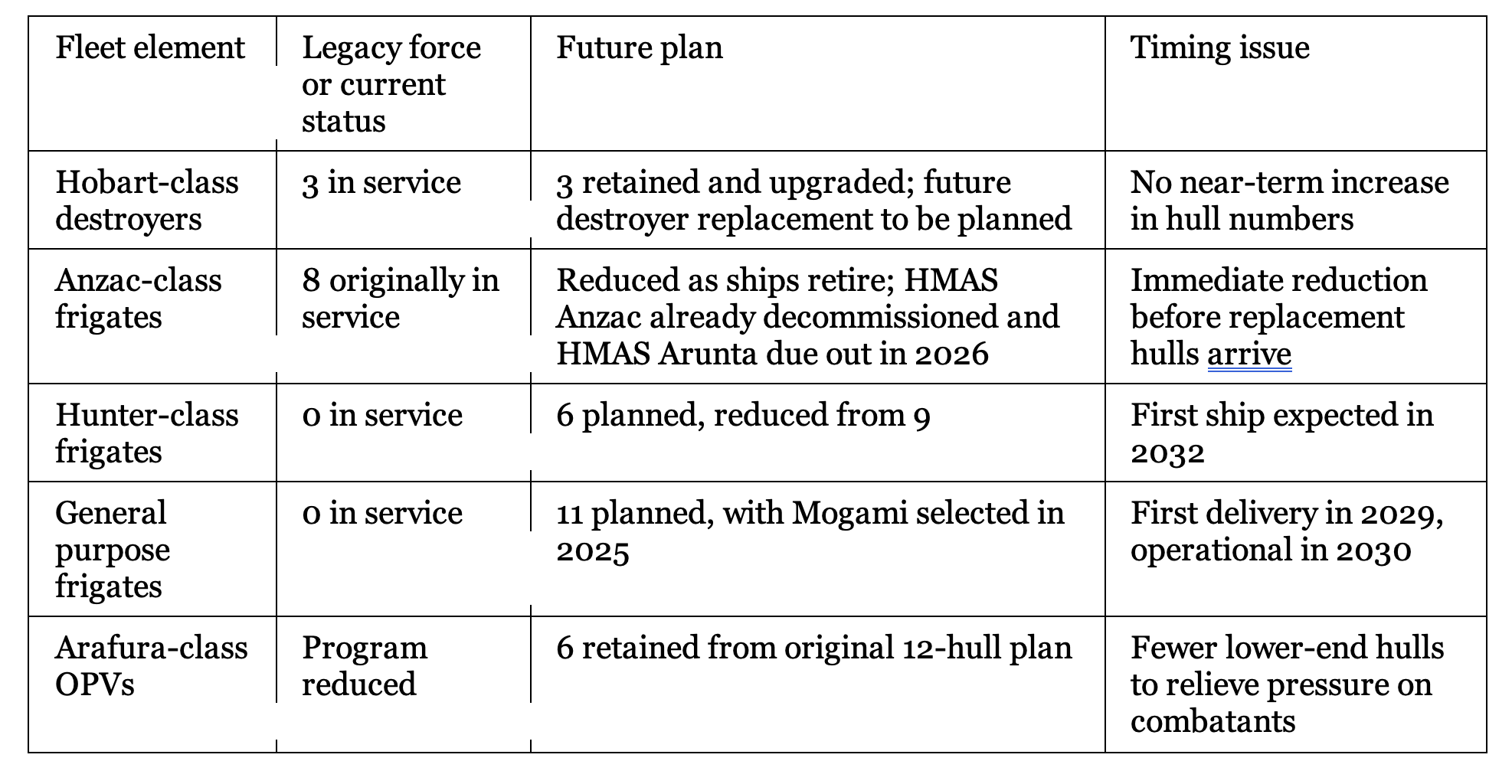
The three Hobart-class destroyers remain the Navy’s most capable major surface combatants, and they will grow more important still as the frigate force thins. Ongoing Aegis combat system upgrades are intended to keep them credible against advanced threats and better integrated into coalition missile defense and fleet air defense tasks. But three destroyers are not a substitute for broader fleet depth. A class of three offers high capability with little resilience: if one ship is in deep maintenance and another in work-up or restricted availability, the number of hulls ready for sustained operations can shrink to a dangerously small figure.
The destroyers will therefore likely be asked to carry both top-end warfighting responsibilities and some of the burden left by shrinking frigate availability. That is not an efficient use of scarce, high-value assets. A destroyer should be concentrated on the missions that justify its cost and capability. When the wider force structure lacks sufficient hulls, however, top-tier ships are routinely pulled into routine presence and escort duties simply because nothing else is available in adequate numbers.
The hull gap matters because Australia does not operate in a benign maritime environment. The 2024 review and subsequent official statements were shaped by a strategic context in which warning times are shrinking, missile threats are growing, and the need for credible denial and sea-control options across the wider Indo-Pacific is acute. In that environment, fleet structure is not merely a force management question. It is a signal of national capacity to persist, escort, reinforce, and operate alongside allies under pressure.
A small fleet can still be sophisticated, but it carries narrower margins for error. It has less tolerance for accident, battle damage, maintenance overruns, industrial delay, or crew shortfalls. It also has diminished capacity to sustain simultaneous commitments, regional engagement in Southeast Asia, support to allied operations, home-water defense, and preparation for high-end contingencies. The result is a Navy that may possess excellent individual ships while lacking sufficient aggregate mass during the transition decade.
The most plausible reading of the next decade is therefore not one of straightforward naval decline, but of a deliberately accepted trough. Canberra appears to have chosen to endure a period of reduced hull availability in exchange for a larger and more capable fleet in the 2030s and beyond. That may ultimately prove to be the right long-term decision. But it remains a trough nonetheless.
Through to the end of the 2020s, the Navy will be working with the force it has rather than the force it wants. The Anzac class will continue to age out. The Hobarts will remain indispensable but numerically sparse. The Arafura reduction means fewer lower-end hulls than originally planned. General purpose frigates will not begin entering service until the final years of the decade, and the Hunter-class frigates arrive later still. The fleet of the early 2030s may well be stronger than today’s, but the fleet of the late 2020s will likely feel thinner, more heavily tasked, and far less forgiving.
That is why the term “hull gap” is analytically useful. It captures the mismatch between the retirement curve of legacy capital ships and the delivery curve of their replacements. More importantly, it directs attention toward operational availability rather than abstract future plans. The Royal Australian Navy is not merely modernizing. It is crossing a precarious bridge between one fleet and the next, and for much of that crossing the number of usable hulls will fall short of what strategy demands.
Bibliography
Australian Government, Department of Defence. 2024 Independent Analysis into the Surface Combatant Fleet of the Royal Australian Navy. Canberra: Commonwealth of Australia, 2024.
Australian Government, Department of Defence. 2024 National Defence Strategy. Canberra: Commonwealth of Australia, 2024.
Australian Government, Department of Defence. Integrated Investment Program 2024. Canberra: Commonwealth of Australia, 2024.
Australian Government, Department of Defence. “HMAS Anzac Decommissioning Ceremony.” Media release, May 2024.
Australian Government, Department of Defence. “HMAS Arunta: Decommissioning Schedule.” Defence capability announcement, 2024.
Australian Government, Department of Defence. “General Purpose Frigate Program: Mogami-Class Selection.” Media release, 2025.
Australian Government, Department of Defence. “Hunter-Class Frigate Program Update.” Project status report, 2024.
Australian Government, Department of Defence. “Hobart-Class Destroyer Aegis Upgrade Program.” Capability development statement, 2024.
Australian Government, Department of Defence. “Arafura-Class Offshore Patrol Vessel Program: Revised Acquisition Plan.” Programme announcement, 2024.
Australian Strategic Policy Institute. “The RAN’s Surface Fleet: Transition Risks and Capability Gaps.” ASPI Policy Brief. Canberra: Australian Strategic Policy Institute, 2024.
Royal Australian Navy. Fleet Readiness and Sustainment Review 2023–24. Canberra: Royal Australian Navy, 2024.