By Robbin Laird
The first week of Weapons and Tactics Instructor Course 2-26 began not with aircraft, but with aluminum matting and a post driver. On March 14, 2026 — the opening phase of the seven-week course — Marines with Marine Wing Support Squadron 373, Marine Aircraft Group 11, 3rd Marine Aircraft Wing, conducted an expeditionary airfield practical application at Auxiliary Airfield II near Yuma, Arizona. What the photographs from that day document is the unglamorous but operationally essential foundation on which everything else in the course depends.
The placement of this evolution in the WTI schedule is deliberate. Before the assault support tactics, before the close air support runs, before the non-combatant evacuation operations at Twentynine Palms, prospective Weapons and Tactics Instructors must understand how a forward airfield comes into existence. The aircraft that will execute all those subsequent missions require surfaces to operate from. Those surfaces do not appear by themselves.
AM-2 Matting: The Portable Airfield
The equipment at the center of the photographs is AM-2 aluminum matting, the interlocking aluminum panels that have served as the Marine Corps’ primary expeditionary landing surface construction system for decades. Each panel is a standardized module with interlocking edges that, assembled in sequence, create a surface capable of supporting fixed-wing and rotary-wing aircraft on terrain that would otherwise be unusable. The system’s value lies not in its sophistication but in its simplicity: it can be transported in a relatively small logistics footprint, assembled by a small team with hand tools and a power driver, and reconfigured or relocated as the operational situation changes.
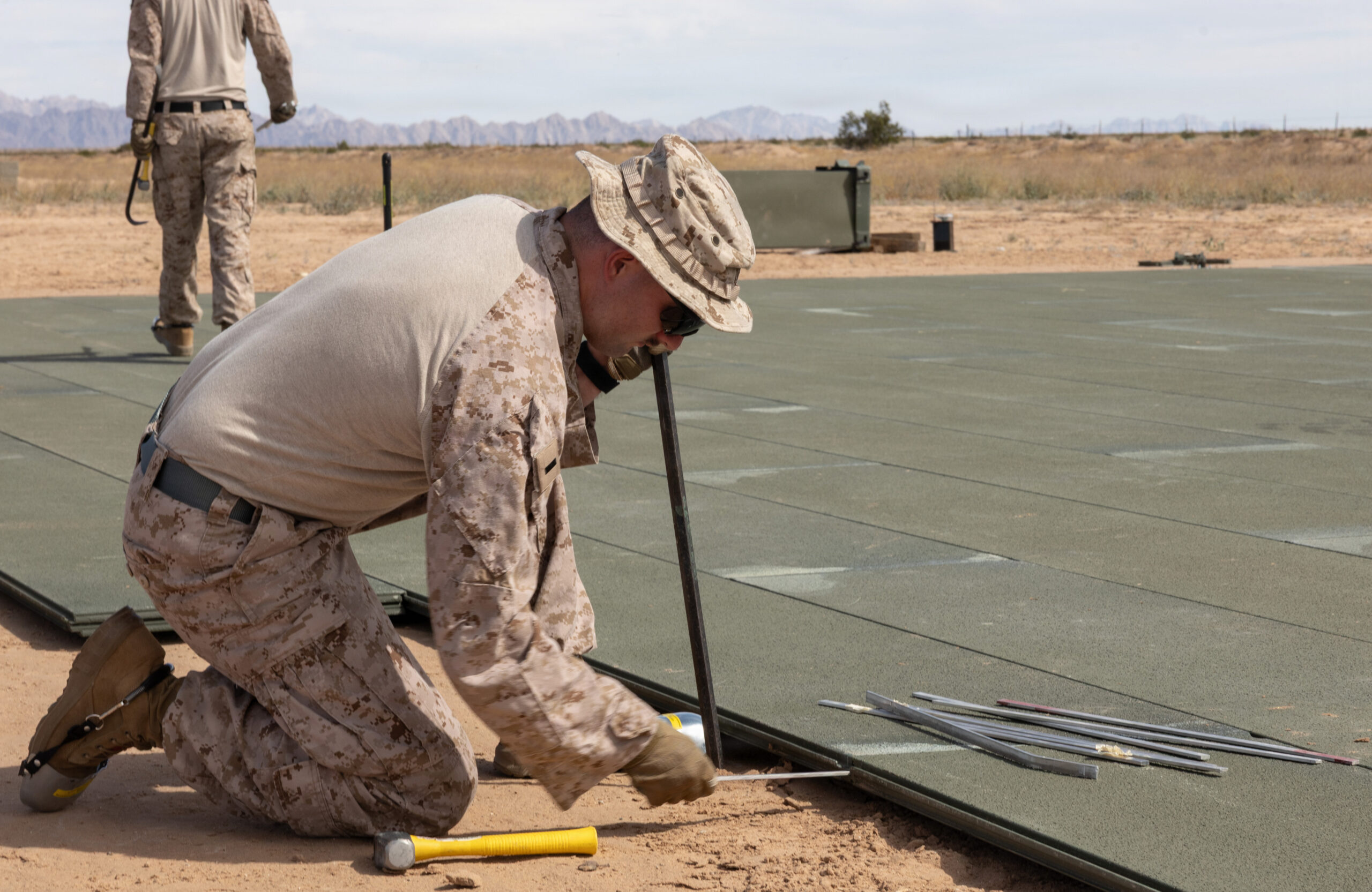
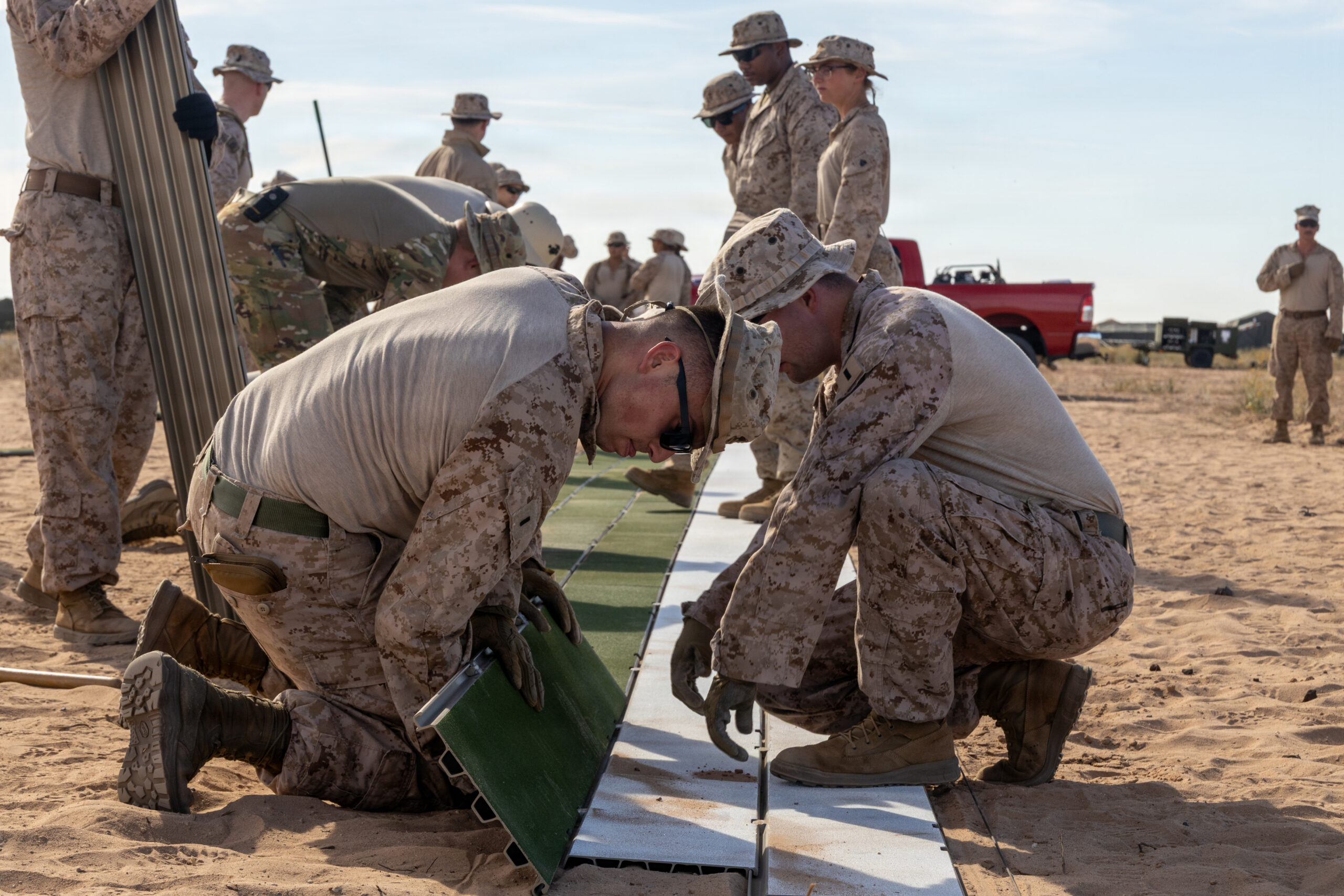
Several photographs show Marines working at ground level securing the matting edges and locking interconnects between panels. One shows a Marine on his knees driving a securing rod through the edge of a mat section with a mallet, a row of additional rods laid out beside him. One shows two Marines at the mat edge working the connector hardware together while multiple additional personnel — Marines and at least one Army soldier in OCP uniform — are active at different points around the expanding surface. The level of hands-on detail in these photographs is notable: this is not observation training. Everyone is working.
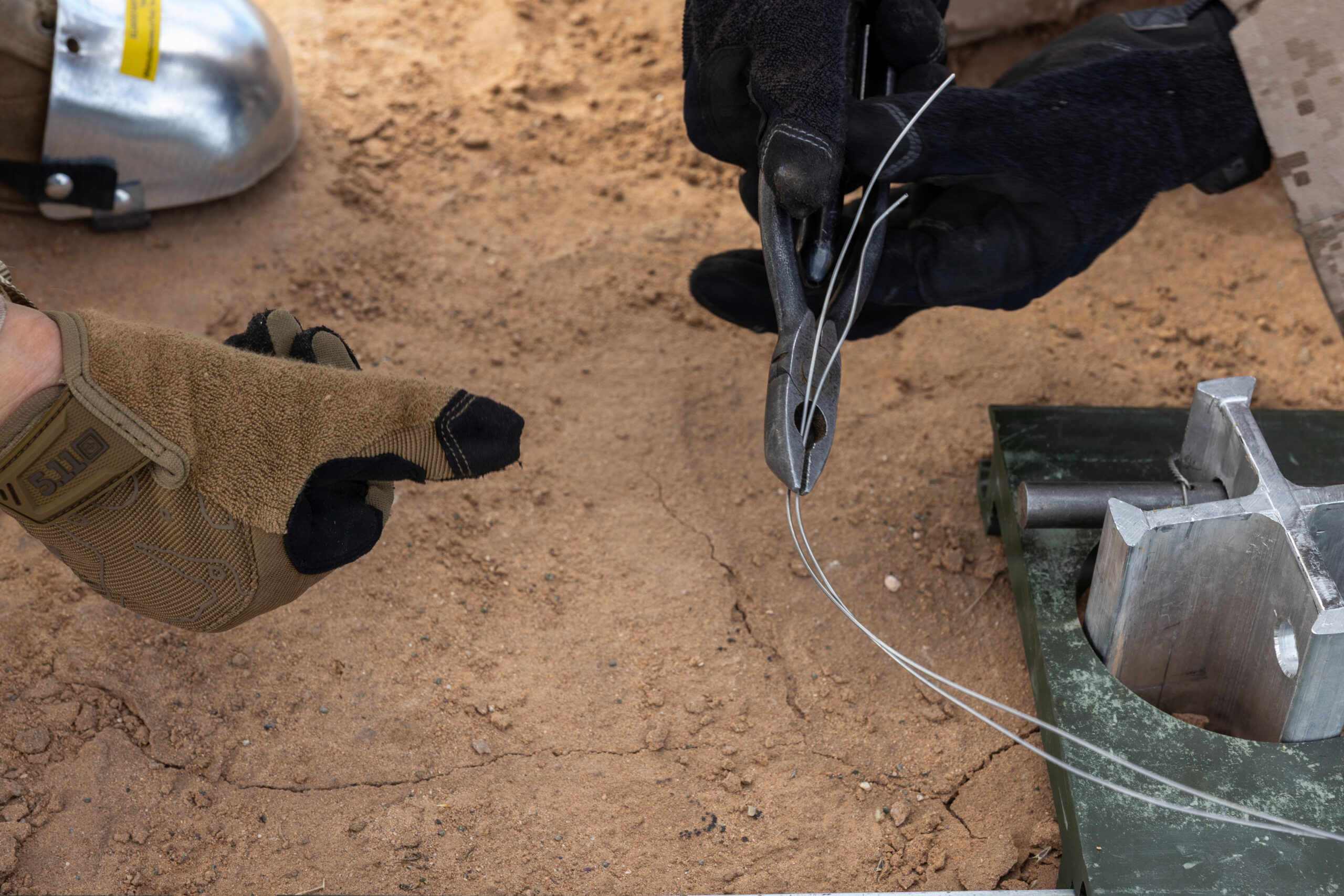
The most operationally precise photograph in the set shows a close-up of two pairs of gloved hands, it shows safety wire being twisted and secured through the connector hardware of the mat assembly. This detail matters. Safety wiring is the step that takes a laid surface from assembled to certified, the step that ensures the matting will not shift or separate under aircraft loads, prop wash, or repeated traffic. It is also a time-consuming, skill-dependent step that cannot be rushed. A prospective WTI who does not understand why it exists and how long it takes cannot accurately plan an expeditionary airfield construction timeline.
The Post Driver and the Anchor System
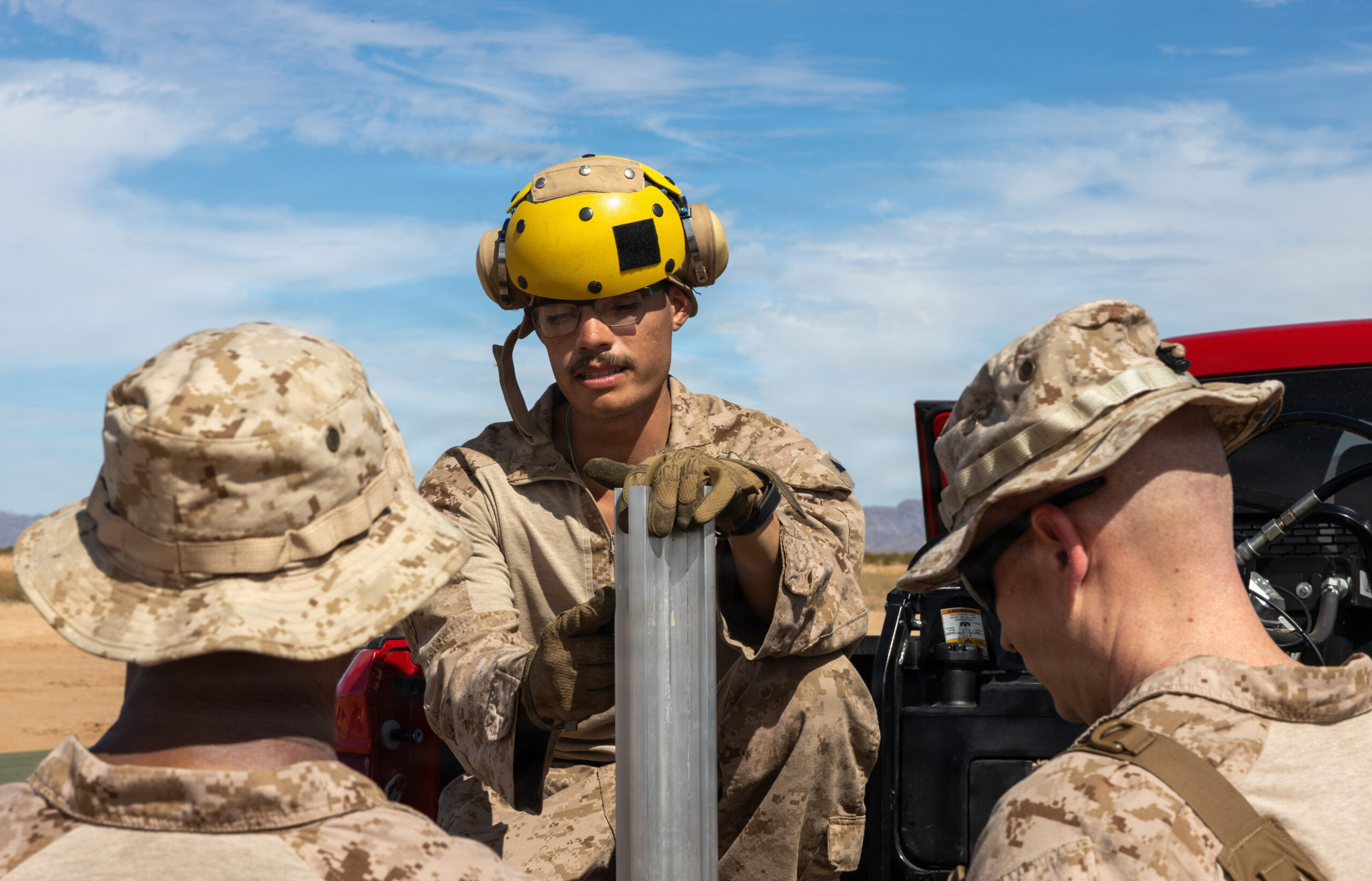
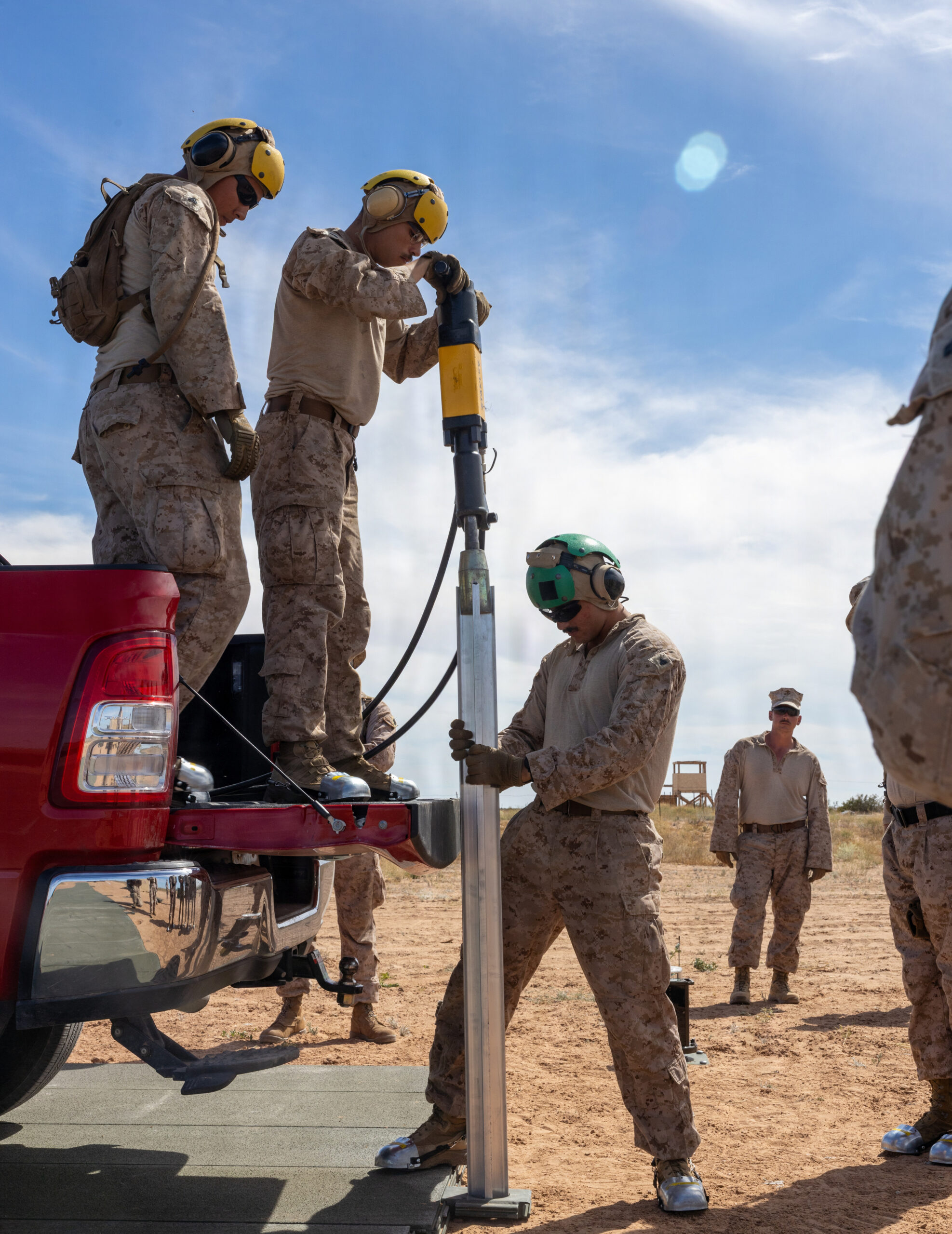
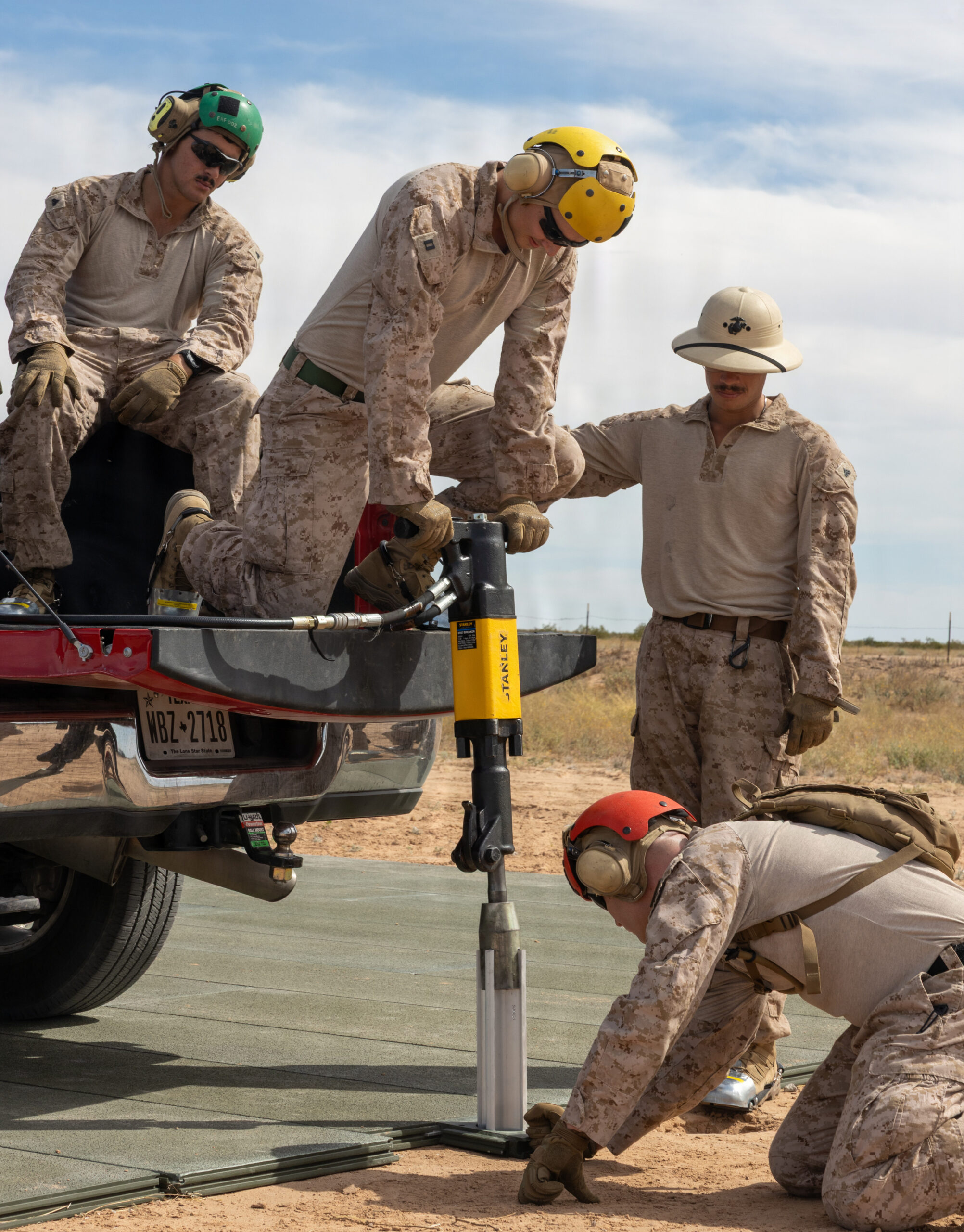
Several images document a parallel activity: the operation of a pneumatic post driver, a Stanley hydraulic impact unit mounted on the bed of a red pickup truck, driving anchor stakes through the matting surface into the desert soil. Two to three Marines work the driver at any given moment: one operating the tool, one steadying the stake, one monitoring from the truck bed. The yellow and green safety helmets worn by the operators are hearing protection for the impact tool.
The anchor stake system is what keeps the matting in place under operational conditions. An unanchored aluminum surface under the rotor wash of a CH-53K or the prop blast of a departing MV-22B is a hazard, not an asset. The anchor stakes driven through the mat and into the substrate below are the mechanical connection between the surface and the ground. Their placement, depth, and spacing are not arbitrary. They are specified in the construction standards that MWSS-373 is trained to execute and WTI students are trained to direct.
The Brief and the Joint Dimension
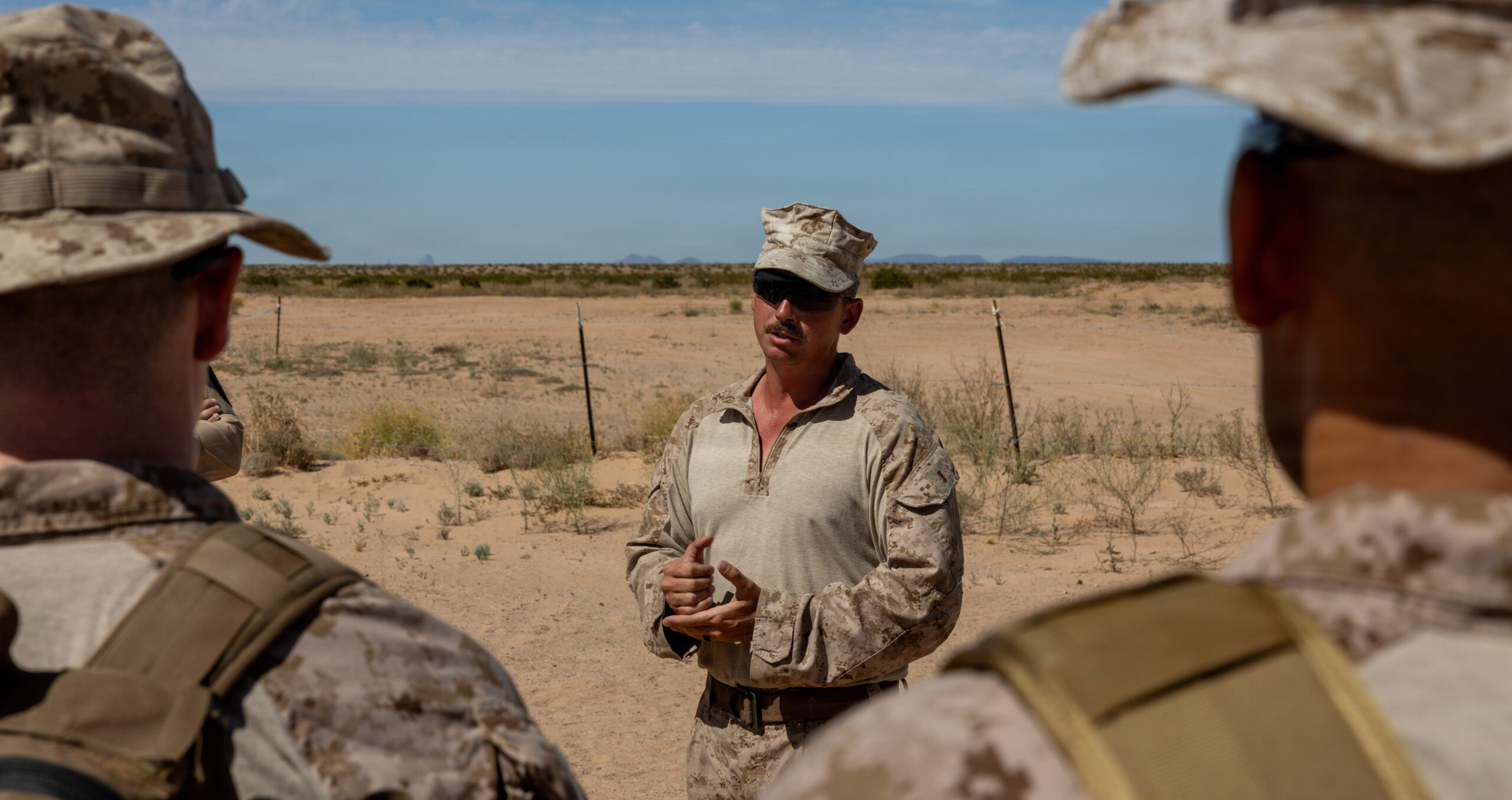
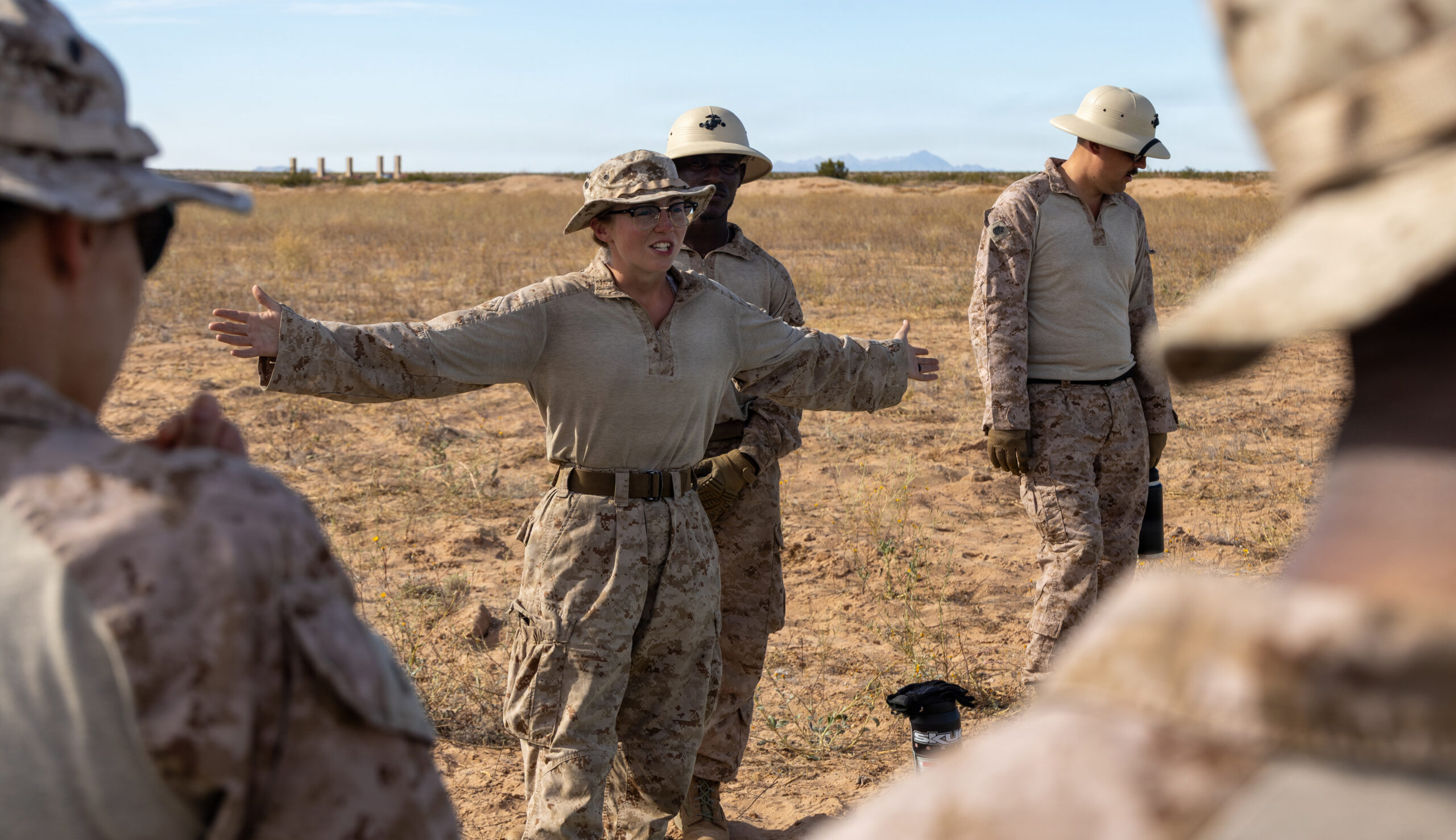
The evolution opens with a brief by Sgt. Rene Medina, a Motor Vehicle Operator with MWSS-373, photographed speaking to a small group of Marines against the flat, fence-lined desert of Auxiliary Airfield II. The fact that a Motor Vehicle Operator is delivering the technical brief is a reminder of how the Marine Wing Support Squadron actually functions: it is not composed exclusively of engineers or aviation specialists. It is a combined-arms support unit whose personnel, across motor transport, engineering, fuels, communications, and aviation ground support specialties, collectively make expeditionary aviation possible.
One image shows a female Marine NCO briefing with both arms extended, orienting the group to something in the field, most likely the layout of the airfield site or the organization of the work parties. Two other Marines in tropical pith helmets flank her. The pith helmets are a visual marker of the heat management measures appropriate for extended outdoor work in the Yuma desert in March.
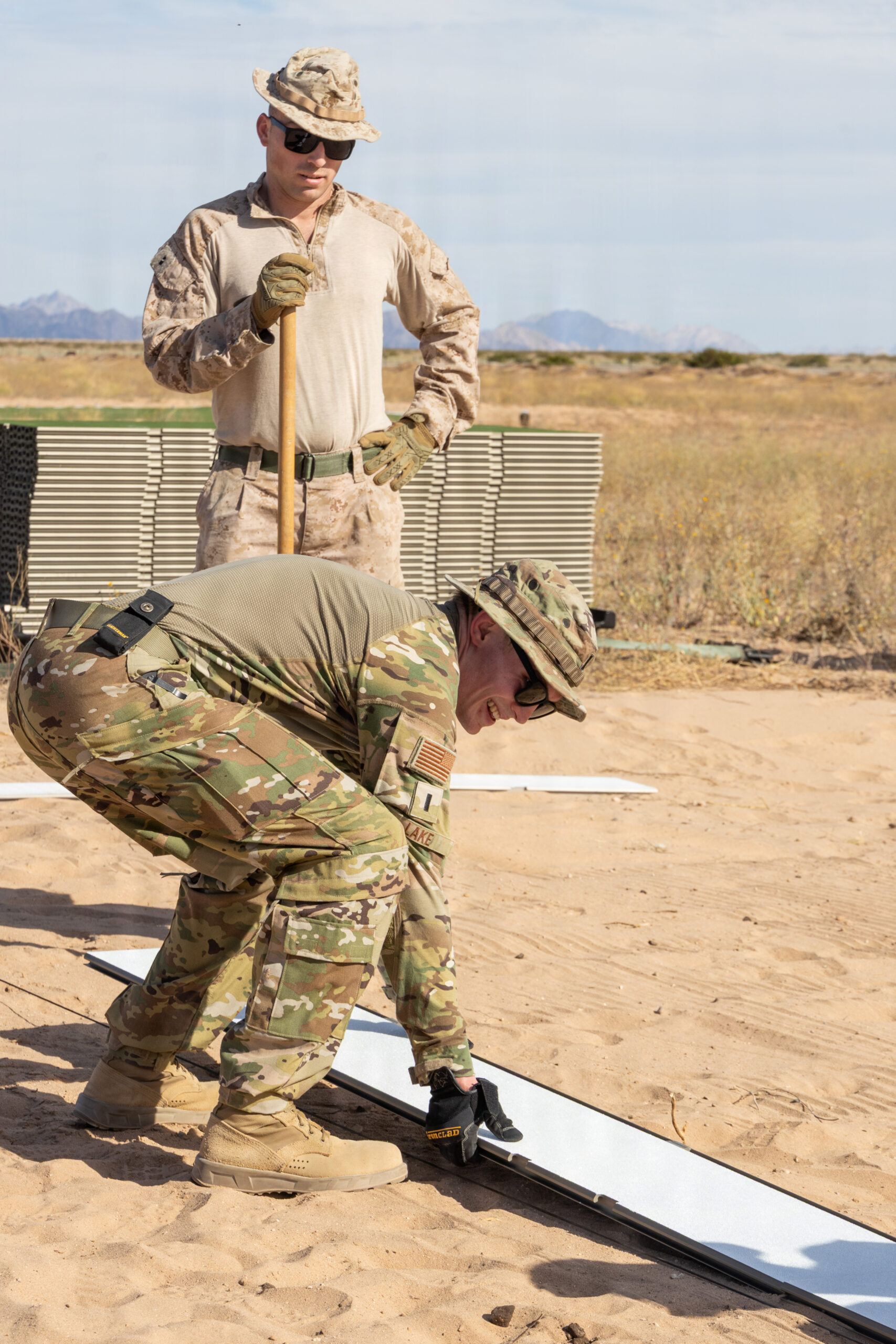
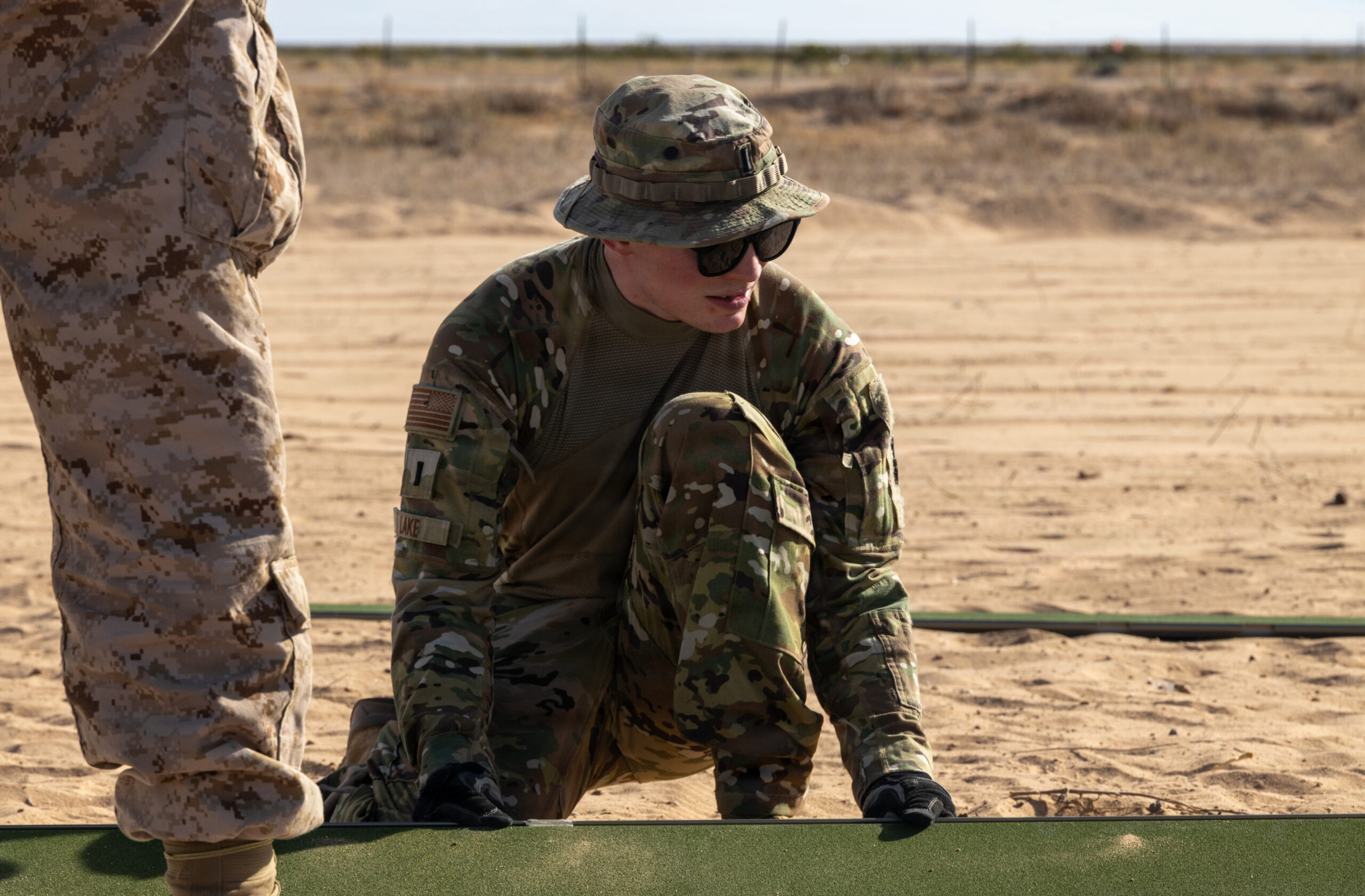
Two photographs show a U.S. Army soldier, name tape “Lake,” first lieutenant rank visible, working directly alongside the Marines on the mat surface. This joint presence is not incidental. WTI explicitly integrates Army, Air Force, and in some evolutions interagency participants across its training events. The expeditionary airfield construction evolution is no exception: in operational scenarios, forward airfield construction may involve joint engineer teams, host nation support elements, or partner-force personnel who need to be able to work alongside Marine Wing Support specialists to a shared standard.
MWSS-373 and the Distributed Operations Imperative
Marine Wing Support Squadron 373 is a 3rd Marine Aircraft Wing unit based at MCAS Miramar, California. Its primary function is to establish, operate, and defend expeditionary airfields and forward operating bases, the physical infrastructure that makes sustained expeditionary aviation possible. In the Marine Corps’ current operational design for the Indo-Pacific, this function is not a support afterthought. It is central.
The concept of distributed Maritime Operations, which drives much of Marine Corps force design under Force Design 2030 and its subsequent iterations, explicitly requires the ability to establish and operate from a network of dispersed, austere sites, islands, coastal strips, or any terrain from which fires, aviation, and intelligence collection can contribute to sea denial and maritime domain control. Each of those sites requires the kind of capability that MWSS-373 provides: a landing surface, a fuel point, a communications node, and the security to defend it long enough to be operationally useful.
What the WTI expeditionary airfield practical application at Auxiliary Airfield II rehearses is not simply a construction skill. It rehearses the decision cycle: how quickly can a team assess a site, determine what matting configuration is required, sequence the work parties, execute to standard, and certify the surface as ready for aircraft operations?
A prospective WTI who completes this evolution understands the answer to that question from personal experience. When they later plan an assault support mission that requires a forward arming and refueling point at an unimproved site, they know what it actually takes to make that site ready.
The Enabling Logic of WTI
The photographs from March 14, 2026 do not show aircraft. They show Marines and soldiers on their knees in the desert, driving stakes and twisting safety wire and learning the assembly sequence for an aluminum surface that will someday — in a real operation, at a real forward site — determine whether an aircraft can land or cannot.
This is the enabling logic that WTI builds into every prospective instructor: aviation capability is not bounded by the aircraft. It extends to the surfaces those aircraft require, the fuel that sustains them, the communications that coordinate them, and the security that protects all of it. The Marine Wing Support Squadron is not a support unit that follows the aviation. It is a component of an integrated system that makes the aviation possible in the first place.
The WTI student who hammered a stake into the desert floor at Auxiliary Airfield II on March 14 will carry that understanding through every subsequent evolution in the seven-week course and back to their squadron when the course is done.
WTI Events: The Engine of Marine Aviation Transformation at MAWTS-1